46
Study of the Effect of Dissipation Points on
the Lightning Protection
Prof.Dr.Ahmed A.Hossam-Eldin, Mahmoud I.Houssin
Abstract— The study is concentrated on the different possible protection systems for lightning. Two experimental tests (in high voltage Laboratory) were
made to give the answers if delaying streamer air terminal is effective than franklin rod or not. Experimental test was made to reach the effective number of dissipation point in delaying streamer air terminal. One empirical equation was developed to determining the relationship between the flashover vol-tage and the number of dissipation points. Another experimental test for breakdown volvol-tage to different air gaps are measured and compared between franklin rod and delaying streamer air terminal.. The experimental results are consistent with the theoretical and the practice.
Index Terms— Air gap, Air terminal, Delaying streamer, Protection, Flashover voltage, Lightning dissipation point,Lightning, Experiment test.
—————————— ——————————
1 I
NTRODUCTIONSince the dawn of civilization, lightning has inflicted a great deal of damage on the structures built by mankind. About 250 years ago, an effective method of protection became available when Benjamin Franklin invented the lightning rod. A great deal of the research done since then was regarding how to best place the lightning rods so as to provide effective protec-tion at a reasonable cost. In recent years, the marketplace has been flooded with products for alternative protection methods. These include gadgets that claims to eliminate lightning [also called Charge Transfer Systems (CTS)], and rods that claim to emit giant early streamers that vastly extend their protective range (ESE devices) [1]. Three types of lightning protection systems are in common use today conventional systems, Charge Transfer Systems, and systems based on Early Streamer Emission air terminals.
2
C
ONVENTIONALA
IRT
ERMINALS(F
RANKLIN ROD)
The science of lightning protection was born when Franklin discovered that lightning was a form of electricity. The conven-tional protection method consists of the following:a) Deploying “air terminals” at suitable points above the stru c-ture to act as sacrificial termination points for the lightning strokes.
b) Dissipating the collected lightning charges safely into the ground via ground rods that are connected to the air terminals via “down conductors”.
c) Bonding the down conductors to any nearby conducting objects in the building to prevent side flashes.
d) Installing suitable surge protection devices on the electric and electronic systems of the building [1].
The conventional lightning protection technique has proven its effectiveness as evidenced by the comparative statistics of lightning damage to protected and unprotected structures. The rolling sphere method commonly used in the design of such systems is relatively crude, in part, because of our insufficient understanding of the lightning attachment process [2]. A useful engineering tool (matlab program) for determining the number and positions of air terminals are developed by this [3]. In 1889, F. Pashchen published a paper which set out what has become known as Paschen's Law. The law essentially states that the breakdown characteristics of a gap are a function (generally not linear) of the product of the gas pressure and the gap length, usually written as:
V= f (Pd)
Where p is the pressure and d is the gap distance. In actuality, the pressure should be replaced by the gas density. For air, and gaps on the order of a millimeter, the breakdown is rough-ly a linear function of the gap length:
V = 30pd + 1.35 kV (1)
Where d is in centimeters, and p is in atmospheres. ————————————————
Author Prof. Dr. Ahmed A. Hossam-Eldin, Prof. of Electrical Engineering, Alexandria University, Alexandria, Egypt, Mo-bile: +201227712278, Fax: +2035921853,
(email:[email protected])
Author Mahmoud I. Houssin, Alexandria University, Alexan-dria, Egypt Mobile: +20127382168,
47 TABLE 1 :- Critical Flashover Voltage With Different Air Gap
Distance For Plan Surface Air Gap Distance
(cm)
Flashover Voltage (KV)
5 151.35
7.5 226.35
10 301.35
12.5 376.35
15 451.35
16.5 496.35
17.5 526.35
18.5 556.35
20 601.35
This table and the previous equation (1) for homogenous fields or nearly homogenous fields. Much research has been done since then to provide a theoretical basis for the law and to de-velop a greater understanding of the mechanisms of break-down. But it should be realized that there are many, many fac-tors which have an effect on the breakdown of a gap, such as radiation, dust, surface irregularities. Excessive theoretical analysis might help understanding why a gap breaks down, but won't necessarily provide a more accurate value for the breakdown voltage in any given situation.
3.Lightning Elimination Devices
While the concept itself is much older, the commercialization of CTS started in the early 1970s. Shortly thereafter, studies were commissioned by several departments of the US gov-ernment to evaluate their effectiveness, and the results were presented in a report edited by J. Hughes [4]. The conclusion was that lightning cannot be eliminated and that the subject gadgets did not work. This was confirmed by several subse-quent studies. Recently, a comprehensive review of CTS was conducted by Professors Uman and Rakov [2]. Again, the conclusion was that the lightning elimination claim was un-founded. The above work is of special significance as it was widely endorsed by the scientific community, including ICLP (International Conference on Lightning Protection), the Ameri-can Geophysical Union and the AmeriAmeri-can Meteorological So-ciety. Visitors to the LEC factory in Boulder, Colorado, are usually shown a lab test which is claimed to prove that dissipa-ters prevent lightning. In that test, an energized overhead net is used to represent the cloud. The net is initially energized at a low dc voltage to represent the pre-strike condition. The ap-plied voltage is then increased via a regulator that supplies the transformer of the test set. With a grounded Franklin rod in the test gap, flashover occurs at a certain voltage [5]. When this is replaced by an umbrella dissipator while maintaining the same length of the air gap, flashover does not occur when the regu-lator is made to apply the maximum available voltage. The lack of flashover to the umbrella dissipator in the LEC test has nothing to do with the claimed ability to prevent lightning. It is rather a consequence of the following:
a) As a result of the well-known effect of the gap factor, the flashover voltage for a given gap length is significantly higher
for the net-to-umbrella configuration compared to the net to rod configuration.
b) The maximum voltage available from the LEC test set is high enough to break down the net-to-rod gap but below that needed to break down the net-to-umbrella gap [5].
4 Dissipation Points
The underlying theory of CTS’s described in Zipse’s article [6] claims that a CTS will inject several coulombs of positive charge into the air above the protected structure, and that this charge will neutralize an approaching lightning leader. The article presents the equation for determining the number of points, N, needed to provide this charge:
N = (Q / (Ip) (t)) = (2.5 / (10)(17 x 10^5)) = 1500 (2)
la-48 boratory. In our experiments we have found, for example, that
an array of 80 points emits a corona current about twice the value of that from a single isolated point. Use of Eq. (2) would indicate the current should be 80 times as large Eq. (2) is in-correct [7].
5 Experimental Study
Objective
From the previous there is a question shall be having ans-wered:
What is the relationship between the number of dissipater point and the time of streamer formation?
This question shall be answered by experimental in high vol-tage Laboratory.
5.1 Experiment Number (1)
The main goal of this experiment is create a relationship be-tween the number of points, N, for dissipation array system and the flashover voltage. To create this relationship we will energize an overhead net that used to represent the cloud. The net is initially energized by impulse voltages generators to certain voltage to represent the pre-strike condition. A grounded delaying streamer air terminal in the test gap is fixed on two side wooden ladder were we can control the distance between the tip of the rod and the net (air gap distance), then The applied voltage is increased via a regulator that supplies the transformer of the test set, flashover occurs at a certain voltage. See figure 1 We record the critical flashover voltage for constant air gap distance (10 cm) and for difference num-bers of dissipation point. See table 2
TABLE 2:- CRITICAL FLASHOVER VOLTAGE FOR AIR GAP (10 CM) WITH DIFFERENT NUMBER OF DISSIPATION POINT FOR DELAYING STREAMER AIR TERMINAL
Number of dissipation
point Flashover Voltage (KV)
1 148.5
250 157.5
500 166.5
750 174
1000 184
Experiment conditions
Rod diameter = 1/2ً = 1.27 cm Rod length = 60 cm Temperature = 26 º C
Pressure = 760 Torr = 1013 hPa
Repeat the same experiment for different air gap distance and record the critical flashover voltage for difference numbers of dissipation point. See table 3
TABLE 3 :- CRITICAL FLASHOVER VOLTAGE FOR DIFFERENT AIR GAP DISTANCE WITH DIFFERENT NUMBER OF DISSIPATION POINT FOR DELAYING STREAMER AIR TERMINAL
Flashover Voltage(KV)/ Number of dis-charge points
Air gap distance
( cm ) 1 250 500 750 1000
102 101.5 100.5
100 99
5
133.5 130.5
127.5 124.5
121.5 7.5
183 174.5 166
157 148.5 10
220.5 210
200 190
180 12.5
292.5 274.5
256.5 238.5
220.5 15
312.5 292
271.5 250.5
230 16.5
333 308.5 284
259 234.5 17.5
360 330
299 269
238.5 18.5
Fig.1 A Grounded Dissipator Rod In The Test Gap
Delaying streamer rod For air gap distance (10 cm)
100 120 140 160 180 200 220 240
1 250 500 750 1000
Number of point
F
la
sh
o
v
er
v
o
lt
a
g
e
(k
v
)
49 5.2 Results Comparison for Experiment Number (1)
Observation on Experimental Work & Results:
The relationship between the critical flashover voltage and number of dissipation points N is approximately linear. The critical flashover voltage increases with the number of dissipa-tion points N increase with constant factor for each air gap distance. Empirical equations are developed to determining the relationship between the flashover voltage and the number of dissipation points
N = [(250/S) X (V - V1)] + 1 (3)
S constant factor V flashover voltage (KV) V1 flashover voltage (KV) at N=1 N number of dissipation point
This empirical equation for:
Rod diameter = 1/2 inch = 1.27 cm Rod length = 60 cm
Temperature = 26 º C
Pressure = 760 Torr = 1013 hPa
A correction factor must be multiply for any other condition.
5.3 Experiment Number (2)
The main goal of the experiment to answer the following ques-tion: Is delaying streamer air terminal take time for forming streamer more than conventional system (Franklin rod) or not? To answer this question we use the same arrangement for the previous experimental.
5.3.1 Franklin Rod
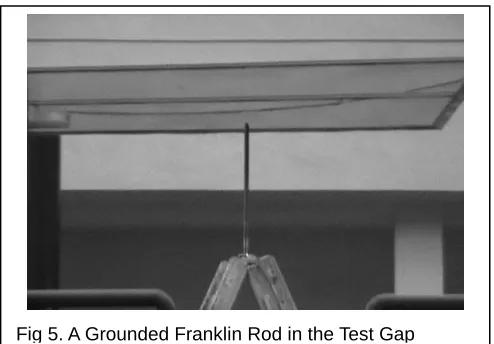
The net is initially energized by impulse voltages generators to certain voltage to represent the pre-strike condition. A grounded Franklin rod in the test gap is fixed on two side wooden ladder were we can control the distance between the tip of the rod and the net (air gap distance), then The applied voltage is increased via a regulator that supplies the transfor-mer of the test set, flashover occurs at a certain voltage. See figure 5, 6
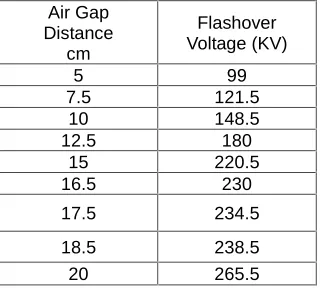
The following table gives the recorded reading for the critical flashover voltage in different air gap distance.
Fig. 3.the Relationship between the Number of Points, N, For Dissipation Array System and the flashover
Voltage at different air gap distance Fig. 4different air gap distance the Relationship between equation constant factor, S, for
50 TABLE 4 :- CRITICAL FLASHOVER VOLTAGE WITH DIFFERENT AIR
GAP DISTANCE FOR FRANKLIN ROD AIR TERMINAL
Air Gap Distance
cm
Flashover Voltage (KV)
5 99
7.5 121.5
10 148.5
12.5 180
15 220.5
16.5 230
17.5 234.5
18.5 238.5
20 265.5
Experiment conditions
Rod diameter = 5/8ً = 1.6 cm Rod length = 50 cm Temperature = 30 º C
Pressure = 760 Torr = 1013 hPa
5 EQUATIONS
5.3.2 Delaying Streamer Rod
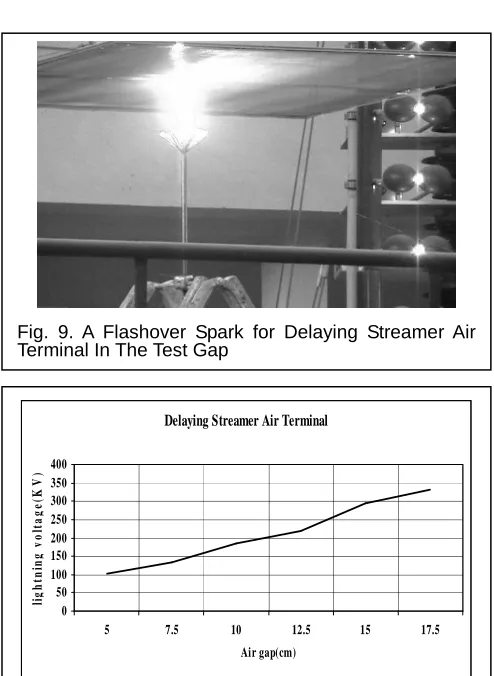
When a grounded Franklin rod is replaced by an umbrella dis-sipator while maintaining the same arrangement of experi-ment, and control the distance between the tip of the dissipator rod and the net (air gap distance), then the applied voltage is increased via a regulator that supplies the transformer of the test set, flashover occurs at a certain voltage. See figure 8, 9
The following table gives the recorded reading for the critical flashover voltage in different air gap distance.
TABLE 5 :- CRITICAL FLASHOVER VOLTAGE WITH DIFFERENT AIR GAP DISTANCE FOR DELAYING STREAMER AIR TERMINAL
Experiment conditions
Rod diameter = 1/2 inch = 1.27 cm Rod length = 60 cm
Temperature = 30 º C
Pressure = 760 Torr = 1013 hPa
Air Gap Distance
cm
Flashover Voltage (KV)
5 102
7.5 133.5
10 183
12.5 220.5
15 292.5
16.5 312.5
17.5 333
18.5 360
20 -
Fig. 6. A Flashover Spark for Franklin Rod In The Test Gap
Franklin Rod
0 50 100 150 200 250 300 350 400
5 7.5 10 12.5 15 17.5 20
Air Gap (cm)
li
g
h
tn
in
g
v
o
lt
a
g
e
(
K
V
)
Fig. 7. Critical Flashover Voltages with Different Air Gap Distance for Franklin Rod Air Terminal
51
5.3.3 Comparisons between Franklin Rod & Delaying Streamer Air Terminal
TABLE 6:- CRITICAL FLASHOVER VOLTAGE WITH DIFFERENT AIR GAP DISTANCE FOR FRANKLIN ROD & DELAYING STREAMER AIR TERMINAL
Air Gap Distance
cm
Flashover Voltage for Franklin Rod
(KV)
Flashover Voltage for Delaying Streamer Air Terminal (KV)
5 99 102
7.5 121.5 133.5
10 148.5 183
12.5 180 220.5
15 220.5 292.5
16.5 230 312.5
17.5 234.5 333
18.5 238.5 360
20 265.5 -
5.3.4. Results Comparison for Experiment Number (1)
Observation on Experimental Work & Results:
1. For all air gap distance the critical flashover voltage for delaying streamer air terminal is greater than flashover voltage for Franklin rod.
2. The difference voltage between the two flashover voltage increases with air gap distance increase.
3. The relationship between the critical flashover voltage and air gap distance is approximately linear for the two type of air terminal, but the slope of those is different.
4. The slope for delaying streamer air terminal is greater than for Franklin rod.
6 References
[1] Abdul M. Mousa, “War Of The Lightning Rods“Electricity Today Issue 2, 2004 Ph.D., P.Eng., Fellow IEEE
[2] Uman, M. A. and Rakov, V. A., “A Critical Review of Nonconve n-tional Approaches to Lightning Protection”, Bulletin of the Amer i-can Meteorological Society, December 2002.
[3] Ahmed A.Hossam-Eldin and Mahmoud I.Houssin, “Design And Assessment Of Lightning Protection Systems In Petroleum Structures” MEPCON,2005
[4] Hughes, J. (Editor). (1977). Review of Lightning Protection Technology for Tall Structures, Office of Naval research, Arling-ton, Virginia, Report No. AD-A075 449, 275 pp. 6
[5] Mousa, A.M. (July 2003). “Validity of the Lightning Elimination Claim”, Proceedings of the IEEEPES Annual Meeting, Toro n-to,Ontario, 6 pp.
[6] Zipse, D.W. (2001 November 1). “Prevent Lightning Strikes with Charge Transfer Systems”, Power Quality, pp. 24-27.
[7] Rison, W. (2002). “There Is No Magic To Lightning Protection: Charge Transfer Systems Do Not Prevent Lightning Strikes”, Report for New Mexico Institute of Mining and Technology So-corro, New Mexico.
Fig. 9. A Flashover Spark for Delaying Streamer Air Terminal In The Test Gap
Delaying Streamer Air Terminal
0 50 100 150 200 250 300 350 400
5 7.5 10 12.5 15 17.5
Air gap(cm)
li
g
h
tn
in
g
v
o
lt
a
g
e
(K
V
)
Fig. 10. Critical Flashover Voltages with Different Air Gap Distance for Delaying Streamer Air Terminal
Comparisons between Franklin Rod & Delaying Streamer Air Terminal
0 50 100 150 200 250 300 350 400 450
5 7.5 10 12.5 15 17.5 20
Air Gap (cm)
L
ig
h
tn
in
g
V
o
lt
a
g
e
(K
V
)
Franklin Rod Delaying Streamer Air Terminal