Proposed Model For Virtual Labs Interaction With
Openstack Integration Using KVM Hypervisor
Dr Deepak Arora, Varun Kumar, B. Jagdeep, Prabhat Verma
Abstract: Over the last few years, the use of the simulation technologies and the internet in education industry has become wide spread. A Virtual Lab is definitely a large-scale solution to a large-scale problem. Its implementation being very intense, but the benefits of Virtualization Technology greatly facilitates the provisioning of accessibility to Adaptive Learning software. Bearing the expenses to purchase the individual software‘s is not feasible for students, institutions, or the state itself. Cloud VLAB, or simply said a Virtual Laboratory; server-side licensing is taken care of, as software licenses are scalable and costs much less. Cloud computing paradigm promises to deliver the desired hardware to the end user at a low cost with an exceptionally easy to use interface through the commonly available internet. This paper outlines an effort at the Amity University, to deploy a hybrid Infrastructure as a Cloud Service, so as to enhance the student learning and experimenting experience. This paper covers the deployment methods and configurations implemented for OpenStack along with security provisions to deliver the desired computer hardware. The rationale behind the provisions of virtual hardware and the operating system configurations have been defined in great detail supported by examples. This paper also covers how the resources have been used within the taught courses as a Virtual Lab, and in the research projects. The authors also added the Service offering on to the IaaS cloud. The reason behind choosing OpenStack and KVM hypervisor is that both are open source and right now one of the market leaders for cloud computing.This development has led to the student‘s freedom to enhance their practical knowledge.
Index Terms: Cloud Computing, Hypervisor , KVM , OpenStack, VLab, Virtualization..
————————————————————
1
I
NTRODUCTIONAccording to NIST, ―Cloud computing is a model for enabling ubiquitous, convenient, on-demand network access to a shared pool of configurable computing resources (e.g., networks, servers, storage, applications, and services) that can be rapidly provisioned and released with minimal management effort or service provider interaction‖ [1]. The main feature of cloud computing is rapid scalability power of the system to enlarge the services or reduce the services as per the consumer needs and moreover the authors can say that, pay-per-use model where meeting service are provided by the cloud computing vendor. Creating an illusion of any system is called as virtualization. Virtualization came in mid of 19th century. Around 1960 the first-time virtualization concept was given by IBM. For virtualizing any kind of system the authors need to virtualize CPU, memory and input-output device such as network and storage. There are three kind of virtualization; first is full virtualization, second is para-virtualization, third is hardware-assisted virtualization. [2] The next step of virtualization is cloud computing or we can say that combination of grid computing and virtualization results cloud. There are three types of cloud computing: private, public and hybrid cloud. Private cloud: The virtualization and cloud services are used in single premises is known as private cloud. Public cloud: The virtualization and the cloud services are used anywhere in the world publicly is known as public cloud. Hybrid cloud: The combination of public and private cloud is called as hybrid cloud. This can be used from certain premises as well as publicly anywhere in the world.
Figure 1: Logical diagram of VLab
65
different classes or if a machine stopped working. In this paper the authors outline the deployment method for creation of virtual lab. In order to deploy cloud infrastructure onto a Virtual Laboratory there were a number of decisions required that relate to: Creation of student account and faculty account to access the lab. Enabling student and faculty to access internal and external cloud resources. To ensure that the Universities network security is not compromised at any level. Selecting software and hardware services required for curriculum delivery. For the deployment of virtual lab the authors have used OpenStack and KVM Hypervisor. They are the pillars of our cloud Vlab infrastructure. Both of them are open source and high demanding in current computing market. KVM provide all kind of hypervisor facilities such as high availability etc. OpenStack is easily integrated with KVM and provides the graphical user interface to the students. OpenStack allows the students to manage their virtual machines. There is no need to copy all stuff from one PC to another when buying a new one. It also means students can create a repository of information that stays with him and keeps growing as long as he wants them.
2
B
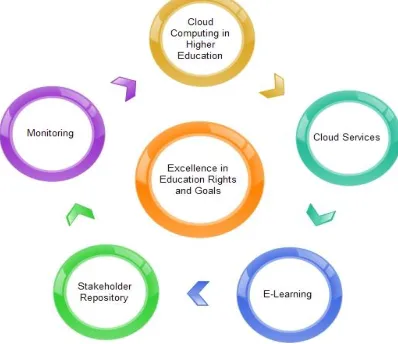
ACKGROUND AND RELATED WORKThe cloud based preparing skeleton obliges the usage and handling of data in higher education as an absolute component for economy, social, and creative transformation. Accomplishing this goal basically incorporates the usage of designing, which would allow data transmission and make new regions for preparing, imaginative work. The impression of cloud in preparing has pulled in designers and their countries' attention all over the world, especially in light of inventive consequences of an open access to knowledge"[13]. The general establishment for giving hypothetical and operational mixing of ICT [4] in all movement districts and step by step life zones interprets, because of higher guideline to organization [5]. Subsequently, the sensible skeleton of joining dispersed processing in higher preparing is demonstrated with alternate points of view like: technique, objectives and driving forces; possessions and work places; machine holdings; indicating and learning activities; routines for execution weighing and evaluation as in Fig.2. The quick headway of building gives various open entryways. Furthermore makes strains that are tricky to supervise and changes, that are much hard to implement.
Figure 2. Logical Cloud Integration Framework
There are diverse different open-source cloud stages, therefore the learners believe that it hard to pick the most suitable way that each one cloud stage has its characteristics. "A huge amount of papers are there to research and compare at each stage, makes a qualitative survey and breaks down building outline. Takes a gander at from some crucial points of view and gives specific recommendations to use, leads a study to help book significant others pick the best brought together with their needs and gather their own particular specific cloud infrastructure."[12]. Physical servers and managing data goes hand in hand with a significant esteem hence, a couple of associations picked Iaas cloud for the improvement of their server center. Openstack is the true open-source Iaas cloud stages [11] and it is at this moment used by people as far and wide as would be prudent. These being the clarifications behind picking it to evaluate, some short presentations of it are presented underneath [10]. OpenStack, a collection of open-source software projects, [8] aims to deploy and configure cloud simply, scalably, and full of vital features. OpenStack‘s major contributors are NASA and Rackspace[9,10,11]. OpenStack‘s three important features, namely-
Nova-Compute unit by NASA Swift-Object storage by Rackspace Glance-Image service
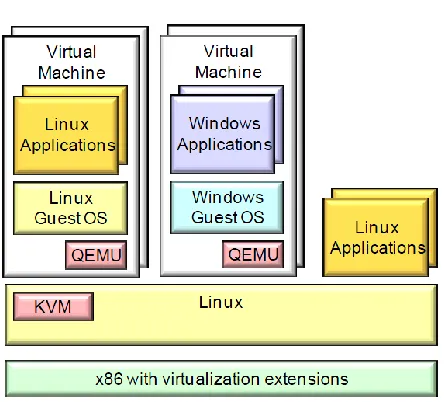
KVM Architecture
Achieving the Linux operating system as a Native bare metal hypervisor is done through a loadable kernel module, KVM. As a hypervisor provides so many features and facilities that it is thought of as a very specialized operating system to run VMs unlike the normal operating systems that run arbitrary applications. The KVM module actualizes inside Linux the crucial capacities to do the enchantment that permits virtual machines to capacity; however it embraces the rationality of not reinventing the wheel and utilization the secured and demonstrated Linux OS capacities for the rest. By not needing to change fundamental capacities, engineers can center their exertions on enhancing Linux for VM forms — not reproducing those capacities inside the hypervisor code stack. It also means that all the advances in Linux as an OS apply to virtualization as well:
Scheduling, resource control, and memory management.
Virtual machines under KVM in Linux are simply treated as any other running process during execution.
Storage. VM images are treated like any other Linux file on a
disk device. Thus storage support is any type of storage that is supported by Linux today, which includes local disk, a variety of file systems, NAS, iSCSI, and SAN. Improvements to the storage I/O stack and support for the storage vendor's infrastructure all carry over to KVM and allow VMs to leverage Linux's robust and proven storage stack.
Hardware support. KVM inherits the entire Linux device
Security. KVM also is able to leverage the Linux security model, SELinux, which essentially "sandboxes" processes so that if a process becomes compromised, the problem is limited to that process and does not compromise the entire system.
Figure.3 KVM Architecture
The roots of Windows support started from the very inception of KVM. Qumranet initially developed KVM for hosting Windows desktops. Further, Red Hat entered into a virtualization interoperability agreement with Microsoft in February 2009, which ensures that each company will test and support its operating systems aboard the other company's hypervisor. This raises the potential that performance won't be compromised when running on the other vendor's hypervisor and will ensure that support will be provided without finger-pointing. SUSE and Microsoft have a similar virtualization interoperability agreement as part of their broad collaboration on Windows and Linux interoperability and support.
3
M
ETHODOLOGY AND MODELPhysical machine setup: Dell Inspiron N4050 with processor
Intel(R) Core(TM) i5-2450M CPU @ 2.50GHz (4 CPUs), ~2.5GHz which can expand upto 3.5gHz at heavy workload. Having 8Gb memory, L3 3MB cache, 1Tb Hdd& 1 NIC.
Hypervisor and OpenStack integration setup: Install Ubuntu
12.04 LTS as a server OS on bare-metal hardware then run KVM package on that, it provides a hypervisor Environment. Through which virtual machines can be created on. For remotely accessing and managing the vm‘s and all resources of physical hardware, OpenStack Grizzly is integrated. The cloud management software is a piece of software that orchestrates the whole process of adding the physical machine, getting the IP address lease from the network and creating the virtual machine. Above shows the interaction between the cloud management software and other components.
Figure. 4: OpenStack and RabbitMQ services
In the Fig.4 the circular component is a physical machine, which is the combination of hardware and hypervisor (which provides a framework to run virtual machines). Cloud management software should be flexible enough to run on different operating systems and different vendors‘ hardware. The arrow component is RabbitMQ, which acts as a postman between all services of OpenStack. Those services have component like a network which includes DNS and DHCP. The network components should be designed to handle both the host and the virtual machine requests. The swift and glance component is the image service and storage service; this is where the VMs‘ images are stored. The Horizon (dashboard) component is the front-end which allows users to request the virtual machine and allows a cloud administrator to change configurations (e.g., adding more IP address to a DHCP server and more). The down component keystone is the cloud security access point. The OpenStack keystone receives a request from the user and takes the corresponding VM‘s image file to process it (e.g., adding a swap partition and padding the image to appropriate size) [6] and sends a request to the hypervisor to create a virtual machine. Finally, the cloud management software requests a network component for IP and MAC assignment to the virtual machine [7].
4
M
OTIVATION/
U
SEC
ASES67
machine. The virtual lab allowed the institute to deliver the optimum requirements or desired hardware to the students via the internet. This saved the requirement of premium space and thus students are also benefitted from being able to access the cloud from both within and off the campus, anytime 24/7 to complete the assignments. Furthermore different modules like ‗Web-Technologies‘ and ‗Socket Programming‘ (Typically dealing with the Client-Server based programming and configurations), are exempted from dedicated labs or hardware required. Maintaining and repairing time and cost is saved as machines did not need to be re-provisioned, if a machine stops working due to any reason. Traditionally each student is given a system i.e., hard disk, CPU, processor, etc. With the adoption of this cloud computing model the considerable reduction in the amount of hardware required, which possesses the threat of hardware failures or any severe failures can be rectified by using the snapshot feature i.e., the failed system can be reverted back to its well-working state. Thus cutting down the time and effort to rectify the failure. Students‘ projects are based on the LAMP (Linux, Apache, MySQL, PHP) or WAMP (Windows, Apache, MySQL, PHP) type configurations, the cloud service provides a good solution for the low cost hardware provisioning. For the first time, the control of the LAMP and WAMP configurations are in the hands of the students. Also with the snapshot facility the students were able to both secure their work and acquire the practical experience of what works and what does not. The mode of education has shifted from traditional instructive teacher-led models towards more student-centered constructive approach. Students are encouraged to learn by doing rather just reading it up in books. This provided the opportunity to the students of ‗What works? And What does not work?‘ and the students are given the opportunity to adopt a trial and error approach. Students are even encouraged to experiment with various operating systems. To allow such freedom, the students are given the root privileges for Linux and full administrator rights for Windows operating system. Typically using bare metal, such access was restricted. OpenStack provide the inbuilt security mechanisms [11] i.e., keystone, networks rules, security groups, etc., thus the security of the University network is maintained.
5
C
ASES
TUDY AND BENEFITS OF VLABIn the current scenario, education must be given in a best possible manner. This can be achieved through experimental approach. By using practical applications the users will be highly benefitted. This approach will provide such infrastructure for project. For these users the administrator will provide a vm with required configuration, and assign one of them as local admin to the project. That local admin is solely responsible for resource assignment to fellow users of the same project. That admin is configuring the base/master vm from the predefined flavors (by using the default templates or customizing the default template for given parameters such as Memory and root disk.
Name RAM (MB) Root Disk Tiny 512 0
Small 2048 20 Medium 4096 40 Large 8192 80 Xlarge 16384 160
Table 1: Flavor details
Figure. 5: VLabFlavor Details
After configuring the base/master vm, admin user is responsible for creating the required number of instances for each user, managing and monitoring the resources, assigning the instances of base vm to its teammates, so that the users can use that vm instance for required purpose. The software up-gradation is done centrally. If there is a need for resource up-gradation then the admin will upgrade the base/master vm and it will be reflected to its all other instances same as that of the base/master instance. Secondly if the project is to be accessed over the network, then the admin can put the project over the network and share them along with other fellow project users. The other users are capable of using the application for their required purpose remotely. They can do the required task and after completing the task, they can logout from their account, thus their instance will be saved for later use. The user can also take snapshot of the instance and use that for restore option if something went wrong. Any changes made on the instance will not revert back on the base/master vm.
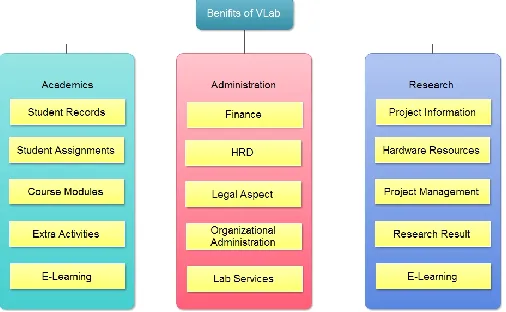
Vlab shows a great promise to deliver the promises it shows. In the above figure the benefits of Vlab is shown. The benefits are shown in three most demanding field, those are academics, administration, research. In each of the three fields the Vlab promises to deliver the feasibilities such as managing the overflowing student records magnificently, managing student assignments, distributing course materials, specifying extra activities, and also providing the feature of E-Learning through which the students can access e-lab they want, which also removes the need of physical space required to store such book. Vlab benefits in the field of administration too. It shows great help in finance thus simplifying the workload greatly. It also helps in Human Resources Deployment, Legal aspects, Organizational administration, and lab services. Vlab benefits in the field of research such as; project information, hardware resources, project management, research result, E-Learning. While in research E-Learning is very crucial for collecting resources and to store those resources neatly and organized which is project management based on the project information. Thus ultimately compiling these results into research results.
6
C
ONCLUSION AND FUTURE WORKVLab is designed to allow administrators and researchers to deploy IaaS infrastructure. This paper concludes to deploy cloud services using OpenStack to create a virtual lab. OpenStack triumphs over other cloud OS‘s as it being an open-source and its advantage is to provide various advanced features such as tools for creating and managing virtual machines on top of existing resources. This will help us to make the experimental setup of the computing course and more student focused. Based on the experience from the Vlab, Applications and Infrastructure in Clouds acquiring resources through a commercial provision would be too costly for educational purposes. While deploying the entire system, keeping future prospect in mind, the students are allowed to study and evaluate its performances in dynamic reconfiguration in Cloud Computing Infrastructure.
R
EFERENCES[1] P. Mell and T. Grance, "The NIST Definition of Cloud Computing, National Institute of Standards and Technology, USA2009.
[2] VMware, ―Understanding full virtualization,
paravirtualizationand hardware assist,‖ VMware White Paper, 2007.
[3] N. Sultan ―Cloud Computing for Education: A New Dawnti,
International Journal of Information Management, 2010, vol. 30, pp. 109–116.
[4] M. Zuvic-Butorac, Z. Nebic, and D. Nemcanin, ―
Establishing an Institutional Framework for an E-learning Implementation Experiences from the University of Rijeka, Croatia‖, Journal of Information Technology Education, Vol. 10, 2011, pp.44-56
[5] S. Sasikala, S. Prema, ―Massive Centralized
CloudComputing (MCCC) Exploration in Higher Education,‖Advances in Computational Sciences and Technology, 2010, 3 (2), pp.111–118.
[6] Khan, I.; Rehman, H.; Anwar, Z., "Design and Deployment of a Trusted Eucalyptus Cloud," Cloud Computing (CLOUD), 2011 IEEE International Conference on , vol., no., pp.380,387, 4-9 July 2011.
[7] PatríciaTakako Endo, GlaucoEstácioGonçalves et al., A Survey on Open-source Cloud Computing Solutions, VIII Workshop Clouds, Grids e Aplicações, ,pp. 3-16, 2010.
[8] ChangqingJi; Yu Li; WenmingQiu; Awada, U.; Keqiu Li, "Big Data Processing in Cloud Computing Environments," Pervasive Systems, Algorithms and Networks (ISPAN), 2012 12th International Symposium on , vol., no., pp.17,23, 13-15 Dec. 2012
[9] I. Voras, B. Mihaljecić, M. Orlić, et al, ―Evaluating
Open-Source Cloud Computing Solutions‖, MIPRO, Proceedings of the 34th International Convention, pp. 209-214, 2011.
[10]Xiaolong Wen; GenqiangGu; Qingchun Li; Yun Gao; Xuejie Zhang, "Comparison of open-source cloud management platforms: OpenStack and OpenNebula," Fuzzy Systems and Knowledge Discovery (FSKD), 2012 9th International Conference on , vol., no., pp.2457,2461, 29-31 May 2012
[11]OpenStack: Introduction of OpenStack,―http://www.openstack.org/‖.
[12]Xiaolong Wen, GenqiangGu, Qingchun Li, Yun Gao, Xuejie Zhang, ―Comparison of Open-Source Cloud Management Platforms: OpenStack and OpenNebula‖2012 9th International Conference on Fuzzy Systems and Knowledge Discovery
[13]MAH Masud,Xiaodi Huang, Jianming Yong,―Cloud