83 | P a g e
Design of novel High Secure Image Encoding using
V.L.S.I.
Kongari Srikanth
1, B.Ramu
21
PG Scholor, DIET, HYD
2
Associate Professor,DIET,HYD
ABSTRACT
The community of the research in the last few years has received significant attention from the field of approximate computing, particularly in different signal processing context. The compression algorithms of the image and video such as MPEG and JPEG and so on, which can be exploited to realize the implementations of highly power-efficient of these algorithms. However, existing approximate architectures naturally fix the approximations of hardware levels statically and are not adaptive to the input data. This project addresses this issue through proposing a reconfigurable approximate for encoders of MPEG which optimizes consumption of power with the aim of maintaining a particular peak signal-to-noise ratio threshold for any video. I design reconfigurable adder/ subtract blocks, and later integrate these blocks in the special levels all the video in to images these images will be converted to digital form and then compression of the image.
I. INTRODUCTION
Introducing a limited amount of computing imprecision in image and video dispensation algorithms repeatedly
results in an insignificant amount of perceptible visual change in the output, which makes these algorithms as
ideal candidates for the use of approximate computing architectures.
Approximate Computing architectures develop the fact that a small relaxation in the output correctness can
result in considerably simpler and lower power implementations. On the other hand, the most approximate
hardware architectures projected so far suffer from the restriction that, for widely varying input parameters, it
becomes very tough to provide a quality bound on the output, and in some other cases, the output quality may be
severely degraded. The main reason for this output quality variation is that the degree of approximation (DA) in
the hardware architecture is permanent statically and cannot be modified for different inputs. One possible
solution is to assume a conservative approach and use a very low DA in the hardware so that the output
accuracy is not drastically exaggerated. However, such a conventional approach will, as expected, considerably
impact the power savings as well.
II. EXISTED SYSTEM
There are of two compression techniques. One is lossless compression and another one lossy compression.
Lossy compression is employed to decrease the data of the image, picture or video. By victimization of this
compression technique the receiver could lose some data. It’ll be loss to the receiver as well as to the sender. In
84 | P a g e
Fig.1 Block Diagram
To overcome this drawback of reduction of the information or data, a brand new compression technique was
been introduced, i.e., lossless compression.
Lossless compression is exactly opposite to lossy compression. Lossy compression is irreversible and lossless
compression is reversible compression. Lossless compression sends the image without reduction of the
information to the receiver.
Fig. 2 Existed System
MPEG encoding involves three kinds of frames: 1)I-frames (Intra-frame encoded); 2) P-frames (Predicted
encoded); and 3) B-frames (Bidirectional encoded). As evident from their names, as I-frame is encoded
completely for data bits. An I-frame usually proceeds each MPEG data stream. P-frames are constructed using
the differences between the current frame and the immediately preceding I or P frame. B-frames are produced
relative to the closest two I/P frame on either side of the current frame. The I, P and B frames are further
compressed when subjected to DCT, which helps to eliminate and existing inter-frame spatial redundancy as
much as possible.
III. PROPOSED SYSTEM
By exploitation lossless compression, the receiver won’t lose any information or data from the image picture or
video. The quality of the image also won’t be modified by the lossless compression.
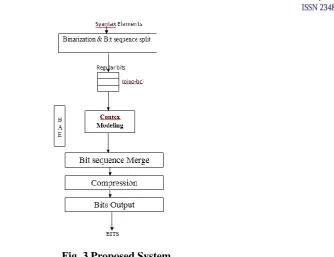
The process of the lossless compression is: At initial stage the information or the data of the image are
remodeled into binary forms i.e., zero and one format (0,1). This information can splits into rows and columns.
This can be referred to as binirization. During this method the binary digits can forms like bits in a very
85 | P a g e
Fig. 3 Proposed System
These bits are ready to merge. Now the data is united with the primary digit of the primary row with the primary
digit of the primary column. During this method all the rows and columns are united.
Then the binary data is prepared to compress. As we all know that, we are utilizing lossless compression
technique here to change the image. The image is reworked into binary data here just in case of lossless
compression. This can be very helpful technique to achieve the accurate image as we would like. In this
technique first the binary data will be remodeled into black and white format as we tend to shown in the fig.3.
Then the images are going to be transformed into binary data i.e., zero and one (0,1) format as we tend to shown
in fig.4. Here we tend to square measure victimization sixty four bit compression that is extremely helpful to the
rework. Finally lossless compression can send the original data as output. The ultimate output comes without
any loss of information within the image. As a result, we tend to used lossless compression technique for this
point. Lossless compression is extremely advantageous and really helpful technique than lossy compression
technique
.
IV. RESULTS
86 | P a g e
The above image (Fig.4) is to be sent to another person. If this is the case, then we need to change the image
into black and white image as in Fig.5.
Fig.5 Black and white
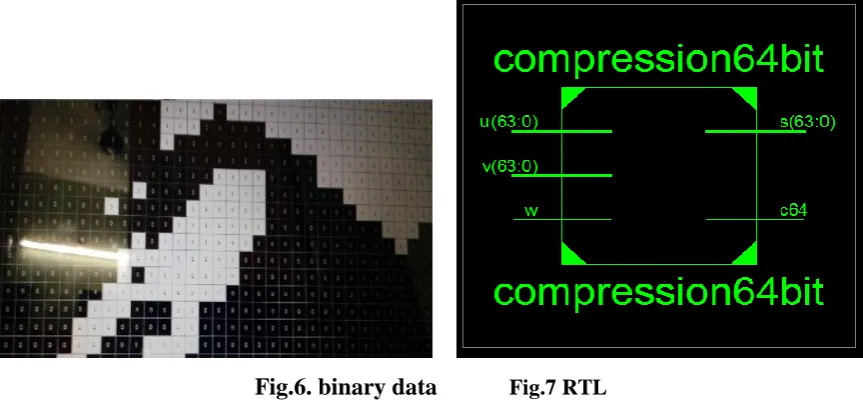
This black and white image is further converts to 0, 1 format as it is in the Fig.6.
Fig.6. binary data Fig.7 RTL
The above figure shows the RTL Schematic diagram and the output of compressed data is shown in below
figure.
Fig 8 Output
V. CONCLUSION
This new and advanced proposed system tells us the about the transformation of the image from one device to
another device. Suppose I want to send a color image from Tx to Rx, then I have to consume more data. To
deduce the data, I want to change the image by following steps. By using this technique, the color image will be
transformed into black and white image and then it will be transformed into 0, 1 binary form by compressing the
87 | P a g e
image is converted to binary data with the help of mat lab and the binary data is compressed by using Xilinx
14.7.
REFERENCES
[1] F. Ahmed-Zaid, F. Bai, S. Bai, C. Basnayake, B. Bellur, S. Brovold,et al., ―Vehicle safety
communications—Applications (VSC-A) finalreport,‖ U.S. Dept. Trans., Nat. Highway Traffic Safety
Admin., Washington,DC, USA, Rep. DOT HS 810 591, Sep. 2011.
[2] J. B. Kenney, ―Dedicated short-range communications (DSRC) standardsin the United States,‖ Proc. IEEE,
vol. 99, no. 7, pp. 1162–1182,Jul. 2011.
[3] J. Daniel, V. Taliwal, A. Meier, W. Holfelder, and R. Herrtwich,―Design of 5.9 GHz DSRC-based vehicular safety communication,‖IEEE Wireless Commun. Mag., vol. 13, no. 5, pp. 36–43, Oct. 2006.
[4] P. Benabes, A. Gauthier, and J. Oksman, ―A Manchester code generatorrunning at 1 GHz,‖ in Proc. IEEE, Int. Conf. Electron., Circuits Syst.,vol. 3. Dec. 2003, pp. 1156–1159.
[5] A. Karagounis, A. Polyzos, B. Kotsos, and N. Assimakis, ―A 90nmManchester code generator with CMOS switches running at 2.4 GHzand 5 GHz,‖ in Proc. 16th Int. Conf. Syst., Signals Image Process.,Jun. 2009,
pp. 1–4.
[6] Y.-C. Hung, M.-M. Kuo, C.-K. Tung, and S.-H. Shieh, ―High-speedCMOS chip design for Manchester and
Miller encoder,‖ in Proc. Intell.Inf. Hiding Multimedia Signal Process., Sep. 2009, pp. 538–541.
[7] M. A. Khan, M. Sharma, and P. R. Brahmanandha, ―FSM basedManchester encoder for UHF RFID tag emulator,‖ in Proc. Int. Conf.Comput., Commun. Netw., Dec. 2008, pp. 1–6.
Mrs. S. Thirumala Devi received B.Tech degree in Electronics and Communication Engineering from Sri Vishnu Engineering College for women, Bhimavaram (JNTUH) in 2008, and M.Tech in VLSI design from Sri Vishnu Engineering College for women (JNTUK) in 2013. She is working as an Asst professor in the department of ECE in KKR&KSR Institute of Technology and Sciences .she is having 6 years of experience.
M.BALAJI received degree in Electronics and Communication Engineering from Jawaharlal
Nehru Technological University (JNTUK), KAKINADA in 2014. He is persuing M.Tech with
Department Of VLSI Design in KKR&KSR Institute of Technology and Sciences,