University of Pennsylvania
ScholarlyCommons
Publicly Accessible Penn Dissertations
1-1-2014
Inference for Approximating Regression Models
Emil Pitkin
University of Pennsylvania, [email protected]
Follow this and additional works at:http://repository.upenn.edu/edissertations Part of theStatistics and Probability Commons
This paper is posted at ScholarlyCommons.http://repository.upenn.edu/edissertations/1405
For more information, please [email protected].
Recommended Citation
Pitkin, Emil, "Inference for Approximating Regression Models" (2014).Publicly Accessible Penn Dissertations. 1405.
Inference for Approximating Regression Models
Abstract
The assumptions underlying the Ordinary Least Squares (OLS) model are regularly and sometimes severely violated. In consequence, inferential procedures presumed valid for OLS are invalidated in practice. We describe a framework that is robust to model violations, and describe the modifications to the classical inferential procedures necessary to preserve inferential validity. As the covariates are assumed to be
stochastically generated ("Random-X"), the sought after criterion for coverage becomes marginal rather than conditional. We focus on slopes, mean responses, and individual future observations. For slopes and mean responses, the targets of inference are redefined by means of least squares regression at the population level. The partial slopes that that regression defines, rather than the slopes of an assumed linear model, become the population quantities of interest, and they can be estimated unbiasedly. Under this framework, we estimate the Average Treatment Effect (ATE) in Randomized Controlled Studies (RCTs), and derive an estimator more efficient than one commonly used. We express the ATE as a slope coefficient in a population regression and immediately prove unbiasedness that way. For the mean response, the conditional value of the best least squares approximation to the response surface in the population - rather than the conditional value of y, is aimed to be captured. A calibration through pairs bootstrap can markedly improve such coverage. Moving to observations, we show that when attempting to cover future individual responses, a simple in-sample calibration technique that widens the empirical interval to contain $(1-\alpha)*100\%$ of the sample residuals is asymptotically valid, even in the face of gross model violations. OLS is startlingly robust to model departures when a future y needs to be covered, but nonlinearity, combined with a skewedX-distribution, can severely undermine coverage of the mean response. Our ATE estimator dominates the common estimator, and the stronger the R squared of the regression of a patient's response on covariates, treatment indicator, and interactions, the better our estimator's relative performance. By considering a regression model as a semi-parametric approximation to a stochastic mechanism, and not as its description, we rest assured that a coverage guarantee is a coverage guarantee.
Degree Type Dissertation
Degree Name
Doctor of Philosophy (PhD)
Graduate Group Statistics
First Advisor Lawrence D. Brown
Keywords
INFERENCE FOR APPROXIMATING REGRESSION
MODELS
Emil Pitkin
A DISSERTATION
in
Statistics
For the Graduate Group in
Managerial Science and Applied Economics
Presented to the Faculties of the University of Pennsylvania
in
Partial Fulfillment of the Requirements for the
Degree of Doctor of Philosophy
2014
Supervisor of Dissertation
Lawrence D. Brown
Miers Busch Professor of Statistics
Graduate Group Chairperson
Eric Bradlow
K.P. Chao Professor, Marketing, Statistics and Education
Dissertation Committee
Lawrence D. Brown, Miers Busch Profes-sor of Statistics
Richard A. Berk, Professor of Statistics and Criminology
Andreas Buja, Liem Sioe Liong/First Pacific Company Professor of Statistics
INFERENCE FOR APPROXIMATING REGRESSION MODELS
COPYRIGHT© 2014
Acknowledgments
I thank first Mama and Papa – Drs. Pitkin – together with Dedushka Rafa, Babushka
Rita, and Babushka Sonya. You were my first teachers. I learn from you always.
Love and reverence for your suffuses my every step. I dedicate this dissertation
to you. I thank my incomparable, good, and wise advisor Larry Brown, who is a
towering flame and who cultivated all my sparks, however slight. I thank Richard
Berk, Andreas Buja, Ed George, and Linda Zhao who have also generously and
significantly shaped my thinking as a statistician and this work. I thank my early
mentor Ken Stanley, whose unfailing trust and reservoir of wisdom has propelled me
on. I thank my classmates Alex Goldstein, Adam Kapelner, Justin Rising, Jordan
Rodu, Jose Zubizaretta, and also Justin Bleich. We few, we happy few! I thank the
members of the Salon and of the Captain’s Club. Words and equations and flint are
all the same – rub them the right way and the sparks will fly.
I thank Mr. Waldman and Moreh Shem for their love of learning and of teaching,
Ethan Schaff for being the best math teacher I ever had, Mr. Randall and Mr. Jarvis
for their perfect advice, Mr. Astrue for his frequent support, Dr. Fichtner for his
ABSTRACT
INFERENCE FOR APPROXIMATING
REGRESSION MODELS
Emil Pitkin
Lawrence D. Brown
The assumptions underlying the Ordinary Least Squares (OLS) model are regularly
and sometimes severely violated. In consequence, inferential procedures presumed
valid for OLS are invalidated in practice. We describe a framework that is robust
to model violations, and describe the modifications to the classical inferential
pro-cedures necessary to preserve inferential validity. As the covariates are assumed to
be stochastically generated (Random-X), the sought after criterion for coverage
be-comes marginal rather than conditional. We focus on slopes, mean responses, and
individual future observations. For slopes and mean responses, the targets of
infer-ence are redefined by means of least squares regression at the population level. The
partial slopes that that regression defines, rather than the slopes of an assumed
lin-ear model, become the population quantities of interest, and they can be estimated
unbiasedly. Under this framework, we estimate the Average Treatment Effect (ATE)
in Randomized Controlled Studies (RCTs), and derive an estimator more efficient
regression and immediately prove unbiasedness that way. For the mean response, the
conditional value of the best least squares approximation to the response surface in
the population rather than the conditional value of y, is aimed to be captured. A
calibration through pairs bootstrap can markedly improve such coverage. Moving to
observations, we show that when attempting to cover future individual responses, a
simple in-sample calibration technique that widens the empirical interval to contain
(1−α)∗100% of the sample residuals is asymptotically valid, even in the face of gross
model violations. OLS is startlingly robust to model departures when a futureyneeds
to be covered, but nonlinearity, combined with a skewedX-distribution, can severely
undermine coverage of the mean response. Our ATE estimator dominates the
com-mon estimator, and the stronger the R2 of the regression of a patient’s response on
covariates, treatment indicator, and interactions, the better our estimator’s relative
performance. By considering a regression model as a semi-parametric approximation
to a stochastic mechanism, and not as its description, we rest assured that a coverage
Contents
1 Introduction 1
2 Random Predictors and Model Violations∗ 4
2.1 Abstract . . . 4
2.2 Introduction . . . 5
2.3 Discrepancies between Standard Errors Illustrated . . . 6
2.4 Populations and Targets of Estimation . . . 8
2.5 Observational Datasets and Estimation . . . 13
2.6 Decomposition of the LS Estimate According to Two Sources of Variation 15 2.7 Assumption-Lean Central Limit Theorems . . . 16
2.8 The Sandwich Estimator and the M-of-N Pairs Bootstrap . . . 18
2.9 Adjusted Predictors . . . 20
2.10 Proper and Improper Asymptotic Variances Expressed with Adjusted Predictors . . . 23
2.11 Discussion . . . 27
2.12 Proofs . . . 29
3.1 Abstract . . . 32
3.2 Introduction . . . 33
3.3 Neyman Framework, Fixed X, True Models . . . 35
3.4 Target of Estimation . . . 38
3.5 Illustration on real data . . . 54
3.6 Conclusion . . . 56
3.7 Technical appendix . . . 58
4 Calibrated Prediction Intervals 64 4.1 Abstract . . . 64
4.2 Introduction . . . 64
4.3 Marginally correct intervals . . . 67
4.4 Procedures . . . 72
4.5 Performance comparison . . . 74
4.6 Calibrated Intervals for the Mean Response . . . 76
4.7 Conclusion . . . 79
Bibliography 83
List of Tables
4.1 n = 100 . . . 76
4.2 n = 500 . . . 76
4.3 n = 1000 . . . 76
List of Figures
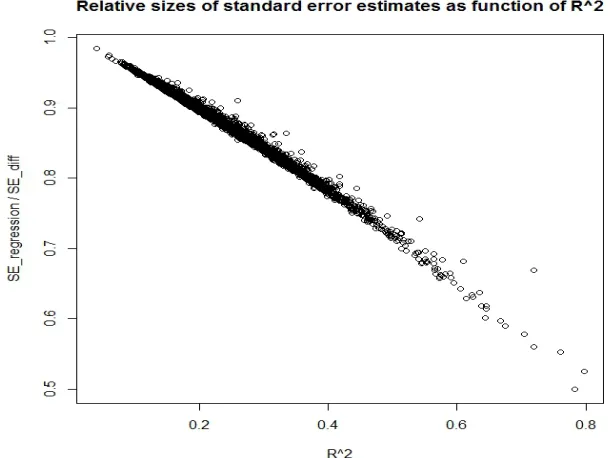
3.1 R2 plotted against SEˆ (ˆτˆregression)
1
Introduction
The organizing principle of this work, which will be repeated in each chapter, is
two-fold: 1) that classical regression theory does not accommodate non-linearity or
heteroskedasticity in the presence of random predictors, and 2) that a re-examination
of the target of inference can and does give rise to valid, marginal inference.
Hal-bert White wrote a series of three papers (White, 1980b), (White, 1980a), (White,
1982) in which he addressed and solved the question of inference for misspecified
models. The sandwich estimator he introduced is asymptotically equivalent to the
non-parametric “pairs bootstrap,” which we will employ often in this work. Chapter
2, an adaptation of (Buja et al., 2013), examines this form of valid inference, which
includes a comparison of the relative performance of classical, or “conventional”
stan-dard errors, and those implied by the sandwich or the bootstrap. The key insight is
that regression slope estimates derived through OLS are asymptotically unbiased for
regression coefficients derived through population least squares. It is the randomness
of the joint distribution of the predictors and response that motivates the population
least squares procedure.
Chapter 3 changes orientation but preserves the statistical framework. We turn to
Randomized Controlled Trials (RCTs) and the attendant estimation of the Average
progenitor in Neyman’s thesis (Splawa-Neyman et al., 1990) to contemporary ones
that consider, as we do, semi-parametric settings (Zhang et al., 2008), (Rosenblum and
van der Laan, 2010), and then we explicitly define an estimator that is asymptotically
efficient relative to the difference in means estimator. Our estimator can be expressed
as a slope coefficient in a regression model of the sort defined in chapter 2, and
it is therefore asymptotically unbiased. This work sets a principled foundation to
the study of efficient ATE estimators, and admits many natural extensions to more
complex study designs.
The problem of predicting future observations in a regression setting without
in-voking normal-theory parametric intervals is not new. (Stine, 1985), for example,
examines the coverage of bootstrap prediction intervals. In his scheme the operating
assumption is that the model is correctly specified, and hence that the distribution of
the errors is known. (Schmoyer, 1992), who conscientiously avoids resampling
meth-ods, creates an estimator derived from a convolution of the empirical distribution of
the regression residuals. More resonant with our work, which assumes only a joint
distribution P between the X~ and y, and more recently, (Politis, 2013) states as a
common sense principle that in the absence of a model (the “model - free” case),
prediction intervals should be based on quantiles of the observed predictive
distri-bution. We adapt this principle to generate prediction intervals based on quantiles
of the empirical distribution of the residuals. In chapter 4 we show how a simple
in-sample calibration technique, which places minimal assumptions on the data
gen-erating process, gives desired, asymptotically valid coverage. Chapter 4 continues
with an exploration of valid coverage for the mean response. Again, our target of
inference is based on the population least squares approximation to the conditional
mean. We in simulations show examples where Xβ~ is covered with probability lower
theory are applied to misspecified models with random predictors. Again relying on
2
Random Predictors and Model Violations
∗Excerpted and adapted from Buja, A., Berk, Richard A., Brown, Lawrence D.,
George, Edward I., Pitkin, E., Traskin, M. Zhao, L., Zhang, K.: A Conspiracy of
Random X and Model Violation Against Classical Inference in Linear Regression.
2.1
Abstract
This chapter reviews the insights of Halbert White’s asymptotically correct inference
in the presence of “model misspecification.” This form of inference, which is pervasive
in econometrics, relies on the “sandwich estimator” of standard error. White permits
models to be “misspecified” and predictors to be random. Careful reading of his
theory shows that it is a synergistic effect — a “conspiracy” — of nonlinearity and
randomness of the predictors that has the deepest consequences for statistical
infer-ence. A valid alternative to the sandwich estimator is given by the “pairs bootstrap.”
We continue with an asymptotic comparison of the sandwich estimator and the
stan-dard error estimator from classical linear models theory. The comparison shows that
when standard errors from linear models theory deviate from their sandwich analogs,
they are usually too liberal, but occasionally they can be too conservative as well. The
chapter concludes by answering why we might be interested in inference for models
that are not correct.
2.2
Introduction
The classical Gaussian linear model reads as follows:
y = Xβ+, ∼ N(0N, σ2IN×N) (y,∈IRN, X ∈IRN×(p+1), β ∈IRp+1). (2.1)
Important for the present focus are two aspects of how the model is commonly
in-terpreted: (1) the model is assumed correct, that is, the conditional response means
are a linear function of the predictors and the errors are independent,
homoskedas-tic and Gaussian; (2) the predictors are treated as known constants even when they
arise as random observations just like the response. Starting with Halbert White’s
(White, 1980a), ((White, 1980b), (White, 1982)) seminal articles, econometricians
have used multiple linear regression without making the many assumptions of
clas-sical linear models theory. While statisticians use assumption-laden exact finite
sample inference, econometricians useassumption-lean asymptotic inference
based on the so-called “sandwich estimator” of standard error. The approach in this
chapter is to interpret linear regression in a semi-parametric fashion: the generally
nonlinear response surface is decomposed into a linear and a “residualized”
nonlin-ear component. The modeling assumptions can then be reduced to i.i.d. sampling
from largely arbitrary joint (X~, Y) distributions that satisfy a few moment
condi-tions. It is in this assumption-lean framework that the sandwich estimator produces
asymptotically correct standard errors.
boot-strap.” As the name indicates, the pairs bootstrap consists of resampling pairs (~xi, yi),
which contrasts with the “residual bootstrap” which resamples residuals ri.
Asymp-totic theory exists to justify both types of bootstrap under different assumptions
(Freedman, 1981), (Mammen, 1993). It is intuitively clear that the pairs bootstrap
can be asymptotically justified in the assumption-lean framework mentioned above.
In what follows we will use the general term “assumption-lean estimators of
standard error” to refer to either the sandwich estimators or the pairs bootstrap estimators of standard error.
The chapter concludes by comparing the standard error estimates from
assumption-lean theory and from classical linear models theory. The ratio of asymptotic variances
— “RAV” for short — describes the discrepancies between the two types of standard
error estimates in the asymptotic limit. If RAV 6= 1, then there exist deviations
from the linear model in the form of nonlinearities and/or heteroskedasticities. If
RAV = 1, then either the model is correct, or there has been a false negative.
2.3
Discrepancies between Standard Errors
Illus-trated
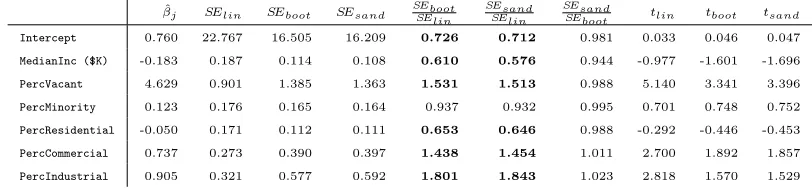
The table below shows regression results for a dataset in a sample of 505 census tracts
in Los Angeles that has been used to examine homelessness in relation to covariates
for demographics and building usage (Berk et al., 2008). We show the raw results
of linear regression to illustrate the degree to which discrepancies can arise among
three types of standard errors: SElin from linear models theory, SEboot from the pairs
bootstrap (Nboot = 100,000) and SEsand from the sandwich estimator (according to
(MacKinnon and White, 1985)). Ratios of standard errors are shown in bold font
Table 1: Regression coefficients along with their standard errors estimated by
different means.
ˆ
βj SElin SEboot SEsand SEbootSElin SEsandSElin SEsandSEboot tlin tboot tsand
Intercept 0.760 22.767 16.505 16.209 0.726 0.712 0.981 0.033 0.046 0.047
MedianInc ($K) -0.183 0.187 0.114 0.108 0.610 0.576 0.944 -0.977 -1.601 -1.696
PercVacant 4.629 0.901 1.385 1.363 1.531 1.513 0.988 5.140 3.341 3.396
PercMinority 0.123 0.176 0.165 0.164 0.937 0.932 0.995 0.701 0.748 0.752
PercResidential -0.050 0.171 0.112 0.111 0.653 0.646 0.988 -0.292 -0.446 -0.453
PercCommercial 0.737 0.273 0.390 0.397 1.438 1.454 1.011 2.700 1.892 1.857
PercIndustrial 0.905 0.321 0.577 0.592 1.801 1.843 1.023 2.818 1.570 1.529
The ratios SEsand/SEboot show that the standard errors from the pairs bootstrap
and the sandwich estimator are in rather good agreement. Not so for the standard
errors based on linear models theory: we haveSEboot, SEsand > SElinfor the predictors
PercVacant, PercCommercial and PercIndustrial, and SEboot, SEsand < SElin for
Intercept,MedianInc ($1000),PercResidential. Only forPercMinorityisSElin
off by less than 10% from SEboot and SEsand. The discrepancies affect outcomes
of some of the t-tests: under linear models theory the predictors PercCommercial
and PercIndustrial have commanding t-values of 2.700 and 2.818, respectively, which are reduced to unconvincing values below 1.9 and 1.6, respectively, if the pairs
bootstrap or the sandwich estimator are used. On the other hand, for MedianInc
($K) the t-value −0.977 from linear models theory becomes borderline significant with the bootstrap or sandwich estimator if the plausible one-sided alternative with
negative sign is used.
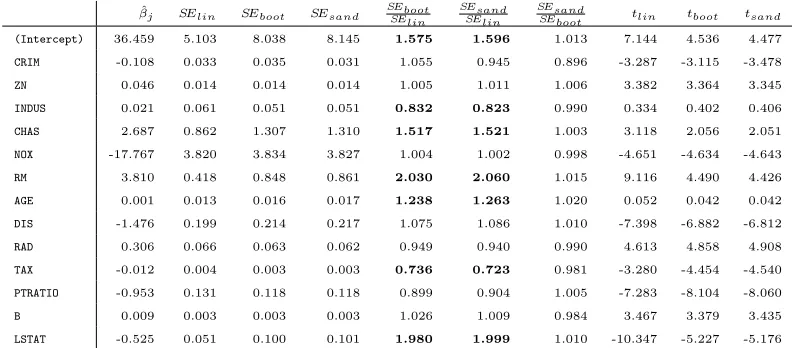
The second illustration of discrepancies between types of standard errors, shown in
the table below, is with the Boston Housing data (Harrison Jr and Rubinfeld, 1978).
We focus only on the comparison of standard errors. Here, too,SEboot andSEsand are
mostly in agreement as they fall within less than 2% of each other, an exception being
CRIM with a deviation of about 10%. By contrast, SEboot and SEsand are larger than
their linear models cousin SElin by a factor of about 2 for RM and LSTAT, and about
SEsandare only a fraction of about 0.73 ofSElinforTAX. Also worth stating is that for several predictors there is no substantial discrepancy among all three standard errors,
namely ZN, NOX, B, and even for CRIM, SElin falls between the somewhat discrepant values of SEboot and SEsand.
Table 2: Regression coefficients along with their standard errors estimated by
different means.
ˆ
βj SElin SEboot SEsand SEbootSElin SEsandSElin SEsandSEboot tlin tboot tsand
(Intercept) 36.459 5.103 8.038 8.145 1.575 1.596 1.013 7.144 4.536 4.477
CRIM -0.108 0.033 0.035 0.031 1.055 0.945 0.896 -3.287 -3.115 -3.478
ZN 0.046 0.014 0.014 0.014 1.005 1.011 1.006 3.382 3.364 3.345
INDUS 0.021 0.061 0.051 0.051 0.832 0.823 0.990 0.334 0.402 0.406
CHAS 2.687 0.862 1.307 1.310 1.517 1.521 1.003 3.118 2.056 2.051
NOX -17.767 3.820 3.834 3.827 1.004 1.002 0.998 -4.651 -4.634 -4.643
RM 3.810 0.418 0.848 0.861 2.030 2.060 1.015 9.116 4.490 4.426
AGE 0.001 0.013 0.016 0.017 1.238 1.263 1.020 0.052 0.042 0.042
DIS -1.476 0.199 0.214 0.217 1.075 1.086 1.010 -7.398 -6.882 -6.812
RAD 0.306 0.066 0.063 0.062 0.949 0.940 0.990 4.613 4.858 4.908
TAX -0.012 0.004 0.003 0.003 0.736 0.723 0.981 -3.280 -4.454 -4.540
PTRATIO -0.953 0.131 0.118 0.118 0.899 0.904 1.005 -7.283 -8.104 -8.060
B 0.009 0.003 0.003 0.003 1.026 1.009 0.984 3.467 3.379 3.435
LSTAT -0.525 0.051 0.100 0.101 1.980 1.999 1.010 -10.347 -5.227 -5.176
Important messages are the following: (1) SEboot and SEsand are in substantial
agreement; (2)SElinon the one hand and{SEboot, SEsand}on the other hand can show
substantial discrepancies; (3) these discrepancies are specific to predictors. In what
follows we describe how the discrepancies arise from nonlinearities in the conditional
mean and/or heteroskedasticities in the conditional variance of the response given the
predictors. Furthermore, it will turn out that SEboot and SEsand are asymptotically
correct whileSElin is not.
2.4
Populations and Targets of Estimation
Before we compare standard errors it is necessary to define targets of estimation in
a semi-parametric framework. Targets of estimation will no longer be parameters
nonparametric class of data distributions. A seminal work that inaugurated this
approach is P.J. Huber’s 1967 article whose title is worth citing in full: “The behavior
of maximum likelihood estimation under nonstandard conditions.” The “nonstandard
conditions” are essentially arbitrary distributions for which certain moments exist.
A population view of regression with random predictors has as its ingredients
random variables X1, ..., Xp and Y, where Y is singled out as the response. At this
point the only assumption is that these variables have a joint distribution
P = P(dy,dx1, ...,dxp)
whose second moments exist and whose predictors have a full rank covariance matrix.
We write
~
X = (1, X1, ..., Xp)T.
for the column random vector consisting of the predictor variables with a constant 1
prepended to accommodate an intercept term. Values of the random vector X~ will
be denoted by lower case ~x= (1, x1, ..., xp)T. We write any function f(X1, ..., Xp) of
the predictors equivalently as f(X~) because the prepended constant 1 is irrelevant.
Correspondingly we also use the notations
P =P(dy,d~x), P(d~x), P(dy|~x) or P =PY,X~, PX~, PY|X~ (2.2)
for the joint distribution of (Y,X~), the marginal distribution of X~, and the
condi-tional distribution ofY givenX~, respectively. Nonsingularity of the predictor
covari-ance matrix is equivalent to nonsingularity of the cross-moment matrix E[X ~~XT].
to the response Y, which is the conditional expectation of Y given X~:
µ(X~) := argminf(X~)∈L2(P)E[(Y −f(
~
X))2] = E[Y |X~ ]. (2.3)
This is sometimes called the “conditional mean function” or the “response surface”.
Importantly we do not assume that µ(X~) is a linear function of X~.
Amonglinear functionsl(X~) = βTX~ of the predictors, one stands out as the best
linear L2(P) or population LS linear approximation to Y:
β(P) := argminβ∈IRp+1E[(Y −βTX~)2] = E[X ~~X
T
]−1E[X~Y ]. (2.4)
The right hand expression follows from the normal equationsE[X ~~XT]β−E[X~Y] =
0 that are the stationarity conditions for minimizing the population LS criterion
E[(Y −βTX~)2] =−2βT
E[X~Y] +βTE[X ~~XT]β+ const.
By abuse of terminology, we use the expressions “population coefficients” forβ(P)
and “population approximation” for β(P)TX~We will often write β, omitting the
argument P when it is clear from the context that β =β(P).
The population coefficients β = β(P) form a statistical functional that is
de-fined for a large class of data distributions P. The question of how β(P) relates to
coefficients in the classical linear model (2.1) will be answered in Section 2.6.
The population coefficientsβ(P) provide also the best linearL2(P) approximation
toµ(X~):
β(P) = argminβ∈IRp+1E[(µ(X~)−βTX~)2] = E[X ~~X
T
]−1E[X~µ(X~) ]. (2.5)
This fact shows that β(P) depends onP only in a limited way, as will be spelled out
The response Y has the following natural decompositions:
Y = βTX~ + (µ(X~)−βTX~)
| {z }
+ (Y −µ(X~)
| {z }
= βTX~ + η(X~) +
| {z }
= βTX~ + δ
(2.6)
These equalities define the random variable η = η(X~), called “nonlinearity”, and ,
called “error” or “noise”, as well δ = +η, for which there is no standard term so
that “linearity deviation” may suffice. Unlike η=η(X~), the error and the linearity
deviationδ are not functions of X~ alone; if there is a need to refer to the conditional
distribution of either given X~, we may write them as |X~ and δ|X~, respectively.
The erroris not assumed homoskedastic, and indeed its conditional distributions
P(d|X~) can be quite arbitrary except for being centered and having second moments
almost surely:
E[|X~] = 0P , σ2(X~) := V[|X~] = E[2|X~] <P ∞. (2.7)
We will also need a quantity that describes the total conditional variation of the
response around the LS linear function:
m2(X~) := E[δ2|X~] = σ2(X~) +η2(X~). (2.8)
We refer to it as the “conditional mean squared error” of the population LS function.
Equations (2.6) above can be given the following semi-parametric interpretation:
µ(X~) | {z }
= βTX~
| {z }
+ η(X~)
| {z }
semi-parametric part parametric part nonparametric part
The purpose of linear regression is to extract the parametric part of the response
surface and provide statistical inference for the parameters even in the presence of a
nonparametric part.
To make the decomposition (2.9) identifiable one needs an orthogonality
con-straint:
E[ (βTX~)η(X~) ] = 0.
For η(X~) as defined above, this equality follows from the more general fact that the
nonlinearity η(X~) is uncorrelated with all predictors. Because we will need similar
facts for and δ as well, we state them all at once:
E[X~ η] = 0, E[X~ ] = 0, E[X~ δ] = 0. (2.10)
Proofs: The nonlinearity η is uncorrelated with the predictors because it is the
pop-ulation residual of the regression of µ(X~) on X~ according to (2.5). The error is
uncorrelated with X~ because E[X~] = E[XE~ [|X~]] = 0. Finally, δ is uncorrelated with X~ because δ =η+.
While the nonlinearity η = η(X~) is uncorrelated with the predictors, it is not
independent from them as it still is a function of them. By comparison, the error
as defined above is notindependent of the predictors either, but it enjoys a stronger
orthogonality property than η: E[g(X~)] = 0 for all g(X~)∈L2(P).
It is important to note that β(P) doesnotdepend on the predictor distribution if
and only ifµ(X~) is linear. More precisely, for a fixed measurable functionµ0(~x)
con-sider the class of data distributionsP for whichµ0(.) is a version of their conditional
mean function: E[Y|X~] =µ(X~)=P µo(X~). In this class we have:
µ0(.) is nonlinear =⇒ ∃P1,P2 : β(P1)6=β(P2),
(For proof details, see Appendix 2.12.1.) Two population LS lines for two different
predictor distributions may differ when the conditional response is nonlinear, while
they will be identical when it is linear in the covariates.
In the presence of nonlinearity the LS functional β(P) depends on the predictor
distribution, hence the predictors are not ancillary for β(P).
2.5
Observational Datasets and Estimation
The term “observational data” means in this context “cross-sectional data”
con-sisting of i.i.d. cases (Yi, Xi,1, ..., Xi,p) drawn from a joint multivariate distribution
P(dy,dx1, ...,dxp) (i= 1, 2, ..., N). We collect the predictors of case i in a column
(p+ 1)-vector X~ i = (1, Xi,1, ..., Xi,p)T, prepended with 1 for an intercept. We stack
theN samples to form random columnN-vectors and a random predictorN×(p
+1)-matrix: Y = Y1 .. .. YN
, Xj =
X1,j
.. .. XN,j
, X = [1,X1, ...,Xp] = ~
XT1
...
...
~
XTN
.
Similarly we stack the values µ(X~ i), η(X~ i), i =Yi −µ(X~ i),δi, and σ(X~ i) to form
random column N-vectors:
µ=
µ(X~1)
..
..
µ(X~ N) , η=
η(X~ 1)
..
..
η(X~ N) , = 1 .. .. N , δ = δ1 .. .. δN , σ =
σ(X~ 1)
..
..
The definitions of η(X~), and δ in (2.6) translate to vectorized forms:
η = µ−Xβ, = Y −µ, δ = Y −Xβ. (2.12)
It is important to keep in mind the distinction between population and sample
prop-erties. In particular, the N-vectors δ, and η are not orthogonal to the predictor
columns Xj in the sample. Writing h·,·i for the usual Euclidean inner product on
IRN, we have in general hδ,Xji 6= 0,h,Xji 6= 0, hη,Xji 6= 0, even though the
asso-ciated random variables are orthogonal to Xj in the population: E[δXj] = E[Xj]
= E[η(X~)Xj] = 0.
The sample linear LS estimate of β is the random column (p+ 1)-vector
ˆ
β = ( ˆβ0,βˆ1, ...,βˆp)T = argminβ˜ kY −Xβ˜k2 = (XTX)−1XTY . (2.13)
Randomness stems from both the random response Y and the random predictors
inX. Associated with ˆβ are the following:
the hat or projection matrix: H = X(XTX)−1XT,
the vector of LS fits: Yˆ = Xβˆ = HY,
the vector of residuals: r = Y −Xβˆ = (I −H)Y.
The vector r of residuals is of course distinct from the vector δ = Y −Xβ as the
2.6
Decomposition of the LS Estimate According
to Two Sources of Variation
When the predictors are random and linear regression is interpreted semi-parametrically
as the extraction of the linear part of a nonlinear response surface, the sampling
vari-ation of the LS estimate ˆβ can be additively decomposed into two components: one
component due to errorand another component due to nonlinearity interacting with
randomness of the predictors. This decomposition is a direct reflection of the
decom-position δ = +η, according to (2.6) and (2.12). We give elementary asymptotic
normality statements for each part of the decomposition. The relevance of the
decom-position is that it explains what the pairs bootstrap estimates, while the associated
asymptotic normalities are necessary to justify the pairs bootstrap.
In the classical linear models theory, which is conditional on X, the target of
estimation is E[ ˆβ|X]. When X is treated as random and nonlinearity is permitted,
the target of estimation is the population LS solution β=β(P) defined in (2.4). In
this case, E[ ˆβ|X] is a random vector that sits between ˆβ and β:
ˆ
β−β = ( ˆβ−E[ ˆβ|X]) + (E[ ˆβ|X]−β) (2.14)
This decomposition corresponds to the decomposition δ = +η as the following
lemma shows.
Definition and Lemma: The following quantities will be called “Estimation Offsets” or “EO” for short, and they will be prefixed as follows:
T otal EO: βˆ−β = (XTX)−1XTδ,
Error EO: βˆ −E[ ˆβ|X] = (XTX)−1XT,
N onlinearity EO: E[ ˆβ|X]−β = (XTX)−1XTη.
This follows immediately from the decompositions (2.12), =Y −µ,η =µ−Xβ,
δ =Y −Xβ, and these facts:
ˆ
β= (XTX)−1XTY, E[ ˆβ|X] = (XTX)−1XTµ, β= (XTX)−1XT(Xβ).
The first equality is the definition of ˆβ, the second uses E[Y|X] =µ, and the third
is a tautology.
The variance/covariance matrix of ˆβ has a canonical decomposition with regard
to conditioning on X:
V[ ˆβ] = E[V[ ˆβ|X]] + V[E[ ˆβ|X]]. (2.16)
This decomposition reflects the estimation decomposition (2.14) and δ = +η in
view of (2.15):
V[ ˆβ] = V[ (XTX)−1XTδ], (2.17)
E[V[ ˆβ|X]] = E[V[ (XTX)−1XT|X] ], (2.18)
V[E[ ˆβ|X]] = V[ (XTX)−1XTη]. (2.19)
(Note that in general E[ (XTX)−1XTη]6=0 even though E[XTη] =0 and hence (XTX)−1XTη−→0 a.s.)
2.7
Assumption-Lean Central Limit Theorems
The three EOs arise from the decompositionδ =+η(2.6). The respective CLTs draw
on the analogous conditional second moment decompositionm2(X~) =σ2(X~)+η2(X~)
form:
Proposition: The three EOs follow central limit theorems under usual multivariate CLT assumptions:
N1/2( ˆβ−β) −→ ND 0, E[X ~~XT]−1E[δ2X ~~XT]E[X ~~XT]−1 (2.20)
N1/2( ˆβ−E[ ˆβ|X]) −→ ND 0, E[X ~~XT]−1E[2X ~~XT]E[X ~~XT]−1 (2.21)
N1/2(E[ ˆβ|X]−β) −→ ND 0, E[X ~~XT]−1E[η2X ~~XT]E[X ~~XT]−1 (2.22)
Proof Outline: The three cases follow the same way; we consider the first. Using
E[δX~ ] =0 from (2.10) we have:
N1/2( ˆβ−β) = 1 N X
TX−1 1 N1/2 X
Tδ
= 1
N
P ~
XiX~ T i
−1
1 N1/2
P ~
Xiδi
D
−→ E[X ~~XT]−1N0,E[δ2X ~~XT]
= N0,E[X ~~XT]−1E[δ2X ~~XT]E[X ~~XT]−1 ,
(2.23)
The proposition can be specialized in a few ways to cases of partial or complete
well-specification:
First order well-specification: When there is no nonlinearity, η(X~) = 0,P
then
N1/2( ˆβ−β) −→ ND 0, E[X ~~XT]−1E[2X ~~XT]E[X ~~XT]−1
The sandwich form of the asymptotic variance/covariance matrix is solely due
First and second order well-specification: When additionally
homoskedas-ticity holds, σ2(X~)=P σ2, then
N1/2( ˆβ−β) −→ ND 0, σ2E[X ~~XT]−1
The familiar simplified form is asymptotically valid under first and second order
well-specification but without the assumption of Gaussian errors.
Deterministic nonlinear response: σ2(X~)= 0, thenP
N1/2( ˆβ−β) −→ ND 0, E[X ~~XT]−1E[η2X ~~XT]E[X ~~XT]−1
The sandwich form of the asymptotic variance/covariance matrix is solely due
to nonlinearity and random predictors.
2.8
The Sandwich Estimator and the
M
-of-
N
Pairs
Bootstrap
Empirically one observes that standard error estimates obtained from the pairs
boot-strap and from the sandwich estimator are generally close to each other. This is
intuitively unsurprising as they both estimate the same asymptotic variances. A
closer connection between them will be established below.
2.8.1
The Plug-In Sandwich Estimator of Asymptotic
Vari-ance
The simplest form of the sandwich estimator of asymptotic variance is the plug-in
version of the asymptotic variance as it appears in the CLT of (2.20), replacing the
according to (2.20). For plug-in one estimates the population expectationsE[X ~~XT]
and E[ (Y −X~Tβ)X ~~XT] with sample means and the population parameter β with
the LS estimate ˆβ. For this we use the notation ˆE[...] to express sample means:
ˆ
E[X ~~XT] = N1 P
i=1...NX~iX~ T
i = N1 (X
T
X)
ˆ
E[ (Y −X~βˆ)2X ~~XT] = N1 P
i=1...N(Yi−X~iβˆ)
2X~
iX~ T
i = N1 (X T
Dr2X),
where D2
r is the diagonal matrix with squared residuals ri2 = (Yi −X~iβˆ)2 in the
diagonal. With this notation the simplest and original form of the sandwich estimator
of asymptotic variance can be written as follows (White, 1980b):
ˆ
AVsand := ˆE[X ~~X T
]−1Eˆ[ (Y −X~Tβˆ)2X ~~XT] ˆE[X ~~XT]−1 (2.24)
The sandwich standard error estimate for the j’th regression coefficient is therefore
defined as
ˆ
SEsand( ˆβj) := 1
N1/2( ˆAVsand) 1/2
jj . (2.25)
2.8.2
The
M
-of-
N
Pairs Bootstrap Estimator of Asymptotic
Variance
To connect the sandwich estimator (2.24) to its bootstrap counterpart we need the
M-of-N bootstrap whereby the resample sizeM is allowed to differ from the sample
size N. It is at this point important not to confuse
M-of-N resampling with replacement, and
M-out-of-N subsamplingwithout replacement.
In resampling the resample size M can be any M < ∞, whereas for subsampling it
bootstrap resampling, and we will focus on the extreme case M N, namely, the
limit M → ∞.
Because resampling is i.i.d. sampling from some distribution, there holds a CLT
as the resample size grows, M → ∞. It is immaterial that in this case the sampled
distribution is the empirical distributionPN of a given dataset{(X~i, Yi)}i=1...N, which
is frozen of size N asM → ∞.
Proposition: For any fixed dataset of size N, there holds a CLT for the M-of-N
bootstrap as M → ∞. Denoting by β∗M the LS estimate obtained from a bootstrap
resample of size M, we have
M1/2(β∗M−βˆ) −→ ND 0, Eˆ[X ~~XT]−1Eˆ[ (Y −X~Tβˆ)2X ~~XT] ˆE[X ~~XT]−1 (M → ∞).
(2.26)
This is a straight application of the CLT of the previous section to the empirical
distribution rather than the actual distribution of the data, where the middle part
(the “meat”) of the asymptotic formula is based on the empirical counterpart r2
i =
(Yi−X~ T
i βˆ)2 of δ2 = (Y −X~ T
β)2. A comparison of (2.24) and (2.26) results in the
following:
Observation:The sandwich estimator (2.24) is the asymptotic variance estimated by the limit of the M-of-N pairs bootstrap as M → ∞ for a fixed sample of size N.
2.9
Adjusted Predictors
The adjustment formulas of this section serve to express the slopes of multiple
re-gressions as slopes in simple rere-gressions using adjusted single predictors. The goal
is to analyze the discrepancies between the proper and improper standard errors of
2.9.1
Adjustment formulas for the population
To express the population LS regression coefficient βj =βj(P) as a simple regression
coefficient, let the adjusted predictorXj•be defined as the “residual” of the population
regression of Xj, used as the response, on all other predictors. In detail, collect all
other predictors in the random p-vector X~−j = (1, X1, ..., Xj−1, Xj+1, ..., Xp)T, and
letβj• be the coefficient vector from the regression of Xj ontoX~−j:
βj• = argminβ˜∈IRpE[ (Xj −β˜
T ~
X−j)2] = E[X~−jX~ T
−j]
−1E[X~
−jXj].
The adjusted predictor Xj• is the residual from this regression:
Xj• = Xj −βTj•X~−j. (2.27)
The representation of βj as a simple regression coefficient is as follows:
βj =
E[Y Xj•]
E[Xj•2]
= E[µ(X~)Xj•]
E[Xj•2]
. (2.28)
2.9.2
Adjustment formulas for samples
To express estimates of regression coefficients as simple regressions, collect all
predic-tor columns other thanXj in aN×prandom predictor matrixX−j = (1, ...,Xj−1,Xj+1, ...)
and define
ˆ
Using the notation “ˆ•” to denote sample-based adjustment to distinguish it from
population-based adjustment “•”, we write the sample-adjusted predictor as
Xjˆ• = Xj−X−jβˆjˆ• = (I −H−j)Xj. (2.29)
where H−j = X−j(XT−jX−j)−1XT−j is the associated projection or hat matrix. The
j’th slope estimate of the multiple linear regression of Y on X1, ...,Xp can then
be expressed in the well-known manner as the slope estimate of the simple linear
regression without intercept of Y onXjˆ•:
ˆ
βj =
hY,Xjˆ•i
kXjˆ•k2
. (2.30)
With the above notation we can make the following distinctions: Xi,j• refers to
the i’th i.i.d. replication of the population-adjusted random variable Xj•, whereas
Xi,jˆ• refers to thei’th component of the sample-adjusted random column Xjˆ•. Note
that the former, Xi,j•, are i.i.d. for i= 1, ..., N, whereas the latter, Xi,jˆ•, are not
be-cause sample adjustment introduces dependencies throughout the components of the
random N-vector Xjˆ•. As N → ∞ for fixed p, however, this dependency disappears
asymptotically, and we have for the empirical distribution of the values {Xi,jˆ•}i=1...N
the obvious convergence in distribution:
{Xi,jˆ•}i=1...N D
−→ Xj•
D
= Xi,j• (N → ∞).
2.9.3
Adjustment Formulas for Decompositions and Their
CLTs
The vectorized formulas for estimation offsets (2.14) have the following component
T otal EO : βˆj −βj =
hXjˆ•,δi
kXjˆ•k2
,
Error EO : βˆj−E[ ˆβj|X] =
hXjˆ•,i
kXjˆ•k2
,
N onlinearity EO : E[ ˆβj|X]−βj =
hXjˆ•,ηi
kXjˆ•k2
.
(2.31)
Asymptotic normality can also be expressed for each ˆβj separately using population
adjustment:
Corollary:
N1/2( ˆβ
j −βj)
D
−→ N 0,E[m
2(X~)X
j•
2
]
E[Xj•2]2 !
= N
0,E[δ
2X
j•
2
]
E[Xj•2]2
N1/2( ˆβ
j−E[ ˆβj|X]) D
−→ N 0,E[σ
2(X~)X
j•2]
E[Xj•2]2 !
N1/2(E[ ˆβ
j|X]−βj) D
−→ N 0,E[η
2(X~)X
j•2]
E[Xj•2]2 !
(2.32)
2.10
Proper and Improper Asymptotic Variances
Expressed with Adjusted Predictors
The following prepares the ground for an asymptotic comparison of linear models
standard errors with correct assumption-lean standard errors. We know the former
to be potentially incorrect, hence a natural question is this: by how much can linear
models standard errors deviate from valid assumption-lean standard errors? We look
for an answer in the asymptotic limit, which frees us from issues related to how the
Here is generic notation that can be used to describe the proper asymptotic
vari-ance of ˆβj as well as its decomposition into components due to error and due to
nonlinearity:
Definition:
AVlean(j)(f2(X~)) := E[f
2(X~)X
j•2]
E[Xj•2]2
(2.33)
The proper asymptotic variance of ˆβj and its decomposition is therefore according to
(2.32)
AVlean(j)(m2(X~)) = AVlean(j)(σ2(X~)) + AVlean(j)(η2(X~))
E[m2(X~)Xj•2]
E[Xj•2]2
= E[σ
2(X~)X
j•2]
E[Xj•2]2
+ E[η
2(X~)X
j•2]
E[Xj•2]2
(2.34)
The next step is to derive an asymptotic form for the conventional standard error
estimate in the assumption-lean framework. This asymptotic form will have the
appearance of an asymptotic variance but it is valid only in the assumption-loaded
framework of first and second order well-specification. This “improper” standard
error depends on an estimate ˆσ2 of the error variance, usually ˆσ2 =kY −Xβˆk2/(N−
p−1). In an assumption-lean context, with both heteroskedastic error variance and
nonlinearity, ˆσ2 has the following limit:
ˆ
σ2 N−→→∞ E[m2(X~) ] = E[σ2(X~) ] +E[η2(X~) ]
Standard error estimates are therefore given by
ˆ
Vlin[ ˆβ] = ˆσ2(XTX)−1, SEˆ
2
lin[ ˆβj] = ˆ
σ2 kXjˆ•k2
Their scaled limits are (a.s.) under usual assumptions as follows:
NVˆlin[ ˆβ]
N→∞
−→ E[m2(X~) ]E[X ~~XT ]−1, NSEˆ 2lin[ ˆβj]
N→∞
−→ E[m
2(X~) ]
E[X2
j•]
.
(2.36)
These are the asymptotic expressions that describe the limiting behavior of linear
models standard errors in an assumption-lean context. Even though they are not
proper asymptotic variances except in an assumption-loaded context, they are
in-tended and used as such. We introduce the following generic notation for improper
asymptotic variance where f2(X~) is again a placeholder for any one among m2(X~),
σ2(X~) and η2(X~):
Definition:
AVlin(j)(f2(X~)) := E[f
2(X~)]
E[Xj•2]
(2.37)
Here is the improper asymptotic variance of ˆβj and its decomposition into components
due to error and nonlinearity:
AVlin(j)(m2(X~)) = AV(j)
lin(σ2(X~)) + AV
(j)
lin(η2(X~))
E[m2(X~)]
E[Xj•2]
= E[σ
2(X~)]
E[Xj•2]
+ E[η
2(X~)]
E[Xj•2]
(2.38)
We examine next the discrepancies between proper and improper asymptotic
vari-ances.
2.10.1
Comparison of Proper and Improper Asymptotic
Vari-ances
It will be shown that the conventional asymptotic variances can be too small or too
large to unlimited degrees compared to the proper marginal asymptotic variances. A
m2(X~). To this end we form the ratios RAV
j(...) as follows:
Definition and Lemma: Ratios of Proper and Improper Asymptotic Variances
RAVj(m2(X~)) :=
AVlean(j)(m2(X~))
AVlin(j)(m2(X~)) =
E[m2(X~)X
j•2]
E[m2(X~)]E[X
j•2]
RAVj(σ2(X~)) :=
AVlean(j)(σ2(X~))
AVlin(j)(σ2(X~)) =
E[σ2(X~)X
j•2]
E[σ2(X~)]E[X
j•2]
RAVj(η2(X~)) :=
AVlean(j)(η2(X~))
AVlin(j)(η2(X~)) =
E[η2(X~)Xj•
2
]
E[η2(X~)]E[X
j•2]
(2.39)
The second equality on each line follows from (2.38) and (2.34). The ratios in (2.39)
express by how much the improper conventional asymptotic variances need to
mul-tiplied to match the proper asymptotic variances. Among the three ratios the
rel-evant one for the overall comparison of improper conventional and proper inference
is RAVj(m2(X~)). For example, if RAVj(m2(X~)) = 4, say, then, for large sample
sizes, the correct marginal standard error of ˆβj is about twice as large as the incorrect
conventional standard error. In general RAVj expresses the following:
If RAVj(m2(X~)) = 1, the conventional standard error for ˆβj is asymptotically
correct;
if RAVj(m2(X~)) >1, the conventional standard error for βj is asymptotically
too small/optimistic;
if RAVj(m2(X~)) <1, the conventional standard error for βj is asymptotically
too large/pessimistic.
The ratiosRAVj(σ2(X~)) andRAVj(η2(X~)) express the degrees to which
heteroskedas-ticity and/or nonlinearity contribute asymptotically to the defects of conventional
2.10.2
Meaning and Range of the
RAV
Observations:
(a) IfXj•has unbounded support on at least one side, that is, if P[Xj•
2
> t]>0∀t >
0, then
sup f
RAVj(f2(X~)) = ∞. (2.40)
(b) If the closure of the support of the distribution of Xj• contains zero but there is
no pointmass at zero, that is, if P[Xj•2 < t]>0 ∀t >0 but P[Xj•2 = 0] = 0, then
inf
f RAVj(f
2
(X~)) = 0. (2.41)
Even though the RAV is not a correlation, it is nevertheless a measure of
associ-ation between f2(X~) andX
j•2:
Heteroskedasticities σ2(X~) with large average variance E[σ2(X~)|X
j•2] in the
tail of Xj•
2
imply an upward contribution to the overall RAVj(m2(X~));
het-eroskedasticities with large average variance concentrated near Xj•2 = 0 imply
a downward contribution to the overall RAVj(m2(X~)).
Nonlinearitiesη2(X~) with large average valuesE[η2(X~)|X
j•2] in the tail ofXj•2
imply an upward contribution to the overallRAVj(m2(X~)); nonlinearities with
large average values concentrated nearXj•2 = 0 imply a downward contribution
to the overall RAVj(m2(X~)).
2.11
Discussion
We compared statistical inference from classical linear models theory with inference
that relies on strong assumptions and treats the predictors as fixed even when they
are random, whereas the latter uses asymptotic theory that relies on few assumptions
and treats the predictors as random. At a practical level, inferences differ in the type
of standard error estimates they use: linear models theory is based on the “ususal”
standard error which is a scaled version of the error standard deviation, whereas
econometric theory is based on the so-called “sandwich standard error” which derives
from an assumption-lean asymptotic variance. We observe the following:
As the semiparametric framework makes no demands on the correctness of the
linearity and homoskedasticity assumptions of linear models theory, a new
in-terpretation of the targets of estimation is needed: linear fits estimate the best
linear approximation to a usually nonlinear response surface.
The discrepancies between standard errors from assumption-rich linear models
theory and assumption-lean econometric theory can be of arbitrary magnitude
in the asymptotic limit, but real data examples indicate discrepancies by a
factors of 2 to be common. This is obviously relevant because such factors can
change a t-statistic from significant to insignificant and vice versa.
The pairs bootstrap is seen to be an alternative the sandwich estimate of
stan-dard error. In fact, the latter is the asymptotic limit in the M-of-N bootstrap
2.12
Proofs
2.12.1
Proofs from Section 2.4
The linear case is trivial: if µ0(X~) is linear, that is, µ0(~x) = βT~x for some β,
then β(P) = β irrespective of P(d~x) according to (2.5). The nonlinear case is
proved as follows: For any set of points ~x1, ...~xp+1 ∈ IRp+1 in general position and
with 1 in the first coordinate, there exists a unique linear function βT~x through the
values of µ0(~xi). Define P(d~x) by putting mass 1/(p+ 1) on each point; define the
conditional distribution P(dy|~xi) as a point mass at y = µo(~xi); this defines P
such that β(P) = β. Now, if µ0() is nonlinear, there exist two such sets of points
with differing linear functions βT1~x and βT2~x to match the values of µ0() on these
two sets; by following the preceding construction we obtain P1 and P2 such that
β(P1) = β1 =6 β2 =β(P2).
2.12.2
Conditional Expectation of RSS
The conditional expectation of the RSS allowing for nonlinearity and
heteroskedas-ticity:
E[krk2|X] = E[YT(I −H)Y|X] (2.42)
= E[(Xβ+η+)0(I−H)(Xβ+η+)|X] (2.43)
= E[(η+)T(I −H)(η+)|X] (2.44)
= tr(E[(I −H)(η+)(η+)T|X]) (2.45)
= tr((I −H)(ηηT +E[T|X]) (2.46)
= tr((I −H)(ηηT +Dσ2) (2.47)
= |(I −H)η|2+ tr((I −H)D
2.12.3
Limit of Squared Adjusted Predictors
The asymptotic limit ofkXjˆ•k2:
1
NkXjˆ•k
2 = 1
NX
T
j(I −H−j)Xj
= 1
N X
T
jXj−XTjH−jXj = 1 NX 2 i,j − 1 N X
Xi,jX~ T i,−j X i ~ Xi,−jX~
T i,−j
!−1 X
i
~
Xi,−jXi,j !
P
−→ E[Xj2] − E[XjX~−j]E[X~−jX~ T −j]
−1E[X~
−jXj]
= E[Xj•2]
2.12.4
Asymptotic Normality in Terms of Adjustment
We gave the asymptotic limit of the conditional bias in vectorized form after
(2.20)-(2.22). Here we derive the equivalent element-wise limit using adjustment The
vari-ance of the conditional bias is the marginal inflator of SE.
N1/2(E[ ˆβj|X]−βj) = N1/2
hXj•,ηi
kXj•k2 =
1
N1/2X
T
jη− N11/2X
T jH−jη
1
NkXj•k
2
1
N1/2X
T
jH−jη = 1
N1/2X
T
jX−j(XT−jX−j)−1XT−jη
= 1
N
X
i
Xi,jX~ T i,−j ! 1 N X i ~ Xi,−jX~
T i,−j
!−1
1
N1/2
X
i
~
Xi,−jη(X~i) !
D
≈E[XjX~−j]E[X~−jX~ T
−j] 1
N1/2
X
i
~
Xi,−jη(X~i) !
= βTj· 1
N1/2
X
i
~
= 1
N1/2
X
i
(βTj·X~i,−j)η(X~i)
1
N1/2 X
T
jη−X T jH−jη
D
≈ 1
N1/2
X
i
Xi,j−βTj·X~i,−j
η(X~i)
D
−→ N 0,V[(Xj−βjT·X~−j)η(X~)]
= N0,V[Xj•η(X~)]
N1/2(E[ ˆβj|X]−βj) D
−→ N 0,V[Xj•η(
~ X)]
3
Improved Precision in Estimating Average
Treatment Effects
3.1
Abstract
The Average Treatment Effect (ATE) is a global measure of the effectiveness of an
experimental treatment intervention. In the context of randomized trials, classical
methods of its estimation either ignore relevant covariates or do not fully exploit
them. Regression based adjustment has primarily considered covariates as fixed, or
the model as correctly specified. We relax these assumptions and present a method for
improving the precision of the ATE estimate: the treatment and control responses
are estimated via a regression, and information is pooled between the groups to
produce an asymptotically unbiased estimate. The respective statistical models are
thought only to estimate some linear approximation to the population response
sur-faces. Marginally valid standard errors are derived, and the estimator’s performance
is compared to a classical estimator. Conditions under which the regression-based
estimator is preferable are detailed, and demonstrations on real and simulated data
3.2
Introduction
In the study of randomized controlled trials (RCTs), the average treatment effect
(ATE) is a measure of an experimental intervention’s global effect on a study
popula-tion. For a treatment population T and control population C, the ATE is defined as
τ =E[T]−E[C] for some measured response that can be continuous or categorical.
The parameter τ can be estimated in a multitude of ways, each estimator depending
on the sampling framework and model specification. The interpretation of and scope
of inference for the ATE parameter will depend on these choices.
Past work has followed two principal strands. The first, earliest investigations of
randomized experiments centered around finite, fixed populations, all of whose
mem-bers would be randomized into either treatment(s) (the number of treatments could
exceed one) or control groups; the random assignment furnished the randomness,
and inference extended only as far as to these subjects in the trial. The foundation
was thereby laid by Neyman, and subsequently developed by Rubin, for the notion
of “potential outcomes,” whose unbiased estimation represented the first attempt to
estimate some ATE (Splawa-Neyman et al., 1990)1. In this, earliest exploration of
the ATE, the scope of inference was the collection of units examined in the study
only. The Neyman framework has since evolved to accommodate a superpopulation
from which the experimental units are sampled (Imbens and Rubin, 2007).
More recent literature has aimed to improve the precision of the ATE estimates via
regression; whenever signal exists, the conditional variance of the response is reduced,
with attendant gains in efficiency. The conventional philosophy behind regression
adjustments in RCTs is appealing: not only does the ATE become a parameter of the
model, but the random discrepancies in empirical covariate distributions between the
1Neyman considered a series of plots in a field, on each of which one of several varieties of fertilizer
treatment and control groups are adjusted away, and the essential difference between
treatment and control groups is retained. Some authors (Freedman, 2008) assume
the framework in which a true, generating model exists, which could be correctly and
completely specified via a regression equation. The estimating regression model in
practice, however, is often misspecified, and in this case covariance adjustment can
lead to undesirable consequences: in an influential critique, Freedman demonstrates
how regression-based ATE estimators can lead to reduced asymptotic precision, and
how they can be beset by small-sample bias. Often, fixed-X design is often implicitly
assumed, explicitly when inference is restricted to the sample at hand. Elsewhere, also
in the name of improving precision of the ATE estimate, knowledge of the population
mean of the covariate distribution is assumed (Lin, 2013). In this chapter we will
step aside from the finite sample Neyman framework within which Freedman offers
his analysis, and we will make fewer assumptions.
In our view, the posited statistical model rarely captures the data generating
pro-cess, and subjects’ covariates ought to be treated as random. We therefore argue for
an analysis of RCTs that places minimal assumptions on the population from which
data are generated, and assume only that there exists a joint distribution between
the covariates, the treatment indicator, and the response2. There exist best linear
approximations to the regression surfaces, derived through population least squares,
and these linear approximations are the targets of inference for the treatment and
control regressions. Considered this way, we derive efficient, asymptotically unbiased
estimates for the unconditional average difference between these surfaces. Such an
ap-proach, with minimal assumptions placed on the data generating mechanism, echoes
the work of (Yang and Tsiatis, 2001) and (Tsiatis et al., 2008). In this
assumption-2Fixed X is rarely reasonable in the context of RCTs: after patients have entered a clinical trial,
lean framework, we derive an efficient ATE estimator for a more powerful test of the
ATE.
In section 2 we describe the assumptions that have underlain much of previous
work. In section 3 we define our perspective, define our estimator of the ATE, and
compare its performance to an alternate, simple estimator. Section 4 illustrates the
comparison on a dataset and investigates the behavior of our estimator via simulation.
Section 5 concludes.
3.3
Neyman Framework, Fixed X, True Models
Most pithily, the heart of Neyman’s paradigm can be described as a
“repeated-sampling randomization-based” method (Rubin, 1990). Of N subjects {Yi}1:N, fixed
once and for all, nT are assigned to the treatment group, and the remaining nC =
N −nT are exposed to the control condition. In subsequent hypothetical
realiza-tions of the experiment, another nT subjects out of the original N are exposed to
the treatment, and the remainder to the control. Each of the nN
T
subsets has an
equal probability of being the “treated block” in any given experiment. Note that in
the thought experiment, the same, fixed nT number of units are assigned treatment,
rather than each of the n subjects being assigned treatment as a Bernoulli trial with
probability nT/n.
To each subject are associated two hypothetical states, one of which is observed
in practice3. These are called “potential outcomes,” and they refer to the
(determin-istic) response of the subject, had he been subjected to the treatment (or control)
condition. Let Yi(0) be the ith patient’s response under the control, and letYi(1) be
the corresponding response under treatment. The ith patient’s unobserved treatment
effect is defined as Yi(1)−Yi(0). The sample-ATE, known as SATE, is defined as
τS = 1
N
N X
i=1
[Yi(1)−Yi(0)] (3.1)
and is estimated (w.l.o.g. let Y1, . . . YnT be treated) by
ˆ
τS = 1
nT nT
X
i=1
Yi(1)− 1
nC nC
X
i=1
Yi(0) (3.2)
ˆ
τS is an unbiased estimate of τS.
In the literature a complementary parameter exists, called the population average
treatment effect (PATE). Here the subjects under investigation are thought to have
been sample from a superpopulation. The parameter, if the potential outcomes were
known, would be computed similarly to the SATE, except the summation in (3.1)
would be taken not over the sample in question but over all subjects in the population.
In RCTs, where the desired scope of inference extends beyond the sample in question,
the PATE is the more logical parameter to estimate. The estimate will be more
variable: “sample selection error,” defined by ∆S = P AT E −SAT E, adds to the
uncertainty of the ATE estimate (Imbens, 2004), (Imai et al., 2008).
The attractiveness of this estimator described lies in its simplicity: at its core it
is just a difference of means. In the name of simplicity, however, potentially useful
subject specific characteristics are sacrificed. It can therefore be desirable to estimate
the ATE by way of regression: the intention behind this approach being to make more
precise the estimate of the ATE parameter by adjusting for the treated and control
units’ covariates. The conclusions are sensitive to the assumptions made about the
statistical model.
Freedman (Freedman, 2008), responding to its pervasiveness as an estimation
acronym for “intention to treat.4” b
IT T can be estimated via regression in several
ways. In the first, most simple and slightly contrived way, one regresses the response
on the treatment indicator only, and takes note of the indicator’s coefficient. This
is akin to measuring the difference of treated and control means. For testing the
equality of bIT T to some value, usually 0, one employs the usual t-tests 5
One may then proceed to introduce covariates into the regression; the new
co-efficient of the treatment indicator, ˆbIT T, is now the estimator of bIT T. Freedman
demonstrates that while augmenting the design with covariates can improve the
per-formance of the estimator, it can worsen it as well (standard error is either increased
or decreased, depending on the data). What’s worse, the nominal standard error of
ˆb
IT T, in addition to the estimator itself, can be severely biased. The
counterintu-itive result arises because, as Freedman writes: “randomization does not justify the
assumptions behind the OLS model.” That is, the demands the Neyman paradigm
places on the nature of the data are not nearly as stringent as those imposed by OLS,
with its requirements of homoscedasticity, linearity, and fixed design.
A recent and interesting paper by (Lin, 2013) reacts to Freedman’s critique, works
in the Neyman paradigm, and reports the conditions under which regression
adjust-ment can give asymptotically valid coverage. His most trenchant point is that, by
in-cluding a full set of covariate-treatment indicator interactions in the regression model,
thereby allowing heterogeneous effects, OLS adjustment cannot worsen asymptotic
precision. In his formulation, the covariates, once observed, are fixed, and “random
assignment is the sole source of randomness in this model.” Another recent paper
(Imbens and Wooldridge, 2008) analyzes ATEs under more flexible circumstances,
4“Intention to treat” is described as “the effect of assigning everybody to treatment, minus the
effect of assigning them to control.”
5Interestingly, the usual t-tests assume the units to have been randomly sampled, but conclusions