e-ISSN: 2278-7461, p-ISSN: 2319-6491 Volume 7, Issue 5 [May 2018] PP: 61-65
Investigation of Color Removal of Sunflower Oil Industrial
Wastewater with Fenton Process
Sefika Kaya
1, Yeliz Asci
21-2 Eskisehir Osmangazi University, Department of Chemical Engineering, Eskişehir, Turkey
Corresponding Author: Sefika Kaya
Abstract: Recently, advanced oxidation processes (AOPs) based on the generation of a free hydroxyl radical (OH∙) which degrades most organic pollutants quickly and non-selectively, are reported as a potential alternative for the treatment of industrial wastewater containing non-biodegradable organic pollutants. Fenton process, one of the AOP's, employs ferrous ions and hydrogen peroxide under acidic pH conditions. Strong oxidative hydroxyl radical is produced and the ferrous ions are oxidized to ferric ions. Since both ferrous and ferric ions are coagulants, the Fenton process can therefore have the dual functions of oxidation and coagulation in the treatment process. This study was performed to investigate the removal of color from sunflower oil industry wastewater using the Fenton process. The effect of parameters such as the concentration of FeSO4.7H2O (150-400 ppm), pH (1.5-5), the concentration of H2O2 (100-400 ppm), the temperature
(20-50oC), reaction time and stirring speed were evaluated to determine the optimum conditions for the removal of color in the industrial wastewater. Under optimum conditions removal of color were achieved 97%.
Keywords:Color removal, Industrial wastewater, Treatment, Fenton Process, Oxidation
--- Date of Submission: 25-05-2018 Date of acceptance: 09-06-2018
---I INTRODUCTION
Treatment of industrial wastewater which is harm for the environment, recover and reuse have become the main topic of the researches in recent years. It is extremely important that the organic matter, suspended solids, nutrients and toxic substances in the wastewater should be reduced to the desired level by various treatment methods. For this reason, the traditional treatment methods have been insufficient to bring the wastewater pollution to discharge standards, and the increasing costs of removing the wastewater from the industrial wastewater have led the industry to search for more effective water management approaches [1].
The sunflower oil industry discharges waste water in large quantities and the discharged waste water is quite polluted. In the production of sunflower oil, the waste water from the refining section contains considerable amounts of chemicals such as oil, soap, sodium hydroxide, sodium carbonate,phosphoric acid and sulfuric acid. The release of these wastewater into the environment is causing great problems. Particularly in aqueous environments, water cuts in contact with air, reducing the amount of oxygen in the water and posing a great danger to live life [2].
pH 9.5
COD (mg∕l) 7100
Colour (Abs) 3.00
λmax (nm) 359.2
Oil and grease (mg∕l) 600
All experiments were performed in erlenmeyer flasks with a total volume of 50 ml in batch mode. First the pH of wastewater was adjusted to desired value using 2.0 M H2SO4 solutions. FeSO4.7H2O was added to
obtain the desired Fe (II) concentration than H2O2 (30%) was carefully added to start the Fenton reaction. The
samples were shaken in constant temperature shaking water bath. After Fenton oxidation process, pH of treated wastewater was adjusted to pH 8 by the addition of 2.0 M NaOH. The Fenton oxidized samples were scanned using UV–Visible spectrophotometer.
III RESULTS AND DISCUSSION
3.1. Effect of the Fe (II) concentration
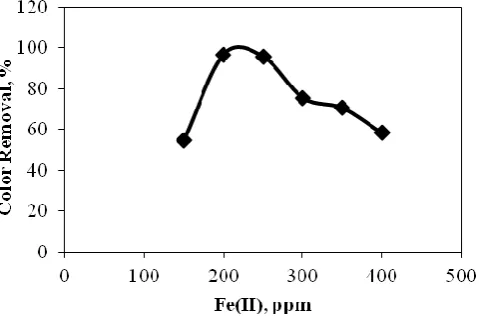
Fe (II) concentration was varied from 150 ppm to 400 ppm and the other conditions were fixed (initial pH value of 2, H2O2 concentration of 200 ppm, temperature of 30oC and reaction time of 120 min). It was
obvious that the Fe (II) concentration significantly affected the color removal. The decolorization efficiency decreased when the Fe (II) concentration increased further. This may be explained as follows: the increase in amount of iron facilitates decomposition of H2O2 and allows formation of more OH. radicals. But, high
concentration of iron reduces the oxidation potential of the formed OH. radicals and causes reduction of the decolorization efficiency [6].
Figure 1. Effects of concentration Fe(II) on color removal. 3.2. Effect of the pH
The pH also significantly affects the treatment efficiency of the Fenton process. Under the conditions of Fe (II) concentration of 200 ppm, H2O2 concentration of 200 ppm, temperature of 30oC and reaction time of
0 20 40 60 80 100 120 140
0 2 4 6
C
o
lo
r
R
em
o
v
al
,
%
pH
Figure 2. Effects of pH on color removal.
3.3. Effect of the H2O2 concentration
In the Fenton process, H2O2 is the most important parameter because it is the source of hydroxyl
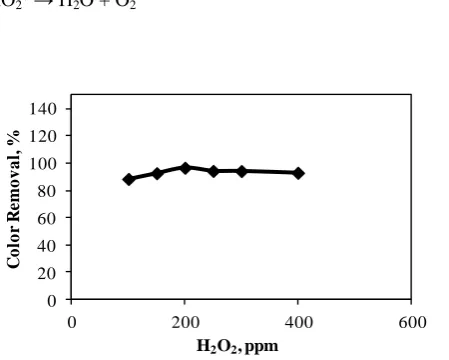
radicals (OH.) [8]. As shown in the following figure, color removal increased with increasing H2O2
concentration to 200 ppm by 100 ppm. Other values began to decline. For this reason, the optimal concentration of H2O2 was selected as 200 ppm. When working with high concentrations of hydrogen peroxide, hydrogen
peroxide reacts with hydroxyl radicals, causing the hydroxyl radicals in the environment to decrease. The resulting hydroperoxyl radicals react with the hydroxyl radical to form H2O and O2 [9]. For this reason, it is very
important to determine the optimum amount of hydrogen peroxide in experimental studies.
H2O2 + ·OH → H2O + HO2· (1)
·OH + HO2· → H2O + O2 (2)
0 20 40
60 80 100
120 140
0 200 400 600
C
o
lo
r
R
em
o
v
a
l,
%
H2O2, ppm
Figure 3. Effects of concentration H2O2 on color removal.
3.4. Effect of the temperature
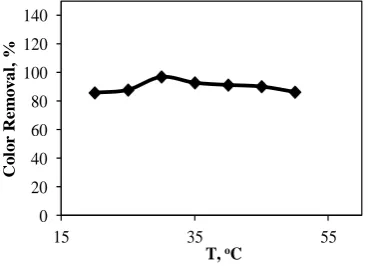
The effect of the temperature (20-50oC) on the color removal efficiency was investigated at an initial pH value of 2, Fe (II) concentration of 200 ppm, H2O2 concentration of 200 ppm and reaction time of 120 min.
0 20 40 60 80 100 120 140
15 35 55
C
o
lo
r
R
e
m
o
v
al
,
%
T, oC
Figure 4. Effects of temperature on color removal.
3.5. Effect of the reaction time
The effect of the reaction time on the color removal efficiency was investigated under the following conditions: pH value of 2, Fe (II) concentration of 200 ppm, H2O2 concentration of 200 ppm and temperature of
30oC. The great advantage of advanced oxidation processes is that they have effective removal efficiency at low reaction times. When Figure 5 is examined, it is concluded that high efficiency is obtained from the first minute for fenton processing and optimum reaction time is determined as 30 minutes.
0 20 40 60 80 100 120 140
0 100 200 300
C
o
lo
r
R
e
m
o
v
a
l,
%
Reaction time
Figure 5. Effects of reaction time on color removal.
3.6. Effect of the mixing speed
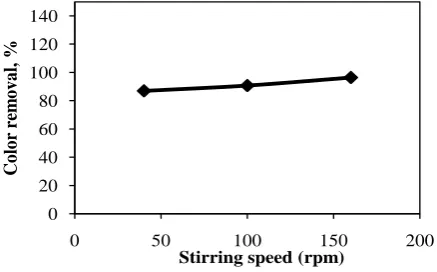
As you can see in the figure the removal of color increased with increasing mixing speed (initial pH value of 2, Fe (II) concentration of 200 ppm, H2O2 concentration of 200 ppm, temperature of 30oC and reaction
time of 30 min). For this reason, a mixing speed of 160 rpm was used in the experiments. In advanced oxidation processes, increasing the mixing speed increases the color removal efficiency. In addition, the high mixing speed provides homogeneous distribution of iron ions and hydrogen peroxide [11].
0 20 40 60 80 100 120 140
0 50 100 150 200
Co
lo
r
re
m
o
v
a
l,
%
Stirring speed (rpm)
Figure 6. Effects of stirring speed on color removal.
IV CONCLUSION
In this work, color removal of sunflower oil industrial wastewater was investigated in batch system by Fenton process and was effectively achieved. The Fenton oxidation process was evaluated by examining pH, H2O2 concentration, Fe(II) concentration, temperature, reaction time and stirring speed. The optimal operational
parameters were found to be a pH of 2.0, a 200 ppm H2O2 concentration, a 200 ppm Fe (II) concentration, and a
stirring speed of 160 rpm at a temperature of 30°C. Under these conditions, the color removal of oil industrial wastewater was found as 96.47% within 30 min. Overall, it can be concluded that it is feasible to treat contaminated wastewater by using Fenton oxidation process.
ACKNOWLEDGMENTS
This work was supported by the Scientific Research Projects Commission of Eskişehir Osmangazi University as project number 201615059.
REFERENCES
[1]. Kilic, Y. M.; Kestioglu, K. Investigation of Applicability of Advanced Oxidation Processes in Industrial Wastewater Treatment, Journal of Uludag University Engineering-Architecture Faculty, 2008, 13, 1, 67.
[2]. Spellman, F. R. Water and Wastewater Treatment Plant Operations, CRS Press, Taylor & Francis Group, 2014, 851 p.
[3]. Gogate, P. R.; Pandit, A. B. A Rewiev of Imperative Technologies for Wastewater Treatment I: Oxidation Technologies at Ambient Conditions, Advances in Environmental Research, 2004, 8, 501-551.
[4]. Değermenci, G. D.; Bayhan, Y. K.; Değermenci, N. Investigation of the Treatment of Industrial Wastewater Containing High Organic Matter by Fenton Process, Iğdır University, 2014, 4, 2, 17-22.
[5]. Gürtekin, E.; Sekerdag, N. A Advanced Oxidation Process: Fenton Process, Pamukkale University Journal of Engineering Sciences, 2008, 14, 3, 229-236.
[6]. Zhang, J.; Zhang, X.; Wang, Y. Degradation of phenol by a heterogeneous photo-Fenton process using Fe/Cu/Al catalysts, RSC Advances, 2016, 6, 13168-13176.
[7]. Parsons, S. Advanced Oxidation Processes for Water and Wastewater Treatment, IWA Publishing, London, 2004, 368 p.
[8]. Elmolla, E.; Chaudhuri, M. Degradation of the Antibiotics Amoxicillin, Ampicillin and Cloxacillin in Aqueous Solution by the Photo-Fenton Process, Journal of Hazardous Materials, 2009, 172, 1476-1481.
[9]. Xu, L.; Wang, J. Fenton-like degradation of 2,4-dichlorophenol using Fe3O4 magnetic nanoparticles, Applied Catalysis
B:Environmental, 2012, 123-124, 117-126.
[10]. Muthukumari, B.; Selvam, K.; Muthuvel, I.; Swaminathan, M. Photoassisted hetero-Fenton mineralisation of azo dyes by Fe(II)-Al2O3 catalyst, Chemical Engineering Journal, 2009, 153, 9-15.