- 324 - Abstract—Cake industry has developed rapidly in recent years all over the world. Many modifications have been made on cake ingredients in order to improve cake quality. This study reports a possibility of substitute the egg in cake making by using whey proteins (WP) and lupine proteins (LP). Five different levels of whey proteins (8, 12, 16, 20, and 24 g) were used to substitute 66.67% of the total egg and the resulted cake volumes were compared with the control, which showed that the cake volume was improved by increasing the level of whey proteins but not reach the volume of control cake . Only two levels (16 and 20 g) of WP were chosen to be used in combination with LP for total substitution of egg in cake. Also, four different levels of lupine proteins (5.5, 7.5, 9.5, and 11.5 g) were used to substitute 33.33% of the total egg and the resulted cake volumes were compared with the control which showed that the cake volume was improved by increasing the level of lupine proteins but not reach the volume of control cake . Only two levels (7.5 and 9.5 g) of LP were chosen to be used in combination with WP for total substitution of egg. The combination treatments (7.5g LP+ 16g WP), (7.5g LP+ 20g WP), (9.5g LP+ 16g WP), and (9.5g LP+ 20g WP) were used for total substitution of egg with and without soy lecithin (SL) which indicated the improvement of the resulted cake in presence of SL. Evaluation of resulted cake by measuring the volumes for the combination treatments revealed that there were significant differences between the control cake and the egg-substituted cake; however, the treatment (9.5g LP+ 16g WP+ 5g SL) had the highest volume among the others.
It was concluded that the total substitution of egg by using WP and LP resulted in a cake which was differed from the control. However, some changes in the formula and the mixing method must be taken in consideration to improve the quality of egg-substituted cake.
Key Words—Lupine proteins, whey proteins, egg-substituted cake, egg-free cake
I. INTRODUCTION
Cake is the most characteristic and unique bakery product made from soft wheat flour. It becomes a traditional centerpiece of festive and joyous celebrations [1]. Cake industry has developed rapidly in recent years all over the world. Many modifications have been made on cake ingredients in order to improve cake quality. Generally cake can be classified into two types: shortened cake and sponge or foam cake. However cake are prepared under different names, but most of them are following these two classes in their ingredient and the method of preparation. The ingredient in both types of cake mix is including all or some of the following: flour, egg white, or whole egg, milk, sugar, shortening and leavening agents, flavors, and others. In preparation of cake batters, the egg white or whole egg produces stable foam which contains a lot of air when beaten
with sugar. When mixed with flour, this foam forms a batter in which air serves as a leavening agent [2]. Thus, the role of egg is not only in forming a part of the network of the cake structure, but also the egg yolk adds flavor, color and acts as an emulsifier. In addition, egg improves the nutritive value of the cake [3]. On the other hand eggs are considered the most costly ingredients in some types of cakes. Increasing the amount of eggs in some types of cake as in yellow cakes, could result in increasing the amount of cholesterol [1]. Therefore the use of vegetable proteins for partial or total substitution of eggs in cake formulations appears to be an interesting objective, and especially so for the people with specific dietary needs or restrictions (vegans, vegetarians, high cholesterol people, etc.) [4]. Some of the functional properties of eggs in cakes are including, binding action, leavening action, tenderization action, flavor, color and food value. The almost unique foaming, emulsifying, and heat coagulation properties of egg proteins confer them a very important functional role in the definition of cake characteristics, mainly volume and texture [2]. This makes it extremely difficult to replace eggs successfully by different sources of proteins, even by the use of several types of additives such as hydrocolloids, in cakes [4]. This alternative should insure almost the same physical and organoleptic characteristics of egg.
Bovine plasma is a by-product of the animal slaughtering industry, which its native protein known to have properties similar to those of egg whites. Good results have been obtained by using bovine blood plasma to substitute egg whites at various levels. Some studied reported that the use of fresh, frozen, and spray-dried plasma to replace egg in cake resulted in cakes with similar volume, texture, and appearance [5].
Lupine seed (Lupinus albus ssp. Graecus) is a valuable, ancient leguminous plant which grows well in different soils and climates. It is used as food by people surrounding the Mediterranean Sea and by those living in the Andean highlands [6].
Lupines are interesting plant species in that the protein content of the seeds is high in comparison to soybean and other protein containing crops. Approximately 48% protein is found in lupine in comparison to 35_43% in soybean [7].It was found that thermal denaturation was the best treatment to be used to improve the foaming ability of white lupine protein, and xanthan gum was found to be the best additive in terms of improving this foam’s stability. The best conditions for the foaming process were a heat treatment of the protein solution at 73 C for 14 min before the whipping process. This solution had a protein concentration of 3% (w/v) and a
Studying The Possibility Of Preparing An
Egg-Free Or Egg-Less Cake
xanthan gum concentration of 0.07% (w/v) at neutral pH. The texture and microstructure of the cooked lupine protein foams found to be similar to those of the uncooked egg-white foams [8]. Studying the possibility of a total substitution of egg proteins in yellow cakes by vegetable proteins which was isolated from white lupine seeds indicated that although lupine proteins have good foaming and emulsifying properties, they did not possess the typical egg-heat coagulation capacity. The problem associated with the occurring of undesirable volume collapse of the lupine cakes was reduced by using: emulsifiers, 4–5% mono- and di-glycerides (MDG), and hydrocolloids, 0.5–0.6% of xanthan gum. Control cakes showed both large central height and maximum diameter, which did not occurred in lupine cakes. This lower volume, which is due to the thickening effect of xanthan gum, may be the reason why the lupine-cakes were harder than the controls [4].The cakes produced with lupine protein, are very rich (>10%) in the amino acid arginine, and can be useful for children or athletes, who need this supplement, as well as for vegetarians, vegans, and people with high cholesterol levels for other obvious reasons [4].
Whey is a by-product of cheese and casein manufacture. It contains approximately 15-20% of the original milk proteins. Whey represents rich mixture of secreted proteins which have wide chemical, physical and functional properties. These proteins also have a high nutritional value and a good balance of amino acids [9]. It has been used in many food industry areas like infant foods, ice cream, soft drinks, and many others [10]. A study showed that whey proteins could produce good foam [10]. This foam is almost similar to the uncooked egg white foam at different concentration. Another studied showed the possibility of replacing egg solids with whey protein concentrate, soy lecithin, and glycerol mono stearate. They concluded that an acceptable egg-less cake can be prepared by replacing egg with whey protein concentrate [11].
Therefore, the objective of this study will be on studying the possibility of preparing an egg-free or egg-less cake by using lupine protein, which is isolated from white lupine seeds, whey protein concentrate, and some other additives to the standard ingredient of cake with comparing some physical and chemical properties of the treated cake with the standard cake.
II. MATERIALS:
Straight-grade wheat flour was obtained from a local mill with extraction rate of 72% in 50-kg polypropylene-knit bags. Lupine protein and whey protein were obtained from NaProFood GmbH&Co.KG (Bruckberg-Germany). Ingredients such as: sugar, shortening, eggs, baking powder, milk and vanilla were obtained from local market.
III. METHODS:
Moisture, ash, protein, and dry gluten were determined according to Approved Methods [1]. Perten Glutamic Instrument (Brabender type. 2100/2200, Duisburg, Germany) was used for gluten washing.
Cake making process was carried out at Modern Flour Mills and Macaroni Factories Company (Amman-Jordan).The ingredients used in preparing the control cake were: flour 29.7%, sugar 25.7%, baking powder 1.1%, salt 0.2%, milk 1.3%, vanilla 0.1%, fat 18.0%, egg 16.5%, Water 6.9% and Mono- and di-glycerides 0.5%. Sugar and shortening were creamed together for five minutes at speed two. Eggs were added and creamed for another five minutes at speed two. The remaining ingredients and water were added alternately to the shortening-sugar-egg blend and mixed for one minute at speed one. The bowl was scraped with a rubber spatula, and batter mixed again for three minutes at speed three. For the treated cake the egg substitutions (whey protein or lupine protein) and the additional water were mixed together in separated bowl and added to cake batter in the stage of the adding egg. Approximate 400 g of batter was prepared for each formulation. The batter then poured into rounded stainless steel cake pan (20 cm diameter). The pans were filled only half-full with batter. The cake pans were immediately placed on the middle rack of the oven for 40 minutes. Baking was carried out at 170 C° in an electrically heated, natural convection oven. Each treated cake was immediately placed on top of a wire rack and allowed to cool in the pan for 10 minutes. After that cakes were removed from their pans and allowed to cool at room temperature for about 1 h before being individually wrapped in polyvinyl plastic bags. Analysis of cakes was performed after 24 h storage at room temperature for equilibration.
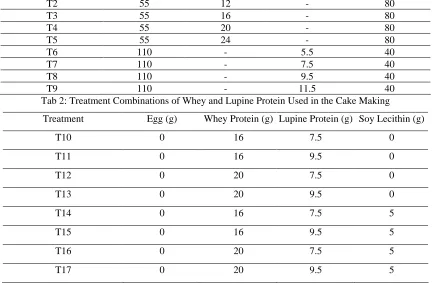
The experimental samples were prepared by first preparing the control cake as modified recipe shown in table 1. Then partial substitution of the egg used in cake were done by using nine treatment, five of them (T1 to T5) were referred to the using of whey proteins with different levels for 66.67% substitution of egg. While the other four treatments (T6 to T9) were referred to the using of lupine protein with different levels for 33.33% substitution of egg. Table 2 showed the different level of whey and lupine protein for partial substitution.
The study was designed to evaluate the resulted treated cake by comparing their volumes and physical characteristics with the control cake. Thus, to choose the best cake treatment from the partial egg substitution with both whey protein and lupine protein to make a combination treatments with complete egg substitution as shown in Table 1. The combination treatments represented eight treatments (T10 to T17), in which the first four treatments of cake soy lecithin was not used, while it was used in the last four treatments.
Tab 1: Treatment Combinations for Partial Egg Substitution
Treatment Egg (g) Whey Protein (g) Lupine Protein (g) Additional
water(g)
- 326 -
T1 55 8 - 80
T2 55 12 - 80
T3 55 16 - 80
T4 55 20 - 80
T5 55 24 - 80
T6 110 - 5.5 40
T7 110 - 7.5 40
T8 110 - 9.5 40
T9 110 - 11.5 40
Tab 2: Treatment Combinations of Whey and Lupine Protein Used in the Cake Making
Treatment Egg (g) Whey Protein (g) Lupine Protein (g) Soy Lecithin (g)
T10 0 16 7.5 0
T11 0 16 9.5 0
T12 0 20 7.5 0
T13 0 20 9.5 0
T14 0 16 7.5 5
T15 0 16 9.5 5
T16 0 20 7.5 5
T17 0 20 9.5 5
Cake volumes were measured by using the rape seed displacement method following AACC [1]. Moisture content of cake, total ash content,, protein content , were determined following the procedures described in above . Experiments were performed in duplicate and the data were analyzed using ANOVA procedures of the general linear model (GLM). Differences among means of different treatments were drawn using the Duncan multiple range test of the GLM procedures [12]. Values in the text and tables are expressed as Means ± S
IV. RESULTS AND DISCUSSION
Moisture content of the wheat flour, lupine proteins, and whey protein were on as is basis 13.00, 7.12, and 6.12 % respectively, as shown in Table 3. The ash content of the wheat flour sample, lupine protein sample, and whey protein sample were 0.48, 7.46, and 3.18 % respectively on as is basis. Whereas, the ash content as 14 % moisture basis (m.b.) for the wheat flour sample, lupine protein sample, and whey protein sample were 0.47, 6.90, and 2.91% respectively. The lower the extraction rate, the lower the ash content in flour, which means lower bran content [13]. Also the ash content is directly related to the flour color. The higher the ash content, the darker the flour color, which cause undesirable characteristics for cake color [14].
Crude protein content in wheat flour, lupine proteins, and whey proteins were 9.30, 82.00, and 70.00 % respectively on as is basis. Whereas, crude protein content in wheat flour, lupine proteins, and whey protein content on 14 % m.b. were 9.19, 75.92, and 64.12 respectively (Table 3). Cake flour must have low to medium flour protein content (7-10 % on 14 % moisture basis) which does not develop a significant degree of toughness during cake mixing and ensure the formulation of a fine foam structure in the cake [14]. Wet gluten content for wheat flour was 26.36 % on 14
% m.b., whereas, dry gluten content for wheat flour was 8.89 % on 14 % m.b. (Table 3). This result showed that this type of flour suitable for cake making.
A cake with 66.67 % of egg substitution was prepared by using levels of whey proteins as described in Table 1. The resulted cake volumes were shown in Table 4. The cake volume for the control treatment was 850.0 cc whereas the cake volume for the treatment T1 was 626.7 cc which observed that the cake volume was decreased when the egg was substituted. The decreasing in cake volume could be related to the role of the egg in air incorporating and retaining air during the mixing process, which finally affects the cake volume [14]. However, the cake volume was improved by increasing the level of whey proteins. As shown in Figure 1 the cake volumes were 626.7, 660.0, 710.0, 736.7, and 753.3 cc for whey proteins of levels 8, 12, 16, 20, and 24 g respectively. A study showed that whey proteins foam is almost similar to the egg white foam by the gas droplet size; however the numbers of the droplets are different. Also egg white proteins formed foams with higher quantity at lower protein concentrations and less whipping time than whey proteins foam [15]. This finding could explain the resulted higher volumes of control cake in comparison to whey proteins egg substituted cake.
protein levels 5.5, 7.5, 9.5, and 11.5 g respectively. This could be due to the ability of lupine proteins to produce foam which is similar to the egg white foam [4].
Table 6 presents cake volume at different combination treatments. The cake volumes were decreased significantly when the egg was totally substituted. The cake volumes for T10, T11, T12, T13, T14, T15, T16, and T17 were 563.3, 620, 660, 603.3, 553.3, 628.3, 700, and 637.7 cc respectively. The decrease in cake volumes is due to the absence of the egg which has the greater importance in determining the product’s final volume. Egg proteins readily whip into foam of extremely fine air cells. When egg foam is subjected to heat, the air trapped within the bubbles will expand, thereby increasing the volume of the foam. As a result of the coagulation of the egg white, the egg foam will become rigid and will thus maintain its increased volume [14]. Whereas in the case of 100 % substitution of egg, the cake batter was probably not sufficiently viscous to minimize the coalescence of gas bubbles, which causes loss of leavening gases found during baking as large bubbles rise to the surface and escape [3]. Although lupine and whey proteins have good foaming and emulsifying properties, they did not possess the typical egg-heat coagulation capacity. Actually, this might be the reason of the decreasing in cake volume in the treated cake [15, 16 and 4]. The addition of soy lecithin improved the cake volume as it shown in Table 6, due to the role of soy lecithin, as an emulsifier, to promote the formulation and stabilization of foam emulsion [13].
Treatment T16 had the highest cake volume among the combination treatment. So, the panelist chose T16 to be intensively physically and chemically tested and compared with the control by consumer evaluation.
It was concluded that partial substitution of egg with either WP or LP resulted in lower cake volume and the total substitution of egg with a combination of 16g WP & 9.5g LP combined with 5g SL resulted in reasonable cake volume.
Table 6 presents cake volume at different combination treatments. The cake volumes were decreased significantly when the egg was totally substituted. The cake volumes for
T10, T11, T12, T13, T14, T15, T16, and T17 were 563.3, 620, 660, 603.3, 553.3, 628.3, 700, and 637.7 cc respectively. The decrease in cake volumes is due to the absence of the egg which has the greater importance in determining the product’s final volume. Egg proteins readily whip into foam of extremely fine air cells. When egg foam is subjected to heat, the air trapped within the bubbles will expand, thereby increasing the volume of the foam. As a result of the coagulation of the egg white, the egg foam will become rigid and will thus maintain its increased volume [14]. Whereas in the case of 100 % substitution of egg, the cake batter was probably not sufficiently viscous to minimize the coalescence of gas bubbles, which causes loss of leavening gases found during baking as large bubbles rise to the surface and escape [3]. Although lupine and whey proteins have good foaming and emulsifying properties, they did not possess the typical egg-heat coagulation capacity. Actually, this might be the reason of the decreasing in cake volume in the treated cake [15, 16 and 4]. The addition of soy lecithin improved the cake volume as it shown in Table 6, due to the role of soy lecithin, as an emulsifier, to promote the formulation and stabilization of foam emulsion [13].
Treatment T16 had the highest cake volume among the combination treatment. So, the panelist chose T16 to be intensively physically and chemically tested and compared with the control by consumer evaluation.
It was concluded that partial substitution of egg with either WP or LP resulted in lower cake volume and the total substitution of egg with a combination of 16g WP & 9.5g LP combined with 5g SL resulted in reasonable cake volume.
Tab 3. Chemical Properties of Wheat Flour, Lupine Proteins, and Whey proteins Used in Cake Preparation
Ash% Protein%
Ingredient Moisture % As is basis 14 % m.b. As is basis 14 % m.b.
Wet
gluten
%
14%
m.b.
Dry
gluten
%
14%
m.b.
Wheat flour 13.00±0.03 0.48±0.02 0.47±0.02 9.30±0.03 9.19±0.04 26.36 8.89
Lupine
Proteins 7.12±0.04 7.46±0.05 6.90±0.04 82.00±0.03 75.92±0.03 ____ _____
Whey
Proteins 6.12±0.03 3.18±0.04 2.91±0.04 70.00±0.06 64.12±0.05 ____ ____
328
Tab 4. Cake Volumes Resulted from Whey proteins Egg Substitution
Treatment * Mean
C 165 g E 850.0 ± 25.17 a
Trt1
55 g E + 8 g WP 626.7 ± 12.02
d
Trt2 55 g E + 12 g WP 660.0 ± 11.55 cd
Trt3
55 g E + 16 g WP 710.0 ± 20.82
cb
Trt4 55 g E + 20 g WP 736.7 ± 17.64 b
Trt5
55 g E + 24 g WP 753.3 ± 14.53
b
a,b,c,d
Means within column with different superscripts differ (P<0.05). * C= control cake, E= egg, WP= whey proteins.
CON
T1 T2
T3 T4 T5
600 700 800 900
CON T1 T2 T3 T4 T5 Treatment
V
o
lu
m
e
(
c
c)
Fig 1. Cake Volume in Relation to the Different Levels of Whey Proteins Egg substitutions
Tab 5. Cake Volumes Resulted from Lupine proteins Egg Substitution
Treatment* Mean
C 165 g E 850.0 ± 25.17 a
Trt6 110 g E + 5.5 g LP 690.0 ± 15.28 c
Trt7 110 g E + 7.5 g LP 733.3 ± 12.02 bc
Trt8 110 g E + 9.5 g LP 746.7 ± 18.56 bc
Trt9 110 g E + 11.5 g LP 766.7 ± 18.56 b
a,b,c
Means within column with different superscripts differ (P<0.05). * C= control, E= egg, LP= lupine proteins
CON
T6
T9 T8 T7
600 700 800 900
CON T6 T7 T8 T9 Tr e a t me nt
Fig 2. Cake Volume in Relation to the Different Levels of Lupine Proteins Egg Substitution
Tab 6. Volume of Cake of Different Combination Treatments.
Treatment * Mean
C 165 g E 850.0 ± 25.17 a
Trt10
0 g E +7.5 g LP + 16 g WP 563.3 ± 12.02
ef
Trt11 0 g E +7.5 g LP + 20 g WP 620.0 ± 23.10 cd
Trt12 0 g E +9.5 g LP + 16 g WP 660.0 ± 11.55 bc
Trt13 0 g E +9.5 g LP + 20 g WP 603.3 ± 8.82 de
Trt14
0 g E +7.5 g LP + 16 g WP +5 g SL 553.3 ± 14.53
f
Trt16
0 g E +9.5 g LP + 16 g WP +5 g SL 700.0 ± 5.77
b
Trt17 0 g E +9.5 g LP + 20 g WP +5 g SL 637.7 ± 7.88 cd
a,b,c,d,e,f
Means within column with different superscripts differ (P<0.05).
* C= control, E= egg, LP= lupine proteins, WP= whey proteins, SL= soy lecithin
V. SUMMARIES
Partial substitution of egg with either WP or LP resulted in lower cake volume;however,total substitution of egg with a combination of 16g WP and 9.5g LP combined with 5g SL resulted in reasonable cake volume .
REFERENCES
[1] American Association of Cereal Chemists, Method 10-05, 44-15A,
08-03, 46-13, and 56-81B. Approved Methods of the AACC, 8th ed. The Association, St. Paul, MN. 2000
[2] JH Freeland-Graves; GC Peckham. Foundations of Food Preparation.
6th ed. New Jersey: Prentice-Hall, Inc, 1996
[3] MP Penfield; AM Campbell. Experimental Food Science. 3rd ed. San
Diego:Academic Press, 1990.
[4] A Raymundo; J Empis; I Sousa. White lupine protein isolate as a
foaming agent. Z Lebensm Unters Forsch A 1998, 207: pp91–96.
[5] W Stadelman; O Cotterill. Egg Science and Technology, 4th ed. Food
Product Press: New York, 1995, pp105-135.
[6] O Privett; L Bland; J Schmidt. Studies on the composition of egg lipid.
Food Sci. 1962, 27: pp463-470
[7] R Leutzinger; E Baldwin; J Cotterill. Sensory attributes of commercial
egg substitutes. Food Sceince.1977, 42: pp1124-1129.
[8] WT Yamazaki; LT Kissell. Cake flour and baking research. Cereal
Foods World. 1978, 23(3): 114-119.
[9] L Johnson; C Havel; R Hoseney. Bovine plasma as a replacement for
egg in cake. Cereal Chem. 1979, 56: pp339-342.
[10] S Singh; GS Chauhan, Raghuvanshi; P Sharma; OP Chauhan, A Bajpai.
Replacement of egg solids with whey protein concentrate and optimization of its levels in cake making. Food Sci. Technol. 2003, 40(4): pp386-388.
[11] CC Lee; JA Love; LA Johnson. Sensory and physical properties of cake with bovine plasma products substituted for egg. Cereal Chem.1993, 70(1):pp 18-21.
[12] SAS. User’s Guide. Release 8.02 Edition, SAS Institute Inc. Cary, NC.
2004.
[13] K Kulp; J Ponte. Handbook of Cereal Science and Technology. 2nd ed.
New York: Marcel Dekker Inc. 2000.
[14] EJ Pyler. Baking Science and Technology. Vol 2. Siebel Public Co. Chicago. 1973.
[15] CW Pernell; EA Foegeding, PJ Luck, JP Davis. Properties of whey and
egg white protein foam, colloids and surfactants. Physicochem. Eng.
Aspects 2002, 204:pp 9–21.
[16] I Arozarena; H Bertholo; J Empis, A Bunger, I Sousa. Study of total