e-ISSN: 2278-7461, p-ISSN: 2319-6491
Volume 7, Issue 2 Ver. II [February 2018] PP: 01-06
Recent Progress on the Applications of Up conversion
Luminescent Materials In Bioimaging
Huang Dan
1, Zhang Haiming
21
Department of science, Tianjin Polythchnic University, CHN,
2Department of science, Tianjin Polythchnic University, CHN
Corresponding Author: Zhang Haiming
Abstract: Upconversion luminescence (UCL) is a kind of anti-Stokes light that converts long wavelength excitation into short wavelength emission. Because the longer wavelength of light (usually near infrared light) has a large penetration depth, which will help reduce the background noise during imaging, the application of upconversion luminescent materials is of great significance to enhance the quality of biofluorescence imaging. In this paper, we summarize the recent advances in the application of rare earth ion doping and triplet-triplet annihilation, which are used in biofluorescence imaging. Combining both the excitation and the emission bands, principle, the use of different materials, different modification of a variety of upconversion materials on the application of biological imaging in the improvement process, and then put forward the future of the application of conversion materials used in biological imaging in urgent need to solve the problem.
Keywords: Upconversion luminescence,Bioluminescence imaging,Rare-earth doped,Triplet - triplet annihilation
--- ---Date of Submission 14-02-2018 ---Date of acceptance: 03-03-2018 --- ---
I.
INTRODUCTIONBioimaging is a discipline reflecting the living conditions of the body's metabolism and biological factors such as enzymes, receptors, genes and other physiological information with the help of the existing imaging means[1]. The development of bioimaging technology enables people to obtain real-time, quantitative, in situ and high-sensitivity biological information of living body, which lays the foundation for the development of life science research. According to the different types of imaging probes, typical biological imaging technologies include X-ray, B-scan ultrasonography, Computed Tomography (CT), Positron Emission Computed Tomography (PECT), Magnetic Resonance Imaging (MRI), Single Photon Emission Computed Tomography (SPECT). These technologies are mature at this stage, but their clinical application is limited due to their common shortcomings such as large radiation, severe photobleaching, high cost and complicated operation[2-6].
Bio-optical imaging refers to the technique that the cells or tissues and even organisms of one’s body are imaged to get the biological information using the combination of optical detection means with optical detection molecules. In recent years, techniques for biological imaging using organic or inorganic fluorescent substances as imaging probes have enabled non-invasive detection and real-time visualization of living organisms from molecular to tissue scales. Fluorescent semiconductor quantum dots (eg, CdSe/ZnS) have good optical and chemical properties such as a larger extinction coefficient, higher quantum efficiency, and narrower emission bandwidth, and because their emission bands may depend on their size, the nature of tunable emission will be achieved. Magnetic nanoparticles have been used as probes for T2 MRI, which can significantly improve the detection sensitivity of MRI[7-10]. However, in clinical applications, whether quantum dots or magnetic nanomaterials, their application range is limited by some defects of their own. The potential toxicity of a quantum dot itself can cause serious damage to the organism under certain conditions, which greatly limits its range of application. Almost all of the organic fluorescent materials and quantum dots require ultraviolet (UV) and visible light excitation, while biological samples are easily excited by UV and visible light to produce background fluorescence, which leads to a serious reduction in tissue penetration. On the other hand, the biological samples will be damaged and mutated when long exposed to UV[11-15].
laid the most crucial foundation for their application in bioimaging. In addition, UC nanoparticles also have many other advantages ,such as narrow emission bandwidth, long lifetime, tunable emissions, high light stability[21-23]. These characteristics make UC nanomaterials a hot spot in the field of bioimaging research.
According to the latest research results, some rare earth doped upconversion nanoparticles show down conversion under certain conditions, which opens up new fields for the imaging of the second biological window (NIR-II). Therefore, although some reviews have been made in the field of bioimaging for researchers, this article focuses on the recent advances in upconversion luminescent materials in the field of bioimaging, and summarizes the upconversion luminescent materials based on several different mechanisms and describes them with specific examples. In the meantime, we discussed the application of near-infrared imaging in two regions and forecasted the application prospects of these materials in order to provide reference for researchers.
II.
BIOIMAGING APPLICATIONS OF RARE EARTH DOPED UPCONVERSION NANOPARTICLES (UCNPS)Due to its long fluorescence lifetime and high emission efficiency, rare earth doped upconversion luminescent materials are expected to be the next generation of fluorescent probes. Because of these two features, fluorescence imaging of rare earth-doped upconverting luminescent materials for living organisms can be excited with lower excitation power, thus promoting the rapid imaging technology without sample scanning. Combining this imaging technique with the confocal microscopy of UCNPs allows for rapid three-dimensional imaging of vivo cells in animals. Combining this technology with image reconstruction techniques can eliminate ambiguous backgrounds and enables high-quality, high-contrast real-time three-dimensional stereoscopic imaging since the NIR excitation light excitation can minimize background autofluorescence (Fig.1). Furthermore, the near-infrared excitation characteristics of UCNPs determine the deep imaging depth and are very suitable for in vivo tissue optical imaging[24].
Fig.1 (a) Schematic of wide-field epi-fluorescence microscopy with z-sectioning; The out-of-focus luminescence induces blurs in the raw images; (b) Raw epi-fluorescence image (left) and its 3D reconstructed image (middle). UCNPs (green) were internalized in HeLa cells, whose nuclei were stained with red. Right is a 3D trajectory of a single UCNP in a HeLa cell.
From the viewpoint of the emission band, owing to the upconversion properties, the emission peak of UCNPs excited by the NIR light can fall in the visible band and the NIR band. Today, UCNPs with emission peaks in the visible band (eg Er3+/Yb3+ or Ho3+/Yb3+ doping) have been successfully applied to the imaging of a variety of animals. However, the imaging contrast of the UCNPs whose emission peak is located in the NIR band has more room for improvement. Zheng et al. use a time-gated imaging technique, which uses pulse excitation and acquisition of time-delayed signals to remove short-lived background noise, to further enhance the image contrast (Fig.2(a)). Although UCNPs with emission bands in the NIR band exhibit autofluorescence with high-contrast imaging capabilities, time-gated imaging can provide higher image quality without being disturbed by scattered light (Fig.2(b)(c)). Time-gated imaging technique improves detection sensitivity by at least an order of magnitude over traditional systems that use optical filters, and fortunately, pulsed excitation shows almost negligible thermal effects compared to continuous 980 nm excitation (Fig.2(d))[25].
thermal effect caused by laser by regulating the excitation wavelength of UCNPs. Recently, Xie, X., et al.[28] Introduced Nd3+ into Yb3+ doped UCNPs to tune the wavelength of the excitation light from the usual 980nm to 800nm. Since the absorption cross section of Nd3+ ions at the wavelength of 800 nm is one order of magnitude higher than the absorption cross section of Yb3+ at 980 nm, the overall upconversion efficiency is generally the same as that of conventional Yb3+ doping in spite of the extra energy transfer from Nd3+ to Yb3+. At 800nm, the energy absorption of water molecules is much lower than that at 980 nm, so in the field of in vivo imaging, the use of this UCNPs can minimize the damage to cells and tissues.
Fig.2 (a) Diagram of time-gated imaging mode; (b) Left is the luminescence image of a mouse with subcutaneous injection of UCNPs; Right is the time-gated luminescence image of the same mouse; (c) Left is a bright-field image of a mouse with subcutaneous injection of UCNPs; Middle is the time-gated luminescence image; Right is the time-gated luminescence image with thebright-field LED illumination; (d) Comparison of the heating effect between continuous wave mode and time-gated luminescence mode.
The optical properties of UCNPs depend on the energy levels of the lanthanide ions and therefore their excitation width is very narrow. In order to further broaden the excitation wavelength range of UCNPs to achieve broadband absorption, Zou et al. used organic NIR dyes as an antenna for collecting near-infrared photons. Its research shows that UCNPs coated with NIR dyes can be excited in the range of 740-850 nm to produce upconversion luminescence. This broadband absorption feature makes it possible to flexibly select the excitation source (ie not limited to excitation sources at 980 or 800 nm). The use of NIR dyes as an antenna can also increase photon absorption and increase the emission efficiency (about 3300 times). In addition to near infrared dyes, other antenna materials with high photon absorption, such as NIR quantum dots and plasmonic nanostructures, can also be used to overcome the low photon absorption of lanthanides in UCNPs[26,27].
III.
BIOIMAGING APPLICATION OF UPCONVERSION LUMINESCENT MATERIALS IN TRIPLET-TRIPLET ANNIHILATION (TTA)Since Parker and Hatchard proposed the concept of TTA upconversion in 1962, the main research direction is how to rationally select the triplet donor and acceptor levels to increase the anti-Stokes shift and how to improve the conversion efficiency. Compared with the triplet acceptor, the development of triplet photosensitizer has attracted more researchers' attention. The current triplet photosensitizers are mainly divided into two categories: metal complex triplet photosensitizer and organic triplet photosensitizer. Metal complex triplet photosensitizer, such as polybipyridine ruthenium(Ru(II)) complex, Pt(II)/Pd(II)porphyrin/ phthalocyanine complexes, Pt(II) acetylene complexes and cyclic metal Pt(II)/Ir(III) complex,is widely used because the inter-system channeling efficiency of metal complex triplet photosensitizer’s molecules is nearly 100% as the involvement of metals, which makes it easier to reach the triplet state. Organic triplet photosensitizer possesses unparalleled potential advantages of metal complex triplet photosensitizer, such as more economical and environmental friendly, strong visible light absorption, easy adjustment of singlet triplet energy level, etc. However, due to the low ISC efficiency of organic compound molecules, its molecular design is more challenging[29,30].
absorption and emission wavelengths by judiciously selecting triplet photosensitizers and receptors. The research team of Fuyuo Li, Fudan University, wrapped the triplet photosensitizer PdOEP (1-9) with the acceptor DPA in silica nanoparticles and converted the 532nm light to 400nm light in aqueous solution, resulting in an upconversion quantum efficiency of 4.5%. These UCNPs have the characteristics of low cytotoxicity and good light stability, and can be used in cell imaging to effectively eliminate background fluorescence such as autofluorescence of biological samples to obtain high signal-to-noise ratio.
In view of the above, TTA-based upconverting materials are more suitable for bioimaging applications than rare earth-doped upconverting materials. However, due to the environmental sensitivity of TTA-based self-assembled nanoparticles, the stability of the TTA upconverting material has not been well solved so far. Therefore, the stability of the material is a key issue in the practical use of TTA materials for biological imaging.
IV.
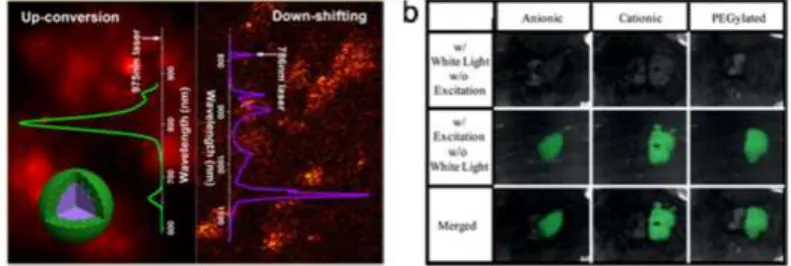
RECENT DEVELOPMENT OF NEAR INFRARED IMAGING IN SECOND WINDOW Carroll et al.[31] proposed a bold assumption in 2003 by measuring the penetrating power and scattering absolute value of quantum dot fluorescence in biological tissue and blood that the imaging performance of the organism's fluorescence imaging wavelength in the region around 1320 nm is better than at 840 nm. In recent years, more and more researchers rely on this assumption to commit themselves to the field of NIR-II imaging. As mentioned above, some rare earth doped upconverting nanoparticles show down conversion characteristic under certain conditions, which are the basis of NIR-II imaging. In the meantime, more NIR-II materials currently studied include rare earth doped materials, so a brief review of NIR-II imaging is hereby made.In 2006, Lezhnina et al.[32] developed a series of rare earth fluoride nanoparticles in which the ((Nd0.05La0.95)F3)@(LaF3) core-shell dopant has high resolution fluorescence signal in the first and second windows of near infrared light under the 450W xenon lamp irradiation.It has strong fluorescences at 793nm, 1046nm and 1063nm, respectively. In 2008, Pisarska et al.[33] reported the energy level transition of neodymium-chromium co-doped (Cr3+-Nd3+ co-doped) in lead borate glass. The data show that this co-dopant is excited by 632 nm and shows good near-infrared two-zone optical properties at 1060 nm. In 2016, Yu et al.[34] reported that Ho3+-Yb3+ co-doped KLu2F7 has clear fluorescence at 1190 nm with extremely high quantum yield. β-NaGdF4/Nd3+@NaGdF4/Tm3+-Yb3+ has a unique infrared fluorescence activity. The crystal structure has obvious fluorescence at 800nm, showing the upconversion luminescence under a wavelength of 975nm irradiation while it has a clear fluorescence at a wavelength of 1060 nm, showing the down-conversion luminescenceunder a wavelength of 786 nm irradiation. The rare-earth doped Y2O3: Er3+ dopant contained in PEG-modified liposomes shows obvious fluorescence at the wavelength of 1550nm under the excitation of 980nm excitation light. The size of this liposome is only 650nm so that it can be injected into the mouse through the tail vein. The clear light of liver NIR-Ⅱ imaging can be obtained under the excitation light irradiation[35-38].
Fig. 3(a)Dual-Modal fluorescence emission of β-NaGdF4/Nd3+@NaGdF4/Tm3+−Yb3+;(b)NIR-Ⅱ image of the liver of a mouse.
V.
CONCLUSIONensuring the biocompatibility of materials is a hot issue and a direction of further research. For the TTA material, the focus of the current research is still on the synthesis method. The TTA material synthesized by the current synthesis method is too large in size and has poor stability. Therefore, the application of TTA material in biofluorescence imaging will have a bright future if the synthesis problem could be solved. As for the NIR-II biological imaging, it is absolutely the hot issue in today's research. Of course, it is beyond the scope of this paper, but NIR-II imaging is increasingly being used in medical and biological research. With the continuous development of new technologies and the continuous emergence of new equipment, the research scope of NIR-II imaging will continue to expand, which will provide a brand new method for the diagnosis and treatment of human diseases.
REFERENCES
[1]. Alexey N.B., Elina A.G., Vyacheslav I, et al. Optical properties of human maxillary sinus mucosa andestimation of Methylene Blue diffusion coefficient in the tissue[C]. Proceedings of SPIE, 2005, 5771 (5): 316-327
[2]. Giepmans, B. N. G., Adams, S. R., Ellisman, M. H., and Tsien, R.Y. (2006) The fluorescent toolbox for assessing protein location and function. Science 312, 217−224.
[3]. Kobayashi, H., Ogawa, M., Alford, R., Choyke, P. L., and Urano, Y. (2010) New strategies for fluorescent probe design in medical diagnostic imaging. Chem. Rev. 110, 2620−2640.
[4]. Caravan, P. (2006) Strategies for increasing the sensitivity of gadolinium based MRI contrast agents. Chem. Soc. Rev. 35, 512−523. [5]. Shields, A. F., Grierson, J. R., Dohmen, B. M., Machulla, H.-J., Stayanoff, J. C., Lawhorn-Crews, J. M., Obradovich, J. E., Muzik, O., and Mangner, T. J. (1998) Imaging proliferation in vivo with [F-18]FLT and positron emission tomography. Nat. Med. 4, 1334−1336.
[6]. Nikolaus, S., Larisch, R., Wirrwar, A., Jamdjeu-Noune, M., Antke, C., Beu, M., Schramm, N., and Muller, H.-W. (2005) [123I]-Iodobenzamide binding to the rat dopamine D2 receptor in competition with haloperidol and endogenous dopamine-an in vivo imaging study with a dedicated small animal SPECT. Eur. J. Nucl. Med. Mol. Imaging 32, 1305−1310.
[7]. Harisinghani, M. G., Barentsz, J., Hahn, P. F., Deserno, W. M.,Tabatabaei, S., van de Kaa, C. H., de la Rosette, J., and Weissleder, R.(2003) Noninvasive detection of clinically occult lymph-node metastases in prostate cancer. N. Engl. J. Med. 348, 2491−2499. [8]. Lee, J.-H., Huh, Y.-M., Jun, Y.-w., Seo, J.-w., Jang, J.-t., Song, H.-T., Kim, S., Cho, E.-J., Yoon, H.-G., Suh, J.-S., et al. (2007)
Artificially engineered magnetic nanoparticles for ultra-sensitive molecular imaging. Nat. Med. 13, 95−99.
[9]. Lee, N., Kim, H., Choi, S. H., Park, M., Kim, D., Kim, H.-C., Choi, Y., Lin, S., Kim, B. H., Jung, H. S., et al. (2011) Magnetosomelike ferrimagnetic iron oxide nanocubes for highly sensitive MRI of single cells and transplanted pancreatic islets. Proc. Natl. Acad. Sci. U. S.A. 108, 2662−2667.
[10]. Lee, N., Yoo, D., Ling, D., Cho, M. H., Hyeon, T., and Cheon, J. (2015) Iron oxide based nanoparticles for multimodal imaging andmagnetoresponsive therapy. Chem. Rev. 115, 10637−10689.
[11]. Weissleder, R. (2001) A clearer vision for in vivo imaging. Nat. Biotechnol. 19, 316−317.
[12]. He, X., Wang, K., and Cheng, Z. (2010) In vivo near-infrared fluorescence imaging of cancer with nanoparticle-based probes. WIREs Nanomed. Nanobiotechnol. 2, 349−366.
[13]. Wang, R., and Zhang, F. (2014) NIR luminescent nanomaterials for biomedical imaging. J. Mater. Chem. B 2, 2422−2443. [14]. Wolfbeis, O. S. (2015) An overview of nanoparticles commonly used in fluorescent bioimaging. Chem. Soc. Rev. 44, 4743−4768. [15]. Liu, T.-M., Conde, J., Lipiński, T., Bednarkiewicz, A., and Huang, C.-C. (2016) Revisiting the classification of
NIR-absorbing/emitting nanomaterials for in vivo bioapplications. NPG Asia Mater. 8, e295.
[16]. Gamelin, D. R., and Güdel , H. U. (2000) Design of luminescent inorganic materials: New photophysical processes studied by optical spectroscopy. Acc. Chem. Res. 33, 235−242.
[17]. Larson, D. R., Zipfel, W. R., Williams, R. M., Clark, S. W., Bruchez, M. P., Wise, F. W., and Webb, W. W. (2003) Water-soluble quantum dots for multiphoton fluorescence imaging in vivo. Science 300, 1434−1436.
[18]. Deng, Z. T., Tong, L., Flores, M., Lin, S., Cheng, J. X., Yan, H., and Liu, Y. (2011) High-Quality Manganese-Doped Zinc Sulfide Quantum Rods with Tunable Dual-Color and Multiphoton Emissions. J. Am. Chem. Soc. 133, 5389−5396.
[19]. Zhao, B., Yao, Y., Yang, K., Rong, P., Huang, P., Sun, K., An, X., Li, Z., Chen, X., and Li, W. (2014) Mercaptopropionic acid-capped Mn2+:ZnSe/ZnO quantum dots with both downconversion and Bioconjugate Chemistry Review DOI: 10.1021/acs.bioconjchem.6b00654 Bioconjugate Chem. 2017, 28, 115−123 121upconversion emissions for bioimaging applications. Nanoscale 6, 12345−12349.
[20]. Yu, J. H., Kwon, S.-H., Petraś ek , Z., Park, O. K., Jun, S. W., Shin, ̌ K., Choi, M., Park, Y. I., Park, K., Na, H. B., et al. (2013) Highresolution three-photon biomedical imaging using doped ZnS nanocrystals. Nat. Mater. 12, 359−366.
[21]. Subha, R., Nalla, V., Yu, J. H., Jun, S. W., Shin, K., Hyeon, T., Vijayan, C., and Ji, W. (2013) Efficient photoluminescence of Mn2+-doped ZnS quantum dots excited by two-photon absorption in nearinfrared window II. J. Phys. Chem. C 117, 20905−20911. [22]. Auzel, F. (2004) Upconversion and anti-stokes processes with f and d ions in solids. Chem. Rev. 104, 139−173.
[23]. Wang, F., Deng, R., Wang, J., Wang, Q., Han, Y., Zhu, H., Chen, X., and Liu, X. (2011) Tuning upconversion through energy migration in core-shell nanoparticles. Nat. Mater. 10, 968−973.
[24]. Zou, W., Visser, C., Maduro, J. A., Pshenichnikov, M. S., and Hummelen, J. C. (2012) Broadband dye-sensitized upconversion of near-infrared light. Nat. Photonics 6, 560−564.
[25]. Chen, G., Damasco, J., Qiu, H., Shao, W., Ohulchanskyy, T. Y., Valiev, R. R., Wu, X., Han, G., Wang, Y., Yang, C., et al. (2015) Energy-cascaded upconversion in an organic dye-sensitized core/shell fluoride nanocrystal. Nano Lett. 15, 7400−7407.
[26]. Lee, J., Yoo, B., Lee, H., Cha, G. D., Lee, H.-S., Cho, Y., Kim, S. Y., Seo, H., Lee, W., Son, D., et al. (2016) Ultra-wideband multi-dyesensitized upconverting nanoparticles for information security application. Adv. Mater., DOI: 10.1002/adma.201603169. [27]. Wu, X., Zhang, Y., Takle, K., Bilsel, O., Li, Z., Lee, H., Zhang, Z., Li, D., Fan, W., Duan, C., et al. (2016) Dye-sensitized
core/active shell upconversion nanoparticles for optogenetics and bioimaging applications. ACS Nano 10, 1060−1066.
[28]. Schietinger, S., Aichele, T., Wang, H.-Q., Nann, T., and Benson, O. (2010) Plasmon-enhanced upconversion in single NaYF4:Yb3+/Er3+ codoped nanocrystals. Nano Lett. 10, 134−138.
[29]. Wu, M., Congreve, D. N., Wilson, M. W. B., Jean, J., Geva, N., Welborn, M., Van Voorhis, T., Bulovic, V., Bawendi, M. G., and Baldo, M. A. (2016) Solid-state infrared-to-visible upconversion sensitized by colloidal nanocrystals. Nat. Photonics 10, 31−34. [30]. Vetrone, F., Naccache, R., Zamarron, A., de la Fuente, A. J., Sanz-Rodriguez, F., Maestro, L. M., Rodriguez, E. M., Jaque, D., Sole,
[31]. Hao, J., Zhang, Y., and Wei, X. (2011) Electric-induced enhancement and modulation of upconversion photoluminescence in epitaxial BaTiO3:Yb/Er thin films. Angew. Chem., Int. Ed. 50, 6876−6880.
[32]. Tikhomirov, V. K., Chibotaru, L. F., Saurel, D., Gredin, P., Mortier, M., and Moshchalkov, V. V. (2009) Er3+-doped nanoparticles for optical detection of magnetic field. Nano Lett. 9, 721−724.
[33]. Hong, G., Diao, S., Chang, J., Antaris, A. L., Chen, C., Zhang, B.,Zhao, S., Atochin, D. N., Huang, P. L., Andreasson, K. I., et al. (2014) Through-skull fluorescence imaging of the brain in a new near-infrared window. Nat. Photonics 8, 723−730.
[34]. Hong, G., Lee, J. C., Robinson, J. T., Raaz, U., Xie, L., Huang, N. F., Cooke, J. P., and Dai, H. (2012) Multifunctional in vivo vascular imaging using near-infrared II fluorescence. Nat. Med. 18, 1841−1846.
[35]. Du, Y., Xu, B., Fu, T., Cai, M., Li, F., Zhang, Y., and Wang, Q. (2010) Near-infrared photoluminescent Ag2S quantum dots from a single source precursor. J. Am. Chem. Soc. 132, 1470−1471.
[36]. Zhang, Y., Hong, G., Zhang, Y., Chen, G., Li, F., Dai, H., and Wang, Q. (2012) Ag2S quantum dot: A bright and biocompatible fluorescent nanoprobe in the second near-infrared window. ACS Nano 6, 3695−3702.
[37]. Zhu, C.-N., Jiang, P., Zhang, Z.-L., Zhu, D.-L., Tian, Z.-Q., and Pang, D.-W. (2013) Ag2Se quantum dots with tunable emission in thesecond near-infrared window. ACS Appl. Mater. Interfaces 5, 1186−1189.