THE EFFECT OF ICE APPLICATION TO ANTERIOR THIGH ON MAXIMAL FUNCTIONAL
*
Ashok N
Clinical Physiotherapist SRM College of Physiotherapy
A R T I C L E I N F O
INTRODUCTION
Cryotherapy is the local or general use of low temperatures in medical therapy.The term comes from Greek, with
and the word therapeia meaning cure. Cryotherapy was first used in the late 19th century. The form of surgery using extreme cold temperatures is called cryosurgery, while other therapies using cryotherapy are cryosaunas (cold saunas) and ice pack therapy.The various techniques that are used for administering cold are ice massage, ice towels, immersion in cold or cold whirlpool, ice bag, excitatory cold.
type of application of cryotherapy which helps in reducing the muscle temperature. Ice bag application provides longer decreases in muscle temperature than does ice massage. The physiologic effects of cold application in
in metabolism, inflammation, pain, and muscle spasm and increase in tissue stiffness.2-4 Cold application decreases the responsiveness of the neuromuscular system, including nerve conduction velocity and specific reflex activity.
is used to reduce pain, reduce spasticity, reduce muscle spasm, reduce swelling, promote repair, provide excitatory stimulus when muscles are inhibited. The quadriceps femoris muscle is present in anterior compartment of thigh. It has four parts- rectus femoris, vastus lateralis, vastus medialis, vastus intermedius. Rectus femoris is originated from anterior inferior iliac spine and area above acetabulum and other three
International Journal of Current Advanced Research
ISSN: O: 2319-6475, ISSN: P: 2319 –
Available Online at www.journalijcar.org
Volume 6; Issue 6; June 2017; Page No.
DOI: http://dx.doi.org/10.24327/ijcar.2017.
Article History:
Received 13th March, 2017 Received in revised form 8th April, 2017
Accepted 10th May, 2017 Published online 28th June, 2017
Key words:
Anterior Thigh,Performance Tests
Copyright©2017 Ashok N et al. This is an open access article distributed under the Creative Commons Attribution License, which permits unrestricted use, distribution, and reproduction in any medium, provided the original work is properly cited.
*Corresponding author: Ashok N
Clinical Physiotherapist SRM College of Physiotherapy SRM University Kattankulathur-603203
THE EFFECT OF ICE APPLICATION TO ANTERIOR THIGH ON MAXIMAL FUNCTIONAL
PERFORMANCE TESTS
Ashok N., Divyasree G and Sivakumar V.P.R
SRM College of Physiotherapy SRM University Kattankulathur
A B S T R A C T
Background: To determine the effect of ice application to anterior thigh on maximal functional performance tests and to find the prolonged effect of ice bag application .The result helps the players to know when to return on field after application of cryotherapy following an injury.
Methods: 30 subjects were selected as per inclusion and exclusion criteria. An informed consent statement was obtained from them. Then the participants were asked to perform single-leg vertical jump test and agility shuttle run test. A 1
between maximal functional tests. The values were taken and it was considered as pre values.
Result: The results show that the performance of the participants has decreased after the application of cryotherapy. Also, at first minute after application of cryotherapy there was decrease in the performance and at the tenth minute after application of cryotherapy the performance increased but not equal to the pre test value.
Conclusion: This Study conclude that the performance of the athletes decrease soon after the application of cryotherapy.
is the local or general use of low temperatures in The term comes from Greek, with cryo-cold meaning cure. Cryotherapy was first used in the late 19th century. The form of surgery using atures is called cryosurgery, while other therapies using cryotherapy are cryosaunas (cold saunas) and ice pack therapy.The various techniques that are used for administering cold are ice massage, ice towels, immersion in xcitatory cold. Ice bag is a type of application of cryotherapy which helps in reducing the Ice bag application provides longer decreases in muscle temperature than does ice massage.1 The physiologic effects of cold application include decrease in metabolism, inflammation, pain, and muscle spasm and Cold application decreases the responsiveness of the neuromuscular system, including nerve conduction velocity and specific reflex activity.3, 5 Ice therapy is used to reduce pain, reduce spasticity, reduce muscle spasm, reduce swelling, promote repair, provide excitatory The quadriceps femoris muscle is present in anterior compartment of thigh. It has four tus femoris, vastus lateralis, vastus medialis, vastus intermedius. Rectus femoris is originated from anterior inferior iliac spine and area above acetabulum and other three
vastus group muscles originate from femur. All four muscles get inserted into patella. The patella is a sesamoid bone in the tendon of quadriceps femoris. The ligamentum patellae is actual tendon of the quadriceps femoris, which is inserted to the tibial tuberosity.
The quadriceps muscle are strong extensors of knee and are extremely important for activities of daily living (ADL), including standing up, sitting down, stairs climbing and gait. The action of quadriceps muscle is also crucial to do the maximal functional performance tests (single leg vertical jump test and agility shuttle run test).
been implicated in decrease afferent proprioception information at the knee6.
Currently, ice application is routinely used by some athletes after training and competitive bouts and is commonly prescribed during the rehabilitation of muscle strains or contusions. Sports medicine professionals use various forms of cold application on a daily ba
chronic athletic injuries. It is essential that these professionals to know about the physiologic effects of cold in order to provide care and to select the most appropriate cold application protocols for athletes. The primary r
using cryotherapy in acute injury management is to lower the temperature of the injured tissue which reduces the tissue's metabolic rate 7, 8,9,10 and helps the tissue to survive the period of hypoxia following the injury.
International Journal of Current Advanced Research
– 6505, Impact Factor: SJIF: 5.995
www.journalijcar.org
2017; Page No. 4092-4096
http://dx.doi.org/10.24327/ijcar.2017.4096.0437
This is an open access article distributed under the Creative Commons Attribution License, which permits unrestricted use, distribution, and reproduction in any medium, provided the original work is properly cited.
Physiotherapy
THE EFFECT OF ICE APPLICATION TO ANTERIOR THIGH ON MAXIMAL FUNCTIONAL
Kattankulathur-603203
the effect of ice application to anterior thigh on maximal and to find the prolonged effect of ice bag application .The o return on field after application of cryotherapy
30 subjects were selected as per inclusion and exclusion criteria. An informed the participants were asked to perform leg vertical jump test and agility shuttle run test. A 1-minute rest period was allowed between maximal functional tests. The values were taken and it was considered as pre- test
ow that the performance of the participants has decreased after the application of cryotherapy. Also, at first minute after application of cryotherapy there was decrease in the performance and at the tenth minute after application of cryotherapy the
mance increased but not equal to the pre test value.
the performance of the athletes decrease soon after
vastus group muscles originate from femur. All four muscles get inserted into patella. The patella is a sesamoid bone in the tendon of quadriceps femoris. The ligamentum patellae is quadriceps femoris, which is inserted to
The quadriceps muscle are strong extensors of knee and are extremely important for activities of daily living (ADL), including standing up, sitting down, stairs climbing and gait. of quadriceps muscle is also crucial to do the maximal functional performance tests (single leg vertical jump test and agility shuttle run test). Cryotherapy has also been implicated in decrease afferent proprioception
ice application is routinely used by some athletes after training and competitive bouts and is commonly prescribed during the rehabilitation of muscle strains or ports medicine professionals use various forms of cold application on a daily basis to treat both acute and chronic athletic injuries. It is essential that these professionals to know about the physiologic effects of cold in order to provide care and to select the most appropriate cold application protocols for athletes. The primary reason for in acute injury management is to lower the temperature of the injured tissue which reduces the tissue's and helps the tissue to survive the period of hypoxia following the injury.9, 11
Research Article
International Journal of Current Advanced Research Vol 6, Issue 06, pp 4092-4096, June 2017
Hopper et al12 found statistically significant decrease in proprioception at the ankle joint after a 15 minutes of ice bath immersion ; yet the deemed their results to have no clinical significance because of the small differences found. The degree to which proprioception is altered after cryotherapy may be minimal, but it is possible that subtle proprioceptive deficit may result in decrease performance in playing field.
Cross et al13 reported that ice immersion of the lower leg up to the fibular head negatively affected functional performances (lower height achieved on single-leg vertical jump, slower time on agility shuttle run). In spite cryotherapy has decrease in performance in playing field it is used to reduce pain and inflammation after injuries. But due to this reason we cannot avoid the use of cryotherapy on field.
Therefore the purpose of this study was to find the performance of the functional performance tests (single-leg vertical jump and agility shuttle run) after the application of cryotherapy and also to see the prolonged effect of ice bag application. We hypothesized that there is a significant effect of ice bag application on functional performance tests.
METHODOLOGY
30 subjects were selected as per inclusion and exclusion criteria. An informed consent statement was obtained from them. In this study we adapted quasi experimental study design. The athletes were recruited based on inclusion and exclusion criteria and they were segregated into two groups. The inclusion criteria are follows, age between 18-24 years Males, Participants should be assessed with no history of injury within 12 months.
An active warm up exercises was given to each of the participants. The warm up exercises consisted of 3 minutes of light jogging followed by 3 minutes of stretching. Three minutes were allowed for general stretching, which consisted of the butterfly stretch for the inner thigh and groin, hamstring stretch, seated spinal twist for lower back and gluteal muscles, quadriceps muscle stretching and standing calf stretch for gastrocnemius and soleus muscle groups.
Stretching was followed by ten 2-legged vertical jumps. The 2-legged jumps were performed with a counterforce movement using both arms, and participants were instructed to jump as high as possible.
After warm up exercises the participants were asked to perform 3 practice trials of each of the 2 functional tests (single-leg vertical jump test and agility shuttle run test) with a 30-second rest period between trials to ensure proper technique. Then the participants were asked to perform single-leg vertical jump test and agility shuttle run test. A 1-minute rest period was allowed between maximal functional tests. The values were taken and it was considered as pre- test values.
Cryotherapy Application
An ice bag was employed as the cryotherapy modality in this study. An ice bag was filled with crushed ice and the middle of the ice bag was placed over the anterior thigh. A crepe bandage was used to enhance therapeutic effect of cryotherapy. The ice bag was placed only on anterior thigh of both the lower extremity for 20 minutes. The subject was instructed to be relaxed during the cryotherapy application to limit muscle activity and minimize any change in tissue temperature14.
Post-Intervention Measures
The participants were asked to perform the single- leg vertical jump test and agility shuttle run test at the first minute after the application of cryotherapy , which is considered as post-test1 and the same tests was asked to be repeated by the participants at the 10th minute, which is considered as post- test2.
Single-Leg Vertical Jump Test
The dominant leg of the participants was been assessed by ‘KICK -TEST’ i.e. a ball was placed in front of the participant and he was asked to kick the ball. The leg by which the participants kicked was considered as a dominant leg. The participants stand side on to a wall with dominant shoulder facing the wall and reaches up with the hand closest to the wall. Keeping the feet flat on the ground, and color powder in his fingertips the point of the fingertips is marked. This is called the standing reach height. The participants then gets ready to jump only with the help of his dominant leg, and jumps vertically as high as possible using leaned arm and dominant leg to assist in projecting the body upwards. Attempt to touch the wall at the highest point of the jump. The difference in distance between the standing reach height and the jump height is the score.
Agility Shuttle-Run Tes
The participants were instructed to begin at the starting line and sprint to touch a line 30 ft (9.14m) from the starting line, then sprint back to the starting line, and repeat it one more time. The test began when the tester shouted a ‘‘go’’ command. The tester started the stopwatch once the nearest 0.01 second. The time to complete the task was noted.
Data Analysis
We calculated the statistical analysis using IBM SPSS (version 20) software. Mean and Standard Deviation were used to assess all the parameters. Paired t-test was adopted to find the effect of ice application to anterior thigh on
The Effect Of Ice Application To Anterior Thigh On
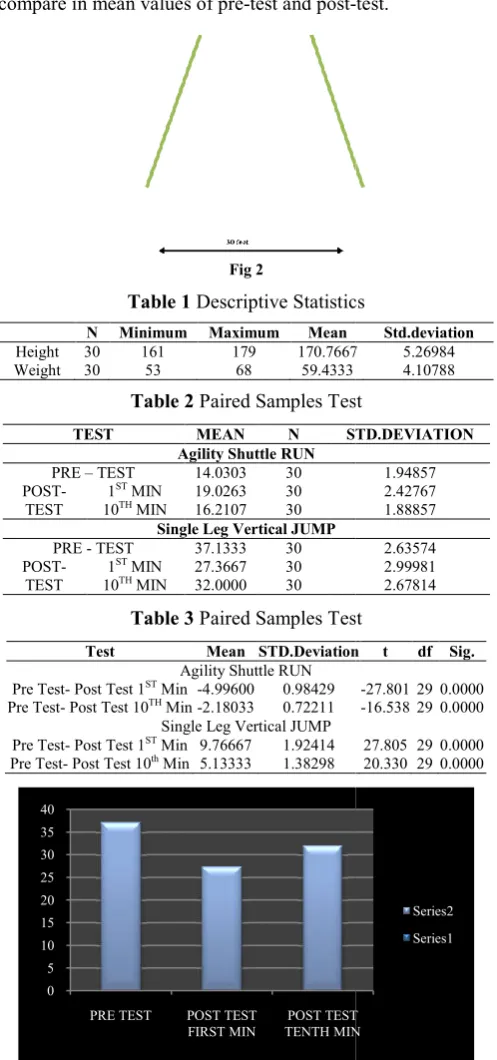
functional performance tests. A paired t-test was used to compare in mean values of pre-test and
Fig 2
Table 1 Descriptive Statistics
N Minimum Maximum Mean
Height 30 161 179 170.7667 Weight 30 53 68 59.4333
Table 2 Paired Samples Test
TEST MEAN N STD.DEVIATION
Agility Shuttle RUN
PRE – TEST 14.0303 30 POST-
TEST
1ST MIN 19.0263 30
10TH MIN 16.2107 30
Single Leg Vertical JUMP
PRE - TEST 37.1333 30 POST-
TEST
1ST MIN 27.3667 30
10TH MIN 32.0000 30
Table 3 Paired Samples Test
Test Mean STD.Deviation
Agility Shuttle RUN Pre Test- Post Test 1ST Min -4.99600 0.98429
Pre Test- Post Test 10TH Min -2.18033 0.72211
Single Leg Vertical JUMP Pre Test- Post Test 1ST Min 9.76667 1.92414
Pre Test- Post Test 10th Min 5.13333 1.38298
Graph 1 Comparision of Pre Test And Post Test Ofsingle
Vertical JUMP
Graph 2 Comparision of Pre Test and Post Test of Agility Shuttle Run
0 5 10 15 20 25 30 35 40
PRE TEST POST TEST
FIRST MIN POST TEST TENTH MIN 0 5 10 15 20
PRE TEST POST TEST
FIRST MIN
POST TEST TENTH MIN
Anterior Thigh On Maximal Functional Performance
test was used to
-test.
RESULTS
The mean value for the pre test is 14.0303 and the mean value for post test at first minute and post test at tenth minute is 19.0263, 16.2107 respectively. When
first minute was compared the mean value obtained is 4.99600 and when pre test and post test at tenth minute was compared the mean value obtained is
0.000 which shows there is a significant difference exi between the pre test and the post test.
The mean value for the pre test is 37.1333 and the mean value for the post test at the first minute and post test at the tenth minute is 27.3667, 32 respectively.
When pre test and post test at the first minute
the mean value obtained is 9.76667 and when the pre test and post test at tenth minute was compared the mean value obtained is 5.13333.The p value is 0.0000 which shows there is a significant difference exists between the pre test and the post test. The results show that the performance of the participants has decreased after the application of cryotherapy. Also, at first minute after application of cryotherapy there was decrease in the performance and at the tenth minute after application of
increased but not equal to the pre test value. With the following results we can reject the null hypothesis and accept alternate hypothesis.
DISCUSSION
The effects of ice bag application to the anterior thigh on 2 measures of maximal functional performance were studied. Each functional performance measures a different aspect of explosive power. Cross et al
performance for the single-leg vertical jump and the agility shuttle run after ice immersion of the lower leg in a cold whirlpool at 13°C for 20 minutes. In a study it was stated that the vertical jump test measures the immediate generation of anaerobic power.37 In the same study, they wanted to isolate the treated extremity to control for external factors such as overcompensation with the non treated leg. As a result, they elected to have the subjects perform a single
instead of the standard do
methodology is supported by Risberg and Ekeland suggested that two-leg tests are associated with the ability to perform daily functions, whereas single
closely associated with the functional stability encou during more demanding activities. The time in the agility shuttle run is not only highly dependent on power output but also on the individual’s ability to change body position. The decrements in all of these maximal functional performance tests may be explained by the effects of cold application on the quadriceps.
Cold application to the muscle has been shown to decrease the motor nerve conduction velocity, decrease the maximal strength, and increase the tissue stiffness. Reid
that low temperature could increase the friction between Ca and its cellular ‘‘gate’’ during the exchange that could result in the delay of action potential generation. Ruiz
reported that after 25 minutes of ice application to the quadriceps, concentric and eccentric isokinetic force production decreased significantly. Bergh and Ekblom (1979) best demonstrated this relationship finding the height of the jump decreased with a decrease in muscle temperature at a Descriptive Statistics
Std.deviation
170.7667 5.26984 4.10788
Paired Samples Test
STD.DEVIATION 1.94857 2.42767 1.88857 2.63574 2.99981 2.67814
Paired Samples Test
STD.Deviation t df Sig.
-27.801 29 0.0000 -16.538 29 0.0000
27.805 29 0.0000 20.330 29 0.0000
Comparision of Pre Test And Post Test Ofsingle- Leg
Post Test of Agility Shuttle Run
POST TEST TENTH MIN Series2 Series1 POST TEST TENTH MIN Series1
Maximal Functional Performance Tests
The mean value for the pre test is 14.0303 and the mean value for post test at first minute and post test at tenth minute is 19.0263, 16.2107 respectively. When pre test and post test at first minute was compared the mean value obtained is -4.99600 and when pre test and post test at tenth minute was compared the mean value obtained is -2.18033. The p value is 0.000 which shows there is a significant difference exists between the pre test and the post test.
The mean value for the pre test is 37.1333 and the mean value for the post test at the first minute and post test at the tenth minute is 27.3667, 32 respectively.
When pre test and post test at the first minute was compared the mean value obtained is 9.76667 and when the pre test and post test at tenth minute was compared the mean value obtained is 5.13333.The p value is 0.0000 which shows there is a significant difference exists between the pre test and the t test. The results show that the performance of the participants has decreased after the application of cryotherapy. Also, at first minute after application of cryotherapy there was decrease in the performance and at the tenth minute after application of cryotherapy the performance increased but not equal to the pre test value. With the following results we can reject the null hypothesis and accept
The effects of ice bag application to the anterior thigh on 2 measures of maximal functional performance were studied. Each functional performance measures a different aspect of reported decrease in functional leg vertical jump and the agility shuttle run after ice immersion of the lower leg in a cold whirlpool at 13°C for 20 minutes. In a study it was stated that the vertical jump test measures the immediate generation of In the same study, they wanted to isolate the treated extremity to control for external factors such as overcompensation with the non treated leg. As a result, they elected to have the subjects perform a single-leg vertical jump instead of the standard double leg. This choice of methodology is supported by Risberg and Ekeland38 who leg tests are associated with the ability to perform daily functions, whereas single-leg tests are more closely associated with the functional stability encountered during more demanding activities. The time in the agility shuttle run is not only highly dependent on power output but also on the individual’s ability to change body position. The decrements in all of these maximal functional performance be explained by the effects of cold application on
Cold application to the muscle has been shown to decrease the motor nerve conduction velocity, decrease the maximal strength, and increase the tissue stiffness. Reid et al reported ow temperature could increase the friction between Ca2+ and its cellular ‘‘gate’’ during the exchange that could result in the delay of action potential generation. Ruiz et al26
International Journal of Current Advanced Research Vol 6, Issue 06, pp 4092-4096, June 2017
rate of 4.2% x degree C-1. Decreases in CMJ height can be attributed to changes in dynamic strength following the application of cold. Richendollar et al. (2006) found the application of a cold pack to the anterior thigh decreased the sprint times as well.
The aim of this study is to examine the effect of ice application to anterior thigh on maximal functional performance tests and to determine the prolonged effect of ice application. In this study we used ice bag which was filled with crushed ice and it was placed on the anterior thigh for twenty minutes. Jane Kennet (2007) in his study stated that application of crushed ice produced a significantly greater reduction in skin surface temperature (19.56 ± 3.78°C) than gel packs (13.19 ± 5.07°C) and frozen peas (14.59 ± 4.22°C). The crushed ice had the greatest cooling efficiency and sustained decreased skin surface temperatures post application, indicating these agents are potentially the most clinically beneficial. Also, he stated that twenty-minute application of crushed ice and water immersion caused skin surface temperature to fall within the therapeutic temperature range.
This study also helps the athletes to know when to return back on field after ice application. The results of this study indicated that a 20 minute, cold application treatment applied to the anterior thigh had an immediate and subsequent impairment on functional performance. The decrease in the performance may be attributed to joint and muscle stiffness and also decrease in the nerve conduction velocity. Functional performance decrements may also be related to the stretch-reflex phenomenon. As noted by Davies & Young (1983) the impaired ability of the muscle spindle to trigger the stretch-reflex may have decreased the amount of elastic potential which could be produced during the eccentric loading phase of muscular contraction. It was evident by the work of Bergh & Ekblom (1979) that muscular contraction speed and the capacity to generate force are reduced by cold.
The pre and post test values were obtained by single-leg vertical jump and agility shuttle run. The post values were measured at first and tenth minute after the application of cryotherapy. The post test values at first minute shows that there was decrease in the performance and the post test values at the tenth minute shows that the performance level has increased. The mean time to complete the agility shuttle run before the application of ice was 14.0303. The mean time to complete the agility shuttle run after the ice application at first minute was 19.0263 and at tenth minute is 16.2107. The mean height that was reached for the single-leg vertical jump before the application of ice was 37.1333. The mean height that was reached for single-leg vertical jump after application of ice at the first minute was 27.3667 and at the tenth minute were 32.0000. The results show that increase in the performance at the tenth minute is not equal to the pre test results.
The results of this study show that further research is needed to increase the interval for post test time and to find if the performance level returns to the normal as pre test values. Also this study was performed in the recreational athletes so further study can be done in the athletes who are on field and also it can be done in the injured athletes to determine their effect of performance following cryotherapy. In this study the change in intramuscular temperature was noted. More research can also be done to find the change in temperature at
each minute after ice bag application. Athletic trainers commonly use cold in the treatment of musculoskeletal injuries. Not only does it decrease the potential for secondary hypoxic injury, it also reduces pain, facilitating early exercise. The results of this study indicate that cooling the anterior part of thigh decrease the performance level of the athletes. Our findings do add to the knowledge base of athletic trainers and other sports medicine professionals, who should be aware of the extent of physiologic responses to cold application as well as the potentially detrimental effects on maximal physical performance.
CONCLUSION
This has been concluded that the performance of the athletes decrease soon after the application of cryotherapy. Sports medicine professionals should carefully weigh the consequences of returning athletes to strenuous activity immediately following cryotherapy treatment.
References
1. Zemke JE, Andersen JC, Guion WK, McMillan J, Joyner AB. Intramuscular temperature responses in the human leg to two forms of cryotherapy: ice massage and ice bag. J Orthop Sports Phys Ther. 1998; 27:301-307.
2. Halvorson GA. Therapeutic heat and cold for athletic injuries. Physician Sportsmed. 1990; 18(5):87-92, 94. 3. Knight KL. Cryotherapy in Sport Injury Management.
Champaign, IL: Human Kinetics; 1995: 9, 65-67,68,130-132.
4. McMaster WC. Cryotherapy. Physician Sportsmed.
1982; 10(11):112-119.
5. Mecomber SA, Herman RM. Effects of local hypothermia on reflex and voluntary activity. Phys Ther. 1971; 51:271-281.
6. Uchio Y, Ochi M, Fujihara A, Adachi N, Iwasa J, Sakai Y. Cryotherapy influences joint laxity and position sense of the healthy knee joint. ArchPhys Med Rehabil. 2003; 84:131-135.
7. Hocheka PW. Metabolic arrest. Intensive Care Med.1986: 12: 127-133.
8. May JW, Hergrueter CA, Hansen RH. Seven-digit replantation: digit survival after 39 hours of cold ischemia. Plast Reconstr Surg. 1986; 78:522-525. 9. Meeusen R, Lievens P. The use of cryotherapy in
sports injuries. Spons Med. 1986; 3:398-414.
10. Sabri S, Roberts VC, Cotton LT. Effects ofextemally applied pressure on the haemodynamics of the lower limb. Br MedJ. 197 1; 3:503-508.
11. Knight KI. Cryotherapy, Theory, Technique, and Physiology. I st ed. Chattanooga, Tenn: Chattanooga Corp; 1985:18-55.
12. Hopper D, Whittington D, Davies J. Does ice immersion influence ankle joint position sense?
Physiother Res Int. 1997; 2:223-236.
13. Cross KM, Wilson RW, Perrin DH. Functional performance following an ice immersion to the lower extremity. J Athl Train. 1996; 31:113-116.
The Effect Of Ice Application To Anterior Thigh On Maximal Functional Performance Tests
15. Lee JM, Warren MP, Mason SM. Effects of ice on nerve conduction velocity. Physiotherapy. 1978; 64:2-6.
16. Ozmun JC, Thieme HA, Ingersoll CD, Knight KL, Ozmun JC. Cooling does not affect knee proprioception. J Athl Train. 1996; 31:8-11.
17. LaRiviere J, Osternig LR. The effect of ice immersion on joint position sense. J Sport Rehabil. 1994; 3:58-67. 18. Kanlayanaphotporn R, Janwantanakul P. Comparison
of skin surface temperature during the application of various cryotherapy modalities. Arch Phys Med Rehabil.2005; 86:1411-1415.
19. Enwemeka CS, Allen C, Avila P, Bina J, Konrade J, Munns S. Soft tissue thermodynamics before, during, and after cold pack therapy. Med Sci Sports Exerc.
2002; 34:45-50.
20. Merrick MA, Jutte LS, Smith ME. Cold modalities with different thermodynamic properties produce different surface and intramuscular temperatures. J Athl Train. 2003; 38:28-33.
21. Cornwall MW. Effect of temperature on muscle force and rate of muscle force production in men and women. J Orthop Sports Phys Ther. 1994; 20:74-80. 22. Davies CTM, Young K. Effect of temperature on the
contractile properties and muscle power of triceps surae in humans. J Appl Physiol. 1983; 55:191-195. 23. Myrer JW, Measom G, Fellingham GW. Temperature
changes in the human leg during and after two methods of cryotherapy. J Athl Train. 1998; 33:25-29.
24. Evans TA, Ingersoll C, Knight KL, Worrell T. Agility following the application of cold therapy. J Athl Train.
1995; 30:231-234.
25. Palmer JE, Knight KL. Ankle and thigh skin surface temperature changes with repeated ice pack application. J Athl Train. 1996; 31:319-323.
26. Ruiz DH, Myrer JW, Durrant E, Fellingham GW. Cryotherapy and sequential exercise bouts following cryotherapy on concentric and eccentric strength in the quadriceps. J Athl Train. 1993; 28:320-323.
27. Swenson C, Sward L, Karlsson J. Cryotherapy in sports medicine. Scand J Med Sci Sports. 1996; 6:193-200.
28. Chesterton LS, Foster NE, Ross L. Skin temperature response to cryotherapy. Arch Phys Med Rehabil.
2002; 83:543-549.
29. Gallant, S.G., Knight, K.L., Ingersoll, C.D. and Kovaleski, J.E. (1996) Cryotherapy effects on leg press and vertical jump force. Journal of Athletic Training
31,S18.
30. Mlynarczyk JM. Temperature Changes in the Ankle During and After Ice Pack Application of 10, 20, 30, 45, and 60 Minutes. Terre Haute, IN: Indiana State University; 1985. Thesis.
31. Jane Kennet, Natalie Hardaker, Sarah Hobbs, James Selfe. University of Central Lancashire, Preston, Lancashire, UK. Cooling efficiency of 4 common cryotherapeutic agents. Journal of athletic training
2007;42(3):343-348
32. Blaine C Long, Mitchell L Cordova, Jody B Brucker, Timothy J Demchak, and Marcus B Stone. Exercise and quadriceps muscle cooling time. Journal of athletic training 2005, 40(4):260-263.
33. Yanagisawa O, Homma T, Okuwaki T, Shimao D, Takahashi H. Effect of cooling on human skin and skeletal muscle. Eur J Appl Physiol. 2007; 100(6):737-45.
34. Rajadhyaksha V, Dastoor D.H, Shahani M (1982). Influence of cooling of anterior aspect of thigh on maximal isometric tension of muscle quadriceps. 35. Mc Lean D.A (1989). The use of cold and superficial
heat in treatment of soft tissue injuries.
36. Lee J.M, Warren M.P (1974). Cold therapy in rehabilitation.
37. McArdle WD, Katch FI, Katch VL. Exercise Physiology: Energy, Nutrition and Human Performance. Philadelphia, PA: Lippincott Williams & Wilkins; 2001:224-228.
38. Risberg MA, Ekeland A. Assessment of functional tests after anterior cruciate ligament surgery. J Orthop Sports Phys Ther. 1994; 19:212-216.
How to cite this article:
Ashok N et al (2017) 'The Effect Of Ice Application To Anterior Thigh On Maximal Functional Performance Tests',
International Journal of Current Advanced Research, 06(06), pp. 4092-4096.DOI: http://dx.doi.org/10.24327/ijcar.2017.4096.0437