Available at http://www.ijcsonline.com/
Fast and Hybrid Image Segmentation Based on Level set and Normalized Graph
Cut
Basavaprasad BA, Ravindra S HegadiB
ȦResearch and Development Center, BharathiarUniversity, Coimbatore-641046, India ḂDepartment of Computer Applications, Solapur University, Solapur-413255, India
Abstract
Image segmentation is an important issue still challenging for this in computer Vision application. The methods based on active contour method are one of the most successful techniques. It has received a tremendous amount of attention in computer vision processing. The operation can be carried out manually or automatically. In the proposed work, the three-phase construction of the level set evolution (LSE) and estimation of bias field for image back- ground in the occurrence of intensity. The three-phase formulation is used to separate an image into three regions. Intensity in homogeneousness frequently arises in real-world images. The proposed method is a hybrid technique which is a combination of the Level Set Algorithm and Graph Cut Theory which is applicable to both gray and color image segmentation. To begin with, the color image is converted into ycbcr. Afterwards we implemented the level set method to separate the background from foreground. Thereafter we build a model of and implemented the maximum flow algorithm to obtain the minimum cut which we call as the initial segmentation of an image. At the end we used a recursive process to accomplish the outcome of image segmentation. The core idea of our method is to build a perfect graph model and reuse the existing segmentation techniques.
Keywords: Image, segmentation, hybrid, level set, normalized cut.
I. INTRODUCTION
In biomedical application, image processing becoming an interesting area that considered as important role to perform further diagnosis or other task. Image segmentation is an important steps in image processing techniques that has been surveyed, and so far there is no appropriate solution is achieved for digital image processing due to its wide spread usage and applications. Observing this as the first step, it is a difficult process which is normally used in analysis of medical images. The goal of image segmentation is a partition of an image into a set of image regions, used to locate objects and boundaries (lines, curves, etc…) in images. More precisely, image segmentation in the process of assigning a label to every pixel in an image such that pixels with the same label share certain characteristics.
Clustering is most commonly used automated segmentation techniques implemented in the diverse fields of bioinformatics applications precisely used in the microscopic image processing.
An effective image segmentation method, is Level Set segmentation, in this paper we are going to implement a level set approach for active contour image segmentation.
Level set method is originally developed by Osher and Sethian and then applied to image segmentation by Malladi.
Present level set approaches for image segmentation can be characterized into two major classes: edge-based models and region-based models [7]. Firstly region-based models which targets to aim to identify all regions of interest by spending a convinced region descriptor to lead the motion of the active contour.
Nevertheless, it is very problematic to define a region descriptor for homogeneities images with intensity. Furthermost, region-based models depend on the supposition of intensity homogeneity. A distinctive illustration is piecewise constant (PC) models proposed in [4], [5, 6]. In [8, 9], level set approaches are projected based on an overall piecewise smooth (PS) formulation initially proposed by Mumford and Shah [13]. These techniques do not undertake homogeneity of image intensities and consequently are able to segment images with intensity in homogeneities. Conversely, these techniques are computationally over costly and are rather profound to the initialization of the contour [10], which significantly bounds their services. An edge-based model uses the edge information of the pixel to segment the image. Such models do not undertake homogeneity of image intensities and therefore can be realistic to images with intensity in homogeneities. Conversely, these types of techniques are in general moderately complex to the early conditions and often suffer from severe boundary outflow problems in images where the weak object boundaries exists.
the bias field. Our application is so important that it can be used for segmentation and bias improvement.
II. LITERATURE SURVEY
Image segmentation which is based on graph cut method is a binary segment, i.e. the image is divided into foreground and background. In the beginning, our approach combines level set algorithm with graph cut theory which is used to make binary segmentation for gray images. However, this method is not good for color image segmentation. During this process, we are going to improve this method through multiple iteration, so the extended approach not only deals with binary segmentation, but also handle multi-value segmentation, which suits more for gray or color image .Our main goalis to build a new graphic model, and extend the existing binarysegmentation method using normalized graph cut and level set algorithm to solve the multi-value segmentationproblems which can deal with both gray and color image. It will be discussed in below sessions. Experiment results say that our proposed methods conduct a better segmentation compared to existing binary segmentation methods.
A. Level Set Method
Numerous PDEs (Partial Differential Equations) are used in image processing which mainly grounded on the surfaces and moving curves with velocities based on curvature. In this area, the level set method was very influent and useful. The fundamental idea of level set is to characterize the curves or surfaces as the level set with zero of progressive dimensional hyper-surface. These techniques not only provide more accurate numerical implementations but also handle topological change very easily. Essentially, it means that the curves which are closed in a surface of two-dimensional are observed in a three-dimensional space as a continuous surface. The definition of a smoothing function (x,y,t) stands for the surface while the set of definitions (x,y,t)=0 for the curves. Consequently, the development of a curve can be converted into an advancement of a function with three-dimensional Level Set. Given a Level Set function
(x,y,t=0), whose zero level set corresponds to curve. The entire surface can be divided into two regions. Internal region and an external region with curve as the boundary. It describes a Signed Distance Function (SDF) on the surface using the formula:
(1)
Where, d is the shortest distance between the point of x on the surface and on the curve.
The entire evolutional procedure of the curve and every point will be formulated as following:
The common movement formula for Level Set is:
Where F is a function which represents speed, which is related to evolving surface characteristics (e.g. curvature,
normal direction, etc.) and image characteristics (e.g. gray, gradient). When it is applied to image segmentation, the design of F depends on information of image and the ideal value is zero on the edge of the target (i.e. the bigger value of the gray gradient).
Level set method, due to its stability and irrelevancy with topology, it displays a great advantage in solving the problems of corner point producing, curve breaking and combining, etc. Therefore, it is used in a wide range [10-11].
The energy function consists of an internal energy term and an external energy term, respectively. The internal energy term P( ) penalizes the deviation of the level set function from a signed distance function, whereas the external energy term ( ) drives the motion of the zero level set tothe desired image features such as object boundaries. The resulting evolution of the level set function is the gradient flow that minimizes the overall energy functional. The energy function is:
= ( =
As it is well aware that a distance function which is signed necessity fulfill a required property of 1. So ) redirected the abnormality between level set function and the signed distance function precisely. In the meantime, due to the disciplining effect of the internal energy, the evolving function will be logically and mechanically preserved as an imprecise and signed distance function throughout the evolution process. Consequently the re-initialization procedure is totally eradicated in the formulation of the proposed work.
B. Graph Cut Theory
In recent years, an optimizing technique based on graph theory i.e. graph cut has been widely used in computer vision domain [12]. The following is how the graph cut theory implemented in image segmentation. We consider the image segmentation problem as a pixel assignment issue. Each pixel p in image P is represented by its feature vector . So the image P can be represented by the set of all feature vectors, denoted as V.
Where ,
hereN represents total number of pixels in the image. The main goal of image segmentation is to find the
corresponding label set L
i.e which is the label 1
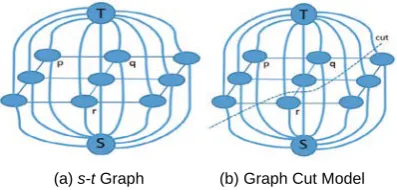
kinds of edges are called as t-links, which is shown in Fig. 1(a).
Figure 1.S-t Graph and Graph Cut Model.
To indicate the strength of the edges, each edge will be given a non-negative weight. The Cut is an edge set which is composed of all disconnected edges, and the sum of these disconnected edges weight is the cutting cost. For image segmentation problem, the cut will divide all vertices into two disjoint
subsets i.e. and , wher and ,
as shown in Fig. 1(b). Min-cutis the cut which has the minimum cost of all the cuts, corresponding to the best image segmentation result. So looking for the minimum cut it can be formalized as a process of optimizing energy function according to the following equation:
(5) hereR(L) is an regional term which relates to each
individual vertex and R(L) is the weight of t-links which can be calculated by the equations given:
(6)
Where , so
(7)
B(L) is called boundary term which can be defined as the following:
Where, = (9)
) (10)
Here is set of all neighbor pixels, is a constant parameter, represents the punishment only exists in the boundary between foreground and background.
is the weight of n-links, which means similarity between two similar pixels.
is an important balancing factor between regional term and boundary term. It determines the influence degree of these two terms to the energy function respectively. In this paper, maximum flow algorithm is used in order to find the minimum cut of s-t diagram.
III. PROPOSEDMETHOD
In this section, we are going to present our method to segment imagebased on Level set and graph cut theory.
A. Descriptions and Preparations
As described in Section II, γ factor is used when the weightof n-links is defined. This factor will determine whether the adjacent pixels are in the same class or not. In order to get the relationship between neighboring pixels at the initial stage,a preprocessing has been implemented for the gray image, gray value of pixels was selected as the feature. Due to gray value is ranging in value from 0 to 255. So, we use a feature vector with 256 dimensions. The gray values dimension is 1, and the rest dimensions are 0. For the color image, RGB features were extracted. First of all, where color image is converted to Ycbcr and then we apply Level set algorithm in order to separate background from image. Next we built a model of graph and then minimum cut is computed using maximum flow algorithm which we call initial segmentation of the image. At the end we usedthe recursive process to accomplish the result of image segmentation. In the next section, the overall process of our method will be explained.
B. Implementation
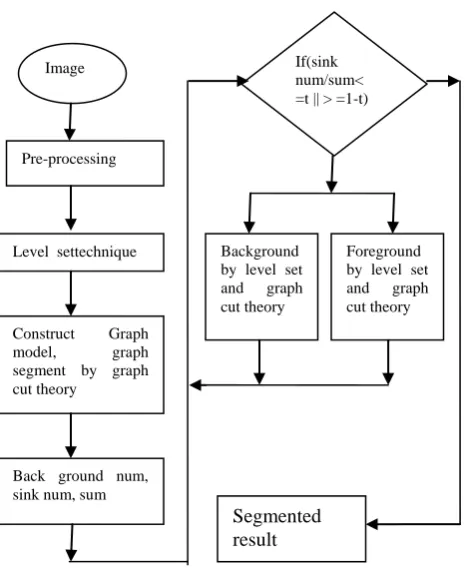
As shown in Fig. 2, input is an image which is converted to ycbcr in order to segment the image into a set of small regions. Next, as described in Subsection A, we extractfeatures of the image and use these data to apply level set algorithm which is used to separate background. After separating background we are going to implement a graph model, and use the maximumflow algorithm to get the minimum cut, which is initial imagesegmentation result. Now, Ifnumber of background pixels isequal to the number of foreground pixels and it does not meetthe terminal threshold, a new round segmentation based onbackground pixels and foreground pixels is implemented. Thenext process is the same as above. Repeat thisprocess until the condition is satisfied. Finally, the segmented image will be displayed. The details of our methodwill be described in the next section.
v
Figure 2.The process of color image segmentation.
C. Detailed Analysis
(1) Preprocessing : in the preprocessing , if the image taken is gray image then we are not going to perform any conversion and extract features for the same but if the image taken is color image then it has too be converted into ycbcr image in order segment the image.
(2) Feature Extraction.: In this stage, we extract features from every pixel and assign the feature value to the corresponding pixel dimension.
(3) Level set technique: Now, Carry out Level set technique based on the received features and separate background using zero level set value.
(4) Now, Construct Graph Model and Graph Cut Process. Based on the membership degree matrix obtained by level set technique, according
to the Equation (5), the t-links weights of pixel P(i, j) can be calculated as follows:
(11)
As Equation (6) has defined, the n-links weights B(p, q) between pixels p(i, j) and q(s, t) are described as follows. For gray image:
For color image:
Where δ (p, q) is:
(14)
= (15)
Gray corresponds to gray value matrix and color represents RGB value matrix. This step is the key point of our method. After the graph model has been constructed, we use maximum flow algorithm [14] to get the result. The output is initial image segmentation, which is image has been divided into two categories: foreground and background.
(5) Iterative segmentation to obtain segmentation results.
In this method, we take the ratio of background and foreground as the terminal threshold. If the ratio not meets the termination, the image segmentation process will be continued until it meet the termination. The general graph model only provides two terminals S and T which represent the background and foreground respectively. We use binary value segmentation process several times for gray and color images and the key of the method is to
construct a fine graph model, then use the existing binary segmentation method to solve the multi-value segmentation problem. Algorithm 2 shows the main flow of this method.
IV. EXPERIMENTAL RESULTS
For gray image segmentation, we compare the binary segmentation results and multi-value segmentation results. In Fig 3, we can see that the segmentation results of binary segmentation is quite difficult, the outline of main object is difficult to distinguish. The foreground and background pixels have been mixed together and affect the segmentation results. However, in the case of multi-value segmentation, the result is much better and the profile of target objects is more clear.
Image
Pre-processing
Level settechnique
Construct Graph model, graph segment by graph cut theory
Back ground num, sink num, sum
If(sink num/sum< =t || > =1-t)
Background by level set and graph cut theory
Foreground by level set and graph cut theory
Figure3. The segment results of Image Camera by Binary Segmentation and Multi-Value segmentation.
V. CONCLUSIONS
In this it is concluded that the three phase formulation used for level set evolution and bias field estimation for Image Background in presence of intensity will provide better results. In our approach it is proved that the hybrid segmentation by level set and graph cut provide a better results in Image segmentation. where level set method separates the background and make easy for minimal cut of graph by using graph cut theory finally it provide better segmentation results for both gray or color images in manually or automatically when compared to many existing technologies.
ACKNOWLEDGMENT
I would like to thank Research and Development Center, Bharathiar University, Coimbatore for giving me the opportunity to work as Research Scholar. I also would like to thank Prof. RavindraS.Hegadi, Department of Computer Applications, Solapur University, Solapur, who is co-author and research guide for his valuable support.
REFERENCES
[1] Linda G. Shapiro and George C. Stockman “The Computer Vision”, pp 279-325, New Jersey, Prentice-Hall, ISBN 0-13-030796-3, 2001.
[2] Barghout, Lauren, and Lawrence W. Lee. "Perceptual information processing system." Paravue Inc. U.S. Patent Application 10/618,543, filed July 11, 2003.
[3] Xin-Jiang1,2, Renjie-Zhang1, Shengdong-Nie1, Image Segmentation Based on Level Set Method,2012 International Conference on Medical Physics and Biomedical Engineering. [4] T. Chan and L. Vese, “Active contours without edges,” IEEE
Trans.Image. Process. vol. 10, no. 2, pp. 266–277, Feb. 2001. [5] R. Ronfard, “Region-based strategies for active contour models,”
Int. J. Comput. Vis., vol. 13, no. 2, pp. 229–251, Oct. 1994. [6] L. Vese and T. Chan, “A multiphase level set framework for image
segmentation using the Mumford and Shah model,” Int. J. Comput. Vis., vol. 50, no. 3, pp. 271–293, Dec. 2002.
[7] S.-C. Zhu and A. Yuille, “Region competition: Unifying snakes, region growing, and Bayes/MDL for multiband image segmentation,” IEEE Trans. Pattern Anal. Mach. Intell., vol. 18, no. 9, pp. 884–900, Sep. 1996.
[8] Seerha G, “A Review on latest image segmentation techniques,” International Journal on Computer Science and Engineering, 2009. [9] M. Hameed, M. Sharif, M. Raza, S. W. Haider, and Iqbal M., “ The
Framework for the assessment of classifiers for medical image segmentation with transform and moment based features,”, The Research Journal of Recent Sciences (RJRS), Volume: 2, Issue no: 6, pp. 1-10, June 2013.
[10] Sethian J A. Level set methods and fast marching methods: evolving interfaces in computational geometry, fluid mechanics, computer vision, and material science. Cambridge.UK: Cambridge University Press,2nd ed ,1999.
[11] Sethian J A. A review of recent numerical algorithms for hypersurfaces moving with curvature dependent speed. Journal of Differential Geometry, 1989; 31:131-161.
[12] Y. Boykov, G. Funka-Lea. ”Optimal object extraction via constrained graph-cuts,” International Journal of Computer Vision (IJCV), 2004.
[13] Y. Boykov, V. Kolmogorov. ”An experimental comparison of mincut/ max- flow algorithms for energy minimization in vision,” Pattern Analysis and Machine Intelligence, voI. 26, pp. 1124-1137, 2004.