Self Adaptive Utility-Based Routing
Protocol (SAURP): A Result
Rakhi S. Belokar
Dept. of CSE, MSS’CET, Jalna, Maharashtra, India
Abstract
This report introduces a novel multi-copy routing protocol, called Self Adaptive Utility-based Routing Protocol (SAURP), for Delay Tolerant Networks (DTNs) that are possibly composed of a vast number of devices in miniature such as smart phones of heterogeneous capacities in terms of energy resources and buffer spaces. SAURP is characterized by the ability of identifying potential opportunities for forwarding messages to their destinations via a novel utility function based mechanism, in which a suite of environment parameters, such as wireless channel condition, nodal buffer occupancy and encounter statistics, are jointly considered. Thus, SAURP can reroute messages around nodes experiencing high buffer occupancy, wireless interference, and/or congestion, while taking a considerably small number of transmissions. The developed utility function in SAURP is proved to be able to achieve optimal performance, which is further analyzed via a stochastic modeling approach. Extensive simulations are conducted to verify the developed analytical model and compare the proposed SAURP with a number of recently reported encounter-based routing approaches in terms of delivery ratio, delivery delay and the number of transmissions required for each message delivery. The simulation results show that SAURP outperforms all the counterpart multi-copy encounter-based routing protocols considered in the study.
Keywords
SAURP, DTN
Chapter 1
I. Introduction
Delay Tolerant Network (DTN) [1] is characterized by the lack of end-to-end paths for a given node pair for extended periods, which poses a completely different design scenario from that for conventional mobile adhoc networks (MANETs) [13]. Due to the intermittent connections in DTNs, a node is allowed to buffer a message and wait until the next hop node is found to continue storing and carrying the message. Such a process is repeated until the message reaches its destination. This model of routing is significantly different from that employed in the MANETs. DTN routing is usually referred to as encounter-based, store-carry-forward, or mobility-assisted routing, due to the fact that nodal mobility serves as a significant factor for the forwarding decision of each message.
Although improved in terms of performance, the previously reported multi-copy schemes are subject to the following problems and implementation difficulties.
First, these schemes inevitably take a large number of transmissions, energy consumption, and a vast amount of transmission bandwidth and nodal memory space, which could easily exhaust the network resource. Second, they suffer from contention in case of high traffic loads, when packet drops could result in a significant degradation of performance and scalability. Note that the future DTNs are expected to operate in an environment with a large
number of miniature hand-held devices such as smart phones, tablet computers, Personal Digital Assistants (PDAs) and mobile sensors. In such a scenario, it may no longer be the case that nodal contact frequency serves as the only dominant factor for the message delivery performance as that assumed by most existing DTN literature. Therefore, limitations on power consumption, buffer spaces and user preferences should be jointly considered in the message forwarding process.
we introduce a novel DTN routing protocol, called Self Adaptive Utility-based Routing Protocol (SAURP), that aims to overcome the shortcomings of the previously reported multi-copy schemes. Our goal is to achieve a superb applicability to the DTN scenario with densely distributed hand-held devices. The main feature of SAURP is the strong capability in adaptation to the fluctuation of network status, traffic patterns/characteristics, user encounter behaviors, and user resource availability, so as to improve network performance in terms of message delivery ratio, message delivery delay and number of transmissions
Chapter 2
II. Literature Survey
Most (if not all) previously reported encounter-based routing schemes have focused on nodal mobility, which has been extensively exploited as the dominant factor in the message forwarding decision. Those schemes contributed in the context of introducing new interpretations of the observed node mobility in the per-node utility function.
Nelson proposed an enhanced version of MSF by taking the number of message replicas transferred during each contact in proportion to the pernode utility function, which is in turn determined by the evolution of the number of nodal encounters during each time-window.
Lindgren et al. in Jones et al. in [11] introduced a novel utility function for DTN routing by manipulating the minimum expected inter-encounter duration between nodes. Ling et al. in designed a feedback adaptive routing scheme based on the influence factors solely determined by the node mobility, where a node with higher mobility is given a higher factor and messages are transmitted through nodes with higher influence factors.
Lindgren et al. in [2] introduced a DTN routing scheme which predicts encounter probability between nodes. Burgess et al. in introduced a routing protocol which bases its decisions on whether to transmit or delete a message on the path likelihood. The path likelihood metric is based on historic information of the number of encounters between nodes. Y. Liao et al. in introduced a routing scheme that combines erasurecoding with an estimation routing scheme and selectively distributes messages blocks to relay nodes. The decision of forwarding a message depends on the contact frequency and other factors such as buffer occupancy, and available battery power level.
the derivation of the routing metric to decide which message to replicate first among all the buffered messages in the custodian node. The derivation of the routing metric, nonetheless, is not related to buffer status. Khrifa et al. in [14] proposed a forwarding and dropping policy for a limited buffer capacity. The decision under this policy is made based on the value of per-message marginal utility. This policy nonetheless was designed to suit homogeneous nodal mobility.
Lee et al. introduced a comprehensive routing scheme as resource allocation that jointly optimizes link scheduling, routing, and replication. This framework allows the developed solutions to be adaptive to various network conditions regarding nodal interferences and connections/disconnections. Tan et al. introduced a routing strategy based on calculating the expected end-to-end path length as a metric in forwarding messages mainly based on the reciprocal of the encountering probability. It is defined as the expectation of message transmission latency through multi-hop relays.
Another scheme is called delegation forwarding , where a custodian node forwards a message copy to an encountered node if the encountered node has a better chance to “see” the destination. The key idea is that a custodian node (source or relay) forwards a message copy only if the utility function (represented by the rate of encounters between node pairs) of the encountered node is higher than all the nodes so far “seen” by a message, and then current custodian will update its utility value of that message to be equal to that of the encountered node.
Mosli et al. in [13] introduced a DTN routing scheme using utility functions that are calculated from an evaluation of context information. The derived cost function is used as an assigned weight for each node that quantifies its suitability to deliver messages to an encountered node regarding to a given destination.
Spyropoulos et al. in [6], [12] developed routing strategies that use different utility routing metrics based on nodal mobility statistics, namely Most Mobile First (MMF), Most Social First (MSF) and Last Seen First (LSF). A sophisticated scheme was introduced by Spyropoulos et al., called Spay and Focus [6], which is characterized by addressing an upper bound on the number of message copies (denoted as L). In specific, a message source starts with L copy tokens. When it encounters another node B currently without any copy of the message, it shares the message delivery responsibility with B by transferring L/2 of its current tokens to B while keeping the other half for itself. When it has only one copy left, it switches to a utility forwarding mechanism based on the LSF (time elapsed since the last contact). This scheme has proven to significantly reduce the required number of transmissions, while achieving a competitive delay with respect to network contentions such as buffers space and bandwidth.
Chapter 3
III. System Development
A. Self Adaptive Utility-Based Routing Protocol (SAURP)
The proposed SAURP is characterized by the ability of adapting itself to the observed network behaviors, which is made possible by employing an efficient timewindow based update mechanism for some network status parameters at each node. We use time-window based update strategy because it is simple in implementation and robust against parameter fluctuation. Note that the network conditions could change very fast and make a completely
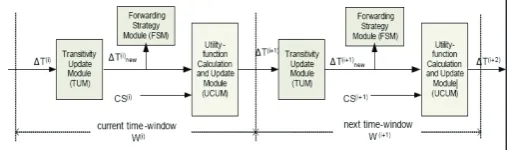
event-driven model unstable. Fig. 1 illustrates the functional modules of the SAURP architecture along with their relations.
The Contact Statistics (denoted as CS(i)) refers to the statistics of total nodal contact durations, channel condition, and buffer occupancy state. These values are collected at the end of each time window and used as one of the two inputs to the Utility-function Calculation and Update Module (UCUM). Another input to the UCUM, as shown in Fig. 1, is the updated utility denoted by ∆T(i) new, which is obtained by feeding ∆T(i) ( the inter-contact time between any node pair, A and B) through the Transitivity Update Module (TUM). UCUM is applied such that an adaptive and smooth transfer between two consecutive time windows (from current time-window to next time-window) is maintained. ∆T(i+1) is the output of UCUM and is calculated at the end of current time window W(i). ∆T(i+1) is thus used in time window W(i+1) for the same tasks as in window W(i).
Forwarding Strategy Module (FSM) is applied at the custodian node as a forwarding decision making process when encountering any other node within the current time window based on the utility value (i.e., ∆T(i)). It is important to note that CS, TUM, FSM, and message vector exchange are event-driven and performed during each contact, while UCUM is performed at the end of each time-window. The following subsections introduce each functional module in detail.
Fig. 1: The SAURP Architecture
A. Contact Statistics (CS)
To compromise between the network state adaptability and computation complexity, each node continuously updates the network status over a fixed time window. The maintained network states are referred to as Contact Statistics (CS), which include nodal contact durations, channel conditions, and buffer occupancy state, and are fed into UCUM at the end of each time window. The CS collection process is described as follows. Let two nodes A and B be in the transmission range of each other, and each broadcasts a pilot signal per k time units in order to look for its neighbors within its transmission range. Let T(A;B), Tfree, and Tbusy represent the total contact time, the amount of time the channel is free and the buffer is not full, and the amount of time the channel is busy or the buffer is full, respectively, at node A or B during time window W(i). Thus, the total duration of time in which node A and B can exchange information is calculated as:
Tfree = T(A;B) – Tbusy
Note that the total contact time could be accumulated over multiple contacts between A and B during W(i).
B. Utility-function Calculation and Update Module (UCUM)
∆T(i)), as well as an update process via the transitivity property update and (ii) the observed interencounter time obtained from the current CS(i) (denoted as ∆T(i) cs ) [5-6].
1. Calculation of Inter-encounter Time (∆T(i))
An eligible contact of two nodes occurs if the duration of the contact can support a complete transfer of at least a single message between the two nodes. Thus, in the event that node A encounters B for a total time duration Tfree during time window W(i), the number of eligible contacts in the time window is determined by:
where Tp is the least time duration required to transmit a single message. Let ∆T(i)cs(A;B) denotes the average inter-encounter time duration of node A and B in time W(i). Obviously, ∆T(i) (A;B) = ∆T(i)(B;A). We have the following expression for ∆T(i) cs(A;B):
∆T(i)cs(A;B) describes how often the two nodes encounter each other per unit of time (or, the encounter frequency) during time window W(i) considering the event the channel is busy or the buffer is full. Thus, inter-encounter time of a node pair intrinsically relies rather on the duration and frequency of previous contacts of the two nodes than simply on the number of previous contacts or contact duration. Including the total duration of all the contacts (excluding the case when the channel is busy or the buffer is full) as the parameter is expected to better reflect the likelihood that nodes will meet with each other for effective message exchange.
2. Time-window Transfer Update
Another important function provided in UCUM is for the smooth transfer of the parameters between consecutive time windows. As discussed earlier, the connectivity between any two nodes is measured according to the amount of inter-encounter time during W(i), which is mainly based on the number of contacts (i.e., nc) and the contact time (i.e., Tfree). These contacts and contact durations may change dramatically from one time window to the other and address significant impacts on the protocol message forwarding decision. Hence, our scheme determines the next time window parameter using two parts: one is the current time window observed statistics(i.e., ∆T(i) cs ), and the other is from the previous time window parameters (i.e., 4T(i)), in order to achieve a smooth transfer of parameter evolution. The following equation shows the derivation of 4T(i+1) in our scheme.
The parameter is given by
If ∆T(i) cs > W, which happens if if n(i)c = 0, then ∆T(i+1) = 2W/n(i1)c.
This case represents a worst case scenario, i.e. unstable node behavior, or low quality of node mobility. Hence, the ∆T(i+1)
value should be low. ∆T(i+1) represents the routing metric (utility) value that is used as input to the next time window. This value is maintained as a vector of inter-encounter time that is specific to every other node, which is employed in the decision making process for message forwarding.
C. The Transitivity Update Module (TUM)
When two nodes are within transmission range of each other, they exchange utility vectors with respect to the message destination, based on which the custodian node decides whether or not each message should be forwarded to the encountered node. With a newly received utility vector, transitivity update [2] is initiated. We propose a novel adaptive transitivity update rule, which is different from the previously reported transitivity update rules [2, 6]. The proposed transitivity update rule is characterized as follows: (1) it is adaptively modified according to a weighting factor α, which is in turn based on the ratio of ∆T(i) of the two encountered nodes regarding the destination rather than using a scaling constant. Note that the weighting factor α determines how large impact the transitivity should have on the utility function. (2) It can quantify the uncertainty regarding the position of the destination by only considering the nodes that can effectively enhance the accuracy of the utility function. The transitivity property is based on the observation that if node A frequently encounters node B and B frequently encounters node D, then A has a good chance to forward messages to D through B. Such a relation is implemented in the proposed SAURP using the following update strategy:
where α is a weighting factor that must be less than 1 to be valid:
α has a significant impact on the routing decision rule. From a theoretical perspective, when a node is encountered that has more information for a destination, this transitivity effect should successfully capture the amount of uncertainty to be resolved regarding the position of the destination. To ensure that the transitivity effect can be successfully captured in the transitivity update process, an update should be initiated at node A regarding D only when ∆T(i)(A;D) > ∆T(i)(B;D). Otherwise, the transitivity property for node A is not useful since node A itself is a better candidate for carrying the messages destined to node D rather than forwarding them through B. This rule is applied after nodes finish exchange messages.
D. The Forwarding Strategy Module (FSM)
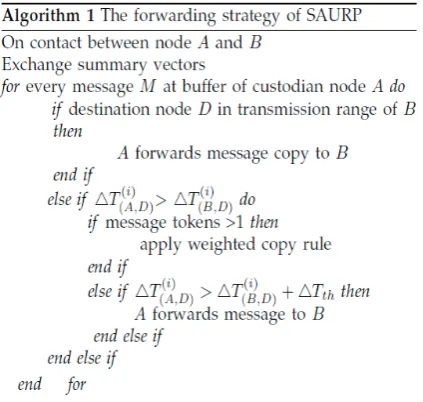
The decision of message forwarding in SAURP is mainly based on the utility function value of the encountered node regarding the destination, and the number of message copy tokens. If more than one message copy are currently carried, the weighted copy rule is applied; otherwise the forwarding rule is applied.
1. Weighted Copy Rule
where NA is the number of message tokens that node A has, ∆T(i) (B;D) is the inter-encounter time between node B and node D, and ∆T(i)(A;D) is the inter-encounter time between nodes A and D. This formula guarantees that the largest number of message copies is spread to relay nodes that have better information about the destination node. After L message copies have been disseminated to and carried by the encountered custodian nodes, each custodian node carrying the message performs message forwarding according to the forwarding rule as described in the next subsection. It may be noted here that the idea of weighted copy rule was firstly examined and has been proved to achieve improved delivery delay [8].
2. The Forwarding Rule
If the destination node is one hop away from an encountered •
node, the custodian node hands over the message to the encountered node and completes the message delivery. If the inter-encounter time value of the encountered node •
relative to that of the destination node is less than that of the custodian node by a threshold value, ∆Tth, a custodian node hands over the message to the encountered node [5-6]. The complete mechanism of the forwarding strategy in SAURP is summarized as shown in Algorithm 1.
Algorithm 1 The forwarding strategy of SAURP
E. Analytical Model of SAURP
In this section a statistical analysis is conducted to evaluate the performance of SAURP. Without loss of generality, Community-Based Mobility Model [6] is employed in the analysis. The problem setup consists of an ad hoc network with a number of nodes moving independently on a 2-dimensional torus in a geographical region, and each node belongs to a predetermined community. Each node can transmit up to a distance K _ 0 meters away and each message forwarding (in one-hop) takes one time unit. Euclidean distance is used to measure the proximity between two nodes (or their positions) A and B. A slotted collision avoidance MAC protocol with Clear-to- Send (CTS) and Request-to-Send (RTS), is implemented for contention resolution [5].
Fig. 2: Paths of Message Copies to Destination
A message is acknowledged if it is received successfully at the encountered node by sending back a small acknowledgment packet to the sender. The performance measures in the analysis include the average delivery probability and the message delivery delay. The analysis is based on the following assumptions.
Nodes mobility is independent and heterogeneous, where •
nodes have frequent appearance in some locations.
Each node in the network maintains at least one forwarding •
path to every other node. Fig. 2 illustrates the paths that a message copy may take to reach the destination.
Each node belongs to a single community at a time (representing •
some hot spots such as classrooms, office buildings, coffee shops), and the residing time on a community is proportional to its physical size.
The inter-contact time ∆T(A;B) between nodes A and B follows •
an exponential distribution with probability distribution function (PDF), P ∆T(A;B) (t) = β(A;B):e− β (A;B)t, where t is the time instance.
It has been shown that a number of popular user mobility models have such exponential tails (e.g., Random Walk, Random Waypoint, Random Direction, and Community-based Mobility [9]). In practice, recent studies based on traces collected from real-life mobility examples argued that the inter-contact time and the contact durations of these traces demonstrate exponential tails after a specific cutoff point. Based on the mobility model of the nodes, the distribution of the intercontact time can be predicted and calculated using time window updates. Thus, parameter β AB is calculated as β AB = 1/∆T(A;B).
Chapter 4
IV. Performance Analysis
We analyze the performance implication of the following. First, the performance of the protocols is evaluated with respect to the impact of the number of message copies. Second, with respect to the low transmission range and varying buffer capacity under high traffic load.
Table 1: Buffer no =1,2 ,3
Tick(ms) Source
Destination
node
Time at dest
(in ms)1
1
2
2
1
2
3
2
2
2
3
3
2
1
3
4
After simulation it gives result as Total Systems: 3
ID:1 reachable :[2, 3] MaxBuffers:2 ID:2 reachable :[1, 3] MaxBuffers:1 ID:3 reachable :[1, 2] MaxBuffers:1
Chapter 5
V. Conclusion
The report introduced a novel multi-copy routing scheme, called SAURP, for intermittently connected mobile networks that are possibly formed by densely distributed and hand-held devices such as smart phones and personal digital assistants. SAURP aims to explore the possibility of taking mobile nodes as message carriers in order for end-to-end delivery of the messages. The best carrier for a message is determined by the prediction result using a novel contact model, where the network status, including wireless link condition and nodal buffer availability, are jointly considered. We provided an analytical model for SAURP, whose correctness was further verified via simulation. We further compared SAURP with a number of counterparts via extensive simulations. It was shown that SAURP can achieve shorter delivery delays than all the existing spraying and flooding based schemes when the network experiences considerable The study provides a significance that when nodal contact does not solely serve as the major performance factor, the DTN routing performance can be significantly improved by further considering other resource limitations in the utility function and message weighting/forwarding process
References
[1] Disruption Tolerant Networking. [Online Available: http:// www.dtnrg.org.
[2] [Online] Available: http://www. IEEE TRANSACTIONS. com
[3] [Online] Available: http://www. google.com
[4] Ahmed Elwhishi and Pin-Han Ho. 2009. SARP - a novel multi-copy routing protocol for intermittently connected mobile networks. In Proceedings of the 28th IEEE conference on Global telecommunications (GLOBECOM’09), Mehmet Ulema (Ed.). IEEE Press, Piscataway, NJ, USA, 4482-4488.
[5] Ahmed Elwhishi, Pin-Han Ho, K. Naik, Basem Shihada, "Self Adaptive Contention Aware Routing Protocol for Intermittently Connected Mobile Networks", IEEE Transactions on Parallel and Distributed Systems Vol. 24, No. 7, 2013.
[6] T. Spyropoulos, K. Psounis, C. Raghavendra,"Spray and wait: An efficient routing scheme for intermittently connected mobile networks", In Proceedings of the 2005 ACM SIGCOMM workshop on Delay-tolerant networking (WDTN ’05)
[7] Evan P. C. Jones, Lily Li, Paul A. S. Ward,"Practical Routing in Delay-Tolerant Networks", In SIGCOMM’05 Workshops, August 22–26, 2005, Philadelphia, PA, USA.
[8] A. Krifa, C. Barakat, T. Spyropoulos,"Optimal buffer management policies for delay tolerant networks", In Proc. of IEEE SECON, 2008
[9] T. Spyropoulos, K. Psounis, C. S. Raghavendra,“Efficient Routing in Intermittently Connected Mobile Networks: The Single-copy Case,” IEEE Trans. Networking Vol. 16, Issue. 1, Feb. 2008 “Efficient routing in intermittently connected mobile networks: The Multi-copy case,” IEEE Trans.
Networking vol. 16, Issue 1, Feb. 2008.
[10] Z. Li, Haiying Shen,"Utility-based Distributed Routing in Intermittently Connected Networks", 37th International Conference on Parallel Processing. (ICPP ’08). September 8-12, Portland, Oregon, USA, 2008.
[11] H. Dubois-Ferriere, M. Grossglauser, M. Vetterli,"Age matters: Efficient route discovery in mobile Ad-Hoc networks using encounter ages", In Proceedings of ACM/ IEEE MOBIHOC, pp. 257–266, 2003.
[12] T. Spyropoulos, K. Psounis, C. S. Raghavendra,“Performance analysis of mobility-assisted routing,” In Proc. ACM/IEEE MOBIHOC, 2006.
[13] Z. Zhang,"Routing in Intermittently Connected Mobile Ad Hoc Net-works and Delay Tolerant Networks: Overview and Challenges", IEEE Communications Surveys and Tutorials, 8(1).
[14] M. Musolesi, S. Hailes, C. Mascolo,"Adaptive routing for intermittently connected mobile Ad-Hoc networks", In Proceedings of IEEE WoWMoM, June 2005, pp. 183–189. [15] T. Spyropoulos, K. Psounis, C. S. Raghavendra,“Utility-based Message Replication for Intermittently Connected Heterogeneous Wireless Networks”, In Proceedings of IEEE WoWMoM workshop on Autonomic and Opportunistic Communications (AOC), (INRIA Technical Report RR-6129), June 2007.