A Comparative Study of Sentiment Analysis
Techniques in World Wide Web
1
Harsha Chakravarty,
2Manoj Kumar Singh,
3Dr. Arvind Kumar Sharma
1,2Dept. of CSE, Gurukul College of Engineering & Technology, Kota, India
3Dept. of CSE, University of Kota, Kota, India
Abstract
Nowadays, the use of social media websites have been providing many opportunities to the users to publicly voice their opinion due to this the sentimental analysis is a mechanism that could track the mood of the people about any particular product by review. Due to this, the idea of sentimental analysis is emerging topic of research among the researchers communities. In this paper an overview of sentimental analysis and its techniques, research issues have been presented also this paper proposes in aspect level
sentimental analysis system that classifies the aspects of a person
as positive, negative and neutral.
Keywords
Sentiment Analysis, Opinion Mining, Reviews, Sentiments
I. Introduction
The sentimental analysis was started in 20th century it is the one
of the most interesting and growing topic for research field. It consists of various methods though it is classified. We can define
sentimental analysis, which is also known as opinion mining as
the detection or finding the opinions from the positive text and negative text [1]. It generally deals with only positive and negative
sentiment rather. Sentiment analysis consists of various methods,
techniques, and tools about detecting and extracting information, like opinions and attitudes, from any text. Likely, it has been about
opinion polarity, like someone has positive, neutral, or negative opinion towards something. The main object of sentiment analysis has been a product or a service whose review has to be made public on the Internet. Thus, the sentiment analysis and opinion
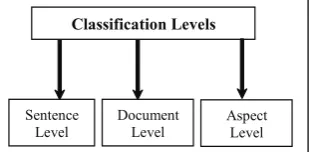
mining are used as synonyms in the context of sentiments and opinions of the people. It consists of three classification levels of
sentiment analysis such as- document, sentence and aspect which
are shown in fig. 1 as follows.
Sentence Level
Classification Levels
Document
Level Aspect Level
Fig. 1: Classification Levels of Sentiment Analysis
In the very first level i.e. document level we use it to classify an opinion document as expressing a positive or negative or neutral
sentiment.
Secondly in sentence level it’s about a sentence in which it is
determined whether each sentence expressed a positive, negative,
or neutral opinion. Neutral concludes nothing or we can say a
no opinion. It is related to subjectivity classification which
distinguishes sentences that tells the factual information from
sentences that express subjective nature and opinions performs. Last level is Aspect level was earlier known as feature level.
Despite of looking a language constructs like documents, paragraphs, sentences, clauses or phrases, this level will directly
looks at the opinion itself. It is totally based on the idea that an opinion consists of a sentiment that could be positive or negative and a target of opinion.
The rest of this paper is organised into different sections: Section II presents a background of sentiment analysis and its taxonomy.
Section III presents a brief review of papers as literature review. Section IV contains the different useful data mining techniques. Section V discusses the techniques, trends and data mining areas. Section VI concludes the paper while references are mentioned in the last.
II. Sentiment Analysis – A Background
Sentiment analysis or web opinion mining term was coined in the
year 1995.[2] There are various techniques of Sentiment analysis
such as machine learning algorithms, link analysis methods, and score based approaches in Machine learning approaches it could be grouped in two categories mainly supervised and unsupervised
techniques..In it the task Natural Language Processing techniques
play a vital role. And the supervised techniques, support vector
machines (SVM), Naive Bayes, Maximum Entropy are some of the
most common techniques used. Semantic Orientation Approach.
in it it performs classification based on positive and negative sentiment words and phrases contained in the each evaluated text
.Two types of techniques have been used in previous sentiment
classification research using the semantic orientation approaches. The corpus-based techniques: Corpus-based techniques is used to tried finding co-occurrence patterns of words to determine their sentiments.[3]The dictionary-based techniques.In it,it uses synonyms, antonyms and hierarchies in WordNet or other lexicons
with sentiment information to determine word sentiments.
Lexicon-based approaches.It is mainly rely on a sentiment lexicon, i.e., a collection of known and precompiled sentiment
terms, phrases and even idioms, developed for the traditional
genres of communication, such as the Opinion Finder lexicon; but, even more complex structures like ontologies, or dictionaries
measuring the semantic orientation of words or phrases can be used for this. Other Unsupervised Approaches Bootstrapping is another approach. The idea is to use the output of an available initial
classifier to create labeled data, to which a supervised learning
algorithm may be applied.
The taxonomy of sentiment analysis techniques is referred in fig. 2.
Sentiment Analysis
Machine Learning Approach
Supervised
Learning
Unsupervised
Learning
Semi-supervised
Learning Dictionary-based Approach
Corpus-based Approach
Lexicon -based Approach
III. Literature Survey
In this section, we present the a literature survey on the basis of past years of research papers and literatures carried out by several researchers in the sentiment analysis domain has been discussed.
In [4], C. C. Agarwal, C. X. Zhai, presented a survey in the field of
sentiment analysis and opinion mining and described aspect-based
sentiment analysis which exploits the full power of the abstract model. After that they briefly introduced the problem of analyzing
comparative sentences. Finally, they concluded the paper by saying that all the sentiment analysis tasks were very challenging and natural language processing had no easy problems.
In[5], Mike Thelwall, Kevan Buckley, Georgios Paltoglou have
given an algorithm Senti Strength for sentiment strength detection improved version in which the social websites directly indicates sentiment. Social web data sets like MySpace, Twitter, YouTube,
Digg, Runners World, BBC Forums indicates that SentiStrength
was successful in the sense of performing better than a baseline approach for all datasets in both supervised and unsupervised.
In[6], Vishal A. Kharde, S. S. Sonawane proposed a paper in
which they were used various machine learning algorithms like
Naive Bayes, Max Entropy, Support Vector Machine. The main
focus was on the study of combining machine learning method
into opinion lexicon method to improve the accuracy of sentiment classification and adaptive capacity to variety of domains and
different languages.
In[7], Jeevanandam Jotheeswaran,S. Koteeswaran proposed
method was evaluated using twitter data set. the proposed decision
forest based feature extraction improves the precision of the classifiers in the range of 12.49% to 62.5% when compared to PCA and by 49.5% to 62.5% when compared to decision tree
based feature selection.. Multilayer neural network is used for
classification. LVQ type learning models constitute popular
learning algorithms due to their simple learning rule, their intuitive
formulation of a classifier by means of prototypical locations in the data space, and their efficient applicability to any given number of classes. Movie review features obtained from Twitter was extracted
using inverse document frequency and the importance of the word
found. Principal component analysis was used for feature selection
based on the importance of the work with respect to the entire
document. It would be concluded from the experimental results that the LVQ. classifier performs better than the CART and Naive Bayes classifiers. proposed decision forest based feature selection improves the efficiency of the classifiers. Further investigations to improve the performance of LVQ are to be studied.
In[8], Federico Neri Carlo Aliprandi Federico Capeci Montserrat Cuadros Tomas It was described a Sentiment Analysis study performed on over than 1000 Facebook posts about newscasts,
comparing the sentiment for Rai – the Italian public broadcasting service - towards the emerging and more dynamic private company
La7. The study maps study results with observations made by the Osservatorio di Pavia, which was an Italian institute of research specialized in media analysis at theoretical and empirical level,
engaged in the analysis of political communication in the mass media.The study takes also in account of the data provided by Auditel regarding newscast audience, correlating the analysis of Social Media, of Facebook in particular, with measurable data, available to public domain. In it they described a Sentiment
Analysis study performed on over than 1000 Facebook posts
about newscasts, comparing the sentiment for Rai - theItalian public broadcasting service - towards the emerging and more
dynamic private company La7. It maps Sentiment Analysis on
Social Media with observations and measurable data. Its results
accurately reflect the reality as described by the Osservatorio di Pavia and Auditel, highlightening the importance of Facebook
as a platform for online marketing. Monitoring the social media activities is a good way to measure customers’ loyalty and interests, keeping track of their sentiment towards brands or products. The
study had been performed by a Knowledge Mining system used
by some security sector-related government institutions and
agencies in Italy to limit information overload in OSINT and Web
Mining. The linguistic and semantic approaches implemented in
this system enable the research, the analysis, the classification of
great volumes of heterogeneous documents, helping documental analysts to cut through the information labyrinth, analysts to take
account of complexity of public views, assigning automatically a sentiment polarity, rapidly accessing all the potential text of
interest.
In[9], Wu Hea, Shenghua Zhab,1, Ling Li ,Social media had been
adopted by many businesses. More and more companies were using social media tools such as Facebook and Twitter to provide various services and interact with customers.the large amount of user-generated content could be there on social media sites.
Companies are helped to understand how to perform a social
media competitive analysis and transform social media data into knowledge for decision.makers and e-marketers, the social media competitive analysis on the leading companies in an industry in a systemic way.They used the social media not only to promote their services, but also to bond with their customers. Findings from this study suggest that social media plays an important role in sustaining a positive relationship with customers.
In[10], Ming Hao,Christian Rohrdantz, Halldór Janetzko, Umeshwar Dayal,Daniel A. Keim*, Lars-Erik Haug, Mei-Chun Hsu, studied a large number of tweets included opinions about
products and services .the twitter became the interesting web, thus
the tweets were under utilized as a source for evaluating customer
sentiment. they introduced three novel time based visual sentiment
analysis techniques: topic-based sentiment analysis,stream analysis ,pixel cell-based sentiment They applied these techniques
to a variety of twitter data to show their distribution and patterns,
and to identify influential opinions.Their approach attempts to automatically analyze large volumes of twitter comments and
results commented on positively or negatively. The author
evaluated a novel topic-based text stream analysis technique that
automatically detects which attributes were frequently commented on in tweets, based on their density distribution, negativity, and
influence characteristics. Also presented two novel visualization techniques that help analysts explore the data in different ways from the previous methods using tag-cloud and radial visualization. In [11], Eman M.G. Younis presented, throughout which, twitter micro blogs data has been collected, pre-processed, analyzed and visualized using open source tools to perform text mining and sentiment analysis for analyzing user contributed online reviews about two giant retail stores in the UK namely Tesco and Asda stores over Christmas period 2014 The sentiment analysis of the
customer opinions makes it easier for businesses to understand their competitive value in a changing market and to understand their customer views about their products and services it had also use un-supervised techniques in sentiment analysis and opinion mining for improving the business competitive value and the customer relationship management. And also to comparing various
level classification on a set of about 2,624 tweets received during the run-up to the Irish General Elections in February 2011.superior
to various naive unsupervised approaches which use subjectivity
lexicons to compute an overall sentiment score for a <tweet,
political party> pair. introduced a new dataset of political tweets which would be made available for use by other researchers.
Each tweet in it set had been annotated for sentiment towards a political entity, as well as for the presence of sarcasm. Hence
they concluded that they could classify a tweet as being positive, negative or neutral towards a particular political party or party
leader with an accuracy of almost 59% using a simple approach based on lexicon lookup.
In[13] Asst. Prof. A Kowcika*, Aditi Gupta, Karthik Sondhi, Nishit Shivhre, Raunaq Kumar has proposed a system that was able to collect useful information from the twitter website and efficiently
perform sentiment analysis of tweets regarding the Smart phone
war. The system had used efficient scoring system for predicting
the user’s ageand the user’s gender predicted using a well trained
Naïve Bayes Classifier. Sentiment Classifier Model made the tweet with a sentiment. It helped in productively analyzing the data based
on various consumer features like location, gender and age group. alsop it was able to collect useful information from the twitter website and completely performed sentiment analysis on the data
and predict the user‘s age and gender using an efficient scoring system and a well trained Naïve Bayes Classifier, respectively. In [14], Kunpeng Zhang, Yu Cheng, Yusheng Xie, Daniel Honbo they developed a sentiment identification system called SES which implements three different sentiment identification algorithms. They arugment basic compositional semantic rules first algorithm., and then they thought sentiment should not be simply classified
as positive, negative, and objective but a continuous score to
reflect sentiment degree. All word scores are calculated based
on a large volume of customer reviews., they proposed a third algorithm which takes emoticons, negation word position, and
domain-specific words into account.Although, a machine learning
model was employed on features derived from outputs of three
algorithms.Thus, the results that utilizing Random Forest would
acquire a better accuracy than decision tree, neural network, and
logistic regression.they also proposed a flexible way to represent
document sentiment based on sentiments of each sentence
contained. SES is available online for second algorithm . In[15] , Diana Maynard, Mark A. Greenwood the reaction of
sarcasm scope on the polarity of tweets was analyised by the author, compiled a number of factors which could improve the accuracy of opinion mining when sarcasm was present. It was concluded that the effect of sentiment and sarcasm contained in
hashtags, and had developed a hashtag to keniser for GATE, so that
sentiment and sarcasm found within hashtags could be detected
more easily.Thus they concluded that the hashtag tokenisation 98% Precision, whereas sarcasm detection 91% Precision and polarity detection 80% has achieved . with their sentiment detection tools overall. Thus the tools were so perfect, that they exhibit advanced
over the state-of-the-art in certain aspects.
In [16], Soujanya Poria, Erik Cambria, Devamanyu Hazarika, Navonil Mazumder, Amir Zadeh
Louis-Philippe Morency, proposed a LSTM-based model that used for the utterances to capture contextual information from the surroundings in the same video, thus aiding the classification process. method shows 5-10% performance improvement over the state of the art and high robustness to generalizability. The contextual relationship among utterances in a video was mostly ignored in the literature.In it,they developed a LSTM-based
network to extract contextual features from the utterances of a
video for multimodal sentiment analysis. The proposed method
had outperformed the state of the art and showed significant
performance improvement over the baseline.
In[17] Debreceny, Glen L. Gray has done an important form
of audit evidence was corporate email, which included the
background, intent, and outcome of managerial actions. Emails were semi-structured data, fields for sender, recipient, subject, and
date, as well as the email body and attachments. Data mining of
emails (DME) combines understanding of social networks, textual
analysis using natural language processing and other techniques,
and domain knowledge. Email data mining research received a
considerable boost by the availability of a large archive of emails
from the now-defunct Enron Corporation. It provides an overview of DME techniques, and the potential expanded applications of DME by auditors.
In[18] Necmiye Genc-Nayebi∗ , Alain Abran, In the study it has been examined that online product reviews, there were now some
academic studies focused on mobile app stores and user reviews. The objectives of the systematic literature review were identify the proposed solutions for mining online opinions in app store user reviews, challenges and unsolved problems in the domain, any new contributions to software requirements evolution. The mobile app ecosystem and user reviews contain a wealth of information
about user experience and expectations. Developers and app store
regulators could leverage the information to better understand their audience. Mining opinions from app store reviews still
requires pre-processing at the content level, including filtering
out non-opinionated content and identifying the trustworthiness and genuineness of the opinion and its source.. Developers and app store regulators could leverage reviews to better understand
their audience. Here, they presented their principal findings from the SLR.
In[19]Syed Akib AnwarHridoy,Tahmid Ekram, Mohammad Samiul Islam,Faysal Ahmed Rashedur M. Rahman] In it they we have discussed a methodology which allows utilization
and interpretation of twitter data to determine public opinions.
Analysis was done on tweets about the iPhone 6. Feature specific popularities and male–female specific analysis had been included.
In it ,they discussed a methodology by which it was possible to determine the popularity/opinion/sentiment of a product in
different locations across male and female users.Each individual
word in every tweet was assigned its own part of speech tag..The NamSor mining tools was used to categorise genders for each
of the tweets.The accuracy of the classification was also high specially because of NamSor’s statistical claim over 96 % of
the names from the United States were given correct gender
classifications. Finally the data was presented graphically and
several comparisons to real world scenarios were made to justify the accuracy of the methodology.The purely reduction were the
increasingly generalized negative sentiments towards the iPhone 6 screen and touch because of the bending issue plaguing iPhone 6 users since its release and sharpness.
In[20] Upma Kumari, Dinesh Soni, Dr. Arvind K Sharma,In this
paper the authors present a cognitive study of various techniques and tools which have been used in the sentiment analysis process. In this paper a cognitive study of sentiment analysis techniques and tools has been presented. The proposed methodology provides
important phases the sentiment of text, whether it is positive or
In [21] Pradeep Kumar Agarwal, Dr. Arvind K Sharma, This
paper presents the various web opinion mining techniques and tools which have been used to track the opinion or polarity from the user generated contents i.e. review sites, forums, discussion groups, blogs, products etc. This paper covers all opinion mining
techniques which have been used to extract the opinions from the
social networking sites to identify the opinion of the online users i.e. positive or negative.
IV. Proposed Methodology
In this section we are going to propose a methodology for the proposed work, the importance and familiarity of sentiment
classification by using machine learning techniques has been utilized in the recent research paper. (Referred in Appendix-1)
A. Data Sources
This section discusses about the data sources to be used for opinion mining. There are various data sources available on web, i.e. Blogs, Micro blogs, online posts, News feeds, Forums, review sites etc.
Here the data can be in the form of speech, text, gestures, etc.
Blogs:
• Now-a-days people express their opinions or views
about a particular topic, product, service, event or issue on a particular place called blogs. The name associated to universe of all the blog sites is called .
Review Sites:
• Companies consider the reviews of customer in
order to provide proper products and services. These reviews are stated on sites such as www.amazon.com, www.yelp.
com,www.reviewcenter.com, www. CNET.com
Data Sets:
• We can take dataset from many websites like Amazon, Myntra and other online shopping sites for performing Opinion Mining process which includes analyzing
the reviews that are posted by the customers or users on various products.
Micro Blogging:
• The practice of creating and publishing small posts on a personal blog on a micro blogging websites. e.g. A “tweet” on twitter could be a microblog post.
Forums:
• An Internet forum, or message board, is an online discussion site where people can hold conversations in the form of posted messages.
Online Posts:
• people share their own ideas, opinions, photos,
videos, views, likes, dislikes, comments on specific topics
etc.
World Wide Web (WWW)
Sentiments (Information Retrieval)
People’s Feelings (Gathered Text)
Classification of Text
Positive
Comment Comment Negative
Summarisation of Comments
Opinionated Summary
V. Sentiment Analysis Issues
There are various issues of Sentiment analysis namely -A. Domain dependence
B. Spam and fake detection
C. Language problem
D. Named entity identification E. Biopolar words
F. Huge lexicon
A. Domain Dependence
Domain-dependence opinion words is A MAJOR problem in opinion mining, which facilitates the extraction of opinions from text. Although, existing work pay close attention to adjectives and
verbs, only limited work focuses on noun and noun phrases.
B. Spam and Fake Detection
With the explosive growth of social media. The fake reviews are
also increasing. The fake reviews reffered to bugs called fake reviews which misguids the users and customers by providing them untruthful negative or positive sentiments related to any entity and in order to lower the reputation of an entity.So these spams makes sentiment opinions useless in various applications.
C. Language Problem
The English language is mostly used during the sentiment
analysis but the researchers get attracted with many other
language i.e Arabic,Chinese,german, French,urdu etc.due to this
researchers are due to this the researchers are facing challenge
for developing resource like lexicon, dicitionaries and corpus for
these language.
D. Named Entity Identification
The detection of Person entities in images can be acheived
in a fairly robust manner by detecting human faces, and face recognition technologies can help recognise and disambiguate
the specific person.
VI. Conclusion
In sentiment analysis people’s opinions sentiments and experience
have been considered valuable information for decision-making process. Nowaday, many websites encourages users to impress their views , opinions ,emotions and suggestions related to a particular product, personality, service, governance, policies etc.
In this, context the extraction of useful information from these
opinions becomes a challenging task. So, this situation encounters a new era of research i.e. called sentiment analysis. This paper discusses about various aspects of sentiment analysis and research challenges and research scope of sentiment analysis. In future this paper opens a new doors for the researchers of this domain .In future, we will propose a framework by using the aspect level sentiment analysis.
References
[1] C. C. Agarwal, C. X. Zhai,"A Survey of Opinion Mining and Sentiment Analysis", Springer Science, Business Media, LLC, 2012.
[2] Mike Thelwall, Kevan Buckley, Georgios Paltoglou, "Sentiment Strength Detection for the Social Web", This is a preprint of an article published in the Journal of the American
Society for Information Science and Technology.
of Computer Applications, Vol. 139, No. 11, 2016.
[4] Jeevanandam Jotheeswaran,S. Koteeswaran,"Feature
Selection using Random Forest method for Sentiment
Analysis", Indian Journal of Science and Technology, Vol 9(3), 2016.
[5] Federico Neri Carlo Aliprandi Federico Capeci Montserrat Cuadros Tomas,"Sentiment Analysis on Social Media", 2012 IEEE/ACM International Conference on Advances in Social
Networks Analysis and Mining.
[6] Wu Hea, Shenghua Zhab, Ling Li,"Social media competitive analysis and text mining: A case study in the pizza industry", International Journal of Information Management 2013 Elsevier Ltd.
[7] Ming Hao, Christian Rohrdantz, Halldór Janetzko, Umeshwar Dayal, Daniel A. Keim, Lars-Erik Haug, Mei-Chun Hsu, "Visual Sentiment Analysis on Twitter Data Streams", 2011 IEEE Conference on Visual Analytics Science and Technology (VAST 2011): Proceedings of a meeting held 23-28, October 2011
[8] Eman M.G. Younis,"Sentiment Analysis and Text Mining for Social Media Microblogs using Open Source Tools: An Empirical study, International Journal of Computer Applications, Vol. 112, No. 5, 2015.
[9] Akshat Bakliwal, Jennifer Foster, Jennifer van der Puil, Ron O’Brien, Lamia Tounsi, Mark Hughes,"Sentiment Analysis of Political Tweets: Towards an Accurate Classifier", Proceedings of the Workshop on Language in Social Media (LASM 2013), pp. 49–58.
[10] Asst. Prof. A Kowcika, Aditi Gupta, Karthik Sondhi, Nishit Shivhre, Raunaq Kumar,"Sentiment Analysis for Social
Media", Vol. 3, Issue 7, 2013.
[11] Kunpeng Zhang, Yu Cheng, Yusheng Xie, Daniel Honbo, "SES: Sentiment Elicitation System for Social Media Data", 2011, 11th IEEE International Conference on Data Mining Workshops.
[12] Diana Maynard, Mark A. Greenwood,"Who cares about
sarcastic tweets? Investigating the impact of sarcasm on
sentimental analysis".
[13] Soujanya Poria, Erik Cambria, Devamanyu Hazarika, Navonil Mazumder, Amir Zadeh Louis-Philippe Morency,"Context-Dependent Sentiment Analysis in User-Generated Videos", Proceedings of the 55th Annual Meeting of the Association for Computational Linguistics, pp. 873–883.
[14] Debreceny, Glen L. Gray,"Data Mining of Electronic Mail and Auditing: A Research Agenda", R Journal of Information Systems: 2011, Vol. 25, No. 2oger S.
[15] Necmiye Genc-Nayebi, Alain Abran,"A systematic literature review: Opinion mining studies from mobile app store user reviews", The Journal of Systems and Software.
[16] Syed Akib AnwarHridoy, Tahmid Ekram, Mohammad Samiul Islam, Faysal Ahmed Rashedur M. Rahman,"Localized twitter opinion mining using sentiment analysis".
[17] Upma Kumari, Dinesh Soni, Dr. Arvind K Sharma,"A Cognitive Study of Sentiment Analysis Techniques and Tools: A Survey", IJCST Vol. 8, Issue 1, Jan - March 2017. [18] Pradeep Kumar Agarwal, Dr. Arvind K Sharma,"Web Opinion
Mining Techniques and Tools for Finding User’s Opinion", International Journal of Innovations & Advancement in Computer Science IJIACS, Vol. 5, Issue 9, 2016.
Appendix – 1
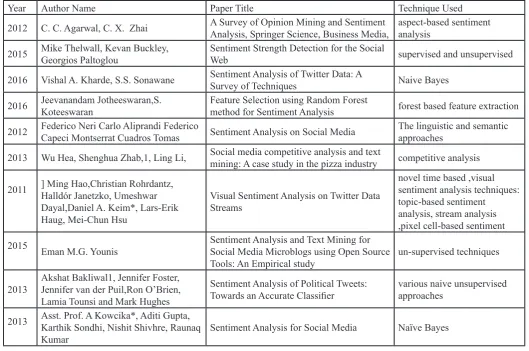
Table 1: Comparative Study of Sentiment Analysis Techniques
Year Author Name Paper Title Technique Used
2012 C. C. Agarwal, C. X. Zhai A Survey of Opinion Mining and Sentiment Analysis, Springer Science, Business Media, aspect-based sentiment analysis
2015 Mike Thelwall, Kevan Buckley, Georgios Paltoglou Sentiment Strength Detection for the Social Web supervised and unsupervised
2016 Vishal A. Kharde, S.S. Sonawane Sentiment Analysis of Twitter Data: A Survey of Techniques Naive Bayes
2016 Jeevanandam Jotheeswaran,S. Koteeswaran Feature Selection using Random Forest method for Sentiment Analysis forest based feature extraction
2012 Federico Neri Carlo Aliprandi Federico Capeci Montserrat Cuadros Tomas Sentiment Analysis on Social Media The linguistic and semantic approaches
2013 Wu Hea, Shenghua Zhab,1, Ling Li, Social media competitive analysis and text mining: A case study in the pizza industry competitive analysis
2011 ] Ming Hao,Christian Rohrdantz, Halldór Janetzko, Umeshwar Dayal,Daniel A. Keim*, Lars-Erik Haug, Mei-Chun Hsu
Visual Sentiment Analysis on Twitter Data Streams
novel time based ,visual
sentiment analysis techniques:
topic-based sentiment analysis, stream analysis
,pixel cell-based sentiment 2015 Eman M.G. Younis Sentiment Analysis and Text Mining for Social Media Microblogs using Open Source
Tools: An Empirical study un-supervised techniques
2013 Akshat Bakliwal1, Jennifer Foster, Jennifer van der Puil,Ron O’Brien, Lamia Tounsi and Mark Hughes
Sentiment Analysis of Political Tweets:
Towards an Accurate Classifier various naive unsupervised approaches
2013 Asst. Prof. A Kowcika*, Aditi Gupta, Karthik Sondhi, Nishit Shivhre, Raunaq
2011 Kunpeng Zhang, Yu Cheng, Yusheng Xie, Daniel Honbo SES: Sentiment Elicitation System for Social Media Data Random Forest
2011
Ming Hao,Christian Rohrdantz, Halldór Janetzko, Umeshwar Dayal,Daniel A. Keim*, Lars-Erik Haug, Mei-Chun Hsu,
Data Mining of Electronic Mail and
Auditing Text mining
2017 Upma Kumari, Dinesh Soni, Dr. Arvind K Sharma A Cognitive Study of Sentiment Analysis Techniques and Tools: A Survey Text based