Abstract
The policy makers in the post liberalization foreseeing the unequal income distributions which will widen the gap between the haves class and have-nots class in the society, took a different path than that of the earlier mechanisms to bridge the gap in the society in India. Obviously the government needs to extend various basic amenities and to support the underprivileged. One of the most important of the policies is to address the issues that the financially excluded population and intricacies government would face due to exclusion; and thus devised extension of banking and financial services through Microfinance to cater to the excluded. Accordingly, the policy initiatives on financial inclusion, a holistic approach initiating multiple services like providing insurance, payments and remittances, besides enabling financial discipline through saving and extending support to have income-generating activities to unbanked rural segment was made possible. In this backdrop, this paper makes an attempt to identify the significance and major initiatives taken for growth of Microfinance in India, how it facilitated the financially excluded with services, how the ecosystem and framework of MFIs is supporting the cause and the important challenges that MFIs faced are elaborated.
Keywords: Microfinance - MFI Ecosystem - Key Challenges
Introduction
Indian economy, post-Independence has adopted socialistic approach in its policy framework. However, in 1991, with the adoption of liberalization, privatization and globalization measures, the economy slowly tilted from its socialistic pattern dominance towards capitalistic approach. The countries across the globe had the trends of development witnessed with private players in the process of industrialization. India, post liberalization, has witnessed similar development and policy reforms as is evident have immensely contributed to economic growth. However, it is evident that such developments in various economies have resulted in unequal income distribution as capital and resources flew to some sections of the society. Indian economy too witnessed a distribution of wealth became highly unequal Walton (2010) . As a result, some sections of the population or segments gained more from the higher growth than the rest of the sections.
* C. Anitha is a Research Scholar at JNTU Hyderabad and is working as Asst. Professor at IBS Hyderabad, IFHE University.. ** Dr. D. Raghunatha Reddy, Professor in Management Studies, SMS, JNTU Hyderabad.
Evolution and Emerging Role of MFIs
in Indian Microfinance Sector
– C. Anitha*
In India, the government nationalized major banks in 1969 and 1974 to direct them lend to the budding entrepreneurs and agriculture and that have been listed in priority sector to reach out to rural segment. The credit to rural segment of unbanked population was through two sources formal and informal. According to the AIDIS , there are two categories of agencies which provide rural credit (refer Box -1) in India. The first being 'institutional agencies' were: government, co-operative agencies, commercial banks including regional rural banks, insurance, provident fund, financial Corporation/ institution, and financial company and 'other institutional agencies'. The later include 'non-institutional agencies' were: landlord, agriculturist money lender, professional money lender, trader, relatives and friends, doctors, lawyers and other professionals, and 'others'.
According to 2011 Census data, 68.8 per cent of Indians live in rural areas and nearly 75 per cent of rural households, the main earning family member makes less than Rs. 5,000 per month (or Rs. 60,000 annually). Basu et al (2005) India's rural poor currently have very little access to finance from formal sources. Currently, one of the biggest challenges increasing wealth concentration in the hands of a privileged few Indians (George).
Box:1
Different Types of Micro-credit providers in India Domestic Commercial Banks
Public Sector Banks;
Private Sector Banks & Local Area Banks Regional Rural Banks
Co-operative Banks
Unregistered Non-Banking Financial Corporations Registered Non-Banking Financial Corporations,
Co-operative Societies Small Finance Banks.
Compiled by Author
The banks were supposed to render banking and financial services across the country to every one including economically weak; however the efforts of banks because of various reasons could not fructify. Primary of the reasons is due to high costs and high risks that are associated with extending services to the economically weak (transaction costs) and non-availability of acceptable collaterals, key formal documents (identity proofs), volume of transactions, illiteracy and lower profitability in most cases, banks and financial institutions have distanced from extending credit and as well as services to the economically weak.
The policies of the government and strategies were unable to address the issues and challenges of financial exclusion even after post nationalization of banks and other initiatives.
growth in the developing and developed economies. Microfinance refers to a movement that envisions a world in which low-income households have access to a range of good quality and affordable financial services like credit and savings, insurance, payments and remittances, besides financing income-generating activities. The experiences from other emerging economies, and realization of significance of financial inclusion by Indian government led to adoption of microfinance as a tool to alleviate people from poverty and focus on inclusive growth with equal access to opportunities to a greater extent than ever before.
Review of Literature
Joseph Massey, et al.,( 2010), paper discusses the significance of financial inclusion in a developing economy and acknowledges the vital role played by financial institutions for the same. The role and efforts made by the government and financial institutions in promoting financial inclusion can be deepened by pro-active players in capital market.
Nair (2001) study presents the development and status, strategic overview and significant issues in the process of institutionalizing micro finance in India. According to the author, the success of Micro Finance Institutions is measured thorough three levels of efficacy - outreach and financial sustainability, income or impact of poverty on the users and local development of financial market. The study observes that at least half of the mF institutions are without proper legal sanction for banking business, and finds that there is an urgent need to streamline the norms and institutions to govern micro finance industry to safe guard the interests of the borrowers to alleviate poverty through resource distribution.
Pramanik et al. (2013), study explains that Microfinance has gone beyond the means of delivering the financial services as a channel and turned out to be a focal point for supply various services to the poor. The study delineates the trends and progress under MF sector under two models - SHG-Bank Linkage Model (objectives, principles, credit velocity and benefits) & MFI-Bank Linkage Model(funding related issues).The study suggests that SHGs should not only look at extending credit, but induce goal oriented savings products using technology for door step banking needs to members of SHGs. Ningshen et al. (2014), in the paper presents the existing scenario of microfinance, Institutional frame work of MFIs such as NBFCs, Section 25 Companies, Cooperatives, MACS and societies/ Trusts. Further, paper discusses lending models like -Grameen, SHG and SHG bank Linkage Model and their growth, performance and regional distribution; Besides updating the MFIs development and regulation Bill post 2011, the study concludes that Indian MFIs are showing recovery trends after crisis. Further, they emphasize that charging amicable interest rates (for clients as well as MFIs) for sustainability and client outreach and penetration for orderly development of MFIs.
posed by these issues are highlighted. This paper discusses few International transformation experiences - Bolivian, BancoSol transformation of an NGO to an MFO bank; Further, the paper narrates various institutional transformational experiences and highlights the options available to MFOs and their implications. The study additionally mentions that if regulatory norms are eased for entry, several other institutions come in claiming to be MFOs, the microfinance sector will encounter credibility crisis.
Jayadev M et al (2012) in their conceptual note discusses the important models of microfinance viz SHG - Bank linkage model, NBFC-MFI model and the model of trusts and associations. Further analyzes various sources of finance available to MFI, such as savings and deposits, philanthropic and social sources, soft loans and grants, investment funds, micro finance investment vehicles, quasi-equity, non-convertible debentures, bank loans, private equity from capital markets etc,. and suggest how securitization can be good source of financing MFIs.
Study concludes with a remark that the MFI, which are intended to alleviate poverty in the society, are not able to give the desired results due to multiple / over finance by different financial institutions and hence there is a dire need for developing a suitable model for financing the rural poor. Pole et al. (2014) conducted post Ordinance by Government of AP, when MFIs were facing liquidity issues and were struggling to for financial sustenance , study finds out various funding methods for MFIs - Equity, Non-Convertible Debentures, External Commercial Borrowings and Commercial Papers with relevant institutional case examples. Further, the study brings out innovative way of MFI funding through securitization, with relevant cases of Microloans discusses inherent risks and benefits related to securitization and how it can help both banks as well as MFIs suffering from lack of funds.
Kumar et al (2007) brings out one of the important risks that may affect the clients of MFIs, if the later were to face external environmental risks such as - natural disaster, economic crisis or civil conflicts and discusses the requirement of two fold preparedness - internal and external for MFIs. Besides ,the authors identifies some of the critical factors like capable human resources, requirement of sound -MIS, financial management and accounting systems and institutional MIS and clients for sustaining through critical times.
Vijeta et al (2015) in a case study, considered three MFIs namely Cashpor Microcredit, Utkarsh Microfinance Pvt Ltd and SKS Microfinance Pvt Ltd and studied how the adoption of ICT has facilitated in increased outreach and cost reduction. Further, study discusses how the deployment of Information and communication technology (ICT) have scaled up the access to funds in micro finance sector, enhanced outreach and lowered transaction costs; the impact of ICT in the context of work efficiency, client management and risk management were also highlighted.
Objectives of the study
turn facilitates the economic and sustainable development of any nation. Micro finance being one of the emerging tools in financial inclusion, and MFIs playing a key role in facilitating the same, the study attempts to:
• Understand the evolution of microfinance and MF sector in India;
• Study the emergence and role played by Micro Finance Institutions in India; • Study the ecosystem: framework for MFIs; and
• List the key challenges faced by MFIs in India.
Methodology of the Study
To achieve the objective of the study the following ratio analysis and trend analysis is used.
Data Source: Microfinance is an emerging sector, there is no information available in public or private domains excepting the information compiled by SROs like (MFIN & SaDhan) and their published information in the form of sector reports or averages. Secondary data for this study is compiled and used from sources like MFIN - Micro meter, Bharat Microfinance Report published by Sa-Dhan. These are the only two major Self-Regulatory Organizations of MFIs, provides sources of information .
Features of Microfinance
The features of microfinance distinct from credit lending in India are as follows:
• Target segments: Unlike the traditional banking businesses, microfinance caters to low-income segments. Clients avail loans small (Up to Rs. 1 lakh) , short term and unsecured in nature. • Interest rate: The interest rate charged for the clients is slightly on the higher side
(12.5-24%), more than average bank interest charged as the operational costs for the institutions offering micro credit is high.
• Collaterals: The clients availing various forms of microfinance loans without any collaterals.
• Modes of Repayment: Unlike the traditional credit offered by banks, the terms of repayment is made by the frequency of earning patterns of the clients - weekly or fortnightly. Clients with good track records are rewarded and are offered larger loans in future.
• Group Lending: Unlike the traditional lending, the loans are lent to a group. The loan is given to a group of 10-15 people rather than an individual to ensure peer pressure to repay loan. As this provides cross guarantees to each other and any default by one member, liability would lie on the group and would affect the credit worthiness of whole group.
of credit worthiness of the microfinance client is done by visiting his house or business and assessing his character and ability and willingness to pay.
Evolution of Microfinance Sector
In India, the emergence of first micro finance was through informal Self Help Groups (SHGs) to provide savings and credit services. However, not much growth or development was witnessed till liberalization in 1991. As seen in table-1, post 2002, RBI initiatives like provisioning of unsecured lending and MFI lending as priority sector, the industry witnessed growth.
Prior to the AP microfinance crisis, according to M-CRIL microfinance Review 2012, this sector recorded a 62% phenomenal growth in terms of numbers of unique clients and 88 percent per annum in terms of portfolio (2005-2010). During 2010, the AP crisis, the growth of Indian microfinance sector substantially slowed down due to allegations of high lending rates, pouching of customers from SHGs, multiple lending to customers coupled with coercive collection practices had resulted in borrower's suicides. All this took a while for the crisis to sub-due; with Government's Ordinance, implementation of Microfinance bill with the suggestions made by Malegam committee and several initiatives by RBI's inclusive drive (selective credit control, lending to weaker sections of the society and enhancing financial literacy) had put the micro finance industry back on growth track.
Snap shot : Evolution of MFI sector in India (Table: 1)
Early period
1974: Shri Mahila Sewa Sahakari Bank one of the First forms of Micro finance; (owned and managed by women to provide financial services to women in the unorganized sector).
1982: NABARD Established
1984: NABARD advocated SHG linkage: important tool for poverty alleviation.
Progress, Growth and crisis
2002: RBI issues: provisioning norm for the unsecured lending on par with other secured loan to SHGs.
2004: The RBI includes: MFI lending as priority sector, for financial Inclusion
2006: The Government shuts down: Few microfinance companies branches- due to: high interest rates, unethical recovery practices and poaching clients from SHGs.
2007: Private Equity players Entry: due to favorable regulations into the market.
2008: ICAI Technical Guide on Accounting for Microfinance Institutions, with 29 accounting Standards
2009: Microfinance institutions Network (MFIN) launched, financial inclusion tool: All NBFC-MFI Association.
2010: borrowers default : on MFI loans in AP: coercive debt collection practices led poor borrowers to suicide.
o Government ordinance: to clamp down on MFI activities.
2011 : RBI releases Malegam Committee regulations
o RBI issues: norms for categorisation of bank loans; priority sector loans facilities
to MFIs
o RBI introduces: new category of NBFC MFI
o Govt Initiatives : Microfinance Equity Fund of `100 crore and SHG Fund of `500
crore Consolidation and maturity
2012: The Malegam committee recommendations: fully implemented and industry back on the growth path
o RBI to be the sole regulator to microfinance industry
o Margin cap revised: from 12% to 10% (for MFIs with portfolios > Rs.1,000
million)
2014: The RBI issues: universal Banking license to Bandhan, (the largest micro lender in India in terms of assets).
o MFIN was formally recognized by the RBI as a self-regulatory organization (SRO).
o PMJDY launched: to provide bank account and Insurance cover.
2015: The Government launched MUDRA Bank to help finance small businesses.
o Sa-Dhan was formally recognized by the RBI as a self-regulatory organization
(SRO).
o RBI eases lending norms for MFI companies
o RBI Grants : Licence to to 8 MFI companies as Small Finance Bank licence o Committee on Medium-Term Path on Financial Inclusion : Deepak Mohanty
Committee
Emerging role of MFIs in Micro Finance Industry
Post financial crisis in Andhra Pradesh (2010), microfinance industry emerged and was consolidated. The market witnessed numerous, small and medium non-profit players (refer Table 2) gave way their way to one dominated by fewer large commercial players that were successfully attracting equity and debt capital, human resources and clients at a fast rate.
As per Bharat Microfinance report , MFIs have extended loans and/or credit services of small value, high volume transactions with unbanked or under banked sections of the poor. MFIs played multiple roles by acting as banks' Business Correspondents, linking the Self Help Groups, providing insurance services as agents of insurance service providers and also offering money transfer services to migrant workers. Acknowledging the leading role in financial inclusion that is being by MFIs, Reserve Bank of India (RBI) has extended policy support for MFIs by including them under priority sector to get the credit from banking sector.
Table: 2 Size of MFIs
Loans Small Medium Large
Gross loan Portfolio
Less than Rs. 5 Cr. Between 5 cr &20 cr. Above 20 cr.
Client outreach Less than 10,000 10,000 to 50,000 Above 50,000
Age (institutional experience in MF)
1 to 5 years 5 -10 years 10 years and above
Source: Quick Report 2007, a snapshot of MFIs in India.
As per Bharat Micro Finance Report (BMR) 2016 , the microfinance service providing Institutions have gone up from a few to several hundreds and the quantum of credit made available to the poor has gone past Rs.60,000 crore; where 12,221 employees have reached catering close to 40 million clients. In India, MFIs operations are spread in 29 States, 4 Union Territories and 588 districts; and currently, there are 166 MFIs with a branch network as against 54 MFIs in 2002 with an outstanding loan portfolio of Rs 63,853 crore against Rs 2145cr in 2002.
MFIN , Microfinance Industry In India has a total loan portfolio of Rs. 10916 cr, with a growth of 26% over the last year. The estimated Gross Loan Portfolio is around 90% excluding portfolios of Self Help Groups. The key lenders (refer table 3) in this catergory are - NBFC-MFIs, Banks, Small Finance Banks (SFBs), NBFCs and Non- Profit MFIs have been compiled.
Source: MFIN Micro Meter 2016; Figure 1 represents the growth of loans outstanding represented by 46 NBFC-MFIs (reporting to MFIN), top 10 private sector banks, 6NBFCs and 5 small finance banks
and two Non-profit MFIs.
As per the data sourced from MFIN Micrometer 2016, there are 12 small (book loan less than Rs 1bn) MFIs, 22 medium - sized MFIs (loan book ranging from (more than Rs. 1 bn to less than Rs. 5bn) and 22 large MFIs (more than Rs. 5 bn). Mostly 90% of the Industry's Gross Loan Portfolio (GLP) is accounted by large MFIs. During the Financial year 16-17, NFBC-MFI extended 42%, Banks extended 38%, SFBs extended 14% and rest of 7% of Micro finance lending was done by NBFCs and Non-profit MFIs (refer Figure -2).
times, some MFIs operate in a limited geographical area, to have better understanding of the issues specific to such area.
MFIs: Client Out Reach
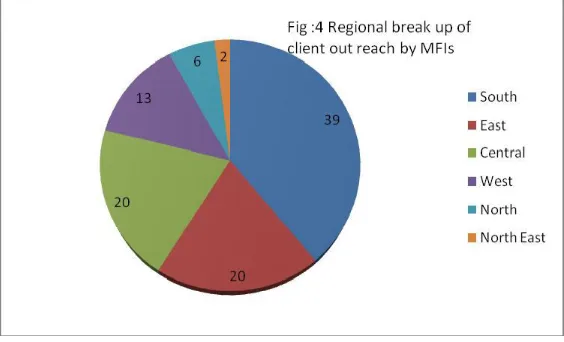
According to BMR 2016, Indian MFIs have a the total client base of 399 lakh, Of which, Southern region alone contributes to 39% . While both East and Central contribute to West and North have 13% and 6% of total outreach respectively. Northeast has the least client outreach numbers with 2%.As per the figure :4, almost 80% of mf activities of MFIs are spread across South, Central and Eastern parts of India and there is a huge scope for development in North and Western region.
Source : BMR 2016
Organizational Structure of MFIs in India
Table :3 : No of MFIs across Legal formSociety 78
Trust 19
Section 8 Company (sec 25 under 1956 Act)
29
Cooperative or MACS 12
Local Area Bank 1
NBFC 13
NBFC -MFI 71
Total 223
Source: Microfinance sector : A snapshot of 2015-16, by Sadhan
In India, there are diverse legal and Institutional forms of MFI models exist (refer table 3). These institutions are witnessed in various forms and can be broadly categorized into three forms:
a. The not-for-profit MFIs (NGO-MFIs): societies (registered under the Societies Registration Act, 1860), trusts (registered under the Indian Trust Act, 1882/Public Trust Act, 1920) and Section 25 Companies registered under Section 25 of the Companies Act, 1956.
b. Co-operatives (registered under the Mutually Aided Cooperative Societies Acts of the States MACS)
c. For-profit MFIs: NBFC registered under Companies Act, 1956 and with RBI). NBFC-MFI: RBI Circular , May 2011
Costs
Initially, as per the Report , the costs of MFIs were classified as (i) administrative (or operational) cost, and (b) financial cost. The administrative cost were broken down two components into - personnel costs (on salary expenses and other incentives provided to staff) and other administrative costs (such as travel, stay, stationary, depreciation, taxes and so on). Later, the costs were categorized into three broad overheads viz. Personnel Cost or Staff Cost, Overhead or Administrative Cost and Finance Cost or Funding Cost.
The financial costs comprises of interest and fee paid on borrowings and loan loss provisions and dividends paid to shareholders (in case if MFI has equity base in its capital structure). Further, report notes that a typical MFI would incur about just more than half of its total expense on administration and operations and the remaining goes towards meeting financial cost.
Source: BMR 2016
Box : 2 Product s and services offered by MFIs
Micro-Savings:
- Krishna Bhima Samruddhi Local Area Bank Ltd. finances over 80% of its loan portfolio by actively mobilising
savings.
The Self-Help Group (SHG): concept is based on thrift and is expected to cultivate the regular savings habit among
members. Sa-Dhan member MFIs train SHG-members to build up and rotate these savings as loans among
themselves before they are linked to bank credit. The credit limit itself is decided by banks based on a gr aduated
savings-credit ratio.
Micro-Credit:
- Income Generating Loan: Most MFIs offer a loan repayment pe riod of up to 52 weeks, while Federations offer
SHGs up to 3 years and Sewa Bank up to 5 years.
- Emergency loan: e. g. SKS (AP-based, operates all over India), Grameen Koota (Karnataka), Sonata (UP). -
Personal loan: e. g. Share Microfin (AP-based, operates all over India).
- Supplementary/top-up loan: e. g. Nirantara (Karnataka).
- Festival and health loans. - Family needs loan & housing loans: e. g.Ujjivan (Karnataka; only 22% of Ujjivan’s
clients took business loans, the rest have opted for family needs loans).
- Education loan: e. g. Mahasema m Trust.
- Vehicle loan: e. g. Hindusthan (Mumbai)
Micro-Insurance:
- Health Insurance: e. g. SKS, BASIX (both AP-based, operate all over India).
- Life Insurance: e. g. Grameen Koota - Pension Insurance: e. g. Sewa Bank ( Gujarat; with UTI Retirement Benefit
Pension Fund).
- Cattle Insurance: e. g. BASIX, Grameen Koota.
Ecosystem: Framework of MFIs
Ecosystem of MFIs constitute of network of organizations - including supplier of funds, investors, customers, competitors, associations regulators and other partners - involved in the delivery of a specific product or service through both competition and cooperation or an association to guide MFIs, let us look at the various stake holders which interact with MFIs:
Stake holders: The parties hold an interest with ongoing activities of MFIs as they would directly or indirectly get influenced by the decision of the latter. The following are the stakeholders for MFIs:
• Investors: this category constitutes of conventional equity shareholders, private equity and people who invested through non-conventional ways like crowd funding (large number of people pool the capital through websites and social media). Debenture holders who invest by providing debt capital to MFIs.
• Lenders: includes banks and other financial Institutions (insurance and Asset Management Companies) and other entities like donors or trustees.
• Customers: constitutes of people who avail products and services provided by MFIs, mostly located in geographical segments of rural and semi-urban areas. Most of these customers are deprived of formal banking and financial services.
• Partners: includes strategic business partners such as NGOs, banks, financial institutions, insurance companies and others who tie up with MFIs to offer products or services to the customers along with latter.
• Regulators: The RBI along with Government of India guide and regulate the MFIs. Besides them, SIDBI, NABARD and MUDRA Bank (set up in 2015) also facilitate in regulating this segment. • Associations: Besides the above mentioned regulators, RBI gave special status to Micro-Financial Institutions Network (MFIN) and Sa-Dhan as Self-Regulatory Organizations (SROs) to enhance self-regulation. Further, these associations facilitate in data collection of MFIs to monitor the growth and progress of the industry and also provide counseling, training and consulting to enrich the growth of MFIs.
Ecosystem: Frame work and Key Challenges
Funding and Risk management framework
Unlike banks, MFIs cannot receive any funds on their own to lend to customers. MFIs have to depend on external sources such as grants, loans from banks and Developmental Financial Institutions, and traditional sources of equity and debt for meeting their operational requirements.
According to Sousa-Shields Frame work (2004) most of the MFIs start their journey as NGOs, receive strategic support from donors or trusts till their maturity and would tap traditional sources like debt or equity to fund and enhance their sustainability. The loans from Developmental Financial Institutions such as (SIDBI, RGVN, FWWB, RMK and NABARD) but could not cater to the large number of MFIs, especially NGO-MFI. MFIs turned NBFCs from NGOs find it easy to raise funds through equity, for instance, large MFIs like SKS and others found equity, as an easy route to lure investors and used capital markets. Further, microfinance industry has also witnessed deals through private equity, Non-Convertible Debentures (NCDs), Commercial Paper and subordinated debts by MFIs refer chart 2 .
Funding challenges are different across the MFIs based on size and segment of institution. Large and sometimes medium sized NBFC-MFIs are fairly comfortable to procure funds through equity or debt.
Risk management
A MFI is subjected to similar risks like any other bank or Financial Institution. These risks include credit, operational, financial and strategic risks. Credit risk (default risk): lending being an inherent activity, MFI is exposed to credit risk if borrowers were to default. As MFI caters to vulnerable and economically weaker sections of the society, this risk can be more prominent. Operational risk: these risks arise when MFI carries its day to day operations and arises out of people, processes and systems and at times due to external events. Financial risk: A MFI can be subjected to this type of risk if it has leverage or debt in its capital structure. Strategic risk: If a MFI adopts unknowingly or knowingly inappropriate strategic choices, this could lead to this type of risk. Concentration risk: MFI can expose to specific geographical locations like floods, draughts, earth quakes or any natural disasters or due to political activism, which can distress the financial position of the clients, which eventually might be threat to MFIs, during fund recovery.
One of the major issues faced by MFIs is fraud prevention. For instance, there is always a possibility of misreporting by branch (the client numbers, cash collected not reported, level of cash available, interest rate charged, etc., ) to the head quarters due to lack of infrastructural facilities. Hence, there is always a requirement to have checks and balances to curb frauds or such practices at various levels.
Managing Information Communication and technology (ICT)
Technology, innovation, and knowledge have become the key drivers of economic growth today . Use of Information Communication and Technology (ICT) in any industry has changed its dynamics and in banking sector too, the deployment of information technology has facilitated easing credit and other related services and enhanced customer satisfaction. The advent and use of ICT is replacing the traditional brick and mortar model in Indian microfinance sector as well Sravani (2013). Vijeta et. al (2015) in their study find that with the introduction of ICT in MFIs, has improved its work efficiency, enhanced risk management (easier data collection, reduction in frauds, misappropriation of cash/funds and facilitated prompt decisions making) for 3 large MFIs; further client management services outreach, handling large volumes of data, reduced paper work, easy grievance and complaints handling process were improved.
maintaining MIS manually and they are unable to computerize the process. There are witnesses that lack of good MIS lead to improper record keeping and cash management.
Managing Resources
Resources play a key role in any business (be it physical or human) and more so with micro finance sector is no exemption; In this sector, managing human resources is even more critical is reaching clients in remote areas is through field staff ( more so with infrastructural constraints and lack of technology). According to IRMA report, some of the issues faced by MFIs are managing human resource planning, employee turnover, lack of second leadership, low remunerations to employees, lack of systems of recognitions and rewards and inadequate organizational system for capacity building . Besides, most of the small to medium MFIs employees lack competencies in terms of knowledge or skill sets in the areas of planning, goal setting, decision making technical and problem solving skills. In addition, one of the challenges faced by mf sector is poaching of people by large MFIs from medium/ small MFIs. Further, lack of sector specific training for mf sector huge training costs are incurred for employee skill development. Larger MFIs seems to offer better employee compensation, resulting in employee attrition for the latter.
Findings
• The funding costs are not uniform across the various segments (small, medium and large) MFIs; Large MFIs are able to raise funds on their own to a great extent with low average costs, while medium and small are facing challenges in raising funds at a lower costs.
Sourcing of funds, one of the key challenges MFIs encounter is - to identify the suitable financial source i.e., to choose between equity or debt and which form of debt (bank loans, Non-Convertible Debentures, External Commercial Borrowings and others) that would in turn determine the average financial cost. Further, MFIs will have to consider operational and administrative costs to determine product pricing that is offering to the clients. Pole et al. (2014) finds Securitization . is an innovative way of financing that can help both banks as well as MFIs suffering from lack of funds.
• Even though the technological benefits are quite evident to enhance efficiency, reduce operational costs, from research it is evident that small and medium sized MFIs do not have required capital to invest in technology. Due to which, Industry best practices could not be implemented and MFIs have to compromise by locally developed solutions. As a consequence, MFIs have face multi throng challenges such as - operational issues and limitations from processes adopted and due to which, manual interventions are required very often. This could consequently, lower credit rating of MFIs and increases borrowing costs for MFIs.
Vijeta e tal (2015) regulatory and infrastructural refurbishment is required to address the issues faced by microfinance sector stakeholders. Besides, the industry is facing infrastructural challenges like electricity and availability of broadband are inherent at macro level.
Sravani (2013) the advent of Point of Sale technologies (POS), Automatic Teller Machines (ATMs), Interactive Voice Response (IVR) systems and smart cards in technology can enhance Management Information Systems (MIS) which could increase general information sharing, efficiency, and lower the costs for MFIs.
Concluding Remarks
The above study reveals there is vast scope for microfinance in India due to financial inclusion. As the MFIs are playing a crucial role in contribution towards inclusive growth, some of the steps can be initiated to strengthen the sector.
MFIs rather than depending on borrowings from banks or equity, can resort to innovative financial instruments such as raising funds through Securitization, Private Equity, crowd funding or external commercial borrowings to raise funds at competitive rates.
As mf sector is at a growing stage, MFIs would require funds constantly to increase the outreach. As there is interest ceiling to price their products, MFIs can increase additional revenues through non-interest income by offering fee based services other than credit like - remittances, insurance (life, health, cattle or crop), and card services to the requirements of unbanked clients. While providing handholding to clients (services like promoting, marketing, counseling, training and mentoring to sell clients' products), MFIs can resort to working on partnership model (Business Correspondents/ with NGOs/ insurance companies/) or adopting cost effective technologies (POS/ IVR ) to reduce their operational costs.
From the study it is found that there are no sector-specific training facilities available. Further, study finds - an immediate requirement for development or relevant, comprehensive and integrated training modules with professional expertise for the mf sector. Authors advocate an initiation from the government to set up educational institutions in collaborations with associations like (MFIN, Sa-Dhan,or NABARD) or institutions like IRMA or IFMR, at a larger scale that can impart required training to the industry at low cost.
Further, MFI could adopt effective HR practices and can provide financial incentives for better employee performance, and could focus on imparting training and skill development. Adoption of job rotation practices and enrichment facilitates in capacity building reduces employee turnover.
Further, if MF sector sets a clear career path for progress along with performance linked incentives would motivate employees to facilitate for organizational growth.
Looking ahead, there are strong growth prospects available to institutions like MFIs to untap the potential markets, provided they improvise their systems and processes to face the challenges ahead.
Acknowledgement
Authors want to acknowledge the valuable inputs given by Dr. Narender Vunyale.
References
1. Report on `Evolving landscape of MFIs in India', by Ernst &Young 2016
2. Report on Shifting trends in the microfinance ecosystem, 2016 Price Waterhouse Coopers.
3. MFIN (2017) Micrometer, Issue 21, Mar 2017 http://mfinindia.org/wp-content/uploads/2017/05/ Micrometer-Issue-21_Q4-FY-16-17_23rd-May_Public.pdf
4. Report by IRMA 'workshop on managerial and operational problems of MFIs in India', IRMA, June 2006.
5. Bharat Microfinance Report 2011: SIDE BY SIDE Microfinance: Under Scrutiny But Resilient by Sadhan
6. Microfinance Sector: A snapshot of 2015-16, published by Sa-dhan, SIDBI and UK aid Vol3, Issue 1, 2016.
7. Prasad Pole, Anurag Asawa and Deepak Shah "Securitization of Microloans: An Indian Perspective of the Innovation in Microfinance Industry" IUP Vol. 20, issue 1, 2014 PP 61-75
8. Vijeta Singh and Puja Padhi, 2015 "Information and communication technology in microfinance sector: case study of 3 Indian MFIs", IIM Kozhikode society Review volume 4 issue 2, pp. 106-123. 9. George 2016 `Unequal India in an Unequal World: Causes, Consequences & Policy Options', Institute
for Sustainable Development & Governance (ISDG), Trivandrum working paper 2016. 10. Census of India, 2011, Ministry of Home Affairs, Government of India, New Delhi,
Caste Census (SECC)
12. Basu, Priya and Srivastava, Pradeep, Scaling-Up Microfinance for India's Rural Poor (June 2005). World Bank Policy Research Working Paper No. 3646. Available at SSRN: https://ssrn.com/ abstract=757389
13. Bharat Microfinance Report 2016, published by Sa-Dhan
14. Quick Report 2007, a Snapshot of Microfinance Institutions in India, published by Sadhan
15. Marc de Sousa-Shields and Cheryl Frankiewicz, ` Financing Microfinance Institutions: the context of Transition to Private Capital'. Micro REPORT #8, USAID,2004
16. The Bharat Microfinance Report Quick Data 2008, Published by Sa-dhan,
17. M-CRIL."Microfinance Review, 2012: MFIs in a Regulated Environment a financial and social analysis", Micro-Credit Ratings International Limited, (2012): 1-81.
18. Sravani M 'Role of technology in microfinance sector in India' IJSSIR, Vol. 2 (9), 2013 Online available at indianresearchjournals.com
19. The All India Debt and Investment Survey (AIDIS), which was carried out as part of the 59th round of the National Sample Survey (NSS) during January to December 2003.
20. Joseph Massey. (2010). Role of Financial Institutions in Financial Inclusion, FICCI's Banking & Finance Journal
21. Tara S Nair, "Institutionalizing Micro Finance in India: An overview of strategic issues", Economic and Political Weekly Volume 36, Issue 4, 2001 PP 399-40
22. Dr. Barin Kumar Pramanik and Mitali Halder "Progress of MF in India: Agency wise Analysis" Global Research Analysis Volume 2, Issue -7, 2013 pp..18-21.
23. Pamchuiso Ningshen &M.P. Boraian, "Management of Micro Finance Institutions (MFIs) In India"Volume VII, Issue 10, 2014, PP 59-67
24. M.S. Sriram, Rajesh S Upadhyula "The transformation of the Microfinance sector in India Experiences, Options, and Future" Journal of Micro Finance,Volume6, Issue.2, 2004 pp 90-112.
25. M. Jayadev,Rudra Narasimha Rao, "Financial resources of the microfinance sector: Securitization deals Issues and challenges Interview with the MFIs Grameen Koota and Equitas", IIMB Management Review Volume 24, issue 1, 2012 pp28-39.
26. Prasad Pole, Anurag Asawa and Deepak Shah "Securitization of Microloans: An Indian Perspective of the Innovation in Microfinance Industry" IUP Vol. 20, No. 1, 2014 PP 61-75