Volume 12, Issue 10 (October 2016), PP.82-90
“Identification of Interactivity Level and Interactivity Type of a
Learning Material”
NIDHI A DORIYA
1, JUHI K GOR
2 1MTech student of Computer Department, Gujarat University
2MTech student of Computer Department, Gujarat University
ABSTRACT:- The Metadata for educational resources helps to understand the details of learning object used on a website. From the IEEE Learning Object Metadata there are various metadata which we can extract automatically. Still there are metadata like interactivity type, interactivity level and Learning Path for which automatic extraction is not identified. This research paper shows automatically extraction of interactivity type and interactivity level of a webpage. Interactivity type and level will help students to study as per their learning convenience and interest.
KEYWORDS:- Web-based learning, Learning material, e-Learning, Interactivity level, Interactivity type, Learning object, Learning Object Metadata
I.
INTRODUCTION
The objective is automatic extraction of interactivity type and interactivity level from a webpage. Interactivity type and interactivity level are educational category metadata describes in IEEE learning object metadata model. Generally webpage have three types of interactivity: 1) Expositive interactivity 2) Active interactivity 3) Mixed interactivity. And three types of interactivity level. 1) Low 2) Medium 3) High.
Metadata for educational resources helps to understand the details of learning object used in a website. Each student has different grasping power and has different choices for studying. Same way for teachers, it’s difficult to find best suitable material with respect to the students’ pre knowledge and interest. Interactivity type and level will be helpful for a students and teachers for finding suitable learning object as per their needs.
Learning Object
A learning object is "a collection of content items, practice items, and assessment items that are combined based on a single learning objective".
Learning objects go by many names, including content objects, chunks, educational objects, information objects, intelligent objects, and knowledge bits, knowledge objects, learning components, media objects, and reusable curriculum components, reusable information objects, and reusable learning objects, testable reusable units of cognition, training components, and units of learning.
Examples of Learning object
The best way to understand what a learning object is, and why they matter, is to look at examples.
Following are some examples of learning objects:
Electronic calculators
Animations
Tutorials
Text entries
Bibliographies
Audio clips
Video clips
Quizzes
Photographs
Illustrations
Diagrams
Graphs and charts
Maps
Learning Object Metadata
Metadata is data that describes other data. It summarizes basic information about data, which can make finding and working with particular instances of data easier.
Learning Object Metadata (LOM) is a metadata standard to describe educational resources. LOM is a data model, usually encoded in XML, used to describe a learning object and similar digital resources used to support learning. It is nothing but a description of a learning object.
Metadata standards
It is recommended that the learning objects should be associated with some common metadata standard.
Some metadata standards are listed below:
IEEE LOM, http://ltsc.ieee.org/wg12/index.html
DCMI, http://dublincore.org/
IMS, http://www.imsglobal.org/
SCORM, http://www.adlnet.gov/scorm/index.cfm
CanCore, http://www.cancore.ca/ ADL, http://www.adlnet.org We are going to focus on IEEE LOM.
IEEE Schematic representation of the hierarchy of elements in the LOM data model
The LOM comprises a hierarchy of elements shown in figure. At the first level there are nine categories, each of which contains sub-elements; these sub-elements may be simple elements that hold data, or may themselves be aggregate elements, which contain further sub-elements. The semantics of an element are determined by its context: they are affected by the parent or container element in the hierarchy and by other elements in the same container.
Categories of metadata
There are nine categories of IEEE LOM. They are described below.
Table I: Categories of IEEE LOM Metadata
category
Description of contents
1. General Descriptive information of the learning object as a whole, such as: identifier, title, language, description, keyword, coverage, structure, aggregation level.
2. Life-cycle
Elements related to the creation or revision history of the learning object as well as information about those who have contributed to the development, creation, revision of the learning object.
3. Meta-metadata Information regarding the creation of the metadata record.
4. Technical The category consists of elements that describe the technical characteristics of the learning object such as the format, size, location and technical requirements.
5. Educational
The educational category aggregates elements regarding pedagogical and educational information about the use of a learning object. Such elements include: Interactivity type, Learning resource type, Interactivity level, Semantic density, Audience or Intended end user role, Context, Typical age range, Difficulty, Typical learning time, Description, Language.
6. Rights The rights category includes information regarding the intellectual property rights and conditions of use of the learning object.
7. Relation The relation category presents information about the relationship of the described learning object with other objects.
8. Annotation The annotation category provides a comment regarding the use of learning objects.
9. Classification The classification category classifies the content of the learning object based on an appropriate classification system.
We are going to focus on education category of LOM. It is discussed in the next topic.
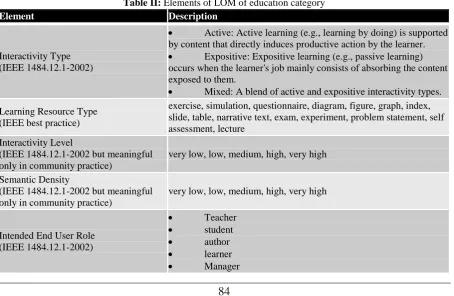
Elements of learning object metadata of education category
There are following elements of learning object metadata of education category.
Table II: Elements of LOM of education category
Element Description
Interactivity Type (IEEE 1484.12.1-2002)
Active: Active learning (e.g., learning by doing) is supported by content that directly induces productive action by the learner.
Expositive: Expositive learning (e.g., passive learning) occurs when the learner's job mainly consists of absorbing the content exposed to them.
Mixed: A blend of active and expositive interactivity types.
Learning Resource Type (IEEE best practice)
exercise, simulation, questionnaire, diagram, figure, graph, index, slide, table, narrative text, exam, experiment, problem statement, self assessment, lecture
Interactivity Level
(IEEE 1484.12.1-2002 but meaningful only in community practice)
very low, low, medium, high, very high
Semantic Density
(IEEE 1484.12.1-2002 but meaningful only in community practice)
very low, low, medium, high, very high
Context
(IEEE 1484.12.1-2002)
School
higher education
training
Other Typical Age Range (range)
Difficulty
(IEEE 1484.12.1-2002 but meaningful only in a context of a community)
very easy
easy
medium
difficult
very difficult Typical learning time open text element Description open text element Language standardized def.
II.
PROBLEM STATEMENT
Millions of E-learning websites and learning materials are available on a world wide web. It becomes a very tedious task for e-learners to find proper suitable website or learning materials from all the options available. The metadata holding content data such as authors, titles, subject, keywords, granularity are already extracted. It is required to know the interactivity type and level of webpage to minimize the learning time of e-learner.
III.
PROPOSED MODEL
E Learning interactivity is defined as the “dialogue” between learners and eLearning tools through which learners become engaged and involved in the eLearning process. It is a key element of the actual eLearning course design process, and it has proven to be a practice that adds outstanding value to your eLearning course. It involves forms of action or reaction on learners’ behalf, in order for them to achieve results or reach a conclusion. eLearning interactions may include multiple choice quizzes, tests, eLearning scenarios, simulations, animation videos etc, that help learners to deepen their understanding of the subject matter through experimentation, dealing with unpredicted circumstances, or even learning from their mistakes.
The eLearning Interactivity Type& Level:
The eLearning interactivity types are defined based on the extent of interactivity in the eLearning process. With this in mind, there are Three main eLearning interactivity Types:
• Active: Active learning (e.g., learning by doing) is supported by content that directly induces productive action by the learner. Learners have great control over their eLearning experience, as they are required to fully interact with the eLearning content and give feedback. This level may include: interactive games, simulated job performance exercises, customized audio or videos, avatars, stories and scenarios, as well as multimedia. Interactivity level of active e-learning is generally high.
• Expositive (Passive): Expositive learning (e.g., passive learning) occurs when the learner's job mainly consists of absorbing the content exposed to them. Learners are not required to interact with eLearning resources and the eLearning process is strictly linear. This level may include: simple images and graphics, simple video and audio, test questions, etc. Interactivity level of Expositive e-learning is generally Low.
• Mixed: A blend of active and expositive interactivity types. Learners may have some control over their eLearning experience, as they are required to make simple interactions with the eLearning material. This level may include: animations, clickable menus, drag and drop interactions, and multimedia. Interactivity level of mixed e-learning is generally moderate.
Proposed Model
Fig.3: Proposed Model for finding interactivity type and interactivity level
Model Description
As shown in a figure, finding an interactivity type of a webpage is seven step processes.
Step1: For finding interactivity type of webpage. We have taken URL of a page as an input for which we want result. We have taken WebPages which are using http or https protocol.
Step 2: URL contains link of the webpage. jsoup’s “connect” class helps to fetch that URL.
Step 3: Each webpage has source code. Using jsoup’s “html parser”, we got source code of the fetched URL. Step 4: Using Java pattern matcher, we have found learning objects available in a webpage using objects’ extensions.
For example, it will help us to identify images with .png extension, images with .jpg extension etc. Using this, we can find out total numbers of images available on a webpage.
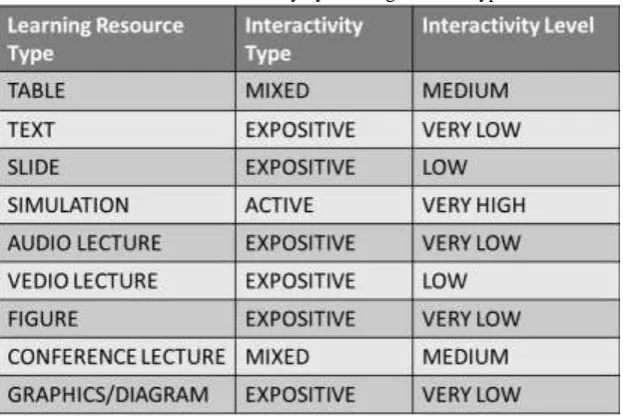
Step 5: After getting all the objects available in a webpage, we have differentiated between non-interactive and interactive learning objects and make a count of it. We consider learning objects type to decide its interactivity type and level.
Interactivity Type &
Interactivity Level
Input URL
Fetch URL
Getting HTML Source Code
OF a Webpage
Getting Numbers of Learning object
available on a webpage as per its
Learning Object Type
Differentiating Between
non-Interactive and non-Interactive Objects
Finding Interactivity Type of a
webpage
Finding Interactivity Level of a
webpage
On The Basis of Learning
Resource Type deciding
Expositive, Active or Mixed
Interactivity Type
By Using java Pattern
Matching
By Using Classes of Jsoup
Html parser
Table III: Interactivity by learning resource type
Step 6: Once we got numbers of total learning objects, non-interactive learning objects and interactive learning objects available on a webpage we can decide interactivity type of a webpage.
Step 7: After deciding the interactivity type of a website, we can know whether webpage is less interactive or more interactive. This way interactivity level can be found out.
IV.
EXPERIMENTS CONDUCTED
To analyze our model, we have taken different WebPages as an input and we have analyzed results.
List of WebPages
Table IV shows list of WebPages. We have tested and we got interactivity type and level for those WebPages.
Table IV: List of WebPages
Sr No
Webpage Non
Interactive Object
Interactive Objects
Interactivity Type
Interactivity Level
1 http://home.ku.edu.tr/~daksen/mgis410/downlo adsClassNotes.html
105 6 Active High
2 http://home.ku.edu.tr/~daksen/mgis410/downlo adsMiscellaneousFiles.html
46 0 Expositive Low
3 http://ocw.mit.edu/courses/aeronautics-and- astronautics/16-660j-introduction-to-lean-six- sigma-methods-january-iap-2012/lecture-videos/lean-thinking-part-1/
21 1 Expositive Low
4 http://ocw.mit.edu/courses/biology/7-013- introductory-biology-spring-2006/audio-lectures/3-biochemistry-1/
22 3 Expositive Low
5 http://www.animations.physics.unsw.edu.au/ 5 0 Expositive Low
6 http://faraday.physics.utoronto.ca/IYearLab/I ntros/StandingWaves/Flash/reflect.html
1 3 Expositive Low
7 http://www.eummena.org/index.php/map.html 7 0 Expositive Low
8 http://www.learnerstv.com/presentation/presen tationcategory.php?cat=Medical
64 2 Expositive Low
9 http://web2.0calc.com/ 5 22 Active High
10 http://www.math-tests.com/Factors-Test/factors-test.html
2 3 Expositive Low
11 http://www.tutorialspoint.com/java/java_onlin e_quiz.htm
7 13 Active High
13 http://www.online-calculator.com/ 5 5 Mixed Moderate 14
http://www.indiabix.com/online-test/general-knowledge-test/82
13 87 Active High
15 http://www.onlinequizportal.com/play_now_m ode/Challenge.html
11 1 Expositive Low
16 http://www.webmath.com/nsolve.html 18 16 Active High
17 https://www.univie.ac.at/moe/onlinewerkzeuge. html
31 13 Active High
18 https://msdn.microsoft.com/en-us/library/ms524741(v=vs.90).aspx
25 4 Expositive Low
19 http://www.phdcc.com/dynamic-cd/dcddoc/aspdoc.asp
6 6 Mixed Moderate
20 http://php.net/manual/en/features.commandlin e.options.php
13 2 Expositive Low
21 http://www.theworld.com/web/help/dynamic-pages.shtml
11 0 Expositive Low
V.
RESULT ANALYSIS
We have tested interactivity type and level of many WebPages. Some of those are shown in following figures.
http://www.theworld.com/web/help/dynamic-pages.shtml
We have taken this URL as an input and we have found that this webpage has total 11 objects. In which, there are 11 less interactive objects and there are none interactive objects. So the interactivity type of a webpage is Expositive and its interactivity level is Low.
Fig.4: The Webpage which has Expositive Interactivity type and Low Interactivity level
http://www.phdcc.com/dynamic-cd/dvddoc/aspdoc.asp
Fig.5: The Webpage which has Mixed Interactivity type and Moderate Interactivity level
http://www.indiabix.com/online-test/general-knowledge-test/82
We have taken this URL as an input and we have found that this webpage has total 100 objects. In which, there are 13 less interactive objects and there are 87 interactive objects. So the interactivity type of a webpage is Active and its interactivity level is High.
Fig.6: The Webpage which has Active Interactivity type and High Interactivity level
VI.
CONCLUSION
VII.
FUTURE SCOPE
For finding Interactivity type we have taken WebPages which are using http or https protocol as an input. Further work can be done for parsing WebPages, which are using protocols other protocols. We have taken only WebPages and found the interactivity type and level of that WebPages. More work can also be done by taking whole website as an input and interactivity type and level of a website can be find out.
REFERENCES
[1]. Arjaria, Siddhartha Kumar, and Devshri Roy. "Learning Content Management Using Machine Learning." International Journal of Information and Education Technology 2.5 (2012): 472.
[2]. Roy, Devshri, Sudeshna Sarkar, and Sujoy Ghose. "Automatic extraction of pedagogic metadata from learning content." IJ Artificial Intelligence in Education 18.2 (2008): 97-118.
[3]. Tripti Malviya and Prof. Devshri Roy . "Automatic Metadata Tagging of Learning Resource Types." International Journal for Scientific Research and Development 1.2 (2014): 197-200
[4]. Coursey, Kino High, Rada Mihalcea, and William E. Moen. "Automatic keyword extraction for learning object repositories." Proceedings of the American Society for Information Science and Technology 45.1 (2008): 1-10.
[5]. Borg, Claudia, Michael Rosner, and Gordon J. Pace. "Towards automatic extraction of definitions." Proceedings of the 5th Computer Science Annual Workshop, CSAW. 2007.
[6]. Del Gaudio, Rosa, and António Branco. "Supporting e-learning with automatic glossary extraction: Experiments with Portuguese." RANLP Workshop: Natural Language Processing and Knowledge Representation for eLearning Environments. 2007.
[7]. Han, Hui, et al. "Automatic document metadata extraction using support vector machines." Digital Libraries, 2003. Proceedings. 2003 Joint Conference on. IEEE, 2003.
[8]. Changuel, Sahar, Nicolas Labroche, and Bernadette Bouchon-Meunier. "A general learning method for automatic title extraction from html pages."Machine Learning and Data Mining in Pattern Recognition. Springer Berlin Heidelberg, 2009. 704-718.
[9]. Roy, Devshri, Sudeshna Sarkar, and Sujoy Ghose. "A Comparative Study of Learning Object Metadata." Learning Material Repositories, Metadata Annotation & Akerkar) puting (Eds. Joshi, Boley Book Advances in Semantic Com, TMRF ean Automatic Metadata Annotation Tool 2: 103. [10]. Miranda, Sergio, and Pierluigi Ritrovato. "Supporting Learning Object Repository by automatic