Page 13 www.ijiras.com | Email: [email protected]
Barriers Affecting The Adoption Of Building Information
Modelling In Construction Consultancy Firms In Abuja, Nigeria
U. Nuruddeen
S. A. Usman
Departments of Building, Abubakar Tafawa Balewa University, Bauchi, Nigeria
I. INTRODUCTION
The construction industry is dynamic in nature due to the increasing uncertainties in technology, and development processes [1]. It is also been described as very complex, extremely competitive, highly fragmented with adversarial business environment which relies on traditional ways of “doing things” and has resistive nature to change [2]. It is a cliché within the construction organizations that the construction quality is poor, budgets are unreliable and the price is too high, failures and errors are arising due to multifarious causes and occur in all steps of the construction process [3]. The construction sector faced so many criticisms across the globe for its inefficiency and lack of productivity.
Nowadays, building projects are becoming much more complex and difficult; the project team is facing unprecedented changes [4]. The Nigerian construction sector is not also free from aforementioned problems and even more. It has severally been characterized as inefficient with low productivity [5].
It is important to fully understand Project Consultancy services, the construction consultants have a wide variety of roles to play during the construction process, Construction consultants are hired by owner and engaged them in the construction project to oversee and control the construction process from inception to completion. Construction consultants have varied qualifications. Some have an architectural, engineering, building, and quantity surveying
Abstract: Construction consultants have a wide variety of roles to play during construction process; their services need to be improved in terms of quality and performance by adopting the use of Building Information Modelling (BIM) tools in various construction phases to meet the construction project goals. The aim of this study is to assess the barriers affecting the adoption of BIM by construction consultants in Abuja, Nigeria. Quantitative research method through descriptive survey was used. Sixty six (66) structured questionnaires were administered to construction consultants in Abuja Nigeria. The data were tested for reliability and the questionnaire administration attained 80% success rate. It was found that many barriers hindering the widespread adoption of this technology have been revealed but the most significant one is the cost of adoption and low level of awareness, lack of standard tools as well as lack of executive buy-in rated second most significant barriers with RII=0.892,. Thus, the study recommends that the regulatory bodies Architect Registered Council of Nigeria, (ARCON), Council of Registered Builders of Nigeria (CORBON), Council of Registered Engineers of Nigeria (COREN), and Quantity Surveyors Registration Board of Nigeria (QSRBN) should mobilize clients on the importance on BIM; to set aside the cost of operation and embraced the BIM services in their project. The government should address the issue of cost of purchasing BIM tools by subsidizing the price of the softwares to enable the practitioners to have appropriate choice of BIM tool that suits the practice’s way of work. In the same vein the legislative arm of government should provide ways of incorporating BIM in the curriculum of tertiary institutions offering relevant courses
Page 14 www.ijiras.com | Email: [email protected] background, the owner can utilize the consultant's services in
reviewing plans, budgets and the various stages of construction on construction sites. These services need to be improving significantly, using modern tools to meet the construction project goals and objective and also the client‟s satisfaction.
Recent developments in the sector have set new challenges for the collaborative activity of different parties in construction projects [6]. Such collaboration will enhance the whole construction sector and the construction process, to obtain buildings of better quality, reduce cost, minimize project time and improve productivity. The paradigm shift in construction process is experiencing an increased transfer of technology from developed nations to developing nations [7].
Building Information Modelling (BIM) has been described as the next paradigm shift in the design and construction services [8]. As such, BIM has been promoted as “one of the most promising recent developments in the architecture, engineering, and construction (AEC) firms”, capable of reducing project cost, enhancing productivity and quality and decreasing the time for project delivery [9]. Building Information Modeling (BIM) which many claim has been in existence for a long time, is relatively new in developing countries [10]. In order to increase efficiency, many construction organizations have been interested in adopting BIM; however, they do not understand how to implement BIM into their project efficiently, how to select from various BIM software applications available, or how to determine which project will benefit most from BIM [11]. By using BIM, more stakeholders can be included in early phases of the project; where they can introduce their domain knowledge into the project which can make the system more data intensive [12].
BIM implementation serves as a useful alternative to addressing key construction sector issues, and offers solutions to these in order to increase productivity, efficiency, and quality, reduce costs, lead times and duplications, via effective communication with stakeholders in remote construction projects [13].
Successful technology adoption depends on many factors, including people‟s attitudes toward the technology, corporate culture, relationships between companies, characteristics of the specific projects, industry-wide issues of legal precedents, communication density, organizational barriers, and an individual‟s resistance to change [14]. [7] brought to light the major setbacks to adoption of BIM in UK based construction industries and some countries in the Middle East to be the lack of initiative, knowledge and training, fragmented nature of the construction industry, varied market readiness across organizations and geographies, and industry‟s resistance to change traditional working practices. However, the adoption of BIM in Nigerian construction industries is also hampered by Resistance to change, legal and contractual constraints‟ and „high cost of integrated software, Lack of enabling environment, and Lack of trained professionals to handle the tools [15].
BIM is the global digital construction technology but its adoption is lagging behind in Nigerian construction sector. Different researches have been done on BIM uptake in Nigeria but the adoption level remained intracompany model-based
modeling which does not fully open access to data integration and the collaborative model server. Construction consultants should only be considered at BIM Capability if they shared object-based models with at least two other construction organizations from different disciplines. The adoption of BIM being noticeably towards integrated practice has not been studied in relation to construction consultancy firms in Nigeria. According to [5] for a successful adoption of BIM, an organization needs to be part of a multidisciplinary model-based collaborative. [7] Cited many issues as barriers to integrated BIM team working in Iran; and these fragmented barriers cause knockdown effect on the successful BIM adoption. In addition to that, [16] reported that, there is a danger that the construction professional will continue to operate BIM tools in isolation without overcoming the barriers that might retard the collaboration process. [17], eliciting barriers would definitely overcome the hesitant of BIM collaboration and facilitate the Consistent and cohesive communications within the construction industries.
The construction consultancy firm will therefore, require improving its capacity for greater integration and collaboration with other disciplines in the production process.
[5] described the adoption of BIM in Nigeria as very minimal and there is no thorough study conducted on BIM in Nigeria to provide empirical data for further study, in the same vein [18] concluded that, the majority of BIM adopters in Nigeria are construction consultants and their adoption level is at stage 2 of BIM evolution. Stage 2 of BIM evolution managed three dimensional (3D), times scheduling (4D), and project cost (5D) but does not support collaboration. For a successful adoption of BIM, an organization needs to be part of a multidisciplinary model-based collaborative project. The construction consultancy firm will therefore, require improving its capacity for greater integration and collaboration with other disciplines in the production process.
This paper aimed at exploring the barriers affecting the adoption of Building Information Modeling (BIM) by construction consultants with a view to sensitizing the consultants thereby, improving their levels of collaboration and enhances team effectiveness in BIM-based projects.
Most of the researches and industry best-practice identify the barriers to successful adoption of BIM as lessons learned through a survey of BIM-assisted projects; although very few present these from literature searched. [19] Sighted the survey conducted by the UK construction companies reported that, the primary barriers to the BIM adoption are the unfamiliarity of firms with the use of BIM, reluctance to train staff or initiate new work flows, lack of opportunities to implement BIM, and lack of proof for tangible benefits of using BIM. Similarly, [15] documented numerous potential barriers to BIM adoptions while [20] highlighted that, the barriers to BIM adoption fall into two categories: process barriers to the business including legal and organizational issues that prevent the adoption; and technology barriers related to readiness and implementation. [11] Outlined the barriers to adoption of BIM extracted from different authors across the globe shown in table 1
Page 15 www.ijiras.com | Email: [email protected] Gilligan and Kunz (2007)
Learning curve Eastman et al. (2008), Yan and Damian (2008) Lack of executive buy in Bernstein et al. (2012)
Shift of liability among Agostino et al. (2007) project participants Bernstein et al. (2012), and
Kunz n et al. (2008) Poor collaboration among
BIM software‟s
Eastman et al. (2008), Won et al. (2008), Young et al. (2009) Management problems
with BIM master model
Won et al. (2008),
Lack of collaboration management tools
Gilligan and Kunz (2007), Won et al. (2008) Organizational structure
that does support BIM
Eastman et al. (2008), Won et al. (2008)
Security risk Won et al. (2008), Young et al(2009)
Lack of industry standards D‟Agostino et al. (2007), Eastman et al. (2008), Young
et al. (2009) Shortage of BIM
implementation data in construction phase
D‟Agostino et al. (2007), Young et al. (2009)
Difficulties in measuring impacts of BIM
Bin zakariya et al., (2013), Bernstein et al. (2012), Gilligan and Kunz (2007), Lack of knowledge and
awareness
buildingSMART, (2011) Chan, 2014; Rogers et al., (2015) Unavailability of standards
and guidelines
buildingSMART, (2011) Chan, 2014; Rogers et al., (2015) Lack of demand Chan, 2014; Rogers et al., (2015), Bin zakariya et al., (2013), Bernstein et al. (2012) Resistance to change Abubakar et al., 2014; Rogers
et al., 2015 Source: Won et al. (2013), p2
Table 1: Barriers to Adoption of BIM
II. METHODS
The identified barriers reviewed from the previous work were translated into structured questionnaires and administered quantitatively to construction consultants offering design and construction services in Abuja Nigeria. Abuja being the study area due to high concentration of construction practitioners and massive execution of construction works. A total of 66 structured questionnaires were administered, purposive non-probability sampling was used in selecting those that have BIM experience and provide the desired information based on the criteria set by this research. Fifty four (54%) questionnaires were retrieved and represent 81.8%, with 4 questionnaires being rejected due to incomplete filling out and it represents 6%. Therefore a total
of 50 properly filled questionnaires were used for analysis which represents 75.8% response rate. The questions asked for this study were relevant and straight forward and the alpha test was run to determine the reliability of the scales and the value obtained was > 0.7. Therefore, comparing this result (> 0.7) with the work of [22] indicates acceptable and reliable testing instrument.
The data generated for this study were subjected to analyses using mean score and standard deviation, SPSS version 21 was used as tool for the analysis. The data were further subjected to ranking analysis to determine the firm‟s perception of the significant barrier affecting the adoption of BIM in the construction consultancy firms. Relative Importance Index Method (RII) was used in this research and the formula was computed as
Relative importance index (RII) = Σ w / (A x N) - - - , (0 ≤ index ≤ 1)
Where: w = weighting given to each factor by the respondents,
A = highest weight (i.e. 5 in this case), and
N = total number of respondents (i.e. in this case 50). The rating of all the factors for degree of significance will be based on the value of their respective relative importance index (RII). The item with the highest RII is ranked first followed by the next and so on. Therefore, this research adopted the method of RII ranking used by [16] where he rank RII above 0.85 to be very significant and RII of 0.54 to be not significant at all
III. RESULTS AND DISCUSSION
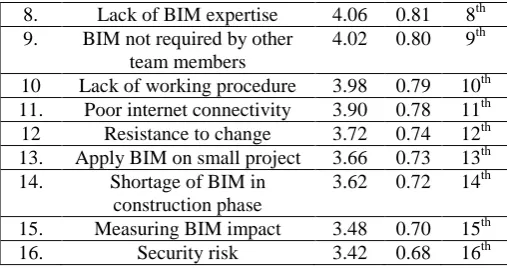
Table 2 shows responses of respondents on barriers to adoption of BIM, from the table it can be seen that, the most significant barriers to adoption of BIM by construction consultants are cost of investment with (RII =0.912), However, low awareness level, lack of standard tools as well as lack of executive buy-in rated second most significant barriers with RII=0.892. Lack of client demand, (RII=0.840), lack of training on BIM software‟s (RII =0.832) ranked 5th and 6th respectively. However, poor collaborations among project participants (RII= 0.824), lack of BIM expertise (RII=0.812), BIM is not required by other team members (RII=0.804), lack of working procedures (RII=0.790), poor internet connectivity (RII=0.782), resistance to change (RII=0.740) were considered to be significant factors based on their RII values. Also, how to apply BIM to small projects (RII=0.731), shortage of BIM in construction phase (RII=0.720), difficulties in measuring BIM impact (RII=0.704) and security risk (RII=0.682) were considered fairly significant barriers.
S/n Factors Mean RII Rank
1. Cost of investment 4.56 0.91 1st 2. Low level of awareness 4.46 0.89 2nd 3. Lack of standard tools 4.46 0.89 2nd 4. Lack of executive buy-in 4.46 0.89 2nd 5. Lack of client demand 4.20 0.84 5th 6. Lack of training BIM
software
4.18 0.83 6th 7. Poor collaboration among
participant
Page 16 www.ijiras.com | Email: [email protected] 8. Lack of BIM expertise 4.06 0.81 8th
9. BIM not required by other team members
4.02 0.80 9th 10 Lack of working procedure 3.98 0.79 10th 11. Poor internet connectivity 3.90 0.78 11th 12 Resistance to change 3.72 0.74 12th 13. Apply BIM on small project 3.66 0.73 13th 14. Shortage of BIM in
construction phase
3.62 0.72 14th 15. Measuring BIM impact 3.48 0.70 15th
16. Security risk 3.42 0.68 16th
Source: Field Survey, (2017)
Table 2: Barriers to Building Information Modeling Adoption by Consultants
IV. CONCLUSION
The study assessed the barriers to BIM adoption in construction consultancy firms in Abuja Nigeria. The barriers were analyzed quantitatively using mean score standard deviation SD, and relative importance index ranking were used. Cost of investment, lacks of standard tools, low level of awareness, as well as lack of executive buy-in were ranked as top most significant barriers hindered the prospect of BIM adoption in construction consultancy firms. This was in closed conformity with the conclusions made by [5] where he attributed cost of investment, lack of executive buy-in and low level of awareness as huge barriers to BIM adoption. It is also in closed consistent with the work of [22] and [7] where they identified cost of soft ware, lack of owner‟s demand and low level of awareness as significant barriers to BIM adoption. It also contradicted the findings of the studies on barriers of BIM in Malaysia [10] and UK [2] where the resistance to culture changes, Human altitude and lack of working procedures were highlighted as the major barriers to the implementation of BIM.
The study information was collected from both the primary and secondary sources. The barriers affecting BIM adoption were tested using mean score, standard deviation (SD) and the relative importance index (RII). When the RII values were computed on the data obtained from the survey questionnaire; there were some factors that scored identically in terms of ranking. Consideration of the level of rankings was noted and also not possible to differentiate between them; thus it was decided to give joint rankings when the scores were the same.
Failure to adopt BIM is attributed to cost of investments, low level of awareness, lack of standard tools, lack of executive buy-in, as well as lack of training on BIM software‟s. Thus, the study recommends that the regulatory bodies Architect Registered Council of Nigeria, (ARCON), Council of Registered Builders of Nigeria (CORBON), Council of Registered Engineers of Nigeria (COREN), and Quantity Surveyors Registration Board of Nigeria (QSRBN) should mobilize clients on the importance on BIM; to set aside the cost of operation and embraced the BIM services in their project. The government should address the issue of cost of purchasing BIM tools by subsidizing the price of the softwares to enable the practitioners to have appropriate choice of BIM
tool that suits the practice‟s way of work. In the same vein the legislative arm of government should provide ways of incorporating BIM in the curriculum of tertiary institutions offering relevant courses.
The study identified and assesses the barriers affecting the adoption of BIM in construction consultancy firms in Abuja, Nigeria. This information is very important to consultants and related construction professionals under the intricacies of adopting BIM. It also contributes to the existing literature in field relevant to the study that can enlighten professionals more about the barriers relating to adoption of BIM. It also helps the construction consultancy firms in identifying these factors so as to provide strategy of overcoming them.
This study has the limitation of a relatively small number of responses (construction consultants only); this might not be the whole construction practitioners in Abuja. There is therefore, the need for further studies of similar nature to cover the whole construction professionals in Abuja
ACKNOWLEDGMENT
I wish to express my gratitude to Almighty Allah for given me the strength, knowledge and good health for the entire duration of this study.
I wish to express my appreciation to head of Building Technology Department Dr. Nuruddeen Usman for his assistance, guidance and direction throughout this study. I also acknowledge the contributions received from Dr. Bustani of Building Technology Department Faculty of Environmental Technology. I also acknowledge the assistance accorded to me by the people that help in data collection and those that responded to the questionnaire and makes this study success.
Lastly, I wish to acknowledge the effort of my entire family members for their support and prayers during the entire period of study.
REFERENCES
[1] Khalfan, M. A. and Anumba, C. J. (2000). Development of a Readiness Assessment Model for Concurrent Engineering in Construction, Benchmarking: An International Journal 8(3), 223 - 239.
[2] Pales, E. (2013). An Analysis of BIM Adoption Holdback Assuming a Sharp Change in Process and Culture. Unpublished Master‟s Thesis in Architectural Technology and Construction Management University College, Horsens, Denmark
[3] Kjartansdottir I. B. (2011). BIM adoption in iceland and its relation to lean construction, Unpublished Master‟s Thesis, School of Science and Engineering, Reyjakic University.
Page 17 www.ijiras.com | Email: [email protected] [5] Umar, A. (2015). an assessment of critical success factors
for building information modelling adoption by clients in the construction industry. Unpublished Master‟s Thesis, Ahmadu Bello University, Zaria
[6] Korpela, J. (2015). Benefits and challenges of building information modeling according toparticipants of construction project. Unpublished master‟s thesis, Aalto University, Finland
[7] Hosseini, M. R., Chileshe, N., Zuo, J., & Baroudi, B. (2015). Adopting global virtual engineering teams in AEC Projects: A qualitative meta-analysis of innovation diffusion studies.Construction Innovation, 15(2), 151-179 [8] Shelden, D. (2009). Information Modelling as a Paradigm
Shift. Architectural Design, 79(2), 80 83.
[9] Azhar, S. 2011. Building Information Modeling (BIM): Trends, Benefits, Risks, and Challenges for the AEC Industry. Leadership and Management in Engineering, 11(3), 241-252.
[10]Enegbuma, W.I. and Ali, K.. N (2011). A Preliminary Critical Success Factor Analysis of Building Information Modelling Implementation in Malaysia: Proceedings of the Asian Conference on Real Estate, Sustainable Growth, Management Challenges, held on 3-5 October, Thistle Johor Bahru, Malaysia
[11]Won, J., and Lee, G. (2010). “A case study on BIM collaboration and information management method.” J. Arch. Inst. Korea, 24(8), 25–32.
[12]Smith D.K & Tardiff M. (2009). Building information modeling:a strategic implementation guide for architects, engineers, constructors and real estate asset managers. New Jersey: John Wiley & Sons, Inc
[13]Hanif, M., I. Haq and M.Q. Shahbaz, 2009. On a new family of estimators using multiple auxiliary attributes. World Applied Sciences Journal 7(11), 1419-1422. [14]O‟Brien, W. J. (2000). “Implementation issues in project
web sites: A practitioner‟s viewpoint.” J. Manage. Eng.,
16(3), 34–39. Park, J.-D., and Kim, J.-W. (2009). “A study on the ontology representation of the IFC based building information model.” J. Archit. Inst. Korea, 25(5), 87–94.
[15]Abubakar, M., Ibrahim, Y., Kado, D., & Bala, K. (2014). Contractors‟ Perception of the Factors Affecting Building Information Modelling Adoption in the Nigerian Construction Industry: Paper presented at the Computing in Civil and Building Engineering (2014), Orlando, Florida, United States
[16]Usman, S. A. (2017). Factors affecting the adoption of building information modelling in construction consultancy firms in Abuja, Nigeria. Unpublished Master‟s Thesis, Abubakar Tafawa University, Bauchi [17]Yusuf, J. K. (2014). Investigation into the adoption of
Building Information Modelling in Architectural SMEs. Unpublished Master‟s thesis of Building Information Modelling and Integrated Design in the United Kingdom [18]Muhammad A. (2015). Factors affecting the adoption of
information and communication technology in Nigerian construction firms in abuja, nigeria. Unpublished Master‟s Thesis, Abubakar Tafawa University, Bauchi
[19]Arayici, Y., Khosrowshahi, F., Ponting, A. M., & Mihindu, S. (2009). “Towards implementation of building information modelling in the construction industry” [20]Eastman, C., Teicholz, P., Sacks, R. and Liston,K. (2011).
BIM Handbook, a Guide to Building Information Modelling 2nd Ed. Hoboken: John Wiley & Sons, Inc. [21]Tavakol M. & Dennick R. (2011) Making Sense of
Cronbach's Alpha. International Journal of Medical Education (2)1