1
International Journal of Research in Social Scienceshttp://www.ijmra.us, Email: [email protected] A REVIEW OF MACROECONOMIC EFFECTS OF FISCAL POLICY
Seema
Assistant Professor Indus Degree College, Kinana
Abstract
Fiscal policy deals with the taxation and expenditure decisions of the government. Monetary policy, deals with the supply of money in the economy and the rate of interest. These are the main policy approaches used by economic managers to steer the broad aspects of the economy. In most modern economies, the government deals with fiscal policy while the central bank is responsible for monetary policy. Fiscal policy is composed of several parts. These include, tax policy, expenditure policy, investment or disinvestment strategies and debt or surplus management. Fiscal policy is an important constituent of the overall economic framework of a country and is therefore intimately linked with its general economic policy strategy.
Keywords: fiscal policy, Bayesian structural VAR, debt dynamics
Introduction
Fiscal policy also feeds into economic trends and influences monetary policy. When the government receives more than it spends, it has a surplus. If the government spends more than it receives it runs a deficit. To meet the additional expenditures, it needs to borrow from domestic or foreign sources, draw upon its foreign exchange reserves or print an equivalent amount of money.1 This tends to influence other economic variables. On a broad generalisation, excessive printing of money leads to inflation. If the government borrows too much from abroad it leads to a debt crisis. If it draws down on its foreign exchange reserves, a balance of payments crisis may arise. Excessive domestic borrowing by the government may lead to higher real interest rates and the domestic private sector being unable to access funds resulting in the „crowding out‟ of private investment. Sometimes a combination of these can occur. In any case, the impact of a large deficit on long run growth and economic well-being is negative. Therefore, there is broad agreement that it is not prudent for a government to run an unduly large deficit. However, in case of developing countries, where the need for infrastructure and social investments may be substantial, it sometimes argued that running surpluses at the cost of long-term growth might also not be wise (Fischer and Easterly, 1990). The challenge then for most developing country governments is to meet infrastructure and social needs while managing the government‟s finances in a way that the deficit or the accumulating debt burden is not too great.
2
International Journal of Research in Social Scienceshttp://www.ijmra.us, Email: [email protected] sector to fund the large public sector driven industrialization process and also cover social welfare schemes. Indirect taxes were a larger source of revenue than direct taxes. However, growth was anaemic and the system was prone to inefficiencies. In the 1980s some attempts were made to reform particular sectors and make some changes in the tax system. But the public debt increased, as did the fiscal deficit. Triggered by higher oil prices and political uncertainties, the balance of payments crisis of 1991 led to economic liberalisation. The reform of the tax system commenced with direct taxes increasing their share in comparison to indirect taxes. The fiscal deficit was brought under control. When the deficit and debt situation again threatened to go out of control in the early 2000s, fiscal discipline legalisations were instituted at the central level and in most states. The deficit was brought under control and by 2007-08 a benign macro-fiscal situation with high growth and moderate inflation prevailed. The global financial crisis tested the fiscal policy framework and it responded with counter-cyclical measures including tax cuts and increases in expenditures. The post-crisis recovery of the Indian economy is witnessing a correction of the fiscal policy path towards a regime of prudence. In the future, the focus would probably be on bringing in new tax reforms and better targeting of social expenditures.
India‟s fiscal policy architecture
The Indian Constitution provides the overarching framework for the country‟s fiscal policy. India has a federal form of government with taxing powers and spending responsibilities being divided between the central and the state governments according to the Constitution. There is also a third tier of government at the local level. Since the taxing abilities of the states are not necessarily commensurate with their spending responsibilities, some of the centre‟s revenues need to be assigned to the state governments. To provide the basis for this assignment and give medium term guidance on fiscal matters, the Constitution provides for the formation of a Finance Commission (FC) every five years. Based on the report of the FC the central taxes are devolved to the state governments. The Constitution also provides that for every financial year, the government shall place before the legislature a statement of its proposed taxing and spending provisions for legislative debate and approval. This is referred to as the Budget. The central and the state governments each have their own budgets.
The central government is responsible for issues that usually concern the country as a whole like national defence, foreign policy, railways, national highways, shipping, airways, post and telegraphs, foreign trade and banking. The state governments are responsible for other items including, law and order, agriculture, fisheries, water supply and irrigation, and public health. Some items for which responsibility vests in both the Centre and the states include forests, economic and social planning, education, trade unions and industrial disputes, price control and electricity. There is now increasing devolution of some powers to local governments at the city, town and village levels. The taxing powers of the central government encompass taxes on income (except agricultural income), excise on goods produced (other than alcohol), customs duties, and inter-state sale of goods. The state governments are vested with the power to tax agricultural income, land and buildings, sale of goods (other than inter-state), and excise on alcohol.
3
International Journal of Research in Social Scienceshttp://www.ijmra.us, Email: [email protected] payments crisis of 1991, which would be discussed later. Following economic liberalisation in 1991, when the fiscal deficit and debt situation again seemed to head towards unsustainable levels around 2000, a new fiscal discipline framework was instituted. At the central level this framework was initiated in 2003 when the Parliament passed the Fiscal Responsibility and Budget Management Act (FRBMA).
Taxes are the main source of government revenues. Direct taxes are so named since they are charged upon and collected directly from the person or organisation that ultimately pays the tax (in a legal sense).2 Taxes on personal and corporate incomes, personal wealth and professions are direct taxes. In India the main direct taxes at the central level are the personal and corporate income tax. Both are till date levied through the same piece of legislation, the Income Tax Act of 1961. Income taxes are levied on various head of income, namely, incomes from business and professions, salaries, house property, capital gains and other sources (like interest and dividends).3 Other direct taxes include the wealth tax and the securities transactions tax. Some other forms of direct taxation that existed in India from time to time but were removed as part of various reforms include the estate duty, gift tax, expenditure tax and fringe benefits tax. The estate duty was levied on the estate of a deceased person. The fringe benefits tax was charged on employers on the value of in-kind non-cash benefits or perquisites received by employees from their employers. Such perquisites are now largely taxed directly in the hands of employees and added to their personal income tax. Some states charge a tax on professions. Most local governments also charge property owners a tax on land and buildings.
Indirect taxes are charged and collected from persons other than those who finally end up paying the tax. For instance, a tax on sale of goods is collected by the seller from the buyer. The legal responsibility of paying the tax to government lies with the seller, but the tax is paid by the buyer. The current central level indirect taxes are the central excise, the service tax, the customs duty and the central sales tax on inter-state sale of goods. The main state level indirect tax is the post-manufacturing sales tax. The complications and economic inefficiencies of this multiple cascading taxation across the economic value chain are discussed later in the context of the proposed Goods and Services Tax.
Conclusion:
The fiscal expansion associated with budget composition matters for the length of the crisis since all fiscal variables, such as public consumption, public investment, income taxes and goods service taxes, would lead to a reduction of the duration of the crisis. Furthermore, the result suggests that the government may undertake such measures as expenditure-based or revenue-based fiscal expansion in order to reduce the duration of the crisis. The result also suggests that income tax cuts are a more effective tool than government consumption, public investment and goods and service taxes in shortening the length of the crisis in those countries. A decrease in the income tax by 1% would shorten the length of the crisis by around two months, which is not the case with public consumption, public investment and goods and service taxes.
4
International Journal of Research in Social Scienceshttp://www.ijmra.us, Email: [email protected] [1] Empowered Committee of State Finance Ministers. 2009. "First Discussion Paper on Goods
and Services Tax in India."
[2] Fischer, Stanley and William Easterly. 1990. "The Economics of the Government Budget Constraint." The World Bank Research Observer, 5:2 (July 1990), pp. 127-42.
[3] Herd, Richard and Willi Leibfritz. 2008. "Fiscal Policy in India: Past Reforms and Future Challenges." Organisation for Economic Co-operation and Development, Economics Department Working Paper No. 595.
[4] Kumar, Rajiv and Alamuru Soumya. 2010. "Fiscal Policy Issues for India after the Global Financial Crisis (2008-2010)." Asian Development Bank Institute, Working Paper No. 249. [5] Ministry of Finance. 2011. "Fiscal Policy Strategy Statement (Budget 2011-12)."
[6] Planning Commission. 2011. "Approach to the Twelfth Five Year Plan."
[7] Rao, N. Govinda and R. Kavita Rao. 2006. "Trends and Issues in Tax Policy and Reform in India." India Policy Forum, NCAER, www.ncaer.org/downloads/Journals/ipf0506- paper2.pdf.
[8] Reserve Bank of India. 2011. "Database on the Indian Economy, http://dbie.rbi.org.in, date accessed 19th October 2011." Singh, Nirvikar and T. N. Srinivasan. 2004.
5
International Journal of Research in Social Scienceshttp://www.ijmra.us, Email: [email protected] A REVIEW OF SCOPE AND NATURE OF MANAGERIAL ECONOMICS
Sapna
Assistant Professor PIGGCW Jind Abstract
Economics impacts our day-to-day lives. Economics also influences the decisions taken by managers of business firms. Any business is part of an economy. As we know, economic conditions heavily impact business activities and vice versa. The per capita income of the citizens will define the purchasing power on the basis of which, the business enterprises will decide what products to manufacture and sell. A new enterprise has to forecast the demand for the product, which it wants to sell. The day to day product market has to decide a viable price depending upon the interaction between the demand and the supply. Thus, management practitioners and academicians brought economics to their perspective and developed ‗Managerial Economics‘.
Keywords: Economy, Business, Product Market, Viable Price, Etc.
Introduction:
Managerial economics is a discipline which deals with the application of economic theory to business management. It deals with the use of economic concepts and principles of business decision making. Formerly it was known as ―Business Economics‖ but the term has now been discarded in favour of Managerial Economics.
Managerial Economics may be defined as the study of economic theories, logic and methodology which are generally applied to seek solution to the practical problems of business. Managerial Economics is thus constituted of that part of economic knowledge or economic theories which is used as a tool of analysing business problems for rational business decisions. Managerial Economics is often called as Business Economics or Economic for Firms.
Definition of Managerial Economics:
―Managerial Economics is economics applied in decision making. It is a special branch of economics bridging the gap between abstract theory and managerial practice.‖ – Haynes, Mote and Paul.
―Business Economics consists of the use of economic modes of thought to analyse business situations.‖ - McNair and Meriam
―Business Economics (Managerial Economics) is the integration of economic theory with business practice for the purpose of facilitating decision making and forward planning by management.‖
6
International Journal of Research in Social Scienceshttp://www.ijmra.us, Email: [email protected] ―Managerial economics is concerned with application of economic concepts and economic analysis to the problems of formulating rational managerial decision.‖ – Mansfield
Nature of Managerial Economics:
The primary function of management executive in a business organisation is decision making and forward planning.
Decision making and forward planning go hand in hand with each other. Decision making means the process of selecting one action from two or more alternative courses of action. Forward planning means establishing plans for the future to carry out the decision so taken.
The problem of choice arises because resources at the disposal of a business unit (land, labour, capital, and managerial capacity) are limited and the firm has to make the most profitable use of these resources.
The decision making function is that of the business executive, he takes the decision which will ensure the most efficient means of attaining a desired objective, say profit maximisation. After taking the decision about the particular output, pricing, capital, raw-materials and power etc., are prepared. Forward planning and decision-making thus go on at the same time.
A business manager‘s task is made difficult by the uncertainty which surrounds business decision-making. Nobody can predict the future course of business conditions. He prepares the best possible plans for the future depending on past experience and future outlook and yet he has to go on revising his plans in the light of new experience to minimise the failure. Managers are thus engaged in a continuous process of decision-making through an uncertain future and the overall problem confronting them is one of adjusting to uncertainty.
In fulfilling the function of decision-making in an uncertainty framework, economic theory can be, pressed into service with considerable advantage as it deals with a number of concepts and principles which can be used to solve or at least throw some light upon the problems of business management. E.g are profit, demand, cost, pricing, production, competition, business cycles, national income etc. The way economic analysis can be used towards solving business problems, constitutes the subject-matter of Managerial Economics.
Thus in brief we can say that Managerial Economics is both a science and an art. Scope of Managerial Economics:
The scope of managerial economics is not yet clearly laid out because it is a developing science. Even then the following fields may be said to generally fall under Managerial Economics:
1. Demand Analysis and Forecasting 2. Cost and Production Analysis
7
International Journal of Research in Social Scienceshttp://www.ijmra.us, Email: [email protected] 5. Capital Management
These divisions of business economics constitute its subject matter.
Recently, managerial economists have started making increased use of Operation Research methods like Linear programming, inventory models, Games theory, queuing up theory etc., have also come to be regarded as part of Managerial Economics.
1. Demand Analysis and Forecasting: A business firm is an economic organisation which is engaged in transforming productive resources into goods that are to be sold in the market. A major part of managerial decision making depends on accurate estimates of demand. A forecast of future sales serves as a guide to management for preparing production schedules and employing resources. It will help management to maintain or strengthen its market position and profit base. Demand analysis also identifies a number of other factors influencing the demand for a product. Demand analysis and forecasting occupies a strategic place in Managerial Economics.
2. Cost and production analysis: A firm‘s profitability depends much on its cost of production. A wise manager would prepare cost estimates of a range of output, identify the factors causing are cause variations in cost estimates and choose the cost-minimising output level, taking also into consideration the degree of uncertainty in production and cost calculations. Production processes are under the charge of engineers but the business manager is supposed to carry out the production function analysis in order to avoid wastages of materials and time. Sound pricing practices depend much on cost control. The main topics discussed under cost and production analysis are: Cost concepts, cost-output relationships, Economics and Diseconomies of scale and cost control.
3. Pricing decisions, policies and practices: Pricing is a very important area of Managerial Economics. In fact, price is the genesis of the revenue of a firm ad as such the success of a business firm largely depends on the correctness of the price decisions taken by it. The important aspects dealt with this area are: Price determination in various market forms, pricing methods, differential pricing, product-line pricing and price forecasting.
4. Profit management: Business firms are generally organized for earning profit and in the long period, it is profit which provides the chief measure of success of a firm. Economics tells us that profits are the reward for uncertainty bearing and risk taking. A successful business manager is one who can form more or less correct estimates of costs and revenues likely to accrue to the firm at different levels of output. The more successful a manager is in reducing uncertainty, the higher are the profits earned by him. In fact, profit-planning and profit measurement constitute the most challenging area of Managerial Economics.
8
International Journal of Research in Social Scienceshttp://www.ijmra.us, Email: [email protected] topics dealt with under capital management are cost of capital, rate of return and selection of projects.
6. Production Possibility curves: The production possibility curves is a hypothetical representation of the amount of two different goods that can be obtained by shifting resources from the production of one, to the production of the other. The curve is used to describe a society‘s choice between two different goods. Figure 1, shows the two goods as consumption and investment. Investment goods are goods that are involved in the production of further consumption goods. They include physical capital such as machines, buildings, roads etc. and human investments such as education and training. The sums of all investments make up the capital stock of a society
7. Opportunity Cost: This hypothetical curve shows how much of consumption must be given up to increase investments (the movement from A to B). This demonstrates the important economic concept of Opportunity Cost, which is the cost of anything (such as an investment in a new road), in terms of what has to be given up. This is the general concept of cost in economics. For the individual, these costs could be financial, but they could include a individual‘s time and other intangibles. For society the production possibility curve shows opportunity cost only on the curve itself. If society found itself inside the curve, for instance, during a recession (where all resources are not being utilized), then a movement out to the production possibility curve has no real opportunity cost. The unemployed resources are just being utilized (unemployed labor going back to work).
Conclusion:
The various aspects outlined above represent the major uncertainties which a business firm has to reckon with, viz., demand uncertainty, cost uncertainty, price uncertainty, profit uncertainty, and capital uncertainty. We can, therefore, conclude that the subject-matter of Managerial Economics consists of applying economic principles and concepts towards adjusting with various uncertainties faced by a business firm.
References:
[1] Diwedi, D.N Managerial Economics, Vikas Publishing House, New Delhi [2] E. F Brigham & J.L Pappas, Managerial Economics, Dried & Press [3] Managerial Economics by Atmananad, Excel Books.
[4] Managerial economics by DM Mithani, Himalys Publishing House
9
International Journal of Research in Social Scienceshttp://www.ijmra.us, Email: [email protected] MANAGERIAL ECONOMICS: MEANING, SCOPE &RELATIONSHIP
Kusum Lata
Assistant Professor Indus Degree College, Kinana Abstract
Economic principles inform good business decision making. Although economics is sometimes dismissed as a discourse of practical relevance to only a relatively small circle of academicians and policy analysts who call themselves economists, sound economic reasoning benefits any manager of a business, whether they are involved with production and operations, marketing, finance, or corporate strategy. Along with enhancing decision making, the field of economics provides a common language and framework for comprehending and communicating phenomena that occur within a business, as well as between a business and its environment.
Meaning
The science of Managerial Economics has emerged only recently. With the growing variability and unpredictability of the business environment, business managers have become increasingly concerned with finding rational and ways of adjusting to an exploiting environmental change. The problems of the business world attracted the attentions of the academicians from 1950 onwards. Managerial economics as a subject gained popularity in the USA after the publication of the book ―Managerial Economics‖ by Joel Dean in 1951.
Managerial economics generally refers to the integration of economic theory with business practice. Economics provides tools managerial economics applies these tools to the management of business. In simple terms, managerial economics means the application of economic theory to the problem of management. Managerial economics may be viewed as economics applied to problem solving at the level of the firm. It enables the business executive to assume and analyse things. Every firm tries to get satisfactory profit even though economics emphasises maximizing of profit. Hence, it becomes necessary to redesign economic ideas to the practical world. This function is being done by managerial economics.
Keyword: Economics,Decision Making
Nature of Managerial Economics:
10
International Journal of Research in Social Scienceshttp://www.ijmra.us, Email: [email protected] Decision Making:
Managerial economics is supposed to enrich the conceptual and technical skill of a manager. It is concerned with economic behaviour of the firm. It concentrates on the decision process, decision model and decision variables at the firm level. It is the application of economic analysis to evaluate business decisions. The primary function of a manager in business organisation is decision making and forward planning under uncertain business conditions. Some of the important management decisions are production decision, inventory decision, cost decision, marketing decision, financial decision, personnel decision and miscellaneous decisions. One of the hallmarks of a good executive is the ability to take quick decision. He must have the clarity of goals, use all the information he can get, weigh pros and cons and make fast decisions.
The decisions are taken to achieve certain objectives. Objectives are the motivating factors in taking decision. Several acts are performed to attain the objectives quantitative techniques are also used in decision making. But it may be noted that acts and quantitative techniques alone will not produce desirable results. It is important to remember that other variables such as human and behavioural considerations, technological forces and environmental factors influence the choices and decisions made by managers.
Scope of Marginal Economics:
Managerial Economics is a developing subject. The scope of managerial economics refers to its area of study. Managerial economics has its roots in economic theory. The empirical nature of managerial economics makes its scope wider. Managerial economics provides management with strategic planning tools that can be used to get a clear perspective of the way the business world works and what can be done to maintain profitability in an ever changing environment.
Managerial economics refers to those aspects of economic theory and application which are directly relevant to the practice of management and the decision making process within the enterprise. Its scope does not extend to macro-economic theory and the economics of public policy which will also be of interest to the manager. While considering the scope of managerial economics we have to understand whether it is positive economics or normative economics.
Positive versus Normative Economics:
Most of the managerial economists are of the opinion that managerial economics is fundamentally normative and prescriptive in nature. It is concerned with what decisions ought to be made.
11
International Journal of Research in Social Scienceshttp://www.ijmra.us, Email: [email protected] Positive Economics:
A positive science is concerned with ‗what is‘. Robbins regards economics as a pure science of what is, which is not concerned with moral or ethical questions. Economics is neutral between ends. The economist has no right to pass judgment on the wisdom or folly of the ends itself.
He is simply concerned with the problem of resources in relation to the ends desired. The manufacture and sale of cigarettes and wine may be injurious to health and therefore morally unjustifiable, but the economist has no right to pass judgment on these since both satisfy human wants and involve economic activity.
Normative Economics:
Normative economics is concerned with describing what should be the things. It is, therefore, also called prescriptive economics. What price for a product should be fixed, what wage should be paid, how income should be distributed and so on, fall within the purview of normative economics? It should be noted that normative economics involves value judgments. Almost all the leading managerial economists are of the opinion that managerial economics is fundamentally normative and prescriptive in nature. It refers mostly to what ought to be and cannot be neutral about the ends. The application of managerial economics is inseparable from consideration of values, or norms for it is always concerned with the achievement of objectives or the optimisation of goals.
RELATIONSHIP WITH ECONOMIC THEORY
The main branch of economic theory with which managerial economics is related is microeconomics, which deals essentially with how markets work and interactions between the various components of the economy. in particular, the following aspects of microeconomic theory are relevant"
theory of the firm
theory of consumer behaviour (demand)
production and cost theory (supply)
price theory
market structure and competition theory Managerial Economics and Statistics:
Statistics is important to managerial economics. It provides the basis for the empirical testing of theory. Statistics is important in providing the individual firm with measures of the appropriate functional relationship involved in decision making. Statistics is a very useful science for business executives because a business runs on estimates and probabilities.
12
International Journal of Research in Social Scienceshttp://www.ijmra.us, Email: [email protected] economics is constantly faced with the choice between models ignoring uncertainty and those that explicitly incorporate probability theory.
Statistical tools are widely used in the solution of managerial problems. sampling is very useful in data collection. Managerial economics makes use of correlation and multiple regression in business problems involving some kind of cause and effect relationship.
Managerial Economics and Mathematics:
Mathematics is yet another important subject closely related to managerial economics. For the derivation and exposition of economic analysis, we require a set of mathematical tools. Mathematics has helped in the development of economic theories and now mathematical economics has become a very important branch of the science of economics.
Mathematical approach to economic theories makes them more precise and logical. For the estimation and prediction of economic factors for decision making and forward planning, the mathematical method is very helpful. The important branches of mathematics generally used by a managerial economist are geometry, algebra and calculus.
The mathematical concepts used by the managerial economists are the logarithms and exponential, vectors and determinants, input-out tables. Operations research which is closely related to managerial economics is mathematical in character.
CONCLUSION
Managerial economics is a management science that gives you more idea about the economic aspects of a market and how they affect your decision making. This is very important because economic profits play a crucial role in a market based economy., While above normal profits are indicators of expansion and growth, below normal profits cautions you about tightening or retrenchment. Business economics is comprised of several tools of micro and macroeconomic analysis which are useful in management decision-making that act as facilitators to solve business problems. Micro economic instruments used in this context include demand analysis, production and cost analysis, breakeven analysis, theory of pricing, technical progress, location decisions and capital budgeting.
REFERENCES
Depalli p.(2010) business: definition, characteristics and scope retrieved from http;/www.economicsdiscussion.net/
dominic s. (1989). Managerial economics: theory and problem. Shaums outline series; McGraw-hill book publishers
John C.(2014) managerial economics and decision makink.retrieved from http:/www.managementguru.net/
13
International Journal of Research in Social Scienceshttp://www.ijmra.us, Email: [email protected] BUSINESS COMMUNICATION
Poonam
Assistant Professor Indus Degree College, Kinana
Abstract
Communication is one of the most important part of human life as well as mean of business expansion. In the business sector various communication methods are used to promote a product or services, or organization; it is also used to deliver information and receive information from others. It is also a means of relaying between a supply chain, for example the consumer and manufacturer. According to the encyclopaedia business communication is known simply as ―communications".
Keywords: communication, behaviour, management, business sector
Introduction:
Communication is neither the transmission of a message nor the message itself. It is the mutual exchange of understanding, originating with the receiver. Communication needs to be effective in business. Communication is the essence of management. The basic functions of management (Planning, Organizing, Staffing, Directing and Controlling) cannot be performed well without effective communication.Business communication involves constant flow of information. Feedback is integral part of business communication. Organizations these days are verly large and involve large number of people. There are various levels of hierarchy in an organization. Greater the number of levels, the more difficult is the job of managing the organization. Communication here plays a very important role in process of directing and controlling the people in the oragnization. Immediate feedback can be obtained and misunderstandings if any can be avoided. There should be effective communication between superiors and subordinated in an organization, between organization and society at large (for example between management and trade unions). It is essential for success and growth of an organization. Communication gaps should not occur in any organization.
14
International Journal of Research in Social Scienceshttp://www.ijmra.us, Email: [email protected] regulated by certain rules and norms. In early times, business communication was limited to paper-work, telephone calls etc. But now with advent of technology, we have cell phones, video conferencing, emails, satellite communication to support business communication. Effective business communication helps in building goodwill of an organization.
Business Communication can be of two types:
Oral Communication - An oral communication can be formal or informal. Generally business communication is a formal means of communication, like: meetings, interviews, group discussion, speeches etc. An example of Informal business communication would be - Grapevine.
Oral communication implies communication through mouth. It includes individuals conversing with each other, be it direct conversation or telephonic conversation. Speeches, presentations, discussions are all forms of oral communication. Oral communication is generally recommended when the communication matter is of temporary kind or where a direct interaction is required. Face to face communication (meetings, lectures, conferences, interviews, etc.) is significant so as to build a rapport and trust.
Advantages of Oral Communication
There is high level of understanding and transparency in oral communication as it is interpersonal.
There is no element of rigidity in oral communication. There is flexibility for allowing changes in the decisions previously taken.
The feedback is spontaneous in case of oral communication. Thus, decisions can be made quickly without any delay.
Oral communication is not only time saving, but it also saves upon money and efforts.
Oral communication is best in case of problem resolution. The conflicts, disputes and many issues/differences can be put to an end by talking them over.
Oral communication is an essential for teamwork and group energy.
Oral communication promotes a receptive and encouraging morale among organizational employees.
Oral communication can be best used to transfer private and confidential information/matter.
Disadvantages/Limitations of Oral Communication
15
International Journal of Research in Social Scienceshttp://www.ijmra.us, Email: [email protected] Oral communication is less authentic than written communication as they are informal and
not as organized as written communication.
Oral communication is time-saving as far as daily interactions are concerned, but in case of meetings, long speeches consume lot of time and are unproductive at times.
Oral communications are not easy to maintain and thus they are unsteady.
There may be misunderstandings as the information is not complete and may lack essentials.
It requires attentiveness and great receptivity on part of the receivers/audience.
Oral communication (such as speeches) is not frequently used as legal records except in investigation work.
Written Communication - Written means of business communication includes - agenda, reports, manuals etc.
Written communication has great significance in today‘s business world. It is an innovative activity of the mind. Effective written communication is essential for preparing worthy promotional materials for business development. Speech came before writing. But writing is more unique and formal than speech. Effective writing involves careful choice of words, their organization in correct order in sentences formation as well as cohesive composition of sentences. Also, writing is more valid and reliable than speech. But while speech is spontaneous, writing causes delay and takes time as feedback is not immediate.
Advantages of Written Communication
Written communication helps in laying down apparent principles, policies and rules for running of an organization.
It is a permanent means of communication. Thus, it is useful where record maintenance is required.
It assists in proper delegation of responsibilities. While in case of oral communication, it is impossible to fix and delegate responsibilities on the grounds of speech as it can be taken back by the speaker or he may refuse to acknowledge.
Written communication is more precise and explicit.
Effective written communication develops and enhances an organization‘s image.
It provides ready records and references.
Legal defenses can depend upon written communication as it provides valid records. Disadvantages of Written Communication
16
International Journal of Research in Social Scienceshttp://www.ijmra.us, Email: [email protected] Also, if the receivers of the written message are separated by distance and if they need to
clear their doubts, the response is not spontaneous.
Written communication is time-consuming as the feedback is not immediate. The encoding and sending of message takes time.
Effective written communication requires great skills and competencies in language and vocabulary use. Poor writing skills and quality have a negative impact on organization‘s reputation.
Too much paper work and e-mails burden is involved.
Conclusion : An effective and efficient communication system requires managerial proficiency in delivering and receiving messages. A manager must discover various barriers to communication, analyze the reasons for their occurrence and take preventive steps to avoid those barriers. Thus, the primary responsibility of a manager is to develop and maintain an effective communication system in the organization.
References:
1. Apple, W., Streeter, L. A. & Krauss, R. M. (1979). Effects of pitch and speech rate on personal attributions. Journal of Personality and Social Psychology, 37, 715-727.
2. Beebe, S. A., & Beebe, S. J. (2006). Public speaking: An audience-centered approach (6th ed.). New York: Pearson.
3. Cbsnews.com. Neurological Reasons behind Fear of Public Speaking http://www.cbsnews.com/stories/2003/10/09/health/main577348.shtml
17
International Journal of Research in Social Scienceshttp://www.ijmra.us, Email: [email protected] FROM OPPRESS ION TO A SS ER TION: A STUDY IN FEM I NISM
Dr.Sitender Kumar
H.No.2001,HBC,Sector-4, Kurukshetra
Abst ra ct
The feminist studies have succeeded in raising the status of many female authors hitherto more or less scanted by scholar and critics. The most of the feminist critics originated from French. The feminist movement, which started in the West in the 1960s, went a long way in arresting the injustice meted out to women. The term 'Feminism' was first used by the nineteenth century French dramatist Alexander Dumas, to refer to the then-emerging movement for women's rights.
Keywords: - Feminism, Feminist Criticism, Feminist Movement, Feminist Ideas.
Virginia wolf (1882) was born in an intellectual family in London. She used stream of consciousness technique in her novels. Virginia Woolf major novel are Mrs. Dalloway (1925) To The Light House(1927), The Waves (1931), She was also a renowned journalist and a critic (p 385) Virginia woof presented two lectures at women's colleges at Cambridge University in 1928 entitled 'A Room of One's Own' {1929) and in 'Three Guineas'(1938). She also produced several collection of essays on a broad range of literary topics and writers (p. 671).
In 'A Room of One's Own'(1929) Wooifs raised a number of issues. However the central theme is the feminism. Virginia woolfs says that most of the hooks on women have been written by men. She says that all the male authors tended to write about women as sexual and romantic object, in practical life, she draws the actual picture of women's condition. Imaginatively she is of the highest importance," and practically she is complete insignificant..' and she is all but absent from history (p 577)
18
International Journal of Research in Social Scienceshttp://www.ijmra.us, Email: [email protected] through the great female writers, we find that, in addition to the material and psychological impediments to their creativity, they were faced with an even greater obstacle She goes on to say
"They had no tradition behind them, or on so short and partial that it was of little help. For we think back through our mother if we are women It is useless to go to the great man writer for half (p 678)
In 1941, Woolf walked into a river her pockets loaded with stone, and drowned herself, suffering the same fate as her imaginative characters, Shak espeare sister, who was driven to suicide on account of the overwhelming forces and institutions thwarting her female genius
Simon De Beavour was born in Pans in 1908 and died seventy eight year later, in 1986 She was a French philosopher and novelist She belonged to a feminist collective andpolitically active in feminist causes. At the time of her death she was honored as a crucial figure in the struggle for women's rights She won the French literary award the Prix Goncourt for her novel. The Mandarins
The Second Sexis a highly influential novel written by the learned woman, Simone De Beavour (1949) four years after the Second World War (1939 -45) The Second Sex is a 20" century classic in the history of feminism. In This Novel the most famous line is "One is not born but becomes a woman" (p 73) The Second Sex drew attention to the distinction between gender and sex on the contrary, man almost always addresses himself to the weakness of woman. By flattery, by an appeal to her passion, he seeks access to her h eart and when he has gained her affections, he used her as the instrument of his pleasure Simon de Beauvoir refused to be second in western culture. She said
'I want to be the equal of man, I want to be the same as man Finally, I want to be a man I want to be a masculine (p 113)
Shashi Deshpande was born in 1938 in Dharwar in Karnatka. She won the Sahitya Academe Award for her novel That Long Silence in 1990 In this novel she tells the story about an Indian house wife.
19
International Journal of Research in Social Scienceshttp://www.ijmra.us, Email: [email protected] order to express herself freely Thus the credit goes to the heroine of the novel Jaya who faces many problems in the absence of Mohan boldly She did not act against the voice of her own conscience She remained truthful and faithful to her husband she was quiet innocent That Long Silenceis a memorable novel both thematically and realistically Charlotte Bronte (1816-1855) is one of the three memorable English women novelists of the 19rcentury Bronte describes the condition of the women in her novel 'Jane Eyre'(1847), because in the 18!n century the condition women was very depressing
The feminist theme in the novel revolves around its protagonist, Jane Eyre. In the novel the love affair is unconventional almost unique because here an 18 years old girl Jane falls in love with a man namely Mr Rochesser who is more than twice her age Jane Eyre not only gives the true basis of an ideal love relation but also settles down, the theory for a union Intensity of feeling can be found in the novel right from the beginning till the very end. Mrs Reed has intense hatred for Jane, and Jane in retaliation begins to tee! an intense dislike of Mrs Reed as Jane says
I am glad you are no relation of mine I'll never call you aunt again as long as I live I‘ll never come to see, you when I amgrown up
and If any one asks me how I liked you. and how you treated me I will say the very thought of you makes me sick, and that you treated me with miserable cruelty. (P 36-37)
In this novel the love story transcends the prevailing narrow minded notions of sex and of man, woman relationship.
It may be seen that feminist ideas as Bronte, Simon, woolf, and Dash Pande describe the position of women in society, thought the novels presented here. The condition of women presented elsewhere in the novels brought general awareness among them and they become assertive in their rights.
References
Abrams, M.H. 2007. A Glossary of Literary Terms. Ed. 8 Thomson : United Kingdom.
Carter, R., and John McRae. 2012. The Routledge. History of Literature in English. Ed 2 Routledge: New York.
20
International Journal of Research in Social Scienceshttp://www.ijmra.us, Email: [email protected] Basker, A. Shukla. 2008 Feminist Theorists A Critical Study. Sunrise Publisher &
Distributor: Jaipur
Shasi Desh Pande, That Long Silence. New Delhi \ Penguin Books 1939
Charlotte, Bronte. 2000 Jane Eyre. Peacock Books : New Delhi
JUSTICE ADMINISTRATION IN ANCIENT INDIA – A CRITICAL STUDY
Dr. Anita Rathi,
Associate Professor
Dept. of History, R.G. P.G. College, Meerut
Judicial Administration is one of the most important functions of the state. It makes the people conscious about the existence of state by checking the Criminal activities and setting various disputes arising out of civil society, the institutions of administration of justice have been growing and developing slowly and steadily along with the march of time. From the ancient time the process of judicial administration has evolved from a simple and less complex process to a much more complicated legal one. But the fact remains that the institutions of judicial administration were as indispensable a part of ancient Indian society as they, are today.
In the Rigvedic and Later Vedic periods, the King was the fountain of justice and power and he used to administer justice through popular assemblies like Sabha and Samiti. The Vedas do not mention any officer for administering justice. But spies was employed to keep an eye on unsocial activities like theft and burglary and especially on the theft of cows. Judicial power, sometimes was delegated to the Adhyakshyas or overseers. The village level cases were decided by "Gramyavadins" or village judges.
21
International Journal of Research in Social Scienceshttp://www.ijmra.us, Email: [email protected] Beside, being one of the important departments of state administration justice was also considered as a means to promote Dharma. Administration of justice was under the absolute control of the King was to see that his subjects got just law and quick justice. It seems that at that point of time the states were fully aware that without a proper judicial system the whole administration is bound to sink and lose respect.
Justice was being administrated on certain basic principles; one such principle was that the laws was supreme and even the King was required to accept the supremacy of law. According to Manu the great law giver The King was liable to pay fines and in fact a thousand times more than a ordinary citizen is required to pay for committing similar offences Manavadhar masastra and Arthsastra also have confirmed that the King was never above the law of the land.
Another basic principle of judicial administration was that the judiciary and the executive were separate from each other. It was secured by the jury system as well as by the system of trial in public. According to jayaswal The administration of justice under Hindu monarchy always remained separate from the executive and generally independent in spirit.
Administration of justice vas controlled by Brahmin, who were quite well-versed in the Vedas and the Sastras. There was no need of a lawyer as is the case with our present day judicial system. There was no secret trial as these might morally weaken the subject. In addition to this, cases were disposed of in a reasonably short time and the expenditure involved was minimal.
However, according to the Historians, Indian legal and judicial system, in the true sense originated during the 5th Century B.C., Which R.S. Sharma termed as the "age of Budha". Formerly people were being governed by the tribal laws which did not recognize any class distinction but by now, the tribal communities have been divided clearly into four distinct classes. So the Dharmasutraslaid down the duties of each of the four Varnas and the civil, Criminal laws come to be based on varna division. Civil Criminal law as were administered by royal agents, who inflicted rough and ready punishment such as scourging, beheading, tearing out of the tongue etc. In many cases, punishment for criminal offences were governed by the idea of revenge, which meant a tooth far a tooth and an eye for an eye.
Although the Brahminical law books took into account the social status of the different varnas while framing their laws they did not ignore the customs of non-vedic tribal groups which were gradually absorbed into the brahminical social order.
From the Fourth Century B.C. onwards and till about sixth century A.D. India saw the rise of some imperial dynasties like the Mauryas, the Guptas, the Kushanas and the Vardhans. Under the rule of there dynasties judicial administration really occupied a very significant position. Besides the civil and the Criminal courts, every villages had its own Panchayat which looked after the judicial administration of the village headmen or Gramikas usually headed the judiciary yet the decisions were taken by the village assemblies.
22
International Journal of Research in Social Scienceshttp://www.ijmra.us, Email: [email protected] and harassment of the people. He also appointment special class officers to conduct every three year tour.
Especially under the Guptas, judicial administration of India was for more developed that in any earlier time. Several law books were complied during this period by Yajnavalkya, Narada, Brihaspati and Katyayana for the first time. Civil and Criminal laws were dearly defined and demarcated. Theft and adultery come under criminal law. Disputes regarding various types of properties came under criminal law.
Elaborate laws were laid down about inheritance. Like earlier times, many laws continued to be based on difference in varnas. It was the duty of the King to uphold the laws. The King tried cases with the help of the Brahman priests. The guilds of artisans, Merchants and other were governed their own laws.
The literary sources which give us knowledge about the judicial administration in ancient India are, as a matter of fact, not older than the fourth century B.C. The descriptions of the judicial administration of ancient India are well-explained in the ancient laws books called "Dharmasutras" and Smritis which together with their commentaries are called Dharmasastras.
Many other texts like the Arthasastra of Kautilya, Manusmriti, Naradasmriti. Brihaspatismriti and the epic like the Ramayana and the Mahabharata also give us a good account of the judicial administration in ancient India.
The Dharmastras which were complied in 500-200 B.C. and the principal Smritis which were codified in the first six centuries of the Christian era give the detail of duties laid down for different Varnas and the King and the officials. The prescribed rules according to the Dhamasutras are how property is to be held, sold and inherited and new punishment for persons guilty of theft, assault, murder, adultery etc. are to be administered.
The Vedas, the Ramayana and the Mahabharata make us believe that in the ancient India polity, justice and law were regarded as very important institutions, Law was considered as the "King-of King" and the rule of law prevailed in the society.
The Puranas and Smritis like Naradasmriti, Yajyavalkyasmriti, Brihaspatismriti etc. which belong to the comparatively later period than the Vedas contain information about the Hindu legal and judicial system. Similarly Manusmriti whose author Manu is still being regarded as the greatest laws giver of India tells us about the functions of judges and the importance of justice in society.
Another important law book is the Arthasastra of Kautilya. It is fact, an elaborate, comprehensive and authentic treatise that deals with all aspect of state administration including the judiciary.
REFERENCE
Agarwala, VS - Harscharita (in Hindi), Patna, 1953
23
International Journal of Research in Social Scienceshttp://www.ijmra.us, Email: [email protected] Birendra, Nath - Judicial Administration in Ancient India, 1979.
Devahuti, D - Harsha A Political Study, Oxford, 1970.
Kane, PV - Hindu Customs and Modern Law, Bombay, 1950. Law NN - Studies in Ancient Hindu Polity, Calcutta, 1914. Senugupta NC - Evolution of Ancient Indian Law, Calcutta, 1953. Sternbach, L - Juridical Studies in Ancient Indian Law.
Stokes W - Hindu Law, 1836.
LEPEL GRIFFIN : THE REVISED VERSION OF THE POWER AND POLITICS OF THE SIKH CHIEFS
Dr. Anita Rathi,
Associate Professor
Dept. of History, R.G. P.G. College, Meerut
Most important writer among the British administrator was Lepel Griffin. Unlike other administrator historians of the last century, who either wrote in retirement or while they were on furlough, Lepel Griffin, began to contribute to the vast historical information while still young. He wrote on varied and controversial topics. Lepel Griffin born at Watford, Hertfordshire, where his father was serving as locum tenes, on 20th July, 1838, was only son of the three children of Henry Griffin. He passed the Indian Civil service examination in 1859, and was posted to the Punjab as an assistant commissioner on 17th Nov., 1860.
24
International Journal of Research in Social Scienceshttp://www.ijmra.us, Email: [email protected] The Punjab Chiefs included all the Chiefs and Sirdars of the plain country of the Punjab proper, from the Beas to the Indus. The second portion, treats of the outlying districts and dependencies of the providence; the cis-Sutlej states; the Jalandhar Doab; the Rajput Hill states; the Derajat and Peshawar; Bahawalpur and Kashmir and the Delhi territory.
Griffin says that the intention of the work has been to give a picture of the Punjab aristocracy as it exists at the present day. No mention has accordingly been made of many families, Hindu, Muhammadam, once powerful and wealthy. Which fell before the Sikhs. No mention has been made of many Old Sikh families, whose jagirs were seized by Maharaja Ranjit Singh, and whose descendants are not plain husbandmen. A few notices of tribes and families of no present importance, have for special reasons, been given; but as a general rule, only the histories of those men have been written who possess, at the present time, rank, wealth or local influence.
In the beginning from pages V to LVII Griffin gives the precedence List of the chiefs and Native Gentlemen of the Punjab and its Dependencies (excepting the Shimla Hill States) admitted to the Public Viceregal Durbar held at Lahore on the 18th Oct., 1864 under the seven columns of Division, no. of seat of chiefs, no. of dependents Names, Nazr, Khilat and Remarks. Next from pages 1 to 606 Griffin gives the Biographies of the Punjab Chiefs. He mentions the names of the members, real or reputed of the royal family of Lahore. He was the first author who published and gives the correct account of the wives and Children of the great Maharaja. He starts with the biography of Maharaja Ranjit Singh. First of all he mentions about the sixteen wives of Maharaja after that he writes about the children of Maharaja. The biographies of these chiefs runs pages 1 to 606.
He also mentions about the Sikh shrines which runs from pages 605 to 616. He gives the details of all the shrines of ten Gurus. He tells that in the Punjab are numerous shrines consecrated to the memory of the Sikh Gurus. These are known by the name of Gurudhwara, Darbar Sahib or Derah and generally have been built at places associated in some way with the Guru and commemorating some incident in his life. At all these shrines the several Granths or Sikh scriptures are daily read along by the priests or Granthis and many of them support a large number of attendants, musicians and worshippers. Some of the shrines are of great beauty. Then he mentioned the names of the few important ones like Kartarpur, Nankana, Mokutsar and Amritsar.
Griffin's treatise on the Law of Inheritance helped the British in properly understanding the customs and traditions of the Sikhs. In his view, it is difficult to understand the history of the Punjab, on the growth of the Sikh power, Trans and Cis-Satlej. Without a knowledge of the laws and customs which, even in the days of the greatest anarchy and violence, were acknowledged generally by the chiefs and which in the majority of cases were observed by them.
25
International Journal of Research in Social Scienceshttp://www.ijmra.us, Email: [email protected] Griffin discusses the laws in 71 points. He says that it is necessary to know the origin and growth of the Sikh Chiefships to properly understand the laws. He writes, "It is necessary to consider the origin and development of the Sikh chiefships, before the rules of succession, which obtain amongst them, can be accurately determined, for these have grown up gradually and without abruptness, and have been modified, as much by a remembrance of the Hindu Code, by which the Sikhs were bound before they adopted the reformed faith, as by the exercise of almost uncontrolled power, which, in a time of license and confusion, made the will of the strongest often the only law". Griffin further added that it is a matter of great difficulty to declare, authoritatively, the laws that prevailed among the Sikhs. It is difficult to determine what were the general rules by which particular families.
The Rajas of the Punjab is the biographical work. It presents a connected account of the political relations of the British Indian Government with the Patiala state in detail and with Bhadaur, Jind, Nabha, Kapurthala, Faridkot and Mandi in brief. His sole motive of writing this book was to convince the Sikhs that the British policy towards them had been just and benevolent telling about the main aim of writing this book he says, "My object has not been to record the biographies of reigning families so much as to give a connected account of the political relations of the British Government with the Independent states of the Punjab from the commencement of the present century".
Lepel Griffin had two-fold objective in writing the history of the Punjab, viz., to provide justification of British expansion in India and to establish the superiority over the Indians of character of the English people, which of course, was not a new thesis. Criticizing the rule in India he says, "Native rule in India, in former days, signified oppression of the most terrible kind, insecurity of life and property; luxury and debauchery in the prince, misery and want in the people; and although much has been written regarding the preference of the people for the rule of their hereditary chiefs, the simple fact remains that whenever an opportunity has been afforded them, the people have accepted British rule with the most unfeigned satisfaction". He even criticizes the administration of Ranjit Singh. He writes that, "The Punjab proper, during the time of Maharaja Ranjit Singh was certainly a favourable specimen of a native state. Yet the revenue system of Ranjit Singh was but an organized system of pillage and the country was farmed to contractors, who were bound to pay a certain sum into the state treasury and were permitted to collect as much more as was possible for themselves."
Griffin treats the Sikh faith in his "Ranjit Singh". His reasoning is interesting. Ranjit Singh's career and character could not be properly understood without an understanding of the Sikh religious system. Therefore, 'a few words the on the principles of the creed as expounded by Nanak's became necessary.
26
International Journal of Research in Social Scienceshttp://www.ijmra.us, Email: [email protected] Ernst Trumpp for a fuller understanding, telling the reader that the accounts of Sikhism given by Cunningham and H.H. Wilson were 'slight and defective'. They were not acquainted with the Sikh scriptures. For Griffin as for Trumpp, the pages of the Adi Granth were 'involved, incoherent and shallow'.
In a separate chapter on the state of Punjab at the time of Ranjit Singh's birth, Griffin outlines the development of the eighteenth century, largely in terms of misls or confederacies in which a number of robber chiefs agreed, after a somewhat democratic and equal fashion, to follow the flag and flight under the general orders of one powerful leader. Of the six misls between the hirs Satlej and Indus, the Sukarchakia was more important only than the Nakkai; it was less important than the Alluwalia, Bhangi, Kanhiya and the Ramgarhia. This supposed fact can be and has been used to highlight Maharaja' Ranjit Singh achievement, but in the pages of Griffin it serves more to imply that he was an upstart.
In chapter V "The Maharaja", Griffins describes the features of the great Maharaja. He notices that even halff century after his death, Maharaja Ranjit Singh was 'a favourite subject' with the ivory painters of Amritsar and Delhi, by whom he was ordinarily represented in middle or old age. Griffin gives Baron Bugel's pen-portrait of the Maharaja is striking but unprepossessing. The whole chapter of Griffin's book is devoted to the character and personality of Maharaja Ranjit Singh to contrast the little good that was in him with the immensity of his foibles.
In Chapter VI The Court of Ranjit Singh Griffin gives portraits of the principal courtiers of the Maharaja. Griffin says that Ranjit Singh was a superstitions but not a religious man. He did not follow the doctrines of Gurus seriously. For Griffin he was opportunist, to whom only those doctrines were agreeable which allowed him to rivet his authority more closely on the rude Jats he ruled.
In a chapter on the army and administration of Maharaja Ranjit Singh, Griffin begins by saying that the military genius of the Maharaja was not so much shown in his generalship as in the skill with which he raised a powerful, disciplined and well equipped army, after realizing the superiority of the British military organization. The change was largely facilitated by the employment of European offices like general Ventura, General Allard, Colonel Auguste Court and General Avitabile, and a host of others. They were not entrusted with supreme command. The Punjabi generals too were very eminent, like Mohkam Chand, Diwan Chand, Fateh Singh Kalianwala, Nihal Singh Atariwal, Buddh Singh Sandhanwalia, his brother Atar Singh, and Hari Singh Nalwa.
As regards the decline of Sikh state and annexation of the Punjab by the British, Griffin attributed the fall to the fact that Ranjit Singh's rule was personal and not dynastic and weak successors only hastened the pace of its decline. The fall of the Empire was inevitable since it was based open violence, treachery and blood.
27
International Journal of Research in Social Scienceshttp://www.ijmra.us, Email: [email protected] of his own. Having experience of serving in the Punjab where he dealth with the study people of the Punjab, he suggested the maintenance of the status quo so far as social political structure was concerned.
However, his main concern, therefore, remained to provide justification for British rule in the Punjab and basis for preservation of British Empire in India. His writings leave no doubt that like other conservative thinkers, he believed in the policy of divide et empera Like them he suggests that the loyalty of aristocracy and army were only dependable pillars of permanence of British rule in this country. All the same, it has to be admitted that he was one of those few administrator historians who have left to us a rich heritage of historical literature on the period which though not very remote, is yet obsure in history.
REFERENCES
1. Fauja Singh and A.C. Arora, eds. Maharaja Ranjit Singh : Politics, Society and Economy, Patiala : Punjabi University, 1984.
2. Ganda Singh, Bibliography of the Punjab. Patiala : Punjabi University, 1966.
3. Grewal, J.S. Contesting Interpretations of the Sikh Tradition, New Delhi : Manohar, 1998. 4. Grewal, J.S. Essays in Sikh History from Guru Nanak to Maharaja Ranjit Singh, Amritsar,
1972.
5. Griffin, Lepel. Rajas of the Punjab. Lahore : The Punjab Printing, 1870 (reprinted in 2 Vols. By Punjab Languages Department, Patiala, 1970.
6. Griffin, Sir Lepel, Ranjit Singh (Rulers of India Series) Clarendon Press, Oxford, 1905. 7. Gupta, H.R. History of the Sikhs, Vol. – 1, 1739-68, Calcutta, 1939.
8. Harbans Singh Singh & N.G. Barrier, ed, Essays in Honour of Dr. Ganda Singh, Patiala, 1976.
9. Khurana, G. Historiography on the Sikh Power in the Punjab. New Delhi : Allied Publishers, 1985.
10. Khushwant Singh. Ranjit Singh : Maharaja of the Punjab. London : George Allen and Unwin, 1962.
11. McLeod, W.H. Sikhism. Penguin Books, 1997.
12. Mill, James, The History of British India from 1809 to 1835 (ed. H.H. Wilson), London, 1844
13. Narang, G.C. Transformation of Sikhism, 5th Ed. New Delhi, 1960.
28
International Journal of Research in Social Scienceshttp://www.ijmra.us, Email: [email protected] CHANGE IN CROPPING PATTERN AND DETERIMENTS OF CHANGE IN CROPPING PATTERN OF THE VILLAGE - A CASE STUDY OF VILLAGE BIRAN BADI IN TESHIL
RATIA OF DISTRICT FATEHABAD (HARYANA)
MAHENDER PAL
Research Scholar
Department of Geography, Punjab University, Chandigarh
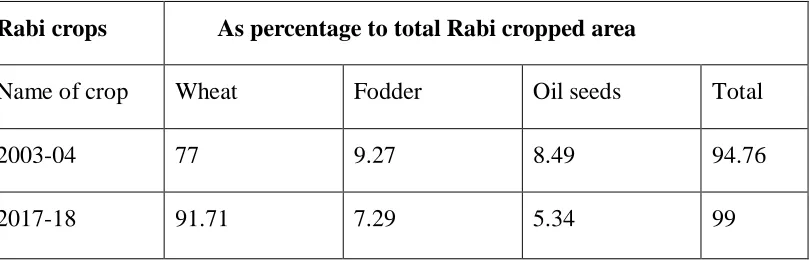
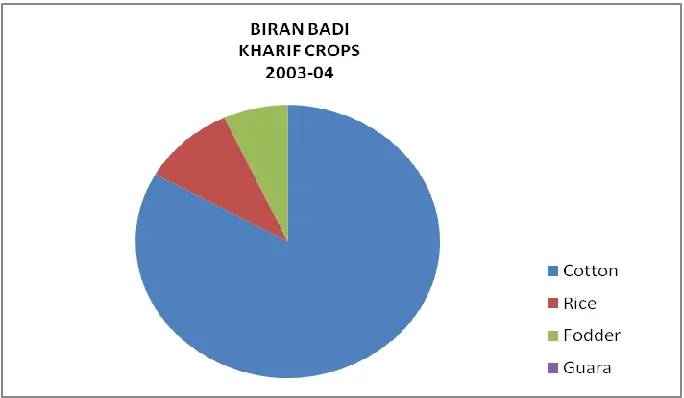
Abstract: Cropping pattern refers to the type of crops raised & the proportion of area under various crops at a point of time. It is, however, a dynamic concept as it changes over space & time. In this study dominant, secondary & minor crops are taken to determine the cropping pattern in village. Major crops of this season grown in village are wheat, pulses, mustered.Fodder refers to the crops which are cut green for feeding the livestock. Rice, cotton, guara and fodder crops such as bajara & chari are main kharif crops. After analyzing data, we can say that advancement in technology, irrigation facilities, government effort to develop agriculture, and financial assistance by banks has changed cropping pattern in the village. Though all the above factors helped the farmers a lot to improve their income source, but still they are not adjusting themselves to the new change.