Removal of
Escherichia Coli
through Rapid Depth
Filtration by using Burnt Oil Palm Shell (BOPS) as
a Filter Media in Water Treatment Process
Ali, M.F., Budari, N.M.
Institute for Infrastructure Engineering and Sustainable Management (IIESM) Faculty of Civil Engineering, Universiti Teknologi MARA, 40450 Shah Alam,
Selangor, Malaysia. Email: [email protected]
Abstract – Escherichia Coli is the ubiquitous microorganism contaminating the drinking water. This study is using granular bed filtration as a vigorous, simple and economical method to prevent the penetration of bacterial contamination, by discovering an alternative filter media from local source namely the burnt oil palm shell (BOPS). The result indicated that dual media BOPS/sand were higher reduction and longer total service of time compare to anthracite/sand, whereas BOPS/sand, 65.57% and anthracite/sand, 34.35% removal of E.coli by direct filtration process. The BOPS is identified as a potential filter media that will help in reducing the cost of water treatment and enhancing environmental sustainability. The results from this study were suggested that BOPS as a new biodegradable medium filter in water treatment process specifically for the removal of disease-causing by E.coli.
Index Term – Total Coliform; Escherichia Coli; Burnt Oil Palm Shell; Granular Media Filtration.
I. INTRODUCTION
E.coli is one of the species in the feacal coliform group, and has been used as an indicator for the feacal contamination in a given water sample. The gram-negative cell wall of E.coli is complex and can stay alive for longer periods in natural waters [5]. Drinking water should be free from the potential hazard to human health and safe drinking water regulation requires zero number of E.coli [2].
In spite of an intensive use of membrane technologies, many municipal potable water treatment plants around the world are still using granular bed filtration as a vigorous, simple and economical method to prevent penetration of disinfectant-resistant pathogenic microorganism [4].
The literature findings were using sand and other media such; anthracite, garnets or activated carbon as a granular filter media. However there are no quantitative surrogates for total coliform and E.coli removal by discovering an alternative granular filter media specifically for microbial removal in water treatment process.
Discovering burnt oil palm shell as an alternative filter media from local sources is also highly essential since it will help to reduce the cost of treatment, as it can be processed and produced locally.
Oil palm shell is identified as potential filter media in water/wastewater treatment industry [6]. The burnt oil palm shells (BOPS) are prepared from oil palm fruit shells that are solid waste by-product from oil palm factories and abundantly available in Malaysia [7]. The effectiveness of BOPS evaluated by filtrate water quality, whereas E.coli removal and head loss value. This paper aims to investigate the BOPS performance as an E.coli removal by using granular media filtration in water treatment process.
II. METHODOLOGY
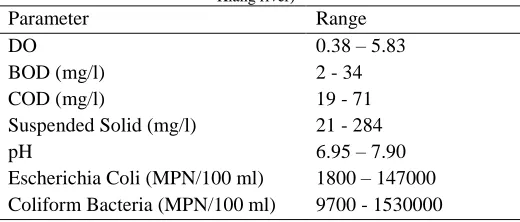
The study focused on Klang River water, 1K02 Klang Bridge sampling station, and the characteristics of Klang River as shown in Table 1.0. Klang River in class III, slightly polluted for river status in Malaysia [1]. Samples were collected in 25 litre plastic container and transport to the laboratory. Samples were analysed for total coliform and E.coli parameter.
Table 1.0
Characteristics of Klang river water from Station 1K02 (downstream area of Klang river)
Parameter Range
DO 0.38 – 5.83
BOD (mg/l) 2 - 34
COD (mg/l) 19 - 71
Suspended Solid (mg/l) 21 - 284
pH 6.95 – 7.90
A. Designing and Construction of Filtration Unit
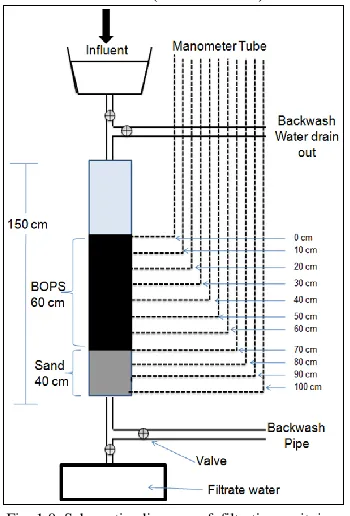
A laboratory scale filtration system was constructed to make similar with water treatment plant designation as shown in Figure 1.0. Filter units were prepared for experimental with effective size of dual-media consists 60 cm of BOPS (ES= 1.0 mm) over 40 cm of sand (ES= 0.5 mm).
Fig. 1.0. Schematic diagram of filtration unit in rapid depth filtration
Initial head loss will be determined for every effective size at a flow rate 5m3/m2/hr. The head loss verify by the
level of water from the manometer tubes at every 10 cm depth. A total of eleven manometer tubes install for each filter column. The filters column utilize in the study is fabricated from clear Perspex and equip with a backwashing facility.
B. Morphology of Filter Media
Figure 2.0 shows the differences morphology of BOPS, these figures were taken by Scanning Electron Microscope (SEM). From the structure, it was found that higher ES of BOPS have larger pore size than lower ES and significantly larger pore size of BOPS has lower removal efficiency as compared to lower pore size.
Fig. 2.0. SEM result of (a) BOPS at ES 0.85-1.0mm and (b) BOPS at ES 1.0-2.0mm
C. E.coli Detection
E.coli studies were performed with Colilert Test Kit. Colilert simultaneously detects E.coli in water samples. E.coli metabolize Colilert’s nutrient indicator, the samples fluoresces. Colilert simultaneously detect these E.coli within 24-28 hours and results interpretation by Most Probable Number (MPN).
III. RESULTSAND DISCUSSION
A. Initial Head Loss
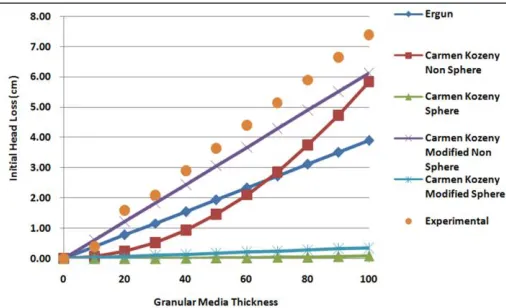
Initial head loss was determined by clean water less than 1.0 NTU passes filter bed. The comparable result is based on theory from Ergun, Carmen Kozeny spherical, Carmen Kozeny non spherical, Carmen Kozeny modified spherical and Carmen Kozeny modified non spherical equation [7], as shown in Figure 3.0 and 4.0 for sand and BOPS granular media.
Fig. 3.0. Initial Head Loss of Sand at ES 0.5mm, V = 5m3/m2/hr
a
Fig. 4.0. Initial Head Loss of BOPS at ES 1.0 mm, V = 5m3/m2/hr
As shown in Figure 3.0 and 4.0, Carmen Kozeny non spherical and Carmen Kozeny modified non sphere equation was close to experimental initial head loss results. Higher effective size of BOPS cause lower initial head loss value compared to sand media. On the other hand, lower effective size was increased friction force of the bed hence increase the head loss value as a highlighted the literature [3]. Initial head loss is a crucial factor in rapid depth filtration,
whereas the initial head loss is proportional to operation time of filtration unit.
The concept of filter media for spheres medium where the sieve openings correspond to the diameter, but for nonspherical media, the sieve opening was correspond to the smallest dimension of the smallest particle cross section. The variation of initial head loss of sand and BOPS shows that head loss value is proportional to granular media thickness, its mean head losses increase with filter bed depth, and for the experimental, head loss were measured by length of manometer tube.
B. Quality Service Time of Filter
Bacteria removal by granular media filtration is significant removal process as a vigorous, simple and inexpensive method to prevent pathogenic microorganism. The steps removals of bacteria by granular media filtration were involved in two: transport of bacteria from suspension to the medium filter, and followed by attachment of bacteria to the medium filter [9]. From this study E.coli removal were determined. As a result shown, combination dual media BOPS/sand have a greater performance compared with anthracite/sand, whereas, 65.57% for E.coli removal as shown in Table 2.0.
Table 2.0
Percentage reduction of E.coli in dual media filtration
Type of Media
ES (mm) Flow Rates m3/m2/hr
E.coli
(Most Probable Number (MPN))
% Reduction
Influent Effluent
BOPS/Sand 1.0/0.5 5 27300 9400 65.57
Anthracite/Sand 0.9/0.5 5 27300 17923 34.35
Figure 5.0 and 6.0 show the variation of head loss, influent and effluent quantitative value for E.coli of BOPS/sand and anthracite/sand in dual media filtration. All the results exhibited the same trend in the rise of head loss over total service time of filter. In constant of time anthracite/sand produce large number of head loss compare to BOPS/sand and consequences of short running of total
service time, and the mass of deposited particles also higher [8].
The particle deposited is differ between BOPS/sand and anthracite/sand, BOPS/sand cause particle deposited in the upper of filter bed, meanwhile anthracite/sand large particle deposited on the bottom of filter bed. As a particle retained in the bottom of the filter that easily to reduce the head loss of filter and short running of total service time.
Fig. 6.0. Changes of E.coli and head loss for anthracite/sand at ES 0.9/0.5 mm, V = 5m3/m2/hr
C. Profile Terminal Head loss
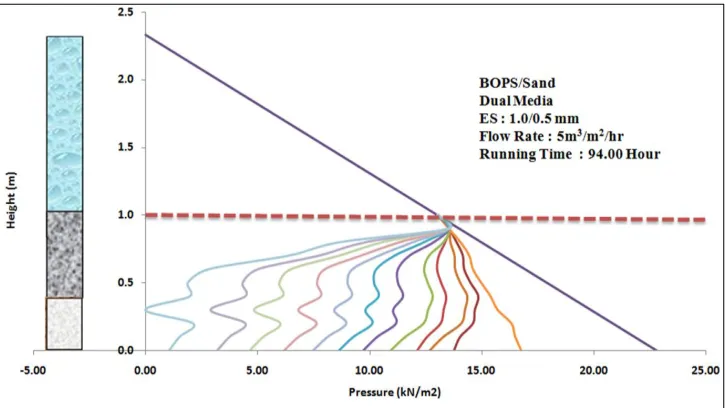
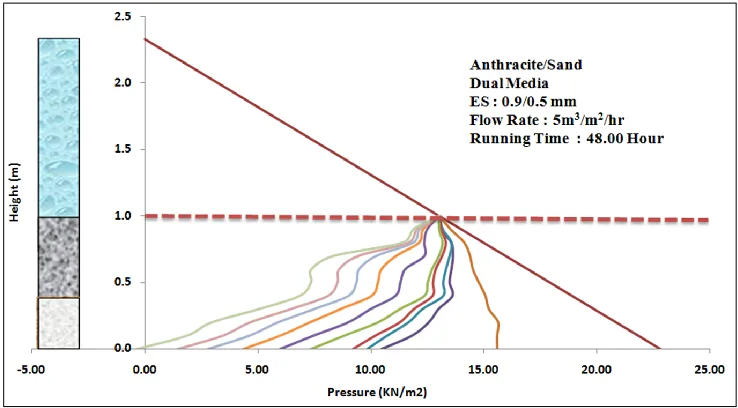
Figure 7.0 and 8.0 show the profile terminal head loss in dual media BOPS/sand and anthracite/sand as a filter media with respect to media thickness. Combination BOPS/sand higher total service of time compare to anthracite/sand. Service time of filtration unit were affected by the effective size, smaller
effective size tends higher head loss value [3], and the short running of filtration unit. Filter bed depth is proportional to the pressure of fluid, whereas, the pressure of fluid increases when the depth of filter increases. The filter cycle is terminated if this maximum head loss occurs prior to the bacteria, turbidity and suspended solid concentration break through limits.
Fig. 8.0. Profile Terminal Head loss of Anthracite/Sand, dual media filter at 5m3/m2/hr flow rate and ES 0.9/0.5 mm
From figure 7.0 and 8.0, the removal process starting from the beginning of filter bed, but more particle removal occurred in lower effective size of filter bed. The early part of filter runs, the medium filter cleans the feed water, the particles being removed and intercepted high in dual media BOPS/sand bed, but as the deeper bed gets dirtier the particles penetrate more deeply and the loss of head increases.
BOPS/sand and anthracite/sand as a dual media filter, significantly more E.coli removal occurred in the
BOPS/sand. BOPS may play an important role in the removal of big particles, and sand is liable removal of small particles.
As an effect, pores the sand is less than pores for BOPS, its mean throughout a filter run; big particles are deposited in BOPS filter bed meanwhile small particles deposited on sand filter bed. During the filter run, particles are deposited in the pores of the filter bed and cause a decrease in the porosity and a correspond increase in the head loss through the filter bed. Based on head loss results, a combination of BOPS/sand as a filter media is successful combination of dual media filtration is more effective, economical and easy to maintain.
IV. CONCLUSIONS
From this study, the following conclusions could be drawn with regard to the BOPS performance as an E.coli removal in granular media filtration. Dual media BOPS/sand as a filter media is a successful combination of E.coli removal, compare with the anthracite/sand.
This study shows that BOPS/sand at flow rates 5m3/m2/hr is greatly reduction of E.coli in direct filtration and
for the time being higher total running time of filtration unit. In other hand, BOPS as a new biodegradable filter media as an alternative filter media from local sources with utilizing oil palm shell is identified as potential filter media and it will help to reduce the cost of water treatment and
good for Mother Nature.
ACKNOWLEDGEMENT
The author would like to address special thanks to supervisor and all supporting staffs from Water Resources and Environment Division, Faculty of Civil Engineering, Universiti Teknologi MARA (UiTM) for their kind and warm helping hand throughout this period of study. Finally the author dedicated to beloved family for their motivation support in completing this research.
REFERENCES
[1] Department of Environment. River Water Quality. Putrajaya, Malaysia. 2005, 2006, 2007, 2008, 2009.
[2] EC Drinking Water Directive, Brussels, 1998
[3] Farizoglu, B., Nuhoglu, A., Yildiz, E. and Keskinler, B. 2003. The Performance of Pumice as a filter bed material under rapid filtration conditions. Filtration and Separation. 40-45.
[4] Gitis, V. 2008. Rapid sand filtration of cryptosporidium parvum: effects of media depth and coagulation. Water Science & Technology. [5] Jiang, J.Q., Wang, S., Panagoulopoulos, A. 2007. The role of
potassium ferrate (IV) in the activation of Escherichia coli and in the reduction of COD for water remediation. Desalination. 210: 266 – 273 [6] Jusoh, A., Goh Eng Giap, S., Nora’aini, A., Halim, A.G., Noor,
M.J.M.M., Zakaria, M.P. 2006. Comperative performances of single and dual media filters of sand and burnt oil palm shell. Jurnal Teknologi. 45: 43-52.
[7] Jusoh, A., Nora’aini, A., Halim, A.G., Norsani, W.N. 2009. Effective depth, initial head loss and backwashing criteria as the key factors of burned oil palm shell (BOPS) granular filtration. Desalination and Water Treatment. 10: 80-86.
[8] Mays, D.C., Hunt, J.R. 2005. Hydrodynamic aspects of particle clogging in porous media. Environ. Sci. Technol. 39(2): 577-584. [9] Mark W LeChevallier and Kwok-Keung Au. World Health