Original Research Article.
Virtual Patient as a Simulation-Based Learning Tool to Help Students
Learn Clinical Reasoning Skills in Medicine
Abdullah Ali Al-Qahtani
1*, Abdulmajeed Al-Drees
21*MBBS, Intern, College of Medicine, King Saud University, Riyadh, Saudi Arabia. 2Associate Professor, Department of Physiology,
College of Medicine, King Saud University, Riyadh, Saudi Arabia.
ABSTRACT
Background: Numerous instructional methods are used in medical education, including interactive lectures, problem-based learning, case-problem-based learning, and bedside teaching. Bedside teaching provides students with a real-life experience interacting with patients. Therefore, researchers have been working to create computer programs with virtual patients that simulate live patients, which aim to improve medical student clinical reasoning skills without the need of live patients. Objective: We conduct this study to find out the perception and to know the benefit of the diagnostic reasoning program for the medical students as learning tool at College of Medicine, King Saud university.
Methods: A cross-section study was conducted at College of Medicine, King Saud University, Riyadh, Saudi Arabia from November 2014 until March 2015.
A pretested self-administered questionnaire was handled to 321 medical undergraduate students from the third, fourth and the fifth year of both genders and selected randomly. Data was entered into Microsoft Office Excel 2007 then exported to SPSS version 21.0 for data analysis. Qualitative and quantitative data collection methods and Chi-Square test were used.
Results: The results were divided into ten categories according to five themes: learning, specialty, assessment,
authenticity, and implementation. In correlation with our reviewed literature, one of the primary targets of virtual patients is to stimulate relative thinking and problem- solving. The students claimed that it was an enjoyable experience that allowed them to practice their skills in history taking, physical examination, ordering investigations and treating accordingly. It was also found that student satisfaction increased relative to the number of cases they attempted (p < 0.05).
Keywords: Virtual Patient; Diagnostic Reasoning Program; Medical Student; Student Perception.
*Correspondence to:
Abdullah Ali Al-Qahtani
MBBS, Intern, College of Medicine, King Saud University, Riyadh, Saudi Arabia. Article History:
Received: 29-11-2017, Revised: 25-12-2017, Accepted: 21-01-2018
Access this article online
Website:
www.ijmrp.com
Quick Response code
DOI:
10.21276/ijmrp.2018.4.1.082
INTRODUCTION
Numerous instructional methods are used in medical education, including interactive lectures, problem-based learning (PBL), case-based learning, and bedside teaching. Bedside teaching provides students with a real-life experience interacting with patients. However, its limitations include inadequate number of patients for the sessions, a limited spectrum of cases, time consumption, and the need for
trained instructors.1 Therefore, researchers have been working to
create computer programs with virtual patients (VPs) that simulate live patients, which aim to improve medical student clinical reasoning skills without the need of live patients.1,2
Richard E. Mayer introduced and promoted the cognitive theory of multimedia learning (CTML). He showed that words and pictures help people learn more deeply than words alone.3 He also
found that learning is more effective when words and pictures are
converted into mental representations (schema) by the active learner.3 CTML is based on the principles of dual-channel working
memory (auditory and visual channels), the limited capacity and duration of working memory, and the active processing of information, including organization and integration with prior knowledge.3-5
Three memories are involved in the CTML model: very short-term sensory memory (visual and auditory), very short-term working memory (selection, processing, and integration of information), and long-term memory (knowledge store) with five different forms of word and picture representation.3 In addition, learners become
more conscious of information stored in their long-term memory when it has been applied.3 Furthermore, meaningful learning is
Clinical reasoning is a complex intellectual activity. It is the ability to gather relevant information from the patient, then integrating it with previous knowledge and experience to reach a diagnosis and decide on management.7 Both simulated patients and virtual
patients have been reported to be beneficial mediums for gaining diagnostic reasoning skills.7 A virtual patient (VP) is defined as
interactive computer simulations of a real-life patient used to practice history taking, physical examination, diagnostic skills and management.2 The learning process with a virtual patient is active,
contextual and can provide a more authentic learning experience than classroom-based PBL. In addition, VPs give learners the ability to make choices and experience the consequences in an engaging and realistic environment.8 High acceptance of virtual
patient programs has been documented among both pre-clinical and clinical year medical students.9,10 In addition, students
reported VPs to be realistic and challenging. Student satisfaction was high with the use of VPs in combination with other teaching activities. Furthermore, it has been found that using VPs improved
students’ knowledge and clinical examinations skills more than traditional methods, such as didactic lectures, case-based learning, bed-side teaching, and interactive OPD teaching clinic.11
However, students displayed little interest in further assessment and feedback regarding VPs.10 Students also considered the
relatively high technical demands of the program as a disadvantage. Furthermore, the scenarios and program interface complexity were reported to create a cognitive overload.8
The recommended ten principles of VP design to help students develop clinical reasoning skills: Relevancy, level of difficulty, interactivity, ability to give feedback, optimal use of media, student
focus, learning point’s recapitulation, authenticity, and questions
and explanations.2 The study also highlights the importance of
considering VP-based activities integration with other course activities. Various approaches should be used in the early stages
of integration, which should also be appropriate to the student’s
level.
VPs have been used in numerous educational programs, like Diagnostic Reasoning Program (DxR) and Second Life.8,12 DxR,
first introduced in 1990, is simulated patient software that allows students to practice their clinical reasoning skills by providing tools to gather information in order to diagnose and treat. With DxR,
students are required to repeatedly state the patient’s problem,
generate hypotheses and interrupt information (Bryce et al., 1998). DxR has been used in many health colleges.7,8
MATERIALS AND METHODS
Cross-section study was conducted at College of Medicine, King Saud University, Riyadh, Saudi Arabia using qualitative and quantitative data collection methods. The data was collected from third, fourth, and fifth-year medical undergraduate students of both genders, from November 2014 until March 2015. All participants
were informed of the objectives of the study. The study objective was explained to the participants prior to their participation. Ethical approval was obtained from the Institutional Review Board. Participants were requested to provide a written informed consent which emphasized on voluntary participation; right to withdrawal at any stage without any adverse consequences, as well as anonymity was assured by assigning each student with a code number for the analysis
Questionnaire
An anonymous, self-administrated questionnaire (validated by Samuel Edelbring)10 with minor modifications was used. The first
part of the questionnaire pertained to gender, age, academic year, and grade point average (GPA). The second part of the questionnaire contained questions about the number of cases the students finished, the time it took to work on them, and the methods of working with cases. The third part of the questionnaire contained questions about diagnostic reasoning program (DxR) benefits and perceptions using a 5-point Likert scale based answers as strongly agree (5), agree (4), neutral (3), disagree (2), and strongly disagree (1). At the end of the questionnaire, there were open-ended questions. The participants were directed to answer the questions by choosing the appropriate choices and writing the answer to open-ended questions. Incomplete questionnaires were excluded.
Data were coded and entered into Microsoft Excel 2007, then analyzed using SPSS® version 21.0 (IBM Corporation, Armonk, NY, USA). The average score for each student was calculated on a 5-point Likert scale. The 5-point Likert scale responses were
combined into three different categorical variables: ‘agree’ (strongly agree plus agree), ‘neutral’, and ‘disagree’ (strongly
disagree plus disagree). Chi-Square test was used to measure the associations among the different categorical variables (agree, neutral, and disagree), and gender and year of study.
Focus Groups
The students' perceptions of DxR were explored in a focus group discussion. All students of the third, fourth and fifth academic years were invited to participate in the focus groups, and only 50 students consented. Participants (n=50) were divided into five focus groups, with each group containing students from different academic years. One of the authors, a medical educationist, moderated the sessions, which started with a briefing on the study objective. Then the discussion was initiated using a series of preset directing questions to ensure consistency across the groups. The sessions lasted for 2 hours. During the sessions, students were encouraged to speak freely while a moderator assistant took notes, and the discussion was audio-recorded and transcribed. Three of the authors analyzed the transcript, identifying recurrent themes. The themes were further divided into categories. A summary report of each group was generated and presented to the groups.
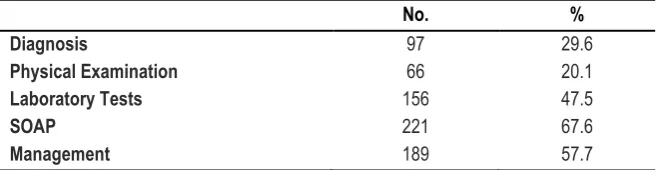
Table 1: Number of counts calculated for each section given by the students
No. %
Diagnosis 97 29.6
Physical Examination 66 20.1
Laboratory Tests 156 47.5
SOAP 221 67.6
Table 2: Independent Samples Test
Gender Sig. (2-tailed) Mean Difference 95% Confidence Interval of the Difference
0.005 0.27962 0.08612 0.47311
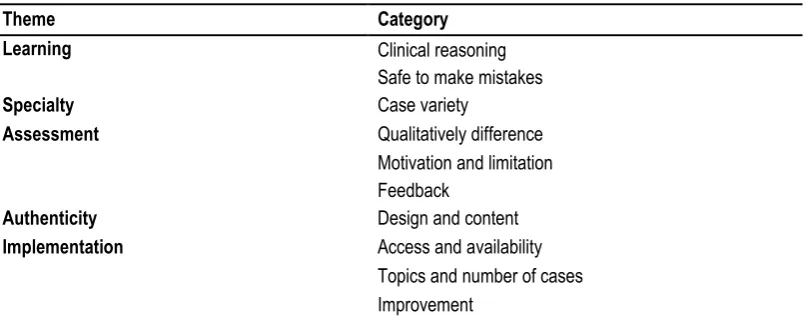
Table 3: Result themes and Categories
Theme Category
Learning Clinical reasoning
Safe to make mistakes
Specialty Case variety
Assessment Qualitatively difference
Motivation and limitation Feedback
Authenticity Design and content
Implementation Access and availability
Topics and number of cases Improvement
RESULTS
The results have been divided into ten categories, which fall under five general themes. The presentation of the results includes quotations from the students during the focus group session. The most reliable quotation was chosen to avoid redundancy. However, other students expressed similar ideas with fluctuations in agreement. For a synopsis of the results. (Table 1).
Chi-square test was used for categorical variables, while the association between continuous variables were examined using T-test. Independent T-test was used to analyze the mean difference between the two trial arms. In case an independent variable contained more than two categories, analysis of variance test (ANOVA) was used to measure significant associations with the study outcome. SPSS software, version 21 (SPSS Inc., Chicago, Illinois, USA) was used for data entry and analysis. All analyses were carried out at a 5% two-sided significance level and results were reported with 95% confidence intervals.
Surveys were analyzed for each student, and a mean satisfaction score was awarded for each question. The analysis was theme based, as several questions in the survey were intended to measure student satisfaction towards a predefined theme. Below, statistical analysis is presented for each proposed test and
supported by students’ quotes gathered from several focus groups meeting.
A total of 321 students completed the surveys, of which 184 were male (56.8%) and 137 were female (42.3%). The mean satisfaction score for male and female students was 1.72 and 1.63. The mean difference between both mean scores was statistically significant (p < 0.05) (table 2). This means that male students scored an overall higher satisfaction score than female students. Clinical year distribution was as follows: 137 students from the third year, 102 from the fourth year, and 80 from the fifth year. There were three different student GPA categories: 2.75-3.74 (3.7%), 3.75-4.74 (36.7%) and 4.75-5.0 (50.9%).
THEME 1: LEARNING
Category 1: Clinical Reasoning
ANOVA test was conducted to measure the association between student satisfaction and the average number of times each
individual case was attempted. Students who attempted each case more than twice had a significantly higher satisfaction score than students who worked on each case only once (p < 0.05). One of the main targets of VPs is to stimulate relative thinking and searching to solve problems. From the focus group questions on
clinical reasoning, a student quoted that “if you are dedicated to solve the case it makes you go and read about it”. From the
students’ point of view, the opportunity to learn about cost efficiency was one of DxR interesting features: “The cost is a good point because it will minimize my investigation”. Furthermore,
students mentioned that one of the positive aspects of DxR is that it mimics real-life situations: “It is more realistic in terms of doing
the physical examination, like stethoscope you can hear the heart
beats with the abnormalities”.
Category 2: Safe to Make Mistakes
Since the DxR is web-based software, students were more relaxed concurring cases, as it was safe to make mistakes. As an active learning technique, they preferred DxR over real-life situations, where they sometimes got stressed dealing with live
patients. “It is fine for me to make mistakes in DXR rather than
real patient”, a student commented, to which the majority of
participants agreed. THEME 2: SPECIALTY Category 1: Case Variety
An ANOVA test was done to investigate the association between the number of DxR cases attempted by each student and their satisfaction score. As the number of cases increased (more than
15 cases), so did the mean students’ satisfaction score (p < 0.05).
Moreover, students were satisfied with the number of cases, topic variation, and relevance of topics to their curriculum themes. “I
liked the variety of the cases and its association with what we are
studying at the moment,” was a common comment by many
students during the focus group. On the other hand, a few students felt that the cases were novel to them and had not been covered in the theoretical part of their studies. As they quoted,
THEME 3: ASSESSMENT
Category 1: DxR Assessment-Qualitatively Different in Manner of Student Year
Third-year students were more satisfied with DxR than both fourth and fifth-year students, as the mean satisfaction score for third, fourth and fifth-year students were 1.84, 1.60, 1.51 (p-value < 0.05). Student feedback showed that DxR did not differentiate between the third, fourth, and fifth year in terms of information
presented. “As third-year students, we know how to take history
but investigation and treatment are beyond our knowledge,” noted
a third-year focus group student. Another student in the same
meeting also commented: “it does not differentiate between the student’s clinical year, for the third year it should access history
and physical exam parts and continue for fifth-year students, with
investigation and management”. In addition, students were required to list differential diagnosis for each case, which was considered one of the difficult aspects. They commented,
“Differential diagnosis is beyond our level since some of the differential we did not take or have any knowledge about it”.
Category 2: Motivation and Limitations
According to the students’ feedback, the DxR experience was enjoyable: “In somehow, it was interesting in the beginning”. They
enjoyed the role assigned to them while working cases, doing physical examinations, requesting medical tests and treating
accordingly. As a student commented, it was “enjoyable in terms
of ordering the investigation and planning a management
protocol”. However, stress while attempting cases were mentioned
during the focus group and the students quoted different reasons
for that, such as: “it makes me stress because I want to score all mark”, and “DxR put me on pressure because of the deadline”.
The amount of time spent on average by each student was measured, which was statistically correlated with student satisfaction. It was noticed that if students spent more than one hour on a case, their satisfaction score decreased significantly (p < 0.05). During the focus group, students complained from a heavy workload during the academic year and minimal time to
work on the DxR: “very long cases which take a lot of time to solve and sometimes it is too much for a student to handle”. Another student complained “it is time-consuming (a lot of writing)” and that “SOAP is time-consuming”. This can be noticed from table 1, as many of the students selected SOAP as the most difficult question.
Category 3: Feedback
The students appreciated DxR feedback given at the end of each completed case. As most of the students agreed during the focus
groups, “it gives you feedback about the things you missed”. They
also endorsed a software feature which allows them to consult a
specialist: “in examination and investigation after your interpretation it gives you consultation form a specialist”.
THEME 4: AUTHENTICITY Category 1: Design and Content
The participants believed that the DxR interface was outdated,
misleading and complex: “DxR layout is very old”; “user interface is complicated”. The students also complained about the quality of the radiological images: “some images in the DxR were not clear,
especially the radiological imaging”. This feedback was mostly
from students who did not attempt as many cases on DxR as other students with higher satisfaction scores, which has been linked as aforementioned. However, the students admired how the
case histories were presented: “the question presented in DxR history is good, clear, and covering the subject of the case”.
THEME 5: IMPLEMENTATION Category 1: Access and Availability
Students were asked about the locations where they worked on DxR from. Answers included home, college and coffee shops. An independent t-test showed that there was no statistically significant difference between the mean satisfaction score for students working from these different places. This implies that location of work does not affect the satisfaction score of students. During the focus group, students agreed that the flexibility of access to DxR was one of the features they admired, and
mentioned that “because it is a web-based you can do it in college home or anywhere and at any time”.
Category 2: Topics and Number of Cases
Students were satisfied with the number of cases that were
presented per theme. “I believe that the number of cases is acceptable”, as a student commented. “Most of the cases are common”, mentioned another student, to which the rest agreed to. Category 3: Suggested Improvements
The students suggested several methods to improve DxR. These
include improving the rigid grading system. “The DxR is too ideally, you should answer everything to get the full mark. I think they should lower their standard and make it if you reach a certain degree you get the full mark for the section like if you should ask 10 questions in history if you asked 7-8 questions it’s enough”. Another student added, “fail or pass will be better in evaluation”.
Furthermore, students believed more workshops on DxR should be implemented in order for them to improve and adapt to the
software: “the orientation was beneficial to us, but we need more
workshops”. Another issue that participants believe need
improvement is that spelling and misspelled words were
considered a problem: “I always have a problem with spelling”.
Moreover, different names for one disease were considered an
issue: “in differential diagnosis some diseases have more than
one name but the DxR recognizes only one and count the other as
mistake”; “Because it is web-based if you change one letter in a
word it counts as mistake and the whole mark is lost”.
DISCUSSION Learning
Clinical reasoning: Students reported that DxR helped test their existing knowledge12 and it allowed them to actively apply their
newly gained insights in clinical reasoning during the corresponding teaching events.13,14 Our study adds that DxR
motivated them to read more about the cases they attempted in order to solve them. Moreover, students mentioned numerous positive features of DxR software, including how it mimics real-life situations.Safe to make mistakes: Students claimed that computer cases were not stressful as opposed to real patient interactions, which may be could be highly stressful. If a mistake was made on a VP, they did not feel embarrassed or intimidated.2,9,12,14
Additionally, they could try things on a computer patient they could not on a real patient.12 In our study, students also preferred DxR
over real-life situations where they sometimes got stressed dealing with real patients.
Specialty
common diseases, which are often complicated with co-morbidities at presentation.14 Case variety is a beneficial feature of
DxR, and students were satisfied with the number of cases, their variation, and their relevance to the topics in their curriculum. Assessment
Qualitatively different: The degree of difficulty of DxR cases
should be appropriate for students’ knowledge and academic
levels. Students indicated that DxR did not differentiate between the third, fourth, and fifth year in terms of information presented. Motivation and Limitation
Students said the program was interesting, fun, non-stressful, yet engaged them to think. They enjoyed the opportunity to practice gathering information and working through a patient’s problem
from beginning to end. They also appreciated the feedback on their performance.12 In our experience, students also felt DxR was
enjoyable and interesting in terms of ordering investigations and planning management. They also commended the DxR feedback given at the end of each case, as well as the specialist consultation feature, which allowed them to ask for a second opinion when they felt doubtful about a finding. However, our students believed that DxR was time-consuming and required a lot of effort to score a full mark.
Authenticity
Students had difficulty sometimes searching in the DxR database. This was complicated by differences in terminology.12 In our study,
students also found the DxR layout to be outdated and the user interface to be misleading and complex. However, they liked how the case history was presented and felt they would use the software to practice their history-taking skills.13
Implementation
Access and availability: Our study showed that students appreciated the flexibility of access to DxR. VPs were always accessible, unlike real patients.2,12,13 The number of cases
available was acceptable and topics of cases were commonly seen in the clinic, as the students claimed.
Suggested Improvement
The students suggested several improvements to DxR. According to them, DxR is rigid and will not accept any spelling mistakes. Furthermore, DxR will recognize only one name for a disease, even if it has more than one. Moreover, they felt they needed further seminars and workshops on how to use DxR. Lastly, they believed it would be better to use a pass or fail system, as a grading system is not flexible.
CONCLUSIONS
The study evaluates the perception of students toward diagnostic reasoning program (DxR) in a system-based hybrid curriculum. It shows that DxR has no positive effect on knowledge and skill outcome in a system-based hybrid curriculum at College of Medicine, King Saud University, Riyadh. Therefore, students need more guidance and training concerning working with the web cases presented on DxR. Moreover, the DxR website needs to be updated in terms of layout and features. Lastly, students require further seminar discussions of the DxR web cases.
REFERENCES
1. Oliven A, Nave R, Gilad D, Barch A. Implementation of a Web-Based Interactive Virtual Patient Case Simulation as a Training and Assessment Tool for Medical Students. European Federation for
Medical Informatics 2011: 233–237. http://doi.org/10.3233/978-1-60750-806-9-233
2. Reichert F, Bosse H, Leng B, De Vleuten C, Haag M, Hoffmann GF. Virtual patients Design principles for virtual patients: a focus group study among students. Medical Teacher 2009; 43: 580–588. http://doi.org/10.1111/j.1365-2923.2009.03369
3. Mayer RE. Cognitive Theory of Multimedia Learning. In R.E. Mayer (Ed.). The Cambridge Handbook of Multimedia Learning. New York: Cambridge University Press; 2005. (pp 31-48).
4. Mayer RE, Moreno R. A split-attention effect in multimedia learning: Evidence for dual processing systems in working memory. Journal of Educational Psychology 1998; 90: 312-320.
5. Mayer RE. Elements of a science of e-learning. Journal of Educational Computing Research 2003; 29(3): 297-313.
6. Mayer RE. What neurosurgeons should discover about the science of learning. Clinical Neurosurgery 2009; 56: 57-65.
7. Wilson RD, Klein JD, Hagler D. Computer-Based or Human Patient Simulation-Based Case Analysis: Which Works Better for Teaching Diagnostic Reasoning Skills. Nursing Education Perspectives 2004; 35: 14–19. http://doi.org/10.5480/11-515
8. Conradi E, Kavia S, Burden D, Rice A, Woodham L, Beaumont C, et al. Virtual patients in a virtual world: Training paramedic students for practice. Medical Teacher 2009; 31: 713–720.
9. Gesundheit N, Brutlag P, Youngblood P, Gunning W T, Zary N. The use of virtual patients to assess the clinical skills and reasoning of medical students: initial insights on student acceptance. Medical Teacher 2009; 31: 739–742.
10. Edelbring S, Brostro O, Henriksson P, Vassiliou D, Spaak J. Technology enhanced learning Integrating virtual patients into courses: follow-up seminars and perceived benefit. Medical education 2012; 46: 417–425. http://doi.org/10.1111/j.1365-2923.2012.04219.x 11. Huang G, Reynolds R, Candler C. Virtual patient simulation at US and Canadian medical schools. Acad Med J Assoc Am Med Coll 2007; 82(5):446–51.
12. Bryce DA, King NJC, Graebner CF, Myers JH. Evaluation of a Diagnostic Reasoning Program (DxR): Exploring Student Perceptions and Addressing Faculty Concerns Demonstrations. Journal of Interactive Media in Education 1998; 98 (1): 196–198.
13. Andrzej A Kononowicz, Paweł Krawczyk, Grzegorz Cebula, Marta Dembkowska, Edyta Drab, Bartosz Frączek, et al. Effects of
introducing a voluntary virtual patient module to a basic life support with an automated external defibrillator course: a randomised trial. BMC Medical Education 2012;12:41.
14. Mihaela Botezatu, Håkan Hult, Uno G Fors. Virtual patient simulation: what do students make of it? A focus group study. BMC Medical Education 2010; 10:91.
Source of Support: Nil.
Conflict of Interest: None Declared.
Copyright: © the author(s) and publisher. IJMRP is an official publication ofIbn Sina Academy of Medieval Medicine & Sciences, registered in 2001 under Indian Trusts Act, 1882. This is an open access article distributed under the terms of the Creative Commons Attribution Non-commercial License, which permits unrestricted non-commercial use, distribution, and reproduction in any medium, provided the original work is properly cited.