263
International Journal of Pharmaceutical Sciences and Drug Research
2015; 7(3): 263-269
Research Article
CODEN (USA): IJPSPP
ISSN: 0975-248X
Evaluation of Memory Enhancing Activity of Leaf Extract of
Dalbergia sissoo
in Mice
Sayanti Sau
*, Mukund Handral
Department of Pharmacology, PES College of Pharmacy, 50 Feet road, Hanumanthanagar, Bangalore- 560 050, Karnataka, India
ABSTRACT
Dalbergia sissoo (family: Fabaceae) is an Asian deciduous rosewood tree. It is the state tree of Punjab state (India)
called as Shisham used for antipyretic, emesis, ulcers, leucoderma, stomach troubles and skin disease, memory enhancer etc. The aim of this study is to evaluate the learning and memory activity of ethanolic leaf extracts of
Dalbergia sissoo in mice. The animals were divided into six groups of 6 each. Group I was considered as normal
control, II as Standard control (Imipramine), III, IV and V was treated group (ELDS 300, 450 and 600 mg/kg respectively) and VI as scopolamine treated (negative control).The effect of ethanolic leaf extract of Dalbergia
sissoo was investigated in mice for memory enhancing activity using various experimental paradigms of learning
and memory viz. Transfer latency (TL) on elevated plus maze and passive avoidance. For memory and learning activity vehicle/ extracts / STD drug administered daily for first seven days, on 8th day dementia was induced
by scopolamine. ELDS significantly enhanced the learning and memory activities against the scopolamine induced dementia and significant decrease in Acetylcholinesterase level in brain in animals. The memory enhanced activity as evidenced by learning and retrieval was due to cholinergic facilitatory effect in animals. These results indicate a possible memory enhancing action of Dalbergia sissoo which qualitatively comparable with that of piracetam.
Keywords: Dalbergia sissoo, Scopolamine, Acetylcholinestrase, Elevated plus maze, ELDS.
INTRODUCTION
Learning is the most characteristic attributes of the man and also of higher animals. Learning is defined as the ability to alter behaviour on the basis of experience. [1]
Memory is special facility of brain which retains the events developed during the process of learning and both are mediated by nervous system. [2] Once
memories have been stored in the brain, it becomes the
*Corresponding author: Ms. Sayanti Sau,
P.G Scholar, Department of Pharmacology, PES College of Pharmacy, 50 Feet road, Hanumanthanagar, Bangalore- 560 050, Karnataka, India; Tel.: +91-9986581229; E-mail: [email protected]
Received: 26 May, 2015; Accepted: 28 May, 2015
part of brain process mechanism when it will recall in future. [3] Learning and memory are closely related, all
learning involves memory but all memory not involves to learning. [4] Probably learning and memory are most
evolutionary advantageous developments for human. These are interesting but ill-understood subjects. [5] The
learning and memory as well as its utilization in behavioural adaptation by an animal are a mystery which is not yet solved completely. [6] Memories are
fixated or consolidated over time, once consolidated, memories are then stable and acquisition of a new memory and its consolidation together form a unique event; consolidation happens only once. [7]
Int. J. Pharm. Sci. Drug Res. May-June, 2015, Vol 7, Issue 3 (263-269)
as language, visio-spatial or executive function that is sufficient to interfere with social or occupational function in an alert person. [8] Particularly affected areas
may be memory, attention, language and problem solving. As the proportion of the elderly people is increasing rapidly the prevalence of dementia will also be more and it is expected that (14.4%) 5.7 million will be over age 85 and 30-45% of them will be suffering from Dementia. [9]
There are a few synthetic medicines e.g. tacrine, donepezil and the natural product based rivastigmine for treatment of cognitive dysfunction and memory loss associated with AD. These compounds have been reported to have their adverse effects including gastrointestinal disturbances and problems associated with bioavailability, which necessitates the interest in finding better AChE inhibitors from natural resources.
[10] In recent years, attempts have been made to develop
drugs for treatment of dementia and attention deficit disorders to improve memory and learning. These agents are commonly referred as Nootropic agents or cognition enhancers. [11]
There is a need for alternative medicine with less adverse effects and more efficacies; in this regard plants are the major resource, which can ameliorate disturbances in cognition, mood, sleep and potentates activities of daily living. Hence there is on-going search for newer therapeutic products for the treatment of psychiatric disorders. Medicinal plant research worldwide is progressing constantly, demonstrating the pharmacological effects in psychiatric disorders. A number of single and compound drug formulations of plant origin are mentioned in Ayurveda for the treatment of psychiatric disorders. [12]
The extract of Dalbergia species was reported to be brain tonic [13] in traditional system of medicine and also
possess antioxidant activity, [14] however there is no
scientific data available on the memory and learning activity of title plant in animals. Hence the present study has planned with aim to determine memory and learning activity of Indian rosewood leaf extract in experimental animal models.
MATERIALS AND METHODS Drugs and chemicals
Scopolamine hydro bromide (Sigma-Aldrich, USA), Diazepam (Ranbaxy, India), Piracetam (Micro labs, India), 5, 5’ Dithio-bis (2-nitrobenzoic acid) (DTNB) (Sigma, St. Louis, MO, USA), Acetylthiocholine Iodide (Sigma, St. Louis, MO, USA). All other chemicals and reagents are of laboratory grade.
Plant material and extraction
The fresh leaves of Dalbergia sissoo Roxb, were collected from Gandhi Krishi Vignan Kendra (GKVK) Karnataka, India in the month of July 2014. The plant was identified and authenticated by Mr. KP Sreenath, taxonomist Department Botany, Bangalore University, India.
The collected fresh leaves were shade dried or tray dried for two weeks and then grinded to a fine powder. In the continuous hot extraction method, the plant leaves powder was extracted in ethanol for 3 days at temperature of 78- 80°C. The mixture was subsequently filtered and concentrated under reduced pressure at 40°C in rotary flush evaporator. The extract yield was 26% w/w. [15] The extract was stored in desiccator. Preparation of Dalbergia sissoo leaf extracts suspension
Weighed quantity of ethanolic leaf extract of Dalbergia
sissoo (ELDS) was suspended in distilled water using
0.5% v/vDimethyl sulphoxide and administered orally to mice. Thesuspension of extract was prepared freshly every day. The extract was administered at a constant volume of 1 ml foreach animal. [16]
Preliminary Phytochemical Investigation
The extracts were used for preliminary phytochemical screening with a battery of chemical tests viz., Molisch’s, Fehling’s, Benedicts and Barfoed’s test for carbohydrates; Biuret and Millon’s tests for proteins; Ninhydrin’s test for amino acids; Salkowski and Libermann-Burchard’s reactions for steroids; Borntrager’s test for anthraquinone glycosides; Foam test for saponins glycosides; Shinoda and alkaline tests for flavonoids glycosides; Dragendorff’s, Mayer’s, Hager’s and Wagner’s tests for alkaloids; and ferric chloride, Lead acetate tests for tannins and phenols. [17] Animals
Swiss albino mice weighing between 18-25 g were procured from Raghavendra enterprises, Bangalore for experimental purpose. Then all the animals were acclimatized for seven days under standard husbandry conditions, i.e.; room temperature of 24 ± 10°C; relative humidity 45-55% and a 12:12h light/ dark cycle. The animals had free access to standard pellet, with water supplied ad libitum under strict hygienic conditions. Each experimental group had separate set of animals and care was taken to ensure that animals used for one response were not employed elsewhere. Animals were habituated to laboratory conditions for 48 hours prior to experimental protocol to minimize (if any) non-specific stress. The experimental protocols were approved by the Institutional Animal Ethics Committee (PESCP/IAEC/03/2014, Date: 25-1-2014) and conducted according to CPCSEA guidelines, Govt. of India.
Acute oral toxicity studies
The acute toxicity study was performed earlier in the laboratory and found that ELDS was not toxic up to 3000 mg/kg body weight. [18] Acute toxicity studies
Int. J. Pharm. Sci. Drug Res. May-June, 2015, Vol 7, Issue 3 (263-269)
24 hours. The animals were observed for 1 week.The dose was selected low, medium and high dose (300, 450 and 600 mg/kg) for the animal studies.
Elevated Plus-Maze Test
The elevated plus maze served as simple behavioral model to evaluate learning and memory in mice. The procedure and techniques and end point for testing memory was followed in accordance with standard literatures. [19] The apparatus consisted of two open
arms (16 cm × 5 cm) and two covered arms (16 × 5 × 12). The arms extended from a central platform (5 cm × 5 cm), and the maze was elevated to a height of 25 cm from the floor. On the first day, each mouse was placed at the end of an open arm, facing away from the central platform. Transfer latency (TL) was taken as the time taken by the mouse to move into any one of the covered arms with all its four legs. TL was recorded on the first day. The cut off time is 90 s. Memory retention was examined 24 h after the first day trial on the second day. Significant reduction in TL value of retention indicated improvement in memory.
Passive Shock Avoidance Paradigm
Passive avoidance apparatus is based on negative reinforcement was used to examine long term memory. The apparatus consisted of a rectangular box (27 × 27 × 27 cm3) having three walls of wood and one wall of
Plexiglas featuring a grid floor (3 mm stainless steel rods set 8 mm apart), with a wooden platform (10 × 7 × 1.7 cm3) at the center of the grid floor an electric shock
was delivered to the grid floor. During training sessions, each mouse was placed on the wooden platform, immediately after mouse stepped down on the grid, an electric shock of 1.8 mA, for 0.2 sec was delivered and it was recorded as step-down latency (SDL). SDL was defined as the time taken by the mouse to step down from wooden platform to grid floor with its entire paw on the grid floor. All the animals were submitted to a single training session. Mice showing SDL in the range (2–15 s) during the first test were used for the second session and the retention test. The second session was carried out 90 min after the first test. In this test animals were trained to remain on the platform for a period of 60 sec and the SDL were noted. Retention was tested after 24 hours (i.e. 9th day after last
dose) in a similar manner, except that the electric shocks were not applied to the grid floor. SDL was recorded with an upper cutoff time of 300 s. Significant increase in SDL indicate improvement in memory. During the study number of step down errors were counted. [20]
Estimation of Brain Cholinesterase
AChE inhibitory activity of the extracts was measured by the spectrophotometric method developed by Ellman et al. (1961). The cerebral cortex, midbrain, medulla oblongata and cerebellum were dissected on ice and weighed as described earlier. [21] The different
parts of brain were homogenized in a tissue homogenizer using phosphate buffer at a pH of 8.0. The homogenate was centrifuged at 3000rpm for 10 min.
The homogenate mixed DTNB (Sigma, USA) and Acetylthiocholine iodide (substrate). Thiocholine released because of the cleavage of substrate by AChE was allowed to react with the –SH reagent DTNB, which is reduced to thionitrobenzoic acid, a yellow colored anion with an absorption maxima at 412 nm was measured utilizing a UV 160A, UV–visible recording spectrophotometer, Shimadzu (Japan). The extinction coefficient of the thiobenzoic acid is 1.36 × 10 -4/molar/centimeter. The rate in moles of the substrate
hydrolyzed per minute per gram of tissue was calculated.
Statistical analysis
Values are expressed as mean ± SEM from 6 animals. Statistical differences in mean were analyzed using one way ANOVA followed by Dunnett’s test. p<0.05 was considered significant.
RESULTS
Phytochemical analysis
Phytochemical study Extract subjected for phytochemical study showed the presence of carbohydrates, proteins, amino acids, steroids, phenolic compounds, tannins, glycosides and flavonoids (Table 1).
Acute toxicity studies
The ethanolic extract did not show any signs and symptoms of toxicity and mortality up to 3000 mg/kg dose.
Effect of ELDS against scopolamine induced dementia in mice using Elevated plus Maze
The transfer latency of the animals significantly decreased (p<0.0001) when compared to control group on day 1 before the administration of the Scopolamine. Which is 47.47% (45.00 ± 1.98), 66.73% (28.50 ± 2.32) and 77.82% (19.00 ± 2.08) respectively for 300, 450 and 600 mg/kg of ELDS with a significance of p<0.0001 and for piracetam treated group TL was 55.83% (37.83 ± 1.57). Retrieval phase on second day, significant decrease (p<0.001) in the TLC was observed for all the groups by 44.51% (27.83 ± 1.95) for piracetam, 43.85% (28.16 ± 2.32), 54.15% (23.00 ± 1.98), 61.46 (19.33 ± 1.83) for 300, 450, 600 mg/kg of ELDS.
The details results are shown in Table 2 and Fig. 1.
Psychopharmacological studies for memory and learning activity using Passive shock Avoidance Paradigm
Int. J. Pharm. Sci. Drug Res. May-June, 2015, Vol 7, Issue 3 (263-269)
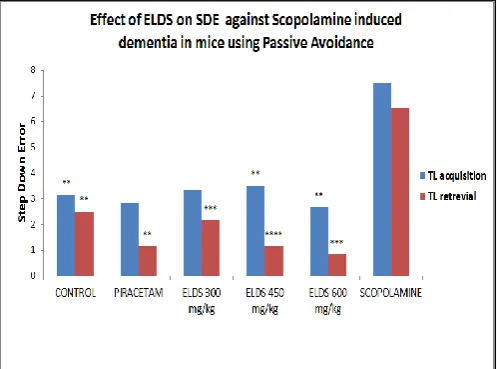
Besides SDE were significantly (p<0.01) reduced by all doses of ELDS 300, 450 and 600 mg/kg by 55.56 %, 53.33 % and 64.44 % respectively (3.33 ± 0.49, 3.5 ± 0.42 and 2.66 ± 0.42 respectively). Piracetam also reduced the SDE by 62.22 % (2.83 ± 0.60) compared to only scopolamine treated group.
The ELDS was able to reverse the scopolamine induced dementia significantly, similar results with significance of (p<0.0001) was seen after 24hr retrieval phase (164.66 ± 2.76), (244.66 ± 3.80) and (274.16 ± 4.08) respectively and for piracetam (233 ± 2.84).
Besides SDE were significantly (p<0.0001) reduced by ELDS 300, 450 and 600 mg/kg 66.67 %, 82.05 % and 87.17 respectively (2.16 ± 0.47, 1.16 ± 0.30 and 0.83 ± 0.30 respectively). Piracetam also reduced the SDE by 82.05 % (1.16 ± 0.30).
The detailed result is depicted in Table 3 and Fig. 2 and 3.
Estimation of brain Acetyl Cholinesterase level of mice
ACh is considered mainly a neurotransmitter and, as such, its functions are associated with both central and peripheral nervous system synapses. ACh degradation AChE, the enzyme whose activity determines the duration and the efficacy of cholinergic neurotransmission. The reduction in ACh breakdown exerted by these drugs allows compensation for the decrease in viable neurons.
Table 1: Data showing qualitative chemical examinations of extract of Dalbergia sissoo leaves
S. No Tests Alcoholic extract 1. Carbohydrates
Molish’s test +
Benedict’s test +
Fehling’s test +
Barfoed’s test +
2. Proteins
Biuret test +
Millon’s test +
3. Amino acids
Ninhydrin’s test + 4. Steroids
Salkowski reaction + Libermann-burchard’s reaction + 5. Flavonois glycosides
Shinoda test +
Alkaline test +
6. Anthraquinone glycosides
Borntrager’s test + 7. Saponin glycosides
Foam test +
8. Alkaloids
Dragendorff’s test -
Mayer’s test -
Hager’s test -
Hager’s test -
Wagner’s test -
9. Tannins and phenols
Ferric chloride test + Lead acetate test + (+) indicate presence while (-) stand for absence.
Table 2: Effect of ELDSon transfer latency against scopolamine induced dementia in mice S.
No. Groups Treatment
Transfer Latency in sec
Acquisition % Change in TLC Retrieval % Change in TLC 1 I Control 51.11 ± 1.40 40.27 37.16 ± 1.70 * 25.91 2 II Piracetam (500 mg/kg) 37.83 ± 1.57 **** 55.83 27.83 ± 1.95 ** 44.51 3 III ELDS (300 mg/kg) 45.00 ± 1.98 *** 47.47 28.16 ± 2.32 ** 43.85 4 IV ELDS (450 mg/kg) 28.50 ± 2.32**** 66.73 23.00 ± 1.98 *** 54.15 5 V ELDS (600 mg/kg) 19.00 ± 2.08 **** 77.82 19.33 ± 1.83 **** 61.46 6 VI Scopolamine (3mg /kg) 85.66 ± 2.74 0 50.16 ± 1.95 0 Values are expressed as Mean± SEM. TLC= Transfer Latency. Statistical analysis is carried one way ANOVA fallowed by Dennett’s test. * (p<0.05), ** (p<0.01), *** (p<0.001), **** (p<0.0001)
Table 3: Effect of ELDS on scopolamine induced dementia in mice using passive avoidance S.
No. Groups Treatment
Acquisition in Seconds Retrieval in Seconds
SDL SDE SDL SDE
1 I Control 165.66 ± 5.49 **** 3.16 ± 0.70 ** (57.78) 219.83 ± 8.38 **** 2.50 ± 0.42 ** (61.53) 2 II Piracetam (500 mg/kg) 195.16 ± 6.04 **** 2.83 ± 0.60 (62.22) 233 ± 2.84 **** 1.16 ± 0.30 ** (82.05) 3 III ELDS (300 mg/kg) 157.33 ± 2.98 **** 3.33 ± 0.49 (55.56) 164.66 ± 2.76 **** 2.16 ± 0.47 *** (66.67) 4 IV ELDS (450 mg/kg) 171.16 ± 3.40 **** 3.5 ± 0.42 ** (53.33) 244.66 ± 3.80 **** 1.16 ± 0.30 **** (82.05) 5 V ELDS (600 mg/kg) 188.33 ± 2.27 **** 2.66 ± 0.42 ** (64.44) 274.16 ± 4.08 **** 0.83 ± 0.30 *** (87.17) 6 VI Scopolamine (3mg /kg) 30.33 ± 2.90 7.5 ± 0.84 (0) 35.00 ± 7.71 6.5 ± 0.42 (0) Values are expressed as Mean± SEM. SDL= Step Down Latency; SDE= Step Down Error. Statistical analysis is carried one way ANOVA fallowed by Dennett’s test. ** (p<0.01), *** (p<0.001), **** (p<0.0001). Values in parenthesis indicate percentage change.
Table 4: Brain acetyl cholinesterase levels of mice S.
No. Groups Treatment
Acetylcholinesterase Inhibition Rate of change Of absorbance
/min % reduction in rate of change absorbance Rate of degradation of M of ACh/gm of tissue
1 I Control 0.165 ± 0.0013 0 0.047 ± 0.000
Int. J. Pharm. Sci. Drug Res. May-June, 2015, Vol 7, Issue 3 (263-269)
Fig. 1: Effect of ELDS on TLC against Scopolamine induced dementia in mice
Values are expressed as MEAN± SEM. TLC= Transfer Latency. Statistical analysis is carried one way ANOVA fallowed by Dennett’s test. * (p<0.05), ** (p<0.01), *** (p<0.001), **** (p<0.0001)
Fig. 2: Effect of ELDS on Step down Latency against Scopolamine induced dementia in mice using Passive Avoidance Paradigm Each bar represents the Mean ± SEM (n = 06). Statistical analysis is carried one way ANOVA fallowed by Dennett’s test. **** (p<0.0001)
Fig. 3: Effect of ELDS on Step down Error against Scopolamine induced dementia in mice using Passive Avoidance Paradigm Each bar represents the Mean ± SEM (n = 06). Statistical analysis is carried one way ANOVA fallowed by Dennett’s test. *(p<0.05), ** (p<0.01), *** (p<0.001), **** (p<0.0001)
Fig. 4: Brain Acetyl Cholinesterase levels of mice
Each bar represents the Mean ± SEM (n = 06). Statistical analysis is carried one way ANOVA fallowed by Dennett’s test. *** (p<0.001), **** (p<0.0001)
The extracts were significantly(p<0.0001) reduced the rate of degradation of Ach indicating the inhibition of cholinesterase compared to control group ELDS 300, 450 and 600 mg/kg decreased the degradation to (0.040 ± 0.0002), (0.027 ± 0.0004) and (0.024 ± 0.0004) respectively, while Piracetam reduced the degradation to (0.035 ± 0.0003).
The rate of degradation can be compared to their rate of absorption at 412 nm and there is no significant difference between the extract treated and piracetam treated groups, the rate of change of degradation for the control is 0.165 where as for the ELDS it 0.140, 0.097 and 0.086 which are closely matching with that of piracetam 0.123.
The results were shown in Table 4 and Fig. 4.
DISCUSSION
Dalbergia sissoo is one of the oldest and most commonly
used herbal used in ancient practice in India. Several bioactive compounds were discovered in Dalbergia
sissoo such as alkaloids, carbohydrates, saponins,
flavonoids, isoflavanoids phytoestrogen, glycosides (Cardiac glycosides, anthraquinone glycoside and saponin glycosides) and steroids. [13]
The present work was aimed to evaluate and generate a scientific data regarding the effect of ethanolic extract
of Dalbergia sissoo for its memory enhancing potential in
experimentally induced dementia using mice.
On treatment ELDS in normal mice showed a significant increase in memory and learning ability during acquisition and retrieval phase in EPM. The memory was enhanced at higher dose which might be due to the concentration of tannins present, which possess many CNS activities. [22] Treatment with drug
Int. J. Pharm. Sci. Drug Res. May-June, 2015, Vol 7, Issue 3 (263-269) [23] Our findings indicated that ethanolic extract of
ELDS treated mice show remarkable dose dependent reduction in transfer latency, indicating significant improvement in memory, thus demonstrating nootropic activity. This facilitatory effect on learning and memory was observed only after treatment for a period of 7 days. This probably may be attributed to the involvement of neurotransmitters since the building of memory is augmented only when the levels of neurotransmitters are attenuated on repeated administration of the extracts.
Administration of scopolamine in animals affects several aspects of short term memory and attention leading to cognitive deficits as observed (Table 2 and Fig. 1) during the acquisition and retrieval phase which is similar to ageing and dementia patients. Scopolamine blocks the muscarinic receptors involved in the modulation of memory leading to decreased attention and learning abilities. [24] Other mechanism leading to
dementia is the reduction in glucose utilization in neuron of several areas of brain in animals which resembles as in case with Alzheimer's disease patient.
[25] Use of EPM in our study as an extroceptive
behavioural model in which TLC was used as the parameter to screen the memory retrieval ability to screen the extracts of ELDS. [26] On treatment with ELDS
extracts significantly reversed the scopolamine induced dementia during learning and retrieval phase. The extracts might act through by enhancing the acetylcholine level by blocking its degradation or increasing the glucose utilization by neurons in brain. The treatment with extracts ELDS to animals reduced significantly the rate of degradation of acetylcholine by inhibiting AChE will supports the assumption, this could be due to presence of flavonoids, alkaloids or tannins in these extracts. However the detailed study is needed to isolate and find out the mechanism of action. Passive avoidance paradigm is based on the negative reinforcement and is used to examine long term memory, where in which animal learn to avoid a noxious event by suppressing its normal exploratory behaviour. [27, 28] Administration of scopolamine in
animal significantly decreases the SDL in control animals (Table 3, Fig. 2 and 3) ELDS treated animals were able to retain the learned activity which was evident from their increased SDL and SDE values. These extracts might potentiated the cholinergic transmission or enhance the glucose utilization by the neurons which was diminished by the scopolamine treatment.
ACh degradation by acetylcholinesterase (AChE) is responsible for the duration and the efficacy of cholinergic neurotransmission. The reduction in ACh breakdown exerted by inhibition of Acetylcholinesterase allows compensation for such decrease in susceptible neurons. Like other plant extracts (Desmodium gangeticum [27] Semicarpus
anacardium [29] and ELDS were able to reverse the
scopolamine induced dementia, by reducing the acetylcholine degradation by acetylcholinesterase (Table 4 and Fig. 4). From above all hypothesis and previous review literatures on ELDS the active compounds present in extract might be having both cholinergic agonistic and anticholinesterase activity. Talma et al. have reported that compounds possessing anticholinesterase activity reduces TNF-α activity in brain, which is an inflammatory mediator in AD. [30]
Extracts of Dalbergia sissoo might act through above mechanisms for its memory enhancement.
Dalbergia sissoo may enhance the glucose utilization
resulting in negating the effect of scopolamine. It may act by inhibiting GABAA receptor subtypes leading to
indirect stimulation of the cholinergic system. Although a great deal of evidence supports that immunomodulators affect learning and memory, the exact mechanism that underlies this effect is yet to be determined. It also possesses antioxidant, anti-inflammatory, immunomodulatory, anxiolytic properties which makes very difficult to judge the mechanism of action. All these mechanisms may act in conjunction facilitating the acquisition and retention of learned activity. Further study is needed to determine the mechanism of action and to find out the active component responsible for its activity.
There is ample evidence demonstrating that the central cholinergic system, serotonergic transmission and noradrenaline function play a vital role in the cognitive function of the brain.
The present findings indicate improvement of learning acquisition of Dalbergia sissoo leaf extract, there by validating its claim as a brain tonic in the Indian system of medicine.
Earlier reports on the chemical constituents of the different plants and their pharmacology suggest that plants containing flavonoids, saponins and tannins possess activity against many CNS disorders. However, further studies are required to identify the phytoconstituents responsible for the observed memory and learning activity effect of ethanol extract at dose 300, 450 and 600 mg/kg and to explain both the mechanism.
Considering the lack of need of drugs with proven effect in improving learning, specific memory improving effect of Dalbergia sissoo can be of enormous interest for further neurochemical investigation which can unravel the mechanism of action of drug with respect to activity.
ACKNOWLEDGEMENT
Int. J. Pharm. Sci. Drug Res. May-June, 2015, Vol 7, Issue 3 (263-269) REFERENCES
1. AK J. Text book of Physiology. Avichal Publishing company: Sirmour (HP), 2007.
2. Chatterjee CC. Human physiology. Edn Nov, Calcutta: Medical Allied Agency, 1997.
3. Guyton H. Textbooks of Medical Physiology. Edn 11, Saunders an imprint of Elsevier, 2006.
4. Bijlani RL. Understanding medical physiology. Edn 3, Jaypee Brothers Medical Publishers (P) Ltd, New Delhi, 2004. 5. Davies A, Asa Blakeley GH, Cecil K. Human Physiology.
Churchill Livingston, London, 2001.
6. Malaz B, Britt P, Laura H, Russell H, Kathleen LN. Screening for Dementia in Primary Care:
7. A Summary of the Evidence for the U.S. Preventive Services Task Force. Ann Intern Med. 2003; 138:927-937.
8. Susan SJ, Bernard H. In memory of consolidation. Learn Mem. 2006; 13:515-521.
9. http://en.wikipedia.org/wiki/Dementia. Access date 15-03-2013.
10. Jeffrey CL, Dilip JV. Alzheimer’s disease and Its Management in the Year 2010. Psychiatr
11. Serv. 1999 Sep; 50(9):1173-1177.
12. Pulok MK, Venkatesan K, Mainak M, Peter HJ. Acetylcholinesterase inhibitors from plants.
13. Phytomed. 2007; 14:289-300.
14. Tripathi KD. Essentials of Medical Pharmacology. Edn 4, Jaypee Brothers Medical Publishers (P)Ltd, New Delhi, 2001. 15. Charak Samhitha . Nrnaya Sagar Press, Bombay, India, 1941. 16. Madhava chetty K, Sivaji K, Tulasi rao K. Flowering plants of
chittoor district Andhra Pradesh, India. Students offset printers. 2008; 1:88.
17. Pooja, Priyanka S, Samanta KC, Vikas G. Evaluation of nitric oxide and hydrogen peroxide scavenging activity Dalbergia
sissoo roots. Pharmacophore 2010; 1(2):77-81.
18. Pankaj SN, Dharmendra S, Kiran P, K J. Antidiabetic activity of ethanolic extract of Dalbergia sissoo L. Leaves in alloxan-induced diabetic rats. Int J of Current Pharm Res. 2010; 2(2):24-27.
19. Adedotun AA, Alexander BO. Laboratory assessment of molluscicidal activity of crude aqueous and ethanolic extracts
of Dalbergia sissoo plant parts against Biomphalaria pfeifferi.
Travel Med Infect Dis. 2008; 6:219–227.
20. Josephin NR, Venkatarathnakumar T, Gowra R, Raadhika K
et.al. Pharmacognostic and preliminary phytochemical
evaluation of the leaves of Dalbergia sissoo Roxb. Asian J Pharm Clin Res. 2012; 5(3):115-119.
21. Asif M, Kumar A. Phytochemical investigation and evaluation of antinociceptive activity of ethanolic extract of
Dalbergia sissoo (Roxb.) bark. J Nat Sc Biol Med. 2011;
2(1):76-79.
22. Kulkarni SK, Verma A. Evidence for Nootropic Effect of BR-16A (Mentat), A Herbal sychotropic Preparation, in Mice. Ind J Pharmacol. 992; 36(1):29.
23. Joshi H, Parle M. Antiamnesic effect of Desmodium gangeticum
in mice. Yakugaku Zasshi. 2006; 126:795-804.
24. Glowinski J, Iversen L. Regional studies of catecholamines in the rat brain-I. J Neurochem. 1966; 13:665-669.
25. Takahash RN, Lima TC, Murato GS. Pharmacological actions of tannic acid; II. Evaluation of CNS activity in animals. Planta Med. 1986; 4:272-275.
26. Adnaik RS, Sapakal VD, Patil VM, Naikwade NS, Magdum CS. Prasham: A Promising memory enhancer in mice. J Herbal Med Toxicol. 2008; 2(2):55-60.
27. Blokland A. Scopolamine-induced deficits in cognitive performance: A review of animal studies. 2005.
28. Piercey MF, Vogelsang GD, Franklin SR, Tang AH. Reversal of scopolamine induced amnesia and alterations in energy metabolism by the nootropic piracetam: implications regarding identification of brain structures involved in consolidation of memory traces. Brain Res. 1987; 424(1):1-9. 29. Jiro Itoh, Toshitaka N, Kameyama T. Utility for the effects of
an elevated plus-maze evaluation of memory in mice: of
nootropics, scopolamine and electroconvulsive shock. Psychopharmacol. 1990; 101:27-33.
30. Joshi H, Parle M. Pharmacological Evidences for the Antiamnesic Effects of Desmodium gangeticum in mice. Ira J Pharma Res. 2007; 6(3):199-207.
31. Vogel HJ. Drug discovery and evaluation: pharmacological assays, Edn 3, New York: Springer, 2008, pp. 595-643. 32. Oliver F, Thomus SA. The neurobiology and
pharmacotherapy of Alzheimer's Disease. J Neuropsychiatry Clin Neurosci. 1999; 11(1):19-31.
33. Talma B, Eran N, Michal S, Yasmine HA, Itzhak W. Acetylcholinesterase inhibitors and cholinergic modulation in Mysathenia Gravis and neuroinflamamtion. J Neuroimmunol. 2008; 201-202:121-127.