Original Research Article.
Prevalence and Causes of Malnutrition Among Children with
Cerebral Palsy in Maternity and Children Hospital,
AIMadinahAIMonawarah, KSA
Assem A. Alblowi
1, Raneem A. AlMutairi
2*, Reem M. Ghabbany
2, Ahmed M. Manaa
1,
Moatasem M. Alouf
1, Bayan H. Alraddady
3, Ghadi K. Ternati
4, Sahar A. Hammouda
51Medical Intern, 2Clinical Dietitian, 3Medical Student,
4Clinical Nutrition Student, 5Professor of Clinical Nutrition, Taibah University, Medina, KSA.
ABSTRACT
Background: Cerebral palsy (CP) is a condition marked by impaired muscle coordination, typically caused by damage to the brain before or at birth. Poor growth and malnutrition are important secondary health conditions impacting the health of children with CP.
Objectives: To evaluate the nutritional status of children with CP and identify the causes of malnutrition among those patients.
Subjects and Methods: In a Retrospective study; information was collected from the medical records using data collection sheet for 119 CP patients attending the hospital from 2012 to 2016. Data collection followed the same approach for all the studied subjects using one study form.
Results: Out of the 119 studied patients 84.9% were
underweight for age while only 2.5% were overweight with the remaining subjects were within the normal range. Most common symptoms encountered were chewing, swallowing and suckling difficulties among 70, 63 & 37% respectively, aspiration among 49.6%, vomiting among 31.3%, seizures among 79.8% and dental caries in 16.8%. It was observed that malnutrition is more prevalent in CP patients with associated medical complications, so malnutrition was prevalent among(89.3%) of patients suffering from chest infection 50%, among those who reported aspiration pneumonia and (90.5%), of patients with seizures. 6.7% of the subjects had food allergy all of which were malnourished, likewise 7.6% of the patients
were suffering from abdominal pain and all were malnourished. Stunted growth affected 81.5% of the subjects and it significantly affected those with poor appitite and difficult swallowing.
Conclusion: Malnutrition is prevalent among CP children. Multiple associated factors are responsible for this situation.
Recommendations: Professional nutrition support should be an integral part of the management of these children and nutritional intervention should be provided early to ensure adequate growth, to improve quality of life, to reduce disease complications and to optimize functional status.
Key words: Cerebral Palsy, Malnutrition, Pediatrics
Neurodevelopment.
*Correspondence to:
Assem A. Alblowi,
Medical Intern,
Taibah University, Medina, KSA.
Article History:
Received: 27-09-2017, Revised: 21-10-2017, Accepted: 05-12-2017
Access this article online
Website:
www.ijmrp.com
Quick Response code
DOI:
10.21276/ijmrp.2018.4.1.012
INTRODUCTION
Cerebral Palsy (CP) is a non-progressive neurological disorder, which occurs during the brain development. Individual with this disorder were most likely born with it although some acquire it
later in life.It affects body movement, coordination, muscle’s
control, tone and balance.1
Poor growth and malnutrition is a significant secondary health conditions that influence the well-being of children with CP. Poor growth of children with CP could be due to factors such as malnutrition and abnormal endocrine function, which have other negative health on the patient.2 The Potential for malnutrition
exists because of dysphagia, increased energy requirements, feed dependence and the inability to close lips or suck properly.3
Many nondrug therapies can help a person with CP enhance functional abilities such as nutritional therapy, physical therapy, occupational therapy, speech and language therapy.4,5
Surgical procedures may be needed to insert a gastrostomy tubes and orthopedic surgeries for children with severe contractures or deformities.6
In previous studies regarding the relationship between malnutrition and CP, a cross sectional study done by CP clinic on Yangon children hospital on 173 child aged from 1 month to 12 years with all types of CP, weight and height were measured and the results revealed that 136 out of 173 (78.6%) were malnourished.7 Another
university of Delhi, India found that feeding difficulties is one of the main factors causing malnutrition among children with CP. Common feeding problems reported were difficulties in self-feeding, chewing and swalloing.8
A research conducted by children hospital in oxford university hospital suggested that there are many causes of malnutrition in children with CP and the reduction of nutrient intake comes primarily including prolonged feeding time, excessive spillage of food, vomiting and communication defects. They also suggest that there are complications of under nutrition among children with CP, including growth defect, impaired immune function and increased risk of infection.9
Children with CP are unable to maintain a normal nutritional state. Children with CP took 2-12 times longer to chew and swallow a standard amount of mashed food and 1-15 times longer for solid food than did their weight-controls. Even long meal times does not compensate for the severity of feeding impairment.10
Several studies conducted in developed countries have shown a high prevalence of overweight and obesity among this population. This could be attributed to a decrease in the motor function because of the underlying condition and an increase in the gastrostomy feeding owing to availability of better health care facilities.11
There's a relationship between the nutritional status and societal participation in children with CP. In one study conducted on 235 participants found that the indicators of malnutrition were common. Poor nutritional status is associated with increased health care utilization (hospitalizations, dietitian visits) and decreased participation in usual activities by the child and parent. Malnutrition is more prevalent in children with moderate or severe CP and accompanied with poor health status and limitations in societal participation.12
Feeding dysfunction among children with moderate to severe CP is correlated with poor health and nutritional status. Even children with only mild feeding dysfunction, requiring chopped or mashed foods may be at risk for poor nutritional status.13
Among children with severe neuromotor and orofacial involvement and mental retardation and gastrostomy tube placed in the first year of life were most likely to exceed the fifth percentile for height and weight. The mechanisms of growth retardation in children severely affected by cerebral palsy are not known, with poor nutrition to be the major contributor. Gastrostomy feeding in children severely affected by CP can improve nutritional status but does not eliminate growth retardation. The importance of growth and adequate nutrition in reducing morbidity in children with severe neuromotor involvement remains to be established.14
OBJECTIVES
To evaluate the nutritional status of children with CP and identify the causes of malnutrition among those patients.
METHODOLOGY
Study Design: Retrospective study.
Subjects & Methods: Subjects were recruited from patient’s files at the Maternity and children’s hospital (MCH). Al-Madinah Al-Monawarah, KSA. The total number of CP patients registered at MCH during period from January 2012 to December 2016 was 138 patients. Nineteen patients were excluded due to missing important data.
All patients have previous diagnosis of CP based on examination by a consultant in pediatric neurology. Weight and height were measured and documented in the file at each visit to the outpatient or hospital. Weight and height were measured by either the clinical dietician (for the outpatient visits) or the nurse (for
hospital admissions) using standard techniques and equipment’s.
The data collection sheet was covering the following topics: socio-demographic variables (Age, sex), variables related to clinical presentation of the disease (Associated symptoms, nutritional status, clinical sign & complication, number of hospital admission. etc) and others variables including feeding route, clinical nutrition examination with special focus on the following symptoms constipation, diarrhea, vomiting, pneumonia, seizures, swallowing difficulties, sucking difficulties, chewing difficulties and abdominal pain.
Ethical Issues
Approval to conduct the current study was obtained from head of the institutional review board committee; Consent was
pre-requisite from the hospital’s administration regarding patient's
files. All data was kept confidential with limited access to the study team. No names were included at any stage of this study.
Statistical Analysis
The encoded answers were entered into Microsoft Excel and copied to SPSS program. Descriptive analysis was done using statistical package for social sciences (SPSS17). The comparative outcomes of results were analyzed by using chi-square. Pearson correlation was used to study correlations between numerical values. The minimal level of significance was set at P 0.005.
RESULTS
The mean age of the studied subjects was 71.1 ± 46.3 months. the study included 52.9% females and 47.1% males.
Low weight was defined as weight per age less than -2 standard deviations (SD) were calculated using the new WHO standards as reference median.
Out of the 119 studied CP patients, 84.9% (N=101) were underweight for age, only 2.5% (N=3) were overweight while the remaining subjects (N=15) were within the normal range with no significant difference between males and females. There was also no significant difference in socioeconomic status between the malnourished and normal patients although all over weight subjects (n=3), belonged to the high socioeconomic class. Poor appetite was reported by 21 (17.6%) of CP patients and there was no significant difference between the appetite and weight status. Stunted growth affected 81.5% of the subjects (length/ height per age less than -2 standard deviations (SD) on WHO child growth standards median).
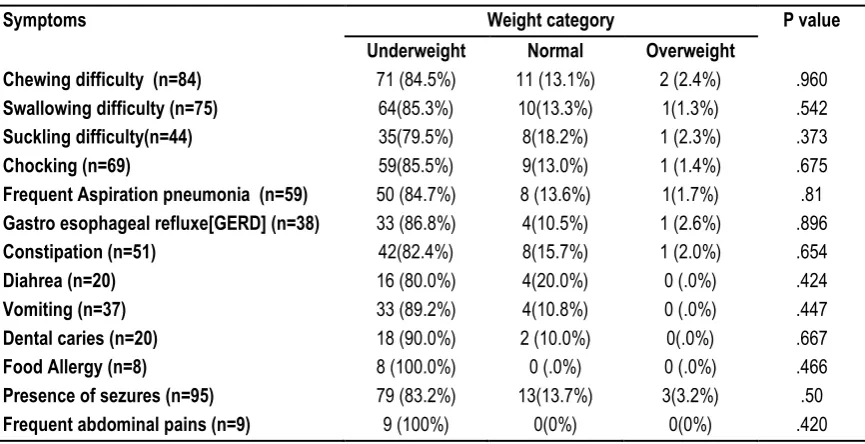
Feeding difficulty was a major complain among 93 subjects (78.2%). Among children with feeding difficulty, 83.9% were under weight (n=78) and 2.2% were overweight (n=2) with the remaining having a normal weight for age. There was no significant difference in weight category between those who suffered from feeding difficulties and those without. Data of associated symptoms are presented in table 1.
Table 1: Associated symptoms in relation to weight category
Symptoms Weight category P value
Underweight Normal Overweight
Chewing difficulty (n=84) 71 (84.5%) 11 (13.1%) 2 (2.4%) .960
Swallowing difficulty (n=75) 64(85.3%) 10(13.3%) 1(1.3%) .542
Suckling difficulty(n=44) 35(79.5%) 8(18.2%) 1 (2.3%) .373
Chocking (n=69) 59(85.5%) 9(13.0%) 1 (1.4%) .675
Frequent Aspiration pneumonia (n=59) 50 (84.7%) 8 (13.6%) 1(1.7%) .81
Gastro esophageal refluxe[GERD] (n=38) 33 (86.8%) 4(10.5%) 1 (2.6%) .896
Constipation (n=51) 42(82.4%) 8(15.7%) 1 (2.0%) .654
Diahrea (n=20) 16 (80.0%) 4(20.0%) 0 (.0%) .424
Vomiting (n=37) 33 (89.2%) 4(10.8%) 0 (.0%) .447
Dental caries (n=20) 18 (90.0%) 2 (10.0%) 0(.0%) .667
Food Allergy (n=8) 8 (100.0%) 0 (.0%) 0 (.0%) .466
Presence of sezures (n=95) 79 (83.2%) 13(13.7%) 3(3.2%) .50
Frequent abdominal pains (n=9) 9 (100%) 0(0%) 0(0%) .420
Table 2: Route of Feeding among patients with different weight category
Route of feeding Wt Category
Underwt Normal Overwt
Mixed [oral + nasogastric tube feeding (NGT)] n= 20 17 (16.8%) 2 (13.3%) 1(33.3)
NGT, n= 25 20 (19.8%) 5 (33.3%) 0 (.0%)
Oral, n=60 54 (53.5%) 5 (33.3%) 1 (33.3%)
Gastrostomy, n=14 10 (9.9%) 3 (20.0%) 1 (33.3%)
Chi-Square =5.95 P value .428
Route of Feeding
The comparative difference between patients with different feeding routs and weight category are presented in table 2. All variables were studies using height/length per age category (stunted growth) as the dependent variable and we could only find significant difference in stature growth among those with poor appetite with (95.2%) of patients with poor appetite had stunted growth compared to (84.6%) of those with good appetite P=.015. Significant difference in height growth was also found among those suffering from difficult swallowing with (86.7%) of them has stunted growth compared to (72.7%) of patients who do not have this symptom, P=. 05
Among the studied 13 symptoms (food allergy, dental caries, constipation, diarrhea, vomiting, pneumonia, GERD, chocking, seizures, swallowing difficulties, sucking difficulties, chewing difficulties and abdominal pain), 55 patients (46.2%) reported four or less combined symptoms with only 4 patients (3.4%) has no reported associated symptoms. Fifty one (42.9%) reported from 5-8 symptoms while only 13 subjects (10.9%) reported nine or more. Using chi-square test, we compared weight per age and height per age (above and below -2SD), between the above categories and results showed no significant difference (P>.05). There was negative but none significant correlation between the number of symptoms and weight per age z score. There was highly significant correlation between the number of associated complications and both the number of hospital admissions per year (r=.257, P=.005), and the length of hospital stay (r=.223, P=.015).
Concerning the reasons of hospital admission 31.1% were regular follow up 23.5% chest infection, 17.6% seizures, 5% pneumonia and 22.7% due to other various reasons such as UTI, anemia and gastroenteritis.
DISCUSSION
In this study we reported high proportion of underweight (84.9%) among children with CP and out of them 81.5% also suffered from stunted growth. When comparing our results with results from other studies, it was found that the prevalence of malnutrition among children with CP in developing countries was 76%15 in
Indonesia, 78.6% in Myanmar and 86% in India,16 a rate that is
similar or even lower than our results. Whereas in developed countries the percentage of malnutrition in CP patients is much lower with 38% in United Kingdom17 and 41.3% in Taiwan.18 This
difference between malnutrition incidence in CP patients in developed and developing countries could have been affected by the access for health care such as taking good treatment, regular checkups, visiting the dietitian clinic, the degree of support for feeding problems and the adequacy of food provision.17
that there is a wide gap between the nutritional status of CP children and normal children.
Some reports found that overweight was also a problem as 5.4% up to 18.2% children with CP were reported to be overweight.20-22
Contrast to this, there was only 2.5% overweight children in the current study reflecting that under nutrition is a major problem in our setting.
There was no significant difference in socioeconomic status between the underweight and normal weight CP patients. In KSA, free access to medical services is provided to all Saudi citizens. No association was found between gender and malnutrition in this study. Same results were reported among none CP Saudi children.19 Other studies in Turkey, Taiwan and Mexico found that
females with CP were more susceptible for malnutrition and claimed that there was a gender discrimination against disabled girls in nutrition.18,22,23 Which may reflect the non-discrimination
health care provision between males and females in our sociocultural environment.
One of the commonly observed complains among subjects was feeding difficulty. The majority of subjects with feeding difficulties were under weight. A study found a relationship between feeding dysfunction, poor growth and health status in children with CP. Children with moderate to severe CP, feeding dysfunction correlated with poor health and nutritional status. Even children with only mild feeding dysfunction, requiring chopped or mashed foods may be at risk for poor nutritional status.13
Out of the 119 studied patients more than half were totally dependent on feeding assistance (58.8%) while only 3.4% were partially dependent, which might also be a reason for malnutrition because these children have to wait for their caregiver to feed them thus lessening their food intake. A research conducted in Oxford university hospital suggested that there were many causes of malnutrition in children with CP and the reduction of nutrient intake comes primarily from prolonged feeding time, excessive spillage of food, vomiting and communication defects.9
We could only find significant difference in stature growth among those with poor appetite and difficult swallowing. Other studies have identified feeding difficulty among CP children as one of the main contributing factor to undernutrition.13,24,25 It impairs the
child’s ability to safely consume nutrients necessary to support
their growth.15,26-28 A study found that children without feeding
problems have better mean z-scores for weight,15,29 height,15 body
mass index (BMI),15 triceps or subscapular skinfold,29 and MUAC
than those with feeding problems29 The reasons for the difference
may be related to the large percentage (81.5%) among our children.
Although multiple associated symptoms (that can markedly impact the nutritional status), affected 115 out of 119 patients, yet we could not find any significant difference in weight per age among those affected by multiple associated symptoms. This contradicts other studies who find that CP children with more than one feeding problem were at a higher risk of under nutrition than children with none or just one feeding problem.17,30 .This may be
explained by the fact that only 4 subjects suffered from a single associated symptom while all the remaining subjects had multiple associated symptoms
It was observed that malnutrition is more prevalent in CP patients with other medical complications, as patients suffering from chest infection, aspiration pneumonia and seizures. Other studies found
that feeding difficulties can have a negative impact on child’s
respiratory health and gastrointestinal functioning further contributing to malnutrition,31 Another study reported that it also
hamper the child’s cognitive, emotional, and physical
developments.32 Furthermore, a study suggested that there were
complications of under nutrition among children with CP, including growth defect, impaired immune function and increased risk of infection9
There was highly significant correlation between the number of associated complications and both the number of hospital admission per year (r=. 257, P=. 005), and the length of hospital stay (r=. 223, P=. 015). Hospitalization of children with CP represents a major expenditure for health care systems. A study conduct on 37,000 hospitalized children with CP, found that children with CP demonstrated longer lengths of stay, more diagnoses and more procedures per admission compared to normal children.33 Good nutritional status could improve the
management of conditions associated with CP resulting in better outcomes for children and families and potentially decrease costs associated with hospitalization.
Comparing the 13 different associated medical complications that were measured with weight category it was found that the majority of CP patients with medical complication were malnourished. In patients with chewing, swallowing and sucking difficulties 84.5%, 85.3% and 79.5% were underweight respectively, Which may have led to decreasing their food intake and depriving them from the necessary nutrient and energy intake resulting in malnutrition. Astudy conducted by the department of food and nutrition in the university of Delhi, India found that feeding difficulties is one of the main factors of malnutrition among children with CP and one of these common feeding problems is difficulties in self-feeding, chewing and swelling.8
Moreover the majority of subjects with frequent aspiration pneumonia (84.7%), GERD (86.8%) and vomiting (89.2%) were under weight. This might be a contributing factor to poor appetite and reduced energy intake leading to malnutrition.
Dental caries was one of the measured associated symptoms and it was found that 18 subject had a dental caries which could be an indication of nutrients deficiency. A study conducted on children and adolescents with CP presented high prevalence of dental caries and periodontal alterations, and these problems were associated with demographic, socioeconomic and health perception.34
Other associated symptom that was prevalent in CP patients is seizures, it was observed that 83.2% of CP patients with seizures were under weight, this might be due to the fact that seizures resulting in increasing energy expenditure thus increasing the energy need which cannot be met through oral diet for CP patients and without using ancillary feeding.
Food allergy was detected in 8 subjects all of which were underweight, furthermore 9 subjects reported having abdominal pain all of which were also underweight, this could indicate reduced food intake in order to avoid feeling pain or fear of having an allergic reaction thus leading to malnutrition
subjects with NGT feeding 19.8% were underweight, It can be recommended that CP patients with feeding difficulties and poor nutritional status should use ancillary feeding methods to improve their nutritional status and their overall health. In one study severely disabled children received nutrition supplements more frequently than those with less severe disability (71% vs.16%).35
Another study conducted on 57 children with feeding gastrostomies attending the CP clinic, all children had severe neuromotor and orofacial involvement and mental retardation; Children with gastrostomies placed in the first year of life were most likely to exceed the fifth percentile for height and weight. Moreover Gastrostomy feeding in children severely affected by CP can improve nutritional status but does not eliminate growth retardation. The importance of growth and adequate nutrition in reducing morbidity in children with severe neuromotor involvement remains to be established.14
This result indicates that CP children are not able to meet their nutritional requirement in order to grow properly so it can be suggested to use ancillary feeding methods to meet their nutritional requirement.
CONCLUSION
Malnutrition is prevalent among CP children. Multiple associated factors are responsible for this situation.
RECOMMENDATIONS
Professional nutrition support should be an integral part of the management of these children and nutritional intervention should be provided early to ensure adequate growth, to improve quality of life, to reduce disease complications and to optimize functional status.
ACKNOWLEDGEMENT
Many thanks to Allah the almighty the generous for giving us the strength to complete this project and we hope we could benefit people from it. We thank our families who supported us throughout the work physically and emotionally.
We would like to share the success with Dr. Sahar A. Ibrahim –
Professor of pediatrics, clinical nutrition consultant. For her generous help, valuable supervision and sincere suggestions throughout the whole project for sharing her knowledge and experience with us.
Our fervent thanks are to, the Maternity and children hospital in Medina, for being so supportive and helpful for facilitating all that we needed in the research.
And lastly, many thanks, to all subjects who were included in this research.
REFERENCES
1. Zali A, Arab L, Ashrafi F, Mardpour S, Niknejhadi M, Hedayati-Asl A et al. Intrathecal injection of CD133-positive enriched bone marrow progenitor cells in children with cerebral palsy: feasibility and safety. Cytotherapy. 2015;17(2):232-241.
2. Johnson J, Seruya M. Surgical Treatment of Pediatric Upper Limb Spasticity: The Shoulder. Seminars in Plastic Surgery. 2016;30(01):045-050.
3. Aggarwal S, Chadha R, Pathak R. Nutritional status and growth in children with cerebral palsy: a review. International Journal of Medical Science and Public Health. 2015;4(6):737.
4. Sullivan P. Nutrition and growth in children with cerebral palsy: setting the scene. European Journal of Clinical Nutrition. 2013;67:S3-S4.
5. Campanozzi A, Capano G, Miele E, Romano A, Scuccimarra G, Giudice E et al. Impact of malnutrition on gastrointestinal disorders and gross motor abilities in children with cerebral palsy. Brain and Development. 2007;29(1):25-29.
6. Samson-Fang L, Fung E, Stallings V, Conaway M, Worley G, Rosenbaum P et al. Relationship of nutritional status to health and societal participation in children with cerebral palsy. The Journal of Pediatrics. 2002;141(5):637-643.
7. Fung E, Samson-Fang L, Stallings V, Conaway M, Liptak G, Henderson R et al. Feeding Dysfunction is Associated with Poor Growth and Health Status in Children with Cerebral Palsy. Journal of the American Dietetic Association. 2002;102(3):361-373. 8. Dahlseng M, Finbråten A, Júlíusson P, Skranes J, Andersen G, Vik T. Feeding problems, growth and nutritional status in children with cerebral palsy. Acta Paediatrica. 2011;101(1):92-98. 9. Zainah S, Ong L, Sofiah A, Poh B, Hussain I. Determinants of linear growth in Malaysian children with cerebral palsy. Journal of Paediatrics and Child Health. 2001;37(4):376-381.
10. Kong C, Tse P, Lee W. Bone age and linear skeletal growth of children with cerebral palsy. Developmental Medicine & Child Neurology. 1999;41(11):758-765.
11. El Mouzan M, Foster P, Al Herbish A, Al Salloum A, Al Omar A, Qurachi M. Prevalence of malnutrition in Saudi children: A community-based study. Annals of Saudi Medicine. 2010;30(5):381-385.
12. Parkes J, Hill N, Platt M, Donnelly C. Oromotor dysfunction and communication impairments in children with cerebral palsy: a register study. Developmental Medicine & Child Neurology. 2010;52(12):1113-1119.
13. Socrates C, Grantham-Mcgregor S, Harknett S, Seal A. Poor nutrition is a serious problem in children with cerebral palsy in Palawan, the Philippines. International Journal of Rehabilitation Research. 2000;23(1):177-184.
14. Stallings V, Charney E, Davies J, Cronk C. Nutritional Status and Growth of Children with Diplegic or Hemiplegic Cerebral Palsy. Developmental Medicine & Child Neurology. 2008;35(11):997-1006.
15. Kong C. Weight-for-Height Values and Limb Anthropometric Composition of Tube-Fed Children With Quadriplegic Cerebral Palsy. Pediatrics. 2005;116(6):e839-e845.
16. Sullivan P, Juszczak E, Lambert B, Rose M, Ford-Adams M, Johnson A. Impact of feeding problems on nutritional intake and growth: Oxford Feeding Study II. Developmental Medicine & Child Neurology. 2002;44(07).
17. Troughton K, Hill A. Relation between objectively measured feeding competence and nutrition in children with cerebral palsy. Developmental Medicine and Child Neurology. 2001;43(03):187. 18. Rogers B. Feeding method and health outcomes of children with cerebral palsy. The Journal of Pediatrics. 2004;145(2):S28-S32.
19. Murphy N, Hoff C, Jorgensen T, Norlin C, Young P. Costs and complications of hospitalizations for children with cerebral palsy. Pediatric Rehabilitation. 2006;9(1):47-52.
Journal of Environmental Research and Public Health. 2014;12(1):335-353.
21. Hillesund E, Skranes J, Trygg K, Bøhmer T. Micronutrient status in children with cerebral palsy. Acta Paediatrica. 2007;96(8):1195-1198.
22. Kelly SM, Rosa A, Field S, Coughlin M, Shizgal HM, Macklem PT. Inspiratory muscle strength and body composition in patients receiving total parenteral nutrition therapy. Am Rev Respir Dis. 1984;130(1):33-7.
23. Win Lai May, Han Win, Kyaw Linn, Kyaw Oo ,Sandar Kyi, Aye Hnin Phyu, Dam Lian Pau. nutritional Status of Children with Cerebral Palsy in Cerebral Palsy Clinic,Yangon
Children’sHospital. The Myanmar Health Sciences Research Journal. 2014;1(26):22-2
24. Rempel GR, Colwell SO, Nelson RP. Growth in Children With Cerebral Palsy Fed ViaGastrostomy.Pediatrics.1988;82(6):857-62. 25. Hung JW, Hsu TJ, Wu PC, Leong CP. Risk factors of undernutrition in children with spastic cerebral palsy. Chang Gung Med J. 2003;26(6):425–32.
26. Sjakti HA, Syarif DS, Wahyuni LK, Chair I. Feeding difficulties in children with cerebral palsy.Paediatr Indones.2008;48(4):224–9. 27. Thommessen M, Kase BF, Riis G, Heiberg A. The impact of feeding problems on growth and energy intake in children with cerebral palsy. Eur J Clin Nutr. 1991; 45(10):479–87.
28. Caram ALA, MorcilloAM, Costa-Pinto EA. Nutritional status of children with cerebral palsy in a Brazilian tertiary-care teaching hospital. Dev Med Child Neurol. 2008;50(12):956.
29. Sankar C, Mundkur N. Cerebral palsy—definition, classification, etiology and early Diagnosis. Indian J Pediatr. 2005;72(10):865–8.
30. Manikam R, Perman JA. Pediatric feeding disorders. J Clin Gastroenterol.2000;30(1):34–46
31. Definition of Cerebral Palsy [Internet]. cerebralpalsy.org. 2017 [cited 18 February 2017]. Available from: http://www.cerebralpalsy.org/about-cerebral-palsy/definition 32. Morgan A, Dodrill P, Ward E. Interventions for oropharyngeal dysphagia in children with neurological impairment. Cochrane Library. 2017.
33. Microcephaly in infants and children: Etiology and evaluation [Internet]. Uptodate.com. 2017 [cited 26 September 2017]. Available from: https://www.uptodate.com/contents/microcephaly-in-infants-and-children-etiology-and-evaluation
34. Sullivan PB, Rosenbloom L, Feeding the Disabled Child. UK: Mac Keith Press, Cambridge University Press, 1996.
[
Source of Support: Nil.
Conflict of Interest: None Declared.
Copyright: © the author(s) and publisher. IJMRP is an official publication of Ibn Sina Academy of Medieval Medicine & Sciences, registered in 2001 under Indian Trusts Act, 1882. This is an open access article distributed under the terms of the Creative Commons Attribution Non-commercial License, which permits unrestricted non-commercial use, distribution, and reproduction in any medium, provided the original work is properly cited.