e-ISSN: 2278-067X, p-ISSN: 2278-800X, www.ijerd.com
Volume 13, Issue 8 (August 2017), PP.22-27
Development of Regression Model Using Lasso And Optimisation
of Process Parameters in Metal Spinning
*
B.Ravi Kumar
1,S.Gajanana
2,K.Hemachandra Reddy
3,M.Krishna Reddy
41,2Department of Mechanical Engineering, MVSR Engineering College, Hyderabad, Telangana, 501510, India 3Department of Mechanical Engineering, Jawaharlal Nehru Technological University, Anantapuramu, India.
Corresponding author: *B.Ravi Kumar
ABSTRACT:-
Metal Spinning is a concept of describing the forming of metal into seamless, axisymmetric shapes by a combination of rotational motion and force. Sheet metal spinning is one of the metal forming processes, which a flat metal blank is rotated at a high speed and formed into an axisymmetric part by a roller which gradually forces the blank on to a mandrel, bearing the final shape of the spun part. Over the last few decades, sheet metal spinning has developed significantly and spun products have been used in various industries. Nowadays the process has been expanded to new horizons in industries, since tendency to use minimum tool and equipment costs and also using lower forces with the output of excellent surface quality and good mechanical properties. The automation of the process is of greater importance, due to its wider applications like decorative household‟s goods, rocket nose cones, gas cylinders etc. The objective of the current work is to develop the mathematical model for the spinning process with surface roughness as response and the input parameters as Mandrel speed (rpm), geometry of the Roller and Thickness of sheet (mm). Type of mandrel (EN8 Material) considered in the spinning process has the geometrical profile of parabola and single roller and double roller tools (EN8 Material) are used to deform the Al2024-T3 sheet metal paper aims to understand the process parameters that affect the surface finish of the spun component. Full factorial Design of Experiments technique is used to find the minimum number of experimental trials that are required to develop the regression model. A regression model using Least Absolute Shrinkage and Selection Operator (Lasso) is developed to further deepen the understanding between the input parameters and the surface roughness. The model was optimised using Sequential Quadratic Programming.Keywords:-
DoE, Lasso, Metal Spinning, Sequential Quadratic Programming, Surface Roughness.I.
INTRODUCTION
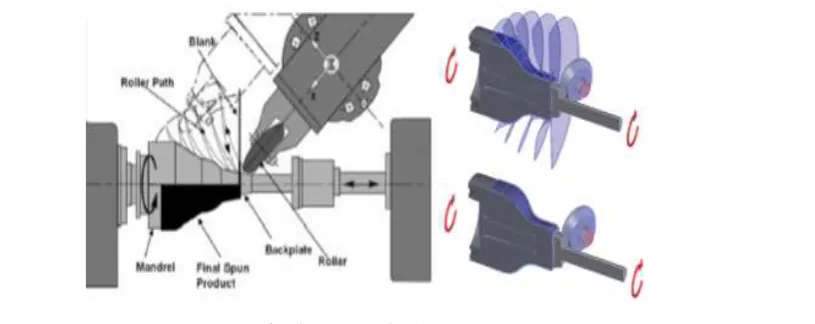
Metal spinning has been one of the oldest chipless forming techniques. However, with the passage of time, automation has taken a foothold in the manufacturing industry and a statistical model to understand the behaviour of the input parameters on the responses has become quintessential. Sheet metal spinning is one of the metal forming processes, where a flat metal blank is formed into an axisymmetric part by a roller which gradually forces the blank onto a mandrel, bearing the final shape of the spun part. As shown in Figure 1, during the spinning process, the blank is clamped between the mandrel and back plate; these three components rotate synchronously at a specified spindle speed. Materials used in the spinning process include non-alloyed carbon steels, heat-resistant and stainless steels, non-ferrous heavy metals and light alloys. The process is capable of forming a work piece with a thickness of 0.5 mm to 30 mm and diameter of 10 mm - 5 m.
II.
METHODOLOGY
AND
EXPERIMENTATION
A mathematical model is developed using Lasso to understand the relationship between the input parameters and the target variable. The optimisation of the model was done using an iterative method for non-linear optimisation. Aluminium 2024-T3 alloy was chosen for the study and the chemical composition of the material is tabulated in table 1.
Table 1 : Composition of Al2024-T3
Element Al Cu Mg Si Cr Mn Fe Ti Zn
Percentage (%) 90-94.7 3.8-4.9 1.2-1.8 Max 0.5 Max 0.1 0.3-0.9 Max 0.5 Max 0.15 Max 0.25
The process parameters shown in table 2 were taken into consideration and a full-factorial approach was adopted to perform the experiment.
Table 2: Process Parameters
Factor Units Designation Test Level
Low High
Speed rpm N 283 485
Thickness of Sheet mm t 0.8 1
Roller Type - R Single Roller Double Roller
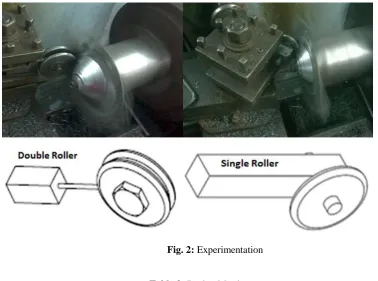
Eight trials were conducted according to the design matrix in table 3. The single-roller was represented with „1‟ while the double-roller was represented with „2‟ to maintain numeric consistency in the statistical model. The experiments were carried out on a Capstan Lathe Machine (Fig. 2) using EN8 Spinning Tool (Roller).
Fig. 2: Experimentation
Table 3: Design Matrix
Trial No. 1 2 3 4 5 6 7 8
Speed (rpm) 283 485 283 485 283 485 283 485
Thickness of Sheet (mm) 1.0 1.0 1.0 1.0 0.8 0.8 0.8 0.8
Roller Type 1 1 2 2 1 1 2 1
The same is written in the Lagrangian form as:
The L1 norm in the cost function allows for sparse solutions and can be adjusted by tweaking the regularisation parameter. It is a mathematical tool that balances between the model fit and the complexity of the model. The behaviour to the cost function with various values of regularisation parameter is outlined below:
Sequential Quadratic Programming (SQP) is an iterative algorithm that is used for the nonlinear optimisation of an objective function that is twice continuously differentiable. The function is minimised by calculating the Jacobian and the Hessian to determine the appropriate search direction over the convex (largely) function. The iteration step with one bound equality constraint is shown below:
It was used to optimise (minimise surface roughness) the equation generated from the regression analysis and the same was validated with the experimental minimum.
The model was developed in Python 3.6.1 using Numpy, Pandas, Scikit-Learn libraries while the optimisation was performed using Scipy library.
## Fits the training data using LASSO # X – Input parameters
# y – Response
# alpha – Regularization parameter class LinearModel():
def __init__(self, X, y, alpha): self.X = X
self.y = y self.alpha = alpha def lasso(X, y, alpha):
clf = linear_model.Lasso(alpha = alpha) clf.fit(X, y)
pred = clf.predict(X) return clf.coef_, clf.intercept_, pred # SQP Optimisation
fun = lambda x: „„„ regression equation ‟‟‟
bnds = ((283,485), (0.8,1.0), (1,2))= Scipy.optimize.minimize(fun, („„„random variables‟‟‟), method = “SLSQP”,
bounds = bnds)
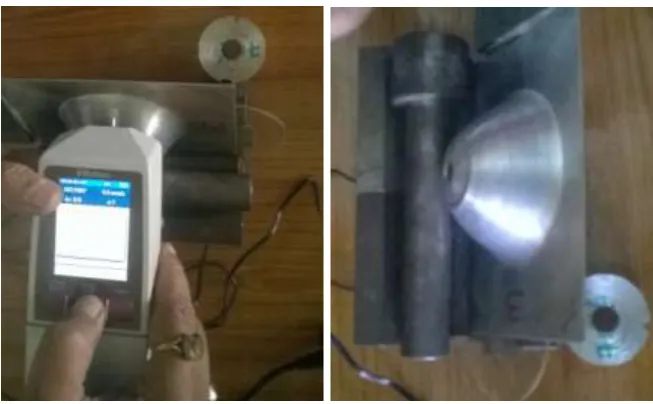
The observations made during the experimentation are recorded in table 4 and the specimen is shown in Fig. 3.
Fig. 3: Surface roughness measurement of specimen
Table 4: Observations
Trial No.
Experimental Values Response Parameter
Speed (rpm) Thickness of Sheet (mm) Roller Type Surface Roughness (Ra)
1 283 1.0 Single Roller (1) 7.05
2 485 1.0 Single Roller (1) 3.64
3 283 1.0 Double Roller (2) 3.60
4 485 1.0 Double Roller (2) 1.78
5 283 0.8 Single Roller (1) 5.62
6 485 0.8 Single Roller (1) 8.04
7 283 0.8 Double Roller (2) 6.78
8 485 0.8 Double Roller (2) 4.11
Regression analysis was performed and the coefficients of the linear model using Lasso are outlined in table 5.
Table 5: Regression Coefficients
Coefficient Value
Intercept 7.72
N 0.027
t 0
R 0
Nt -0.029
NR -0.005
tR 0
A model was selected after comparing the R-Squared and the Adjusted R-Squared of models with various complexities ranging from simple linear equation to a third-degree polynomial. In this study, the following model showed the best relationship and has been selected for further optimisation.
The final equation is: Y = 7.72 + 0.027N – 0.029Nt -0.005NR
Table 6: Validation Metrics
Metric Value
R-Squared 0.765
Mean Square Error (MSE) 0.939
Median Absolute Deviation (MAD) 0.81
The output from the optimisation of the regression model using SQP is tabulated in table 7 and is found to be in close approximation with the actual output, which further validates the mathematical model.
Table 7: Variation between the Optimised Value and the Actual Value
Speed (rpm)
Thickness of Sheet
(mm)
Roller Type Function
Value (Ra)
Experimental Value (Ra)
Absolute Deviation (mm)
485 1.0 2
(Double Roller) 1.90 1.78 0.12
III.
RESULTS
AND
CONCLUSIONS
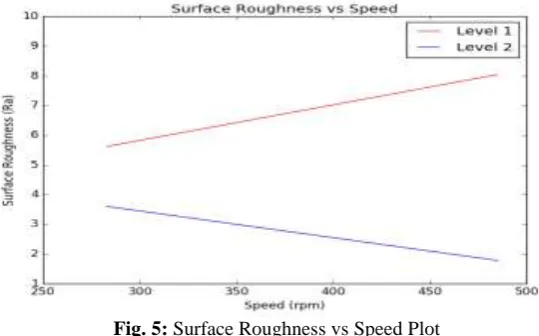
Plots between the process parameters and the surface finish are shown from Fig. 4 to Fig. 6. Level 1 indicates that all the other process parameters other than the ones under study are in the lower level and Level 2 indicates that these are in the higher level.
Fig. 4: Surface Roughness vs Roller Type Plot
When the process parameters were at Level 1, change of roller from a single roller to a double roller increased the surface roughness of the component while the same had an adverse effect when the parameters were in Level 2 (Fig. 5).
Fig. 5: Surface Roughness vs Speed Plot
Fig. 6: Surface Roughness vs Thickness of Sheet Plot
Similar relationship can be drawn from the plot between surface roughness and thickness of the sheet (Fig. 6). In this study, the thin sheet showed higher values of surface roughness for both the rollers at both low and high mandrel speeds when compared to the thick sheet. A thick sheet with higher mandrel speed using a double roller needs to be selected to minimise the surface roughness on the spun component.
REFERENCES
[1]. M. Azaouzi, N. Lebaal, G. Rauchs, S. Belouettar, Optimal design of multi-step stamping tools based on response surface method, Elsevier, Volume 24, May 2012, 1-14.
[2]. Robert Tibshirani, Regression Shrinkage and Selection via the Lasso, Journal of the Royal Statistical Society, Series B (Methodological), Volume 58, Issue 1 (1996), 267-288.
[3]. C A Cantrell, Technical Note: Review of methods for linear least-squares fitting of data and application to atmospheric chemistry problems, Atmos. Chem. Phys. Vol. 8, 2008.
[4]. Donald W Marquardt and Ronald D Snee, Ridge Regression in Practice, The American Statistician, Vol. 29, No. 1, 1975.
[5]. N J D Nagelkerke, A note on a general definition of the coefficient of determination, Biometrika, Vol. 78, No. 3, 1991, 691-692.
[6]. Christophe Leys, Christophe Ley, Oliver Klein, Philippe Bernard, Laurent Licata, Detecting outliers: Do not use standard deviation around the mean, use absolute deviation around the median, Journal of Experimental Social Psychology, 2013.
[7]. B.Ravikumar, S.Gajanana, K.Hemachandra Reddy and K.N Nigam, Development of Co-Ordinate Retrieval System in CAD For Satellite Component by Shear Forming Process Manufacturing Technology Today , Vol 12, No.3, March 2013.
[8]. S.Gajanana, K.Devaki Devi Development of Satellite Component Through Flow Forming Process, International Journal of Multidisp. Research & Advcs. In Engg.(IJMRE), Vol.3, No.IV, October 2011. [9]. H.B. Tang a,b, B.G. Xu b,*, X.M. Tao b, J. Feng, Mathematical Modeling And Numerical Simulation
Of Yarn Behavior In A Modified Ring Spinning System, Applied Mathematical Modelling 35, 2011 [10]. Lin Wang, Hui Long, Investigation Of Material Deformation In Multi-Pass Conventional Metal
Spinning, Materials and Design 32, 2011.
[11]. Ming-Der Chen, Ray-Quan Hsu,_, Kuang-Hua Fuh, An Analysis Of Force Distribution In Shear Spinning Of Cone, International Journal of Mechanical Sciences 47, 2005.
[12]. H.Liu, H.Yang, Y.Q.Li, A Study of Stress and Strain Distributions of First Pass Conventional Spinning Under Different Roller Traces, Journal of Material Processing Technology, 2002.
[13]. Eamonn Quigley, John Monaghan, Metal Forming An Analysis of Spinning Processes, Journal of Materials Processing Technology 103, 2000
*B.Ravi Kumar1. "Development of Regression Model Using Lasso And Optimisation of Process Parameters in Metal Spinning ." International Journal of Engineering Research and Development 13.08 (2017): 22-27.