E-TAILING IN INDIA
K.BAVATHARANI, S.KARTHIKA & V.DEEPIKA
Students, III. B.Com (Honors)
Periyar Maniammai Institute of Science and Technology Vallam, Thanjavur – 613 403, Tamil Nadu
Abstract
Internet these days have become very colloquial criteria in everyone in living in this technologically upgraded era. Hence, the growth of e-tailing and online shopping have become very important and obvious. Many customers have addicted to the comforts provided by the online shopping. Though e-tailing is in an inceptive form in developing countries like India, we cannot push aside the impact it is having on the heavy population. These populous countries have a great human potential which is a boon to the retailer but they should tap on proper resources to convert their business to profit mode. Many factors like trust and security issues to avoid heist, online payment facilities and credit card availabilities are affecting penetration of e-tailing to a deeper perspective in our country where the prospective buyers are of a suspicious nature and resistant to change. E-tailing has the capacity to serve both the rural and urban area of our country and help in the easy access for all people at the same time and in cost effective way. This paper is focused on chances, threats, and challenges faced by e-tailers and e-tailing in Indian scenario.
Keywords: e-tailing, online heists, online shopping.
1. Introduction
Retailing on web is called e-tailing. A customer can purchase goods through online a variety of items
life clothing accessories, mobiles/cell phones, cameras, computers, books, magazines, music series and DVDS,
electronic goods, shoes, furniture’s, health equipments flowers, jewelleries, etc. Till a few years ago, business
mainly relied on physical stores to promote and sell their products or services. Due to advancement of
technology, businesses came up with a new method called online shopping which would allow potential
customers to order their merchandise without having to travel long distances. It is necessary for business
organization to opt for B2C due to global reach, convenience and cost efficiency.
2. E-tailing
3. Growth of e-tailing in India
April 2018 exited with 1054 million users on telecom services reflects a true potential to e-commerce
business. Private equity and venture capital investments in the e-commerce industry in India touched a record
US$ 11.2 billion in the first half of 2017, a 41 per cent rise over last year. Currently, e-commerce has 1-1.5
million transactions daily. As per the Economic Survey 2017-18, the electronic commerce market in India is
estimated at USD 33 billion, with a 19.10 per cent growth rate in 2016-17. As per the National Association of
Software and Services Companies Strategic Review 2018, in the Information Technology and Business Process
Management sector, the Indian e-commerce market was USD 33 billion in 2017-18 and reached USD 38.5
billion, growing at a rate of about 17 per cent in the financial year 2018-19. E-tailing in India is still in an
immature stage but the retail marketing in India is witnessing a revolution. The growth of internet population
has enabled such a drastic change in the fate of e-commerce. It is proved through recent surveys that internet
and mobile phones are much more addictive in nature than drugs and alcohol. Popularity of cash-on-delivery
and rising working women, growing acceptability of online payments, favourable demographics and lack of
organized retail markets are the other key factors driving the growth of online retail in India. Private equity
players and venture capital firms have shown their faith in the growth of online retail in India and it is evident
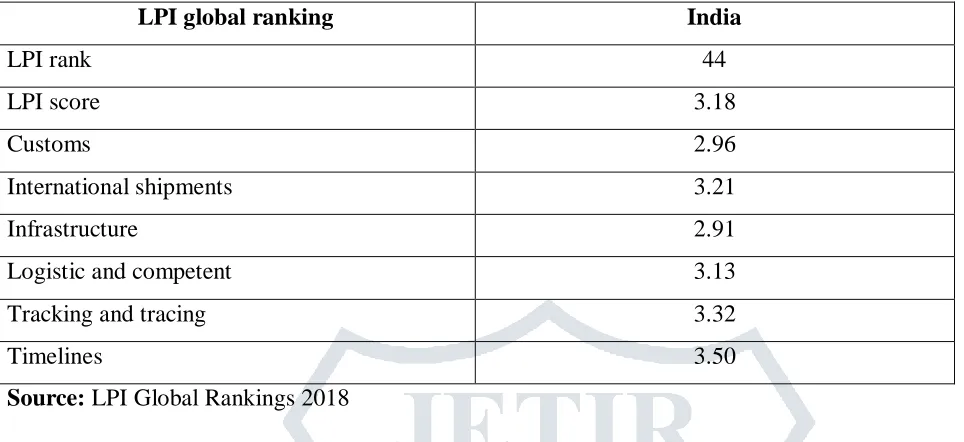
TABLE 1 Logistic Supply Chain
LPI global ranking India
LPI rank 44
LPI score 3.18
Customs 2.96
International shipments 3.21
Infrastructure 2.91
Logistic and competent 3.13
Tracking and tracing 3.32
Timelines 3.50
Source: LPI Global Rankings 2018
There are many challenges faced by logistics in developing countries like India i.e. as the internet user
and retailer have increased greatly in the past few years, this situations creates need for wider network of new
branches and also number of delivery points even making them available to the core rural area in India. The
logistic department of respective organization needs many delivery boys who would cater their needs exactly
with complete local knowledge.
4. Consumer electronic commerce in India
Consumer electronic commerce involves transactions between the business and the consumer or
between the consumer which consist of buying and selling of goods or services using electronic medium and
network it involves buying consuming, and paying for goods and services wholly or partially through internet.
According to the report on consumer e-commerce market in India by e-technology group for internet and
mobile association, in India, the consumer e-commerce has been divided into travel industry and non-travel
industry. It consist of travel aggregates, tour operators, hotels and railways, on another hand it consist paid
content subscriptions, digital downloads. Railway booking has emerged as one of the largest singlproduct
e-commerce sites in India. It allows customers to plan their journey and book tickets avoiding long queues at
5. Importance of B2C
It is necessary for business organization to opt for B2C due to global reach, convenience, and data
collection and cost effective. The customer registers on the site shopper’s registry. A customer shall be able to
collect detailed information and service offered by the vendors only after the registration. The customers buy
the product through the shopping cart. The shopping cart system provides details like shopping charge, taxes,
additional charge and price. The customer can track the order and ascertain delivery status.
6. Online shopping
Online shopping provides many choices to consumer than the traditional bricks-and-mortar retail stores.
In online shopping, lots of shoppers are using the internet nowadays as internet provides a lot of advantages to
shoppers. Customers can purchase product from anywhere anytime in the world. A good example is pizza hut
which provides the option to consumers to order pizzas through online. It also enables customers to chat live
online with service agent for any queries while they shop on internet. There are some online shopping methods
based on contract, consumption, and payment. Indians are the third largest online shoppers world-wide with 84
per cent of shoppers. Though internet provides quick and easy way to purchase a product, there are some
drawbacks in online shopping like, delay in delivery, lack of significant discounts, lack of shopping experience,
lack of touch and feel, fraud, etc.
7. Conclusion
It is concluded that in populated countries like India, there are many opportunities and also obstacles for
success of new concepts like e-tailing. According to a recent survey, 370 million users are utilizing internet
which paves a way for rapid growth in usage of e-tailing. 35 per cent of Indian population is youngsters below
the age 30 and this is a great opportunity for e-tailors to attract the youngsters by providing the products of
their need. Three-fourths of the Indian population today is using internet which gives a chance for the e-tailers
to present their products through various websites. The main factor of e-tailing is time constraint which saves
the customer’s valuable time through online shopping. Though e-tailing provides plenty of services there are
some drawbacks like poor knowledge and awareness, online transaction security, logistic and shipment, touch
8. Reference
Natarajan, C., & Renu Vij (2011). New Era in Retail: The Road and Challenges Ahead for India’s Organized Retailers. Wisdom Voyage, 1 (1), 33-37.
https://www.statista.com/outlook/243/119/ecommerce/india#market-revenue
https://lpi.worldbank.org/international/global
https://www.indianretailer.com/article/multi-channel/eretail/An-analysis-of-the-e-commerce-growth-in-India.a6137/
http://pib.nic.in/newsite/PrintRelease.aspx?relid=186472