Demystifying the Cloud Computing and Its Challenges
Prof. Neha Kanda
Abstract
Cloud computing is a type of Internet-based computing, where shared resources, information, and data are given to PCs and different gadgets on-request. Cloud computing utilizes the internet advances for a conveyance of IT-release abilities 'as an administration' to any required clients i.e. through cloud computing we can get to anything that we need from anyplace to any PC without worried about anything like about their vault, cost, and administration. In this paper, I would toss light on the motivation variables of tolerating cloud computing, survey the few cloud sending and administration models. I likewise incorporate security, protection, and internet reliance and accessibility as evasion issues. It likewise investigates certain advantages of cloud computing over customary IT benefit environment-including versatility, flexibility, diminished capital and higher asset use are considered as appropriation explanations behind cloud computing environment. The later incorporates vertical adaptability as a technical challenge in cloud computing.
Keywords: - Cloud computing, Cloud services, Scalability, Virtualization, Vertical scaling.
I. Introduction
Cloud Computing is a creative innovation that is changing the way we do computing. The key idea of cloud computing is that you don't purchase the equipment or even the product, you require any longer, rather you lease some computational power, stockpiling, databases, and some other asset you require by a supplier as indicated by a compensation as-you-go show, making your speculation littler and arranged to activities as opposed to resources securing. Yet, there is significantly more than that, obviously, and there is a wide range of ways how this approach can be placed in real life [1].
Cloud computing comprises of three particular sorts of computing administrations conveyed remotely to customers by means of the internet. Customers regularly pay a month to month or yearly administration expense to suppliers, to access frameworks that convey programming as an administration, stages as an administration and foundation as an administration to endorsers. Customers who buy in to cloud computing administrations can receive an assortment of rewards, contingent upon their specific business needs at a given point in time. The times of expansive capital interests in programming and IT framework are currently a relic of past times for any endeavor that receives the cloud computing model for obtainment of IT administrations [8]. The capacity to get to capable IT assets on an incremental premise is evening the odds for little and medium estimated associations, furnishing them with the fundamental apparatuses and innovation to contend in the worldwide commercial center, without the already imperative interest in on commencing IT assets. Customers who buy into computing administrations conveyed by means of the "cloud"• can enormously decrease the IT benefit uses for their associations;
Assistant professor & Research Scholar, Dept. of Computer Science & Applications, Guru Nanak National College,
and access more light-footed and adaptable venture level computing administrations, all the while.
II. Analysis Of Cloud Computing
Cloud computingoffering which we can get the applications as utilities over the internet. It enables us to make, arrange, and customize the business applications online.Cloud Computing refers to controlling, designing, and getting to the equipment and programming assets remotely. It offers online information stockpiling, foundation, and application. Cloud computing offers stage independency, as the product isn't required to be introduced locally on the PC. Henceforth, the Cloud Computing is making our business applications mobile and community oriented.
III. Architecture Of Cloud
Cloud computing architecture [2] comprises of several cloud mechanisms, which are heavilyjoined. We preservegenerallyseparate the cloud architecture into two components:
• Front End
• Back End
Every of the ends are associated during a network, generally Internet. The subsequentfigure1.Shows the graphical analysis of cloud computing architecture:
Figure 1 Architecture of Cloud
The front End refers to the customer part of cloud computing framework [2]. It comprises of interfaces and applications that are required to get to the cloud computing stages, Example - Web Browser.
The back End refers to the cloud itself. It comprises of the considerable number of assets required to give cloud computing administrations. It contains enormous information stockpiling, virtual machines, security instrument, administrations, sending models, servers, etc.It is the duty of the back end to give worked in security system; activity control and protocols.The server utilizes certain conventions known as middleware, which help the associated gadgets to speak with each other [2].
IV. Cloud Service Models
Software as a Service (SaaS). These models offer increasing abstraction; they are thus often portrayed as layers in a stack: infrastructure-, platform- and software-as-a-service, but these need not be related. For example, one can provide SaaS implemented on physical machines (bare metal), without using underlying PaaS or IaaS layers, and conversely one can run a program on IaaS and access it directly, without wrapping it as SaaS [3-4].
Figure 2 Cloud Service model 1. Software as a Service (SaaS)
These types of application are generally designed for end-users, delivered over the web. SaaS [6] works so much better for students because it provides access to applications anytime, anywhere, for any type of devices like laptop, smart phone, tablet, or other web-enabled device. Adding more users or scaling the software to more classrooms or campuses is becomes very easy task with SaaS. As an example, a college can scale its SaaS solution from 50 students to 5,000 in a matter of hours – unimaginable in the conventional IT scenario.
2. Platform as a Service (PaaS)
PaaS is the collection of development tools and services which is used for coding and deploying the applications quick and efficient [6]. With PaaS, Students, teachers or other academicians can develop new applications or services in the cloud which is platform independent, and also make them widely available to users through the Internet. It also provides services for testing, deploying, collaborating on, hosting, and maintaining applications.
3. Infrastructure as a Service (IaaS)
IaaS is the combination of hardware and software that powers it all – servers, storage, networks, operating systems. These are also known as On demand data centers which provide compute power, memory, and storage, typically priced per hour according to resource consumption. It can be used to satisfy the infrastructure needs of students, staff or any other academia’s.
V. Cloud Deployment Models
The cloud sending models said underneath are based on the National Institute of Standards and Technologies. There are four essential cloud organization models [7], which are: • Private cloud model: In this framework, the cloud foundation is set up on the preface for the restrictive utilization of an association and its clients. Regarding cost proficiency, this sending model doesn't bring numerous advantages. Be that as it may, numerous extensive ventures pick it due to the security it offers.
• Public cloud model: Public cloud is facilitated on the introduction of the specialist organization. The specialist organization than gives cloud administrations to the greater part of its clients. This sending is by and large embraced by numerous little to moderate sized associations for their non-center and a portion of their center capacities.
• Community cloud: Community cloud model is a cloud framework shared by a gathering of associations of comparative enterprises and foundations with comparable prerequisites i.e. mission, security, consistence and IT strategies. It might exist on or off commence and can be overseen by a community of these associations.
• Hybrid cloud model: Hybrid cloud is a blend of at least two models, private cloud, public cloud or community cloud. Despite the fact that these models keep up their different
substances they are amalgamated through a standard innovation that empowers the movability of information and applications.
Figure 2Cloud Deployment model VI. Cloud Computing Challenges
The present selection of cloud computing is related with various difficulties since clients are as yet wary about its authenticity [6]. The significant difficulties that keep Cloud Computing from being embraced are perceived by associations are as per the following:
• Interoperability
It implies the application on one stage ought to have the capacity to fuse administrations from alternate stages. It is made conceivable through web administrations, however growing such web administrations is exceptionally mind boggling.
• Security and Privacy
Security and Privacy of data is the greatest test to cloud computing. Security and privacy issues can be overwhelmed by utilizing encryption, security equipment and security applications.
• Portability
any case, it isn't yet made conceivable in light of the fact that every one of the cloud suppliers utilizes distinctive standard dialects for their stages.
• Computing Performance
Information concentrated applications on cloud require high system bandwidth, which brings about high cost. Low bandwidth does not meet the coveted computing performance of cloud application.
• Reliability and Availability
It is fundamental for cloud frameworks to be solid and powerful in light of the fact that the greater part of the organizations are presently getting to be dependent on administrations gave by outsider.
VII Characteristics of Cloud Computing
The following figure shows five essential characteristics that cloud computing offers for end users today and each is discussed below.
• On-Demand Self Service
On-demand self-service alludes to the service gave by cloud computing vendors that empowers the provision of cloud assets on demand at whatever point they are required [15]. The clients/consumers can singularly have provision to utilize computing power, stockpiling, networks and programming in a basic and adaptable way. Most clients start by utilizing restricted assets and increment them after some time. On-demand self-service approach approves clients to ask for assets on run time.
• Broad Network Access
Access to assets in the cloud is accessible over various gadget composes [10] which are PCs, workstations, mobile phones, tablets, workstations, thin customers, and so on. Assets are conserved by restricting the use which can be utilized based on need and essentialness of the workloads. Likewise, network assets were additionally rare. IP-based networks were not in predominant use four decades prior; consequently, access to pervasive high-bandwidth, low-dormancy networks did not exist. Later years, costs related with the network have diminished as a result of assembling versatility, commoditization of related advances, and competition in the commercial center. As network bandwidth has expanded, network access and adaptability have additionally expanded accordingly [11].
• Resource Pooling
The supplier's computing assets are pooled to serve various consumers utilizing a multi-inhabitant model in which different clients share nearby assets in the cloud with their companions, are the premise of public cloud frameworks. As per consumer demand, diverse physical and virtual assets are powerfully appointed and reassigned. There is a feeling of location independence in that the client for the most part has no control or information over the correct location of the gave resources but might have the capacity to indicate location at a more elevated amount of abstraction (e.g., nation, state, or datacenter). Cases of assets incorporate capacity, preparing, memory, and network bandwidth [19-20].
• Rapid Elasticity
rapidly outward and internal comparable with demand i.e., occupants utilize the networking, register and capacity resources in the common pool, and then return them to the pool when they never again require those advantages. The very much architected cloud, the acquisition and arrival of benefits from and to the common pool would be robotized, based on service demands and driven by an insight policy [16].
• Measured Service.
In the undertaking, metering services additionally alluded to as "pay per utilize is a methods for responsibility. Metered services is important to the utility part of cloud computing. The real responsibilities of the service supplier are to be straightforward about the amount of the mutual framework a specific occupant utilizes, and the cost of that use. Asset utilization can be monitored, controlled, and detailed for both the supplier and consumer of the used service effectively and effortlessly. Cloud frameworks consequently control and improve asset use by utilizing a metering capacity at some level of abstraction fitting to the sort of service like stockpiling, handling, bandwidth, dynamicclient records and so on [19].
Conclusion
Cloud computing has several benefits over traditional (non- cloud) environment and has the capability to handle most sudden, temporary peaks in application demand on cloud infrastructures. Based on deployment and service, various cloud computing models are developed where each model serves differently to the end users. The initiation of cloud computing in current time has to glow a concern for diverse organizations, institution to take pros of web uses. These model promises the business/service organizations to show more interest to use resources pay per use/ buy or rent resources than investing more money with limited facilities. The characteristics of cloud computing, various deployment, and service-based cloud models are addressed in this paper. Despite having special features cloud computing is facing challenges to support interoperability, security, privacy, portability, computing performance, reliability, and availability efficiently are also discussed. Many people believe that Cloud will reshape the entire ICT industry as a revolution so it is becoming a more thrust area for researchers to find more services efficiently facing challenges.
References
[1] Onur, E., Sfakianakis, E., Papagianni, C., Karagiannis, G., Kontos, T., Niemegeers, I., Chochliouros, I.P., de Groot, S.H., Sjodin, P., Hidell, Maliosz, M., Kaklamani, D.I., Carapinha, J., Belesioti, M., Fytros, E., ―Intelligent End-To-End Resource Virtualization Using Service Oriented Architecture‖, Delft Univ. of Technol., Delft, Netherlands, GLOBECOM Workshops, IEEE, 28 December 2009.
[2] Buyya R, "Market-Oriented Cloud Computing: Vision, Hype, and Reality of Delivering Computing as the 5th Utility," 9th IEEE International Symposium on Cluster Computing and the Grid, pp. 1, 2009.
[3] G. Gruman, "What cloud computing really means", InfoWorld, Jan. 2009.
[4] R. Buyya, Y. S. Chee, and V. Srikumar, ―Market-Oriented Cloud Computing: Vision, Hype, and Reality for Delivering IT Services as Computing Utilities‖, Department of Computer Science and Software Engineering, University of Melbourne, Australia, pp. 9, July 2008.
[6] S. Adabala, V. Chadha, P. Chawla, R. Figueiredo, J. Fortes, I. Krsul, A. Matsunaga, M. Tsugawa, J. Zhang, Mi. Zhao, L. Zhu, and X. Zhu. From virtualized resources to virtual computing Grids: the In-VIGO system. Future Generation Comp. Syst., 21(6):896–909, 2005.
[7] P. Barham, B. Dragovic, K. Fraser, S. Hand, T. L. Harris, A. Ho, R. Neugebauer, I. Pratt, and A. Warfield. Xen and the art of virtualization. In Proceedings of the 19th ACM Symposium on Operating Systems Principles, pages 164–177, NewYork, U. S. A., Oct.2003
[8] F. Gens. (2009, Feb.). “New IDC IT Cloud Services Survey: Top Benefits and
Challenges”, IDC eXchange, Available: [Feb. 18, 2010].
[9] J. Brodkin. (2008, Jun.). “Gartner: Seven cloud-computing security risks.” Infoworld, Available: [Mar. 13, 2009].
[10] M. A. Morsy, J. Grundy and Müller I. “An Analysis of the Cloud Computing Security Problem” In PROC APSEC 2010 Cloud Workshop. 2010.
[11] Cloud Security Alliance (CSA). Available: http://www.cloudsecurityalliance.org [Mar.19, 2010]
[12] S. Arnold (2009, Jul.). “Cloud computing and the issue of privacy.”KM World, pp14-22.
Available: www.kmworld.com [Aug. 19, 2009].
[13] A Platform Computing Whitepaper. “Enterprise Cloud Computing: Transforming IT.” Platform Computing, pp 6, 2010.
[14] Global Netoptex Incorporated. “Demystifying the cloud.Important opportunities, crucial choices.” pp4-14. Available: http://www.gni.com [Dec. 13, 2009].
[15] M. Klems, A. Lenk, J. Nimis, T. Sandholm and S. Tai. “What’s Inside the Cloud? An Architectural Map of the Cloud Landscape.” IEEE Xplore, pp 23-31, Jun. 2009.
[16] C. Weinhardt, A. Anandasivam, B. Blau, and J. Stosser.“Business Models in the Service World.”IT Professional, vol. 11, pp. 28-33, 2009.
[17] N. Gruschka, L. L. Iancono, M. Jensen and J. Schwenk. “On Technical Security Issues in Cloud Computing” In PROC 09 IEEE International Conference on Cloud Computing, 2009 pp 110-112.
[18] N. Leavitt. “Is Cloud Computing Really Ready for Prime Time?” Computer, vol. 42, pp. 15-20, 2009.
[19] S. Mahajan, S. Sharma, & Rana, V. “Design a Perception Based Semantics Model for Knowledge Extraction”. International Journal of Computational Intelligence Research, (2017). 13(6), pp. 1547-1556.
Soil Microarthropods in The Terine Forest Floors Of Northern
Bengal- An Outline Overview
Niles Dasgupta
Raja Routh
Mahendra Chourasiya
Abstract
Terine area of Northern part of West Bengal shows great diversity in terms of Flora and Fauna concerned as because it is situated in the Himalayan Foothills. Weather and climatic condition affects mostly over the long period of time. We restricted our study mainly in two forest floor area under Baikunthapur Forest Division situated in Jalpaiguri District and Mahananda Wildlife Sanctuary in Darjeeling District. We collected samples randomly from three site of our study area. Microarthropods plays vital role in the area affecting Micro Edaphic Environment at the study area. Climatic condition, Soil types and variation in vegetation in the area may affects over their population and variation. Decomposition by Microarthropds of Organic debris controls the nutrient cycles of the soil. Microarthropods may vary at the forest floor of Terine area in Northern Bengal. Collected 36 bags of sample containing 220 Microarthropods reveals that the Northern most portion of Terine Forest harbours highest species Diversity (Shannon-Weaver index) while Southern part shows lowest value. Site-III shows more diversity in comparison to other Site. Further more, Southern portion shows highest species richness (Menhinick’s index). Out of three study area plot the Northern Plot shows highest level in terms of Diversity. Variation in Edaphic factors may responsible for their diversity.
Key Words: Microarthropod, Diversity, Terine, Forest, Climatic condition, Debris, Edaphic Factor
Introduction
Terine area of Northern Bengal has verities of different type’s flora and fauna. Microarthropods play a very crucial role in the variation of physiochemical properties of Micro Edaphic Environment. They are considered as the important degrading factors of soil debris. Their ecological role significantly concerns with the fertility of soil by the process of decomposition of organic debris and nutrient cycling (Heneghan et al. 1998; Coleman and Crossley, 2004).
In fact our present study was taken up to assess the diversity scenario in soil microarthropods communities dwelling Terine forest floors of northern parts of Bengal.
Materials and Methods
Sampling: We collected at three different forest floors (site-I, site-II, and site-III) with more or less similar vegetation’s, along three 5m strips, adjacent to the road side during the four seasons (summer, monsoon, post-monsoon, winter) from April 2015 to March 2016.
Bhotepatty H.B.L.High School, Jalpaiguri,W.B.
We collected soil and litter together with a shovel (Chattopadhyay and Hazra, 2000; Sanyal et al., 2006) and kept in plastic bags for carrying them to college laboratory.
Three bags of soil and litter each of about 500cc volume was collected from every site during the mentioned season.
Collection site
Site-I (26o39/11.47// N, 88o37/11.96// E) was located at Bodaganj forest, Under the Gourikone Beat of Baikunthapur Forest Division situated in Jalpaiguri District atthe northern part of West Bengal. It is approximately 22 km away from Jalpaiguri town and surrounded by a sparsely populated area. Deforestation is the main challenges in this area and remains under tremendous pressure of anthropogenic activity. Site-II was located at the periphery zone of Baikunthapur Forest Division adjacent to the canal road while the site-III (26o48/29.32//N, 88o20/57.34//E) was located at southern part of Sukna Range under Mahananda Wildlife Sanctuary situated some 60 km from Jalpaiguri District Town. Distincly 3 seasons prevails here i.e., summer, Monsoon and winter. Major flora such as Shorea robusta (Sal),Tectona grandis (Segun), Anthocephalus cadamba(Kadam), Mangifera indica(Mango), Syzygium cumini (Jamun), Michelia champaca (Champa), Artocarpus heterophyllus(Jack Fruit), Ficus carica(Fig),etc. were predominant in the site. Lantana camera (Shrub), Dryopteris sp.(Fern) etc. were predominant as ground vegetation at the sites.
Extraction
We extracted soil microarthropods using Berlese-Tullgrenfunnels (Rohitha, 1992; Lakly & Crossley, 2000). The process was run for 4-5 days for eachsample set up depending upon the condition of the soil. Microarthropods extracted wascollected and preserved in 80% alcohol (Ghosh, 1986; Gupta, 1986).
Sorting and preservation
First of allextracts were transferred part by part on a Petri dish and microarthropods were sorted from the extract using needles and fine camel (No.‘00’) hair brush under a dissecting microscope (with 32x magnification). Finally Separated micro arthropods were kept in Eppendorf tubes containing 80% alcohol.
Basically Identification of arthropods was done up to order level only, for estimation of diversity.
Analysis: Group diversity was calculated using Shannon’s Index following Cancela da Fonseca and Sarkar (1998). More than one approach appears necessary to assess a community as there is no unanimous view as which diversity index may satisfy all aspects (Magurran, 1988). Indices used in the present study were -Shannon index of diversity (Shannon and Weaver, 1963) and Richness (Menhinick, 1964).
Results and Observations
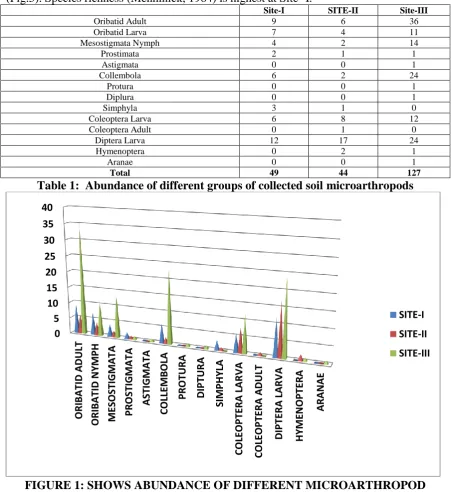
In fact 36 bags of litter and soil were collected from three sites. Total 220 soil microarthropods were extracted from these sites. Highest abundance of micro arthropods was recorded at site-III while lowest abundance was observed at site-II (Table 1).
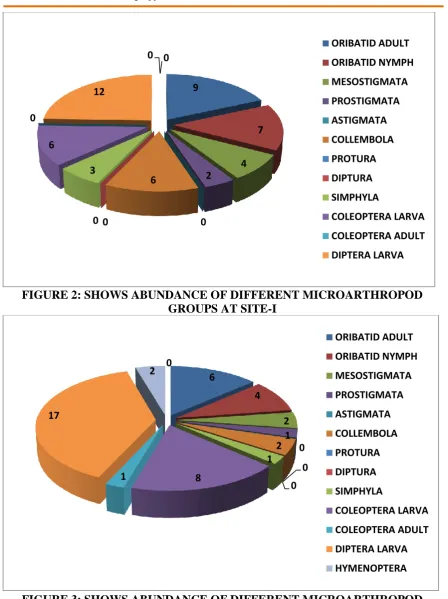
At site-II Diptera larvae were the most abundant group, while Oribatid mites constituted the most numerous group at sites-II and III (Table 1, Figure 2).
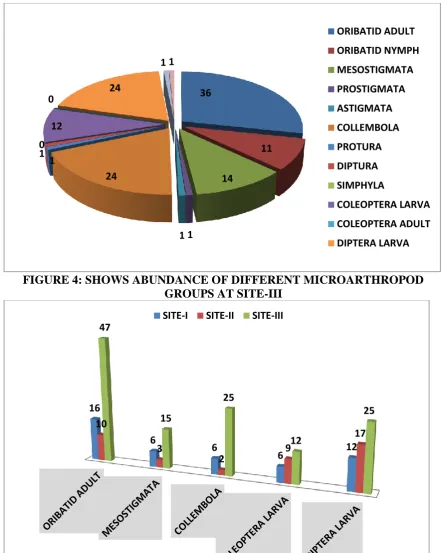
At site-II, Diptera constituted 38.64% (17 out of 44) of the total collection. Oribatid mites and Coleopterans each exhibited 22.73% (10 out of 44) and 20.45% (9 out of 44) relative abundance respectively (Table 1, Fig.3)
At site-III, Oribatida shared 37.01 % (47 out of 127) of total population, followed by Diptera 18.9% (24 out of 127). Other mites and Collembolans collectively shared 55.9%0 of the total collection (Figures 2, 3, 4).
Diversity index (Shannon and Weaver, 1963) was highest at site-III and lowest at site-II (Fig.5). Species richness (Menhinick, 1964) is highest at Site -I.
Site-I SITE-II Site-III
Oribatid Adult 9 6 36
Oribatid Larva 7 4 11
Mesostigmata Nymph 4 2 14
Prostimata 2 1 1
Astigmata 0 0 1
Collembola 6 2 24
Protura 0 0 1
Diplura 0 0 1
Simphyla 3 1 0
Coleoptera Larva 6 8 12
Coleoptera Adult 0 1 0
Diptera Larva 12 17 24
Hymenoptera 0 2 1
Aranae 0 0 1
Total 49 44 127
Table 1: Abundance of different groups of collected soil microarthropods
FIGURE 1: SHOWS ABUNDANCE OF DIFFERENT MICROARTHROPOD GROUPS AT COLLECTION SITE
FIGURE 2: SHOWS ABUNDANCE OF DIFFERENT MICROARTHROPOD GROUPS AT SITE-I
FIGURE 3: SHOWS ABUNDANCE OF DIFFERENT MICROARTHROPOD GROUPS AT SITE-II
9
7
4 2
0 6
0 0 3 6
0
12
0 0 ORIBATID ADULTORIBATID NYMPH
MESOSTIGMATA PROSTIGMATA ASTIGMATA COLLEMBOLA PROTURA DIPTURA SIMPHYLA
COLEOPTERA LARVA COLEOPTERA ADULT DIPTERA LARVA
6
4
2 1
0 2
0 0 1 8
1 17
2 0
ORIBATID ADULT ORIBATID NYMPH MESOSTIGMATA PROSTIGMATA ASTIGMATA COLLEMBOLA PROTURA DIPTURA SIMPHYLA
FIGURE 4: SHOWS ABUNDANCE OF DIFFERENT MICROARTHROPOD GROUPS AT SITE-III
FIGURE 5: SHOWS ABUNDANCE OF DIFFERENT MICROARTHROPOD GROUPS (ADULT AND LARVA) AT COLLECTION SITES
DISCUSSION
36
11
14
1 1 24
1 1 0
12
0 24
1 1
ORIBATID ADULT ORIBATID NYMPH MESOSTIGMATA PROSTIGMATA ASTIGMATA COLLEMBOLA PROTURA DIPTURA SIMPHYLA
COLEOPTERA LARVA COLEOPTERA ADULT DIPTERA LARVA
16
6
6
6 12
10
3
2 9
17 47
15
25
12
Practically unclear gradient in terms of diversity and abundance of micro arthropods from north to south was noticed in the study area. The site located at Bodaganj (site-I) exhibited greater abundance and diversity in comparison to the site located in the periphery of Baikunthapur Forest (site-II). Site-III located at the Sukna Range of Mahananda Wildlife Sanctuary which shows highest diversity and abundance in microarthropod communities among the sampling sites. The Greater density of large trees, diverse ground vegetation, relatively less disturbance in this site might have favored microarthropod communities here.
Site-II showed relatively less abundant and diverse microarthropod communities probably due to the poor occurrence of trees at this site. Trees generally provide shadow which supports moist environment even in sunshine; supply thick litter and favors fungal growth. All these collectively create favorable condition for microarthropods.
Species richness was highest at site-I though the diversity index was highest at site-III. This observation probably indicates remarkable variation in micro-environmental factors in the area.
Conclusion
Tremendous pressure of anthropogenic activities appeared to have some impact on micro arthropods diversity and abundance in the study area. Periphery of Baikunthapur Forest Division exhibits the least diversity. The probable reason is that the site is located adjacent to the motorable roadway with vehicular activity.
Any gradient, however, was not established probably due to variation in micro-environmental factors.
At the end we concluded that further study is required to investigate the actual scenario of the region.
Acknowledgement
Authors are thankful to concerning Forest Divisions and their staffs for their kind cooperation during entire study. We also thankful to the local Panchayets and Forest villagers for their whole hearted support. We express our deep concern to Local Laboratories and Institutions for extending their continuous assistance time to time whenever required.
References
1. Cancela da Fonseca JP, Sarkar S. 1998. Soil microarthropods in two different managed ecological systems (Tripura, India). Applied Soil Ecology, 9: 105-107.
2. Chattopadhyay, A. and Hazra, A. K.2000. Effects of heavy metal contaminated sewage effluents on the soil arthropods in and around Kolkata. Rec. Zool. Surv. India, Occ. Paper No. 186: 1-109.
3. Coleman, D. C., Blair, J. M., Elliott, E. T., and Wall, D. H. 1999. Soil Invertebrates. In: Standard Soil Methods for Long-Term Ecological Research. Oxford University Press, Oxford, New York.pp. 349-377 (Eds.G.Philip Robertson, David C. Coleman, Caroline S. Bledsoe, and Phillip Sollins).
4.Coleman, D. C., Crossley D. A., Hendrix, P. F. 2004. In: Fundamentals of soil ecology, Elsevier academic press, Burlington, USA, pp. 386.
5. Crossley, D.A. (Jr.) and Coleman, D. C. 1999. Microarthropods. In: Handbook of Soil Science CRC Press, Boca Raton. pp. C-59 - C-65 (Ed. Malcom E. Sumner).
7. Fenton, G. R. 1947. The soil fauna with special reference to the ecosystem of forest soil.J. Anim. Ecol., 16:76-93.
8. Ghosh, A. 1986. Collection and preservation of arthropods. In: Manual: collection, preservation, and identification of insects and mites of economic importance. Zoological Survey of India, MOEF,Kolkata.
9. Gupta, A. K. 1986. Collection and preservation of mites. In: Manual: collection, preservation, andidentification of insects and mites of economic importance. Zoological Survey of India, MOEF, Kolkata.
10. Heneghan, L. Coleman, D.C., Zoub, X., Crossley, D.A.(Jr), Hainesc, B. L. 1998. Soil microarthropodcommunity structure and litter decomposition dynamics: A study of tropical and temperate sites. Applied Soil Ecology, 9: 33-38.
11. Lakly, M.B. & Crossley, D.A. Jr. (2000) Tullgren extraction of soil mites (Acarina): Effect of refrigeration time on extraction efficiency. Experimental and Applied Acarology, 24, 135-140.
12. Menhinick, E.F. 1964. A comparison of some species diversity indices applied to samples of field insects. Ecology, 45: 859-861.
13. Oliver I. and Beattie A.J. 1993. A Possible Method for the Rapid Assessment of Biodiversity.Conservation Biology 7: 562–568.
14. Oliver I. and Beattie A.J. 1996a. Designing a cost-effective invertebrate survey: a test of methods for rapid assessment of biodiversity.Ecological Applications 6: 594–607.
15. Oliver I. and Beattie A.J. 1996b. Invertebrate morphospecies as surrogates for species: a case study. Conservation Biology 10: 99–109.
16. Rees C.J.C. 1983. Microclimate and the flying Hemiptera fauna of a primary lowland rain forest in Sulawesi. In: Sutton S.L., Whitmore T.C. and Chadwick A.C. (eds), Tropical Rainforest: Ecology and Management. Blackwell, Oxford, UK, pp. 121–136.
17. Rohitha, B.H. (1992) A simple separation system based on flotation for small samples of insectscontaminated with soil. New Zealand Entomologist, 15, 81-83.
18. Sanyal, A. K., Sarkar, B. J. and Moitra, M. N. 2006. Oribatid mites (Acari: Oribatei). Fauna of Arunachal Pradesh, State fauna Series, Zool. Surv.India.,13 (2): 467 – 478.
19. Shannon, C.E. and Weaver, W. 1963. In: The mathematical theory of communication. University of Illinois Press, Urbana. pp. 1-117.
20. Simpson, E. H. 1949. Measurement of diversity.Nature, 163: 688.
An Accompaniment to Biodegradable Packaging Film
Incorporated With Licorice Root Extract
Divya Yadav
Divya Puri
Mahak Sharma
Abstract
The present study aimed at developing a packaging film incorporated with licorice root extract. The innovation behind using licorice root extract was to explore its properties in food packaging sector, rather than its conventional usage in the pharmaceuticals and cosmetic industries. Two film samples i.e. test sample and control sample were prepared. The test film sample was made using Tween 80, PEG (polyetheleneglycol), food grade pectin, water and licorice root extract and the control sample was not incorporated with licorice root extract and only prepared with Tween 80, PEG, food grade pectin and water. The films were standardized using different formulations. Both the films were subjected to physical tests. The test showed that the films were biodegradable in nature since Tween 80 and PEG also helps in enhancing the biodegradable properties of the film.
Keywords:Biodegradable packaging, licorice root extract, PEG, Pectin.
Introduction
Biodegradable Packaging
Biodegradable films are designed with the intention of replacing the polyethylene film used for different purposes, from various industrial films, packaging products to the bag for the collection of organic waste. Such materials have better properties than traditional non-degradable plastics. They are resistant to moisture, warm organic materials for a period of several weeks or even months without changes in physical properties. This allows greater flexibility composting program. Good as a replacement for current films used in storage, transport and packaging of the product and are completely biodegradable. In addition, do not contain polyethylene, do not leave residues after composting and are made from renewable biomaterials (polyester derived from corn dextrose). A comparative study of the permeability of the biodegradable film for oxygen and carbon dioxide as a form of packaging for the fruit of tomatoes showed that films with low permeability negatively affected the quality of the fruit. However, when the permeability of the biodegradable films is into line with the respiration of the fruit, the prevention of contamination by microorganisms and insects achieved a positive effect on the durability and quality (Muratore et al, 2005). Compared with polyphenol foil, biodegradable film permeability is significantly decreased. Two kinds of experimental films have been applied to freshly chopped pineapple and melon and observed for their influence on the microbiological quality control of the fruit during storage at 10 °C. The types of films that were used in this study are commercial plastic stretch film and experimental
Student, Manav Rachna International Institute of Research & Studies,Faridabad, Haryana, India
cellulose film that includes vanilla as a natural antimicrobial agent. Fresh sliced fruit, without any foil wrapping was used as a control. Methyl-cellulose film had inhibitory effect against Escherichia coli, and the yeast was reduced was recorded. Methyl cellulose films with vanillin increased the intensity of the yellow color with pineapple. Pineapple which was guarded in an ordinary commercial plastic film had a larger amount of ethanol. However, with pieces of pineapple coated biodegradable film with vanillin recorded a decrease of ascorbic acid by 90 % (Sungsuwan et al, 2008).
Active Packaging is very popular recently and will gradually revolutionize the packaging industry. Active packaging are of different types named as, Bio-Chemical active films, Antimicrobial packaging, Oxygen, CO2, Gas-scavenging, Moisture control, Anti-Oxidation, Temperature Controlled Packaging, Active labels and indicators and
Nano-technology enabled packaging (Karleigh Huff 2015).
Active packaging is accurately defined as “packaging in which subsidiary constituents hav e been deliberately included in or on either the packaging material or the package headspac e toenhance the performance of the package system (Robertson, 2006). This phrase empha sizes the importance of deliberately including a substance with the intention of enhancing t he food product. Active packaging is an extension of the protection function of a package a nd is commonly used to protect against oxygen and moisture.
Active packaging systems are developed with the goal of extending shelf life for foods & i ncreasing the period of time that the food is high quality. Active packaging technologies in clude some physical, chemical, or biological action which changes interactions betwen a pa ckage, product, and/or headspace of the package in order to get a desired outcome (Yam et al., 2005).
In particular, a first classifications of active systems can be made, according to their functionality, in absorbers or scavenger systems (Lopez Rubio, 2004; Labuza, 1989; Vermeiren, 1999; Brody, 2001), releasing or emitter systems (Lopez-Rubio, 2004; Vermeiren, 1999; Ahvenainen, 2003) and active systems based on the energy transport (Xia, 2008; Benim, 2007).
Licorice
Glycyrrhizaglabra, family Leguminoseae, is a plant which grows in Egypt and other countries of the world. Its roots possess some nutritive value and medicinal properties.
in cough and cold preparations. Licorice extracts have been used for more than 60 years in Japan to treat chronic hepatitis, and also have therapeutic benefit against other viruses, including human immunodeficiency virus (HIV), cytomegalovirus (CMV), and Herpes simplex. Deglycyrhizinated licorice (DGL) preparations are useful in treating various types of ulcers, while topical licorice preparations have been used to sooth and heal skin eruptions, such as psoriasis and herpetic lesions.
Material and Methods
The study was carried out in the following four phases:
➢ Procurement of Raw materials
➢ Film Preparation
➢ Physical Test of Packaging Films
➢ Statistical Analysis
Phase 1: Procurement of Raw Materials
This phase consisted of procurement of raw materials from the market. The licorice roots and food grade pectin were collected from local market of Faridabad, India. The chemicals named Polyethylene Glycol (PEG) and Tween 80 were collected from Liberty chemicals shop situated in Delhi.
Phase 2: Film Preparation Formation of Licorice Extract
This phase fore mostly consisted of licorice root extract formation followed by film formation using the same extract. Licorice roots were collected and dried in shade at room temperature. After complete drying, these roots were powdered in an electric blender. 10g of licorice root powder was then mixed with 300 ml water and heated at 600C under constant stirring for 4 hours. After cooling down, the solution was filtered using a strainer. Finally the licorice root extract was stored in refrigerator at 40C film preparation.
Film Formation
The test film was formed using combination of following ingredients: 2.5g Pectin + 2ml Tween 80 + 8g PEG 400 + 78.5ml water + 9ml licorice root extract (9.8%). The above ingredients were mixed properly and stirred for half an hour using a magnetic stirrer. The solution was then poured over a ceramic tile and kept for drying at room temperature for 24 hours. The dried films were cut, peeled from the casting surface and stored wrapped in butter paper within air-tight sealed plastic bags. The control film was prepared using the same ingredients, except licorice root extract.
Phase 3: Physical Test of Packaging Films Flame Test
The sample was held at the edge of a flame. If no flame is produced quickly, hold the sample in the flame for about 10 seconds. If the material burns, note the color of the flame, the nature of the smoke, the presence of soot in the air and whether, while burning, the sample drips. Next, extinguish the flame and cautiously smell the fumes. To identify the odor, samples of known plastic samples for comparison can be most helpful. Finally, check your observations against the known characteristics of each plastic. The test was repeated thrice for each sample [ASTM 1980].
Biodegradability Test
Solubility Test
The film solubility in water was determined according to the method reported by Casariego et al., 2009. Four rectangular pieces (7.5 mm × 15 mm) were cut from each film and dried under vacuum in an oven at 105 °C and 35 kPa for 24 h (to a constant weight) to determine the initial dry weight and then the films were immersed in 50 mL of water at 20 °C with occasional agitation. After 24 h of immersion, the specimens of films were recovered by gently rising with distilled water and then dried to constant weight (105°C). The measurement of films solubility was determined as follow
Where; Mi - initial mass of the sample Mf -final mass of the sample
Results and Discussion
The study was conducted in three phases, which are as under:
Phase I: Procurement of Raw Materials
The raw materials like licorice roots and food grade pectin were collected from local market of Faridabad, India. The chemicals named Polyethylene Glycol (PEG) and Tween 80 were collected from Liberty chemicals shop in Delhi.
Phase II: Film Formation
The film was formed just by extraction of licorice root extract followed by film preparation.
Extraction of Licorice Root Extract
Licorice roots were collected and dried in shade at room temperature. After complete drying, these roots were powdered in an electric blender. 10g of licorice root powder was then mixed with 300 ml water and heated at 600C under constant stirring for 4 hours. After cooling down, the solution was filtered using a strainer. Finally the licorice root extract was stored in refrigerator at 40C for future use.
Film Preparation
The film was formed using combination of following ingredients 2.5g Pectin + 2ml Tween 80 + 8g PEG 400 + 78.5ml water + 9ml licorice root extract (9.8%)
The above ingredients were mixed properly and stirred for half an hour using a magnetic stirrer. The solution was then poured over a ceramic tile and kept for drying at room temperature for 24 hours. The dried films were cut, peeled from the casting surface and stored wrapped in butter paper within air-tight sealed plastic bags. And a control film was prepared using 2.5g Pectin, 2mL Tween 80, 8g PEG 8000, 88.5mL water was prepared.
Phase III: Physical Tests
The physical analysis of the biodegradable packaging film (BPF) comprised of the following tests:
Flame Test: The flammability test is used to determine the relative rate of burning of self-supporting plastics. This test is mainly used for quality control, production control and
𝒔𝒐𝒍𝒖𝒃𝒊𝒍𝒊𝒕𝒚 (%) =𝐌𝐢−𝐌𝐟
material comparisons. For quality control, production control and material comparisons, it cannot be used as a criterion for fire hazard.
The flame was of orange colour with slow speed of drip with good scratch able properties for films enriched with licorice root extract. For the control sample with no extract, the flame was of orange colour with moderate drip speed with good scratch able properties. The odour was same like paraffin for both the samples and average time taken for a film of 15 sec. The parameters were checked in accordance with (Nummer, Trombetta et al., 2012). The residue of films after burning was black in colour.
Table 1: Flame Test Results of Packaging Films SAMPLE ODOUR DRIP DRIPPING
SPEED
COLOUR OF
FLAME
TIME
A Paraffin Yes Moderate Orange 15 secs
B Paraffin Yes Slow Orange 15.7secs
* Values are represented as Mean ±SD of triplicate determination, Sample-A: Control (i.e. packaging film without licorice root extract) and Sample-B: Test Sample (i.e. packaging film with licorice root extract)
Biodegradability Test: The films were buried in soil for about a week to check the biodegradability of films. The term biodegradable plastics normally refer to an attack by microorganisms on no water soluble polymer-based materials (plastics). This implies that the biodegradation of plastics is usually a heterogeneous process. Because of the lack of water solubility and the size of the polymer molecules, microorganisms are unable to transport the polymeric material directly into the cells where most biochemical processes take place; rather, they must first excrete extracellular enzymes which depolymerise the polymers outside the cells (Joachim et al., 2014). The test film was found to be biodegradable (since no residues were reported) whereas the control film showed residues, indicating its non-biodegradable nature.
Table 2: Biodegradability Test Results of Packaging Films
PARAMETER SAMPLE-A SAMPLE-B
Biodegradability Test Negative Positive
* Values are represented as Mean ±SD of triplicate determination, Sample-A: Control (i.e. packaging film without licorice root extract) and Sample-B: Test Sample (i.e. packaging film with licorice root extract)
Film Solubility Test: Both the films (i.e. control and test sample) were completely soluble in water. The films were kept for 24 hours in water. After 24 hours no residue was found in either of the samples, which indicated that both the packaging film samples (i.e. control and test sample) were soluble in water (Table 3).
Table 3: Film Solubility Test Results of Packaging Films
PARAMETER SAMPLE-A SAMPLE-B
Film Solubility Test Positive Positive
Acknowledgement
I wish to express my sincere gratitude to my Institute, Manav Rachna International Institute of Research & Studies, and Faridabad, India for giving me an opportunity to transform my idea into a reality.
References
1. Ahvenainen R., Vermeiren L., Heirligs L., Delieghere F., Debevere J. Novel food packaging techniques. Woodhead Publishing Limited: Cambridge England 2003.
2. Brody A.L., Strupinsky E.R., Kline L.R. Active Packaging for Food applications. Technomic Publishing Company, Inc. Pennsylvania, USA, 2001
3. Fenwick GR, Lutomski J and Nieman C, Liquorice, Glycyrrhiza glabra Linn L.Composition, uses and analysis. J Food Chemistry, 1990.
4. Karleigh Huff,Active and Intelligent Packaging: Innovations for the Future
Department of Food Science and Technology,Virginia Polytechnic Institute and State University (Virginia Tech) Blacksburg, 2015.
5. Labuza TP, Breene WM (1989) Applications of "active packaging" for improvement of shelf life and nutritional quality of fresh and extended shelf life of foods. Journal of Food Processing and Preservation 13.
6. Lopez-Rubio A., Almenar E., Hernandez-Muñoz P., Lagaròn J.M., Català R., Gavara R. (2004) Overview of Active polymer based tecnologies for food applications. Food Review International. 2004
7. Vermeiren L, Devlieghere F, Debvere J. 2002. Effectiveness of some recent antimicrobial packaging concepts. Food Add Contamin 19(Suppl.):163-71.
8. ASTM. Standard test methods for flame properties of materials. Method D-635. In Annual Book of ASTM Standards. American Society for Testing and Materials. Conshohocken, PA. 1980
9. Nummer L, Trombetta D, Castelli F, Sarpietro MG, Venuti V, Cristani M et al. Mechanisms of antibacterial action of three monoterpenes. Antimicrobial Agents Chemother. 2012;
10.Robertson, G. L. 2006. Active and intelligent packaging. In Food packaging: principls and practice— 2nd ed. CRC Press, Boca Raton, Fl. Chap. 14
11.Xia J. Milliken & Company 2008,US 7,381,762.
12.Yam, K. L., Takhistov, P. T., and Miltz, J. 2005. Intelligent packaging: concepts and ap plications. Journal of Food Science. 70.
13.Sachdeva A, Vashist D, Rajni, Divya Puri, Antimicrobial activity of active packaging film to prevent bread spoilage International Journal of Food Science and Nutrition 2017.
14.Sungsuwan J, Rattanapanone N, Rachanapun P (2008): Effect of chitosan/methyl cellulose films on microbial and quality discharachteristics of fresh-cut cantaloupe and pineapple. Postharvest Biol. Technol., 49: 403–410.
15.Muscat D, Adhikari B, Adhikari R, Chaudhary DS (2012): Comparative study of film forming behaviour of low and high amylose starches using glycerol and xylitol as plasticizers, Journal of Food Engineering, Volume 109, Issue 2, pp 189–201.
16.Anita Ivanković BIODEGRADABLE PACKAGING IN THE FOOD INDUSTRY
Biography of Authors (10pt)
Divya Yadav Student
Divya Yadav has successfully completed her M.Sc Food & Nutrition from Manav Rachna International Institute of Research and Studies, India and B.Sc Biotechnology from Maharshi Dayanand University, India. She has got hands on expereince on many sophisticated machines like UV Vis Spectrophotometer, PCR, etc. She also coordinated Indo Japanese Conclave III, held at Manav Rachna International Institute of Research and Studies during 13-14 Feb, 2017.
Ms. Divya Puri
Assistant Professor
Ms. Divya Puri is a dedicated, resourceful and goal-driven professional educator with a solid commitment to academic and research based growth of every child. She has completed both her B.Sc (hons) Food Technology and M.Sc Food & Nutrition (Specialization: Food Science & Technology) from University of Delhi. She has taught both undergraduate and postgraduate students at University of Delhi and Indira Gandhi National Open University (IGNOU). She has co-supervised B.Tech Food Technology students at University of Delhi on their research projects. She also possesses hands on experience of various techniques in food industries like Coca-cola, Catch Spices and Delhi Milk Scheme.
Dr. Mahak Sharma Associate Professor
A Study on Opportunities and Challenges in Developing HRD
Climate with special reference to IT Companies in Pune City
Smeeta S. Kabadi
Dr. Shyamkant Shrigiriwar
Abstract
The objective of this research paper is to study the new opportunities and challenges in developing HRD climate in IT companies in Pune city. A survey method was used to collect data from 30 respondents using a well-structured questionnaire. The researcher has used descriptive research design and systematic probability sampling method for this study.
Introdu cti on
For an individual to perform productively, the climate established in the organization needs to be favourable for his development. The term ‘climate’ is used to designate the quality of the internal environment, development of the individual, and commitment towards organizational purpose, and efficiency to work with each other. HRD climate helps employees to acquire traits that would enable them to execute their present or future expected roles and aids in developing their capabilities for organizational development. The HRD Climate of an organization plays a very important role in ensuring the proficiency, enthusiasm and growth of its employees.
Pritchard and Marasick (1973) defined HRD climate as a relatively enduring quality of an organization’s internal environment, distinguishing it from other organizations.
IT Sector in Pune
be a major segment in the next few years. It is also currently the fastest growing segment, growing over 30 per cent annually.
Literatu re Review
Venkateswaran, and K.P. Sai (1997), in their study, concluded that early identification of human resource potential and development of their skill represents two major tasks of human resource development. This can be achieved only when a conducive HRD climate prevails.
Krishna and Rao (1997) surveyed the organizational and HRD climate, and they observed that environment of openness follows ‘good’ among middle and senior managers in the company.
Sr. Alphonsa’s study (2000) highlights that the supervisors’ perception about the HRD climate is satisfactory and there exists a reasonably good value of confrontation.
Rohmetra (1998) conducted a study on the HRD climate and the attitudinal perceptions of employees covering senior, middle and lower managerial levels and the clerical staff. The study shows that there exists an intimate degree of trust and components of attitudinal perception.
Priyadarshini and Venkatapathy’s study (2004) highlights that employees have a strong feeling of belongingness, and there is a sense of equality in the common facilities provided to the employees.
Research Methodology
Statement of the Research problem
It becomes necessary to study opportunities and challenges in developing HRD climate in IT companies as IT sector in the country is growing rapidly from the last decade and Pune city is one of the major hubs of IT companies.
Objectives of the study
1. To study the HRD mechanism of selected IT companies.
2. To study the various opportunities for developing HRD climate in selected IT companies.
3. To study the challenges in developing HRD climate in selected IT companies.
Scope of the study
The study deals with opportunities and challenges in developing HRD climate in IT companies in Pune city. The researcher has collected data only from senior IT professionals in IT companies.
Methods of Data collection
• Primary Data - Primary data was collected through a verbal, face to face conversation using the questionnaire prepared.
• Secondary Data - All relevant secondary data was collected from various sources like the Internet, Books, Magzines, and Articles etc.
Method of analysis and statistical tools
Research design
Tabulation & Data Analysis
Do you find new opportunities in developing/implementing following HRD practices? Measurement Scale: 1- Never 2- Very Rarely 3- Rarely 4- Most of the Times, 5- Always
Indicators Mean
Selection Process 3.3
Induction 3.5
Training and Development 4.8
Performance Appraisal 3.7
Compensation process 3.6
Working Environment 4.1
Employee Career Development 4.2
Average Mean 3.9
Who helps you to identifying new opportunities in developing HRD climate?
1- Never 2- Very Rarely 3- Rarely 4- Most of the Times, 5- Always
3.3 3.5
4.8 3.7
3.6 4.1
4.2
0 1 2 3 4 5 6
Selection Process Induction Training and Development Performance Appraisal Compensation process Working Environment Employee Career Development
Level of Oportunities in Developing HRD Climate
Type of Research Design Descriptive Research Design
Sampling Technique Systematic Probability Sampling
Sampling Area Pune City
Sample Size 30 IT companies (Senior IT Professionals)
Primary Data Well structured questionnaire
Indicators Top
Management
Middle Management
Lower Management
External Parties
Selection Process 4.2 4.3 2.2 3.6
Induction 4.2 4.4 2.8 1
Training and Development
3.2 4.8 2.8 2.9
Performance Appraisal 2.5 4.6 1 1
Compensation process 4.3 4.3 1 1
Working Environment 2.3 4.7 4.1 1
Employee Career Development
3.8 4.5 2.1 1
Average Mean 3.5 4.5 2.3 1.7
Do you find challenges in developing/implementing following HRD practices?
Measurement Scale: 1- Never 2- Very Rarely 3- Rarely 4- Most of the Times, 5- Always
Indicators Mean
Selection Process 4.3
Induction 3.8
Training and Development 4.1
Performance Appraisal 3.3
Compensation process 2.5
Working Environment 3.1
Employee Career Development 3.2
Average Mean 3.5
0 1 2 3 4 5 6
Force behind Identifying New Opportunities
Top Management
Middle Management
Lower Management
Which level of organization face more challenges in developing HRD climate?
Measurement Scale: 1- Never 2- Very Rarely 3- Rarely 4- Most of the Times, 5- Always
Indicators Top
Management
Middle Management
Lower Management
External Environment
Selection Process 1.3 2.3 1 1
Induction 1.2 2.4 2.6 1
Training and Development
3.2 4.6 2.3 3.9
Performance Appraisal 2.5 4.4 1 1
Compensation process 2.3 3.4 1 1
Working Environment 2.3 3.7 4.1 1
Employee Career Development
3.8 4.1 2.1 1
Average Mean 2.4 3.5 2 1.4
4.3 3.8
4.1 3.3 2.5
3.1 3.2
Selection Process Induction Training and Development Performance Appraisal Compensation process Working Environment Employee Career Development
Findings
• IT companies find opportunities in developing HRD climate most of the time, as the average mean identified is 3.7, but the level of opportunities varies. While providing Training and Development to employees, they find more opportunities and scope as the mean identified is 4.8.
• It has been observed that Middle management plays the most important role in identifying new opportunities for developing HRD climate as the average mean identified is 4.5
• IT companies find challenges in developing HRD climate as the average mean identified is 3.5 but the level of challenges varies. Selection process is the most challenging practice for the IT companies as the mean observed is 4.3.
• It has been observed that in developing HRD climate, the most challenging task arrives at middle management level as the average mean identified is 3.5.
Bibliography Books
• Patel M.K., "Case studies on HRD Practices", Anmol Publication Pvt. Ltd., New Delhi, 2005.
• Ashwathappa K., Human resource Management and personal management, Tata McGrawhill, 2003
• Pattanayak Biswajit, Human Resource Management, Prentice Hall of India Publication, 2003.
• Dwivedi, R. S., Management of Human Resources, Oxford and IBH, New Delhi, 1985.
Research Papers
• Dereli, B. (2006). The Effect of Human Resource Development on the Organizational Commitment. e-Proceedings of the 2nd International Conference on Business, Management and Economics, Altinyunus Resort, Hotel/Convention Center, Cesme, Izmir-Turkey, 15-18 June, 2006.
• O'Driscoll, M.P., & Randall, D.M. (1999). Perceived Organizational Support, Satisfaction with Rewards, and Employee Job Involvement and Organizational Commitment. Applied Psychology: An International Review, 48, 197-209.
• Mishra, P. & Bhardwaj, G.,(2002). “Human Resource Development Climate: An Empiri- cal Study among Private Sector Managers”, Indian Journal of Industrial Relations, 38(1), 66-80.
0 1 2 3 4 5
Depth of Challenges at various organizational levels in Developing HRD Climate
Top Management
Middle Management
Lower Management
• Sharma, A. and Purang, P., (2000). “Value Institutionalization and HRD Climate: A Case Study of a Navratna Public Sector Organisation”, Vision-The Journal of Business Perspective, 4, 11- 17.
• Srimannarayana. M., Oct.(2008). “Human Resource Development Climate in India”, Indian Journal of Industrial Relations, 44, 248-55. Venkateswaran K. R Sai, (1997).
• “A Note on HRD Climate”, Vikalpa, 22 (l), 51-53.
• Patterson, M., Warr, P., and West, M., (2004). “Organisational climate and Company Productivity: the Role of Employee Affect and Employee Level”, Journal of Occupational Psychology 77(2), 193-216. Pillai P.R., (2008).
• “Influence of HRD Climate on the Learning Orientation of Bank Employees”, Indian Journal of Industrial Relations, 43(3), 406-418.
Websites
• www.iosrjournals.org
• www.researchpublish.com
• www.wikipedia.com
Ambedkar Views on Gender Equality and Human Rights
K. SITHARDHANAN
Dr. J. THIRUMAL
Abstract
Human Rights and Gender Equality in Health Sector Strategies: how to assess policy coherence is designed to support countries as they design and implement national health sector strategies in compliance with obligations and commitments. The tool focuses on practical options and poses critical questions for policymakers to identify gaps and opportunities in the review or reform of health sector strategies as well as other sectoral initiatives. It is expected that using this tool will generate a national multistate holder process and a cross-disciplinary dialogue to address human rights and gender equality in health sector activities the tool is intended for use by various factors involved in health planning and policy making, implementation or monitoring of health sector strategies. These include (but are not limited to) ministries of health and other sectors, national human rights institutions, development partners and civil society organizations. The tool provides support, as opposed to a set of detailed guidelines, to assess health sector strategies. It is not a manual on human rights or gender equality, but it does provide users with references to other publications and materials of a more conceptual and normative nature. The tool aims to operational human rights-based approach and gender mainstreaming through their practical application in policy assessments.
Keywords: Gender Equality, Women Empowerment, Human Rights, Women Policy, Social Rights Problems, Caste and Class.
Introduction
The role played by B. R. Ambedkar has left its imprint on the social tapestry of the country after Independence, and shaped the political and civic contour of India today. It would have been a different India without him and, in all probability a much more inequitable and unjust one. He attempted to forge India’s moral and social foundations a new and strove for a political order of constitutional democracy that is sensitive to disadvantage, inherited from the past or engender by prevailing social and political relationship. The basic premise of this tool is that aligning national health sector strategies with obligations and commitments on human rights and gender equality is not only the right thing to do ethically and legally it also leads to better more sustainable and equitable results in the health sector. Every United Nation Member State has undertaken international legal obligations for human rights. More than eighty percent of Member States has ratified four or more of the nine core international human rights treaties. There is near universal agreement for the Convention on the Rights of the Child and the Convention on the elimination of all forms of discrimination against Women both of which recognize health as a human right, the importance of gender equality and several other rights relating to underlying determinants of health.
Ph.D Research Scholar Department of Philosophy Annamalai University Annamalainagar-608002
Moreover, the World Health Assembly the governing body of the World Health Organization (WHO) adopts resolutions to guide and direct the Secretariat and the Member States of World Health Organization in the field of health, including gender equality and health-related Human rights. Greater efforts are needed to help Member States full fill goals and obligations such as those outlined in. This includes ensuring that national health sector strategies are consistent with, and further reinforce, human rights standards and principles and gender equality. Historically, international human rights law did not effectively address women’s human rights, and women were even excluded from participating in its early development. Initially, the right to health was also narrowly interpreted to exclude women’s needs and experiences and failed to address obstacles faced by women in making decisions pertaining to health and obtaining health-related services.
Review of literature
S. Mohammed Azaad (2013), women’s economic liberation and for securing women’s social rights the all-round development of women was his topmost agenda and he left no stone unturned in achieving this goal. As the Chairman of the Drafting Committee of Constitution, Ambedkar tried an adequate inclusion of women’s rights in the political vocabulary and constitution of India. Dr. Ambedkar, a social visionary aptly provided appropriate rights to women in the Constitution through several articles and at a later stage, many more were included. The vision of Ambedkar is yet to become reality and unless minds are united it will be only a distant dream.
Satyajit Das (2015), Ambedkar is one of the greatest personalities of 20th century India. His life was a great saga of suffering, sacrifice and struggle. His birth as an untouchable gave him a bitter taste of caste tyranny, oppression and unbearable agony. He was a fighter for the dignity of man and deprived people. His life was a struggle of a champion of human rights. So obviously he was a great thinker of a woman and their rights. Being a pioneer of social justice, he always worked for the woman emancipation. His principal aim was to build up a society based on social justice. To secure and fulfill his dreams he thought everybody should be equal irrespective of caste, creed, gender and religion. For that reason, he started work for the upliftment of woman and their rights. In this context, the present paper intends and tries to narrate the rights and upliftment of woman in the view of Ambedkar. The endeavor was also given to highlight the relevance of Ambedkar at present-day India.
Gender Equality
The term genderis used to refer to the socially constructed differences between men and women. It prescribes specific roles for them and accordingly defines the status of women and men in the family and in society. Gender prescribes what a man should do and a woman should not and what a woman should do and man should not etc. Despite the fact that sex and gender are used quite often synonymously they are not the same. The term sex is a biological category whereas gender is socially constructed feminine and masculine patterns of behavior for women and men. Gender-based social roles define the nature and type of functions taken up by women and men. In most societies actives of women are limited to looking after home and family.