Marriage System and Divorce: Changing Pattern in India
Ms. Ravleen Anand
Dr. Vandana Aggarwal
Abstract
The present study was conducted "The Study of Marriage System and of rise of divorce in India." The aim of research study was to assess the changes of Marriage and systems in India. As we all know Divorce rates have raised very much. As we can say Indian society is becoming too much capitalistic. It is also an important social institution. Marriages in India are between two families, rather two individuals. We, Indians consider it as an auspicious occasion. We celebrate it with pomp and show. There are many rituals and customs in the marriage ceremony which perform according to regions or states. India is a bouquet of different religions and castes so, we have different marriage system. Marriage is a significant occasion in the life of a boy and a girl. Marriage brings a lot of happiness along with a lifelong promise to live together.
Introduction
Celebration in a family gives happiness and pleasure to every member of the family. Marriage is one of the celebrations among them. Marriage is one of the major and universal institutions in Indian social system, which teaches the values of life. It joins two individuals for life. It combines two culture, two families and values. In India, there are different types of marriage system prevails. Their rituals and customs are different from each other. We can see North Indian marriages are differ from that of South Indian. North-East States have different marriage from other parts of India but their aim is one. Marriage is a social duty towards the society. According to Devdutt Patnaik, there was no concept of marriage in earlier time. Men went to women and women went to men as per their pleasure. Divorce means have a marriage ended. Most of the couples divorce because they don’t have trust issues, money is also the reason of divorce , lack of communication as not talking enough throughout the day, ignoring each other, arguing is measure impact in divorce they both start arguing without any reason no one stop and continue their arguing. Abuse physical or emotional abuse is very sad reality for some couples. That’s why divorce is rising in India
Objectives of the Study
The objectives of the present study were to understand “The Study of Marriage System and Rise in Divorce in India".
1) The study sought to analyze the demographic characteristics of the marriage system and rise of divorce system included in the study.
2) Assess the study of marriage system and rise of divorce system in India
3) To examine the structure of Indian society. And with respect to the changing pattern of marriage which leads to the rise of divorce.
Methodology
As it was intended to be an exploratory study The methodology used was an investigative one using research tools. Data for the study was collected from secondary sources. The research executives scanned the books, journals, general and the newspapers articles published.
Background of Marriage
Since our childhood, we have been hearing the story of God and Goddess from our grandparents. We know how Lord Rama married to Goddess Sita. Lord Shiva Married Parvati.
So, marriage has been happening since the age of God and Goddess. In Mahabharata, Queen Drupadi had five husbands. Lord Krishna had 1600 wives. There are different kinds of relationships.
1. Heterosexual: sexually attracted to opposite sex.
2. Homosexual: sexually attracted to one owns sex
3. Monogamy: practice of having one wife
4. Polygamy: practice of having more than one wife
5. Monandry: practice of having one husband
6. Polyandry: practice of having more than one husband
The concept of marriage in Rigvedic period is holy and sacred bond. During Rigvedic periods, girls had right to choose their husband of their own choice. This was done by Swayamvara which is self- selection of husband. Many instances are there such as Swayamvara of Sita and Drupadi in our mythology. Dowry system was practiced and ornaments, dress and wealth as gift to the girl.
Dowry means the demand made by the groom’s family from the bride’s parents for the payment of money as well as other costly gifts. It is considered as Dana.
But in this patriarchic society men have more advantages than women. Men could marry more than one woman such as king Dasharatha and Lord Krishna.
Rigveda mentions eight kinds of marriages;
1. Brahma Marriage
2. Daiva Marriage
3. Arsha Marriage
4. Prajapatya Marriage
5. Gandharva Marriage
6. Kshatra Marriage
7. Manusha Marriage
8. Paisacha Marriage
Child marriage was also prevailing in India. According Manu smriti- the lawbook of Manu, the age of the bride should be one -third of the groom. Young girls were considered irresponsible and irrational in love, parents married them early before they got caught into any scandal. Sometimes, both boy and girl were young when they get married.
Ancient and Medieval Marriages
In our Indian history, we find reasons for the marriage. Mostly, our Kings married had more than one wife. In this era, men especially king and high authorities could marry as many times as they want and along with that they could have concubines.
In medieval times, marriage was quite different than Rigvedic age. Women didn’t have choice of their husband. Marriage was not based on love; most marriages were political arrangement. .
British’s Period
Britishers came to India for Trade and Commerce but soon they established the rule. Britishers fought many wars with Indian rulers and capture all their territories. They made many policies for Indian rulers. After the revolt of 1857, India came under the Queen Victoria’s rule. Now, British officers started making laws to remove the social evils which were prevailed in India. In 1929, British Government abolished Child marriage and in 1829 sati system was banned. Hindu do not recorded their marriage; the Christian population in India has a marriage registration system.
Cultural Marriages
There are many cultures in India. But here we are going to mention about four religion and their cultures. Mainly, we have Hindus, Muslims, Sikhs and Christians largely in number in India. All these four religion Marriage System are differed by each other.
Hindus
In Hinduism, marriages are called ‘Vivaah’ or Shaadi in North India where as it called ‘Kalayama’ in south. There many pre-wedding and post-wedding rituals perform by bride and groom. Red has a significant role in Hinduism. Bride wears red colors Sari or Lehenga. Agni is most important in wedding. Earlier, there was no divorce in the Hindu culture. According to Kautilya, a woman can abandon and marry the brother of her husband when her husband becomes a lunatic, of bad character, traitor of the state. Similarly, a husband could abandon his wife if she acted immorally and was barren. But now days divorce become common in India. If you are not happy or can’t live with your partner due some reasons, one can easily appeal for Divorce.
Muslims
Islam is the second largest religion after Hinduism in India. A marriage in Islam must be between opposite sex. Till now, men are allowed to marry more than girl. Marriage is called ‘Nikah’. Green color is considered sacred in Islam. The ceremony is conduct by Maulavi.
The bride and groom only have to say ‘Qubool Hai’ three times. And they are declared to be Husband- wife. Similarly, divorce happened by saying ‘Talaaq’ three times. But recently Supreme Court banned the ‘Triple Talaaq’.
Sikhism
Anand Karaj is the prescribed form of Sikh wedding. The real goal of marriage in Sikhism is union of both souls with Almighty lord. The concept of marriage is explained by Guru Amar Das, the third Guru of the Sikhs. In Anand Karaj, four Lavan are recited from Guru Granth Sahib. The couple to be married will be sitting in front of Guru Granth Sahib on Floor and the family and friends will sit down. All the wedding happens in the Gurudwaras.
Christian
Marriage Acts
There are two legislation framed to solve the challenge of Marriage Registration laws.
1. The Hindu Marriage Act 1955
Its deals with the marriage registration. Under this act, certain terms and conditions must be fulfilled in order to give the marriage between the individuals a legal and make it valid marriage.
2. Special Marriage Act 1954
It’s lay down the procedure for both solemnization and registration of marriage, where either of the Husband or wife or both are not Hindus, Buddhists, Jains or Sikhs.
3. THE ANAND MARRIAGE ACT 1909
It is the Sikh marriage ceremony which means joyful union it was introduced by Guru Amar Das. In Sikh marriage in front of the guru Granth sahib Ji the couple do four Laavaan. In Sikhism no dowry is allowed.
4. MARRIAGE EQUALITY ACT Equality should be there in couple’s men and women are same after marriage and it is also refers to a political status in which same sex marriage and opposite sex marriage are equal by the law.
5. THE INDIAN CHRISTIAN MARRIAGE ACT IN 1872 This act says that all Christian marriages shall be solemnized under its own provision. Apart from Christian-Christian marriage, the marriage of a Christian with a non Christian must also be solemnized under this act.
Types of Divorce
1. Divorce with Mutual Consent
When the husband and wife Is ready for divorce then the court will consider the divorce. For the petition to be accepted , as if the couple is not living together from past one two years and if a couple is having a child the they both will decide that the child will stay with whom. The second is property. The husband and wife will decide which property will get to whom. This will include both movable and Immovable property.
2. Divorce without Mutual Consent
In this the husband or wife can simply ask for divorce without any reason. The reasons can be like
1. Mental Disorder
2. Conversion
3. Desertion
4. Cruelty
5. Death Issue
Present Position of Marriage in India
Actor Arbaaz Khan and Maliaka Arora broke- up their 20 years of long Marriage. Actor Hrithik Roshan and Sussanne Khan broke-up their 14 years of long Marriage.
Another relationship is landed in India called Live-in-relationship. In this one can live with their partner without having to engage into a legally binding relationship. The Supreme Court in Indra Sarma vs V.K.V Sarma defines live-in relationships in distinct ways-A domestic Cohabitation between an adult unmarried male and an adult unmarried female. The Apex Court in so many of its Judgements stated that if a man and a woman “lived like husband and wife in long term relationship and even had children, then the judiciary would assume that the two were married and same laws would be applicable on them”. Therefore, Live-in relationships are legal in India.
There are many websites which help you to find your perfect life partner Such as Shaadi.com and Jeevansathi.com. Many matrimonial pages are published in the newspapers. And age of girl for marriage is above 18 years and age of boy should be above 21 years states by Supreme Court.
SECTION 377 OF IPC
Section377 of IPC states that whoever voluntarily has carnal intercourse against the order of nature with any man, woman or animal shall be punished. Gay sex is considered to be taboo in India. On 6th September, Supreme Court states decriminalize gay Sex.
Decriminalize homosexuality is incredibly heartfelt and vindicates the dignity of LGBT people.
Causes of Rise in Divorce System
DON’T HAVE MUTUAL UNDERSTANDINGS
The divorce is rising day by day. As the married couple they don’t have mutual understandings between them they start fight in small issues and continue their fight with more than one month.
THEY DON’T SOLVE THEIR PROBLEM BY COMPROMISE
Divorce have emerged as a very likely outcomes of marriage today, questioning the truth of saying that marriage are made in heaven. The main reason for divorce is that couples choose divorce as an option for problem the most of the time they can solved by discussion and compromise.
PRESSURE OF SOCIETY
As we all know earlier the married couples bowed down to the pressure of society to make their marriage work because they think what society will think.
RELATIONSHIP CASUALLY
Today, the couples take their relationship casually and can head to the divorce without trying to solve to save their marriages. Now many people take relationship as a joke or we can say boys are usually want sex from girls this is very wrong. The most common reason of divorce is between a married couple and mother in law spoil the husband and wife relationship also get affected.
ADJUSTMENTS
Suggestions of Divorce System
1. SPEND MORE QUALITY TIME TOGETHER
There are a lot of people who are not happy in their marriages because they don’t spend more time with each other. This can happen when they have hectic schedules. Every couple should go out for dinner spends quality time with each other.
2. ACCEPT YOU MISTAKES WITHOUT ANY ARGUMENT
If a husband is wrong then he should simply say sorry and if a wife is wrong then she should simply say sorry without any argument.
3. CHANGE THE NEGATIVE PATTERNS
Be always respectful with each other, kiss in the morning always love each other. Always trust each other. Share each and everything with each other.
4. TAKE THE WORD DIVORCE OFF
Remove divorce as an option from your marriage. Many couples think that the only option is to take divorce because of their fights but remove divorce from your mind.
5. START FROM SCRATCH
Forget about the fights, the negativity. Remember how you both fell in love your love story and all. Always remember your good movements with each other.
Conclusion
Marriage has a significant role in India society. Marriage is considered to be sacred bond. Indian spends lots of many in Wedding ceremonies and celebrates it with pomp and show. Marriage is a legal permission to live together and love-making. Different communities, caste and religion have different rituals and customs of marriage. Though marriage ceremonies, rules may differ from one society to another, marriage is considered a universal culture. There are so many types of marriage perform in India. Purpose of the marriage is to combine two thinking and values not to ruined someone happiness. Many evils of marriage which can destroy this sacred bond such as Dowry system, domestic violence and extra martial affair. Honesty and trust is the base of marriage which decorated with love. Divorce is defined as an ending marriage by an official decision by the court. In short term they get married just a little bit of romance and then get separated and take divorce. Nowadays marriage is like a joke if the couples get married and after three months their mutual understandings is not there then take divorce its like a play many couples don’t take serious their marriage.
References
1. http://www.legalservicesindia.com/articles/rfs.htm
2. Sec. 5, The Hindu Marriage Act, 1955
3. Section 4(a), the Special Marriage Act, 1954
4. http://www.webindia123.com/law/family_law/hindu_law/marriage.htm
5. Sec. 12, The Indian Christian Marriage Act, 1872
6. Auboyer, Jeannine, Daily Life in Ancient India: from 200 BC to 700 AD. London: Phoenix Press, 2002.
7. UNICEF, Early Marriage. Child Spouses, 2001.
Effect of Green Marketing on the Sustainable Development:
With Special Reference to the Manufacturing Industry in India
Dr Susheela Devi B Devaru
Abstract
The drive of modernization and the era of globalization have changed a lot in the current business fronts; the competition is so fierce that it is very difficult for the organizations to receive a repeat purchase from the side of the customers. On the other hand it is even more difficult to cope up with the policy measures regarding the safety of the environment. The answers to all the questions are the implementation of green manufacturing system and making the process of marketing as ‘Green’. In the Indian region the concept of green marketing is catching pace in different scrapes, it is developing but still need a varied support from the different agencies. The present study evaluates the concept of green marketing in the Indian scenario and will make suggestion regarding the challenges and opportunities related to the implementation of green marketing.
Keywords: Green Marketing, environment, customer, Sustainable Development.
Introduction
The American Marketing Association states the concept of green marketing as the process of marketing of the goods that are safe for the related environment. This concept can be detailed in the terms of related activities of modification in the respective products, some changes in the process of production, changes in the packaging of the present product and even the media has to be managed accordingly. This particular phenomenon is having its social and psychological implication as well. In the corporate scenario the terms ‘Green Marketing’ and ‘Eco-Marketing’ are being taken in contradiction with each other, and in the same manner it is difficult to define the term green marketing separately. In order to mention the term Green marketing we can say that it is a concept that includes all the basic operations of any given organization right from procurement of raw material to disposal of final goods, where the term green refers that any of the activities may not cause any harm to the environment in any form. The growing awareness about the global warming and environment protection is pushing both the parties towards the protection of the same and using the term ‘Green’ in the real sense.
Literature Review
Oyewole, P. (2001). The researcher had tried to develop a link between the concept of green marketing and the establishment of the same in the selected industrial setup. The researcher states that awareness is the biggest tool between the customer and the efforts of the industrial setup to spread the same.
Karna, J., Hansen, E. & Juslin, H. (2003) the researchers have tried to evaluate the actual efforts of the industries in establishing ‘Green’ in their routine course of work. He found that many of the industries are willing to do so but then again the policy and rates of the government establishments are increasing the cost of the materials and other related
services, if they are trying to go ‘Green’ and on the other hand the customer is not willing to pay extra price for the same.
Donaldson (2005) the researcher had conducted the study in the Great Britain and stated that there is a positive change in the awareness of the customer regarding the ecological attitude, and the same is very positive for the companies that are trying to establish ‘Green’ concept in their respective organizations. He also established that this positive attitude of the customer will support the efforts of the companies in the long run.
Alsmadi (2007) this study was conducted in the Jordan region and the researcher established that the customers are highly worried about the safety of the environment and willing to do whatever required. This attitude of the customer is also visible in the final purchase of the products where they are willing to pay the extra price for the safety of their environment.
Examples of Green Marketing Green Marketing
The concept of Green marketing states that a lot of effort is required to satisfy the need and want of the customer i.e. starting from the procurement of the material and shaping the final product requires a series of activities but these activities may not harm the environment at any level and the same is expected from the side of the consumers that the respective use of the product may not harm the related environment or the respective ecosystem in any form. As per the direction of the environment authorities the packaging of the product and even the container should be recyclable, may be in the form of reuse and free from any kind of radiation and same is being advertized through a number of media commercials and city billboards.
Related Issues Green Marketing
a. Need for Standardization
There are a number of commercials on television and other media and most of them use to claim that their products are eco-friendly and may cause no harm to the environment but as a matter of fact it was found by the respective agencies that only five percent of such claims are true. Here lies the need for standardization of the media and even for the actual or physical product.
Need of Green Marketing
b. New Concept
Indian literate and urban consumer is getting more aware about the merits of Green products. But it is still a new concept for the masses. The consumer needs to be educated and made aware of the environmental threats. The new green movements need to reach the masses and that will take a lot of time and effort.
c. Patience And Perseverance
The investors and corporate need to view the environment as a major long-term investment opportunity, the marketers need to look at the long-term benefits from this new green movement. It will require a lot of patience and no immediate results. Since it is a new concept and idea, it will have its own acceptance period.
d. Avoiding Green Myopia
The first rule of green marketing is focusing on customer benefits i.e., the primary reason why consumers buy certain products in the first place. Do this right, and motivate consumers to switch brands or even pay a premium for the greener alternative. It is not going to help if a product is developed which is absolutely green in various aspects but does not pass the customer satisfaction criteria. This will lead to green myopia.
Objective
- To know the efforts of the companies related to green marketing,
- To judge the awareness level of the customers regarding green marketing - Find the relationship between green marketing and sustainable development
Hypothesis
H0: There is a significant and positive relationship between the efforts of the organizations
H1: There is no significant relationship between the efforts of the organizations and
understanding of the consumers regarding green marketing.
Data Analysis and Interpretation Table: Correlation Analysis of Data
Correlation Matrix of Selected Factors influencing Performance Level of Manufacturing Units
A1 A2 A3 A4 A5 A6 A7 A8 A9 A10 A11 A12 A1 1.00
A2 .405 1.00
A3 -.627 .145 1.00
A4 -.339 -.013 .517 1.00
A5 -.112 -.370 -.394 -.233 1.00
A6 .383 .402 .138 .401 -.379 1.00
A7 -.130 -.060 .222 .594 -.446 .227 1.00
A8 .667 .447 -.068 .127 -.543 .698 .076 1.00
A9 -.452 .046 .336 -.017 -.231 -.270 .232 -.241 1.00
A10 .639 .411 -.193 -.258 -.181 .446 -.550 .791 -.344 1.00
A11 -.523 -.076 .480 .363 .017 -.163 .448 -.644 .295 -.815 1.00
A12 -.119 -.207 -.382 -.770 .467 -.693 -.624 -.412 .327 .037 -.296 1.00
Table 1.1: Descriptions of Variables under Study
A1 Production per year
A2 Productivity
A3 Level of automation
A4 Labor’s Attitude A5 Supply Chain Factors
A6 Process timing
A7 Supplier’s Factors A8 Basic Transportation
A9 Storage Facility
A10 Machine Timing
A11 Labor Timing
A12 Output Ratio Interpretation-Stage 1
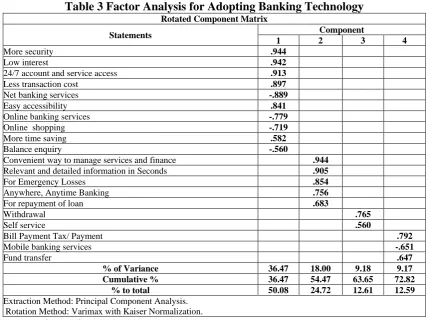
Table 2: Correlation Matrix of Selected Factors influencing Customer Awareness and Recent Consumption
B1 B2 B3 B4 B5 B6 B7 B8 B9 B10 B11 B12 B1 1.00
B2 .532 1.00 B3 .168 .724 1.00 B4 -.622 -.296 .200 1.00 B5 -.885 -.786 -.252 .617 1.00 B6 .924 .420 .051 -.846 -.784 1.00 B7 .060 -.263 .192 -.079 .295 .208 1.00 B8 .206 .016 .043 -.401 -.071 .347 .717 1.00 B9 -.042 -.160 .447 .659 .323 -.223 .441 -.148 1.00 B10 -.497 -.537 .106 .530 .746 -.431 .418 -.289 .694 1.00 B11 -.754 -.500 -.308 .747 .640 -.859 -.500 -.710 .163 .422 1.00 B12 -.120 .134 -.371 .059 -.234 -.256 -.939 -.492 -.567 -.569 .477 1.00
Table 2.1: Descriptions of Variables under Study
B1 NO. of Working Vehicles
B2 Awareness
B3 Purchase
B4 Reference Group
B5 Comparison
B6 Direct Purchase
B7 Knowledge of GSM
B8 Experience of GSM
B9 Product Difference
B10 Service Difference
B11 Maintenance
B12 After sale Service
Interpretation-Stage 2
As far as basic awareness of green marketing is concerned, most of the respondents were found to be aware of the same and the can be viewed from the above given table where in most of the cases the correlation is positive and of higher degree, then in other cases the correlations is negative and shows higher or a moderate degree. It can be inferred from the correlation analysis that yet most of the customers are not aware of the concept related to green marketing and are dependent on media and related sources for the related information. Most of the customers are having belief on the referral buying where one customer is buying the products on the reference of the other customers. This process is time taking but then again it may not create difficulty for the concerned organizations.
Conclusion
customer is fully satisfied with the efforts of the company and completely understand the need of the same then it will be easier for them to pay the extra money. This phenomenon will help both the parties and might prepare a strong background for the sustainable development of the economy. Green marketing assumes even more importance and relevance in developing countries like India. Green marketing is a tool for protecting the environment for the future generation.
The efforts of going ‘Green’ are having a relative importance with the safety of the environment, and with the growing concern of the authorities to save the same is increasing with every passing day and in the lieu of the same the new ventures are establishing the green process in their industrial establishments and the old companies the taking care of their prevailing systems. That’s why briefly we can suggest that the business will survive and be sustainable only when marketers understand the changes in the market which are greening and leads to sustainable development.
References
1. Dr. K. Manian, A.N.(2014). Present Green Marketing-Brief Reference To Indian. International Journal of scientific research and management (IJSRM), 51-57.
2. DR. V. Mohanasundaram. (2012, April). Green Marketing –Challenges And Opportunities. International Journal Of Multidisciplinary research, Vol. 2(no. 4), pg. 66-73.
3. J., P.M. (1994, November). An introduction to Green marketing. Electronic Green Journal, vol. 1(Issue 2).
4. Jain, S.K. & Kaur, G. (2006). Role of socio-demographics in segmenting and profiling green consumers: An exploratory study of consumers in India. Journal of International consumer marketing, 18(3), 107-146
5. Kinoti, M.W. (2011, December). Green Marketing Intervention Strategies and Sustainable Development: A Conceptual Paper. International journal of Business and Social Science, Vol. 2(NO. 23), pg. 263-273
6. Kumar, R. (2013, November). Green Marketing –A brief reference to India. Asian Journal of Multidisciplinary Studies, Vol. 1, Issue 4, pg. 191-203
7. Manju, (2012, December). Green Marketing: New Hopes And Challenges. Spectrum: A Journal of Multidisciplinary Research, Vol. 1, Issue 9, pg 40-47
8. Mintu, L.A. (1993). Environmental Issues in the Curricula of International Business, the green imperative. Haworth Press Inc.
9. Mishra, P.S. (2010, December). Green Marketing In India: Emerging Opportunities And Challenges. Journal of Engineering, Science and Management Education, 3, pg. 9-14.
10.Ottman.(1998)green Marketing, Opportunity for Innovation, Electronic Green Journal, vol. 1, Issue 2, pg. 1-3.
Social Legal Aspect of US-PAK Relations Post 9/11
Gultaj kaur
Abstract
US-PAK relations refer to the bilateral relationship between Pakistan and the United States. On 20 Oct 1947, two months and six days after Pakistan's independence, the United States established relations with Pakistan, making it amongst the first nations to create
relations with the new state. Pakistan allied itself with the U.S. during the Cold warperiod
against the Soviet Union, and was an integral player in the CENTO and SEATO organizations. Pakistan also played a Important role in arranging the 1972 Nixon visit to China which led to normalization of ties among the two countries. Despite a become worse of relations following the election of the left-oriented Pakistan Peoples Party under Zulfiqar Ali Bhutto, relations quickly improved and deepened during Operation Cyclone in the 1980s, which was governed against Soviet expansion in Central Asia and South Asia, by funding and training Muslim mujahideen in Afghanistan to combat the Soviet Union. Relations once again soured after the collapse of the Soviet Union, when the United States officially agree sanctions against Pakistan by passing the Pressler modification , which was enacted against Pakistan for its nuclear weapons program, which was begain after the war with India in 1971 and accelerated after India detonated a nuclear bomb in 1974. Pakistan once again assumed an important role in American geopolitical interests in the region following the attacks of September 11th, 2001, and the successive War on Terror. Relations were become stronger as the United States named Pakistan a major non-NATO ally in 2002—which allowed for the release of over $25 billion of aid to Pakistan. American recovery try following the 2005 Kashmir earthquake were widely valued by the Pakistani public.
Keywords:- Pakistan–United States, Nuclear issue, Geo-strategic
Introduction
Pakistan and the US have built a multifaceted and broad-based relationship, driven by cooperation in areas ranging from education to energy and from defense to trade and investment. This cooperation is rooted in shared values and convergence of interest on regional and strategic issues.The U.S. has been one of Pakistan’s most important development partners and is also a major source of foreign direct investment as well as one of Pakistan’s biggest export markets. The US has been a major investor in Pakistan’s infrastructure and education sectors – the last exemplified by the largest Fulbright Program run by the US anywhere in the world. Similarly, shared common values have brought the Pakistani and American people together. The common aspiration towards democracy and the rule of law animates the societies of both countries. The one million-plus strong Pakistani-American community in the United States is not only a bridge between the two countries but comprises many outstanding entrepreneurs, doctors and academics that contribute to and enrich American society. The US today engages in extensive economic, social, and scientific assistance as well as vital military relations with Pakistan, while
Pakistan continues to occupy a strategic position in the United States' interests in Central and South Asia. The US is the 2nd largest supplier of military equipment to Pakistan after China, and US is one of Pakistan's largest donors of foreign assistance.
PAKISTAN-U.S. Relations
Pakistan is key to success in U.S.-led counterterrorism efforts, with its tribal areas serving as terrorist havens, however, covert U.S. military actions inside Pakistan have put the future of the U.S.-Pakistan military alliance and bilateral cooperation and relations in jeopardy. More, it is pertinent to say here that the United States can never deny the fact that Pakistan is an important stakeholder in the region and could play a vital role in peaceful and respectful withdrawal of NATO forces from Afghanistan. So, both should mend fences after the bumpy ride. And, in a bid to dissipate tensions with Pakistan, the United States has to mend bridges with its ally and restore diplomatic ties between the two countries by finding a way out of the mutual distrust shared by both countries for each other. Both should show interest in addressing the reservations of each other by initiating the process of dialogue and most likely the relations between the two countries would head towards improvement for better Pak-US relations. Pakistan and the United States should be engaged with a constructive approach to achieve shared objectives of peace, stability and economic prosperity in the region. The United States should also address Pakistan’s concern and views with regard to the U.S. strategy for South Asia. But there is a trust deficit between the two countries. The United States always used Pakistan for its benefit and later started blaming Pakistan for the failures in Afghanistan. Moreover, 70-thousand citizens of Pakistan were martyred in the U.S.’s war against terrorism and still the U.S. is blaming Pakistan for its failure, which is not acceptable. Also, both countries should orchestrate a policy of fair dealing and equality. And, if a reset in ties is not possible, a modicum of stability can surely be achieved.
PAK-U.S Relations after 9/11 Incident
The incident of 9/11 became the reason for Pakistan and U.S to become strategic allied for the third time*. On 20th of September 2001, when U.S President George Bush was
addressing the Congress’ joint session, he gave warning that every country, belonging to any region, they all have to decide either they are going to stand with U.S or in they have to make it clear that they are with the terrorists. He further said that from here on, any country that carry’s on to port or provides support to terrorists will be reckoned as the aggressive government by U.S. This message was pretty clear for a state such as Pakistan which had been playing active performer of the internal politics in Afghanistan. In accordance with statement of Lawrence Ziring, to challenge the U.S in the result of the terrible incident of 9/11 would be to put the Pakistan in straight connection with the acts of Al-Qaida. Furthermore, at this occasion there was no unraveling Al-Qaida from the Taliban and Pakistan was strained to pick between being considered as a co-conniver with the named group of terrorists or union the U.S call for the cutting of binds to the Mulla Umar’s regime. U.S also forced Pervez Musharraf to think carefully regarding the decision to defuse the majority of militant groups associated with different Islamist organizations being operated from Pakistan†.The support by Pakistan in the war against terror had needed
* S. Eric Margolis, Pervez Musharraf had little choice,Daily Times, Lahor ,September 2006,(Retrieved on 13
Sep,2018)
† Ziring, Lawrence Pakistan at the Crosscurrent of History, Lahore: Vanguard, 2004, p.305. 14. (Retrieved on 15
Islamabad to supply Washington with blanket over flight and corridor privileges for conducting all required armed and intelligence actions, together with the utilization of naval posts of Pakistan, tactical positions on boundaries, air bases, closing of the diplomatic relationships with government of Taliban and help the U.S to obliterate the network of Al-Qaida‡. In this respect, four airports were provided to U.S forces by Pakistan for logistic assistance along with Dalbadin, Pasni, Jacobabad and Shamsi (Kharan).§ Likewise, U.S also got help from Pakistan to engage in spying activities that included employing of planes for spying activity in North and South Waziristan, Chain of Mountains in Hindu Kush, Zhob, Chitral and hilly zone between Afghanistan and Baluchistan and Kandahar of Pakistan. Devices used to track also employed on various locations to perform the monitoring the activities in the border regions**.One more liability
assigned to Pakistan in this war was to assist the U.S to eradicate the network of Al-Qaida. For this, Pakistan not only detained various leaders of Al-Qaida and cadre and them handing them over to U.S but also participated actively in prevention of various terror schemes. In the month of August, 2006, with the assistance of information provide by lively intelligence of Pakistan, a terror scheme, aiming to target the aircrafts moving between U.S and U.K was blocked. Accordance with the statement of the Foreign Office spokesperson Ms. Tasnim Aslam, Pakistan did some arresting in collaboration with arrests done in U.K to block the scheme. She stated that the arrests in U.K are result of the lively support of the intelligence amongst Pakistan, U.S and the U.K.††
Geo-Strategic Importance of Pakistan
In all respects we cannot ignore the geo-strategic importance of Pakistan in developing relations with any country including USA. Pakistan is always remained a part of world politics because of its location. It is surrounded by India, China, Iran, and Afghanistanxix. Each of the country is major player in global politics.It is in the center of resource rich states like India, China, CARS and Russia. Even for India it provides route to energy resourcesxx.Afghanistan is now a major part of world politics and important in regional and global politics. It is a land of terrorists, and a major country of opium production. The whole world including the US realizes that the peace in Afghanistan is impossible without Pakistan‟s cooperation. Since Soviet invasion in Afghanistan in 1979, USA used Pakistan as frontline state and compelled Soviet to leave Afghanistan. Similarly after 9/11, USA toppled Taliban and terrorists with full support of Pakistan. Iran, Turkmenistan and Tajikistan are also neighboring countries but Pakistan provides easiest route to NATO supplies to the forces in Afghanistan.Furthermore Afghanistan is a landlocked country and dependent on Pakistan for trade purposes.On eastern side India is inhabited with nuclear capability and big market of South Asia. India is also in favor of stable and democratic Pakistan because any extremist government in Pakistan can lead to violence in India.USA also wants stability in Pakistan and hampers India not to take any action against Pakistan because it will affect US interests in Pakistan. China is also the neighbor of Pakistan.USA is preparing India that if USA and China are in rivalry then India would be helpful in South
‡ Pervez Musharraf, In the Line of Fire, Free Press, New York,September 25, 2006: 205(Retrieved on 17 Sep,2018) § 3 airports on standby for US: Secretary”, Daily Times, 19 July 2006. 40. (Retrieved on 20 Sep,2018)
** Shahzad, Syed Saleem, “Stage Set for Final Showdown”, Asia Times Online, 21 July 2004. 39. (Retrieved on 24
Sep,2018)
Asia and same is interest of China in Pakistan. In order to get access to Muslim countries of Middle East and Central Asia china looks to Pakistan for its trade development. Gawadar project is a step of china in this regard.Pakistan is also a nuclear power and is a gateway to Central Asia and access to the Middle Eastern countries is through Arabian Sea.‡‡
Nuclear Issue
Nuclear issue between the two countries also exploits the relations between two countries. US were always against nuclear program of Pakistan that was started during Bhutto regime. In May 1998 Nuclear tests of India, Pakistan followed India and on 28th May 1998 exploded the nuclear bombs despite constant pressure by Global world and USA. The US two decades effort of Nuclear Non-proliferation in South Asia rolled backed in 1998. President Clinton imposed non–humanitarian restrictions under Section 102 of the Arms Export Control Act. Although these restrictions were removed on both India and Pakistanin October 2001 after 9/11 event. United States urged several timesboth the states to join NPT (Nuclear Non-proliferation Treaty) and CTBT but no state is signatory of these treaties. In 2002 press report it was alleged that Pakistan is providing Uranium enrichment material and technology to South Korea since 1990s.Pakistan rejected these press reports. If such reports are confirmed then under US laws non-humanitarian aid must be taken from Pakistan. Bush administration determined that sanctions cannot be imposed under these facts. Then in 2003 second press release was issued that Iran and Libya are also benefitting from Pakistan‟s nuclear program. The matter was investigated and in February 2004 it came before public that Dr.A.Q.Khan was involved in nuclear proliferation to North Korea, Iran and Libya. President Musharraf awarded pardon to A.Q.Khan because of his great contribution to Pakistani Nation.US was assured that government had no knowledge.US turned blind eyes to this issue because of her foreign policy interests in Pakistan.US considered the pardon of A.Q.Khan as Pakistan internal matter.USA is much concerned about A.Q.Khan proliferation of nuclear weapons. The security of Pakistan nuclear weapons is number one worry for USA and that creates hurdles in their relations. China is planning to build up two nuclear reactors in Pakistan and Washington requested Beijing to justify the plan internationally.§§
US-PAKISTAN Relations: A Half-Century Roller Coaster Ride
Although the stakes today are vastly higher, the current crisis fits into a well-established pattern. Ever since the US and Pakistan became allies 57 years ago, their relationship has been extraordinarily volatile, a veritable ride on a roller coaster. It was on 14 May 1954 that the two countries signed a mutual defence security agreement making Pakistan part of the Eisenhower Administration’s containment belt around the Soviet Union and China. By becoming a member of both the South-East Asia Treaty Organization (SEATO) and the Baghdad Pact, in President Ayub Khan’s words, his country became America’s ‘Most Allied Ally in Asia’.***The alliance, however, had a fundamental disconnection. While
Pakistan was anti-communist, India was its main security concern. Even though the US and India were estranged, Washington never considered New Delhi an enemy. The
‡‡ Mutual Security Act of 1958, Hearing before House Committee on Foreign Relations,85th Congress,2nd Session, April
15-16,1958(Washington:1958),P.1753(Retrieved on 12 Oct,2018)
§§ Samina Ahmed, The United States and terrorism in Southwest Asia: September 11 and beyond, International security,
winter 2001/2,P.80. (Retrieved on 13 Oct,2018)
*** Mohammed Ayub Khan (1967), Friends Not Masters, Oxford University Press, London, p. 130. (Retrieved on 13
relationship prospered during the Eisenhower Presidency, but faltered over this disconnection during the Kennedy and Johnson Administrations. When the October-November 1962 Sino-Indian border war prompted US military aid to New Delhi, Islamabad was infuriated. In turn, Pakistan’s burgeoning friendship with China and criticism of US involvement in Vietnam angered Washington. In 1965, after Pakistan went to war with India over Kashmir, Johnson cut off both military and economic aid. For all practical purposes, the alliance was dead.Four years later, Richard Nixon became President and the relationship revived. Pakistan’s vice (its intimate relations with China) became its virtue. Islamabad played a key role in brokering the US opening to China, arguably Nixon’s most significant foreign policy achievement. During the 1971 Bangladesh war, the US ‘tilted’ towards Pakistan, labelling India the aggressor. Good relations continued when Gerald Ford became President after the Watergate scandal caused Nixon’s resignation.Under Jimmy Carter, nuclear nonproliferation, democracy and human rights became central planks of US foreign policy. Relations with Pakistan soured on all three counts. They hit rock bottom on 21 November 1979 after an angry mob sacked the US embassy in Islamabad. Four embassy employees died and another 137 trapped in the security vault were minutes from asphyxiation when the mob fortunately dispersed of its own accord. The Pakistani police and army responded languidly, arriving on the scene only after the attackers had gone.†††But just a month later, the Soviet invasion of Afghanistan made Pakistan a ‘frontline’ state. Although President Zia ul-Haq spurned Carter’s offer of US$200 million in economic aid as ‘peanuts’, he approved covert cooperation between the CIA and the InterServices Intelligence Directorate (ISI) to support the anti-communist Islamic resistance movement in Afghanistan. With Ronald Reagan in the White House during the 1980s, relations prospered. Even so, problems over Islamabad’s clandestine effort to develop nuclear weapons simmered just beneath the surface. After the Red Army left Afghanistan in 1989, Pakistan’s nuclear aspirations became the critical bilateral issue. A year later, US intelligence agencies firmly concluded that Pakistan possessed a nuclear device. A reluctant George H.W. Bush felt compelled to impose Pressler amendment sanctions, suspending military and economic aid.‡‡‡ Differences over nuclear issues and ISI support for Islamic militants continued to mar relations during the 20th century’s final decade.As the new millennium began, Pakistanis remained bitter over US sanctions. The Americans were upset over Pakistan’s support for Islamic terrorists operating in Kashmir as well as ISI’s intimate ties with the pariah Taliban regime in Kabul. The Clinton Administration was further annoyed that the Pakistan army, for the fourth time in the country’s short history, ousted a civilian government in October 1999. Clinton’s steely five-hour visit to Islamabad on 25 March 2000, coming on the heels of five wildly successful days in India, captured the sombre bilateral mood.
Current Situation
The relations between the countries since 9/11 2001 improved but rift in relations was caused in 2011 because of some incidents. On January 27th 2011 Raymond Davis, a diplomat xxxi killed two Pakistanis in an urban area of Pakistan. On 16th March 2011 after
††† Dennis Kux (2001), The United States and Pakistan, 1947-2000: Disenchanted Allies, Woodrow Wilson Center and Johns Hopkins University Press, Washington, p. 242-245. (Retrieved on 24 Oct 2018)
‡‡‡Adopted in 1985 and introduced by Sen. Larry Pressler (R.-North Dakota),
closed door negotiations,$ 2.3 million was paid as blood money to victim families and Davis was deported to USA. Although USA denied any kind of paid compensation. On 2ndMay 2011 at 1am of Pakistan Times, Osama Bin Ladin was killed in Abbottabad (Pakistan) by DEVGRU/SEAL Team 6 of USA special military operations Unit. This event created doubts about Pakistan‟s involvement in protection of most wanted terrorist.On 22nd May 2011 incident of Mehran air base took place. Al-Qaida took the revenge of Osma Bin Laden‟sdeath in which four officials were killed and nine were injuredxxxii.Then on November 26th2011,Salala air base incident took place in which
NATO forces opened fire over two Pakistan-Afghanistan checkposts in which twenty four Pakistani soldiers were killed and thirteenth were injured.This incident was severely criticized by Pakistan and Pakistan in response got the Shamsi airbase vacated by the USA and Pakistan got its control.Pakistan is a major non-NATO ally that cancelled the $500 million training program because of Osama Bin Ladin raid on Pakistan‟s territory which wasviolation of Pakistan sovereignty.In response USA withheld $300 million dollars assistance to Pakistan.
OBAMA’S Policy towards Pakistan: A Train Wreck
While a December 2010 NSC policy review concluded it premature to judge how well the strategy toward Pakistan was faring, a series of disasters since then has thrown the train off the rails. On 27 January 2011, the CIA contractor Raymond Davis shot to death two Pakistanis attempting to rob him in downtown Lahore. After Davis spent three weeks in jail, the US obtained his release by paying US$5 million ‘blood money’ to the families of the victims. The incident was a major setback, ‘confirming’ widespread Pakistani fears of CIA officers roaming Rambo-like around the country. Angry that the agency kept Davis’ mission a secret,§§§ the ISI retaliated by restricting intelligence cooperation. The Americans responded inter alia by postponing an upcoming session of the Strategic Dialogue. It has yet to be rescheduled.The successful 2 May 2011 US Special Forces operation against Osama bin Laden caused an even greater furore. Although Americans applauded Obama’s bold action and rejoiced at the death of the man responsible for the horrendous 9/11 attacks, Pakistanis were furious about the violation of their territory and US unwillingness to inform them in advance. The proud Pakistan army felt humiliated that the world’s most wanted terrorist had been living for five years just a few hundred metres from the country’s premier military academy. For the first since the l971 war, the formerly sacrosanct military became the target for sharp public attacks. The ISI, critics charged, was either incompetent for failing to locate bin Laden or complicit in hiding the al-Qaeda leader.A few days later, the military suffered further humiliation when half a dozen al-Qaeda terrorists occupied the main naval base in Karachi for 16 hours, blowing up two US$35 million dollar P-3 maritime reconnaissance aircraft. The murder of journalist Saleem Shahzad, who reported that al-Qaeda had links inside the navy, was a fresh blow to the military’s reputation. Relations with Washington were additionally strained when Admiral Mike Mullin publicly charged that Pakistani authorities had ‘sanctioned’ Shahzad’s killing. Pakistan’s Information Minister rejected Mullin’s allegation as ‘extremely irresponsible and malicious’. In the bin Laden backlash, US-Pakistani military relations deteriorated. Responding to criticism within the ranks that he was too pro-American, Kayani ordered the withdrawal of the 100 US army trainers, refused visas for
US military equipment technicians, stopped joint counter-insurgency operations, and demanded an end to drone attacks. Washington, in turn, has got tougher with the Pakistanis, holding up some US$800 million in military transfers, including US$300 million to reimburse Pakistan for expenses incurred in fighting the militants. Pakistan’s Defence Minister responded by threatening that his country might have to withdraw troops from the Afghan border. In short, relations have spiralled downward to their lowest point since 9/11.
Conclusion
The US and Pakistan have experienced several military confrontations on the Durand Line. These skirmishes took place between American UC deployed in Afghanistan, and Pakistani troops guarding the border. On November 26, 2011, 24 Pakistani soldiers were assassinating in an aerial attack on Pakistani aeras near the border. The attack further damaged US and Pakistani relations with many in Pakistan calling for a more hardline stance against the United States2011 was rated by the BBC as a "disastrous year" for Pakistan-U.S. relations, primarily due to three events: the Raymond Allen Davis incident, the Salala incident and the death of Osama bin Laden . As early in 2005, Western criticism against Pakistan grow and many European and American political correspondents criticized Pakistan at the publically. The London-based The Economist in fact observed: "As an American ally, Pakistan has become an embarrassment for the United States." In January 2011, the Raymond Allen Davis incident occurred in which Raymond Davis, an alleged private security contractor, shot dead two Pakistani locals after they attempted to rob him. The action sparked protests in Pakistan and threatened relations between the US and Pakistan, including aid flows.Pakistan prosecuted him despite US demands for him to be freed because he enjoys diplomatic immunity.Ultimately he was freed after the US made payments to the families of the slain Pakistanis, but the incident was emblematic of the volatile nature of American-Pakistani relations. In spite of this rocky relationship, the US remains committed to assisting Pakistan's new democratic government in the areas of development, stability, and security. Pakistan is one of a major non NATO ally as part of the War on Terrorism, and a leading recipient of U.S. aid. Between 2002–2013, Pakistan received $25 billion in economic and military aid and sales of military equipment. The equipment included eighteen new F-16 aircraft, eight P-3C Orion maritime patrol aircraft, 6,000 TOW anti-tank missiles, 500 AMRAM air-to-air missiles, 6 C-130 transport aircraft, 20 Cobra attack helicopters, and a Perry-class missile frigate. About half-half of the aid package was disbursed during the Bush administration and during the Obama administration.
References
1. S. Eric Margolis, Pervez Musharraf had little choice,Daily Times, Lahor, September 2006,(Retrieved on 13 Sep,2018)
2. Ziring, Lawrence Pakistan at the Crosscurrent of History, Lahore: Vanguard, 2004,
p.305. 14. (Retrieved on 15 Sep,2018)
3. Pervez Musharraf, In the Line of Fire, Free Press, New York,September 25, 2006:
205(Retrieved on 17 Sep,2018)
4. 3 airports on standby for US: Secretary”, Daily Times, 19 July 2006. 40. (Retrieved on
20 Sep,2018)
5. Shahzad, Syed Saleem, “Stage Set for Final Showdown”, Asia Times Online, 21 July
6. Pakistan helped foil terror plot, https://www.dailynews.com/2006/08/10/pakistan-helped-foil-terror-plot-in-britain-officials-say ,Britain ,August 10, 2006(Retrieved on 24 Sep,2018)
7. Mutual Security Act of 1958, Hearing before House Committee on Foreign
Relations,85th Congress, 2nd Session, April
15-16,1958(Washington:1958),P.1753(Retrieved on 12 Oct,2018)
8. Samina Ahmed, The United States and terrorism in Southwest Asia: September 11 and
beyond, International security, winter 2001/2, P.80. (Retrieved on 13 Oct,2018)
9. Mohammed Ayub Khan (1967), Friends Not Masters, Oxford University Press,
London, p. 130. (Retrieved on 13 Sep,2018)
10.Dennis Kux (2001), The United States and Pakistan, 1947-2000: Disenchanted Allies,
Woodrow Wilson Center and Johns Hopkins University Press, Washington, p. 242-245. (Retrieved on 24 Oct 2018)
11.Adopted in 1985 and introduced by Sen. Larry Pressler (R.-North Dakota),
http://www.realinstitutoelcano.org/wps/wcm/connect/25c9c60047a7a57dbf7aff076e8e2
6e4/ARI121-2011_Kux_US_Pakistan_Relations_2011.pdf?MOD=AJPERES&CACHEID=25c9c60 047a7a57dbf7aff076e8e2(Retrieved on 29 Sep,2018)
12.Pakistan Rejects US Claims over Saleem Shahzad Murder’,
,www.bbc.co.uk/news/world-south-asia-14080211.BBC South Asia News,
Analyzing Financial Health of Select Automobile Companies
Mohmad Mushtaq Khan& Dr. Syed Khaja Safiuddin
Abstract
Financial health of a company is essential for the survival of any company. A company which is financially sound can expand, pay dividends and exist for a longer time period. Indian automobile industry is one of the largest in the world. The industry accounts for 7.1 per cent of the country's Gross Domestic Product****. The Two Wheelers segment is having 80 per cent market share and leads the Indian Automobile market owing to a growing middle class and a young population. The overall Passenger Vehicle (PV) segment has 14 per cent market share. In order to keep up with the growing demand, several auto makers have started investing heavily in various segments of the industry during the last few months. The industry has attracted Foreign Direct Investment (FDI) worth US$ 17.91 billion during the period April 2000 to September 2017, according to data released by Department of Industrial Policy and Promotion†††† (DIPP). Keeping in mind the importance of Automobile industry in Indian economy, the present study aims to see the financial health of two leading Indian Automobile companies. To see the possibility of these companies going bankrupt, Altman Z score model was used. The model is based on five different financial ratios and these ratios are calculated from the financial statements of the selected companies.
Key words:Prediction of Bankruptcy, Altman Z score, Indian Automobile Industry.
Introduction
Finance is the life blood of any business and a business lacking funds cannot survive for a longer period. A business which has more liabilities than its assets is called as Insolvent. Insolvency leads to bankruptcy. Bankruptcy is a legal proceeding involving a person or business that is unable to repay outstanding debts. The bankruptcy process begins with a petition filed by the debtor, which is most common, or on behalf of creditors, which is less common‡‡‡‡.
The auto industry is set to witness major changes in the form of electric vehicles (EVs), shared mobility, Bharat Stage-VI emission and safety norms. Electric cars in India are expected to get new green number plates and may also get free parking for three years along with toll waivers. India's electric vehicle (EV) sales increased 37.5 per cent to 22,000 units during FY 2015-16§§§§ and are poised to rise further on the back of cheaper energy
storage costs and the Government of India’s vision to see six million electric and hybrid vehicles in India by 2020. This paper thus discusses the Altman Z-score as a model used to foresee a possible bankruptcy and its applicability to determine whether India’s two major automobile companies are financially sound or not.
Ph.D Research Scholar MANUU, 2 Asst. Professor (Reader), Department of Management Studies MANUU, Hyderabad
**** https://www.ibef.org/industry/india-automobiles.aspx †††† Department of Industrial Policy and Promotion ‡‡‡‡ Investopedia
Literature Review
N. C. Shilpa and M. Amulya (2017) in their study “Corporate Financial Distress: Analysis of Indian Automobile Industry” found that for Motorcycles manufacturers are doing substantially well supported with high demand from middle income group. Scooters and 3-wheelers are facing prominent fluctuations which have constituted own strategies to compete. Both Passenger car and commercial vehicle manufacturers are confronting serious issues since major policy changes in recent years. Especially the ban of diesel vehicles in metropolitan cities has dipped the sales of four wheelers and has forced to hold the final products at warehouses. Passenger car manufacturers are confident to handle situation because of increased competition in the taxi segment ushering more demand unlike commercial vehicle category.
Mohmad Mushtaq Khan & Dr. Syed Khaja Safiuddin (2016) studied two selected Indian airline companies using Altman Z-score model for five years (2011-15). The findings of the research show that both the selected Indian airline companies are potential candidates of bankruptcy despite of many improvements.
Vasantha, Dhanraj & Thiayalnayaki (2013) studied selected Indian airline companies. The sample consisted of king fisher airlines, jet airways and spice jet airways. The study was concluded advising thecompanies to be efficient in management of funds and employ good business strategies to be in the safer zone of Altman‘s classification of financial health. Sheela&Karthikeyan (2012) evaluated the efficiency of selected companies from pharmaceutical industry and predicted the financial health of pharmaceutical industry by throwing light on companies like Cipla, Dr. Reddy‘s Laboratories and Ranbaxy Laboratories Ltd. Using Altman‘s Z Score model, it has been found that, of the three companies studied Ranbaxy lies in gray area with a score of 2.34,while Cipla and Dr. Reddy‘s are in safe zone with scores higher than 3. Cipla got a Z-score of 3.07 while Dr. Reddy‘s obtained 3.37.
Ummed&Omvir (2012) in their study Distress Prediction Model-Model for predicting Bankruptcy in Aviation Industry found that of the three firms having Z-Score less than 2.60, two have been declared bankrupt. The lending institution has recalled term loan from one firm. Only one firm is financially stable.
Campbell (2008) proposed a reduced form econometric model using both accounting and market data to predict corporate bankruptcies and failures. The study reveals that their model is more accurate than other alternatives. A more accurate reduced form model of them confirms the negative association between distress risk and equity returns too.
Sun and Feng Hui (2006) revealed that bankruptcy not only brings much individual loss to interest parts such as stockholders, creditors, managers, employees, etc., but also too much bankruptcy will greatly shock the whole country’s economic development.
Karels and Prakash (1987) explored that a diverse set of definitions has emerged to explain business failure. The set includes negative net-worth, non- payments of creditors, bond defaults, inability to pay debts, over drawn bank accounts, omission of preferred dividends, receivership, etc. Financial insolvency occurs when the firm is unable to acquire the necessary funds to meet its obligations. Total insolvency occurs when the liabilities exceed the physical assets. Finally, confirmed insolvency occurs when legal steps are taken to protect the firm’s creditors or liquidation occurs.
applied their multiple discriminant analysis to retail firms. Nevertheless, most of the bankruptcy prediction models have been built for large publically traded companies due to the availability of all necessary information and use a pair-matched sample.
Need for the study
There has been much research done on financial performance analysis and insolvency prediction in Indian automobile industry, but most of the papers have focused on different segments like two wheelers, three wheelers and the present study will try to analyze the financial health of individual companies by analyzing the overall financial health of the select companies, so that the consolidated financial health of a company can be seen. For analyzing financial health of select companies Altman Z score will be used. Altman Z score model helps in prediction of bankruptcy prior two years of the actual filing, so this study will try to analyze the odds of bankruptcy for the two leading automobile companies of India.
Objective of the study
1. To apply Altman’s Z-score Model and analyze the financial health of selected
companies.
2. To predict possibility of bankruptcy for selected companies.
Methodology
This research paper places an emphasis on the analysis of selected Indian Automobile Company’s financial health and prediction of bankruptcy using Altman’s model. Five financial ratios which are the inputs in Altman’s bankruptcy prediction model have been calculated based on the selected company’s financial statements taken from their annual reports. Based on the resulting Z-score a conclusion is then drawn as to whether the selected Indian automobile companies remain potential bankruptcy candidates.
Secondary Data
The study is mainly focused on analysis of financial health and examining the insolvency of selected Companies for a period of five years from 2013-2017. The secondary data has been collected from company websites, audited financial statements, reports published by the stock exchange and databases.
The two automobile companies TATA Motors and Maruti Suzuki India Limited were considered for the study being the top two companies based on market share*****.
Altman’s Z-Score as a Bankruptcy Prediction Model†††††
In 1968 Edward Altman developed a bankruptcy prediction model using Multiple Discriminant Analysis (MDA). The generated Z-score is used to predict possible bankruptcy two years prior to the actual filing.
Altman’s Z-score that puts together five financial ratios is generated using the following formula for publically traded firms.
Z-score = 1.2 X1+ 1.4X2+ 3.3 X3+ 0.6 X4+ 1.0 X5 Where
X1 = Working capital/total assets X2 = Retained earnings/total assets X3 = EBIT/total assets
X4 = N.W. (book value)/total liabilities X5 = Sales/total assets
***** https://business.mapsofindia.com/automobile/top-automobile-companies.html
If the final score Z generated in this model is higher than 2.99, then the company’s financial condition is in the “Safe” zone. If Z is between 1.81 and 2.99, then the company’s Z-score is in the grey area. And if Z is less than 1.81, the company is at the edge of bankruptcy, so-called “distress” zone and may file for bankruptcy protection over the following two years. The low values of all components included in the Z-Score model may be a warning sign for stockholders and creditors.
Data Analysis and Interpretation
Z-score of TATA Motors from 2013 to 2017
Year 1.2X1 1.4X2 3.3X3 0.6X4 1.0X5 Z-score
2013 -0.24 0 0.058 0.80 1.40 2.23
2014 -0.22 0 0.046 0.786 1.52 2.13
2015 -0.132 0 -0.33 0.442 1.09 1.07
2016 -0.152 0.259 0.017 1.59 1.48 2.67
2017 -0.194 0.334 -0.234 0.654 1.389 1.94
(Source: http://www.gurufocus.com)
Tata Motors was in ‘grey’ zone for the year 2013 and 2014. The Z score Value has further decreased 2015 and reached to “distress” zone. But in 2016 there has been some improvement and Z score has gone up, but there is again a decrease in Z score value of the company for the year 2017.
Z-score of Maruti Suzuki Ltd from 2013 to 2017
Year 1.2X1 1.4X2 3.3X3 0.6X4 1.0X5 Z-score
2013 0.149 0 0.29 0.73 1.42 2.59
2014 0.18 0 0.31 0.71 1.24 2.44
2015 -0.017 0 0.376 0.75 1.26 2.36
2016 -0.20 0 1.13 1.34 2.5 4.77
2017 -0.20 0 9.65 1.46 2.18 13.09
(Source: http://www.gurufocus.com)
The Z score of Maruti Suzuki ltd for the year 2013 was 2.59, which has shown a decreasing trend till 2015. But from 2016, the Z score of the company has improved and reached to “safe Zone” as per the model.
Findings
1. By applying the Z-score model it is found that Tata Motors was in the “grey” zone for the year 2012 and 2013, but in 2015, the company’s Z score has decreased and had put the company in “distress” zone. There has been some improvement in 2016, but the z score has again decreased in 2017 and the company was in “grey’ zone for the previous year. So, the z score of the company shows the company was in “grey” zone for most of the years of study and needs to improve the financial position before it goes into “distress”.