Trust and ecommerce: A study of consumer
perception
Prof Dr. Mrs. Srilatha T Palekar
INSTITUTE OF BUSINESS MANAGEMENT & RESEARCH Chinchwad, Pune, Maharashtra
Prof Dr.Arun P Pardhi
INSTITUTE OF BUSINESS MANAGEMENT & RESEARCH Chinchwad, Pune, Maharashtra
Abstract- The Internet provides consumers with new means of obtaining useful information and comprises all marketing and sales of products and services. Electronic-commerce is currently attracting a great deal of interest. Not only is it growing rapidly, but also has a significant impact on the computer market and people’s working style. Increasingly more consumers are migrating to Electronic-commerce to make electronic bill payments, to pay for information online, to purchase products, services and prepaid cell phone airtime and even metric report cards. According to Ramsey and eMarketer it has been estimated that the worldwide Electronic-commerce market reached up to $42 billion consumer transactions in the year 2000 and it is expected that it will reach up to $65.9 in the year 2001. Trust has a vital influence on consumer activities and thereby on e-commerce success. Ganesan builds the notion of trust leading to a causal function: trust is responsible for creating consumer activity. Jarvenpaa et al argue that online retailers might increase consumer trust and thereby increase the willingness of prospective customers to shop on the Internet. Commerce Net’s report suggests that trust is the third of the 10 top barriers and inhibitors to e-commerce. Hart and Saunders argue that trust has a changing and evolving dynamic.
Keywords - B2C; ecommerce; consumer; trust; internet security; perceived risks; perceived trust; website quality
I. OBJECTIVE OF THE STUDY
Increasing use of the World Wide Web as a B2C commercial tool raises interest in understanding the key issues in building relationships with customers on the Internet. Trust is believed to be the key to these relationships. Given the differences between a virtual and a conventional marketplace, antecedents and consequences of trust merit re-examination. This research identifies a number of key factors related to trust in the B2C context. The purpose of this research study is to determine the Electronic-commerce security perceptions of Internet users. This implies a study of consumers’ awareness of information security measures and their willingness to conduct online business transactions.
II. IMPORTANCE
III. REVIEW OF LITERATURE
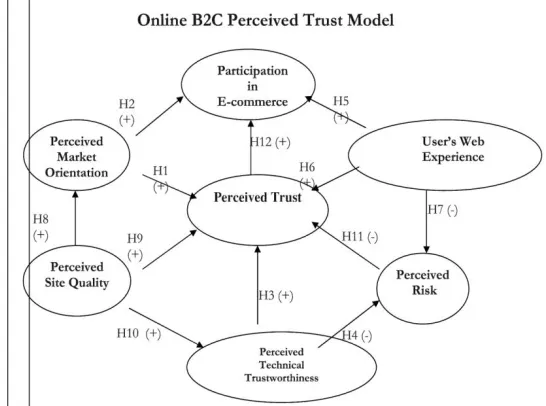
The question is whether commerce is growing to its full potential. Customers’ perception of Electronic-commerce and the risks involved have a significant impact on the transition to electronic business. According to Holt, managing director of WALES [21], virtual only shop selling Welsh goods, consumers’ perceptions of credit card security, vendor trustworthiness and sharing of personal information remain the main obstacles in doing business on the Internet [1]. The article discusses the preliminary findings on Internet and computer users’ attitudes to Electronic-commerce security and their willingness to conduct electronic business transactions. The article, using the findings of the research conducted by Brian J Corbitt, Theerasak Thanasankit, Han Yi conducted in April 2003 suggest that people are more likely to purchase from the web if they perceive a higher degree of trust in e-commerce and have more experience in using the web. Customer’s trust levels are likely to be influenced by the level of perceived market orientation, site quality, technical trustworthiness, and user’s web experience.
IV. RESEARCH METHODOLOGY
To assess the research model in Fig. 1, a self-administered survey approach was used to collect data from Internet users in New Zealand. A survey questionnaire was put up to collect the information via the Internet. The participants were recruited through email invitations, which are embedded with the survey web site URL. The School of Information Management at Victoria University of Wellington in New Zealand hosted the survey web site.
The survey web site was made up of web pages. The actual questionnaire consisted of 74 questions in three sections covering the variables proposed in the model (Fig. 1).
Fig. 1. Research Model with hypothesis indicators.
The questions related to each variable and their operationalisations are provided in detail in Appendix A. A home page served as an information sheet to inform the participants about the survey purpose and questionnaire length. No incentive was offered to induce survey response. As noted by Best et al. in their research on generalisability of Internet surveys, current Internet sampling techniques only permit the generation of diverse, not representative samples. A diversified sample was adopted in this research to mitigate the potential sample bias. Survey invitations were sent out to students at Victoria University of Wellington by email and also used a snow-ball sampling method.
The Web survey method is a natural filter to exclude responses from ineligible respondents, people who do not have access to the Internet. Further, the survey also benefited from automatic data transfer from the web to the database without bothering with data entry and check.
One predominant problem with such a sampling method is that there is no known sample frame and thus the response rate could not be calculated to provide a clue on how representative the sample is of the whole population. Also, since no personal information is collected, non-respondents were not traceable. Given the exploratory nature of this study, such a sampling method suits the research purpose. The web site data collection mechanism identifies the email address of the respondent identifying them as students within the university.
V. DATA ANALYSIS
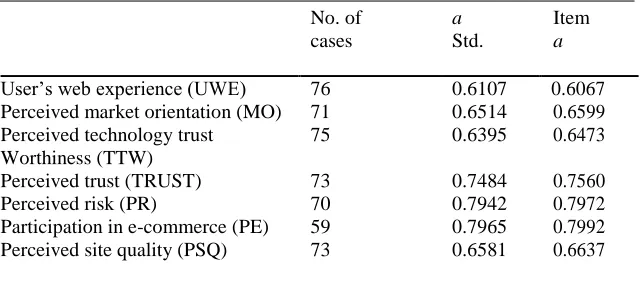
Altogether seven factors were proposed, namely user’s web experience, market orientation, technology trustworthiness, trust, perceived risk, participation in e-commerce and perceived site quality. Given the exploratory nature of the research, 0.6 was chosen as cut point for the reliability test. All seven factors’ a are higher than 0.6. Given the exploratory nature of the research, the scales are considered reliable (see Table 1).
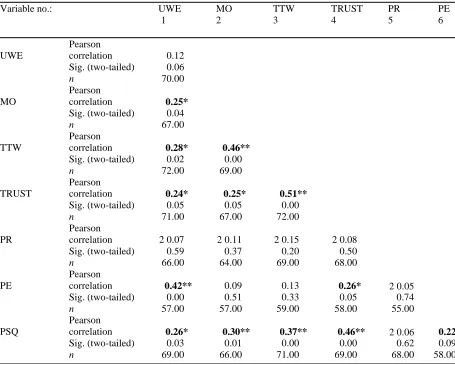
Initially 12 hypotheses have been proposed about trust. Correlation tests were used to find out the relationships among the variables in the model. These are shown in Table 2.
The first hypothesis proposed a positive relation-ship between market orientation and trust. The correlation test did return a significant correlation coefficient of 0.25 ( P # 0.05), suggesting that a higher level of market orientation is actually related to a higher level of trust, therefore H1 is supported by the data.
The second hypothesis proposed that market orientation should be positively associated with e-commerce participation. However, the correlation test did not support this hypothesis by returning a statistically significant test result. Therefore, H2 was not supported. It seems that a higher perceived market orientation is not necessarily linked with customer’s patronage behaviour. While many explanations could explain this result, the one proposed is that due to the early stage of e-commerce development, a majority of customers are still getting used to the idea of shopping on-line. The effect of perceived market orientation on e-commerce may be further complicated by some other reasons, such as trust in e-commerce and perceived risk.
The third hypothesis suggested a positive relation-ship between trust and technical trustworthiness. This hypothesis is strongly supported by a Pearson correlation coefficient 0.51 ( P , 0.01). However, the fourth hypothesis was rejected by a non-significant P value. It can be explained that perceived risk, although partly related to the technology, is also closely related to other aspects like the financial cost, performance of the product and delivery time, which are not so much affected by the technology itself. Therefore a higher level of trust in technology will not necessarily correlate to a reduced level of risk perception.
The fifth, sixth and seventh hypothesis were concerned with the user’s web experience. The fifth hypothesis is supported by the data (B 5 0.42, P , 0.01), indicating that, as predicted, there is a strong positive correlation between user’s web experience and e-commerce participation. The more experienced Internet users tend to purchase more from the Web. Data analysis also indicates that more experienced Internet users tend to have a higher level of trust in e-commerce (B 5 0.24, P , 0.05), therefore H6 is also supported.
H7 was not statistically supported. It appears that although user’s web experience may lead to a higher level of trust, it may not lead to a lower level of perceived risk. This finding suggests that somehow, user’s web experience may not have a great impact on user’s risk perception on e-commerce.
Table 1: Reliability test result of model variables
No. of a Item
cases Std. a
User’s web experience (UWE) 76 0.6107 0.6067
Perceived market orientation (MO) 71 0.6514 0.6599
Perceived technology trust 75 0.6395 0.6473
Worthiness (TTW)
Perceived trust (TRUST) 73 0.7484 0.7560
Perceived risk (PR) 70 0.7942 0.7972
Participation in e-commerce (PE) 59 0.7965 0.7992
Although some users may be more exposed to the positive side more than the negative side of e-commerce, it is highly suspected there is equal chance to see it go the other way around. Therefore the user’s web experience may not make much difference on the user’s perceived risk level.
Perceived site quality is proposed to be positively related to the level of perceived market orientation (H8), trust (H9) and technical trustworthiness (H10). All three hypotheses are strongly supported by the data, suggesting that web site quality is a very important factor, which helps to enhance customer’s favourable attitude to e-commerce web sites in terms of perceived customer orientation (B 5 0.31, P , 0.05), trust (B 5 0.46, P , 0.01) and technical trustworthiness (B 5 0.37, P , 0.01). Therefore, web site quality may actually be very closely related to the marketing purposes and, as expected, have a big impact on marketing objectives.
Finally, H11 proposes that there is a positive relationship between perceived risk and trust. How-ever, this is not supported as the correlation was very low and insignificant. So it virtually contradicts the idea that risk is the natural opposite of trust. What this seems to suggest is that risk and trust are not necessarily linked at least in the context of B2C commerce. Therefore, H11 is not supported H12 proposes that there is a positive relationship between trust and e-commerce. H12 is supported by the data (B 5 0.26, P , 0.05). It can be assumed that a higher level of trust will lead to a higher level of e-commerce participation. Therefore, trust is considered an important factor in e-commerce participation.
Table 2: Correlations between model variables
Variable no.: UWE MO TTW TRUST PR PE
1 2 3 4 5 6
UWE
Pearson
correlation 0.12
Sig. (two-tailed) 0.06
n 70.00
MO
Pearson
correlation 0.25*
Sig. (two-tailed) 0.04
n 67.00
TTW
Pearson
correlation 0.28* 0.46**
Sig. (two-tailed) 0.02 0.00
n 72.00 69.00
TRUST
Pearson
correlation 0.24* 0.25* 0.51**
Sig. (two-tailed) 0.05 0.05 0.00
n 71.00 67.00 72.00
PR
Pearson
correlation 2 0.07 2 0.11 2 0.15 2 0.08
Sig. (two-tailed) 0.59 0.37 0.20 0.50
n 66.00 64.00 69.00 68.00
PE
Pearson
correlation 0.42** 0.09 0.13 0.26* 2 0.05
Sig. (two-tailed) 0.00 0.51 0.33 0.05 0.74
n 57.00 57.00 59.00 58.00 55.00
PSQ
Pearson
correlation 0.26* 0.30** 0.37** 0.46** 2 0.06 0.22
Sig. (two-tailed) 0.03 0.01 0.00 0.00 0.62 0.09
n 69.00 66.00 71.00 69.00 68.00 58.00
Bold letter: correlation significant at 0.01 level.
*Correlation is significant at the 0.05 level (two- tailed). **Correlation is significant at the 0.01 level (two-tailed).
A further examination using linear regression on the predictable factors and dependent variable trust was performed. Marketing orientation, perceived site quality, technical trustworthiness, perceived risk, and user experience are used as predictors of trust. The regression model was statistically significant (df 5 5, F 5 7.943, P , 0.01) and could explain 43% of the variance of trust (R2 5 0.43). Among the five predictors, technical trustworthiness and perceived site quality are found to be strong predictors of trust.
On the other hand, it was predicted that trust, along with user’s web experience and market orientation, is a predictor of participation in e-commerce. The regression model again is supported by the data (the model was significant at 0.01 level). User’s web experience was found to be the strongest predictor of the three with coefficient of 0.441 ( P , 0.01).
However, although trust has a high co-efficient of 0.341, it is not supported by the P value (0.236). Market orientation was found to be of little predict-able value to e-commerce participation. After market orientation was removed from predictor list, it was found R2 increased slightly to 0.218 and predictable power of both user’s web experience and trust increased slightly. Coefficient of user’s web experience increased to 0.46 (P , 0.01) and coefficient of trust increased to 0.37, however it still not statistically supported by the returned P value. Hence it appears that the user’s web experience is the strongest predictor of e-commerce participation in this model.
VI. CONCLUSION
The principle factor as stated earlier is trust. This research grew out of an interest in the perceptions and fears of consumers to use the Internet to conduct Electronic-commerce and their knowledge of the security methods and controls used during online transactions. With the growth in Electronic-commerce and the future forecasting of the increase of online business transactions it is important that Electronic-commerce develop to its full potential. It was expected that consumers are unwilling to divulge their credit card information during an online electronic transaction, generally safety concerns were the main reason.
Familiarity with and confidence in their environment and lifestyle, built up over a long period of time, contribute to the fact that consumers accept the way of purchasing provided by vendors and attach credence to it. Although face-to-face transactions are part of consumers’ everyday living, they do not feel totally confident about it, but because of familiarity with the system, they make use of it. This cyclical process of familiarity which builds up acceptance and credibility, and ultimately trust could be used as a stepping stone to build trust in Electronic– commerce.
The problem of trust and consumers’ perceptions of safety measures should be addressed to convince consumers to use Electronic-commerce. Consumers have to be convinced to trust vendors, and their fear of hackers and safety issues on the Internet will have to be proven wrong over time and with concrete evidence. In practice, the results of this study indicate that the challenge still stands. T
The results of the study as well as other prior research could help to determine and address consumers’ specific needs and concerns about online transactions. Training and development by companies and the implementation of an information security awareness policy are important issues in changing behaviour and perceived perceptions. REFERENCES
[1] S. Ganesan, Determinants of long term orientation in buyer– seller relationships, Journal of Marketing 58 (1994) 1–19.
[2] S.L. Jarvenpaa, N. Tractinsky, M. Vitale, Consumer trust in an internet store, Information Technology and Management 1 (2000) 45–71. [3] P. Dutton, Trust issues in e-commerce (2000). http: // www.sqi.gu.edu.au / wic2000 / docs / Dutton.pdf.
[4] S.J. Tan, Strategies for reducing customer’s risk aversion and internet shopping, Journal of Consumer Marketing 16 (2) (1999) 163–180. [5] P. Rantnasingham, K. Kumar, Trading partner trust in electronic commerce participation, in: Proceedings of the Twenty-first International
Conference on Information Sys-tems, Brisbane, Australia, 2000. [6] Briam J Corbitt, Theerasak Thanasankit, Han Yi
[7] aSchool of Information Systems, Deakin University, 221 Burwood Hwy, Burwood, 3125, Melbourne, Australia bSchool of Information Management, Victoria University of Wellington, P.O. Box 600, Wellington, New Zealand
[8] https://www.semanticscholar.org/paper/Trust-and-e-commerce-a-study-of-consumer-Corbitt-Thanasankit/02b8e4de84e889b378b60983823d117068975ede/pdf