Enhancing the Security of Simplified DES Algorithm Using
Transposition and Shift Rows
Adeem Akhtar1 and Muhammad Zia Ullah Baig2, Waleej haider3
1, 2, 3 MS Computer Science, MAJU, Pakistan
ABSTRACT
Security is playing a very important and crucial role in the field of network communication system and Internet. Simplified Data encryption standard (S-DES) is a private key cryptography system that provides the security in communication system but now days the advancement in the computational power the S-DES seems to be weak against the brute force attacks. To improve the security of S- DES algorithm the transposition and shift row techniques are added before the S-DES algorithm to perform its process. By using an Enhanced S-DES algorithm the security has been improved which is very crucial in the communication and field of Internet. If the transposition and shift row technique are used before the original S-DES algorithm then the intruder required first to break the original S-DES algorithm and then transposition and shift rows techniques. So the security is approximately double as compared to a simple S-DES algorithm.
Keywords: DES Algorithm,Transposition, Shift Rows, S-DES.
1. INTRODUCTION
Encryption is the process of encoding the plaintext into a secret code and decryption is the reverse process of decoding the secret code into plaintext.
There are two types of technique used: asymmetric-key or public-key and symmetric-key or secrete-key. Asymmetric-key uses different keys for encryption and decryption. But Symmetric key uses same key for encryption and decryption.
Asymmetric-key cryptography includes RSA, Digital Signature and Message Digest algorithms and symmetric-key cryptography includes S-DES,DES, AES, 3DES, IDEA, Blowfish algorithms etc [1], [2]
2. SIMPLIFIED DATA ENCRYPTION
STANDARD
S-DES is a block cipher. It encrypts the data in a block of 8 bit. It produces 8 bit cipher text. The key length is 10 bits.
Initially the key is consisting of 10 bits. The algorithm is shown in below figure1 [3].
Fig.1. S-DES Algorithm
S-DES algorithm:
The function fK(L, R) = (L F(R, SK), R) Where XOR is the exclusive-OR operation and key is a sub -key. Computation of f(R, key) is done as follows.
1. Apply expansion/permutation E/P= ] to input 4-bits.
2. Add the 8-bit key (XOR).
3. Pass the left 4-bits through S-Box S0 and the right 4-bits through S-Box S1.
4. Apply permutation P4 = ].
At the end of the algorithm, the inverse permutation is applied; the inverse permutation is done by applying, IP-1 where we have IP-IP-1(IP(X)) =X.
3. THE TRANSPOSITION TECHNIQUE
The transposition technique does not replace the one alphabet with another like the substitution technique but perform the permutation on the plain text to convert it into cipher text. The various transposition techniques are used to perform the operation given below[4],[1],[2]:
A. Rail Fence Technique
B. Simple Columnar Transposition Technique C. Vernam Cipher (One-Time Pad)
D. Book Cipher/Running Key Cipher
1. Rail Fence Technique
The Rail Fence Technique is simplest transposition technique. This technique involves writing plain text as a sequence of diagnosis and reading it row-by-row to produce the cipher text. An example is shown below in fig.2. In this figure the plain text is HELLO and the cipher text is HLOEL.
H L O
E L
Fig. 2. Rail Fence Technique
2. Simple Columnar Transposition Technique
The Simple Columnar Transposition Technique is the variation of the Rail Fence Technique. This technique simply arranges the plain text as a sequence of rows of the rectangle that are read in column randomly. Example of this technique is shown in the fig. 3. The plain text is COME HOME TOMORROW and the cipher text is OMOETRHOOMERCOMW if we choose the column order 2, 4, 5, 3,1. The Simple Columnar Transposition Technique is also used multiple rounds to provide a tight security. Cipher text produced by using
Simple Columnar Transposition Technique with multiple rounds is much more complex to crack as compare to the basic technique.
3. Vernam Cipher (One-Time Pad)
The Vernam Cipher, also called one-time pad, is also implemented using a random set of non repeating characters as the input cipher text. The Vernam Cipher is used one-time pad, which is discarded after a single use, and therefore suitable only for short messages. Example of Vernam Cipher is shown in fig. 4. The plain text is HELLO is converted into UGMEN cipher text by applying one-time pad NCBTZ. The Vernam Cipher was first implemented at AT&T with the help of the device called Vernam machine.
4. Book Cipher/Running Key Cipher
Vernam Cipher. For producing the cipher text, some portion of text from a book is used, which serve the purpose of the one time pad.
4. SHIFT ROWS STAGE
This stage (known as ShiftRows) is shown in figure 5. This is a simple permutation
an nothing more. It works as follow:
•
The first row of state is not altered.•
The second row is shifted with „1‟ bytes to the left in a circular manner.•
The third row is shifted 2 bytes to the left in a circular manner.For decryption process, Inverse Shift row is used. It works as follows:
•
The first row of state is not altered.•
The second row is shifted 2 bytes to the left in a circular manner.•
The third row is shifted with „1‟ bytes to the left in a circular manner.Fig. 5. Shift Rows stage.
5. DESIGN CONCEPT
In present days, the parallel processor and advanced computer machines are discovered which can perform the computation and calculation at very high speed. The S-DES is a very powerful algorithm but these machines may be broken DES security. In order to deliver S-DES algorithm; there must be a most control security mechanism of transposition cryptographic technique is added on it.. The S-DES algorithm has 8-bit key which is not so powerful against the Brute force attack. To improve the key strength the S-DES transposition technique and shift row stage cryptography is powerful scheme and can be implemented before to precede the S-DES algorithm.
6. THE PROPOSED WORK
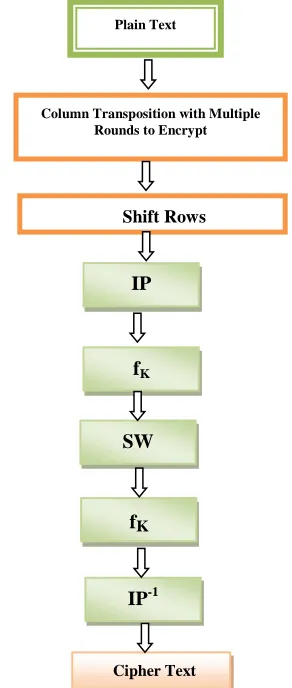
The proposed structure has first to process the Simple Columnar Transposition Technique with Multiple Rounds (SCTTMR) and then the output comes from SCTTMR will gain undergone Shift Rows Stage. The plain text message is first converted into the cipher text by using Simple Columnar Transposition Technique and Shift Row Stage technique .The various rounds of SCTTMR may depend upon the security to provide the message. If the more security is needed then added more rounds of the SCTTMR scheme and if the normal security then uses minimum 1 or 2 rounds. The input to the SCTTMR and Shift Rows is a plain text message and the output is ciphered text message. To apply this scheme we required the matrix or table to perform the encryption process and column number which provide the security key.
The output from Shift row is then converted into a bit form because the S-DES algorithm applies its process on bit level as usual. Then the S-DES has performed its work same as original S-DES. The Enhanced S-DES algorithm encryption scheme is shown in fig. 6.The Enhanced S-DES algorithm decryption scheme is shown in fig. 7
Plain Text
Column Transposition with Multiple Rounds to Encrypt
IP
fK
SW
fK
IP-1
Cipher Text Shift Rows
Fig. 7. Decryption with Enhanced S-DES
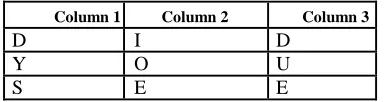
To test the Enhanced DES algorithm, we have to take the input plain text “DID YOU SEE” and then apply the Enhanced DES algorithm. The Simple Columnar Transposition scheme is implemented first, to encrypt the plain text which is shown in fig.8.
Fig. 8. Simple Columnar Transposition Technique 1st round to encrypt
Fig. 9. Simple Columnar Transposition Technique 2nd round to encrypt
The random column number is 2, 3, 1 is taken in the 1st round and the output of the 1st round is ciphered text “IOEDUEDYS”. Now apply the round 2nd which have been taken the output of 1st round as an input and used the same random number to produce the cipher text which is as “OUYEESIDD”. The produced cipher text is then again taken in to row shift as shown in fig 10
Fig. 10. Shift Row Stage
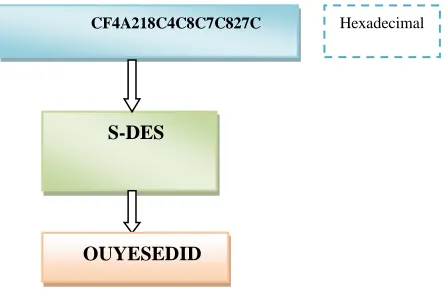
The input text for S-DES is “OUYESEDID” and produced the final cipher text in Hexadecimal
(CF4A218C4C8C7C827C), using the key (0010010111).The
process is shown in Fig. 11.
Fig. 11. Encryption with Enhanced DES
Now the opposite to the encryption process, we have performed the decryption process. We take the output cipher text from S-DES (CF4A218C4C8C7C827C), key (0010010111) and apply the decryption process as normally using S-DES. The complete process of decryption is shown in fig.12.
Column 1 Column 2 Column 3
D I D
Y O U
S E E
Plain Text
Column Transposition with Multiple Rounds to Encrypt
IP-1
fK
SW
fK
IP
Cipher Text
Inverse Shift Rows
Column 1 Column 2 Column 3
O U Y
E S E
D I D
S-DES OUYESEDID
Fig. 12. Decryption with Enhanced S-DES
The decrypted output of the S-DES algorithm is taken and the Simple Columnar Transposition Decryption Technique is applied to get the plain text .The complete decryption is shown in fig 13, fig.14 and fig.15.
Column 1 Column 2 Column 3
O U Y
E E S
I D D
Fig. 13. Inverse Row Shift technique
Fig. 14. Simple Columnar Transposition Technique 2nd round to
decrypt
Fig. 15. Simple Columnar Transposition Technique 2nd round to
decrypt
The final output from the Simple Columnar Transposition Technique is the plain text DID YOU SEE.
7. CONCLUSIONS
In today‟s time, the security is playing a very significant and influential role in the field of networking, Internet and various communication system .The electronic
communication system is used in banking, reservation system and marketing which required a very tight security system. The original S-DES implementation has some flaws, to overcome the most of flaw the Enhanced S-DES algorithm is designed. The Designed system improved the security power of original S-DES. The only weakness of Enhanced S-DES is additional computation is required but nowadays, computer have parallel and high speed computation power so the drawback of the Enhanced S-DES algorithm is neglected because our main aim is to enhance the security of a system. By using the Enhanced S-DES algorithm the security is very constricted and nearly impossible to crack and break the Enhanced S-DES algorithm.
ACKNOWLEDGMENT
We would like to articulate our deep gratitude to Assistant Professor. Waleej Haider who has always been our motivation for carrying out the research paper work.
REFERENCES
[1] William Stallings, " Cryptography and Network Security Principles and Practices", Prentice Hall, November 16, 2005.
[2] Atul Kahte, "Cryptography and Network Security",Tata Mcgraw Hill, 2007.
[3] Lavkush Sharma , Bhupendra Kumar Pathak & Ramgopal Sharma Breaking of Simplified Data Encryption Standard Using Genetic Algorithm. [4] Shah Kruti R., Bhavika Gambhava,"New Approach of
Data Encryption Standard Algorithm", International Journal of Soft Computing and Engineering (IJSCE), ISSN: 2231-2307, Volume-2, Issue-1, March 2012.
Column 1 Column 2 Column 3
D I D
Y O U
S E E
CF4A218C4C8C7C827C Hexadecimal
S-DES