752 | 2018 | ISSUE 4 | VOLUME 13 © 2018 University of Alicante
The effect of spatial working memory capacity on
ball flight perception
NICHOLAS J. KELLING1 , GREGORY M. CORSO2
1University of Houston-Clear Lake, United States of America 2Morehead State University, United States of America
ABSTRACT
Batting in baseball or softball represents a physically and perceptually challenging task. Changes in flight of a high-speed pitched ball require quick and accurate predictions of future location. To be successful, an individual must be able to rapidly gather and process visual information, suggesting an emphasis on spatial working memory. The current experiment assessed if individuals of variant expertise levels (novices and varsity softball players) differed in ability to determine future locations of a pitched ball based on different pitch types and durations. Data suggest an impressive base capability for visual motion prediction including a time appropriate ability to predict motion timing. Additionally, while not central to this capability, data suggest a relevance for spatial working memory in predicting speed. These results demonstrate a need to further investigate a base ability in motion prediction as well as the impact of working memory in high performance skills. Keywords: Motion perception; Visual perception; Ball flight; Working memory.
1Corresponding author. University of Houston-Clear Lake, United States of America.http://orcid.org/0000-0002-1802-7418
E-mail: [email protected]
Submitted for publication March 2018 Accepted for publication May 2018 Published in press July 2018
JOURNAL OF HUMAN SPORT & EXERCISE ISSN 1988-5202 © Faculty of Education. University of Alicante
doi:10.14198/jhse.2018.134.04
Cite this article as:
Kelling, N.J., & Corso, G.M. (2018). The effect of spatial working memory capacity on ball flight perception.
VOLUME 13 | ISSUE 4 | 2018 | 753 INTRODUCTION
Working memory has been shown to be critical in many tasks. Whether it be mentally solving a math equation
or a chef’s ability to prevent adding the same ingredient twice in a recipe (Cowan, 2008), working memory is
the ability to use cognitive resources to plan and to enact actions (for a comprehensive overview see Furley and Memmert, 2010). Integrated into this ability is attention (Awh and Jonides, 2001; Engle, 2002) and spatial processing via the visuospatial sketchpad (Miyake, Friedman, Rettinger, Shah and Hegarty, 2002; Baddeley, 2002). Attention is critical in highlighting significant cues in the environment along with reducing the impact of irrelevant ones (de Fockert, Rees, Frith, and Lavie, 2001). While, the visuospatial sketchpad represents a potential pathway to process the complex dynamics of the physical environment. Considering the incredible speed with which many decisions and actions are made in some high-performance skills, the impact of working memory should be evident in both attentional and processing capacities. However, research
examining the direct impact of working memory’s on high performance skills is lacking (Furley and Wood, 2016).
Working memory as an explanation for expertise differences
Expertise differences are prevalent in the literature; for example, visual tracking (Uchida, et al., 2013), manual timing in response to a moving target (Nakamoto and Mori, 2012), decision making sensitivity in strike zone judgments (Gray, 2010), visual anticipation (Chen, Lee, Ly, Huang, and Yen, 2016; Muller, Fadde, and Harbaugh, 2016), and head/eye movement, (Bahill and Laritz, 1984, Fogt and Zimmerman, 2014). However, identifying that differences exist, does not fully explain expertise. Identifying the fundamental structure of expertise could be benefited by integrating the effect of working memory.
Individual differences in working memory related to physical performance may help elucidate the fundamental structure of expertise (Furley and Wood, 2016). Proceduralized skills, such as batting or pitching, can be very resistant to working memory capacity reductions or reduction of resources based on automaticity. For example, in a putting task, attentional demands have been found to be limited simply to the ball rather than the environment (Beilock, Jellison, Rydell, McConnell, and Carr 2006). Such skills are not resistant to all forms of distraction, such as utilizing explicit attention to highlight the automatic processes used (Beilock, et. al., 2006). While these highly practiced skills rely heavily on automated processes, deviations in attentional processes can result in direct performance reductions, especially when attentional demands are not clearly defined in the environment. However, it is unclear whether automation itself provides this resistance or whether repeated practice allows individuals to maximize their working memory capacity by reducing irrelevant cues. When tested in training environments, individuals with higher working memory capacity have demonstrated higher efficiency in orienting attention than individuals with a lower capacity (Blacker, Curby, Klobusicky, and Chein, 2014).
754 | 2018 | ISSUE 4 | VOLUME 13 © 2018 University of Alicante Working memory in sports
Considering the high visual nature of many sports, visuo-spatial working memory provides the most potential for finding expertise differences. In sports, interest in visual working memory (VWM) has included the impact of concussions on working memory (Theriault, De Beaumont, Tremblay, Lassonde, and Jolicoeur, 2011), activity level and working memory capacity increases (Lambourne, 2006), and memorization of spatial location patterns (Chase and Erikson, 1982). Attentional benefits and performance improvements based on VWM differences can be found in physically active situations, such as basketball and hockey (Furley and Memmert, 2012), shooting sports (Wood, Vine, and Wilson, 2016), and action focused video games which harbour complex visual environments and physical actions (Blacker, et al, 2014).
These examples illustrate the wide impact of visual working memory. While classic visual working memory relates to our ability to maintain perceptions of objects in our environment (Luck and Vogel, 1997), the more modern visuo-spatial working memory concept represents a more complex cognitive architecture with separable components (Logie, 2014). Each individual component would then relate to specific effects and capacities. For example, spatial working memory (SWM) would be responsible for maintaining objects’
motion information for processing, separate from object classification.
This spatial working memory capacity may have the most interest in batting related sports, given that attention is normally well focused, and classification is not as critical as location, when hitting a ball. Thus, making batting an ideal task for investigating potential SWM effects. The speed at which the ball is pitched in a batting situation is remarkably high. In the case of a softball pitch, the ball, traveling 29 m/s, can reach home plate within 500 ms. When removing the time required to swing the bat, a sizable amount of spatial processing must occur within a very small time window. Even with this time restriction, expert players in softball/baseball have been shown to require very little time to activate the movements required (Regan, 1997; Gray, 2002) and they can accurately initiate those movements within a small timing window of 70 ms window or less (Gray, 2002). Higher spatial working memory capacities may allow for more rapid processing of motion information, creating a significant advantage for those in a batting task.
Prediction of ball flight
With these timing limitations, the significant challenge for SWM may be predicting the location of the ball near the time of impact with the bat. Predicting the future location, especially of a fast moving object such as a baseball, represents the amalgamation of many different pieces of information. In particular, both cognitive and perceptual components must be integrated for a single solution. Velocities along X, Y, and Z axes, rotation about these axes, and even information external to the physical characteristics, such as the pitchers motion (Van Der Kamp, Rivas, Van Doorn, ad Savelsbergh, 2008; Chen, et al., 2016; Muller, Fadde, and Harbaugh, 2016) and situational cues (Paull and Glenncross, 1997), may all be relevant in predicting the
ball’s future location. All of this information must be processed simultaneously and because of that working memory may be overtaxed.
Hypotheses
VOLUME 13 | ISSUE 4 | 2018 | 755 MATERIALS AND METHODS
Participants
Two groups of individuals participated in this study. One group consisted of nine collegiate Division I varsity softball players at the Georgia Institute of Technology. These participants were considered highly skilled for the purpose of this experiment. Additionally, these individuals were designated as experts for this comparison based on the high competition level while being ranked in the top 15 nationally for the season. The novice group consisted of nine undergraduate participants who had no varsity athletics experience in any sport (high school or college) and served as a control group for this investigation. Participants were required to have normal or corrected to normal visual acuity, confirmed using a Snellen Eye Chart. The novice group was provided the option to earn extra credit in psychology classes while the expert group had the choice between extra credit or $20.00 for participation. The difference in compensation scheme was based on recruiting a limited pool of the potential athlete participants. All athlete payments complied with National Collegiate Athletic Association (NCAA) regulations verified by the Georgia Tech NCAA compliance office and all participants were treated in accordance to the procedures and guidelines established by the Georgia Tech Institutional Review Board.
Measures
Stimuli Creation
Softballs were “thrown” using an automated pitching machine (Triple Play Ultra, Sports Tutor) utilizing three of the machine’s possible right-handed pitch types. The pitches included fastball (straight pitch with little to no movement), slider (pitch with small downward movement with a larger horizontal movement), and curveball (pitch with large downward movement accompanied by smaller horizontal movement). Within pitch type, additional trajectory deviations were made using an aiming control system on the computer controlled pitching machine. All pitches were thrown with an initial velocity of 104.6 kph (65 mph) to maximize the potential difficulty of the task, but maintain a realistic speed range.
Video collection was aimed at creating photo realistic recreations of machine pitched softballs with high frame rates for smooth visual motion. Videos were recorded using a Casio EX-F1 digital camera placed just behind home plate of an indoor softball-batting cage. This camera was able to create high-resolution images (2816
x 2112 pixels) at sixty frames per second. A wooden shield with a replaceable 12.7 mm (0.5 in) Lexan©
window was placed directly in front of the lens to protect the camera. Lens height was placed at the center of the strike zone area. Anytime a softball struck the Lexan© window, it was replaced to prevent any visual markings from damage appearing on images. Location of the pitched softball was determined using a clay impact structure located on the vertical wooden shield. Stimulus videos were created by combining single frames into videos at a rate of 60 frames per second. However, because of projection display limitations, video resolution was reduced to 960 x 720 pixels to maintain the higher frame rate. An additional visual frame-by-frame inspection was performed to ensure that visual abnormalities were not introduced by the reduction in resolution and to confirm that no new visual characteristics were evident on images of the softballs.
Stimuli Video Types
756 | 2018 | ISSUE 4 | VOLUME 13 © 2018 University of Alicante
a height by width area of 64.77 cm by 44.45 cm. Four videos for each combination of pitch type, length of presentation, and final location (inside or outside zone) were created. Each recorded pitch had a unique plate crossing location, therefore creating a unique motion track with half of the presented stimuli representing strikes. Overall, 72 unique videos were used.
Procedures
Because of the obvious psychomotor advantages the athletes possessed over the novices, performance in these tasks were limited to simple actions. This procedure allowed the focus of the task to be on the perception of the information rather than an assessment of physical capability. After the written informed
consent process, participant’s spatial working memory was assessed through an automated symmetry span
task utilized by Heitz and Engle (2007). In this task, participants are required to determine if checkerboard images are symmetrical along a vertical axis while also maintain the spatial locations of displayed rectangles.
An overhead projection display system was used to present the videos of the pitched balls. To aid all participants, a strike zone was drawn at a central location on the projection screen at a height of 67.5 cm. The projected image was scaled to a 1:1 ratio of visual angles resulting in a full-sized image.
The participant was placed in a seated office chair 182.88 cm (6 ft) directly in front of the projection screen described as the plane of home plate. The seating position was similar to that experienced by a baseball umpire. . Participants were instructed to respond on a standard QWERTY keyboard that had all letter keys removed except for two keys. One key was used to respond to pitches that would have crossed home plate within the depicted area (strike). The second key was used to respond to all pitches that would have crossed outside of the depicted area (ball). Keyboard responses were selected to minimize the motor advantage of the experts.
Stimulus presentations were handled using the Inquisit software suite (2008). Three experimental pitch type blocks were utilized; slider only, fastball only, and combination consisting of slider, fastball, and curveball. The order of the first two experimental blocks, slider only or fastball only was randomized with 24 different videos for each pitch type based on presentation length and final location. Each video was randomly presented twice within each experimental pitch type block resulting in 48 videos. The selected pitch type block was repeated until a consistent level of accuracy was reached; accuracy performance within five correct strike/ball determinations (approximately 10%) over four experimental blocks. Once this level of consistency was reached, the same procedure was repeated with the other pitch type. When both pitch types (slider only and fastball only) were complete, the final block, consisting of a combination of slider, fastball, and curveball stimuli, was presented using the same randomized video presentation procedure. The curveball stimuli were not included in an individual block because of the nature of the pitch. When the pitch exited the machine, a large majority of pitches exiting toward the left resulted in pitches inside the target area. The inverse was true for a large majority of pitches exiting right. Consequently, the curveball was limited to the combination block only, where the mixed, random pitch presentation would make the use of initial direction unreliable for prediction. Latency, recorded from the end of the stimulus presentation until a response was made, and accuracy were recorded. Accuracy feedback was provided after each experimental block. These data allowed
for calculation of two other signal detection variables, C and A’.C and A’ were utilized rather than the standard β and d’ because of a concern regarding the normality of the data. As data was collected once a consistent
level of performance was reached and presentation time was a manipulated factor, C and A’ allowed for a
more independent measure of response bias (Stanislaw and Todorov, 1999). These measures were
VOLUME 13 | ISSUE 4 | 2018 | 757
• An in-target (strike) stimulus combined with an in-target response was recorded as a hit.
• An out-target (ball) presentation with an in-target response was a false alarm.
Only the data from the consistent accuracy level (accuracy performance within 5 correct answers over four trial blocks) were used in the analysis to minimize any learning-based biases due to unfamiliarity with the task. .No notice was given when the pitch type was changed.
Analysis
A 2 (expert or novice) x 2 (single or combination pitch type presentation) x 3 (length of presentation) mixed design was used with expertise as the between participant comparison and symmetry span as a covariate. Only performance on fastball and slider stimuli were used in the analysis as no comparable analysis of in-combination versus single pitch type could be assessed for the curveball stimulus trials because the presentation was limited to in-combination only. However, the inclusion of curveball in the combination presentation did serve to increase the complexity of the visual environment as suggested by Higuchi, Nagami,
Nakata, Watanabe, Isaka, and Kanosue, 2016). C and A’ were analysed using separate repeated measure
ANOVAs. Significant effects were further examined with Bonferroni corrected t-tests.
A secondary analysis was also completed correlating official softball performance statistics with performance in the motion prediction task and symmetry span. Two measures of batting performance were used; batting average and gross production average (GPAv). Gross production average, combination of on base percentage and slugging percentage, is considered by some to be a more accurate assessment of offensive performance beyond batting averages (Schwarz, 2007). Seven of the nine softball participants were included in this secondary analysis. Two players had less than 20 at-bats the following season and were removed from the secondary analysis for lack of data.
RESULTS
Latency
A main effect was found; presentation length recorded from the end of presentation, F(2, 30) = 10.471, p <
.01, ηp2 = .411). Further Bonferroni corrected paired t-tests determined that all three pitch durations resulted in significant mean latency differences. The 367 ms pitch duration resulted in the shortest latency followed by an increase in latency (M = 130.21 ms, SD = 38.28) for the 250ms pitch duration, t(17) = 14.43, p < .01
(two tailed). A further increase in latencies is evident from the 250 ms to the 117 ms pitch duration (M =
162.51 ms, SD = 45.2), t(17) = 15.18, p < .01 (two tailed). The total deviation from the 117 ms duration to the 367 ms duration was 292.72 ms with a standard deviation of 60.38, t(17) = 20.57, p < .01 (two tailed). No general effect of expertise was found, F(1, 15) = 1.41, p= .25, ηp2 = .086, or one for symmetry span, F(1, 15) = 0.60, p= .45, ηp2 = .039. Latency times beginning at stimulus onset and post stimulus can be seen in Figure 1.
Percent Correct
Overall, accuracy was relatively high for all participants (Figure 2). In the accuracy analysis, a single main effect was found for single vs. combination presentation, F(1, 15) = 6.00, p = .027, ηp2 = .286. There were two significant two-way interactions: Single vs. combination presentation x expertise, F(1, 15) = 5.80, p =
758 | 2018 | ISSUE 4 | VOLUME 13 © 2018 University of Alicante
VOLUME 13 | ISSUE 4 | 2018 | 759
A’ and C
A’ resulted in a significant difference between single vs. combination presentations, F(1, 15) = 5.29, p = .036,
ηp2 = .261. Additionally, the interaction between single vs. combination presentations and symmetry span
was found to be significant, F(1, 15) = 6.87, p = .019, ηp2 = .314. Post hoc analyses on presentation type did not divulge significant results when corrected for family-wise error, a limit of the statistical power of the study. However, examination of the interaction of symmetry span and presentation types shows a slightly negative slope for combination presentations compared to a flat slope for single presentation. General effects of expertise and symmetry span were not found, F(1, 15) = 2.20, p= .159, ηp2 = .128 and F(1, 15) = 1.31, p = .27, ηp2 = .081 respectively. No statistically significant effects were found for the criterion measure C.
Secondary Analysis
Pearson correlation matrix was calculated involving measures of latency, accuracy, A’ and C along with
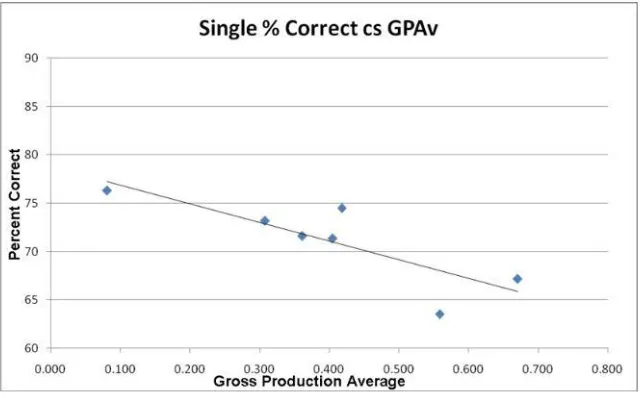
additional measures of batting average (BA) and gross production average (GPA). Significant negative correlations were found for GPA and single pitch presentation, r(7) = -.76, p = .047, BA and single pitch presentation, r(7) = -.82, p= .023, and BA and single pitch A’, r(7) = -.80, p = .032.
Negative correlations evident in the secondary analysis present an interesting picture of the task and resources involved. The correlation between gross production average (GPAv), along with batting average, and percent correct in single presentation blocks suggests better hitters had greater difficulty when presented with the same pitch type repeatedly, see Figure 3. This finding raises the possibility that good hitters may be utilizing more information about previous pitches in their prediction of a current pitch.
Statistical Limitations
760 | 2018 | ISSUE 4 | VOLUME 13 © 2018 University of Alicante
schemes. The extreme group design utilized in this work is designed specifically to investigate the potential for differences rather than provide a quantitative estimate of potential effects. While the statements made when utilizing extreme group approaches are limited and must be done carefully, there still exists a statistical advantage for exploratory designs (Preacher, Rucker, MacCallum, and Nicewander, 2005).
Additionally, because the main concern in a small sample size is the representativeness of the sample, it is worth noting that in this design, measures within a participant utilized mean values across multiple presentations. This approach should result in more stability than a single measurement. The second concern would be a falsely represented sample. However, as the patterns demonstrated in the data are consistent with a relatively small error, it is not evident that a few individuals in the sample are significantly modifying the results.
DISCUSSION
VOLUME 13 | ISSUE 4 | 2018 | 761
pitch recognition assessment, improvements in performance were not found while training for depth perception, eye flexibility, visual recognition, and visual tracking (Szymanski, et al., 2011).
An alternative explanation to the equivalent performance may be the camera angle used in the stimuli presentation. The decision to move the viewing angle from a batter position to an umpire-like position was used to remove a possible advantage for the experts because this would be an abnormal request for novices with little to no experience in batting. This change may have disadvantaged experts due to a shift from the normal task. However, both groups demonstrated relatively high performance. This result does demonstrate a rather robust and surprising base capability of predicting a future location.
However, experts exhibited poorer performance than novices (as shown by A’ and accuracy) in presentations
involving multiple pitch types over a single type. This finding is interesting considering that pitch presentations during a game would be combined. One would predict that experts would demonstrate superior performance relative to novices, especially in a combined presentation, as repeated exposure would promote a learned scheme. Even though moving the viewpoint to that of the umpire might have altered the visual processing of the experts, this cause is unlikely. The X, Y, and Z motion components would not differ significantly between the two viewpoints until the ball was well into flight. While it is also possible that denying the experts their natural swinging action may have resulted in diminished performance, previous research has found more accurate predictions of pitch type with uncoupled, non-swinging responses (Ranganathan and Carlton, 2007). When considering the relatively high performance found throughout the experiment, such general performance seems not to be limited directly to expertise but a base capacity that expertise builds upon.
A second concern regarding the experimental environment is the limited resolution of the stimuli presentations. Gray and Regan (2006) suggested gradients caused by the rotation of the seams in travel might be a valuable aid to the experts in providing additional needed information. A frame-by-frame colour analysis was performed on all stimulus videos to identify any natural gradient patterns. RGB characteristics were identified for the center, center top, and center right locations on each frame. No such gradient patterns were found in the stimulus videos. While this may be of some concern, it is worth noting that performance overall on the task was fairly high. Additionally, any ball rotation would be most useful for determining curveballs, which were presented but not utilized in the analysis.
The significant findings of length of presentation from the main analysis suggest an attempt by the participants to maximize accuracy. The decrease in latency coupled with no significant time related effects in percent
correct (Figure 1), C, or a’ show that the visual system can accurately pursue the problem with limited information. The lack of findings for C suggests that no criterion shift was evident based on expertise. The decrease in latency implies that additional time may be required to complete the process if limited information is provided. Such a fact would suggest that an optimal time might exist for motion prediction to provide the optimal reaction while gathering the maximum visual information. Such information could be critical for training of athletes, as an optimal time to perform a batting task should maximize the trade-off between percent of ball flight and decision-making.
As latency did not vary by expertise, it is reasonable to assume that the differences found in decision time, as suggested by Paul and Glencross (1997), is reliant on processing strategic information. Paul and Glencross (1997) found small improvements in accuracy after 80 ms of ball flight. While no such accuracy
differences were found in this study, the likely cause of Paul and Glencross’ result may be the processing of
762 | 2018 | ISSUE 4 | VOLUME 13 © 2018 University of Alicante experts’ ability to utilize early information of an action is critical for optimal performance (Van Der Kamp, et al, 2008). It is possible within the experiment that the information that would have been utilized by the expert players was missing. Because the task did not highlight the reaction and timing of the motor function for the bat swing, the situational cues or the pitcher cues that provide an edge to the experienced batters may not have been activated resulting in a null effect for expertise.
Finally, spatial working memory (SWM) did demonstrate an intriguing result. Within both A’ and accuracy, a
relationship was evident between symmetry span and single versus combination presentation. While the statistical power of the study limited further investigation of this result, the data trend toward higher spans suffering in combination presentations. This finding could result from an attempt by those with higher spans to integrate more complexity into the decisions. Specifically, it is possible that higher SWM individuals were attempting to predict pitch patterns in the combination presentation. As the individuals were informed of the type of pitch and it remained consistent in the single presentation, there was no need to try to determine a pitch type pattern. Although the effect of the additional SWM capacity was negative in this study, the decrement may be artificial, and in real game situations the capacity to actively predict upcoming pitch types and alter ball flight patterns may be significantly advantageous. More data involving in-situ performance would be necessary to expand on this issue.
Additionally, it is possible that slight latency advantages may occur within SWM as seen in the secondary correlational analysis. When specifically limited only to the athlete data, higher spans seemed to demonstrate shorter latencies. Further supporting the idea that higher SWM span individuals are more able to accept and process additional information beyond ball flight when making future location predictions. If SWM is flexible and adaptable over time, it is possible that the extensive training athletes endure would ensure advantageous changes in SWM, creating differences across expertise levels.
The negative correlation found in the secondary analysis, Figure 3, supports the underlying effect. As it is unlikely that a pitcher in a game would constantly throw the same pitch type only altering location, the ability to integrate additional probabilities about pitch types based on the situation may increase batting capability. Inversely, when presented with a scenario where the pitcher does the unlikely and throws the same pitch repeatedly, varying only in location, good hitters may be utilizing the same situational probability schemes reinforced in training causing decreases in accuracy for this experiment.
The most surprising result may be the timing of the participant’s responses. If adjusted to begin the response clock at the start of the pitch, response time would be nearly identical for any length of presentation (Figure 1). This result suggests that the perceptual system is used to mentally predict the path in time with the visual presentation. The latency of the response is the time it takes the visual system to imagine the path the ball will travel, the longer the prediction, corresponding to shorter pitch presentations, the longer the amount of time that is required to respond. A greater SWM span possibly results in increasing the rate at which the mental projection occurs. This increase in mental speed results in faster latencies. This speed would be highly advantageous to a batter as the increase in response time to predict the location would allow for more time for batting swing corrections. Such a conclusion suggests that symmetry span should demonstrate a correlation with batting performance measures, such as batting average, but this relation was not evident in
the data. However, these performance measures are an aggregation of much more than an individual’s
VOLUME 13 | ISSUE 4 | 2018 | 763 CONCLUSION
These findings suggest a possible change to current training techniques. As both novices and experts could determine general ball location equally well, it may be warranted to assume that such a capability is a characteristic of the human visual system. As such, attempting to train this capability directly or indirectly may
be unhelpful supporting Szmanski’s, et al (2011) finding of lack of training ability on pitch recognition. Instead, training of timing and situational factors may yield better results as demonstrated by expertise effects when preflight information is included. However, it seems evident that some component of ball flight perception is tied to SWM. Nevertheless, additional work is required to expand on the nuances of this connection to actual batting performance. The most surprising result of this work is the relatively high performance of all participants coupled with a seemingly time appropriate pitch extrapolation. These data would suggest a high base ability for motion prediction that expertise builds upon rather than developed during training.
While these findings may seem to push back against temporal only interpretations of spatial performance and working memory such as Kyllonen and Chaiken, 2003 in favor of a more complex cognitive motion extrapolation (as detailed by DeLucia and Liddell, 1998), nuances even in this exploratory work demonstrate impressive temporal capabilities. Further work regarding the interaction between SWM and motion prediction certainly seems warranted.
REFERENCES
Awh, E., & Jonides, J. (2001). Overlapping mechanisms of attention and spatial working memory. Trends
in cognitive sciences, 5(3), 119-126. https://doi.org/10.1016/S1364-6613(00)01593-X
Baddeley, A. D. (2002). Is working memory still working?. European psychologist, 7(2), 85.
https://doi.org/10.1027//1016-9040.7.2.85
Bahill, A. T., & LaRitz, T. (1984). Why can't batters keep their eyes on the ball? American Scientist, 72, 249-253.
Beilock, S. L., Jellison, W. A., Rydell, R. J., McConnell, A. R., & Carr, T. H. (2006). On the causal mechanisms of stereotype threat: Can skills that don't rely heavily on working memory still be
threatened?. Personality and Social Psychology Bulletin, 32(8), 1059-1071.
https://doi.org/10.1177/0146167206288489
Blacker, K. J., Curby, K. M., Klobusicky, E., & Chein, J. M. (2014). Effects of action video game training on visual working memory.
Causer, J., Smeeton, N. J., & Williams, A. M. (2017). Expertise differences in anticipatory judgements
during a temporally and spatially occluded task. PloS one, 12(2).
https://doi.org/10.1371/journal.pone.0171330
Chen, Y. H., Lee, P. H., Lu, Y. W., Huang, S. K., & Yen, N. S. (2016). Contributions of Perceptual and Motor Experience of an Observed Action to Anticipating Its Result.
Cowan, N. (2008). What are the differences between long-term, short-term, and working memory?.
Progress in brain research, 169, 323-338. https://doi.org/10.1016/S0079-6123(07)00020-9
de Fockert, J. W., Rees, G., Frith, C. D., & Lavie, N. (2001). The role of working memory in visual selective
attention. Science, 291(5509), 1803-1806. https://doi.org/10.1126/science.1056496
DeLucia, P. R., & Liddell, G. W. (1998). Cognitive motion extrapolation and cognitive clocking in prediction motion tasks. Journal of Experimental Psychology: Human Perception and Performance,
24(3), 901. https://doi.org/10.1037/0096-1523.24.3.901
Engle, R. W. (2002). Working memory capacity as executive attention. Current directions in psychological
764 | 2018 | ISSUE 4 | VOLUME 13 © 2018 University of Alicante
Faul, F., Erdfelder, E., Buchner, A., & Lang, A.-G. (2009). Statistical power analyses using G*Power 3.1: Tests for correlation and regression analyses. Behavior Research Methods, 41, 1149-1160.
https://doi.org/10.3758/BRM.41.4.1149
Furley, P. A., & Memmert, D. (2010). The role of working memory in sport. International Review of Sport
and Exercise Psychology, 3(2), 171-194. https://doi.org/10.1080/1750984X.2010.526238
Furley, P., & Wood, G. (2016). Working Memory, Attentional Control, and Expertise in Sports: A Review of Current Literature and Directions for Future Research. Journal of Applied Research in Memory
and Cognition, 5(4), 415-425. https://doi.org/10.1016/j.jarmac.2016.05.001
Gray, R. (2002). Behavior of college baseball players in a virtual batting task. Journal of Experimental
Psychology: Human Perception and Performance, 28, 1131-1148.
https://doi.org/10.1037/0096-1523.28.5.1131
Gray, R. (2010). Expert baseball batters have greater sensitivity in making swing decisions. Research
Quarterly for Exercise and Sport, 81, 373-378. https://doi.org/10.1080/02701367.2010.10599685
Gray, R., & Regan, D. M. (2006). Unconfounding the direction of motion in depth, time to passage, and rotation rate of an approaching object. Vision Research, 46, 2388-2402.
https://doi.org/10.1016/j.visres.2006.02.005
Heitz, R. P., & Engle, R. W. (2007). Focusing the Spotlight: Individual Differences in Visual Attention
Control. Journal of Experimental Psychology: General, 136, 217-240.
https://doi.org/10.1037/0096-3445.136.2.217
Higuchi, T., Nagami, T., Nakata, H., Watanabe, M., Isaka, T., & Kanosue, K. (2016). Contribution of visual information about ball trajectory to baseball hitting accuracy. PloS one, 11(2).
https://doi.org/10.1371/journal.pone.0148498
Inquisit 2 [Computer software]. (2008). Retrieved from http://www.millisecond.com
Kamp, J. V. D., Rivas, F., Doorn, H. V., & Savelsbergh, G. (2008). Ventral and dorsal system contributions to visual anticipation in fast ball sports. International Journal of Sport Psychology, 39, 100-130. Kyllonen, P. C., & Chaiken, S. (2003). Dynamic spatial ability and psychomotor performance.
International Journal of Testing, 3(3), 233-249. https://doi.org/10.1207/S15327574IJT0303_3
Law, D. J., Pellegrino, J. W., Mitchell, S. R., Fischer, S. C., McDonald, T. P., & Hunt, E. B. (1993). Perceptual and cognitive factors governing performance in comparative arrival-time judgments. Journal of Experimental Psychology: Human Perception and Performance, 19(6), 1183.
https://doi.org/10.1037/0096-1523.19.6.1183
Lee, D. N. (1976). A theory of visual control of braking based on information about time-to-collision.
Perception, 5(4), 437-459. https://doi.org/10.1068/p050437
Luck, S. J., & Vogel, E. K. (1997). The capacity of visual working memory for features and conjunctions.
Nature, 390(6657), 279. https://doi.org/10.1038/36846
Miyake, A., Friedman, N. P., Rettinger, D. A., Shah, P., & Hegarty, M. (2001). How are visuospatial working memory, executive functioning, and spatial abilities related? A latent-variable analysis.
Journal of experimental psychology: General, 130(4), 621.
https://doi.org/10.1037/0096-3445.130.4.621
Müller, S., Fadde, P. J., & Harbaugh, A. G. (2016). Adaptability of expert visual anticipation in baseball batting. Journal of Sports Sciences, 1-9.
Nakamoto, H., & Mori, S. (2012). Experts in fast-ball sports reduce anticipation timing cost by developing inhibitory control. Brain and Cognition, 80, 23-32. https://doi.org/10.1016/j.bandc.2012.04.004
VOLUME 13 | ISSUE 4 | 2018 | 765
Ranganathan, R., & Carlton, L. G. (2007). Perception-action coupling and anticipatory performance in
baseball batting. Journal of Motor Behavior, 39, 369-380.
https://doi.org/10.3200/JMBR.39.5.369-380
Regan, D. M. (1997). Visual factors in hitting and catching. Journal of Sports Sciences, 15, 533-558.
https://doi.org/10.1080/026404197366985
Schwarz, A. (2007, Feb 25). New Baseball Statistic, With a Nod to an Old Standard. The New York
Times. Retrieved from http://www.nytimes.com/2007/02/25/sports/baseball/25score.html
Stanislaw, H., & Todorov, N. (1999). Calculation of signal detection theory measures. Behavior research
methods, instruments, & computers, 31(1), 137-149. https://doi.org/10.3758/BF03207704
Szymanski, J. M., Lowe, H. E., Szymanski, D. J., Cicciarella, C. F., Lowe, D. W., Gillian, S. T., & Spaniol, F. J. (2011). Effect of visual training on batting performance and pitch recognition of division I softball
players. Journal of Strength & Conditioning Research, 25, S49-S50.
https://doi.org/10.1097/01.JSC.0000395655.29164.90
Theriault, M., De Beaumont, L., Tremblay, S., Lassonde, M., & Jolicoeur, P. (2011). Cumulative effects of concussions in athletes revealed by electrophysiological abnormalities on visual working memory.
Journal of Clinical and Experimental Neuropsychology, 33(1), 30-41.
https://doi.org/10.1080/13803391003772873
Uchida, Y., Kudoh, D., Higuchi, T., Honda, M., & Kanosue, K. (2013). Dynamic visual acuity in baseball players is due to superior tracking abilities. Medicine and Science in Sports and Exercise, 45,
319-325. https://doi.org/10.1249/MSS.0b013e31826fec97