Web Based E-Institute Management System
Wasnaa Kadhim Jawad1 and Dr. Muayad Sadik Croock2
1
Iraqi Commission for Computers and Informatics, Informatics Institute for Postgraduate Studies 2 Computer Engineering Department, University of Technology
ABSTRACT
Recently, the streaming of adopting the electronic copies of the conventional system has been increased. This is to increase the accuracy of dealing with the important data and information. In this paper, an e-institute management system based on web applications has been proposed. The proposed system involves four main divisions. Archive system (division) is the first one that tackles the incoming and outgoing official books as well as tracking and transferring them to other divisions. Human resources (HR) system (division) is the second one, which manages the human resources available in an institute in terms of salaries, promotions, holidays and so on. Information technology (IT) system (division) is the third part that deals with the technical management of the institute in terms of sending orders to the workers for fixing some problems and so on. Warehousing system (division) is the last one that manages the storing and issuing items from and to warehouses, sequentially. The proposed system consists of two main parts: a website design as a Graphical User Interface (GUI) and a database. The website is designed using PHP, JavaScript, HTML and CSS environments, whereas database is built using MySQL. It is important to note that the proposed system has been tested and evaluated over different scenarios and activities. The obtained results show the superior performance of the proposed system in terms of efficiency and accuracy for all divisions included.
Keywords: Human Resource Management System, Graphical User Interface, database, HTML, CSS, PHP, MySQL.
1. INTRODUCTION
Normally, a management impacts the life of people and the community significantly. The administration itself is not a target but a way and methodology to access the
aim. The appropriate implementation of managerial functions can result in the best utilization of the potential of institutions and companies to work existing resources to the ultimate range possible to obtain the targets lowest cost. All companies and institutions are now turning off the conventional methods of administration to adopt the modern management [1].
The HR systems have been considered previously in various research projects because of its substantial role and important. In [2], authors affirmed the need to standardize the research process, especially in the field of Human Resources (HR).Researchers needed to develop a process in which development of questionnaire, administration of questionnaire and structuring of comparable measures should follow the same way. Results of such a research could not be generalized without a process which is close to uniformity. In [3], author asserted that HRrepresented the greatest potential competitive advantage of companies. The condition of the materialization of this prerequisite is an effective management of human resources, i.e. careful planning, organizing, leading and controlling. In [4], authors proved that High Commitment Work Systems (HCWS) are the systems that create employee commitment and includes the HR practices like employee participation, inside promotion, team rewarding, profit sharing, training and gain and job security, In [5], authors affirmed that the technological advancement can be the most challenge for the future of HRM due to one way of communication it will often create artificial distance between individuals and organizations.
2. THE SYSTEM DESIGN
2.1 Block Diagram
Figure (1) shows the outline of the suggested system framework. It displays master portions and the desired relations among them. Each sub-system consists of its own database and tables. All of these databases and its contents are related to the main data center to supply a dynamic way of commanding the whole system.
Fig.1. The Suggested System Framework
2.2 Algorithms
The proposed system can be explained as algorithms that represent the included sub-systems. These algorithm are presented as flow-charts.
2.2.1 Algorithm of Archive System
The Archive system consists of two major processes as indicated in the Figure (2) below. These processes are:
Sadr (Outgoing):This process is used to add, update, delete and search for a specific outgoing managerial book, for instance the algorithm of adding new managerial book as shown in Figure (3) below.
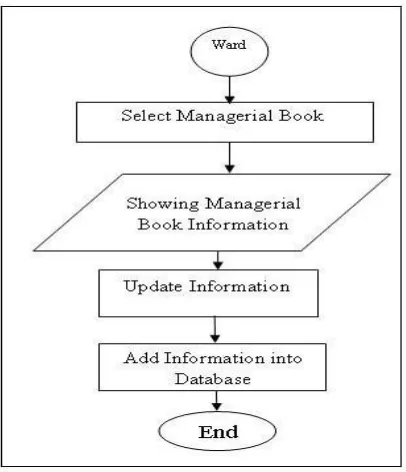
Ward (Incoming): This process is used to add, update, delete and search for a specific incoming managerial book, for instance the algorithm of updating managerial book information as shown in Figure (4) below.
Fig. 2. Archive System
Fig. 4. Updating Incoming Managerial Book Information
2.2.2 Algorithm of Human Resources System
The HR system part consists of five major processes as indicated in the Figure (5). These processes are:
Employees: This process is used to add, update, delete and search for a specific employee as shown in Figure (6).
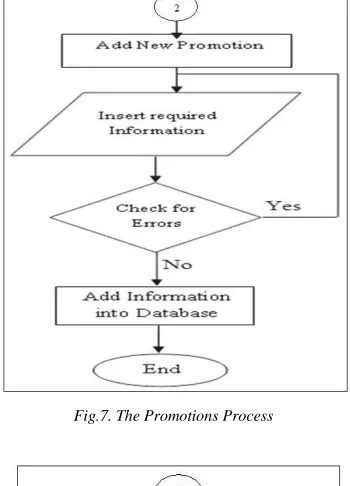
Promotions: This process is used to perform the activities of adding, updating and searching of a promotion for a specific employee as shown in Figure(7).
Thanks: This process is utilized for doing the actions related to thanks and awards including adding, updating and searching for a specific employee as shown in Figure (8).
Vacations: This process is performing add, update and search activities of vacation for a specific employee as shown in Figure (9).
Salary: This process is so critical and fateful, in this process we add allocation and presumption for a specific employee. Depending on these two factors, the salary is calculated for a specific employee or for all employees as shown in Figure (10).
Fig. 5. The HR system
Fig.7. The Promotions Process
Fig. 8. The Thanks Process
Fig. 9. The Vacation Process
Fig.10. The Salary Process
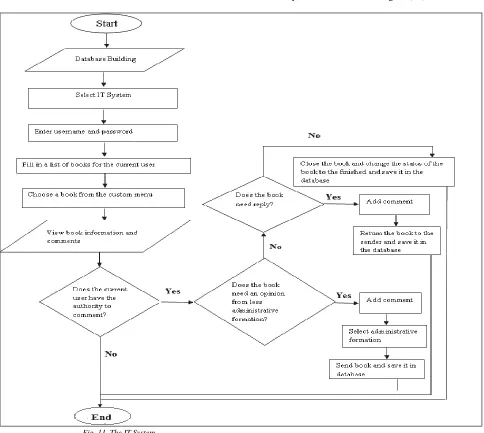
2.2.3 Algorithm of IT System
below. The proposed algorithm starts from the highest administrative formation to the least administrative formation. This algorithm tackles the administration flow of such subjects supported by official books.
Fig. 11. The IT System
2.2.4 Algorithm of Warehousing System
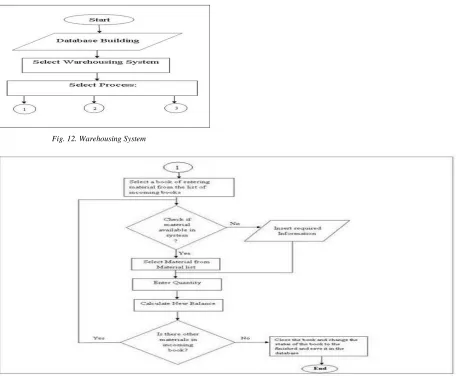
In warehousing system, there are three main processes as shown in Figure (12) below that explains the proposed algorithm in a flowchart. These processes are:
Add: this process is used to add new material in warehousing system as shown in Figure (13) below.
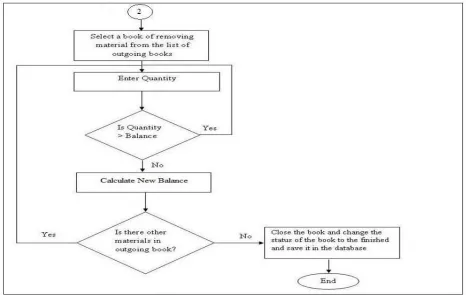
Remove: this process is used to remove material from warehousing system as shown in Figure (14) below.
Fig. 12. Warehousing System
Fig. 14. Removing Material from Warehousing System
Fig. 15. Inventory in Warehousing System
2.3 Web Page Interface
In order to ease the using of the proposed system by users without skills in the programming, a GUI is designed for each sub-system.
2.3.1 Interface of Archive System
The main interface of Archive system and its related data is shown in the Figure (16). Each button in this main page has a specific function and represents a particular function that stores the information in the relative table in ―swdb‖ database.
2.3.2 Interface of HR System
The main interface of Human Resources system and its related data as shown in Figure (17). Each button in this main page has a specific function
and represents a
particular table in "hr" databaseFig. 17. GUI Of HR Sub-System
2.3.3 Interface of IT System
The main page of the information technology system is the login page as shown in the Figure (18) to determine the current user of the system and its permissions.
Fig. 18. GUI Of IT Sub-System
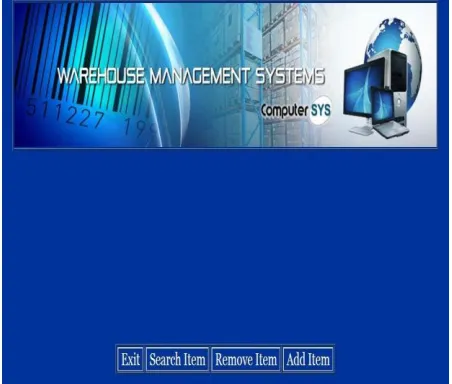
2.3.4 Interface of Warehousing System
The main interface of warehousing system is shown in Figure (19). Each button in this main page represents a particular function in "warehouse" database.
Fig. 19. GUI Of Warehousing Sub-System
2.4 Databases
The designed system includes different databases. These databases can be explained in ER diagram for each sub-system as follows.
2.4.1 Database of Archive System
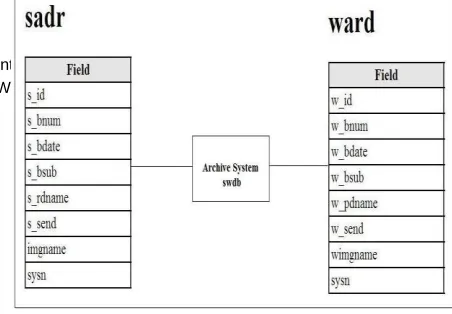
The database built for the archive system is called "swdb". It consists of two tables, shown in Figure (20) below, explained as:
Sadr: This table consists of (8) fields that begin
with s_id: sadr id, s_bnum: sadr book number,
s_bdate: sadr book date, s_bsub: sadr book subject, s_rdname: sadr received department name, s_send: sadr sender department name,
imgname: name of outgoing book image, sysn: system number).
Ward: This table consists of (8) fields that starts
with (w_id: ward id, w_bnum: ward book number, w_bdate: ward book date, w_bsub:
ward book subject, w_pdname: ward
Fig. 20. Database Of Archive Sub-System
2.4.2 Database of HR System
The database built for the human resources system is called "hr" shown in Figure (21) below, it consists of seven relational tables linked to each other as follows:
Employees: This table consists of (17) fields begin
with (emp_seq:employee sequence , emp_code:
employee code,emp_name:
employee,name,emp_birth: employee birth ,emp_martstatus: employee marital,status,emp_childno: employee childern number, emp_religion: employee childern number,
emp_cert: employee certification, emp_degree: employee degree, emp_step: employee step,
emp_basesal: employee base salary, emp_fullsal: employee full salary, emp_address: employee address, emp_commencedate: employee commence date, emp_appno: employee appointment number ,
emp_appdate: employee appointment date,
imgname: image of administrative book ).
Promotions: This table consists of (13) fields begin
with (prom_seq: promotion sequence , emp_seq: employee sequence , prom_no: promotion number,
prom_date: promotion date, prom type: promotion type, cur_deg: current degree, cur_step: current step, cur_add: current address, new_deg: new
degree, new_add: new address,new_step: new step, stage, salary).
Thanks: This table consists of (6) fields begin with
(thank_seq: thank sequence, emp_seq: employee sequence, thank_bno: thank book number,
thank_date: thank book date, thank_reason: thank
reason,grant_dept: granting department).
Leaves: This table consists of (7) fields begin with
(leave_seq: vacation sequence, emp_seq: employee sequence, leave_type: vacation type, leave_bno: vacation book number, leave_bdate: vacation book date, leave_startdate: vacation start date,
leave_duration: vacation duration).
Allotments: This table consists of (8)fields begin
with (allot_seq: allotment sequence,emp_seq:
employee sequence, allot_type: allotment type,
allot_amount: allotment amount, allot_ratio: allotment ratio, allot_bno: allotment book number,
allot_bdate: allotment book date, allot_cont: allotment continuity ).
Deductions: This table consists of(8)fields begin
with (deduct_seq: deduction sequence, emp_seq: employee sequence, deduct_type: deduction type,
deduct_amount: deduction amount, deduct_rate: deduction rate, deduct_bno: deduction book number,
deduct_bdate: deduction book date, deduct_cont: deduction continuity).
Basesalary: This table consists of (3) fields beginwith (degree:employee degree, step: employee step,
base_salamount: base salary amount)
2.4.3 Database of IT System
The database built for the information technology system is called "it". It consists of one table as shown in Figure (22) below, called maintable. This table consists of (7) fields that starts with (bookid : book sequence, bookno: book number, bookdate:date of book, sourceid, destid: destination ID, comments, regat: date of registration).
Fig. 22. Database Of IT Sub-System
2.4.4 Database for Warehousing System
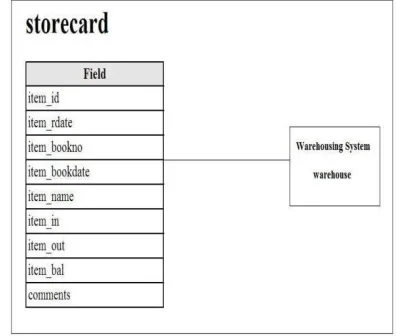
The database built for the warehousing system is called "warehouse". It consists of one table as shown in Figure (23) below called storecard. This table consists of (9) fields begin with (item_id: item sequence, item_rdate: date of delivery of items, item_bookno: item book number, item_bookdate: item book date, item_name: item name, item_in: number of items entering the warehouse, item_out: number of items outgoing from the warehouse, item_bal: remaining balance of materials, comments).
Fig. 23.Database Of Warehousing Sub-System
3. RESULTS
In order to evaluate the proposed system, different activities have been performed throughout the functions of the sub-systems. We call these activities as case studies, one for each sub-system to show the performance of the proposed system in terms of easy in use and reliability.
3.1 Archive System
The Archive system is tested by adding a new managerial book for each outgoing book. The procedure of adding a new book can be summarized as: when the user clicks on Add New Record button as shown in Figure (24). Adding a new record is performed by inserting the required data as indicated in Figure (25) below. When the user clicks on Save Data button the information is stored in the database.
Fig. 24. Main Page Of Outgoing Books
3.2 HR System
The HR system is tested by searching for employee promotion by selecting a specific employee name as explained in Figure (26), the required information about each employee's promotion is viewed as shown in Figure (27).
Fig. 26. Search Page Of Employee Promotion
Fig. 27. Employee's promotion Data page
3.3 IT System
The Information Technology system is tested by following the adminstration steps and tracking
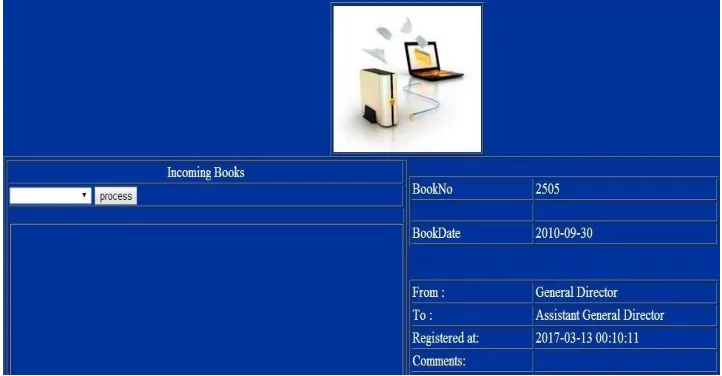
Fig. 29. Selecting And Processing A Book Information
managerial transactions starting from the highest administrative authority (General Director) to the smallest administrative formation in any company or institution. The procedure of managing and keeping track administrative transactions can be summarized inthe following example: when the general manager wants to track one of the incoming administrative books, he/she must enter the user name and password correctly to identify the current user of the system as shown in Figure(28). After granting authorization to enter system, the general manager can choose any book from the list of the incoming books and address any book as shown in the Figure(29).
Fig. 28. Main registration page for IT system
3.4 Warehousing System
The Warehousing system can be evaluated by adding material for warehouse. The procedure of adding material is explained in the next example: if we suppose that the user clicks on Add Item button, shown in Figure (30) below, adding a new item is completed by inserting the required data from the incoming managerial books regarding this order as indicated in Figure (31) below. When the user chooses to click on Save button, this information is stored in the database.
Fig. 30. Warehousing System Master Page
Fig. 31. Add item page
4. CONCLUSION
An e-institute management system has been proposed. The proposed system included four main parts: Achieve, HR, IT and warehousing. These parts have been considered as sub-systems inside the proposed system. In terms of technical description, the proposed system has been built over database and GUI interfaces. The database was built using MySQL environment, while the presented GUI interface webpages have been designed using PHP, HTML, CSS and bootstrap. A host server has been rented to upload the proposed system in an efficient way. The proposed system was evaluated throughout different activities exploiting the provided facilities. The outcome results showed the superior performance of the proposed system.
REFERENCES
[1] NabilThunon Al-Sayegh, "Management principles and basics", Modern Book World, First Edition, 2011. [2] Steinmetz, H., Schwens, C., Wehner, M., andKabst, R.
(2011). Conceptual and methodological issues in comparative HRM research: The Cranet project as an example. Human Resource Management Review, 21, 16–26.
[3] Samolejova, A., Wicher, P., Lampa, M., Lenort, R., Kutac, J., Sikorova, A., 2015. Factors of human resource planning in metallurgical company. Metalurgija 54, 243—246.
[4] Chang, S., Takeuchi, R., Liangding, J. and Yahua, C. (2014), Do High-Commitment Work Systems Affect Creativity? A Multilevel Combinational Approach to Employee Creativity, Journal of Applied Psychology, July, 99 (4), 665-680.