e-ISSN: 2278-067X, p-ISSN: 2278-800X, www.ijerd.com
Volume 10, Issue 6 (June 2014), PP.59-67
Effect of EGR on NO
x& Performance Parameters in single
cylinder four stroke CI engine.
1
Avinash M.Wankhade,
2Pratik G.Sapre,
3Sunil D.Nagulkar,
4
Parmeshwar A.Bhargade
1
Associate Professor & HOD Department ofMechanical Engineering, Babasaheb Naik College of Engineering
2,3,4
Final Year Mechanical Engineering Department of Mechanical Engineering B.N.C.O.E.,Pusad 445215 Sant Gadge Baba Amravati University
Abstract:- The main aim of these work is to reduce the exhaust emission such as oxides of nitrogen and particulate matters. reason behind NOx formation is cylinder temperature if it exceed above 2000K.hence in order to nitrogen oxide exhaust gas recirculation is suitable and economical way to control these harmful emissions which helps to keep overall peak temperature of engine head under control.
From study & analysis conducted on CI engine by scientist, researchers it is found that adding exhaust gases again to combustion chamber cause to change and reduce emission parameters by three main reason firstly to reduce pumping work: secondly to reduction in degree of dissociation in high temperature and mixing of exhaust gases back to combustion with fresh charge acts as a diluents and ideal gas mixture so as to control peak temperature of cylinder thirdly: to reduce heat loss to cylinder walls. Above three main factors play important role to reduced NOX emission. An experiment investigation was conducted on departmental lab engine say single cylinder four stroke water cooled compression ignition to observe effect of hot exhaust gas recirculation (without application of heat exchanger) on emission as well as on performance parameter and correlate reading taken by DA system in default engine with modified one with application of EGR supply throw orifice meter so as to control NOx emissions.
Keywords:- EGR, NOx, Hot EGR, Diesel engine Pollution.
I.
INTRODUCTION
The development & design of engine power generating units with low environmental pollution impact has become one of the most interesting challenges in automotive technology & IC engine. on recent past year stringent emission legislations have been imposed on nitrogen oxides, smoke and particulate matters. Diesel engine are typically characterized by low fuel consumption and very low CO emission but NOx emission from same engine still remain high. it must be in exhaust but we can control it up to some extent by Appling external & internal design modification in engine in order to meet EPA(Environmental Pollution Agencies) standard legislations. it is highly recommended that to reduced the amount of NOx in exhaust gas.
Several factor and techniques is now days using after long research in CI engine such as proposal of future European directive established separate and even more stringent, limit for NOx emission. secondly, for the reduction in NOx emission have probably become the most difficult target to attain, owing to the associate reverse effect of other recently used techniques, such as high supercharging, an improve mixing process by more efficient injection system etc. Thirdly, the development of new generation of exhaust gas recirculation(EGR) values and improvement in electronic control allow a better EGR accuracy and shorter response time in transient condition, fourthly ,the most common operating condition, mainly in passengers cars, have moved to lower engine load, owing to the increased urban traffic densities and it must be consider that it is mainly at partial load where EGR is indicated because of its higher oxygen contents.[3]however technologies like EGR(Exhaust Gas Recirculation)soot, coal traps & exhaust gases after treatment essential to cater to the challenges posed by increasingly stringent environmental emission legislation.[2]
1.1 NOx formation Mechanism in CI engine
formation is the oxidation of the nitrogen present in atmospheric air. The nitric oxide formation chain reactions are initiated by atomic oxygen, which forms from the dissociation of oxygen molecules at the high temperatures reached during the combustion process. The principal reactions governing the formation of NO from molecular nitrogen are as follows.
N2 + O NO + N, N + O2 NO + O, N + OH NO + H.
Chemical equilibrium consideration indicates that for burnt gases at typical flame temperatures,NO2/NO ratios should be negligibly small. While experimental data show that this is
true for spark ignition engines, in diesels, NO2 can be 10 % to 30% of total exhaust emissions of oxides of nitrogen. A possible mechanism for the persistence of NO2 is as follows.
NO formed in the flame zone can be rapidly converted to NO2 via reactions as follow, NO + HO2 NO2 + OH .
Subsequently, conversion of this NO2 to NO occurs via
NO2 + O NO + O2.
Unless the NO2 formed in the flame is quenched by mixing with cooler fluid. This explanation is consistent with the highest NO2/NO ratio occurring at high load in diesels, when cooler regions which could quench the conversion back to NO is widespread wood 1988). The local atomic oxygen concentration depends on molecular oxygen concentration as well as local temperatures. Formation of NOx is almost absent at temperatures below 2000K.Hence any technique, that can keep the instantaneous local temperature in the combustion chamber below 2000 K, will be able to reduce NOx formation.[2]
II.
EGR TECHNIQUES FOR NOx REDUCTION
EGR is a useful technique for reducing NOx formation in the combustion chamber. Exhaust consists of CO2, N2 and water vapors mainly. When a part of this exhaust gas is re-circulated to the cylinder, it acts as diluents to the combusting mixture. This also reduces the O2 concentration in the combustion chamber. The specific heat of the EGR is much higher than fresh air, hence EGR increases the heat capacity (specific heat) of the intake charge, thus decreasing the temperature rise for the same heat release in the combustion chamber,
%EGR = volume of EGR ×100
Total intake charge into the cylinder
Another way to define the EGR ratio is by the use of CO2 concentration [1],
EGR ratio = [CO2] intake − [CO2] ambient
[CO2] exhaust − [CO2] ambient
Three popular explanations for the effect of EGR on NOx reduction are increased ignition delay, increased heat capacity and dilution of the intake charge with inert gases. The ignition delay hypothesis asserts that because EGR causes an increase in ignition delay, it has the same effect as retarding the injection timing. The heat capacity hypothesis states that the addition of the inert exhaust gas into the intake increases the heat capacity (specific heat) of the no reacting matter present during the combustion. The increased heat capacity has the effect of lowering the peak combustion temperature. According to the dilution theory, the effect of EGR on NOx is caused by increasing amounts of inert gases in the mixture, which reduces the adiabatic flame temperature .[1]
At high loads, it is difficult to employ EGR due to deterioration in diffusion combustion and this may result in an excessive increase in smoke and particulate emissions. At low loads, unburnt hydrocarbons contained in the EGR would possibly re-burn in the mixture, leading to lower unburnt fuel in the exhaust and thus improved brake thermal efficiency [2].
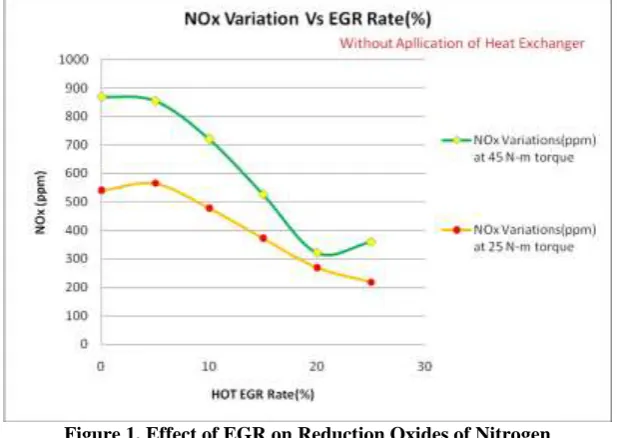
suggested that flame temperature reduction is the most important factor influencing NO formation. Figure 1 shows the reduction in NOx emission due to EGR at different loads. Implementation of EGR in diesel engines has problems like (1) increased soot emission, (2) introduction of particulate matter into the engine cylinders. When the engine components come into contact with high velocity soot particulates, particulate abrasion may occur. Sulphuric acid and condensed water in EGR also cause corrosion. Some studies have detected damage on
Figure 1. Effect of EGR on Reduction Oxides of Nitrogen
Above test carried out on single cylinder four stroke CI engine without application of heat exchanger say hot EGR and NOx variation curve on given two load is as shown in above fig.
Sr
no % of EGR NOx
(ppm volume)
Reduction in NOx (ppm volume)
1 0 870 0
2 5 855 15
3 10 721 134
4 15 527 194
5 20 322 205
Fig 2: Effect of EGR on NOx reduction at 45 N-m torques
the cylinder walls due to the reduction in the oil’s lubrication capacity, which is hampered due to the mixing of soot carried with the particulate laden recalculated exhaust gas Other methods of reducing the particulate emission from diesel engines include multiple injections, supercharging and higher fuel injection pressure etc. The highest attention is currently being paid to two self-regenerating systems: fuel additive-supported regeneration by using cerium- or iron-based additives, and a continuous regeneration trap (CRT) using sulphur-free diesel fuel.[2,3].
During the last 20 years, plenty of research work has been done on EGR and its effects on the engine performance in terms of fuel efficiency, volumetric efficiency, power generated etc. These studies have been carried out at various loads, engine speed and variable engine parameters like temperature and pressure, compression ratio etc .
III.
CLASSIFICATION OF EGR SYSTEMS
Various EGR systems have been classified on the basis of EGR temperature, configuration and pressure.
3.1 Classification based on temperature
gas may condense and the resulting water droplets may cause undesirable effects inside the engine cylinder. (iii) Partly cooled EGR: To avoid water condensation, the temperature of the exhaust gas is kept just above its dew point temperature.[10]
3.2 Classification based on configuration
(i) Long route system (LR): In an LR system the pressure drop across the air intake and the stagnation pressure in the exhaust gas stream make the EGR possible. The exhaust gas velocity creates a small stagnation pressure, which in combination with low pressure after the intake air, gives rise to a pressure difference to accomplish EGR across the entire torque/speed envelop of the engine.
(ii) Short route system (SR): These systems differed mainly in the method used to set up a positive pressure difference across the EGR circuit. Another way of controlling the EGR-rate is to use variable nozzle turbine (VNT). Most of the VNT systems have single entrance, which reduce the efficiency of the system by exhaust pulse separation. Cooled EGR should be supplied effectively. Lundquist and others used a variable venture, in which EGR-injector was allowed to move axially.[10,12]
3.3 Classification based on pressure
Two different routes for EGR, namely low-pressure and high-pressure route systems may be used [1,2] (i) Low pressure route system: The passage for EGR is provided from downstream of the turbine to the upstream side of the compressor. It is found that by using the low pressure route method, EGR is possible up to a high load region, with significant reduction in NOx. However, some problems occur, which influence durability, prohibitionary high compressor outlet temperature and intercooler clogging.
(ii) High pressure route system: The EGR is passed from upstream of the turbine to downstream of the compressor. In the high pressure route EGR method, although EGR is possible in the high load regions, the excess air ratio decreases and fuel consumption increases remarkably.[2,3]
IV.
EXPERIMENTAL SETUP & FABRICATION OF EGR
Engine Specification:-
4 Stroke single Cylinder water cooled self start CI engine. Make:-Kirloskar
Rated Power:-7.5kw (10 HP) Bore Dia.:-80mm
Stoke Length:-110mm
Connecting Rod Length:-234mm Swept Volume:-562cc
Compression Ratio:-17.5:1 Rated Speed:-rpm
Figure 3. Line diagram of the proposed EGR system.
The objective of developing this experimental test setup is to investigate and demonstrate the effects of various EGR rates and other engine parameters on exhaust emissions from the engine. A long route partially cooled EGR system is chosen based on its merits. Several components of this EGR system have been designed and fabricated. An air box is designed to measure the volumetric flow rate of intake air to the engine. It is mounted on the inlet pipe between the air filter and the inlet manifold of the engine as shown in figure 2. The air box dampens out the fluctuations of the intake air. A diaphragm is provided on the side of the air box for dampening out the local undulations effectively. The air box is fitted with an orifice (shown in figure 3) for volumetric flow rate measurement of air. A U-tube manometer is mounted across the orifice, to measure the pressure difference inside the air box and the atmosphere [1]. The coefficient of discharge of the orifice is found experimentally to be 0.5. [12]
Figure 4. A schematic diagram of orifice meter.
V.
RESULTS AND DISCUSSION
.
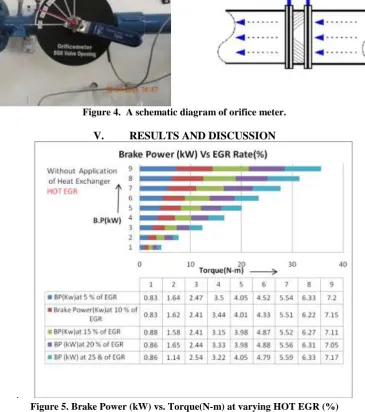
Figure 5. Brake Power (kW) vs. Torque(N-m) at varying HOT EGR (%)
Figure 6. BSFC Vs. Torque (N-m) at Varying EGR.
In above graph BSFC Vs Torque plotted. it indicates the variations of brake specific fuel consumption with increasing EGR rate. There is remarkable improvement in fuel consumption with increasing EGR. One of the main reason for that effect is due to the reduction of pumping work as the amount of EGR rate is increase (with fuel and air flow rate remains constant),the pump work get reduced and hence the entire inlet charge needing to come passed the throttle. Again due to the reduction in heat loss to the wall of cylinder the significant reduction in burnt gas reduction improve the fuel consumption trends. The reductions in degree of dissociation in high temperature burn gases also improve brake specific fuel consumption
VI.
CONCLUSION
Given experimental set-up to measure the effects of EGR on engine characteristics like exhaust gas temperature, brake power, brake specific fuel consumption & oxides of nitrogen reduction has been improved and it is cleared that by caring test we have reduced up to 61.4% of NOx. Experiments were carried out using the setup to prove the effect of EGR as a technique for NOx reduction. It is seen that the exhaust gas temperatures reduce drastically by employing EGR. This indirectly shows the potential for reduction of NOx emission. This can be concluded from the fact that the most important reason for the formation of NOx in the combustion chamber is the high temperature of about 2000K at the site of combustion. Thermal efficiency and brake specific fuel consumption are not affected significantly by EGR. However particulate matter emission in the exhaust increases, side by side HC emission is increased .Diesel engines score higher than that of other engines in most aspects like fuel consumption and low CO emissions, but lose in NOx emissions. EGR is proved to be one of the most efficient methods of NOx reduction in diesel engines. The increase in particulate matter emissions due to EGR can be control by external technique such as coal trap, SCR,DEF techniques Non thermal plasma catalyst etc.
Fig:-7 Emission Test Analyzer (AVL DITEST SYSTEM)
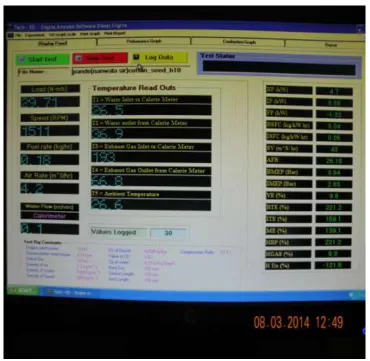
Fig 9:-Emission & Performance Test
REFERENCES
Research Papers
[1]. Prof. Walke P.V., GHRCE Nagpur, Dr.Deshpande N.V. ,Professor,V.N.I.T,Nagpur ,“Performance and emission characteristics of Diesel Engine using catalyst with exhaust gas recirculation.” Proceedings of ASME, Mechanical engineering congress and exposition, November 05-10, 2006, Chicago, Illinois, paper No. IMECE2006-14484
[2]. Avinash Kumar Agrawal, Shravan Kumar Singh, “Effect of EGR on the exhaust gas temperature and exhaust opacity in compression ignition engine’’sadhana vol.29.Part 3,June 2004,pp.275-284.
[3]. G.H.Abd-Alla.,’’Using exhaust gas recirculation in internal combustion engines:a review’’,Energy conversion management 43(2002)1027-1047
[4]. S.Ghosh.,D.Dutta,’’Performance and emission parameters analysis of gasoline engine with EGR’’,IJERD,vol 4,Issue 10(Nov 2012),pp.08-12
[5]. Prof.Gaurav P.Rathod,Mr. Harshraj Dangar.,’’Combine effect of Exhaust Gas recirculation(EGR)& Varying Inlet Air Pressure on Performance & Emission of Diesel Engine’’,IOSR,vol 6,Issue 5(May 2013),pp.26-33.
[6]. Gurumoorthy S.Hebbar,Anant Krishna Bhat.,’’Investigations on Performance & emission of a stationary DI Diesel Engine with different exhaust gas recirculation temperature’’,IJAET,vol 2,Issue 1,pp 1-9,2013.
[7]. Vipul Jain,Dipesh Singh Parihar,Vaibhav jain,Irfan H Mulla.,’’Performance of Exhaust Gas Recirculation(EGR)System on Diesel Engine’’,IJERA,vol.3 Issue 4,Jul-Aug 2013,pp.1287-1297. [8]. Jagadale S.S.,Jugulkar L.M.,’’Performance characteristics of single cylinder diesel engine using blend
of chicken fat based biodiesel’’.,IJMET,Vol 3,Issue 2,May-Aug(2012).,pp.754-768.
[9]. Alain Maiboom.,’’Experimental study of various effects of exhaust gas recirculation(EGR) on combustion and emission of an automotive direct injection diesel engine’’,Energy 33(2008) 22-34.
Books
[10]. Heywood John B. Internal Combustion Engine Fundamentals Inc. edn ( New York: Mc-Graw Hill) pp 572 - 577
[11]. V Ganeshan ,Internal Combustion Engines Inc.end(New York: Mc-Graw Hill) pp 480-499.