COMPARATIVE STUDY OF THE PERFORMANCE OF THE TCP
VARIANTS FOR CONGESTION CONTROL IN MOBILE-AD-HOC
NETWORKS.
Somdeep Sinha1, Niranjan Kumar Mandal2, Biswapati Jana3
1. INTRODUCTION
Among the various type of variants of TCP in congestion control in MANET,TCP Vegas and TCP Reno are most promising mechanism now a days.TCP Vegas represent a valid alternative two congestion control performed by two currently standard and most widespread version of TCP, called TCP Reno. Although it introduced new techniques in to all mechanism of TCP, it
is fully compatible with all the standard version of TCP, because the changes only concern the TCP sending side [1]. To maintain and allocate network resources effectively and fairly among a collection of user is a major issue. The resources
shared mostly are the band width of the links and the ques on the routers or switches. Packet are queued in these queses awaiting transmission. When too many packets are containing for the same the link, the queue overflows and packets have to be dropped. When such drops become common events, the network is said to be congested [2].
In Ad- Hoc networks, since there is no separate network elements called routers and hence the mobile nodes themselves act as the routers (that is, they are responsible for routing the packets). Congestion control method can be router centrist[3]. In existing congestion control method, the source is informed about the congestion in the network so that either it may slow down the packet transmission rate or find an alternative route which may not necessary be an optimal route. It must be pointed out that all the congestion control methods are able to inform the source about the congestion problem because they use transmission control protocol (TCP).
In case of Ad Hoc networks, packet losses are due to congestion in the network and due to due to frequent link failure so when we adapt TCP to as-hoc network it misinterprets the packet losses due to link failure as packet losses due to congestion and in the instance of a timeout, backing-off its re-transmission time out(RTO). This result in unnecessary reduction of Transmission rate because of which throughput of the whole network degrades. Therefore, route changes due to host mobility can have a detrimental impact on PC performance[4].
On demand routing protocol such as AODV and DSR are used for this performance analysis of TCP. This type of routing protocol create roots only when requested by source node. When a node wants to establish a route to a destination ,it is initiates a route discovery process with in the network. Once, the route has been established, it is maintained until either destination becomes in accessible or route is no longer desired.
We have analyzed the performance of two on-demands routing protocol for Ad-Hoc Network. Ad Hoc on demand distance vector and dynamic source routing(DSR), based on TCP traffic follows. We have also use DSDV which is a table driven routing protocol.
2. MATERIALS AND METHOD:
2.1 Routing Protocols:
AODV: It is an Ad-hoc on demand distance vector routing protocol for mobile-ad-hoc networks and other wireless Ad-hoc networks. It is capable of both unicast and multicast routing [5] .It keeps these router as long as their desired by the sources.
1
Department of Computer Science,Vidysagar University, Midnapore, India 2
Department of Electrical Engineering, University of Engineering & Management, Kolkata, India. 3
Department of Computer Science,Vidysagar University, Midnapore, India
International Journal of Latest Trends in Engineering and Technology
Vol.(15)Issue(1), pp.014-018
DOI: http://dx.doi.org/10.21172/1.151.03
e-ISSN:2278-621X
Abstract: A comparative study has been carried out to find the performance of each of TCP New-Reno, TCP Fack, TCP Sack and TCP Vegas for congestion control in Mobile-Ad-Hoc Networks(MANET). For this, two Ad-hoc routing protocol, such as AODV, DSR and one table driven protocol, DSDV have been implemented. For this various node densities and the above three different protocols, simulation data and thus graphs have been obtained for each of TCP Variants for congestion control mechanisms. The simulation study has been done by using widely recognized network simulator NS-2, version 2.29.3 for Manet. The performance studies have been done by analyzing these data for each of them and comparison has been made and results have been discussed.
Ack).
2.3.Variants of TCP:
Transmission control Protocol is the predominant internet protocol and it carries approximately 90% of internet practice in today's heterogeneous wireless and wire network. It is reliable to end to end protocol. However TCP in the present form is not well suited for Mobile Ad-choc-network where packet loss due to broken router can result in the counter productive invocation of TCP’s congestion control n mechanism[9] .
Several studies were carried out to improve TCP and protocol modification done. The reason behind the variants of TCP is that each type posses some special criteria, such as the traditional TCP has known as TCP tahoe.TCP new reno uses the newest re-transmission mechanism of TCP reno. The uses if TCP sack permits the receiver to specify several additional data
packets that have been received out of order within one dup ACK, instead of only the last in order packet received[10].
TCP vegas proposes its own new unique re transmission ad congestion control-strategies. TCP FACK is Reno TCP with Forward acknowledgement.
2.4. Simulation Tool:
The simulation study is done by using widely recognized improved network simulator NS-2, version 2029.3 for Mobile Ad-hoc networks. The ODV,DSR and DSDV protocols are also provided as part of the NS-2 installation. The TCP congestion control techniques were implemented by editing patch file in the NS-2 codes. The saddest tool in NS-2 is used to generate the random typologies for simulation. As simulation are performed for 1000m*1000m grid consisting of 50 nodes, distributed randomly over the two-dimensional grid. The source destination pairs are randomly chosen from the set of 50 nodes in the network. We have consider four different speed of 10m/s,20m/s,30m/s and 40m/s in our simulation, all with pause time of 0 second. Two runs were conducted for each of the average speed and we used resulting different node density of 40,60,80,and 100 nodes creating 128 different movement pattern.TCP packet size of 1460 is consider for our analysis. The TCP clock granularity is set to 200ms.the queue size are set to 50 packets to avoid frequent drop of packet due to buffering. We measured the TCP throughput for each set up when operating over a wireless system.
3. PERFORMANCE EVALUTION:
For different node density in a fixed area, we performed a series of three simulation runs. Each simulation run tested a different technique: TCP New-reno, TCP SACK,TCP SACK and TCP Vegas in each run a set of performance measurements were made for each of the two routing protocol: AODV and DSR, at each of the several nodes destinies from 40 to 100 nodes. The results are shown also graphically in Fig.1 to Fig4.
3.1. Evaluation of TCP New Reno:
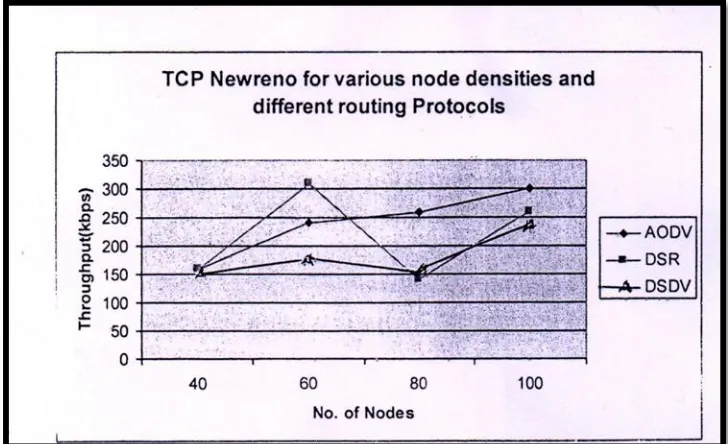
Table-1: Performance of TCP new Reno for various node densities and different routing protocols.
Routing Protocols No. of Nodes
40 60 80 100
Throughput ( Kbps)
AODV 160 240 260 300
DSR 160 310 140 260
Fig1: Performance of TCP new Reno for various node destinies and different routing protocols.
3.2. Evaluation of TCP SACK:
Table 2: Performance of TCP SACK for various node densities and different routing protocols
Routing Protocols No. of Nodes
40 60 80 100
Throughput ( Kbps)
AODV 240 380 420 320
DSR 250 330 380 300
DSDV 340 350 400 340
Fig2: Performance of TCP SACK for various node densities and different routing protocol.
3.3. Evaluation of TCP FACK:
Table-3:-Performance of TCP FACK for various node densities of different routing protocol Routing Protocols No. of Nodes
40 60 80 100
Throughput ( Kbps)
AODV 310 480 430 410
DSR 300 460 480 340
Fig3:-Performance of TCP FACK for various nodes densities and different routing protocols.
3.4. Evaluation of TCP VAGAS:
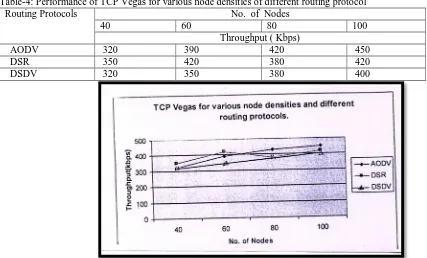
Table-4: Performance of TCP Vegas for various node densities of different routing protocol
Routing Protocols No. of Nodes
40 60 80 100
Throughput ( Kbps)
AODV 320 390 420 450
DSR 350 420 380 420
DSDV 320 350 380 400
Fig4: Performance of TCP Vegas for various nodes densities and different routing protocols.
4. RESULT AND DISCUSSION
Figure1 represent TCP new Reno for all measurement of different throughput. When 20 nodes are used in the grid, DSR routing protocols performance very well then the other two protocols i.e., AODV and DSDV.AODV and DSDV almost gives same throughput .however when the nodes increases in the grid throughput also changes. Now, when we consider the other set of measurement we notice that the through put of the network gradually increase on using AODV routing protocol and also for DSDV. But for DSR routing protocol the throughput is continuously varying of different at different node densities and it provides high throughput when we uses 60 nodes in the grid. On an average DSR routing protocol provides a better throughput compared to other routing protocols.
Figure 3 shows TCP FACK for all the measurement of throughput. It indicates a similar behaviour as TCP SACK .But it has a higher throughput than TCP SACK. It is due to the fact that TCP FACK uses information provided by SACK to add more precise control to the injection of data into the network during recovery. This improves the recovery of lasses significantly. Figure 4 represents TCP VEGAS for all the measurement of throughput. It shows a stable increase when node increases, even through having lower throughput than other variants, where else for the other variants the throughput decreases .When we increase the number of connection in a network, keeping the number of node fixed ,more packets are dropped in the network due to collision.TCP Vegas has a proactive behaviour that prevents the packet being dropped in the network. Due to this nature ,it is restrict the amount of data it transmits in the network thus TCP Vegas achieves low throughput as compared to other variants.
After analyzing the performing from simulated data and graphs obtained, we found that TCP Vegas is better than any other TCP variants for sending data and information due to its better packet delivery fraction and average end to end delay. TCP
Vegas also showed a consistent performance for all three routing protocol as an average.
5. REFERENCES
[1] Yuvaraju B.N and Niranjan N Chiplunkar, “Scenario Based Performance Analysis of Variants of TCP”. International Journal of Computer Applications, Vol.4, No.09 (2010).
[2] Singha Somdeep and Mandal N.K, “Comparative study of the performance analysis of Muticast Routing Protocol of MAODV and ODMRP in mobile Ad-hoc Network using QualNet”. International Journal of Emerging Technology and Advanced Engineering, Vol. 6(3),pp.121-126, (2016).
[3] Geetha Jayakumar and Gopinath Ganapathy, “ Performance Comparison of Mobile Ad-hoc Network Routing Protocols”. International Journal of Computer Science and Network Security(IJCSNS), Vol.7(11),pp. 77-84 ( 2007).
[4] Y.B.Ko and N.H.Vadya, “Location-aided routing (LAR) in mobile Ad-hoc Networks”. Proc. Of Mobicom’98 (1998).
[5] Abdul Hadi Abd Rahman, “Performance Comparison of AODV, DSDV and I-DSDV Routing Protocols in Mobile AD-hoc Networks”. European Journal of Scientific Research, Vol.31(4),pp. 566-576 (2009).
[6] SunJae Jung, Mun Gi Kim and Byung Ho Rhee, “Performance Enhancement Technique for TCP over mobile Ad-hoc Networks”. IEEE Hybrid Information Technology. Pp.210-215 (2006).
[7] Azizol Abdullah, Norlida Ramly, Abdullah Muhammed and Noor Mohd Noor Derahman,”Performance Comparison study of Routing Protocols for Mobile Grid Environment”. IJCSNS International Journal of Computer Science and Network Security, Vol.8(2),pp.82-88(2008).
[8] Hadi Sargolzaey, Ayyoub Akbari Moghanjoughi and Sabira Khatun, “A Review and comparison of Reliable Unicast Routing Protocols for Mobile Ad-hoc Networks”, IJCSNS International Journal of Computer Science and Network Security, Vol.9(1),pp.186-196(2009).
[9] Laura Marie Feeney, “A taxonomy for routing protocols in mobile Ad-hoc Networks”. Technical report, Swedish Institute Computer Science, Sweden(1999).