(Research article)
Aging Effect on Modified Bitumen
Maninder Singha*, Praveen Kumara, M. R. Mauryac , Manoj Guptaa,
aIndian Institute of Technology Roorkee, Civil Engineering Department,India
b
Indian Institute of Technology Roorkee, Chemistry Department,India
Accepted 11 July 2012, Available online 1Sept 2012
Abstract
Polymers are the most common modifiers currently being used to improve bitumen properties. The polymers increase the temperature range over which a binder resists both rutting and thermal cracking. In this paper VG10 bitumen and two polymers: Styrene Butadiene Styrene (SBS) block copolymer, Ethylene Vinyl Acetate (EVA) polymer and crumb rubber (CR) are used as modifiers with varying percentage of 2%, 5% and 8%. The SBS and EVA modified bitumen samples were prepared by means of high and low shear laboratory type mixer rotating at 3000 rpm and 1500 rpm,
respectively at a temperature of 180oC whereas for the preparation of CR the modified samples are prepared at 1100
rpm. The ageing properties of polymer modified bitumen (PMB) have the main role in quality of PMB dispersions and solid PMB. For Short term aging the virgin bitumen and SBS/EVA and CR blends were aged by means of the Thin Film Oven Test (TFOT), at a temperature of 163oC for 5 hrs. The change in physical properties such as penetration, viscosity, softening point, elastic recovery and loss in weight were compared before and after short term ageing.
Keywords: TFOT, SBS, EVA, Brookfield viscometer
1. Introduction
1Environmental factors such as temperature, air and water
can have a profound effect on the durability of asphalt concrete mixes. India is a very vast country, having widely varying climate, terrain, construction materials and mixed traffic both in terms of loads and volume. The flexible roads constitute about 98 percent of the total roads network. Road performance is determined by properties of bitumen as the bitumen is the continuous phase and only deformable component. Binder modification is a major breakthrough and the continuous research and is aiming to produce new binders with better rheological and mechanical characteristics which allow the manufacturing and application of road bituminous mixes with higher performance. Increased traffic factors such as heavier loads, higher traffic volume and higher tyre pressure demand higher performance pavements. The purpose of bitumen modification using polymers and rubbers is to achieve desired engineering properties such as increased shear modulus and reduced plastic flow at high temperatures and increased resistance to thermal fracture at low temperatures.
The effects of reclaimed rubber particles from scrap tyres in the preparation of local asphaltic concrete mixes
*Corresponding author's email: [email protected]
were evaluated and the results showed that the softening point of the binder increases with increasing rubber content (Wahhab et.al.,1991). When bituminous paving binder containing reclaimed PE and LDPE was used for modification of bitumen it was observed that the penetration, ductility and the specific gravity of the modified binder decreases while the softening point and viscosity are increased (Panda et.al.,1997). The temperature susceptibility of the modified binder is also improved. Properties like low temperature ductility, elastic recovery, water and temperature susceptibility, viscosity and Marshall Stability improved by adding modifiers such as CR and EVA to bitumen (Mehndiratta et.al.,2005). Upon incorporated non-vulcanized rubbers into bitumen the resulting range of blends showed higher and intermediate performance compared to the base bitumen (Yousefi ,2002). Mixing of polymers into bitumen has important consequences on engineering properties of bituminous binders (Lepe et.al.,2003). Ageing or hardening of bituminous binder occurs during mixing and lay down process and during service. The complex process of ageing has been studied by several authors (Isacsson et.al.,1998), (Rek et.al,2002a,2002b) and it was established that bitumen ageing is one of the principal factors causing negative change of physical structures and chemical compositions, and results in the deterioration of its physical behaviors International Journal of Engineering, Science and Metallurgy
(Isacsson et.al. (2002). Under extreme aging conditions, even conventional binder is prone to lose its binding capacity (Valcke et.al,2009). The oxidation of binder further contributes to change in the structural and functional grouping that is responsible for chemical and physical aging (Lamontagne et.al,2001). After the short-term aging, the proportion of bitumen compounds such as asphaltenes and resins were increased (Zhang et.al,2011). Subsequently it becomes less adhesive but more cohesive, and make it increasingly brittle and it was established that the complexity increases when the polymer is present (Whiteoak,1991). Ageing indicates binder hardening as it is subjected to oxidative ageing. Less age hardening means more resistance to oxidative degradation of the bitumen.
2. Experimental programme
2.1 Materials
Bitumen grade 80/100 (VG 10) was used for the present study. Crumb rubber (CR) and two types of polymers, ethylene vinyl acetate (EVA) and styrene butadiene styrene (SBS) with varying percentage of 2%, 5% and 8% were used in this study. CR is material locally available and material passing through 1.18 mm IS sieve and retained on 200 micron IS sieve was used. Ethylene vinyl acetate (EVA) copolymer, available as pellets 4 to 5 mm in diameter supplied by KLJ Polymers, New Delhi was used. Styrene butadiene styrene (SBS) polymer used was powdered Finaprene 503 supplied by ATOFINA. Finaprene 503, a linear SBS polymer contains 31% styrene.
2.2 Preparation of Modified Bitumen
In preparing the modified binders, about 500 g of the bitumen was heated to fluid condition in a 1.5 litre capacity metal container. The mixing was performed in the laboratory using an oven fitted with a mechanical stirrer and capable of operating upto 3000 rpm for mixing the bitumen and modifiers. For blending of crumb rubber with bitumen, bitumen was heated to a temperature of 160°C and then crumb rubber was added. The blend was mixed manually for about 3-4 minutes. The mixture was then heated to 170°C and the whole mass was stirred using a mechanical stirrer for about 50 minutes. Care was taken to maintain the temperature between 160°C to 170°C. For preparation of EVA blends, bitumen was heated to a temperature of 170°C. As the bitumen attained a temperature of 170°C, the different EVA polymer contents by mass (2 to 8%) were added to the bitumen and vigorously agitated. The temperature was maintained between 175°C to 180°C and mixing was then continued for 80-90 minutes with a shearing speed of 1500 rpm . For SBS blends, bitumen was heated to a temperature of
170°C and the appropriate quantity of SBS copolymer was added. The temperature was maintained between 175°C to 180°C. The contents were gradually stirred for about 55 minutes at 3000 rpm (Singh, 2006). The modified bitumen was cooled to room temperature and suitably stored for testing ( Cagri Gorkem et.al,2009).
2.3 Short Term Ageing
Ageing of the binders was performed by Thin Film Oven test (TFOT, ASTM D 1754). The test method covers the determination of heat and air on a film of semisolid asphaltic material .In this test about 50 g of bitumen was weighed and poured into cylindrical pans with 140 mm dia. and 10 mm depth and having a thickness of 3.2 mm. The pans were placed on a circular shelf rotating at a speed of 6 rpm. The whole assembly is fixed in an oven. The samples are aged by heating them at 165oC for 5 hr.
3. Tests and results
3.1 Penetration Test
The test was conducted as per ASTM D5.The penetration values of bitumen modified with different percentage of Crumb rubber (CR), Ethylene vinyl acetate (EVA) and Styrene butadiene styrene (SBS) are represented graphically in fig 1. The penetration values are decreasing significantly for 80/100 bitumen mixed with CR, EVA and SBS. It is observed that the penetration value decreases as the concentration of modifier increases. Further, the bitumen modified with EVA seems to be more effective in the penetration values as compared to CR and SBS modifiers. As per IRC:SP 53-2002 the bitumen modified with crumb rubber from 2-8% is found to be CRMB 50 grade, that modified with 2% EVA and 2 and 5% SBS are of PMB 70 and EVA 5%, 8% and SBS 8% are of PMB 40 grade. The recommended grade for cold climatic areas is CRMB 50. PMB 70 are for moderate climate (35 to 45oC) whereas PMB 40 is used for hot climate areas and heavy traffic conditions where maximum atmospheric temperature is above 45oC (IRC:SP:53-2002).
Due to evaporation of volatile material the bitumen after ageing hardens and thus penetration value decreases and the value decreases as the percentage of modifier increases.
3.2 Softening Point Test
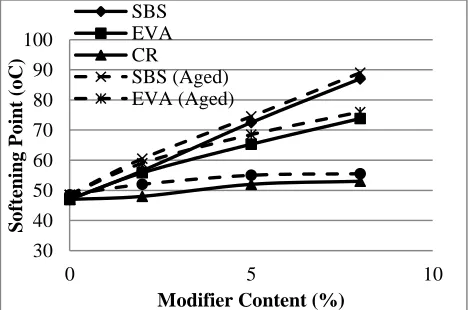
point for 80/100 bitumen increases to more than 70°C by addition of 8% EVA and 8% SBS and should not be used in road construction, but may be used as a roofing material. At 2% the bitumen modified with EVA and SBS, the softening point is almost same but it becomes higher thereafter for SBS. Softening point increases as the bitumen becomes increasingly viscous. Blown roofing bitumen has higher softening point as compared to most paving bitumen. Test results are reported at 40-61oC for paving bitumen and 70-100oC for roofing bitumen (Brown et al,1996)
Figure 1: Penetration vs modifier content before and after ageing
The softening point value increases after ageing and the value increases with increasing modifier content.
Figure 2: Softening Point vs modifier content before and after ageing
3.3 Elastic Recovery Test
Elastic recovery (or elasticity) is the degree to which a substance recovers its original shape following application and release of stress. A degree of elastic recovery is desirable in pavement to avoid permanent deformation. “When a tire passes over a section of pavement, it is desirable for that pavement to have the ability to „give‟, but it is equally important for it to recover to its original shape “, according to asphalt institute website (Lexington, 2003).
The elastic recovery increases with increasing in percentage of modifiers. However, in case of bitumen modified with EVA, it slightly increases after 5%. Elastic recovery values for neat bitumen are very low as compared to modified bitumen. It is clearly shown in fig 3 that the bitumen modified with SBS gives the maximum elastic recovery than that of bitumen modified with CR and EVA.
Figure 3: Elastic Recovery vs modifier content before and after ageing
3.4 Viscosity Tests
Rotational Viscometer was used for determining the kinematic viscosities of the samples at 135oC for 5 min at 20 rpm. The viscosity increases on introduction of CR, EVA and SBS, but the change is more pronounced in case of SBS as compared to CR and EVA (Fig. 4)
0 10 20 30 40 50 60 70 80 90 100
0 5 10
Penet ra tio n , d m m
Modifier Content (%) SBS EVA 30 40 50 60 70 80 90 100
0 5 10
S o ft eni n g P o in t (o C)
Modifier Content (%) SBS EVA CR SBS (Aged) EVA (Aged) 0 20 40 60 80 100
0 2 4 6 8 10
E la st ic Rec o v er y ( 1 5 o C)
Modifier Content (%) SBS EVA CR SBS (Aged) EVA (Aged) 0 1000 2000 3000 4000 5000 6000 7000
0 2 4 6 8 10
Vis co sit y ( cP )
Modifier Content (%) SBS
Figure 4: Viscosity vs modifier content before and after ageing
3.5 Specific Gravity Test
Table 1 show that the specific gravity values decreases significantly by modifying the bitumen. The values for neat 80/100 bitumen are 1.014 which decreases to 0.993, 1.002 and 0.991 respectively for 8% CR, EVA and SBS. Test was conducted as per ASTM D70.
3.6 Loss in Weight
The loss of volatile fractions contributes to the difference in weights between original and aged sample. The maximum loss in weight should be 1% as per IRC: SP: 53:2002. From Table 1, it is observed that there are greater variations in the values after the modification is 5% or more.
Conclusions
1. The physical properties of bitumen such as penetration, softening point and elastic recovery are improved with addition of the polymers and crumb rubber.
2. There is a significant decrease in penetration values for modified blends, indicating the improvement in temperature susceptibility resistant characteristics. EVA modified binder gives lower penetration value compared to SBS and CR.
3. The increase in softening point (which is an indicator of stiffening effect of PMB) is favorable, since bitumen with higher softening point may be less susceptible to permanent deformation or rutting. But this effect is more pronounced in SBS and EVA as compared to CR. So at heavy traffic areas SBS and EVA must be preferred compared to CR.
4. It is observed that bitumen modified with crumb rubber for all percentages varying from 2% to 8% can be used satisfactorily for road construction, whereas bitumen modified with 5 and 8% SBS and 8% EVA may be used as roofing material.
5. Elastic recovery increases with increase in percentage of modifier for CR and SBS and EVA modified binders. Maximum elastic recovery was observed for SBS modified binder. Higher value of elastic recovery indicates more flexibility to the binder and will increase the life of pavement at low temperature. Therefore SBS is better suited for low temperature areas.
6. Following the ageing process, higher softening points as well as lower penetration values are found. The loss of volatile fractions contributes to the difference in weights between original and aged sample.
7. Crumb Rubber is the cheapest binder available in India and its elastic recovery is more as compared to EVA but less than SBS, so it can be used in low cost roads with more percentage as compared to SBS and EVA as far as cost is conserved.
8. The Indian specifications (IRC:53-2002 and IS 15462:2004) specify different grades of modified binders based on empirical tests. Empirical tests provide the information only at specific temperatures and are therefore unable to give a complete picture of the rheological performance of the bituminous binders. Therefore it is suggested that rheological properties such as G*/Sinδ should be used in India also for development of performance grade as per SHRP specifications.
9. In this paper conventional bitumen tests can quantify the difference in the properties of SBS, EVA and CR produced with varying contents for same base bitumen. Also, SBS bitumen has shown a greater degree of improvement in modification compared to EVA bitumen with differences being more pronounced at higher polymer contents.
10. Asphalt consists of 4 fractions namely: saturates, aromatics, resins and asphaltenes. Upon ageing the increase in softening point and viscosity and decrease in penetration is observed. This may be due to increase in content of hard asphalt composition such as asphaltenes and resins and decrease in aromatic content while saturate content remains constant.
References
1. ASTM D 1754 (1997), “Effect of Heat and Air on Asphaltic Materials (Thin Film- Oven Test)”.
2. Brown, E.R. Kandhal, P.S., Lee, D.Y. and Lee, K.W. (1996), “Significance of Tests for Highway Materials”,
Journal of Materials in Civil Engineering, Vol. 8, No.1, pp. 26-40
3. Cagri Gorkem, Burak Sengoz, Predicting stripping and moisture induced damage of asphalt concrete prepared with polymer modified bitumen and hydrated lime, Construction and Building Materials 23 (2009) 2227–2236
4. IRC:SP 53-2002,Guidelines on use of polymer and rubber modified bitumen in road construction.
5. Lamontagne, J., P. Dumas, V. Mouillet and J. Kister, 2001. Comparison by Fourier transform infrared (FTIR) spectroscopy of different ageing techniques: application to road bitumen. Fuel., 80: 483-488
6. Lepe A.P., Boza F.J.M., Gallegos C., Gonzalez O., Muzoz M.E., Santamari A. (2003), “Influence of the Processing Conditions on the Rheological Behaviour of Polymer Modified Bitumen”, Fuel 82, pp1339-1348.
7. Lexington, KY.2003Asphalt Institute. Individual asphalt
binder tests.. Available from:
http://www.asphaltinstitute.org/ai_pages/Lab_Services/Lab _Services_Indiv_Binder_Tests_List.asp.
9. Lu X H, Isacsson U (2002) Construction and Building Materials 16:15
10. Mehndiratta H.C. and Chandra S. (2000), “Investigation on Bituminous Mixes with Blended Modifiers” Journal of Institution of Engineers, India, Vol. 81, pp 115-119. 11. Panda M. and Mazumdar M. (1997), “Development and
Evaluation of a Bituminous Paving Binder Containing Reclaimed Polyethylene”, Indian Highways, IRC, Vol. 25, pp 11-21.
12. Rek V, Barjaktarović M Z (2002) Mat Res Innov 6 2:39 13. Rek V, Barjaktarović M Z, Holjevac Grgurić T (2004) The
rheological properties of aged polymer bitumen.In: Reichert T, eds. (2004) Natural and Artifical Ageing of Polymers. Gesellschaft fűr Umweltsimulatione eV GUS, Pfinztal
14. Singh K. L., (2006),”Rheological Behaviourof Bituminous Binders for Indian Conditions”, Ph.D. Thesis, Transportation Engineering Section, Department of Civil Engineering, IIT Roorkee, pp 21-230.
15. Valcke, E., F. Rorif and S. Smets, 2009. Ageing of EUROBITUM bituminised radioactive waste: An ATRFTIR spectroscopy study. Journal of Nuclear Materials, 39: 175-185.
16. Wahhab, H.A.A. and Amri, G.A. (1991), “Laboratory Evaluation of Reclaimed Rubber Asphaltic Concrete Mixes”, Journal of Materials in Civil Engineering, ASCE, Vol. 3, No. 3, pp 189-203.
17. Whiteoak C D (1991) Shell Symposium, Bucharest, Romania
18. Yousefi A.A., (2002),”Rubber Modified Bitumen”, Iranian Polymer Journal, Vol11, No.5, pp 303-309.
19. Zhang, F., J. Yu and J. Han, 2011. Effect of thermal oxidative ageing on dynamic viscosity, TG/DTG, DTA and FTIR of SBS and SBS/sulphur-modified asphalt.