Abstract—The flexural behavior of reinforced concrete beams is a well-known problem. In the classical studies about this subject, shear strength is neglected or taken into account by simple formula from the linear theory of elasticity, neglecting flexure and shear interaction. For this reason, these classical methods allow to predict only the flexural fracture modes, not the shearing fracture modes.
We present in this paper an analytical model able to analyze reinforced concrete structures loaded in combined bending, axial load and shear in the frame of non linear elasticity. In this model, the expression adopted for the section’s stiffness matrix does not take into account a constant shearing modulus G=f(E) as in linear elasticity, but a variable shearing modulus which is a function of the shear variation using simply formula. In this part, we present a calculus model of reinforced concrete beams on the three dimensions (3D). This model of computation is then expanded to spatial structures in the second part. A computing method is then developed and applied to the calculus of some reinforced concrete beams. The comparison of the results predicted by the model with several experimental results show that, on the one hand, the model predictions give a good agreement with the experimental behavior in any field of the behavior (after cracking, post cracking, post steel yielding and fracture of the beam).
Index Terms—Beams, concrete, modeling, non linear elasticity, shear modulus.
I. INTRODUCTION
The flexural behavior of reinforced concrete beams is a well-known problem: we may refer for instance to references [1]-[6]. In these classical studies about this subject, shear strength is neglected or taken into account by simple formula of the theory of linear elasticity.
We present an analytical model able to analyze reinforced concrete beams loaded in combined bending, axial load and shear, in the frame of non linear elasticity. In this model, the expression adopted for the stiffness matrix [Ks] of the section
takes into account a variable shearing modulus, which is a function of the shear variation (and not a constant shearing modulus G = f (E) as in linear elasticity) using a simply formula.
A computer program, based on methods given and detailed in [3], [4], [7], [8], is then developed and in which leads to the following main results: the history of displacements of structural nodal points, the nodal forces (including the reactions of the supports) and the internal effort in a local system of axes.
Manuscript received October 13, 2013; revised December 23, 2013. The authors are with University “Mouloud Mammeri” of Tizi-Ouzou, 15000, Algeria (e-mail: [email protected])
II. GENERAL HYPOTHESIS
The structure is discretized into beams elements. Elements are decomposed into intermediate sections in order to evaluate the non linear behavior of concrete and reinforcement. The transverse section of the beam is decomposed into concrete layers and longitudinal reinforcement. The deformation of the section follows Bernoulli‟s principle.
A step-by-step procedure is adopted to simulate the applied monotonic loading at each stage; iterative loops are completed until reaching force balance state during this iterative procedure for equilibrium of external loads.
The following systems of axes are introduced to study the equilibrium of an element: a fixed global system attached to the structure; a local system concerning the initial position of the element; an intrinsic system linked to the deformed position of the element and an intermediate system related to the translation of the local system to the origin of the intrinsic system.
The evaluation of the displacement field of the elements is made by numerical integration of deformations section by section. The deformations of a section are calculated by use of the intrinsic system. It is assumed that deformation and displacements are small. The geometrical non linearity concerning the deformation of the element is neglected as well as the nodal deformation at the junction of several elements. The second order effects due to node displacements are introduced by a non linear transformation of displacements at element ends from the intrinsic system to the intermediate system.
III. CONSTITUTIVE MODEL OF MATERIALS
A. Compression Behavior of the Concrete
Many mathematical models of concrete are currently used in the analysis of reinforced concrete structures. Among those models, the monotonic curve introduced by Sargin [9] was adopted in this study for its simplicity and computational efficiency. In this model, the stress strain relationship is:
2 0 ' 0
2 0 '
0
) / ( ) / )( 2 ( 1
) / )( 1 ( ) / (
bc b bc
b
bc b bc
b cj bc
k k
k k
f
(1)
where
bc is compressive stress,
bc is compressive strain, fcj is concrete compressive strength,
0is concrete strain corresponding to fcj , kb' is parameter allow to adjusting the shape of the descending branch of the curve. ForNon-Linear Modelling of Three Dimensional Structures
Taking Into Account Shear Deformation
a normal concrete, it generally takes bykb' kb1, kb is parameter adjusting the thick ascending limb of the law and is given by the following equation:
cj c b
f E = k
0where Ec is the longitudinal strain modulus of concrete.
B. Idealization of the Tensile Behavior of Concrete
The parameter On the other hand, we assume that concrete is linearly elastic in the tension region. Beyond the tensile strength, the tensile stress decrease with increasing the tensile strain. In this field, we have adopted the monotonic concrete stress-strain curve introduced by Grelat for describe this decreasing branch (see Fig. 1) [1]. Ultimate failure is assumed to take place by cracking when the tensile strains exceed the yielding strain of the reinforcement. In this model monotonic concrete tensile behavior is described by (2).
ct c ct E
(
c
ct)2 2
) (
) (
ct rt
ct rt tj ct f
(
ct
c
rt) (2)0
ct
(
c
rt)where
ct is the tensile stress of concrete,
cisthe tensile strain of concrete, ftjis the tensile strength of concrete,
ct is the tensile strain corresponding to ftj,
rtis the ultimate strain of the steel.C. Reinforcement Constitutive Law
Reinforcing steel is modeled as a linear elastic and plastic paler; the constitutive curves are shown on Fig. 2. Extreme deformations are laid down by regulation Eurocodes is 10o/oo
[10].
s a s E
(
s
e)e s f
(
e
s
u)
(3) 0 s
(
s
u)where
sis the steel stress,
sis the steel strain, Ea is steel young modulus, feis yield stress of steel,
eis the yield strain of steel,
uis the ultimate strain of steel.IV. CONCRETE SHEAR MODULUS
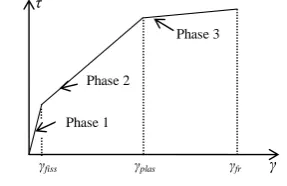
In the classical studies about this subject, shear strength is neglected or taken into account by simply formula of the theory of linear elasticity. Some advanced methods [2], [3], [6], [8], [11]-[17] calculate a variable concrete shear modulus by solving a complex system of equations; namely equilibrium equations, compatibility equations and constitutive laws of the materials One simple empirical equation for the calculation of the post-cracking shear modulus was proposed in [18]. In this study, we distinguish three phases of behaviour (see Fig. 3). Then we propose
formulas to calculate the shear modulus of concrete defined by a parametrical study about some experimental results presented by Vecchio and Collins [16]. Shear modulus is calculated by the linear elasticity before concrete cracking and it is functions of reinforcement and concrete after concrete cracking and after plasticization of steel.
ct rt c ct
ftj
Ec
Fig. 1. Model for calculating the tensile behavior of concrete
σs
fe
εe εu εs
-fe -εu -εe
Fig. 2. Idealized stress-strain of the steel
A. Experimental Observations
Fig. 3 shows the curves of shear stress (τ) as a function of shear strain (γ) testing of the walls tested by Vecchio and Collins [16]. The curve comprises a linear phase elastic values γ ≤ γfiss (Phase 1): the transverse deformation modulus
(G) is calculated by the linear theory of elasticity. In the second part (phase 2), for values of γ between γfiss and γplas,
the transverse deformation modulus (G) depends on the characteristics of the concrete and the steel see (6). The phase 3, for values of γ ≥ γplas, corresponds to the plasticization of
steels: the modulus G also depends on the characteristics of the materials see (7).
τ
Phase 2
Phase 1
Phase 3
γfiss γplas γfr γ
Fig. 3. Shape of the experimental curves (stress-shear strain)
where is shear stress, is shear strain,
fissistheshear strain corresponding to cracking concrete,
plasisthe shear strain corresponding to steel plasticization,
fristheshear strain corresponding to cracking of steel.B. Calculation of Transverse Deformation Modulus G
(Proposed Equations)
Phase 1: Before cracking of concrete, the theory of linear elasticity is valid, the transverse deformation modulus G is a function of longitudinal deformation modulus Ec of concrete,
and it is given by (5).
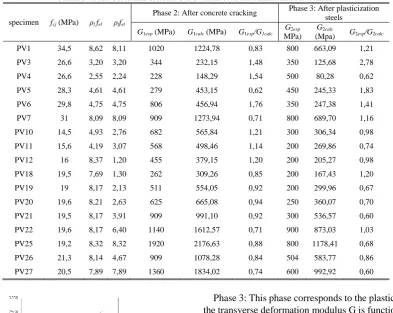
[16] has allowed us to establish a relationship between the transverse deformation modulus G to the characteristics of
material see (6) and Table I.
TABLEI: DETAIL OF EXPERIMENTAL AND TESTS AND VERIFICATION OF TRANSVERSE DEFORMATION MODULE G- PHASE 2: AFTER CONCRETE CRACKING AND PHASE 3: AFTER PLASTICIZATION STEELS.
specimen fcj(MPa) ρl fel ρtfet
Phase 2: After concrete cracking Phase 3: After plasticization steels
G1exp(MPa) G1calc(MPa) G1exp/G1calc G2exp MPa)
G2calc
(Mpa) G2exp/G2calc PV1 34,5 8,62 8,11 1020 1224,78 0,83 800 663,09 1,21
PV3 26,6 3,20 3,20 344 232,15 1,48 350 125,68 2,78
PV4 26,6 2,55 2,24 228 148,29 1,54 500 80,28 0,62
PV5 28,3 4,61 4,61 279 453,15 0,62 450 245,33 1,83
PV6 29,8 4,75 4,75 806 456,94 1,76 350 247,38 1,41
PV7 31 8,09 8,09 909 1273,94 0,71 800 689,70 1,16
PV10 14,5 4,93 2,76 682 565,84 1,21 300 306,34 0,98
PV11 15,6 4,19 3,07 568 498,46 1,14 200 269,86 0,74
PV12 16 8,37 1,20 455 379,15 1,20 200 205,27 0,98
PV18 19,5 7,69 1,30 262 309,26 0,85 200 167,43 1,20
PV19 19 8,17 2,13 511 554,05 0,92 200 299,96 0,67
PV20 19,6 8,21 2,63 625 665,08 0,94 250 360,07 0,70
PV21 19,5 8,17 3,91 909 991,10 0,92 300 536,57 0,60
PV22 19,6 8,17 6,40 1140 1612,57 0,71 900 873,03 1,03
PV25 19,2 8,32 8,32 1920 2176,63 0,88 800 1178,41 0,68
PV26 21,3 8,14 4,67 909 1078,28 0,84 504 583,77 0,86
PV27 20,5 7,89 7,89 1360 1834,02 0,74 600 992,92 0,60
(a) Phase after cracking of the concrete
(b) Phase after plasticization of the steels
Fig. 4. Evaluation of the module G from the experimental trials
Fig. 5. Comparison of calculated values of G relative to experimental values of G for two phases (2 and 3)
Phase 3: This phase corresponds to the plasticization steels, the transverse deformation modulus G is function as material characteristics see (7) and Table I.
We note:
cj el l et t
f f f
w
(4)where
t is transverse reinforcement ratio,
l is longitudinal reinforcement ratio, fet is yield stress of transverse reinforcement, fel is yield stress of longitudinal reinforcement, fcjis the concrete compressive strength.In Fig. 4 we trace G, experimental values, depending on the parameter w. Of all the tests analyzed, we find that the lines
w
G604 and G327winclude all the experimental points.
Therefore, we propose the relationship given in (5), (6) and (7) for the calculation of the transverse module G.
) 1 (
2
Ec
G (0
fiss) (5) 604wG (
fiss
plas) (6)27w
G3 (
plas
fr) (7)where
fiss 0.00003;
plas0.0025;
fr 0.006; is the Poisson‟s ratio, it‟s taken equal 0.2The Fig. 5 shows the relationship Gexperimental / Gcalculus for
phases 2 and 3 depending on the compressive strength of concrete.
with (6) and (7) and the experimental values for all walls studied.
where G1exp is the shear modulus observed experimentally in
the post-cracking stage, G2exp isthe shear modulus observed
experimentally after plasticization of steels, G1calc is shear
modulus calculated using (6), G2calc is shear modulus
calculated using (7). (a) Local and Intrinsic coordinate system
(b) Global coordinate system yG
xG
zG o
x
y J
0
I
z yo
xo
zo
Jo Io
Fig. 6. Geometry of the deformed element
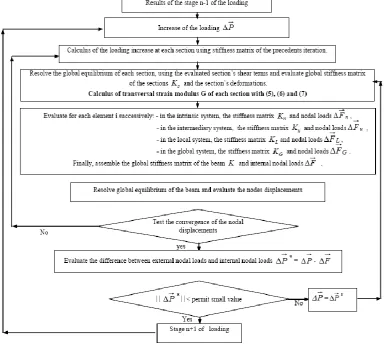
Fig. 7. General organization of the calculus method
V. PROCEDURE FOR CALCULATING THE EQUILIBRIUM STATE OF THE ELEMENT
The structure is discretized into finite elements. Elements are bars with two nodes and each node has six degrees of freedom: three translations and three rotations.
The notations used in the remainder of this chapter are explained in appendix.
The equilibrium Equation of the section in the intrinsic system is given by (8); the transversal strain modulus G is
calculated using (5), (6) and (7).
K Fs s
(8)
Equation (8) is solved by an iterative method. Its solution may be written as:
s -s F
K
1 (9)B. Calculating the Element Stiffness Matrix in the Intrinsic System
Loads acting over the section are functions of the applied forces at element nodes. Their expression is given by:
n s
=
L(x)
F
F
(10) If the length variation of the element is neglected, the IACSIT International Journal of Engineering and Technology, Vol. 6, No. 4, August 2014A. Equilibrium of the Section
We consider the global coordinate system xGyGzG and
xoyozois the local coordinate system related to the initial
position of element. Under the effect of loading, Io node
(respectively Jo) of the element is movedI (respectively J).
expression of the deformation vector Sn of the element, in the intrinsic system, is given using the virtual work theorem which stipulates that the virtual work of the section‟s deformations increase is equal to the virtual work of the section‟s loads increase. The expression is shown as:
dx ) x ( δ ) x ( L S
L T n
0
(11)
Thus, we may write the equilibrium equation of the element in the intrinsic system as follows:
n n n K S
F
(12)
The stiffness matrix Kn of the element, in the intrinsic
system, is evaluated as follows by combining the
relationships (9), (10), (11) and (12):
L
-s T
-n L (x)K L(x)dx
K
0
1
1 (13)
C. Resolve Global Equilibrium of the Beams Element
The second order effects are introduced by transforming the equation from intrinsic system to intermediate system. In fact, the relationship between the expressions of the displacement in intrinsic and intermediate systems, using a geometrical transformation matrix
B
, is given by (14).
u n B S
S
(14)
The equilibrium equation in the intermediate system is given as follows:
u n
T
u ( B K B D) S
F
(15)
The geometric transformation matrix
D
is calculated by neglecting the displacement contribution and the non-linear term.In the local system, using transformation matrix T0, the
element equilibrium may be written as:
L 0 n
T 0
L T (BK B D)T S
F
(16)
The element stiffness matrix KLin the local system may finally be written as:
D)T B K (B T
KL 0T n 0 (17)
Using the rotation matrix TG , the equilibrium equation for the global system may be written as:
G G G G L T G
G T K T S K S
F
(
18)D. Organizational Computing
The procedure described above to determine the equilibrium state of the element is shown in Fig. 7.
VI. COMPARISON WITH EXPERIMENTAL RESULTS
A. Tests of Stuttgart (Beams ET)
To validate our approach, we compare the load – deflection curves obtained with the present model and the experimental curves deduced from the shear tests tested by Stuttgart in [19]. These beams have different cross-sections (see Fig. 8) and Table II summarizes the main mechanical characteristics of the materials used.
TABLEII:MATERIAL PROPERTIES OF STUTTGART TESTS
Concrete (MPa)
Longitudinal reinforcement
(MPa)
transversal reinforcement
(MPa)
Ec= 23800 Ea = 210000 Ea= 200000
fcj = 28.5 fel = 420 fet= 320
50 110 450
4 Ø 20 2 Ø 10
200 1050 900 1050 200
F F
350
(a) Schematic of loading and detail of reinforcement in beams
300
350
75
b 4 Ø 20 2 Ø 10 Stirrup
Ø 6/110
350
300 Stirrup Ø 6/110
300
4 Ø 20 2 Ø 10
(b) Beam ET1 (c) Beam ET2 (b=100 mm) (d) Beam ET3 (b=150 mm) Fig. 8. Stuttgart shears test setup, specimen geometry (mm) in [19]
.
(a) Beam ET1
(c) Beam ET3
Fig. 9. Numerical and experimental load-deflection curves for the Stuttgart beams
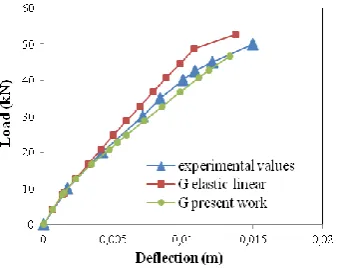
The superposition of the calculated curves to the experimental curves for the three beams ET1, ET2 and ET3, is given in Fig. 9. The comparison is made on the one hand with respect to the experimental results and also relative to the calculation in the case where G is considered the field of linear elasticity.
It appears that in the case of highly stressed beams in shear, it is essential to take into account the shear deformations in nonlinear to better approximate the experimental curves.
B. Tests of CEBTP (Beams OG)
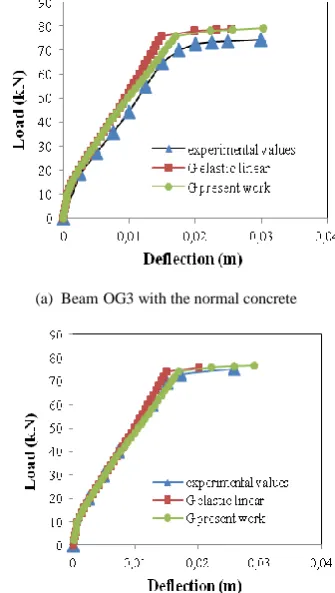
These are two identical beams with respect to the dimensions and reinforcement (see Fig. 10). The beam "OG3" made with normal concrete and the beam "OG4" made with high strength concrete were tested by Fouré [20]. The main characteristics of the materials are summered in Table III.
TABLEIII:PRINCIPAL CHARACTERISTICS OF THE MATERIALS
Beams OG3 OG4
Concrete
fcj = 52.5 MPa
Ec = 39900 MPa
ε0 = 1.7 ftj= 3.35 MPa
fc j= 71 MPa
Ec = 46900 MPa
ε0= 1.9
ftj= 4.05 MPa Longitudinal
And Transversal Reinforcement
Ea = 205000 MPa
fel= 575 MPa
fet = 575 MPa
Ea= 210000 MPa
fel = 590 MPa
fet= 590 MPa
150 mm 9sp. =150 mm 16 16 9 sp. =150 mm
P P
Ø 6 9 Stirrups Ø 6 2 Ø 6 3 Stirrups
Ø 4
2 Ø 1 6
L = 3.30 m
A A
(a) Schematic of test of beams OG
151 mm
25
m
m
25
m
m
2 Ø 6
2 Ø 16
2
45
mm
151 mm
25
m
m
25
m
m
2 Ø 6
2 Ø 16
2
4
4
mm
(b) Cross section A-A (OG3) (c) Cross section A-A (OG4) Fig. 10. Geometry and reinforcement of OG beams;tests of CEBTP [20].
The superposition of the calculated curves to the experimental curves for the two beams OG 3 and OG 4 is given in Fig. 11.
(a) BeamOG3 with the normal concrete
(b) Beam OG4 with the concrete of high strength Fig. 11. Load-deflection curves for the OG beams
The comparison is made on the one hand with respect to the experimental results and also relative to the calculation in the case where G is considered in the field of linear elasticity.
Curves calculated by taking the current modeling approach better curves obtained experimentally.
C. Tests of CEBTP (beams HZ)
The computing method is used for calculation of HZ4 beam tested by Trinh at CEBTP [15]. The dimensions and reinforcement details of the beam are shown on Fig. 12 and the characteristics of the materials are given in Table IV.
A B P P
2.5 m 2.5 m 2.5 m 2.5 m
(a)Schematic of loading of the beam HZ4
(b) Section A (c) Section B
Fig. 12. Dimensions and details of reinforcement for beam HZ4 tested by Trinh [15].
TABLEIV:STEEL AND CONCRETE CHARACTERISTICS
Concrete reinforcement
beam
fc j
(MPa )
ftj
(MPa )
Ec
(MPa) steel
fel
(MPa )
fet
(MPa)
Ea
(MPa)
HZ4 32 3.3 32000
HA20 424 424 19500 0 HA25 450 450 23000
0
The Fig. 13 shows the evolution of the beam deflection at the loading point as function of the applied load for the HZ4 beam, in the experience, in proposed method and in a non linear calculus with shear stiffness preserve the linear elastic value.
Fig. 13.Load-deflection curves for the beam HZ4
The Fig. 13 clearly shows the importance of taking into account the variation of the shear modulus in the behavior of the beam that the failure occurred by shear.
D. Hyperstatic Continuous Beam (Test of Pera)
The computing method is used for calculation of the beam tested by Pera in [21]. The reinforcement details of the beams are shown on Fig. 14, and the characteristics of the materials are given in Table V.
P
2.5 m 2.5 m 5 m
(a) Diagram of loading of the beam
2T8
2T8 2T32 2T32
A
A
(b) Longitudinal section and details of reinforcement
Stirrup Ø 8 (s =7cm)
20 cm
50
c
m
2T8
2T32
(c) Section A-A
Fig. 14. Geometrical characteristics and Details of Beam in [21].
TABLE V: MATERIAL PROPERTIES OF PERATEST
Concrete Longitudinal and
transversal reinforcement
fc j
(MPa)
ftj
(MPa)
Ec
(MPa)
fel
(MPa)
fet
(MPa)
Ea
(MPa)
41 3.1 25000 368 368 200000
The Fig. 15 shows the evolution of the beam deflection at
the loading point as function of the applied load for beam, in the experience, in proposed method and in a non linear calculus with shear stiffness preserve the linear elastic value.
Fig. 15.Load-deflection curves for Pera‟s beam
The curve calculated with the present study approach very satisfactorily the experimental curve from the point of view of the effort and from the point of view distortion.
E. Cranstan Frame
The computing method is used for calculation of the frame tested by Cranstan in [4]. The reinforcement details of the frame are shown on Fig. 16, and the characteristics of the materials are given in Table IV.
A
264 cm
193 c
m
P/2 P/2
H
(a)Dimensions of frame and detail of loading
6Ø 9.5 Stirrup Ø 8 (s =7cm)
10.16 cm
15
.24
c
m
2Ø 9.5
(b) Cross section at mid span
Fig. 16. Geometrical characteristics and details of the reinforcement of the frame tested by Cranstan in [4].
TABLEIV:CHARACTERISTICS OF THE MATERIALS
Concrete Longitudinal and transversal reinforcement
fc j =34 MPa
ftj = 2.59 MPa
Kb= 1.15
K’b= 2.15
ε0 = 0.0002
Ec= 34 000 MPa
fel= 278 MPa
fel = 278 MPa
Ea= 200000 MPa
with shear stiffness preserve the linear elastic value.
Fig. 17. Load-deflection curves for the Cranstan frame
We can see at the experimental and numerical load-deflection response for this structure exhibit a good agreement for the various stages of the behaviour comparatively to the calculus with shear modulus is constant given by the linear elasticity.
VII. CONCLUSION
We presented a model based on the strip-analysis of the sections using a simply formula for the shear modulus tanked into a count not constant of the linear elasticity but variable with the variation of the shear strain. This model is able to predict the behaviour of beams with sections having unusual shapes or reinforcing details, loaded in combined bending, axial load and shear.
Indeed, the predicting results of the model compared with the test results show that, on the one hand, the model predictions are in good agreement with the experimental behaviour in any field of the behaviour (after cracking, post cracking, post steel yielding and fracture of beam), and, on the other hand, the model permits to predict shearing fracture modes for reinforced concrete beams (see the beam HZ4, Fig. 13) and flexion fracture mode (see Fig. 15 and 17).
In perspective, it is to introduce this procedure in the case of other types of structures, such as; beams with external prestressing, concrete beams reinforced with metal fibers, tubular sections and beams - reinforced concrete walls
APPENDIX
The notations used in chapter V, which shows the procedure for calculating the equilibrium of the element, are described below.
s
K is the section stiffness matrix in the intrinsic system. s
F
is vector of exterior loads increase of the cross section it„s expression is given by:
Tz y z y
s= N x , M (x) , M (x) , V (x), V(x) , Mcx
F ( ) ( )
Where Nis the axial load increase, Myis the bending moment increase about y axis, Mz is the bending moment increase about z axis, Vyis the shear increase in the y axis,
z
V
is the shear increase in the z axis, Mcis the torsion
moment increase.
is increase deformation vector of the section, given by the following equation:
Tx z y z y
g , , , , ,
=
0 0 1 0 0 0 0 1 0 0 1 0 1 0 0 1 0 0 0 0 1 0 0 0 0 0 1 0 0 0 0 0 0 1 ) ( x x x x x Lwherex is the abscissa of the cross section relative to intrinsic
system coordinates.
is the length of the element after deformation.n
F
is nodal loads increase in the intrinsic system coordinates.
u
F
is nodal loads increase in the intermediate system coordinates.
L
F
is nodal loads increase in the local system coordinates.
G
F
is nodal loads increase in the global system coordinates.
n
S
is nodal displacements increase in the intrinsic system coordinates.
u
S
is nodal displacements increase in the intermediate system coordinates.
L
S
is nodal displacements increase in the local system coordinates.
G
S
is nodal displacements increase in the global system coordinates.
G
K isthe stiffness matrix of the element in the global system.
REFERENCES
[1] A. Grelat, “Nonlinear behavior and stability of indeterminate
reinforced concrete frames,‟‟ Comportement non Linéaire Et Stabilité
Des Ossatures Hyperstatiques En béTon Armé,‟ Doctoral Thesis, University Paris VI, 1978.
[2] M. S. Kachi, “Modeling the behavior until rupture beams with external
prestressing,‟‟ (Modélisation Du Comportement Jusqu‟à Rupture Des
Poutres À Précontrainte Extérieure), Doctoral Thesis, University of Tizi Ouzou, Algeria, 2006.
[3] M. S. Kachi, B. Fouré, Y. Bouafia, and P. Muller, “Shear force in the modeling of the behavior until rupture beams reinforced and prestressed concrete,‟‟ (l‟effort tranchant dans la modélisation du IACSIT International Journal of Engineering and Technology, Vol. 6, No. 4, August 2014
where
g is the axial strain increase,
yis the curvature increase about y-axis,
z is the curvature increase aboutz-axis,
y is the shear deformation increase about y-axis, z
is the shear deformation increase about z-axis,
xis the torsional increase about x-axis.comportement jusqu‟à rupture des poutres en béton armé et précontraint), European Journal of Engineering, vol. 10, no. 10, pp. 1235-1264, 2006.
[4] O. N. Rabah, “Numerical simulation of nonlinear behavior of frames
Space,‟‟ (Simulation Numérique Du Comportement Non linéAire Des
Ossatures Spatiales), Doctoral Thesis, Ecole Centrale de Paris, France, 1990.
[5] F. Robert, “Contribution to the geometric and material nonlinear
analysis of space frames in civil engineering, application to
structures,‟‟ (Contribution À l‟Analyse Non linÉaire Géométrique Et Matérielle Des Ossatures Spatiales En Génie Civil, Application Aux Ouvrages D‟art), Doctoral Thesis, National Institute of Applied Sciences of Lyon, France, 1999.
[6] F. J. Vecchio and M. P. Collins, “Predicting the response of reinforced concrete beams subjected to shear using modified compression field theory,‟‟ ACI Structural Journal. pp. 258-268, May-June 1988. [7] A. Adjrad. M. Kachi. Y. Bouafia, and F. Iguetoulène, “Nonlinear
modeling structures on 3D,‟‟ in Proc. 4th Annu.icsaam 2011.
Structural Analysis of Advanced Materials,Romania, pp. 1-9, 2011.
[8] Y. Bouafia, M. S. Kachi, and P. Muller, “Modelling of externally prestressed concrete beams loaded in combined bending, axial load and shear until fracture (in non linear elasticity),‟‟ in Proc. 2009 ICSAAM.
2009, Tarbes, France, pp. 1-7, 2009.
[9] M. Virlogeux, “Calculation of non-linear structures in elasticity,‟‟, “Calcul des structures en élasticité non linaire,‟‟ Annals of Roads and
Bridges, no. 39-40, 1986.
[10] Calculation of concrete structures Part 1-1: General rules and rules for buildings, (Calcul des structures en béton, Partie 1-1 : Règles générales et règles pour les bâtiments), Eurocode 2, ENV 1992-1-1, NF P 18 711, 1992.
[11] A. Belarb and T. T. C. Hsu, “Constitutive law of concrete in tension and reinforcing bars stiffened by concrete,‟‟ ACI Structural Journal, pp. 465-474, 1994.
[12] A. L. Dall‟Asta and R. A Zona, “Simplified method for failure analysis of concrete beams prestressed with external tendons,‟‟ ASCE Journal
ofStructural Engineering, vol. 133, no. 1, pp. 121-131, January 2007.
[13] T. T. C. Hsu, “Non-linear analysis of concrete membrane elements,‟‟
ACI Structural Journal, pp. 552-561, 1991.
[14] T. T. C. Hsu and L. X. Zhang, “Tension stiffening in reinforced concrete membrane elements,‟‟ ACI Structural Journal, pp. 108-115, 1996.
[15] J. L. Trinh, “Partial prestressing- Tests continuous beams
“Précontrainte partielle - Essais de poutres continues,‟‟ Annals of the Technical Institute of Building and Public Works,no. 530, pp. 1-31,
January 1995.
[16] F. J. Vecchio and M. P. Collins, “The response of reinforced concrete to in-plane shear and normal stresses,‟‟ University of Toronto, Department of Civil Engineering, pp. 82-03, March 1982.
[17] F. J. Vecchio and M. P. Collins, “The modified compression field theory for reinforced concrete elements subjected to shear,‟‟ ACI
Journal. pp. 219-231, March-April 1986.
[18] K. N. Rahal, “Post-cracking modulus of reinforced concrete membrane elements,‟‟ Engineering Structures, vol. 32, pp. 218-255, 2010. [19] S. Mohr, J. M. Bairan, and A. R. Mari, “A frame element model for the
analysis of reinforced concrete structures under shear and bending,‟‟
Engineering Structures, vol. 32, pp. 3936-3954, 2010.
[20] B. Fouré, “Deformation limits of tensile reinforcement and concrete in
compression for seismic design of structures,‟‟ in Proc. National Conference AFPS, Paris, July 2000, vol. II, pp. 67-74.
[21] Z. S. Ameziane, "Cyclic behavior of ordinary concrete and BHP", “Comportement cyclique des bétons ordinaires et des BHP,” Doctoral Thesis, Doctoral school, Nantes, France, 1999.
Arezki Adjrad was born on May 6, 1969 in Algeria.
He has been an assistant lecturer since 2003, at University “Mouloud Mammeri” of Tizi-Ouzou, 15000, Algeria. He was also a member of Laboratory LaMoMS (experimental and numerical modeling of materials and structures of civil engineering), UMMTO. He is invested in research themes: materials, experimentation, external prestressing, numerical modeling and nonlinear calculation of structures.
Youcef Bouafia was born on August 29, 1961 in Algeria. He has been a professor at University “Mouloud Mammeri” of Tizi-Ouzou, 15000, Algeria since 2003 and he was a lecturer from 1993 to 2003. He was a member of Laboratory LaMoMS (Experimental and Numerical Modeling of Materials and Structures of Civil Engineering), UMMTO. He got his PhD from thesis of central School, Paris in 1991. He was director of laboratory “LaMoMS” from 2002 to 2012 and Head of Department of Civil Engineering from 1999 to 2002. Prof. Bouafia is invested in research themes: materials and composites, experimentation, external prestressing, numerical modeling and nonlinear calculation of structures.
Mohand Said Kachi was born onMay 3, 1966 in Algeria. He has been a professor since 2012, at University “Mouloud Mammeri” of Tizi-Ouzou, 15000, Algeria and Lecturer from 1993 to 2012. He was a member of Laboratory LaMoMS (Experimental and Numerical Modeling of Materials and Structures of Civil Engineering), UMMTO. He got his PhD from University of Tizi-Ouzou in 2006. He has been a member of the laboratory LaMoMS since 2002. Prof. Kachi is invested in research themes: materials, experimentation, external prestressing, numerical modeling and nonlinear calculation of structures.
![Fig. 8. Stuttgart shears test setup, specimen geometry (mm) in [19] .](https://thumb-us.123doks.com/thumbv2/123dok_us/1362022.1645466/5.595.309.547.172.505/fig-stuttgart-shears-test-setup-specimen-geometry-mm.webp)
![Fig. 16. Geometrical characteristics and details of the reinforcement of the frame tested by Cranstan in [4]](https://thumb-us.123doks.com/thumbv2/123dok_us/1362022.1645466/7.595.53.281.56.127/fig-geometrical-characteristics-details-reinforcement-frame-tested-cranstan.webp)