e-ISSN: 2278-7461, p-ISSN: 2319-6491
Volume 7, Issue 1 [january 2018] PP: 01-10
www.ijeijournal.com Page | 1
Tractor Traffic Influence on Soil Properties, Growth and Yield of
Maize in Obubra, Nigeria
Odey, Simon Ogbeche
Department of Wood Products Engineering, Cross River University of Technology, Calabar, Nigeria Correspondence Author:Odey, Simon Ogbeche
Abstract:
A study was conducted at the Research Farm of Department of Agronomy, Cross River University of Technology, Obubra Campus during the 2016 season; with the objectives of ascertaining the influence of tractor traffic on soil properties, growth and yield of maize. The land was manually cleared and ploughed. Four treatments replicated three times were imposed, making a total of 12 plots. The treatments included - No tractor traffic, (A0), 10tractor traffic, (B10), 20 of tractor traffic, (C20) and 30 tractor traffic, (D30). Each plot measured 9 m2. A gross
experimental size of 567 m2 was used. The treatments were laid in a Randomized Complete Block Design (RCBD). A 50 kW tractor was used ininducing compaction on the plots according to the treatments. Soil samples were taken before and after treatments for measurement of physico-chemical properties in the laboratory. Maize (FAMMAX-15) seeds were planted. Data on growth and yield parameters were measured. Analysis was carried out on the data to obtain relationship between tractor traffic, soil properties and growth and yield parameters of maize. Increased tractor traffic led to increase in soil cone index, bulk density and reduction in soil moisture and porosity. Tractor traffic had high positive correlation with bulk density and negative correlation with soil porosity, soil moisture and growth and yield parameters of maize. Bulk density increased with tractor traffic while soil porosity, maize growth and yield reduced with increased tractor traffic. The plots with 30 tractor passes had the lowest grain yield. It was observed that at maturity maize yield on the A0 plots had a mean value of 2.56 t/ha, B10 had 2.11 t/ha, C20 had 1.56
t/ha and D30 had 1.67 t/ha respectively. Regression model for predicting yield of maize before maturity was
formulated. It had coefficient of linearity and standard error of 0.645 and 0.43 respectively.This research has brought to bear the need for controlled tractor traffic on agricultural soils in order to curtail its negative effects on soil and crop yield. Minimum number of tractor traffic below 10 passes on asandy loam field is convenient for effective maize cultivation.
Keywords:
Compaction,Growth, Maize,Properties,Tractor Traffic, Yield--- --- Date of Submission: 12-12-2017 Date of acceptance: 22-01-2018
--- ---
I.
INTRODUCTION
agricultural soils is a global concern since it has adverse effects on the environment and consequently, agricultural production. They further revealed that it is estimated to be responsible for the degradation of an area of 33 million ha in Europe and is one of the major problems facing modern agriculture in the world today. According to Manor and Clark (2001); Wells et al. (2005); and Alameda and Villar (2009) soil compaction reduces crop growth and yields, by restricting root development as well as water and air movement in the soil.
www.ijeijournal.com Page | 3 bulk density is >1.47 g/cm3. On the other hand for Sandy clay and silty clay soils, the ideal bulk density for root growth is < 1.10 g/cm3, while > 1.58 g/cm3 restricts root growth. According to Voorhees (1985) a medium textured soil, having a bulk density of 1.2 g/cm3 is generally favourable for root growth. However, roots growing through a medium textured soil with a bulk density near 1.2 g/cm3 will probably not have a high degree of branching or secondary root formation. In this case, a moderate amount of compaction can increase root branching and secondary root formation, allowing roots to thoroughly explore the soil for nutrients (Hakersson and Lipiec, 2000). This is especially important for plant uptake or non-mobile nutrients such as phosphorus (Giles, 1981)
1.2Objectives of the Research
The objectives of this research areto study the influence of tractor traffic on soil properties and to establish to what extent this affects growth and yield parameters of a maize crop.
II.
MATERIALS AND METHODS
2.1 Experimental Site
The Experiment was located at the Teaching and Research Farm of the Department of Agronomy, Cross River University of Technology, CRUTECH, Obubra Campus located on longitude 08o20’00’’E and latitude 6o05’00’’N. The area lies between the Central Senatorial District of Cross River state. Obubra has two distinct climatic seasons a wet season(from March to October) and a dry season (from November to February).
2.2 Experimental Design and Cultural Operation
The experiment was a Randomized Complete Block Design (RCBD) with three blocks (replications). Four (4) treatments and 3 replications were imposed on the land. Each plot size measured 3m x 3m separated from each other by 3 m for the maneuvering of the tractor. A gross experimental size of 27m x 21m was used for the experiment. The Treatmentsused were zero tractor movement (control),(A0), 10 tractor traffic,(B10), 20 tractor
traffic, (C20), 30 tractor traffic, (D30).The vegetation was manually removed from the plots before the tractor traffic
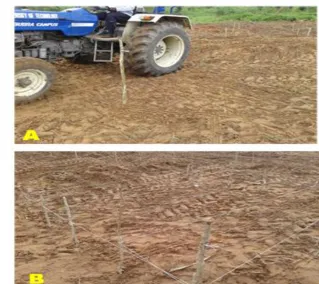
Figure 1: (A) Compaction of plots by tractor and (B) marking of compacted plots prior toplanting
2.4 Cone Index, Moisture Content and Other Soil Properties
Soil cone penetrometer and moisture meter were used to take cone index (CI) and moisture content (MC) of soil on all the plots before and after the treatments. These were taken at three ranges of depths - 0 – 15 cm, 16 – 30 cm and 31 – 45 cm. Soil samples were taken with soil cores and subjected to analysis for physical and chemical properties accordingly.
2.5 Planting and other Operations
The plots were marked and maize (FAMMAX-15) seeds were sown directly at the rate of 2 seeds per stand and at a distance of 70 cm x 30 cm (inter and intra row respectively) according to Anyanwu et al. (1998).A 15 – 15 - 15 (N.P.K) fertilizerwas applied at the rate of 30 g/plot. This was done 3 weeks after planting (3 WAP). Manual weeding was carried out at 2 WAP, 4 WAP and 8 WAP using hoe and cutlass before harvesting. Matured maize cobs were harvested, dried and de-cobbed. The maize cobs were shelled, winnowed and weighed according to treatments.
2.7Data Collection
The growth and yield response of maize to tractor traffic-induced soil compaction was measured by collecting data on regular (weeks after planting (WAP)) basis, deduced from (Reeder et al., 1993; Buttery et al., 1998; Dauda and Samari, 2002; Abu-Hamdeh, 2003; Lipiec et al., 2003; Amauri et al., 2007; Borghei et al., 2008; Weber and Biskupski, 2008; Soltanabadi et al., 2008; Botta et al., 2010; Juliano and Rosolem, 2010 and Becerra et al., 2010 and 2011). Among the parameters measured were height of maize, number of leaves, plant width, cob yield and grain yield.
2.8Data Analysis
The data obtained were subjected to statistical analysis according to the procedure for analysis of variance (ANOVA) for experiment laid out in a Randomized Complete Block Design. Correlation and regression analyses were carried out to obtain relevant relationship between parameters.
www.ijeijournal.com Page | 5 3.1 Results
The results of soil analysis show that the soil in the experimental plot was sandy loam, with values of organic matter, Nitrogen and other essential plant nutrients. It also has a moderate acidic PH value.Soil particle size
distribution before land preparation were 78.2 % sand, 11.5 % silt and 10.3 % clay (see tables 1 and 2).
Table 1: Mean Values of Soil Particle Size distribution after Treatment Application Sample Location % Sand % Silt %Clay Textural Class
A0 81.3 10.3 8.4 Sandy Loam
B10 80.0 10.7 9.3 Sandy Loam
C20 78.3 11.2 10.5 Sandy Loam
D30 76.3 12.1 11.6 Sandy Loam
Table 2:Chemical Properties of the Experimental Site
Chemical Properties Values
PH in water 5.92
Potassium Chloride (KCl) 5.08
Organic Carbon % 0.54
Organic matter % 0.93
Total Nitrogen % 0.078
Total Phosphorus % 3.50
Exchangeable Cation (Cmol/kg)2.81
Calcium (Ca) 3.50
Magnesium (mg) 1.52
Potassium (K) 0.25
Sodium (Na) 0.58
CEC 6.35
3.2Soil Moisture Content and Cone Index at Random Locations on the Field Before Treatment were Applied Figures 2 and 3 showed the distribution of soil compaction (cone index values) and moisture contents in fifteen locations on the agricultural field respectively. These were taken on the 15th of June 2012 prior to commencement of agricultural activities during the year. A lowest cone index of 1.034 MPa was measured at point D within a depth of 0 – 15 cm. While a lowest moisture content of 8.1% was measured at point F within a depth of 0
– 15 cm. The highest penetrometer readings of 1.586 MPa within this depth were measured at point J and N respectively. In general, highest penetrometer readings were recorded at depth of between 30 – 45 cm. Up to 3.999
MPa was obtained within this region. These findings agreed with that of Manor and Clark (2001) and the work of Kumar and Thakur (2005) who revealed that hard pans of 2.0 MPa and above are prevalent in most soils around the
globe. The Plot clearly revealed that cone index increases generally from the soil surface into the soil profile. But this was not the case with the soil moisture, as it was found to be irregular irrespective of the depths that were
Influence of Tractor Traffic on Soil Cone Index During Growth of Maize
www.ijeijournal.com Page | 7 Table 3: Influence of Tractor Traffic on Soil Cone Index During Growth of Maize in Obubra, Nigeria.
3.2 Effect of Tractor Traffic on Growth and Yield Parameters of Maize
Figure 4 (A0, B10, C20 and D20) showed growth of maize plant at 8 weeks after panting (WAP). Plant height
was influenced by tractor traffic. No tractor traffic (A0 Produced the tallest plants, this was followed by B10 having
10 runs of tractor traffic and C20 having 20 runs of tractor traffic. The least height of maize plant was observed from
D30plots that received 30 runs of tractor traffic. For example at 6 WAP one of the A0 plots had an average of 130.8
cm, B10 had 116.9 cm, C20 had 106.8 cm and D30 had 101.1 cm height respectively. The reduction in plant height in
the tractor trafficked plots likely resulted from soil compaction caused by several runs on the plots,possibly causing a reduced rooting depth and low soil moisture content due to increased soil bulk density. The result obtained showed that tractor traffic negatively affected the width of maize crop, as a result of increased bulk density and reduced porosity and soil moisture. Plots with no tractor passes produced the highest width followed by 10 and 20 passes of the tractor plots respectively. The plot with 30 passes of the tractor produced the thinnest crops width. Thus at 6 WAP one of the A0 plots had 1.35 cm, B10 had 1.32 cm, C20 had 1.24 cm and D30 had 1.23 cm average width
respectively The result on the number of leaves produced by maize plant as influenced by tractor traffic showed that tractor traffic affected significantly the number of leaves produced per plot, although not as much as the width and height of plants. Thus it is observed that at 6 WAP one of the A0 plots had 10.5, B10 had 10.1 cm, C20 had 9.7 and
D30 had 9.3 number of leaves respectively. On the average no tractor pass plots (A0) produced highest number of
leaves followed by (B10), C20and D30.The result obtained from the maize yield (cobs and grains) indicated that
tractor traffic influenced the number of cobs produced per plot. Plots with no tractor pass (A0) produced the highest
number of cobs followed by plots with 10, 20 and 30 passes of tractor wheels respectively. The least number of cobs were obtained from plots with 30 passes of tractor traffic. Also the grain yield was affected by tractor traffic, as the plot with no tractor passes gave the highest grain yield. Plots with 10 tractor passes followed suit while 20 passes of tractor plot came next. The plots with 30 tractor passes had the lowest grain yield. Thus it was observed that at maturity maize yield on the A0 plots had a mean value of 2.56 t/ha, B10 had 2.11 t/ha, C20 had 1.56 t/ha and D30 had
Figure 4: Growth of Maize at 8 WAP According to Treatments Operation (A0, B10, C20 and D20)
3.4Correlation Coefficients onEffect of Tractor Traffic on Soil Properties, Growth and Yield of Maize
The results obtained from the Pearson Correlation analysis showed that tractor traffic affected soil bulk density, soil moisture content and soil porosity which in turn affected the growth parameters of maize (plant height, plant width and number of leaves) and maize yield (cob yield and Grain yield). Thus tractor traffic on the plots had high positive correlation with bulk density and high negative correlation with soil moisture, soil porosity, growth parameters (plant height, width and number of leaves) and yield parameters (cob yield, cob weight and grain yield) of maize as shown in Table 4 below. The correlation coefficients were 0.928, -0.780, -0.890, -0.381, -0.500, -0.730, -0.534 and -0.769 respectively. Thus, soil bulk density affected growth and yield parameters negatively as shown. While soil porosity and soil moisture affected positively the growth and yield parameters of maize respectively as shown by their correlation coefficients.Thus, the results in this study on the reduction of growth and yield parameters of maize due to tractor traffic which lead to an increase in soil cone index and bulk density, reduction in soil porosity and moisture, agree with the work of (Dejong-Hugles et al. (2001, Manor and Clark, 2001; Soane and Ouwekerk; 1994; Peterson et al., 2004; Wells et al., 2005; Amauri et al., 2007; Borghei et al., 2008;USDA, 2008; Weber and Biskupski, 2008; Soltanabadi et al., 2008; Botta et al., 2010; Juliano and Rosolem, 2010; Becerra et al., 2010 and 2011 and Odey et al. (2014a, 2014b and 2014c), Odey, 2015)).
www.ijeijournal.com Page | 9 In the Regression analysis, tractor traffic was regressed with bulk density, porosity soil moisture, growth and yield parameters with grain yield as the dependent variable. A regression model was formulated as shown below.
Ym = 29.34 + 0.012TT – 11.5Bd – 0.75Ms – 0.25Ps + 0.03Mh - 0.34Mw + 0.37Ml … (1)
Where,
Ym = Grain yield
TT = Tractor traffic
BD = Soil Bulk density
Ms = Soil moisture
Ps = Soil porosity
Mh = Maize plant height
Mw = Maize stem width
Ml = Number of leaves of maize crop
The above equation (1) had a coefficient of linearity, R2 of 0.645 and standard (std.) error of 0.43, when the observed and predicted values were graphed. This equation shows that in any particular cropping season, the yield of maize, Ym can be estimated (predicted) in advance provided the number of machinery traffic on the land is known;
more over the knowledge of soil and growth parameters of maize must be measured at particular number of weeks, say 6 WAP.The analysis of variance among parameters showed that the mean difference is significant at the 0.05 level. The multiple comparisons revealed that the parameters responded to the different treatments accordingly with higher number of tractor traffic having significant impact on the soil properties and growth and yield parameters of maize.
IV.
CONCLUSION
The successful completion of this research has made it possible to deduce as follows - firstly, severalmovements of tractor wheels on the plots were found to negatively affected soil bulk densityand cone index as these considerably increased depending on the number of tractor passes on the land.While soil porosity and moisture were reduced as a result of the treatments.The growth and yield parameters of maize on the treatments plots were found to be negatively affected by tractor traffic. There was considerable reduction in yield of maize grain due to soil compaction which led to increased bulk density and reduction in porosity and moisture content of the soil.
[4]. Alameda, D. and Villar, R. Moderate soil compaction: Implications and growth and architecture in seedlings of 17 woody plant species. Soil and Tillage Research,2009, 103: 325-331.
[5]. Amauri, N. B., Jasse, F. C., Maria, A. P., Silva, F. O., Eurica, L. S., Cristian, L. S. and Alvaro, P. S. Traffic soil compaction of oxisol related to soybean development and yield. Journal of Agric. Science (Piracicaba, Brazil),2007, 64(6): 608-615.
[6]. Anyanwu, A. C.; Anyanwu, B. O. and Anyanwu, V. A. Agricultural Science for Schools and Colleges.5th Edition,1998, Africana – FEP Publishers Limited.
[7]. Bakker, D. M. and Davids, R. J. Soil deformation observations in a vertisol under field traffic, Austr. J. Soil Res., 1995, 33: 817-832. [8]. Becerra, A. T., Botta, G. F. Lastra Bravo, X., Tourn, M., BelloraMelcon, F., Vazquez, J., Rivero, D, Linares, .P., Nardon, G. Soil
compaction distribution under tractor traffic in almond (Prunusamigdalus L. ) orchard in Almeria Espana, Soil & Tillage Research, 2010, 107: 49-56.
[9]. Becerra, A. T., M. Tourn, G. F. Botta, and Lastra Bravo, X. Effects of different tillage regimes on soil compaction, maize (Zea mays L.) seedling emergence and yields in eastern Argentina Pampas region. Soil & Tillage Research, 2011, 117: 184-190.
[10]. Borghei, Am. Taghinejad, J., Minaei, S., Karimi M., and Varnamkhasti, M. G. Effects of sub soiling on bulk density, penetration resistance and cotton yield in northwest of iran. Int J. Agri-Biol, 2008, 10: 120-123
[11]. Botta, G. F., Jorajuria, D., Rosatto, H., Ferrero, C. Light tractor traffic frequency on soil compaction in the rolling Pampa region of Argentina, Soil & Tillage Research, 2006, 86: 9- 14.
[12]. Botta, G. F., Rivero, D., Tourn, M., Bellora, F., Melcon, O., Pozzolo, G., Nardon, R., Tolon, A., Becerra, H., Rosatto, S. Soil compaction produced by tractor with radial and cross-ply tyres in two tillage regimes, Soil & Tillage Research, 2008, 101: 44- 51. [13]. Botta, G. F., Tolon, A., Becerra, F., Bellora, F. Effect of the number of tractor passes on soil rut depth and compaction in two tillage
regimes. Soil & Tillage Research, 2009, 103: 381-386.
[14]. Botta, G. F., Tolon, A., Becerra, X. Lastra Bravo, M. Tourn.Tillage and traffic effects (planters and tractors) on soil compaction and soybean (Glycine max L.) yields in Argentinean pampas.Soil & Tillage Research, 2010, 110: 167- 174.
[15]. Botta, G.F., Jorajuria, D., Draghi, L. M. Influence of the axle load, tyre size and configuration on the compaction of a freshly tilled clayey soil. Journal of Terramechanics, 2002, 39: 47- 54.
[16]. Buttery, B. R., Tan, C. S., Drury, C. F., Park, S. J., Armstrong, R. J. and Park, K. Y. The effects of soil compaction, soil moisture and soil type on growth and nodulation of soybean and common bean. Can. J. Plant Sci. 1998, 78: 571–576.
[17]. Celik, A. and Raper, R. L. Design and Evaluation of ground-driven rotary subsoilers. Soil and Tillage Research, 2012, 124: 203-210. [18]. Chen, G. and Weil, R. R. Root growth and yield of maize as affected by soil compaction and cover crops. Soil and Tillage
Research,2011, 117: 17-27.
[19]. Chygarev, Y. and Lodyata, S. Research of tire rigidity in terms of ecological safety of agricultural landscapes, InstytutBudownictwa, MechanizacjiiElectryfikacjiRownictwa, Lublin, Poland, 2000, 171-176.
[20]. Dauda, A. and Samari, A. Cowpea yield response to soil compaction under tractor traffic on a sandy loam soil in the semi-arid region of northern Nigeria. Soil Till. Res., 2002, 68: 17-22.
[21]. David, D. and Adams, F.Crops of drier regions of the tropics.Longman Publishing Limited, Singapore, 1985, Pp: 92-98
[22]. DeJong-Hughes, J. M., Swan, J. B., Moncrief, J. F., Voorhees, W. B. Soil Compaction: Causes, Effects and Control (Revision). University of Minnesota Extension Service, 2001, BU-3115-E.
[23]. Donkor, N. T., Gedir, J. V., Hudson1, R. J., Bork, E. W., Chanasyk, D. S. and Naeth, M. A. Impacts of Grazing Systems on Soil Compaction and Pasture production in Alberta. Canadian Journal of Soil Science, 2002, 82: 1–8.
[24]. Duiker, S. W. Effects of Soil Compaction.Agricultural Research and Cooperative Extension, Pennsylvania State University. Available https://www.cas.psu.edu,2004, Accessed 17 February 2015.
[25]. FAO.Food and Agriculture Organization of the United Nations, Statistics Division. Maize, rice and wheat: area harvested, Production quality, yield. www.fao.org/docrep, 2009, Accessed 12 December 2014.
[26]. Giles, J. F. Effects of compaction on soil conditions and crop growth. In 1979 Sugar-beet Research and Extension Reports Cooperative Extension Service, NDSU, 1980.
[27]. Gregory, P. J. Root growth and activity. In Boote, K. J., Bennett, J. M., Sinclair, T. R. and Paulsen, G.M. (Eds.), Physiology and determination of crop yield. ASA-CSSA-SSSA, Madison, Wisconsin, USA, 1994, 65-93.
www.ijeijournal.com Page | 11 [29]. Hakersson, I. and Lipiec, J. A review of the usefulness of relative bulk density values in studies of soil structure and compaction. Soil
Till. Research, 2000, 53: 71-85.
[30]. Hakersson, I. and R. C. Reeder, Subsoil compaction by vehicles with high axle load- extent, persistence and crop response.Soil Till. Research, 1994, 29(2-3):277-304
[31]. Hamza, M. A., and Anderson, W. K., Soil compaction in cropping systems: a review of the nature, causes, and possible solutions. Soil Tillage Res., 2005, 82: 121–145.
[32]. Horn, R., and Fleige, H., A method of assessing the impact of load on mechanical stability and on physical properties of soils.Soil and Tillage Research, 2003, 73: 89- 100.
[33]. Horn, R., Vossbrink, J., Becker, S. Modern forestry vehicles and their impacts on soil physical properties, Soil & Tillage Research, 2004, 79: 207- 219.
[34]. Isaac, N. E., Taylor, R. K., Staggenborg, S. A., Schrock, M. D. and Leikam, D. F. Using cone index data to explain yield variation within a field. Agricultural Engineering International: the CIGR Journal of Scientific Research and Development, 2002, Vol IV.
[35]. Jarajuria, D. and Draghi, L. Sobrecompactaciondelsuelioagricola. Parte I: influenciadiferentialdel peso y del numero de pasadas, RevistaBrasileira de Engenharia Agricola e Ambiental, 2000, 4(2000): 445-452.
[36]. Juliano, C. C. and Rosolem, C. A. Soybean root growth and yield in rotation with cover crops under chiseling and no-till.European Journal of Agronomy, 2010, 33 (3): 242-249.
[37]. Kulkarni, S. S. Bajwa, S. G. andHuitink, G. Investigation of the effects of Soil compaction in cotton. Transactions of the ASABE. ISSN 2151-0032, 2010, 53(3): 667-674.
[38]. Li, X., Zhang, D., Zhang, R., Osman, A. N. Performance of an oscillating subsoiler in reducing resistance. Presentation of the American Society of Agricultural and Biological Engineers, 2012, Paper No. 12-1341191. St. Joseph, Michigan.
[39]. Lipiec, L. V. V. Medvedev, M. Birkas, E. Dumitru. T. E, Lyndina, S. Rousseva, and E. Fulajtar. Effects of Soil Compaction on root growth and crop yield in central and eastern Europe. Int. Agro Physics, 2003, 17: 61-69.
[40]. Manor, G. and Clark, R. L. Development of an Instrumented Subsoiler to Map Soil Hard-Pans and Real-Time Control of Subsoiler Depth.ASAE Annual International Meeting, Sacramento Convention Center, Sacramento, California, USA, August, 2001.
[41]. Manuwa S. I. and A. Adesina.Effect of Traffic Frequency of Medium Power Construction Machinery on Compaction of Arable Terrains. American Society of Agricultural and Biological Engineers, St. Joseph, Michigan www.asabe.org.2011, Accessed 23 May 2014. [42]. Manuwa, S. I. andOdubanjo, O. O. Compaction behaviour of Akure Sandy Clay Loamy Soils. Nigerian Journal of Soil Science, 2007,
17: 10-15.
[43]. Mari, G. R. and Changying, J. Assessing of Soil Compaction Using Some Soil Properties Caused by Agricultural Machinery Traffic. World Journal of Agricultural Sciences, 2007, 3 (5): 582-586.
[44]. Mari, G. R. and Changying, J. Influence of Agricultural Machinery Traffic on Soil Compaction Patterns, Root Development, and Plant Growth, Overview. American-Eurasian Journal of Agric. & Environmental Sciences, 2008, 3(1): 49-62.
[45]. Mason, E. G., Cullen, A. W. J. and Rijkse, W, C. Growth of two radiate pine stock types on ripped and ripped/bedded plots at Karioi Forest. New Zealand Journal of Forestry Science, 1988, 18: 287-296.
[46]. McCarthy D. F..Essentials of Soil Mechanics and Foundations. Upper Saddle River, NJ: Pearson Prentice Hall. P.595. ISBN, 2007, 0-13-114560-6
[47]. Monroe, C. D. and E. J. Kladivko.Aggregate stability of a silt loam as affected roots of maize, soybean and wheat, Commun. Soil Sci. Plant Anal., 1987, 18: 1077-1087.
[48]. Odey, S. O. Development of Instrumented Subsoilers and Effect of Compaction on Growth and Yield of Soybean.Ph.D Thesis, The Federal University of Technology, Akure, Ondo State, Nigeria, 2015.
[49]. Odey S. O.,Manuwa S. I. and Ademosun, O. C. Effect of Tractor Traffic and Moisture Content on Cone Index in a Crop-cultivated Land. Proceedings of Nigerian Branch of International Soil Tillage Research Organisation.ISTRO-Nigeria Symposium, Akure, 2014,.2014a, ISN – 978-187-472-4.
[50]. Odey S. O.,Manuwa S. I. and Ademosun, O. C. Growth and Yield Response of Soybean (verTGX-1448-2E) to Tractor Traffic Induced Soil Compaction in Sandy Clay Soil of Akure, Nigeria. Nigerian Journal of Soil Tillage Research, 2014b, 1: 62-74.
[51]. Odey, S. O., Manuwa, S. I., and Ademosun, O. C. Mean Relative Growth Rate, Leaf Area Index and yield of Soybean (TGX-1448-2E) as Affected by Cone Index in Sandy Clay Soil. Proceedings of the 35th Annual Meeting and 2014 International Conference of the Nigerian Institution of Agricultural Engineers (NIAE), September 22-26, AKURE 2014, 2014c.
[52]. Otto, R., Silva, A. P., Franco, H. C. J., Oliveira, E. C. A., and Trivelin, P. C. O. High Soil Penetration Resistance Reduces Sugarcane Root System Development. Journal of Soil and Tillage Research, 2011, 117: 201-210.
[53]. Raghavan, G. S. V.; Mokyes, E. and Chasse, M. Effect of Wheel Slip on Soil Compaction. J. Agric. Engg. Res., 1990, 22(2): 79-83. [54]. Raper, R. L., Reeves, D. W. Burt, E. C.Using in-row subsoiling to minimize soil compaction caused by traffic. Journal of Cotton
Science,1998, 2(3): 130-135.
[55]. Reeder, R. C. and Smith, J. M. Controlled traffic: In Conservation Tillage Systems and Management,1992, Ch. 10, 46-47. Ames, Iowa: MidWest Plan Service.
[56]. Reeder, R. C., Wood, R. K., and Finck, C. L. Five sub-soiler Designs and their Effects on soil properties and Crop Yields. Transaction of the American Society of Agricultural Engineers,1993, 36(6): 1525-1531.
[57]. Rocky L. Breaking soil compaction: Does it increase forage production? Mississippi State University Extension Service, 2011, Volume 4, Issue 1.
[58]. Shafiq, M., M.A. Hassan and S. Ahamed. Soil physical properties as influenced by induced compaction under laboratory and field conditions Soil Tillage Research, 1994, 29 (1-2): 13-22
[59]. Singh, K. K., Colvin, T. S., Ertach, D. C. and Mughal, A. Q. Tilth Index: An approach to quantifying soil tilth. Transaction of ASAE, 1992, 35(6): 1777 – 1785.
[60]. Soane, B. D., and C. V. Ouwerkerk.Soil Compaction in Crop Production.ISBN 0-444-88286.3.1994, Chap. 12, Pp 265-286
[61]. Soltanabadi, M. H., Miranzadeh, L, M., Karimi, L, M., Varnamkhasti, M. G. and Hemmat, A. Effect of subsoiling on soil physical properties and sun flower yield under conditions of conventional tillage. International.Agrophysics, 2008, vol. 22: 313-317.
[62]. Tardieu, F. Growth and functioning of roots and of root systems subjected to soil compaction. Towards a system with multiple signaling. Soil Tillage Research, 1994, 30: 217-243.