Abstract—
Data driven prognostics employs many types of algorithms some are statics and other are dynamics. Dynamic complex engineering systems such as automobiles, aircraft, and spacecraft require dynamic data modeling which is very efficient to represent time series data. Dynamic models are complex and increase computational demands. In previous work performed by the author, linear regression model is provided to estimate the remaining useful life left of an aircraft turbofan engines and overcome the complexity of using dynamic models. It was simple and efficient but it had some drawbacks and limitations. The same task is resolved again here using multilayer perceptron neural network (MLP NN). Results show that MLP NN as a static network is extensively superior to linear regression model and does not involve the complexity of dynamic models. Phm08 challenge data are used for algorithms training and testing. The final score obtained from MLP NN can be placed in the fifteenth position of the top 20 scores as published on the official site of the Phm08.
Index Term— Multi Layer Perceptron NN, Prognostics, Remaining Useful Life.
I. INTRODUCTION
Data driven prognostics is an efficient way to solve remaining useful life (RUL) estimation of a dynamic complex engineering systems such as automobiles, aircraft, and spacecraft. The main advantage of using data driven prognostics is to estimate RUL without any prior knowledge of underlying physics of the system.
The operational and sensors data of dynamic systems are always time series. Time series data represents operating conditions and system parameters every time point. RUL estimation of dynamic systems can be efficiently performed using any dynamic modeling like recurrent neural network used by Felix O. Heimes in [1]. Other time representation methods are to use static modeling techniques with time
A.M. Riad is with Information System Department, Faculty of Computer and Information Sciences, Mansoura University, Egypt. Hamdy K. Elminir is with National Research Institute of Astronomy and
Geophysics, Department of Solar and Space Research, Egypt. Hatem M. Elattar is with Information System Department, Faculty of Computer and Information Sciences, Mansoura University, Egypt (email:
delays. Both dynamic modeling and static modeling with time delays increases network complexity and computational demands. Leto Peel in [2] stated that "A significant characteristic of the PHM Challenge dataset is that it contains time series and therefore the representation of time or at least how to represent and take account of previous temporal observations is an important consideration. The quickest and simplest method for representing time is to consider each time point independently and create a prediction at each time step. An alternative representation would be to consider using a phase space embedding representation, in which a sequence of instances is generated using a fixed length sliding window. However phase space embedding has the significant drawback of increasing the number of dimensions proportionally with each time step represented, giving rise to the problems associated with the 'curse of dimensionality'. From preliminary experiments it was found that the prediction performance did not improve significantly using the embedding space representation given the increase in computational demands. Therefore the chosen representation was to predict remaining life using single time points".
The previous talk was the inspiration to use single time point representation of time series data. A previous research was performed named 'Forecast a remaining useful life of aircraft turbofan engines based on a linear regression model'. The previous work is in publication process, so a quick summary will be given in a separate section below. The linear regression model works fine but it has some drawbacks and limitations which will be discussed latter.
Another approach is to use MLP NN as a static modeling method and add indicators for the historical system run. This approach used in [2] which describes the winning method in the IEEE GOLD category of the PHM08 Data Challenge. Work described in [2] adopts direct RUL estimation from data based on all sensors readings and operating conditions. This paper describes usage of MLP NN with back propagation learning method to predict the system health of engines in test data set for further RUL estimation. The health index of engines in training data set is calculated based on the six regression models obtained in the previous work done using linear regression and work described in [3] and [4]. Only
Evaluation of Neural Networks in the Subject of
Prognostics As Compared To Linear Regression
Model
thirteen sensors out of twenty one are utilized in MLP NN training due to its behavior with degradation. Additional six features which added to describe historical system run and the three operating conditions are also included in training. The same data preprocessing are applied to the test data set to prepare the input to the network. The output values of HI for engines in test data set are further smoothed and extrapolated to calculate RUL for each engine. The developed algorithm here is scored by the same score function described in [5] which used to evaluate algorithms in 2008 PHM Data Challenge Competition and gives a competitive score.
II. DATA OVERVIEW
The challenge data is obtained from prognostic-data-repository of Prognostics Center of Excellence in National Aeronautics and Space Administration (NASA) [6]. Data sets are created by using high fidelity simulation system C-MAPSS (Commercial Modular Aero- Propulsion System Simulation) [7]. The process that describes how to use C-MAPSS to create the proposed data is described in [5].
A data set consisting of multiple multivariate time series is provided. This data set is further divided in to training and testing subset. Each time series is from a different instance of the same complex engineered system (referred to as a "unit") the data here is about several aircraft engines of the same type (turbofan engines). Each unit starts with different degrees of initial wear and manufacturing variation which is unknown to the user. This wear and variation is considered normal, i.e., it is not considered a fault condition. There are three operational settings that have a substantial effect on unit performance. These settings are also included in the data. The data is contaminated with sensor noise.
The unit is operating normally at the start of each time series, and develops a fault at some point during the series. In the training set, the fault grows in magnitude until system failure. In the test set, the time series ends some time prior to system failure. The objective is to predict the number of remaining operational cycles before failure in the test set, i.e., the number of operational cycles after the last cycle that the unit will continue to operate.
The training set includes operational data from 218 different engines. In each data set, the engine was run for a variable number of cycles until failure. The lengths of the runs varied, with the minimum run length of 127 cycles and the maximum length of 356 cycles. Fig. 1. shows two of the sensor measurements from the first sequence in the training data. The first sequence is 223 samples long. Fig. 1. (A) shows the first two sensor readings as a function of time index and Fig. 1. (B) shows the relationship between readings from the two sensors. The lower plot shows that the readings are clustered around six operating points and the variation around each operating point is very small compared to the magnitude of the readings. The upper plot shows that the readings jump from operating point
to operating point during each run.
.(A)
(B)
Fig. 1. Two of the sensor measurements from the first sequence in the training data set. (A) First two sensors readings as a function of time
index.
(B) Readings are clustered around six operating points
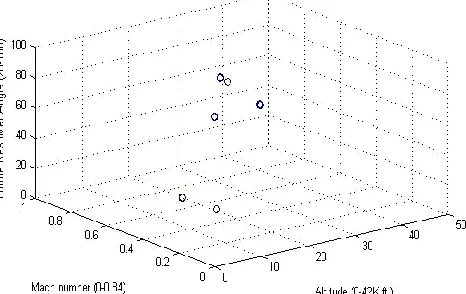
There are three operational conditions that have a substantial effect on unit performance (Altitude, Mach number, and Throttle Resolver Angle). The operational conditions for all engines can be clustered into six different regimes as shown in Fig. 2. The six dots are actually six highly concentrated clusters that contain thousands of sample points each.
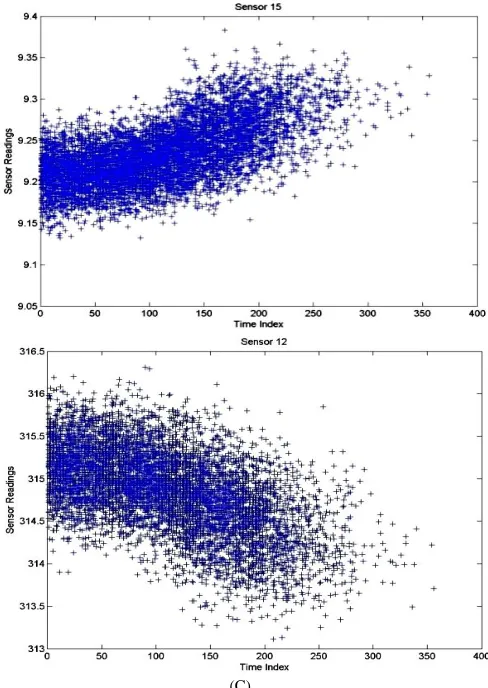
III. SUMMARY ABOUT LINEAR REGRESSION MODEL The previously created linear model was performed through two main phases, learning and testing. In the learning phase operating regime partitioning is performed to divide the training dataset into six clusters each cluster represents single operating regime. After rectangular regime partitioning sensor readings for each regime are explored. Sensors can be categorized into three groups as shown in Fig. 3. Sensors have one or more discrete values, sensors have continuous values but those values are inconsistent, and sensors have continuous and consistent values.
(A)
(B)
(C)
Fig. 3. Different Sensor Groups. (A) Sensors have one or more discrete values. (B) Sensors have continuous values but those values are inconsistent. (C) Sensors have continuous and consistent values.
Health index is adjusted to value 1 for the first five cycles in each engine run to indicate healthy engine, and to value 0 for the time index exceeds 300 to indicate failed engine. For models development only six sensors are selected from sensors that have continuous and consistent values. Those six sensors show high correlation with the health index. Six regression models are built for the six regimes using linear least square method in the form shown in (1).
N
i
i i
x
y
1
(1)
Where x = (x1, x2, …, xN) is the N dimensional feature vector, y
is the health indicator, (α, β) = (α, β1, β2, …, βN) is N+1 model
parameters, and ε is the noise term.
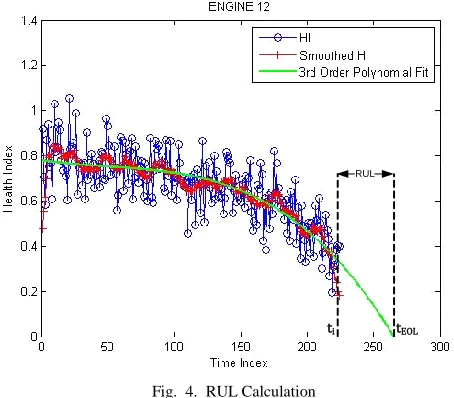
smoothed using simple moving average then curve extrapolated to calculate RUL for each engine run as shown in Fig. 4.
RUL
tEOL
ti
Fig. 4. RUL Calculation
This algorithm is scored by the same score function described in [5] which used to evaluate algorithms in 2008 PHM Data Challenge Competition and gives a score 6877. Equation (2) shows the score function and Fig. 5. shows the score as a function of the error.
(2)
Where s is the computed score, n is the number of UUTs (Unit under test (Engine)), d = tˆRUL− tRUL (Estimated RUL –
True RUL), a1 = 13, and a2 = 10.
Fig. 5. Score as a function of error
The main drawbacks of using the previous method can be
summarized as follow:
1) The score is limited to 6877 as best obtained score which is more than twice the score of the twentieth algorithm in the top 20 scores list of algorithms on test data set.
2) Regression models could not be evaluated before applying on test data set by methods like coefficient of determination due to unavailability of HI data. This cause requirement to check the efficiency of the model only on a test dataset which is time consuming.
3) This model does not take into consideration previous time points during its HI prediction.
4) Engines have few cycles of runs gives poor results in RUL estimation.
Using of MLP NN can eliminate most of the previous drawbacks and gives better results.
IV. METHODOLOGY
Multiple-layer networks are quite powerful. For instance, a network of two layers, where the first layer is sigmoid and the second layer is linear, can be trained to approximate any function (with a finite number of discontinuities) arbitrarily well. This kind of two-layer network is used extensively in back propagation. Two layers MLP NN with twenty two inputs, twenty nodes in hidden layers, and single node output layer is trained by back propagation to predict engine health index for further curve smoothing and extrapolation to estimate RUL. Number of nodes in hidden layers is chosen by trial and error. Rough approximation can be obtained by the geometric pyramid rule. According to this rule, for the three layer network (considering input layer as third layer) with n input and m output. The number of neurons in hidden layer was adjusted according the previous rule, then increasing the number of nodes to achieve best fit. Regarding not to increase number of nodes in hidden layer to a large number is taken into consideration to avoid over fitting. Activation function used in hidden layer is tan-sigmoid transfer function and in the output layer is linear transfer function. The work here can be divided into three main stages; Data preparation, Training, and Testing (simulation).
A. Stage 1: Data Preparation
number of sensors used to train the network is thirteen sensors to enhance network behavior as suggested in the future work in [2] and [4]. As long as it is well known that from [5] the operational settings have a substantial effect on unit performance, it will be used as an input to train the network.
2) Normalization: Data normalization is performed to give a uniform scale in a data set. The following formula in (3) is used for data normalization.
d
x
x
N
d d dd
,
)
(
(3)Where xd are the original data values for feature d, and d, d
are the mean and standard deviation respectively for that feature. Further normalization is performed in each mode to maximize the variance between modes as in [2]. Formula in (4) describes this normalization process.
d
m
x
x
N
mdd m d m d m
,
,
)
(
( , ) ) , ( ) , ( ) , (
(4)Where m refers to one of the six possible modes (regimes). 3) Sensors Reading Smoothing: The sensors data is contaminated with noise. Simple moving average is used to smooth sensors measurements for each engine in each regime. Fig. 6. shows the normalized and smoothed data of S2 measurements for engine number one in the first regime.
Fig. 6. Normalized and smoothed data of S2 measurements for engine number one in the first regime.
4) Adding Historical Run Indicator: Additional six features are added to represent total number of cycles spent in mode since the beginning of run. Those extra six features give a good indication of historical run in each mode to enhance the usage of static network. Fig. 7. shows the number of cycles spent in each mode for the first engine in sequence.
Fig. 7. Number of cycles spent in each mode for the first engine in sequence.
5) Health Index Prediction: The health index for each engine in training data set is calculated by the previously obtained six linear regression models from the previous work. The calculated HI has some values which does not make sense and need to be adjusted. The values of HI at the end of each engine run must be zero. Values during each engine run must not lower than or equal zero. Values lower than or equal zero during engine run are adjusted to the value equal to the average of the previous and next value as in (5).
2
1
1
i ii
x
x
x
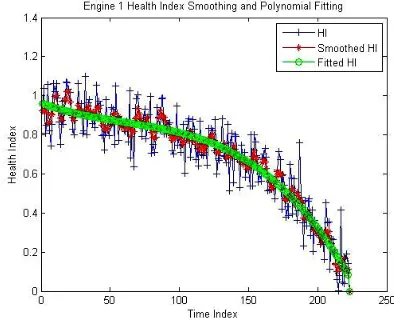
(5)Calculated health index for each regime are combined back to give a uniformly degraded behavior. Obtained health index values are further smoothed to decrease noise. Applying third order polynomial curve fitting to the smoothed HI data to obtain a very smooth degradation trend. The obtained data for HI can now be used as a target data in network training. Fig. 8. shows HI data smoothing and curve fitting to obtain the target data for engine 1 in training data set.
Fig 8. HI data smoothing and curve fitting to obtain the target data for engine 1 in training data set.
Finally after performing previous steps MLP NN training data can be described as follow:
-- Twenty two input parameters categorized as three operational settings, thirteen sensors measurement, and six features that represents historical run in each mode. -- Target data which is the final values of HI for all engines run in training data set.
B. Stage 2: Training
twenty nodes in hidden layer with tan-sigmoid transfer function, and single node output layer with linear-transfer function gives R = 0.98783 and MSE = 0.00171 Where R and MSE are the correlation coefficient and mean squared error between network output and target data respectively. The previous output obtained from single stage training. The results seem great so there is no need for additional training.
B. Stage 3: Testing (Simulation)
1) The first four steps in data preparation stage (Sensors selection, Normalization, Sensors reading smoothing, and Adding Historical Run Indicator) are applied to test dataset.
2) The trained network is simulated to predict health index for engines in test data set.
3) Health index calculated to each engine is further smoothed using simple moving average.
4) Second and third order polynomial curve fitting is applied on the smoothed health index data.
5) Extrapolation of polynomial curve is done until the health index value reaches zero.
6) RUL is calculated by subtracting the time at the point of prediction (ti) from the time at engine end of life (tEOL) (Fig. 9).
RUL = tEOL - ti (5)
Fig. 9. RUL Calculation
V. RESULTS AND DISCUSSION
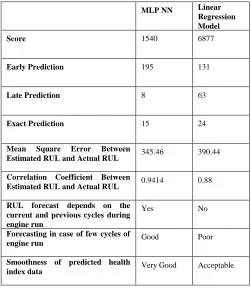
The developed algorithm gives early prediction for 195 engines, late prediction for 8 engines, and exact prediction for 15 engines. The overall score of the algorithm based on the score function in (2) is 1540 which can be placed between the fourteenth and fifteenth score of the top 20 scores as published on the official site of the Phm08 (Fig. 10).
Fig. 10. Top 20 scores list of algorithms on test data set
Results show that MLP NN is working better linear regression model in solving this type of problems. MLP NN gives more smoothed values of HI which leads to better prediction. Also MLP NN show better behavior with engines has few cycles of run. The following table shows the difference in performance between MLP NN and linear regression model.
TABLE 1
MLPNN PERFORMANCE VS.LINEAR REGRESSION MODEL
MLP NN Linear Regression Model
Score 1540 6877
Early Prediction 195 131
Late Prediction 8 63
Exact Prediction 15 24
Mean Square Error Between
Estimated RUL and Actual RUL 345.46 390.44
Correlation Coefficient Between
Estimated RUL and Actual RUL 0.9414 0.88
RUL forecast depends on the current and previous cycles during engine run
Yes No
Forecasting in case of few cycles of
engine run Good Poor
Smoothness of predicted health
VI. CONCLUSION
In this paper MLP NN with back propagation learning as a static network proofs its ability to solve a problem of RUL estimation of a dynamic complex engineering system (aircraft turbofan engine). This method involves prediction of HI first to use it in RUL estimation. Additional work is done to improve features (sensors) selection as recommended in future work in [2] and [4]. Comparison between performance of MLP NN and linear regression model is done which proofs superiority of MLP NN over linear regression model in solving complex forecasting tasks.
REFERENCES
[1] Felix O. Heimes, BAE Systems "Recurrent Neural Networks for Remaining Useful Life Estimation" 2008 international conference on prognostics and health management.
[2] Leto Peel, Member, IEEE (GOLD) " Data Driven Prognostics using a Kalman Filter Ensemble of Neural Network Models" 2008 international conference on prognostics and health management. [3] T. Wang, and J. Lee, “The operating regime approach for precision
health prognosis,” Failure Prevention for System Availability, 62th meeting of the MFPT society - 2008, pp. 87-98.
[4] Tianyi Wang, Jianbo Yu, David Siegel, and Jay Lee "A Similarity-Based Prognostics Approach for Remaining Useful Life Estimation of Engineered Systems" 2008. International conference on prognostics and health management.
[5] Abhinav Saxena, Member IEEE, Kai Goebel, Don Simon, Member, IEEE, Neil Eklund, Member IEEE "Damage Propagation Modeling for Aircraft Engine Run-to-Failure Simulation" May 18, 2008.
[6] http://ti.arc.nasa.gov/tech/dash/pcoe/prognostic-data-repository/
[7] D. Frederick, J. DeCastro, and J. Litt, "User’s Guide for the Commercial Modular Aero-Propulsion System Simulation (CMAPSS)," NASA/ARL, Technical Manual TM2007-215026, 2007. [8] Girish Kumar JHA "Artificial Neural Network" Indian Agricultural
Research Institute, PUSA, New Delhi 110012.
[9] M. Tim Jones "Al Application Programming" Charles River Media © 2003.
[10] NASA Ames Research Center "Integrated System Health Management (ISHM) Technology Demonstration Project Final Report" December 15, 2005.
[11] Mark Schwabacher and Kai Goebel "A Survey of Artificial Intelligence for Prognostics" NASA Ames Research Center,2008. [12] Ian H. Witten, Eibe Frank, Department of Computer Science
University of Waikato "Data Mining Practical Machine Learning Tools and Techniques, Second Edition", 2005.