Priority driven Call Scheduling in Mobile Networks: A MOGA
based approach
PARAGKUMARGUHATHAKURTA1
SUJOYSETT2
NIT Durgapur India
1[email protected] 2[email protected]
Abstract. Enhanced mobile communication in current days demands a drastic evolution in resource management strategies to meet the quality of service (QoS) requirements for the network. Call schedul-ing is such an important scheme for efficient utilization in spite of scarcity of resources. In this paper, a priority driven call scheduling technique is proposed for efficient routing in mobile networks. The proposed scheduler is addressed with two conflicting objectives: to minimize the mean routing cost, and to achieve uniformity in the overall system utilization. In this context, a Multi Objective Genetic algorithm (MOGA) based approach is introduced for finding an optimal route from several alternatives pertaining to the network constraints. This results in effective scheduling and simultaneous improvement in call acceptance for the system. The proposed model takes into account the significance of priority in a comprehensive manner. The performance of the proposed model is evaluated in network scenarios with different parameters and service requirements. In addition, results from simulation studies show the quality of approximation obtained by the proposed model.
Keywords:call scheduling, optimal route, call acceptance, priority, multi objective optimization (MOO), multi objective genetic algorithm (MOGA)
(Received July 16th, 2014 / Accepted February 4th, 2015)
1 Introduction
In current days, resource management strategies are be-coming increasingly important to guarantee the qual-ity of service (QoS) in end-to-end communication be-tween mobile devices. Considering limited amount of resources, the performance of the system in terms of call acceptance depends on efficiency of the applied re-source management schemes. Call scheduling is such a scheme which is significantly important in mobile networks for efficient resource utilization even during congestion [25]. Simultaneously, uniformity of load distribution upon the entire network should be consid-ered for fairness and improved performance. Hence, an efficiently designed scheduling scheme is expected to achieve both requirements.
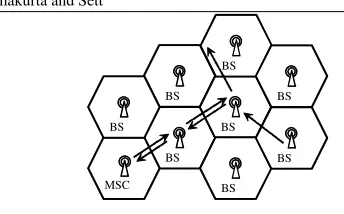
The standard cellular layout [23] through a layered framework is used for scheduling. Each cell repre-senting areas of the layout has one Base Station (BS). The BSs assist in communication between users be-longing to various cells, which again in turn communi-cate between themselves via a Mobile Switching Cen-tre (MSC). Thus, communication between source and destination BSs follows a joint routing scheme. For il-lustration, the communication from source BS to MSC follows a dedicated route, whereas that from MSC to destination BS uses a different one as shown in Figure 1 following the arrowheads.
Thakurta and Sett Priority driven Call Scheduling in Mobile Networks: A MOGA based approach 2
BS BS
BS
BS BS BS
BS
MSC BS
Figure 1:Joint routing scheme
experience good channel conditions in one direction while simultaneously experiencing congestion in the other, thus resulting in delayed scheduling in spite of re-source availability. Further, exhaustive search methods to determine the optimal route are computationally hard [17]. Such exact algorithms can only be used for small scale networks and prototype models. Hence, evolu-tionary algorithms [15] such as genetic algorithm (GA) are used to obtain satisfactory results under this circum-stance as it reduces computation overhead. This makes such approaches scalable to larger networks [13].
Multi Objective Optimization (MOO) [18] approach is comprehensively used to address interrelated con-flicting issues associated with such scheduling schemes. It generates a set of optimal solutions, known as the Pareto solutions, which lie on different Pareto fronts (Fi) [11]. The traditional methods [15] usually
con-vert the MOO into single objective using a heuristic es-timation of the contribution of each objective in terms of their weight values. Here, one objective might domi-nate another superiorly due to wrong estimation of these weights. In such case, many Pareto optimal solutions are lost and solutions obtained lack diversity. On the other hand, evolutionary algorithms are not sensitive to search space and provide numerous optimal solutions at one time.
The approach known as Multi Objective Genetic Al-gorithm (MOGA) can be used to handle the MOO prob-lems using the concept of GA. The wide applicability of MOGA over conventional optimization methods has been successfully established. For example, the trav-eling cost and the total time to traverse in TSP [7] are optimized in such a way that preferential objective is satisfied as both parameters change in different weather or traffic circumstances.
In this paper, a priority based call scheduler through Multi Objective Genetic algorithm (MOGA) based ap-proach is proposed for efficient routing in mobile net-works. Before presenting the detailed scope of the work, it might be mentioned here that the terms path
and route have been used interchangeably in this work. The BS in each cell is assumed to be a node for imple-mentation. The proposed model is structured in a ma-trix representation where every node holds a reference to its neighboring nodes in the higher radial level. Sev-eral constraints have been pertained on the nodes and their interrelation. Simultaneously, scheduling requests are characterized by their respective priorities. In or-der to maximize call acceptance of the system through selection of an optimal route, the proposed scheduler is addressed as a MOO problem. It is involved with two objectives: (a) to minimize the mean routing cost, and (b) to achieve uniformity in the overall system uti-lization. Since these are found to be conflicting with each other, a MOGA based solution is introduced. The initial population of possible alternative routes is iden-tified and the optimal one among those is determined. The standard GA operations are used iteratively until desired solution is obtained. The performance of the proposed model is evaluated in network scenarios with different parameters and service requirements through simulation studies. In addition, it shows the quality of approximation obtained by the proposed model.
The rest of the paper is organized as follows. Sec-tion 2 reviews several existing publicaSec-tions related with the proposed scheme for completeness of the work. Section 3 presents the system model and the problem is described in Section 4. Next, the solution of the prob-lem is presented in Section 5. The simulation results are shown in Section 6 followed by conclusions in Section 7.
2 Related Work
Various scheduling techniques have been used to attain the QoS requirements for routing in earlier works. A concept on priority based scheduling [12] used a heuris-tic estimation to improve the throughput, which was en-hanced by introducing a correlation between schedul-ing cost and users’ demand [26]. Another work in [25] brought the concept of priority users enjoying privi-leges over the conventional users. Tree based rout-ing strategies [9] used different approaches compared to [23, 24] for improving the number of transmissions. A Schedule-based Greedy Expansion (S-Expand) algo-rithm [8] has been proposed to achieve higher revenue in terms of several network parameters. The techniques used in [20, 27] allow the network operator to prioritize usage of the resources.
Thakurta and Sett Priority driven Call Scheduling in Mobile Networks: A MOGA based approach 3
used a utility function characterizing QoS of each mo-bile in terms of throughput. The authors in [2] extended this work under multi-cell network environment. An-other joint scheduling algorithm presented in [22] can provide a certain level of coordination among a group of BSs within the wireless cellular networks. It avoids resource wastage and subsequently improves QoS in terms of call acceptance. In [3], a heuristic priority in packet based scheduling algorithm was proposed while providing guaranteed throughput. An increased num-ber of active connections are obtained by an end-to-end scheduling algorithm [16] for efficient utilization of available facilities.
A novel work [4] by Badia et. al. proposed a GA based approach to simultaneously solve link schedul-ing and routschedul-ing between a pair of nodes. It evaluates an association between fast computation and the over-all system performance, however, not to a desired ex-tent in large scale networks. Another routing scheme [14] investigated the usability of GA operators in influ-encing the resulting solutions for larger networks. This was further explored in [19] to obtain improved perfor-mance in call forwarding topology. Camelo et al. [6] proposed a method for solving routing problems using the Non-dominated Sorting based Genetic Algorithm-II (NSGA-Algorithm-II) [11] for finding different alternatives to guarantee the QoS requirements. Furthermore, Cui et al. [10] studied MOO relying on GAs for determining specific routes.
In short, most of the authors resolved the routing problem in context of call scheduling by optimizing the network performance. However, the overall perfor-mance can be further optimized by performing priority driven scheduling. To obtain optimal solution under this circumstance, an exhaustive search grows unboundedly in complexity for larger networks. However, MOGA used in route optimality has attracted attention for its capability of addressing problems with conflicting ob-jectives and supporting parallel computation as well as acquiring multiple non-dominating solutions in a single run. Thus, a MOGA based approach is attempted in this work for obtaining optimal results within reduced time which is particularly important for interactive mobile services.
3 System Model
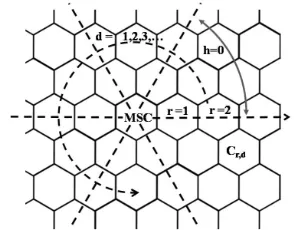
The alignment of the cellular layout in Figure 2 rep-resents MSC as the central node and the nodes repre-senting BSs surround the MSC in concentric circles. The area under the transmission range [24] of MSC is divided into six hexant slices. Accordingly, each node in this range is associated with a value h [h ∈
0,1,2,3,4,5] which is necessary for establishing the spatial relation between the nodes. The dotted straight lines representing the spokes of the layout are used to partition the nodes, which in turn determines the value ofh. With reference to MSC, the nodes in between the spokes and the nodes lying upon the spoke to the right of a slice obtains the corresponding value ofh. Any of the six spokes can be selected as reference for the model with a valueh= 0, and other spokes are incrementally counted in anticlockwise direction from this reference. However, the direction has little impact on the entire problem which is ignored due to symmetric nature of the layout.
Figure 2:Organization of BSs and MSC in cellular layout
Each node in the layout is represented as Cr,d,
wherer andd denote the radial displacement of the node from MSC and the circular displacement of it from the reference spoke respectively. Thusrcorresponds to each concentric circle of BSs growing outwardly from the MSC, andddenotes the displacement within the cir-cle from the reference spoke. Here, MSC is denoted byC0,0. Any other nodeCr,d belongs to a candidate
hexant which is obtained byh = b(d−1)/rcdue to anticlockwise assignment in the proposed model. The spoke with the arrowhead (in Figure 2) represents the reference spoke from where the circular displacementd
of the nodes is calculated. In addition, the transmission range of MSC is represented bylimRwhich is used to
determine the maximum number of nodes (N) present in the layout. It is evident from Figure 2 that the num-ber of nodes in each concentric circle of the layout orig-inating from MSC grows in multiples of six. Thus, the numberN excluding MSC for a givenlimR is
deter-mined by an arithmetic progression which is expressed as follows.
Thakurta and Sett Priority driven Call Scheduling in Mobile Networks: A MOGA based approach 4
3.1 Node Classification
The nodesCr,drepresenting BSs are of two types - (a)
radial node (R) and (b) non radial node (NR). Radial nodes are those lying on the spokes of the layout. All others are called non radial nodes. These are repre-sented as follows.
nodes= (
R whend= (h.r+ 1)∀r≥1
NR otherwise (2)
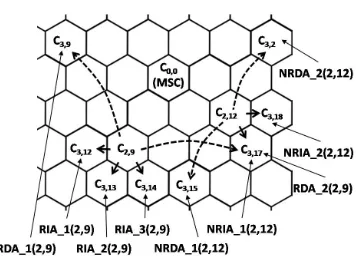
Every node has two interaction modes, viz., (a) immediate adjacency (IA) and (b) distant association (DA). IA signifies the direct interaction between two nodes belonging to consecutive radial levels, whereas, DA indicates the same when established through other nodes belonging to the lower radial level. For exam-ple (in Figure 3), radial nodeC2,9shares IA with nodes
C3,12, C3,13 andC3,14, and DA with nodesC3,9 and
C3,17. Similarly a non radial nodeC2,12shares IA with nodesC3,17 andC3,18, and DA with nodesC3,15 and
C3,2. In addition, the number of nodes sharing IA with a radial node is higher than that of a non radial node, whereas both radial and non radial nodes enjoy equal privileges for DA. The notations RIA and NRIA denote IA for radial and non radial nodes respectively. Simi-larly, RDA and NRDA are considered for DA.
Figure 3:Interaction modes for nodes in cellular layout
3.2 Node Interrelation Matrix (NIM)
The spatial association of the nodes (in Table 1) in the layout is stored as NIM. The adjacency matrix for the entire network is not required by the scheduler as each node maintains interrelation information of the few nodes of higher radial level. This information is essential for finding the candidate routing paths. Thus, NIM results in improved storage space efficiency and reduced scheduling overheads for the entire network.
Table 1:Node Interrelation
Radial N on_Radial
IA RIA_1(r,d): if(d+h−1)≥1, thenCr+1,d+h−1,
elseCr+1,6(r+1)
RIA_2(r,d):
Cr+1,d+h RIA_3(r,d):
Cr+1,d+h+1
NRIA_1(r,d):
Cr+1,d+h NRIA_2(r,d):
Cr+1,d+h+1
DA RDA_1(r,d): if(d−h)≤0, then RIA_1(r,5r+1), else RIA_1(r,d-r) RDA_2(r,d): if(d−r)>2r, then RIA_1(r,1), else RIA_1(r,d-r)
NRDA_1(r,d): RIA_1(r,rh+1) NRDA_2(r,d): ifh+ 1>5, then RIA_3(r,1), else
RIA_3(r,(h+1)r+1)
3.3 Inputs
The scheduler is designed to accept a set of call requests characterized by source node, destination node, request priority and permissible tolerance as inputs. The sched-uler executes joint routing taking MSC as reference. The scheduler has the capacity of re-scheduling a pre-viously established low-priority request in case another request of higher priority is attempted to be routed through a congested path. Further, the number of hops between source and destination nodes is restricted by the allowable end-to-end tolerance.
3.4 Constraints
The communication through a network is involved with various parameters associated with the BS as well as the links between them which are respectively classified as Node Constraints (NC) and Node Association Con-straints (NAC). Parameters such as BS congestion, BS confidence, user density, etc. characterize the former, where as channel capacity, delay heuristics, etc. denote the latter.
Thakurta and Sett Priority driven Call Scheduling in Mobile Networks: A MOGA based approach 5
These parameters are conditionally used by the scheduler to determine an optimal route. For illustra-tion, the scheduler forwards a high priority call through a sub optimal route based on nodes with high BS confi-dence and low user density rather than an optimal route through nodes or links expecting congestion in near fu-ture.
4 Problem Description
The scheduler design is associated with the selection of an optimal route for each of the requests (Reqi) in
the input set pertaining to the constraints while simulta-neously improving the number of calls accepted in the system over a period of time. In this context, the two de-cision variables involved are - (a) the mean utilization (µ) of the path for routing requestReqi, and, (b)
over-all uniformity of the system utilization. The capacity of the nodes and links involved in routing determines the mean utilization (µ) of the route. It needs to be min-imized for efficient utilization of resources. The stan-dard deviation (σ) on the consumption of each node and link capacity from the mean determines the overall uni-formity of the system utilization. Simultaneously, it is to be minimized for distributing the resource consump-tion throughout the system. Hence, a MOO problem addressing this scenario should obey the following.
objectives (
minimize (µ)
minimize (σ) (3)
Here, the variables µand σ for request Reqi are
ex-pressed as follows.
µReqi =
1
li
X
NodeCr,d∈route(Reqi)
costiCr,d (4)
where, li andcostiCr,d denote route length for request
Reqi and routing cost of requestReqi at nodeCr,d
re-spectively, and
σReqi=
1
2(σ(∀nodeCr,d∈route(Reqi), node capacityC
r,d)
+σ(∀adjacent nodesCr1,d1, Cr2,d2
∈route(Reqi),link capacityCr1,d1,Cr2,d2))
(5) subject to,
∀nodeCr,d∈network
X
Reqiinitiated atCr,d≤user density
X
Reqidestined toCr,d≤user density
(6)
∀scheduled route∈network, ∀node∈route,
resource consumption≤NC
∀node association∈route,
resource consumption≤NAC
(7)
In (6), the requests initiating from or getting directed to a node in the network should not exceed the user density of the respective node. In addition, the route for every scheduled request in the network should abide by the node constraints and node association constraints as in (7), which in turn can be expressed in terms ofµReqi
andσReqi.
5 Proposed Scheduler
The scheduler executes in sequential phases. In the first phase, the NIM is initialized for a network along with both the constraints and set of call requests. Next, the optimal route, based on the previous information, is ob-tained through MOGA based approach which is subse-quently used for the priority driven scheduling.
5.1 Phase I
Starting from MSC, the interrelation of every node with the nodes of its next higher level is used to generate the NIM following Table 1. This is continued untillimR
is reached. Without loss of generality, the rows (Mi) of
NIM obtained from (1) are presented by (8).
Mi=
(
C0,0 wherei= 0
Cr,d wherei= 1 + 3r(r−1) +d
(8)
The columns of NIM are generated corresponding to the rows, with values denoting the IA and DA of every node. The IA for MSC is populated with initial values, and thereafter IA and DA of the nodes are generated using successive iterations. This procedure is described by algorithm 1.
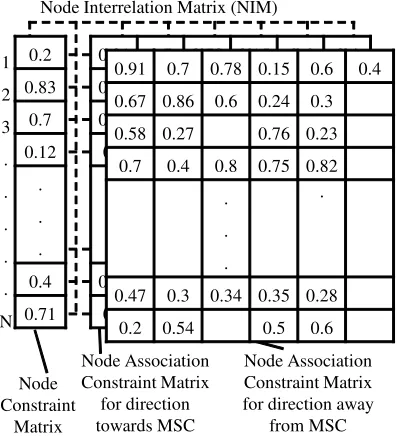
Based on NIM, the information representing the scheduling requests and associated constraints are ran-domly generated which are stored in shadow matrices. Two of these matrices having size of[N×6]denote the node association constraints, one in direction towards MSC and the other away from MSC. Another column vector known as Node Constraint Matrix [N ×1] is maintained alongside. An example of corresponding matrices is shown in Figure 4.
5.2 Phase II
Thakurta and Sett Priority driven Call Scheduling in Mobile Networks: A MOGA based approach 6
Algorithm 1NIM Generation
1: NIM(1,1)=C0,0; 2: foridx1: 1 to 6do
3: NIM(1,idx1+1)=C1,idx1; 4: foridx1: 1 tolimRdo 5: foridx2: 1 to 6*idx1do
6: mIdx=1+3*idx1*(idx1-1)+idx2;
7: NIM(mIdx,1)=Cidx1,idx2; 8: ifCidx1,idx2 ∈Rthen
9: NIM(mIdx,2)=RIA1(Cidx1,idx2); 10: NIM(mIdx,3)=RIA2(Cidx1,idx2); 11: NIM(mIdx,4)=RIA3(Cidx1,idx2); 12: NIM(mIdx,5)=RDA1(Cidx1,idx2); 13: NIM(mIdx,6)=RDA2(Cidx1,idx2); 14: else ifCidx1,idx2 ∈N Rthen
15: NIM(mIdx,2)=NRIA1(Cidx1,idx2); 16: NIM(mIdx,3)=NRIA2(Cidx1,idx2); 17: NIM(mIdx,5)=NRDA1(Cidx1,idx2); 18: NIM(mIdx,6)=NRDA2(Cidx1,idx2); 19: returnNIM
1
2
3
.
.
.
.
.
N
.
.
. 0.2
0.83
0.7
0.12
.
.
.
0.4
0.71
Node Association Constraint Matrix
for direction towards MSC
Node Association Constraint Matrix for direction away
from MSC Node
Constraint Matrix
Node Interrelation Matrix (NIM)
0.91 0.7 0.78 0.15 0.6 0.4
0.67 0.86 0.6 0.24 0.3
0.58 0.27 0.76 0.23
0.7 0.4 0.8 0.75 0.82
.
.
.
.
0.47 0.3 0.34 0.35 0.28
0.2 0.54 0.5 0.6
0.91 0.7 0.78 0.15 0.6 0.4
0.67 0.86 0.6 0.24 0.3
0.58 0.27 0.76 0.23
0.7 0.4 0.8 0.75 0.82
.
.
.
.
0.47 0.3 0.34 0.35 0.28
0.2 0.54 0.5 0.6
Figure 4:Constraint Matrices
several steps. Two sets of candidate paths, i.e., one from source node to MSC, and another from MSC to destina-tion node are determined from NIM. For example, if a route from MSC toCr,dhas to be searched, thenCr,dis
looked up from rows((r∗(r−1)∗3+1)−(6∗(r−1))) to(r∗(r−1)∗3 + 1)of NIM to find the set of nodes in (r−1)that has IA or DA with it. Corresponding to each of these nodes at(r−1), similar look-up is applied to get nodes at(r−2)and this is continued until the look-up reaches at MSC. Then, the optimal candidate from each set is obtained using respective constraints. Fi-nally, these two are merged to provide the desired route between source and destination nodes.
Selection of an optimal path among the alterna-tives is involved with two objecalterna-tives as discussed ear-lier. To understand the interrelation between the objec-tives, which is essential for ascertaining the nature of the problem, an example is illustrated. Let us assume two candidate paths with random node constraint values
{0.8,0.2,0.1,0.3,0.2} and {0.6,0.5,0.55,0.6,0.55}
respectively. Theµvalues for both paths are obtained as 0.32 and 0.57, whereasσvalues are obtained as 0.149 and 0.0015. It is evident that selecting a path with low
µvalue results in increased value ofσand vice versa. If the entire procedure to determine the desired optimal route is executed using exhaustive search [17], the com-putational cost is as follows.
T(Cr,d) = 1
r+
4
rT(C
R r−1,∗) +
2(r−2)
r T(C
N R r−1,∗)
+2(r−3)
r T(C
N R r−1,∗)
(9)
The NIM shows that a radial nodeCr,destablishes
DA with the radial node of its lower level, and con-tributes only single candidate path, which is the first term in right hand side of (9). IfCr,dis non radial, but
lies beside any radial node at levelr, it shares DA with (r−2)nodes of next lower level. It contributes large number of candidate paths, though such condition oc-curs for a fixed number of nodes even for high values of
r. There is an option to select among radial and non ra-dial nodes in lower level. The former is expressed in the second term and the latter as the third in (9). Here,‘∗0
implies thatddoes not have any influence on this com-putation. The remaining non radial nodes contributing candidate paths with only IA is shown by the last term of (9). Moreover, traditional exhaustive search takes exponential time to computeT(Cr,d).
Thakurta and Sett Priority driven Call Scheduling in Mobile Networks: A MOGA based approach 7
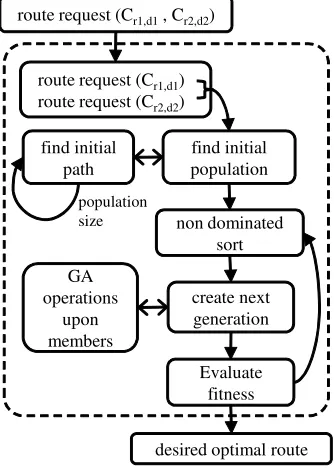
Compared to several MOGA based approaches [5], NSGA-II computes the optimal solution in reduced time if the number of objectives is small. Thus, the con-cept of NSGA-II is introduced in the proposed work to determine the Pareto front with its constraint handling capability. It uses fast non-dominated sorting to evalu-ate solutions belonging to different fronts. Thus, the ex-ecution workflow of finding the optimal route through MOGA based approach is illustrated comprehensively in Figure 5.
route request (Cr1,d1, Cr2,d2)
route request (Cr1,d1)
route request (Cr2,d2)
find initial population find initial
path
population
size non dominated
sort
create next generation GA
operations upon members
Evaluate fitness
desired optimal route
Figure 5:Workflow for finding Optimal Route
As discussed earlier, every request to be scheduled is jointly executed in two parts. For each execution, the initial generation is populated with random routes gov-erned by the population size. Next, this generation is sorted as per non-dominance of objectives. The better half of the generation performs GA operations (selec-tion, crossover and mutation) among themselves to pro-vide the next generation. This cycle is continued till the generation reaches stability in terms of fitness. The desired optimal route is obtained by extracting the so-lution from the Pareto front corresponding to these two parts followed by subsequent merging.
The proposed MOGA in this work uses a population comprising of a subset of all possible candidate routes between either source node and MSC or MSC and des-tination node. These routes are considered here as chro-mosomes, whereas, the nodes and the links in the route denote the genes. Such consideration is necessary to
map the network environment onto GA paradigm. The key-points inside the dotted block in Figure 5 are dis-cussed next.
5.2.1 Initial Population
The set of nodes and links in a candidate route is stored as an array to represent a chromosome of the initial pop-ulation. The size of the initial population follows an adaptive rule and is expressed by (10).
Population Size(P) = (
2limR iflim R≤6
100 otherwise (10)
This is due to the fact that farther a node is from MSC, the number of candidate paths between them is larger. Keeping a fixed population size is useless for smaller networks where the number of candidates is less. The procedure to encode the routes as members of the initial population is illustrated by algorithms 2 and 3.
Algorithm 2find initial generation (Cr,d) 1: paths={};
2: forpopulation sizedo
3: fornumber of attemptsdo
4: path = find initial path((Cr,d));
5: ifpath∈/paths & constraints followedthen
6: paths = paths∪{path};
7: break loop;
8: returnpaths
Algorithm 3find initial path (Cr,d) 1: ifr>1then
2: cdt={}; // candidates
3: limup = (r∗(r−1)∗3 + 1); // upper limit 4: limlow =limup−(6∗(r−1)); // lower limit 5: foridx1=limlowtolimupdo
6: foridx2: 2 to 7do
7: ifNIM(idx1,idx2) ==Cr,dthen
8: cdt=append(cdt,NIM(idx1,idx2));
9: subPath = find initial path (random (cdt));
10: path = append(subPath,Cr,d); 11: else
12: path = {MSC,Cr,d}; 13: returnpath
5.2.2 Selection, Crossover, and Mutation
Thakurta and Sett Priority driven Call Scheduling in Mobile Networks: A MOGA based approach 8
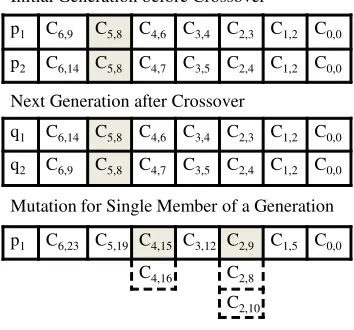
non-dominated sorting. GA operators are applied upon the elite set to generate offspring which are included in the next generation. Crossover is performed fol-lowing the spatial property of the candidate paths, i.e. two candidates can perform crossover if they have at least one common node in between. In the proposed work, single-point crossover is performed twice, once between the set of paths connecting source node and MSC, and other between those connecting MSC and destination node. Single point mutation is applied upon the population only where crossover inherently fails to be applied.
In Figure 6 the crossover point between two can-didates is highlighted. For the remaining cancan-didates where crossover is not possible, mutation is performed randomly upon a single point in the route. Accordingly node associations are modified. This is illustrated using dotted lines in Figure 6.
Initial Generation before Crossover
p1 C6,9 C5,8 C4,6 C3,4 C2,3 C1,2 C0,0
p2 C6,14 C5,8 C4,7 C3,5 C2,4 C1,2 C0,0
Next Generation after Crossover
q1 C6,14 C5,8 C4,6 C3,4 C2,3 C1,2 C0,0
q2 C6,9 C5,8 C4,7 C3,5 C2,4 C1,2 C0,0
Mutation for Single Member of a Generation
p1 C6,23 C5,19 C4,15 C3,12 C2,9 C1,5 C0,0
C4,16 C2,8
C2,10
Figure 6:Crossover and mutation in the proposed work
5.2.3 Next Generation from Elite Set
The population of a generation is a combination of both optimal and sub optimal routes between the nodes. These routes are sorted into Pareto fronts using algo-rithm 4. Each front consists of alternate routes which are non-dominating to each other. The better half of the generation as obtained from the fronts is extracted as the elite set of that generation. GA operations are performed upon this elite set to obtain the offspring set. The elite set along with the offspring set together con-stitute the next generation as explained by following al-gorithm 5. In addition, the operator‘0 used in
algo-rithms 4 and 5 denotes the dominance of one solution
over the other.
Algorithm 4non dominated sort(paths)
1: forpath p1∈pathsdo
2: ddp1= {}; //dominated set 3: dgp1= 0; // dominating count 4: forpath p2∈paths except p1do
5: ifp2p1∀objectivethen
6: ddp1= append(ddp1, p2); 7: else ifp1p2∀objectivethen
8: dgp1=dgp1+ 1; 9: ifdgp1== 0then 10: F1=F1∪ {p1}; 11: current=1;
12: whileFcurrent6=φdo 13: forpathp1∈Fcurrentdo 14: forpathp2∈ddp1do 15: dgp2=dgp2−1; 16: ifdgp2== 0then
17: Fcurrent+1=Fcurrent+1∪ {p2}; 18: current = current +1;
Algorithm 5create next generation (paths)
1: es ={p|pq, q /∈es,|p|=|q|=|paths|/2};
2: forunselected path p1∈esdo
3: forunselected path p2∈es except p1do
4: pt = random crossover point (p1, p2);
5: ifpt6=φthen
6: {q1, q2} = random crossover (p1, p2);
7: gennext=gennext∪{q1, q2};
8: selectedp1=selectedp2=true;
9: forunselected path p1∈esdo
10: q1 = random single point mutation (p1);
11: gennext=gennext∪{q1};
12: selectedp1=true;
13: gennext=gennext∪es;
Observation 1: Crossover and mutation are not si-multaneously operated upon a population, as explained in Algorithm 5. Here, mutation is attempted only where crossover is not possible. This is due to the fact that single point mutation, only by itself, fails to introduce significant modification in a candidate route.
5.2.4 Fitness and Stability of Generation
Thakurta and Sett Priority driven Call Scheduling in Mobile Networks: A MOGA based approach 9
significant deviation of composite fitness of all mem-bers in a generation from that in earlier. Such a genera-tion is termed as a stable one and is subsequently used to obtain the optimal solution from the first Pareto front (F1), as explained in algorithm 6.
Algorithm 6route request (Cr,d) 1: paths = find initial generation(Cr,d); 2: cost_array = determine cost∀path∈paths;
3: fornumber of iterationsdo
4: paths = non dominated sort(paths);
5: paths = create next generation(paths);
6: cost_array = determine cost∀path∈paths;
7: if4cost_array < predefined limitthen
8: break iteration;
9: routeoptimal= {p|p∈paths, p = random(F1)};
10: constraint matrices = constraint matrices - (con-sumption∈routeoptimal);
11: returnrouteoptimal;
Observation 2: The computational cost of algorithm 6 isO(GM P2)whereG,M andPdenote the number of generations, the number of objectives, and the pop-ulation size respectively. TheP2 factor should be re-duced if possible, since it leads to long processing time for large population size.
5.3 Phase III
Phase II is executed at least once for the set of requests placed in a queue. It may happen that a request from the queue fails to be scheduled and any other scheduled low priority request exists, then the latter can be removed and send back to the request queue. Subsequently, the current request is attempted to be scheduled once again. Thus the concept of priority plays an important role in scheduling the requests as explained by algorithm 7.
6 Experimental Results
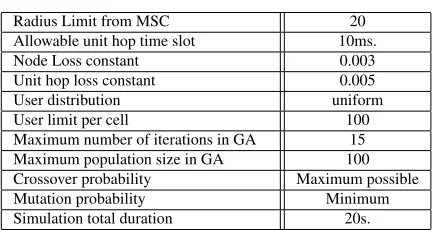
In this section, the simulation results for various scenar-ios in order to assess the performance of the proposed model are presented. In this context, the major system parameters are summarized in Table 2. The simulation studies based on these parameter values are carried out in the subsequent sections.
6.1 Variation between constraints
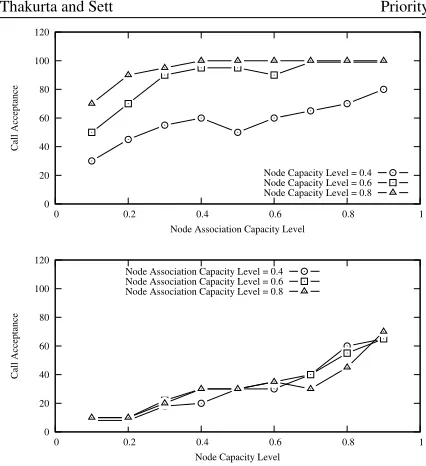
To maximize the number of optimally routed active connection in terms of the call acceptance for the sys-tem, the experiment is carried out by modulating either
Algorithm 7schedule requests (set of requests in re-quest queue< Cr1,d1,Cr2,d2, priority, tolerance>)
1: Initialize NIM and Constraint Matrices;
2: for request Reqcurrent<Cr1,d1,Cr2,d2, Priority, Tolerance>∈request queue (Q)do
3: path = route request (Cr1,d1) | route request (Cr2,d2);
4: ifpath ==φthen
5: find requestReqvictimwithpriorityvictim
<prioritycurrent;
6: ifReqvictim6=φthen
7: discardReqvictim;
8: append (Q,Reqvictim);
9: path = route request (Cr1,d1) | route re-quest (Cr2,d2);
10: ifpath ==φthen
11: discardReqcurrent;
12: append (Q,Reqcurrent);
Table 2:Used System Parameters
Radius Limit from MSC 20
Allowable unit hop time slot 10ms.
Node Loss constant 0.003
Unit hop loss constant 0.005
User distribution uniform
User limit per cell 100
Maximum number of iterations in GA 15 Maximum population size in GA 100 Crossover probability Maximum possible Mutation probability Minimum Simulation total duration 20s.
the node capacity or the node association capacity keep-ing the alternate one at fixed level. In both the scenarios, the system has been stressed under increasing number of scheduling requests, and resulting in acceptable per-formance. The behaviour of call acceptance against the constraint values is shown in Figure 7. For gradual in-crement of node association capacity or node capacity, the number of call acceptance is increased for the sys-tem. In practice, multiple call requests generated from a node. We have considered the user density level as 2.63, 5.26 and 10.52 by uniformly distributing certain number of users (proportionate tolimRof the cellular
Thakurta and Sett Priority driven Call Scheduling in Mobile Networks: A MOGA based approach 10
0 20 40 60 80 100 120
0 0.2 0.4 0.6 0.8 1
Call Acceptance
Node Association Capacity Level Node Capacity Level = 0.4 Node Capacity Level = 0.6 Node Capacity Level = 0.8
0 20 40 60 80 100 120
0 0.2 0.4 0.6 0.8 1
Call Acceptance
Node Capacity Level Node Association Capacity Level = 0.4 Node Association Capacity Level = 0.6 Node Association Capacity Level = 0.8
Figure 7:Call Acceptance vs. Constraints (Node Capacity and Node Association Capacity)
for the same reason as in previous, and corresponding variation in call acceptance is plotted. It is observed that improved performance is achieved for gradual in-crement of either capacity levels.
0 20 40 60 80 100
0 0.2 0.4 0.6 0.8 1
Call Acceptance
Node Capacity Level
User Density = 2.63 User Density = 5.26 User Density = 10.52
0 20 40 60 80 100
0 0.2 0.4 0.6 0.8 1
Call Acceptance
Node Association Capacity Level User Density = 2.63 User Density = 5.26 User Density = 10.52
Figure 8:Call Acceptance upon varying User Density
6.2 Interrelation between Objectives
The objectives introduced in the proposed work are plotted for ascertaining the variation of one against the other. It is observed experimentally, that, in accordance with the assumption, these two objectives are conflict-ing to each other. The MOGA approach towards opti-mizing both objectives results in a set of Pareto-optimal solutions, as shown in Figure 9, with the help of Pareto fronts. The solutions belonging to separate fronts have a dominating relation between them. However, there is no such overall dominance between the solutions be-longing to a single front. After several rounds of iter-ation of MOGA, we reach to the desired stable fitness of a generation. As discussed in Table 2, the maximum
0.044 0.045 0.046 0.047 0.048 0.049 0.05 0.051
0.752 0.754 0.756 0.758 0.76 0.762 0.764 0.766
standard deviation (
σ
) of
individual resource utilization
mean utilization (µ) of resources F1 F2 F3 F4 F5 F6 F7 F8
Figure 9:Pareto optimal fronts and solution points
number of iterations of MOGA for obtaining a stable generation in terms of fitness function is fixed to a cer-tain value. This is determined from the observation that the fronts and the solution points belonging to the fronts stabilize after a certain number of steps, and don’t vary significantly in further generations. This is experimen-tally illustrated in Figure 10. We observe that the values of both objectives vary at initial generations; however, they stabilize later on. Thus, after a few generations, an optimal front containing the desired solution is obtained by this approach.
6.3 Performance comparison
Thakurta and Sett Priority driven Call Scheduling in Mobile Networks: A MOGA based approach 11
0.76 0.761 0.762 0.763 0.764 0.765 0.766 0.767 0.768 0.769 0.77
2 4 6 8 10 12 14
0.0528 0.053 0.0532 0.0534 0.0536 0.0538 0.054
Mean Value of Constraints (
µ
)
Mean Deviation of Constraints (
σ
)
Generation
µ σ
Figure 10:Stabilization of objectives across generations
is involved with consideration of the set of all non-dominated solution points over all the generations as the true Pareto front. Accordingly, comparison of members of each generation in terms of objective functions with the true Pareto front is plotted in Figure 11. Another approach (HI) towards measure of approximation qual-ity is attempted using hypervolume indicator, which is a popular measure of the volume of dominated portion of the objective space related to a reference point. As ex-pected, both the approaches indicate the improvement in quality of approximation with ongoing generations. In addition, the stable convergence of the solutions for the current approach as shown in Figure 11 is obtained with reduced number of generation as compared with the work in [10].
-0.003 -0.0025 -0.002 -0.0015 -0.001 -0.0005 0 0.0005
2 4 6 8 10 12 14 0.1245 0.125 0.1255 0.126 0.1265 0.127 0.1275 0.128 0.1285 0.129 0.1295
Mean Difference (MD) of Generation
from the Original Pareto Front
Hypervolume Indicator (HI) of Generation
Generation MD
HI
Figure 11:Quality of approximation obtained by proposed MOGA
In order to assess the performance of the proposed model in terms of call acceptance, we compare this work with other end-to-end schedulers [22]. The ba-sic scheme works with a single link model. On the other hand, the joint scheme refers to another end-to-end scheduling method which jointly considers the time varying channel conditions in both directions, i.e., to-wards MSC and away from MSC. The simulation has been performed by keeping both Node Capacity and Node Association capacity fixed at 0.8 and varying the number of users across nodes of the system. The
result-ing percentage of calls accepted has been calculated, and is compared against previous two schemes. It is visible from the Figure 12 that the proposed scheme provides improved results in increasing call acceptance.
50 60 70 80 90 100
0 20 40 60 80 100
Call Acceptance
Percentage of Active Users per Cell Proposed Scheme
Joint Scheme Basic Scheme
Figure 12:Comparison between proposed and existing schemes
To highlight the importance of the current work, an experiment is carried out where the Node Capacity and Node Asssociation Capacity are simultaneously varied from 10% to 100% of maximum allowable. The result in terms of call acceptance for the proposed model is evaluated and subsequently compared with the declared values of the work in [10]. Hence, the Figure 13 shows an improved performance of the proposed model over such existing approach.
0 0.2 0.4 0.6 0.8 1
0 20 40 60 80 100
Call Acceptance
Mean Capacity
Proposed Scheme Existing Approach
Figure 13:Performance comparison with existing approach
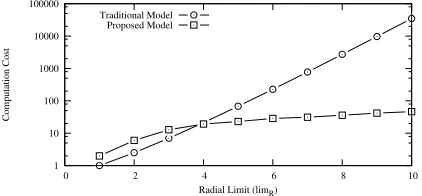
The use of MOGA in the proposed approach has significantly reduced computational complexity when compared with traditional search approaches used in [21]. As shown in Figure 14, the traditional model explodes exponentially whenlimRis increased above
a certain value, whereas the proposed approach pro-vides constant growth even for higher values. However, the traditional approach outperforms the proposed ap-proach for initial values oflimR. The importance of
ac-Thakurta and Sett Priority driven Call Scheduling in Mobile Networks: A MOGA based approach 12
cording to (9). This approach initiates with few random solutions and subsequently attempts to reach an optimal one without exhaustively searching the entire solution space. Thus the proposed approach exhibits improved computation cost, optimality in routing and higher rate of convergence.
1 10 100 1000 10000 100000
0 2 4 6 8 10
Computation Cost
Radial Limit (limR)
Traditional Model Proposed Model
Figure 14:Performance improvement through proposed model
7 Conclusions
The current work proposes a priority based call sched-uler featuring joint routing in mobile networks through MOGA based approach. The significance of priority is introduced along with a number of constraints de-fined over the system. Initially, the cellular layout is represented using NIM followed by the generation of constraint matrices. Then the optimal route for a set of call requests is obtained through MOGA in succes-sive phases. The proposed scheduler is executed and the output is broadcast to all the BSs starting at the MSC. Hence no computation is necessary at the BSs regarding routing.
Performance results demonstrate notable improve-ments in terms of call acceptance as well as com-putational cost for the system over other existing ap-proaches. The gain obtained in the proposed model re-sults from optimization in scheduling an individual call while keeping the entire system at reduced congestion as well, which pays off while scheduling the subsequent requests. In addition, the quality of approximation for the proposed model is measured using standard indica-tors.
The concept of NSGA-II is used in the current work. However, other variations of MOGA can be explored for subsequent improvements. The work can be further enhanced in future by defining the problem with more number of elementary objectives, which can be ex-pected to provide desired solution matching with prac-tical scenarios.
References
[1] Agarwal, R., Majjigi, V. R., Han, Z., Van-nithamby, R., and Cioffi, J. M. Low complexity resource allocation with opportunistic feedback over downlink ofdma networks. IEEE Journal on
Selected Areas in Communications, 26(8):1462–
1472, 2008.
[2] Almajano, L. and Perez-Romero, J. Packet scheduling algorithms for interactive and stream-ing services under qos guarantee in a cdma sys-tem. InVehicular Technology Conference, 2002.
Proceedings. VTC 2002-Fall. 2002 IEEE 56th,
volume 3, pages 1657–1661 vol.3, 2002.
[3] Alpcan, T., Fan, X., Basar, T., Arcak, M., and Wen, J. T. Power control for multicell cdma wireless networks: A team optimization approach.
Wireless Networks, 14(5):647–657, 2008.
[4] Badia, L., Botta, A., and Lenzini, L. A ge-netic approach to joint routing and link scheduling for wireless mesh networks. Ad Hoc Networks, 7(4):654–664, 2009.
[5] Bringmann, K., Friedrich, T., Neumann, F., and 0007, M. W. Approximation-guided evolutionary multi-objective optimization. In Walsh, T., editor,
IJCAI, pages 1198–1203. IJCAI/AAAI, 2011.
[6] Camelo, M., Omana, C., and Castro, H. Qos rout-ing algorithm based on multi-objective optimiza-tion for wireless mesh networks. In Communica-tions (LATINCOM), 2010 IEEE Latin-American Conference on, pages 1–6, Sept 2010.
[7] Changdar, C., Mahapatra, G., and Pal, R. K. An efficient genetic algorithm for multi-objective solid travelling salesman problem under fuzzi-ness. Swarm and Evolutionary Computation, 15(0):27 – 37, 2014.
[8] Chiu, H. S. and Yeung, K. L. A joint routing and scheduling algorithm for efficient broadcast in wireless mesh networks. InWCNC, pages 1– 6. IEEE, 2010.
[9] Chiu, H. S. and Yeung, K. L. Maximizing mul-ticast call acceptance rate in channel multi-interface wireless mesh networks.Trans. Wireless.
Comm., 9(8):2622–2631, Aug. 2010.
Thakurta and Sett Priority driven Call Scheduling in Mobile Networks: A MOGA based approach 13
Computing, 2003. ICCNMC 2003. 2003 Interna-tional Conference on, pages 49–53, Oct 2003.
[11] Deb, K., Pratap, A., Agarwal, S., and Meyarivan, T. A fast and elitist multiobjective genetic algo-rithm: Nsga-ii. Evolutionary Computation, IEEE Transactions on, 6(2):182–197, Apr 2002.
[12] Dianati, M., Shen, X., and Naik, K. Coopera-tive fair scheduling for the downlink of cdma cel-lular networks. IEEE T. Vehicular Technology, 56(4):1749–1760, 2007.
[13] Fadil, Y. A. Routing using genetic algorithm for large networks. Diyala Journal of Engineering Sciences, 3(2):53 – 70, 2010.
[14] Hoffmann, F., Medina, D., and Wolisz, A. Joint routing and scheduling in mobile aeronautical ad hoc networks. IEEE T. Vehicular Technology, 62(6):2700–2712, 2013.
[15] Hong-Xia, Y., Liu, X., and Pu-Kun, L. Intelligent algorithms for solving multiobjective optimiza-tion problems. InWireless Communications, Net-working and Mobile Computing, 2008. WiCOM ’08. 4th International Conference on, pages 1–5, Oct 2008.
[16] Lee, J.-W., Mazumdar, R., and Shroff, N. Joint resource allocation and base-station assignment for the downlink in cdma networks.
Network-ing, IEEE/ACM Transactions on, 14(1):1–14, Feb
2006.
[17] Lorenzo, B. and Glisic, S. Optimal routing and traffic scheduling for multihop cellular networks using genetic algorithm.Mobile Computing, IEEE
Transactions on, 12(11):2274–2288, Nov 2013.
[18] Masazade, E., Rajagopalan, R., Varshney, P., Mo-han, C., Sendur, G., and Keskinoz, M. A mul-tiobjective optimization approach to obtain deci-sion thresholds for distributed detection in wire-less sensor networks. Systems, Man, and Cyber-netics, Part B: CyberCyber-netics, IEEE Transactions on, 40(2):444–457, April 2010.
[19] Pries, R., Staehle, D., Staehle, B., and Tran-Gia, P. On optimization of wireless mesh networks us-ing genetic algorithms. International Journal On Advances in Internet Technology, 1&2, 7 2010.
[20] Raoof, O. and Al-Raweshidy, H. Pricing-based resource allocation in ad-hoc networks using auc-tion theory. InFuture Network and Mobile Sum-mit, 2010, pages 1–8, June 2010.
[21] Ryu, J., Noel, E. C., and Tang, K. W. Distributed and fault-tolerant routing for borel cayley graphs.
IJDSN, 2012, 2012.
[22] Saad, W., Dawy, Z., and Sharafeddine, S. A utility-based algorithm for joint uplink/downlink scheduling in wireless cellular networks. Journal
of Network and Computer Applications, 35(1):348
– 356, 2012. Collaborative Computing and Appli-cations.
[23] Thakurta, P., Poddar, R., and Bandyopadhyay, S. A new approach on co-ordinate based routing pro-tocol for mobile networks. InAdvance Computing
Conference (IACC), 2010 IEEE 2nd International,
pages 177–180, Feb 2010.
[24] Wu, Z., Song, H., Jiang, S., and Xu, X. A grid-based stable routing algorithm in mobile ad hoc networks. In Asia International Conference on
Modelling and Simulation, pages 181–186. IEEE
Computer Society, 2007.
[25] Yaipairoj, S. and Harmantzis, F. C. Dynamic pric-ing with "alternatives" for mobile networks. In
WCNC, pages 671–676. IEEE, 2004.
[26] Yaipairoj, S. and Harmantzis, F. C. Priority telephony system with pricing alternatives. In de Souza, J. N., Dini, P., and Lorenz, P., editors,
ICT, volume 3124 ofLecture Notes in Computer Science, pages 183–191. Springer, 2004.