Multi-scale Finite Element Analysis on Biomechanical Response of
Functionally Graded Dental Implant / Mandible System
C. Y. Tang1, Y. Q. Guo2, C. P. Tsui3, B. Gao4
1,2,3Department of Industrial and Systems Engineering, The Hong Kong Polytechnic University, Hong Kong, P.R. China
4Department of Prosthodontics, College of Stomatology, The Fourth Military Medical
University, Xi'an, 710032, P. R. China
1e-mail: [email protected]; 2e-mail: [email protected];
3e-mail: [email protected]; 4e-mail: [email protected]
Abstract
This paper proposes a multi-scale finite element method to investigate the biomechanical response of functionally graded dental implant / mandible system. Macroscopically, the proposed dental implant / mandible model consists of a functionally graded biomaterial (FGB) dental implant, a mandible and a dental implant / mandible interface. The mandible was considered to construct with cancellous bone and cortical bone with a graded change in mechanical property between these two bones. The FGB dental implant was modeled to be composed of titanium (Ti) and hydroxyapatite (HA) also with a gradient change in composition between both ends of the implant. The interface was assumed to be at an unhealed state during the initial stage of implantation and later grow to have properties equal to those of healthy cancellous bone after healing. A finite element software package ABAQUS incorporated with a user-defined material subroutine, was used to perform the analysis. Microscopically, the micro-architecture of cancellous bone is modeled by using a face-centered-cubic (FCC) finite element (FE) unit cell model. By using this micro-cell FE model, the time-dependent compressive strength of the implant / mandible interface can be predicted. Macroscopically, the proposed method can also be applied to predict the load bearing capability and stress distribution of the implant / mandible interface.
Key words: Mutli-scale finite element method, Functionally graded materials, Dental implant, Mandible
1. Introduction
cancellous bone. Hedia [7] later performed a more complete analysis with that effect taken into consideration.
Yang and Xiang [1] investigated the static characteristics and harmonic response of threaded FGB dental implant in a bone using a three-dimensional finite element method. One problem of the dental implant is the screw loosening. Ekici [8] carried out a three-dimensional finite element simulation to find out that a washer could be effective against loosening of a screw-shape Branemark type dental implant. Clinical studies have shown that bone under load and/or overload may give rise to marginal bone resorption [8]. Van Oosterwyck [9] employed an axisymmetric and plane strain finite element model of the Branemark implant and demonstrated that the implant-bone interface played the role of stress transfer to the marginal (cortical) bone. However, the effects of varying mechanical properties of the bone-implant interface during bone healing period on the surrounding bone have not been investigated. There are numerous literatures [10-12] reporting the mathematical relationships between elastic properties of cortical and cancellous bone and the bone density. Due to the variability of the multiple elasticity-density relationships, the relationship with the highest determination coefficient was suggested to use [10] in development of finite element models for bone.
Finite element micro-cell models have been widely used to predict the elastic properties of particulate polymer composites [13-15]. This kind of unit cell models has also been further enhanced to study the effects of the debonding damage [16-19], matrix damage [19], and varying interphase properties [20] on the mechanical properties of these composites. Meng and Tang [21] also constructed a three-dimensional unit cell model for determining the effect of porosity size on the stress concentration of bioceramics with uniform and interconnected pores.
The objective of the paper is to predict the time-dependent load bearing capability of an implant / mandible system using a multi-scale finite element method. Macroscopically, the proposed implant / mandible model consists of a functionally graded biomaterial (FGB) dental implant, a mandible and a dental implant / mandible interface. The proposed model was implemented in a finite element code – ABAQUS. The time-dependent compressive strength of the implant / mandible interface was predicted by using a micro-cell finite element model that approximates the micro-architecture of cancellous bone. Using the multi-scale FEM, the stress distribution and load bearing capability of the implant / mandible system have also been successfully predicted.
2. Finite element modeling
The proposed dental implant/bone system consists of a functionally graded biomaterial (FGB) dental implant, a mandible and a dental implant / mandible interface as shown in Fig.1. Due to symmetry, only one-fourth of the model needs to be established as shown in Fig. 1.
The surfaces on the symmetric plane are fixed in the normal directions. An occlusive force
F is applied on the implant in the z-direction. The geometric implant / mandible model is
z h Young’s modulus [MPa]
z h Young’s modulus [MPa]
Fig. 1. FGB dental implant in mandible bone. Fig. 2. Graded distribution of Young’s modulus of FGB dental implant.
Young’s modulus of the FGB dental implant, E(z) is given by
( ) HA ( Ti HA)z
E z E E E
h
= + − (1)
in which EHA and ETi are Young’s moduli of HA and Ti, respectively, such that EHA = 40GPa,
ETi = 110GPa with reference to the literature [1]. h represents the height of the implant while z
stands for the distance measured from the bottom end of pure HA.
Young’s modulus [MPa]
r R0
Young’s modulus [MPa]
r R0
Fig. 3. Graded distribution of Young’s modulus of the mandible.
The mandible shown in Fig. 3 is constructed with cancellous and cortical bones. A graded change in Young’s modulus is assumed from the side of the cortical bone to the cancellous bone
at the side of the implant. Young’s modulus of the mandible, E r
( )
is given byGraded implant
Interface
Graded mandible F
Graded implant
Interface
Graded mandible Graded implant
Interface
Graded mandible Graded implant Graded implant
Interface
Graded mandible F
x
0
0 0
0
0 0.7
( ) 0.7 0.7 0.9
0.2
0.9 1.0
can
cor can
can
cor
E r R
E E r
E r E r R
R
E r R
⎧ ⎪
⎛ ⎞
− ⎪
=⎨ + ⎜ − ⎟ ≤ <
⎝ ⎠
⎪
⎪ ≤ <
⎩
(2)
in which Ecan and Ecor are Young’s moduli of the cancellous and cortical bones, respectively,
such that Ecan = 3GPa and Ecor= 14GPa taken from the literature [22]. R0 represents the radius
of the mandible while r stands for the distance measured from the core.
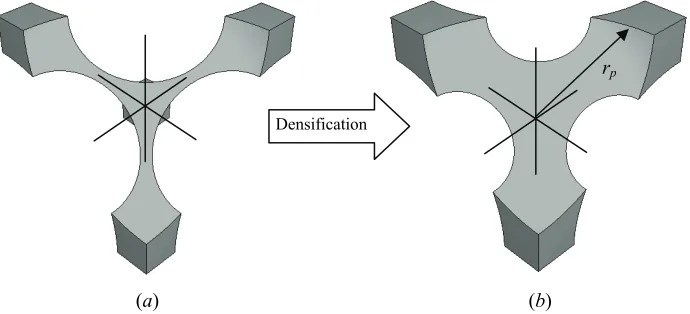
To predict the compressive strength of cancellous bone, the micro-architecture of cancellous bone is modeled by using a face-centered-cubic (FCC) FE unit cell model as shown
in Fig.4. The pore size rp of the micro-cell model will decrease with time to model healing of
cancellous bone. Due to symmetry, only one-eighth of the unit cell is studied.
Fig. 4. Micro-stress analysis of the micro-architecture of cancellous bone,
(a) Unhealed: density of 0.1 g/cm3 and (b) Healed: density of 0.3 g/cm3.
Based on the earlier work of Meng and Tang [21], the micro-stress concentration factor
(μSCF) is determined from the micro-cell FE model. Hence, the compressive strength of the
interface may be estimated by:
SCF cor
can u
u
σ σ
μ
= (3)
where the base material of the micro-cell is assumed to be cortical bone with negligible plastic
deformation and the compressive strength cor
u
σ = 167MPa [23].
(a)
rp
Densification
0 20 40 60 80 100 120 140 0.00
0.05 0.10 0.15 0.20 0.25 0.30 0.35
D
en
sity (
g/cm
3 )
Time (days)
Density evolution
Fig. 5. Density evolution of the implant / mandible interface (from unhealed to healed state).
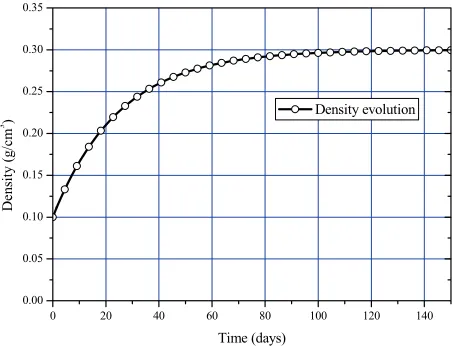
For the implant / mandible interface, it is taken as cancellous bone which is initially at an unhealed state (at the initial stage of implantation) and later grows to a healthy state with the full strength of the bone after a period of healing time. The apparent density of the interface is
assumed to grow from an initial value ρ0 = 0.1g/cm3 to the density of cancellous bone 0.3 g/cm3,
with an increase in time t as shown in Fig.5. The evolution in the density of the interface may
be expressed as follows [24]:
0
( )t A(1 exp( ))Bt
ρ =ρ + − (4)
where A = 0.2 g/cm3 and B = −0.04.
The relation between Young’s modulus, EINT and density ρ of the implant / mandible
interface [12] may be expressed empirically by: r INT
E =Cρ (5)
where the values of C and r are 41399 and 2.18, respectively [12].
To estimate the compressive strength of cancellous bone, an empirical formula developed by Carter and Hayes [25]
2 66 can u
σ = ρ (6)
may also be used.
3. Results and discussion
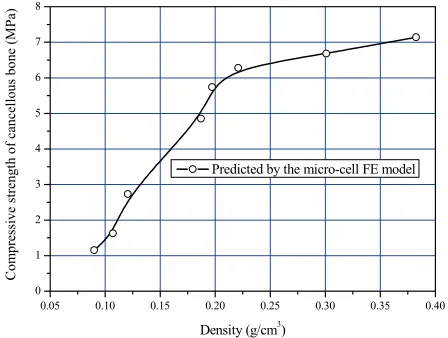
By using the micro-cell model, a relation between μSCF and ρ is obtained and shown in
Fig.6. After densification, μSCF in the interface drops drastically to a lower value. Fig. 7 shows
0.05 0.10 0.15 0.20 0.25 0.30 0.35 0.40 0 20 40 60 80 100 120 140 Micr o-str ess co nc en tr atio n f acto r
Density (g/cm3
)
Predicted by the micro-cell FE model
Fig. 6. Micro-stress concentration factor in the micro-architecture of cancellous bone.
0.05 0.10 0.15 0.20 0.25 0.30 0.35 0.40
0 1 2 3 4 5 6 7 8 C omp re ss iv e s tr engt h o f c an ce ll ou s bo ne ( M P a)
Density (g/cm3
)
Predicted by the micro-cell FE model
Fig. 7. Compressive strength versus density of the interface.
0 20 40 60 80 100 120 140 160 0
20 40 60 80 100 120 140
C
ompre
ss
iv
e s
tre
ngt
h
(M
Pa
)
Time (days)
Compressive strength predicted by multi-scale FEM
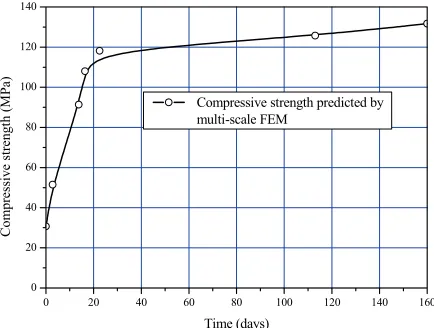
Fig. 8. Evolution of compressive strength.
The von Mises stress distribution in the implant / mandible system on the 100th day is
shown in Fig.9. It is reasonable that the stress in the implant is generally higher than the
cancellous bone of the mandible as shown in Fig.9(a) because Young’s modulus of Ti is higher
than that of the mandible. As the Ti end takes up most of the stress, the stress of the interface is relatively low and uniform (varying from 1.42MPa to 5.48MPa).
(a) Implant / mandible system (b) Implant / mandible interface
Fig. 9. von Mises stress distribution in (a) the implant/mandible system,
(b) the implant / mandible interface, on the 100th day.
The stress distribution in the interface and that in the region of cancellous bone adjacent to
the implant will gradually adapt to each other. On the 100th day, the density of the interface is
close to the density of the healthy cancellous bone. Therefore, the healed interface should possess Young’s modulus close to that of healthy cancellous bone according to Equation (5). In
0 20 40 60 80 100 120 140 160 0
20 40 60 80 100 120 140
Predicted by the proposed multi-scale FEM Predicted by the continuum level FEM with equation (6)
L
oa
d be
ar
ing c
apa
bil
it
y
(N)
Time (days)
Fig. 10. Multi-scale finite element prediction on load bearing capability.
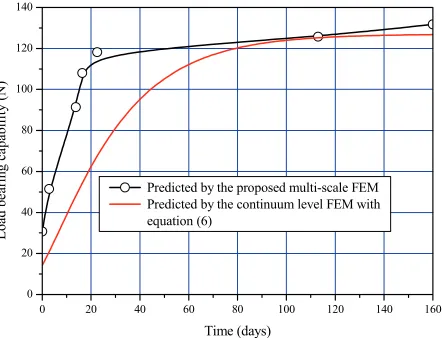
The load bearing capability of the interface is predicted by the proposed multi-scale FEM. This result is plotted together with that determined from the continuum level FEM with Equation (6) in Fig. 10. Both of the results give a similar trend in the increase of load bearing capability. The discrepancy between the two results may be caused by variation in the physical and geometrical properties of the micro-cell model which influences the compressive strength of cancellous bone. Yielding and anisotropy of cortical bone, which have been ignored in the analysis, may also contribute to inaccuracy of the prediction.
4. Conclusion
This research has developed a powerful tool for predicting the time-dependent load bearing capability of an implant / mandible system. The biomechanical response of functionally graded dental implant / mandible system has been investigated by using the proposed multi-scale finite element method. By using a face-centered-cubic (FCC) repeated finite element (FE) unit cell model, the compressive strength and micro-stress concentration factor of the cancellous bone could be determined with consideration of its micro-architecture. The results show that the interface after densification can achieve a full strength and density of the cancellous bone with a lower level of micro-stress concentration factor. Moreover, the time-dependent load bearing capability of the interface from unhealed to healed state could be reasonably predicted. Moreover, the macro-structural stress distribution in the implant / mandible system has also been predicted. The stress of the interface is found to be relatively low and uniform because the Ti end takes up most of the high stress. This demonstrates the benefit of using FGB for dental implantation.
Acknowledgement
References
[1] Yang J., Xiang H.J., A three-dimensional finite study on the biomechanical behavior
of an FGBM dental implant in surrounding bone, J. Biomech. 40, 2377-2385, 2007.
[2] Tang C.Y., Tsui C.P. Stojanovic B. and Kojic M., Finite element modelling of skeletal
muscles coupled with fatigue, Inter. J. Mech. Sci. (In print).
[3] Chan Y.P., Tang C.Y. Darvell B.W., Tsui C.P., Effect of filler shape and volume
fraction on strain damage of particulate-reinforced dental composites, Mater. Sci.
Forum, 532-533, 117-120, 2006.
[4] Stojanovic B., Kojic M., Rosic M., Tsui C.P., Tang C.Y., An extension of hill’s
three-component model to include different types in finite element modeling of muscle, Inter. J. Num. Meth. Eng. 71, 801-817, 2006.
[5] Fan J.P., Tsui, C.P. Tang C.Y. and Chow C.L., 3D-finite element analysis of the
damage effects on the dental composite subject to water sorption, Acta Mech. Sol. Sin., 19, 212-222, 2006.
[6] Hedia H.S., Malmoud N.A., Design optimization of functionally graded dental
implant, Biomed. Mater. Eng., 14, 133-143, 2004.
[7] Hedia H.S., Design of functionally graded dental implant in the presence of trabecular
bone, J. Biomed. Mater. Res. Part B, 75B, 74-80, 2005.
[8] Ekici B., Numerical analysis of a dental implant system in three-dimension, Advances
in Engineering Software, 33, 109-113, 2002.
[9] Van Oosterwyck H., Vander Sloten J., De Cooman, Lievens, S., Puers, B., Duyck J.,
Naert I., Bone overload versus underload: Determinant factors in the long-term success
of oral implants, 11th Conference Proceeding of the ESB, July 8-11, 1998, Toulouse,
France.
[10]Helgason B., Perilli E., Schileo E., Taddei F., Brynjolfsson S., Viceconti M.,
Mathematical relationships between bone density and mechanical properties: A literature review, Clinical Biomech. (In print).
[11]Linde F., Hvid I., Madsen F., The effect of specimen geometry on the mechanical
behaviour of trabecular bone specimens, J. Biomech. 25, 359-368, 1992.
[12]Morgan E.F., Bayraktar H.H., Keaveny T.M., Trabecular bone modulus-density
relationships depend on amatomic site, J. Biomech. 36, 897-904, 2003.
[13]Tsui C.P., Tang C.Y., Lee T.C., Finite Element analysis of polymer composites filled
by interphase coated particles, J. Mater. Proc. Tech. 117, 105-110, 2001.
[14]Guild F.J., Young R.J., A predictive model for particulate-filled composite materials
part 1: hard particles. J. Mater Sci. 24, 298-306, 1989.
[15]Balac I., Milovancevic M., Tang C.Y., Uskokovic P.S., Uskokovic D.P., Estimation of
elastic properties of a particulate polymer composite using a face-centered cubic FE model, Mater. Lett., 58, 2437, 2004.
[16]Tsui C.P., Tang C.Y., Fan J.P., Xie X.L., Prediction for initiation of debonding
damage and tensile stress-strain relation of glass-bead-filled modified polyphenylene oxide, Inter. J. Mech. Sci., 46, 1659-1674, 2004.
[17]Tsui C.P., Chen D.Z., Tang C.Y., Uskokovic P.S., Prediction for dedonding damage
process of glass beads-reinforced modified polyphenylene oxide under simple shear, J. Mater. Proc. Tech., 167, 429-437, 2005.
[18]Tsui C.P., Chen D.Z., Tang C.Y, Uskokovic P.S., Fan J.P., Xie X.L., Prediction for
biocomposite under quasi-static tensile load, Materials Science and Engineering A, 382, 341-350, 2004.
[20]Fan J.P., Tsui C.P., Tang C.Y., Chow C.L., Influence of interphase layer on the overall
elasto-plastic behaviors of ha-peek biocomposite, Biomaterials, 25, 5363-5373, 2004.
[21]Meng Y.H., Tang C.Y., A finite element model for investigating the micro-architecture
of macro-porous Bioceramics, Ann. J. IIE(HK) 2006-2007, 27, 81-86.
[22]Rho J.Y., Ashman R.B., Turner C.H., Young' s modulus of trabecular and cortical
bone material: ultrasonic and microtensile measurements. J. Biomech., 26, 111-119, 1993.
[23]
http://www.feppd.org/ICB-Dent/campus/biomechanics_in_dentistry/ldv_data/mech/basic_bone.htm#top
[24]Reina J.M., García-Aznar J.M. , Domínguez J., DoblaréM., Numerical estimation of
bone density and elastic constants distribution in a human mandible. J. Biomech., 40, 828-836, 2007.
[25]Carter D.R., Hayes W.C., Bone compressive strength: the influence of density and