May 2019
We Would If We Could: Examining Culturally Responsive
Teaching Self-Efficacy in a Middle School Mathematics Methods
Course
Jamaal R. Young
University of Iowa, [email protected]
Jemimah L. Young
University of Iowa, [email protected]
Brandon L. Fox
Stephen F Austin State University, [email protected]
Earl R. Levingston Jr.
University of North Texas, [email protected]
Alana Tholen
University of Iowa, [email protected]
Let us know how access to this document benefits you.
Follow this and additional works at:https://pdxscholar.library.pdx.edu/nwjtePart of theJunior High, Intermediate, Middle School Education and Teaching Commons, and theScience and Mathematics Education Commons
Recommended Citation
Young, Jamaal R.; Young, Jemimah L.; Fox, Brandon L.; Levingston, Earl R. Jr.; and Tholen, Alana (2019) "We Would If We Could: Examining Culturally Responsive Teaching Self-Efficacy in a Middle School Mathematics Methods Course,"Northwest Journal of Teacher Education: Vol. 14 : Iss. 1 , Article 3.
DOI: 10.15760/nwjte.2019.14.1.3
Jamaal R. Young
University of Iowa
Jemimah L. Young
University of Iowa
Brandon L. Fox
Stephen F. Austin State University
Earl R. Levingston, Jr.
University of North Texas
Alana Tholen
University of Iowa
_________________________________________________________________________________________
Despite mounting evidence of the pedagogical importance of culturally responsive teaching, many teachers do not implement culturally responsive practices in their classrooms. The purpose of this study was to investigate pre-service mathematics teachers’ culturally responsive teaching and outcome expectancy in order to inform teacher preparation in mathematics methods courses. Participants completed the Culturally Responsive Teaching Self-Efficacy Scale (CRTSE) and the Culturally Response Teaching Outcome Expectancy Scale (CRTOE). Results suggest that middle school mathematics teachers were only moderately efficacious in their ability to implement culturally responsive teaching approaches, despite strong beliefs in the instructional utility of culturally
responsive teaching practices.
Keywords: culturally responsive teaching, self-efficacy, mathematics education, middle grades, teacher preparation
_________________________________________________________________________________________
Introduction
Effective mathematics teachers are needed in all schools, serving all children, to meet the mathematics instructional demands of our nation. Population trends suggest that by the year 2020 students of color will represent the majority of K-12 learners (Ball, 2009). Schools serving Black and Latinx students are often socially and economically disadvantaged in comparison to middle-class and predominantly white schools, contributing to the outcome that many high-quality teachers are unwilling to work in more diverse schools (Fitchett, 2010). National surveys indicate that students of color and students experiencing poverty are significantly more likely to receive mathematics instruction from under-qualified mathematics teachers (Rahman, Fox, Ikoma, & Gray, 2017). A lack of access to highly-qualified mathematics teachers creates an opportunity gap that fosters
We Would if We Could:
Examining Culturally
Responsive Teaching
Self-Efficacy in a Middle
School Mathematics
achievement disparities. The causes of the lack of qualified mathematics teachers serving Black and Latinx students are numerous, but recruitment and retention are amongst the most salient considerations proffered in the literature (Grant, 2018; Ingersoll, 2017).
Moreover, related studies suggest that recruiting and retaining teachers in schools serving Black and Latinx students is further complicated by issues of cultural discontinuity (Cholewa & West-Olatunji, 2008; Taggart, 2017; Young, Young, & Ford, 2019). Cultural discontinuity is described as “a school-based behavioral process where the cultural value–based learning preferences and practices of many ethnic minority students—those typically originating from home or parental socialization activities—are discontinued at school” (Tyler et al., 2008, p. 281). Teacher preparation programs have the responsibility to prepare pre-service teachers to successfully navigate culturally and linguistically diverse mathematics classrooms. Thus, it is imperative that mathematics teacher
educators develop strategies to increase preservice teacher capacity to implement culturally responsive teaching practices in the mathematics classroom.
Many teacher education programs actively work to impart the knowledge and skills of culturally responsive teaching to their students, but this work fails to predict future implementation of culturally responsive teaching practices (Siwatu, 2011). One explanation for the lack of implementation of culturally responsive teaching amongst pre-service mathematics teachers is a diminished belief in the veracity of culturally responsive teaching. Mathematics pedagogical practices that are divorced from the student’s culture inadequately meet the needs of the
nation’s growing population of culturally and linguistically diverse students. Black and Latinx students, “Experience mathematics education in school
differently, and many are disaffected by their mathematics education experience” (Aguirre et al., 2017, p. 125). Students of color consistently underperform across a multitude of mathematics assessments and inventories (Bohrnstedt, Kitmitto, Ogut, Sherman, & Chan, 2015). Researchers posit that culturally responsive mathematics pedagogies can curb these trends (Gay, 2010; Gutierrez, 2013; Gutstein, 2016; Aguirre et al., 2017). Despite significant uptake of culturally responsive teaching practices in teacher education programs, significant changes in mathematics achievement of Black and Latinx students remains elusive.
Unfortunately, many mathematics teacher educators do not explicitly teach culturally responsive practices beyond the inherent pedagogical overlap. For example, many educators claim that culturally responsive teaching is just "good teaching"; however, pre-service teachers need clear examples to inform their praxis (Frye, Button, Kelly, & Button, 2010). The “good teaching”
2011; Warne, Yoon, & Price, 2014). However, mathematics teachers and teacher educators must honor the cultural influences and contributions of multiple racial, ethnic, and gender groups to the field of mathematics (Gutierrez, 2017). To this end, teacher educators must provide more specific and accessible examples of culturally responsive mathematics teaching because mathematics is a
sociocultural enterprise, which necessitates differentiated instruction.
A pedagogical cornerstone of effective mathematics instruction is the use of multiple representations. The use of multiple representations suggests that one presentation of a concept is insufficient. Likewise, culturally responsive
pedagogies suggest that teaching from a unique viewpoint is insufficient. Many mathematics pre-service teachers easily comprehend the value of multiple representations but struggle to accept the pedagogical premise of culturally
responsive pedagogies. The results of numerous studies across multiple paradigms consistently conclude that preservice teachers struggle to develop proficiency in culturally responsive mathematics teaching (Enyedy & Mukhopadhyay, 2007; Parker, Bartell, & Novak, 2017; Turner, & Drake, 2016; Young, Young,
Hamilton, 2013). Thus, the implementation of culturally responsive pedagogy in the mathematics classroom is not commonplace.
Conceptual Framework
Mathematics teachers must possess more than confidence in their pedagogical content knowledge. To reach all students in the mathematics classroom, the mathematics teacher must be confident that he or she can effectively teach all students. Culturally responsive teaching self-efficacy and outcome expectancy beliefs have the potential to influence pre-service mathematics teacher classroom actions. According to Bandura (1977), self-efficacy is defined as “beliefs in one’s capability to organize and execute the courses of action necessary to obtain the given attainments" (p. 3). These beliefs are important to consider because teacher self-efficacy can predict future classroom actions. Specifically, self-efficacy is necessary to put acquired skills into action (Evans, 1989). Teachers must have confidence in their ability to implement the skills they acquire from their teacher education program before they can successfully implement the skills in the classroom. However, teaching self-efficacy is not rigid, but is fluid and fluctuates when exposed to new subject matter or students with diverse needs (Knoblauch & Hoy, 2008). Because teaching self-efficacy changes based on the context,
climate, and culture, it is essential to consider teacher self-efficacy beliefs concerning culturally responsive teaching competency.
Culturally Responsive Mathematics Instruction: Theory and Practice
cultural pedagogy have been documented over the last several decades, such as “‘culturally appropriate' (Au & Jordan, 1981), ‘culturally compatible' (Jordan, 1985; Vogt, Jordan, & Tharp, 1987), ‘culturally congruent' (Irvine, 2003; Mohatt & Erickson, 1981), ‘culturally relevant pedagogy’ (Ladson-Billings, 1994), ‘culturally responsive’ (Cazden & Leggett, 1981; Gay, 2010), and ‘culturally specific' (Leonard, 2008)" (Fox & Larke, 2014, p. 9). The primary pillars of cultural pedagogy are culturally relevant pedagogy and culturally responsive pedagogy.
Theoretical Underpinnings
Ladson-Billings (1994) identified three primary goals for culturally relevant instruction: experiencing academic success, developing cultural competency, and developing a critical consciousness. Note that cultural competence is often criticized for being tokenistic and for treating culture as a neutral phenomenon (Beagan, 2018; Garran & Rozas, 2013; Herring, Spangaro, Lauw, & McNamara, 2013). Further theorizing cultural pedagogy, Gay (2000; 2010) defines culturally responsive teaching “as using the cultural knowledge, prior experiences, frames of reference, and performance styles of ethnically diverse students to make learning encounters more relevant to and effective for them” (p. 29). Building on the work of other cultural theorists, Leonard (2008) has extensively theorized and researched culturally specific pedagogy in
mathematics education. Similar to culturally responsive pedagogy, Leonard defines culturally specific pedagogy (CSP) “as intentional behavior by a teacher to use gestures, language, history, literature, and other cultural aspects of a particular race, ethnic, or gender group to engage students belonging to the group in authentic student-centered learning” (p. 9). Furthermore, the goals of CSP are similar to the three specific goals of culturally relevant teaching except that CSP applies critical race theory as the approach to developing cultural competence and critical consciousness.
Through the application of critical race theory, it is emphasized that, "There is value in deconstructing race and racism as a means to highlight whiteness as property and its relation to ‘normality'"; furthermore, this
According to Gutstein (2016), teachers practice CSP (specific to mathematics) when they incorporate the "three C's": community knowledge, classical (or mathematics) knowledge, and critical knowledge (p. 458). Together, this integrated approach develops students' mathematics identities. Additionally, CSP allows the student to understand how their cultural experiences contribute to their academic knowledge and growth. Lastly, through CSP and its application of critical race theory, teachers are able to recognize students' realities versus
categorizing students by traditional proficiency standards (Gutstein, 2016;
Gutierrez, 2013). Altogether, the application of critical race theory in this instance affirms students' strengths and provides tools to develop teachers' cultural
competencies within the mathematics classroom.
Practical Considerations
Culturally responsive mathematics recognizes that mathematics is a social construction and learners are social beings (Swetz, 2009). The cultural influence of the sociocultural environment has a direct effect on social interaction;
therefore, mathematics education is a process of negotiation between the social environment and mathematics. Gay (2009) emphasizes the importance of making this distinction when she states that "culturally responsive mathematics teachers need to understand how math is a cultural construction, and how this construction, and its related teaching preferences, privilege some students while disadvantaging and marginalizing others" (p. 198). Furthermore, Gay states that teachers need to learn (1) why the language and culture of math are so mystifying for so many, and to whom; (2) how this mystification affects teaching and learning attitudes and behaviors; and (3) techniques for translating the technical language and culture of mathematics into the nontechnical discourse of everyday life (p. 196).
Additionally, Gutstein (2016) emphasizes the need for teachers to value students’ community knowledge in the same way they value mathematics knowledge so that students can apply what they learn in realistic and relevant contexts.
Culturally responsive mathematics pedagogy relies on teachers’ identity, students’ identity, and communication within and between these identities. The culturally responsive mathematics educator should commit to developing positive
mathematics identities in their classrooms that are inclusive of developing cultural competency, constructing a space for positive mathematical success, and
developing critical consciousness through applying a critical framework. Ukpokodu (2011) identified six dimensions of culturally responsive teaching that support positive mathematics educational experiences for culturally diverse students. The dimensions include: high expectations for students to do rigorous and high-level mathematics; providing instructional scaffolding;
culture into the official curriculum (Frankenstein, 2005; Gay, 2000; Gutierrez, 2000; Ladson-Billings, 1994; Tate, 2005; Ukpokodu, 2011). Culturally responsive mathematics pedagogy provides a pathway for developing stronger mathematical literacy at a moment of limited mathematical literacy in the United States.
Problem Statement
Preparing mathematics teachers to work with all learners is essential to the development of a mathematically literate nation, yet historically teachers have not consistently reached Black and Latinx learners. Increasing the effective use of culturally responsive mathematics instructional practices is one means to address this challenge. Culturally responsive teaching competencies encompass four categories of knowledge: (1) curriculum and instruction, (2) classroom
management, (3) student assessment, and (4) cultural enrichment (Siwatu, 2008). Appropriately, these funds of knowledge represent the foundation of culturally responsive teacher self-efficacy. Despite the changing demographics of today’s schools and the need for culturally responsive teaching, little research has been done to investigate preservice teacher self-efficacy and outcome expectancy beliefs related to culturally responsive teaching in mathematics classrooms (Lastrapes & Negishi, 2012; Siwatu, 2007).
There is mounting evidence to substantiate why culturally responsive teaching remains absent in the mathematics classroom. Methods courses typically represent the culmination of the formal educational experience of preservice teachers before the student teaching experience. Given the importance of these courses, many mathematics teacher educators must allocate the limited
instructional time to the most mathematically pertinent material. In a
mathematics methods course, this tends to be pedagogical practices with rich connections to the mathematics content. These practices focus on didactical approaches to instruction that are primarily content driven, and often narrowly student-centered. However, we contend that culturally responsive instructional approaches require the juxtaposition of the student and the content in the mathematics classroom. When exploring why teachers were not engaged in culturally responsive mathematics teaching, Ukpokodu (2011) identified four major themes: (1) belief that mathematics is culturally neutral; (2) convenience and dominance of textbook-based mathematics instruction; (3) curriculum standardization and high stakes testing; and (4) lack of culturally responsive mathematics teaching models to emulate (p. 49). Each of the four challenges above is uniquely related to the content and learning outcomes presented in a standard mathematics methods course, yet often excluded from the list of topics presented or even considered. Thus, methods courses are an appropriate platform to address the challenges that influence the implementation of culturally
must assess pre-service teachers’ confidence in their ability to meet the needs of all learners. The purpose of this study was to investigate preservice middle school mathematics teachers’ culturally responsive teaching self-efficacy (CRTSE) and outcome expectancy (CRTOE) to inform teacher preparation in mathematics methods courses. This exploratory analysis utilized a descriptive research design to answer the following questions:
1. How efficacious are pre-service middle school mathematics teachers in their ability to execute the practices of culturally responsive teaching? 2. How much do pre-service middle school mathematics teachers associate
culturally responsive teaching with student success?
3. How do pre-service middle school mathematics teacher beliefs in culturally responsive teaching compare to their efficacy to execute the practices of culturally responsive teaching?
Methods
This study took place in a middle school mathematics methods course in a Midwestern University during the semester of 2012, before initial student
teaching. Participants in this study (N = 35) consisted of female (78%) and male preservice teachers. We collected demographic data to provide a context for the examination of CRTSE concerning pre-service teachers cultural and instructional background. Twenty-seven of the pre-service teachers indicated that they were White and eight did not (e.g., Latino, Asian, Black). Given the small number of non-White students in the current sample, explicit numerical representations of the remaining students were avoided to maintain anonymity. When queried about their practicum experiences, 31 (90%) of the participants indicated that they interacted with Latinx/Hispanic students primarily. All of the participants were in a middle school mathematics degree program and within one semester of student teaching. The data in the study were collected before any mathematics instruction was received and represent a baseline for the preservice teachers in this study.
Instrumentation and Data Analysis
Data were collected using the culturally responsive teaching self-efficacy (CRTSE) and culturally responsive teaching outcome expectancy (CRTOE) scales. The CRTSE is a 40-item Likert scaled instrument used to elicit
information from preservice teachers regarding their efficacy in executing specific teaching practices and tasks that are associated with teachers who have adopted a culturally responsive pedagogy (Siwatu, 2007). Preservice teachers were asked to indicate their degree of confidence ranging from 0 (no confidence at all) to 100 (completely confident) on items such as "I am able to identify the diverse needs of my students." Responses to each item were averaged to develop a CRTSE
each pre-service teacher's CRTSE and can serve as a meta-analytic summary tool to assess CRTSE across instrument administrations. Pre-service teachers who have higher scores on the CRTSE are more confident in their ability to implement culturally responsive teaching. Although the sample size for this study was
considerably smaller than other administrations of the CRTSE, the inter-item reliability was substantially high (α = 0.96). The second instrument assessed the pre-service teachers' confidence in the efficacy of culturally responsive teaching to generate positive learning outcomes.
The second instrument used in this study was the 26-item CRTOE. The CRTOE was designed to assess pre-service teachers’ beliefs that engaging in culturally responsive teaching practices will have positive classroom and student outcomes (Siwatu, 2009). Pre-service teachers were asked to indicate their degree of confidence ranging from 0 (no confidence at all) to 100 (completely confident) on items such as “Using culturally familiar examples will make learning new concepts easier.” The inter-item reliability for this administration of the CRTOE was also substantially high (α = 0.95). Pre-service teachers who believe in the positive outcomes associated with culturally responsive teaching will have higher scores on the CRTOE and subsequent higher affinity to the implementation of the practices. Pre-service teachers were given access to the instruments via Qualtrics ©, an online survey administration system. Three categories of data were
collected, (1) demographic responses, (2) responses to CRTSE scale, and (3) responses to CRTOE scale. IBM Statistics 22 ©, was used to perform an exploratory data analysis of the participant scores on the CRTSE and CRTOE scales. We recorded item-specific means on the CRTSE and CRTOE, along with the results of a correlational analysis between the CRTSE and the CRTOE.
Results
The results of this study are presented in three sections below, each corresponding to the three research questions guiding this study. The first two sections present descriptive statistics for participant responses to the CRTSE and the CRTOE instruments. This information describes the student's beliefs in their ability to enact culturally responsive teaching as well as their beliefs in the utility of culturally responsive teaching. The third section presents the results of the correlational analysis of the student responses to the CRTSE and CRTOE instruments and indicates the relationship between the student's beliefs in their ability to implement culturally responsive teaching and their beliefs in its ability to promote positive student outcomes in the classroom.
Culturally Responsive Teaching Self-efficacy
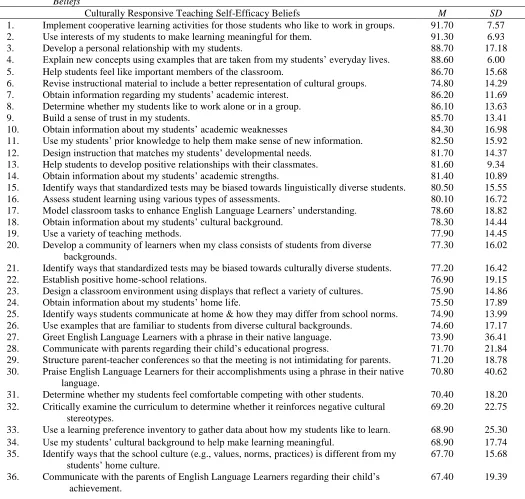
The CRTSE strength index (MCRTSE= 76.760, SDCRTSE = 8.104) indicates
ability to implement the assessed culturally responsive practices. The means and standard deviations for each of the 40 CRSTE items are presented in Table 1.
Table 1
Pre-service Middle School Mathematics Teachers’ Culturally Responsive Teaching Self-Efficacy Beliefs
Culturally Responsive Teaching Self-Efficacy Beliefs M SD
1. Implement cooperative learning activities for those students who like to work in groups. 91.70 7.57
2. Use interests of my students to make learning meaningful for them. 91.30 6.93
3. Develop a personal relationship with my students. 88.70 17.18
4. Explain new concepts using examples that are taken from my students’ everyday lives. 88.60 6.00
5. Help students feel like important members of the classroom. 86.70 15.68
6. Revise instructional material to include a better representation of cultural groups. 74.80 14.29
7. Obtain information regarding my students’ academic interest. 86.20 11.69
8. Determine whether my students like to work alone or in a group. 86.10 13.63
9. Build a sense of trust in my students. 85.70 13.41
10. Obtain information about my students’ academic weaknesses 84.30 16.98
11. Use my students’ prior knowledge to help them make sense of new information. 82.50 15.92
12. Design instruction that matches my students’ developmental needs. 81.70 14.37
13. Help students to develop positive relationships with their classmates. 81.60 9.34
14. Obtain information about my students’ academic strengths. 81.40 10.89
15. Identify ways that standardized tests may be biased towards linguistically diverse students. 80.50 15.55
16. Assess student learning using various types of assessments. 80.10 16.72
17. Model classroom tasks to enhance English Language Learners’ understanding. 78.60 18.82
18. Obtain information about my students’ cultural background. 78.30 14.44
19. Use a variety of teaching methods. 77.90 14.45
20. Develop a community of learners when my class consists of students from diverse backgrounds.
77.30 16.02
21. Identify ways that standardized tests may be biased towards culturally diverse students. 77.20 16.42
22. Establish positive home-school relations. 76.90 19.15
23. Design a classroom environment using displays that reflect a variety of cultures. 75.90 14.86
24. Obtain information about my students’ home life. 75.50 17.89
25. Identify ways students communicate at home & how they may differ from school norms. 74.90 13.99 26. Use examples that are familiar to students from diverse cultural backgrounds. 74.60 17.17
27. Greet English Language Learners with a phrase in their native language. 73.90 36.41
28. Communicate with parents regarding their child’s educational progress. 71.70 21.84
29. Structure parent-teacher conferences so that the meeting is not intimidating for parents. 71.20 18.78 30. Praise English Language Learners for their accomplishments using a phrase in their native
language.
70.80 40.62
31. Determine whether my students feel comfortable competing with other students. 70.40 18.20 32. Critically examine the curriculum to determine whether it reinforces negative cultural
stereotypes.
69.20 22.75
33. Use a learning preference inventory to gather data about how my students like to learn. 68.90 25.30
34. Use my students’ cultural background to help make learning meaningful. 68.90 17.74
35. Identify ways that the school culture (e.g., values, norms, practices) is different from my students’ home culture.
67.70 15.68
36. Communicate with the parents of English Language Learners regarding their child’s achievement.
37. Adapt instruction to meet the needs of my students. 66.00 17.22 38. Implement strategies to minimize the effects of the mismatch between my students’ home
culture and the school culture.
62.40 17.14
39. Teach students about their cultures’ contributions to mathematics. 62.20 15.88
40. Design a lesson that shows how other cultural groups have made use of mathematics. 60.70 20.99
Pre-service teachers’ culturally responsive teaching self-efficacy was highest for the following items: ‘‘I can implement cooperative learning activities for those students who like to work in groups’’ (M = 91.7, SD = 7.57) and ‘‘I can use the interest of my students to make learning meaningful for them’’ (M= 91.30,
SD = 6.923). Item-specific means were lowest among the pre-service teachers for: ‘‘I can design a lesson that shows how cultural groups have made use of mathematics’’ (M = 60.70, SD = 20.99) and ‘‘I can teach students their culture’s contributions to mathematics’’ (M = 62.20, SD = 15.880). Participants in this study had a mean score of 3001.60 (SD = 446.55). High scores on the CRTSE scale indicate a greater sense of efficacy for engaging in specific instructional and non-instructional tasks associated with culturally responsive teaching. The scores for participants in this study ranged from 2207 to 3532.
Culturally Responsive Teaching Outcome Expectations
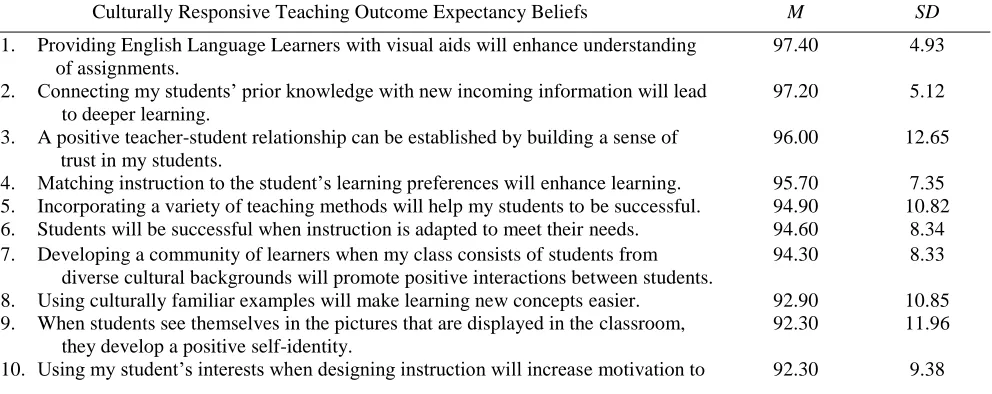
The CRTOE strength index (MCRTOE= 89.746, SDCRTOE = 4.70) indicates that
pre-service middle school mathematics teachers are approximately 89% confident that culturally responsive teaching has a positive influence on student outcomes. The means and standard deviations for each of the 26 CRTOE items are presented in Table 2.
Table 2
Pre-service Middle School Mathematics Teachers’ Culturally Responsive Teaching Outcome Expectancy Beliefs
Culturally Responsive Teaching Outcome Expectancy Beliefs M SD
1. Providing English Language Learners with visual aids will enhance understanding of assignments.
97.40 4.93
2. Connecting my students’ prior knowledge with new incoming information will lead to deeper learning.
97.20 5.12
3. A positive teacher-student relationship can be established by building a sense of trust in my students.
96.00 12.65
4. Matching instruction to the student’s learning preferences will enhance learning. 95.70 7.35 5. Incorporating a variety of teaching methods will help my students to be successful. 94.90 10.82 6. Students will be successful when instruction is adapted to meet their needs. 94.60 8.34 7. Developing a community of learners when my class consists of students from
diverse cultural backgrounds will promote positive interactions between students.
94.30 8.33
8. Using culturally familiar examples will make learning new concepts easier. 92.90 10.85 9. When students see themselves in the pictures that are displayed in the classroom,
they develop a positive self-identity.
92.30 11.96
learn.
11. Helping students from diverse cultural backgrounds succeed in school will increase their confidence in their academic ability.
91.10 11.66
12. Revising instructional material to include a better representation of the student’s cultural group will foster positive self-images.
90.70 13.37
13. Student’s academic achievement will increase when they are provided with unbiased access to the necessary learning resources.
90.40 10.90
14. Establishing positive home-school relations will increase parental involvement. 90.20 10.19 15. Assessing student learning using a variety of assessment procedures will provide a
better picture of what they have learned.
89.90 13.56
16. The likelihood of student-teacher misunderstandings decreases when my students’ cultural background is understood.
88.90 12.92
17. Simplifying the language used during the presentation will enhance English Language Learners’ comprehension of the lesson.
88.80 13.36
18. Students’ self-esteem can be enhanced when their cultural background is valued by the teacher.
88.60 10.92
19. Students will develop an appreciation for their culture when they are taught about the contributions their culture has made over time.
87.60 13.59
20. Conveying the message that parents are an important part of the classroom will increase parent participation.
86.50 17.90
21. Changing the structure of the classroom so that it is compatible with my students’ home culture will increase their motivation to come to class.
86.10 13.84
22. Understanding the communication preferences of my students will decrease the likelihood of student-teacher communication problems.
85.00 11.71
23. Student attendance will increase when a personal relationship between the teacher and students has been developed.
84.10 14.46
24. Encouraging students to use their native language will help to maintain students’ cultural identity.
83.60 15.85
25. The frequency with which students’ abilities are misdiagnosed will decrease when their standardized test scores are interpreted with caution.
79.00 15.76
26. Acknowledging the ways that the school culture is different from student’s home culture will minimize the likelihood of discipline problems.
75.30 21.32
Pre-service teachers’ culturally responsive teaching outcome expectations were highest for the possibility that ‘‘providing English Language Learners with visual aids will enhance their understanding of assignments” (M = 97.40, SD = 4.93). Item-specific means were lowest among the pre-service teachers for the possibility that ‘‘acknowledging the ways that the school culture is different from my students home culture will minimize the likelihood of discipline problems'' (M
= 75.30, SD = 21.32). Participants in this study had a mean score of 2333.40 (SD
= 248.59). High scores on the CRTOE scale indicated a greater belief in the positive outcomes associated with culturally responsive teaching. The scores for participants in this study ranged from 1700 to 2600.
Correlational Analysis
revealed a positive relationship between scores on the CRTSE and CRTOE scales,
r = .46, p < .01. Based on established benchmarks this effect size is considered moderate (Cohen, 2013). In general, the results suggest that if preservice mathematics teachers are efficacious in their abilities to execute the practices of culturally responsive teaching, they tend to believe in the positive outcomes associated with this pedagogy. These results support the hypothesis that CRTSE and CRTOE are related constructs and are consistent with observations in prior research that have shown a positive relationship between self-efficacy and outcome expectancy beliefs (Dussault, Deaudelin, & Brodeur, 2004; Siwatu, 2007).
Limitations
Culturally responsive approaches to mathematics education lack a substantial quantitative database of research (Leonard et al., 2018; Howard, 2010). For example, in a literature synthesis of 35 published studies on culturally responsive mathematics instruction conducted between 1993 and 2018, only three of the identified studies (or approximately 9 percent) were quantitative
(Abdulrahim & Orosco, 2019), compared to the 26 qualitative (74%) and six mixed methods (17%) studies. The absence of quantitative studies is problematic as lack of data hinders the ability of researchers to apply meta-analytic thinking to compare this study's results to established benchmarks from the field. Moreover, conceptualizations of culturally informed pedagogical practices continue to evolve. For example, culturally sustaining pedagogy is emerging as an alternative to or extension of culturally responsive teaching.
According to Paris (2012) culturally sustaining pedagogy seeks to "perpetuate and foster—to sustain—linguistic, literate, and cultural pluralism as part of the democratic project of schooling"(p. 93). Unlike earlier
conceptualizations, culturally sustaining pedagogy seeks to engage youth in the process of supporting their identities and cultural practices. This extension is a necessary consideration for the development and interpretation of culturally informed self-efficacy instruments in the future given the focus on teacher culturally responsiveness present in this study. Although Paris and Alim (2014) respectfully critique the shortcomings of previous asset pedagogies, the authors assert that these foundational perspectives are not without substantial merit that should not be disregarded by the field.
Discussion
ability to implement CRT in their future classrooms. Pre-service mathematics teachers did score relatively higher on general education practices, such as implementing cooperative learning activities and identifying student interest. However, culturally responsive teachers acknowledge and understand the unique role that culture, language, and race play in teaching and learning (Chu, 2013). Based on the results presented in Table 1 this is an area of concern. Results from the demographic questionnaire indicate that 90% of the students worked with diverse students populations within their observation placements. Therefore, acknowledgment and understanding of the effectiveness of culturally responsive teaching is necessary, but it does not adequately provide pre-service mathematics teachers with the capacity to implement culturally responsive teaching practices in their own classrooms. In order for pre-service mathematics teachers to fully immerse themselves in the practice of culturally responsive teaching, they must possess the competence, confidence, and conviction to overcome intrinsic and extrinsic oppositional factors. While pre-service teachers strongly associated culturally responsive teaching with positive student learning outcomes, they lacked confidence in their ability to be efficacious in culturally responsive teaching. The results imply that these pre-service teachers operate under the following notion as it pertains to culturally responsive teaching "We would if we could be we can't so we ain’t."
Concerning the second research question, the results of this study indicate that pre-service mathematics teachers recognize the instructional importance of culturally responsive teaching in the mathematics classroom, but may lack the confidence to embody these practices as an educator. Scores on the CRTOE were statistically significantly related to the same student scores on the CRTSE. Thus, pre-service mathematics educators are confident in the ability of culturally responsive teaching practices to enhance student learning, but given the moderate relationship, one can conclude that some do not feel equally equipped to use these practices in their classrooms. This divergence in confidence is problematic
because it suggests that students recognize that culturally responsive teaching is necessary to meet the needs of all students, but will not use the practices because implementation of culturally responsive teaching requires that pre-service
teachers are efficacious in their ability to implement this practice in the context of their classrooms (Fitchett, Starker, & Salyers, 2012). This paradox further
elucidates why culturally responsive practices may not translate into the mathematics classroom.
CRTSE is increased, CRTOE is increased as well. Based on these findings appropriate recommendations are provided in the next section.
Conclusion
Given the changing demographics of American classrooms, it is very likely that prospective teachers will inevitably teach culturally diverse students (Sleeter, 2001). As such, teacher educators must ensure that pre-service
mathematics teachers are mathematically and culturally fluent. Teachers who fail to understand the relationship between culture and classroom behavior tend to implement traditional instructional techniques that are ineffective when working with diverse students (Siwatu & Starker, 2010). To better prepare pre-service teachers, mathematics teacher educators must strategically look for the points of intersection between mathematics pedagogy and culturally responsive teaching and then use these areas of convergence to engage pre-service teachers in mastery experiences. The results of this study support four specific recommendations for mathematics teacher educators. First, mathematics teacher educators must
establish that mathematics instruction is a cultural enterprise. Based on the results of this study we recommend that teacher educators expose preservice teachers to the contributions of different cultures to the development of mathematics.
Although this perspective is not unique or novel, most mathematics educators fail to explore the contributions of different cultures to the development of
mathematics. Thus, it remains warranted as a recommendation for mathematics teacher educators to support CRTSE and CRTOE.
Secondly, mathematics teacher educators should require preservice teachers to purchase a traditional mathematics textbook, as well as a culturally responsive mathematics exemplar or ancillary textbook (Bright, 2016). The results of this study indicate that preservice teachers are more comfortable with traditional classroom approaches, but struggle to accept asset-based approaches that are often less prevalent in traditional mathematics textbooks (Nicol,
Archibald, & Baker, 2013; Stemn, 2010). Traditional textbook resources provide good general mathematics pedagogies and skills, but preservice teachers need specific examples of culturally responsive teaching that are piloted and refined for classroom use. Several culturally responsive mathematics texts exist (Bonner, 2010; Greer, Mukhopadhyay, Powell, & Nelson-Barber, 2009; Stinson, Wager, & Leonard, 2012), but mathematics teacher educators should provide a list of asset-based texts for preservice teachers to choose from as their resource for the course. Allowing the preservice teacher to choose the text helps to affirm their CRTSE and CRTOE by allowing preservice teachers to autonomously use their meta-cognitive skills to direct them to a text that meets their personal needs.
instruction. Although research related to culturally responsive pedagogy in mathematics classrooms is emergent, researchers cite the following three themes regarding the benefits of engaging in culturally responsive pedagogy in
mathematics classrooms (1) culturally responsive pedagogy fosters a positive and sustained mathematics identity, (2) culturally responsive pedagogy supports mathematics literacy, and (3) culturally responsive pedagogy promotes cultural competency in the mathematics classroom (Bonner & Adams, 2012; Gutstein, 2012; Leonard, 2008; Martin, 2010; Sriraman, Jacobsen, & Mistele, 2013). Preservice teachers must be reminded frequently that mathematics teaching methods matter; in turn, they need to learn how to teach mathematics in a manner that leverages and affirms the unique contributions of different cultural groups.
Finally, based on the study results we recommend that preservice mathematics teachers facilitate vicarious culturally responsive mathematics learning opportunities. Pre-service teachers "should be provided with ample opportunities to see culturally responsive pedagogy and social justice pedagogy modeled in methods courses as well as opportunities to apply and reflect on their practice in field experiences" (Leonard, Brooks, Barens-Johnson, & Berry III; 2010, p. 267). Teacher educators should consider vicarious experiential learning opportunities when these direct opportunities are not feasible. According to Bandura (1997), self-efficacy beliefs are influenced by mastery experience, vicarious experience, verbal persuasion, and psychological and emotional states. Mastery experiences are the most important because they provide an individual with an opportunity to receive concrete evidence substantiating their success or failure (Siwatu, 2011). This type of evidence helps to develop teacher
self-efficacy and thus may increase the likelihood that teachers will translate the skills into classroom practice. Along with mastery experiences, preservice teachers also benefit from the vicarious experiences realized through video case studies and teacher noticing activities.
In conclusion, we argue that through these types of preservice teaching experiences and classroom activities, pre-service teachers can begin to develop more efficacious beliefs about culturally responsive mathematics teaching. “Passion, dedication, and commitment are vital in implementing culturally responsive teaching practices in the classroom” (Frye, Button, Kelly, & Button, 2010, p. 9). Therefore, as mathematics teacher educators begin to marry good mathematics pedagogy with culturally responsive teaching practices, pre-service teachers will develop the passion, dedication, and commitment necessary to bring these practices to fruition in the classroom. A dedication to these
References
Abdulrahim, N. A., & Orosco, M. J. (2019). Culturally responsive mathematics teaching: A research synthesis. The Urban Review, 1-25.
https://doi.org/10.1007/s11256-019-00509-2
Aguirre, J., Herbal-Eisenmann, B., Celedon-Pattichis, S., Civil, M., Wilkerson, T., Stephan, M., Pape, S., & Clements, D. (2017). Equity within mathematics education research as apolitical act: Moving from choice to intentional collective professional responsibility. Journal for Research in
Mathematics Education, 48(2), 124-147. Doi.10.5951/jresematheduc.48.2.0124
Au, K., & Jordan, C. (1981). Teaching reading to Hawaiian children: Finding a culturally appropriate solution. In H. Trueba, G. Guthrie, K. & Au (Eds.),
Culture and thebilingual classroom: Studies in classroom ethnography
(pp. 139-152). Rowley, MA: Newbury.
Ball, A. F. (2009). Toward a theory of generative change in culturally and linguistically complex classrooms. American Educational Research Journal, 46, 45-72.
Bandura, A. (1977). Self-efficacy: Toward a unifying theory of behavioral change. Psychological Review, 84, 191–215.
Bandura, A. (1997). Self-efficacy: The exercise of control. New York, NY: W. H. Freeman.
Beagan B. (2018) A critique of cultural competence: Assumptions, limitations, and alternatives. In C. Frisby, & W. O'Donohue (Eds.), Cultural
Competency in AppliedPsychology (123-138). Springer, Cham.
Bohrnstedt, G., Kitmitto, S., Ogut, B., Sherman, D., and Chan, D. (2015). School composition and the Black–White achievement gap (NCES 2015-018). U.S. Department of Education, Washington, DC: National Center for Education Statistics. Retrieved from http://nces.ed.gov/pubsearch.
Bonner, E. P. (2010). Unearthing culturally responsive mathematics teaching: The legacy of Gloria Jean Merriex. University Press of America.
Bonner, E. P., & Adams, T. L. (2012). Culturally responsive teaching in the context of mathematics: A grounded theory case study. Journal of Mathematics Teacher Education, 15(1), 25-38.
Bright, A. (2016). The Problem with Story Problems. Rethinking Schools, 14-19. Cholewa, B., & West-Olatunji, C. (2008). Exploring the relationship among
cultural discontinuity, psychological distress, and academic outcomes with low-income, culturally diverse students. Professional School Counseling, 12(1), 54-61. doi:2156759X0801200106.
Cohen, J. (2013). Statistical power analysis for the behavioral sciences. New York, NY: Routledge.
Dussault, M., Deaudelin, C., & Brodeur, M. (2004). Teachers’ instructional efficacy and teachers’ efficacy toward integration of information
technologies in the classroom. Psychological reports, 94(3c), 1375-1381. Enyedy, N., & Mukhopadhyay, S. (2007). They don't show nothing I didn't know:
Emergent tensions between culturally relevant pedagogy and mathematics
pedagogy. The Journal of the Learning Sciences, 16(2), 139-174.
Evans, I. M. (1989). A multi-dimensional model for conceptualizing the design of child behavior therapy. Behavioural and Cognitive Psychotherapy, 17(3), 237-251.
Fitchett, P. G. (2010). A profile of twenty-first century social studies teachers.
Journal of Social Studies Research, 34, 229-265.
Fitchett, P. G., Starker, T. V., & Salyers, B. (2012). Examining Culturally Responsive Teaching Self-Efficacy in a Preservice Social Studies Education Course. Urban Education, 47(3), 585–611.
Fox, B. L., & Larke, P. J. (2014). Socioeconomic status and mathematics: A critical examination of mathematics performance in grades three through eight by mathematical objective. MLET: The Journal of Middle Level Education in Texas, 1(1).
Frankenstein, M. (2005). Reading the world with math: Goals for a critical mathematical literacy curriculum. In E. Lee, D. Menkart, & M. Okazawa-Rey (Eds.), Beyond heroes and holidays: A practical guide to K-12 anti-racist, multicultural education and staff development (pp. 306-313). Washington, DC: Teaching for Change.
Frye, B., Button, L., Kelly, C., Button, G. (2010). Preservice teachers' self- perceptions and attitudes toward culturally responsive teaching. Journal of Praxis in Multicultural Education, 5(1), 6-22.
Garran, A. M., & Rozas, L. W. (2013). Cultural competence revisited. Journal of Ethnic & Cultural Diversity in Social Work, 22, 97–111.
Gay, G. (2000). Culturally responsive teaching: Theory, research, & practice. New York, NY: Teachers College Press.
Gay, G. (2009). Preparing culturally responsive mathematics teachers. In B. Greer, S. Mukhopadhyay, A.B. Powell, & S. Nelson-Barber (Eds.),
Culturally responsive mathematics education (pp. 189-206). New York, NY: Routledge.
Gay, G. (2010). Culturally responsive teaching: Theory, research, & practice
(2nd ed.). New York, NY: Teachers College Press.
Greer, B., Mukhopadhyay, S., Powell, A. B., & Nelson-Barber, S. (Eds.). (2009). Culturally responsive mathematics education. New York, NY: Routledge. Gutiérrez, R. (2000). Advancing African-American urban youth in mathematics:
Unpacking the success of one math department. American Journal of Education, 109, 64-111. https://doi.org/10.1086/444259
Gutiérrez, R. (2013). A sociopolitical turn in mathematics education. Journal for Research in Mathematics Education, 44(1), 37-68.
Gutiérrez, R. (2017). Why mathematics (education) was late to the backlash party: The need for a revolution. Journal of Urban Mathematics Education, 10(2), 8-24.
Gutstein, E. (2012). Reading and writing the world with mathematics: Toward a pedagogy for social justice. New York, NY: Routledge.
Gutstein, E. (2016). Our issues, our people – math as our weapon: Critical mathematics in a Chicago neighborhood high school. Journal for Research in Mathematics Education,47(5), 454-504.
Herring, S., Spangaro, J., Lauw, M., & McNamara, L. (2013). The intersection of trauma, racism, and cultural competence in effective work with aboriginal people: Waiting for trust. Australian Social Work, 66,104–117.
Howard, T. C. (2010). Why race and culture matter in schools: Closing the achievement gap in America's classrooms. New York, NY: Teachers College Press.
Ingersoll, R. M. (2017). Misdiagnosing America’s teacher quality program. In M. Akiba, & G. LeTendre (Eds.), International handbook of teacher quality and policy (pp. 79–96). New York, NY: Routledge.
Irvine, J. J. (2003). Educating teachers for diversity: Seeing with a cultural eye.
New York, NY: Teachers College Press.
Jencks, C., & Phillips, M. (Eds.). (2011). The Black-White test score gap. Washington, D.C.: Brookings Institution Press.
Jordan, C. (1985). Translating culture: From ethnographic information to educational program. Anthropology and Education Quarterly, 16,
105-123. https://doi.org/10.1525/aeq.1985.16.2.04x0631g
Knoblauch, D., & Hoy, A. W. (2008). “Maybe I can teach those kids.” The influence of contextual factors on student teachers’ efficacy
beliefs. Teaching and Teacher Education, 24(1), 166-179.
Ladson-Billings, G. (1994). The dreamkeepers: Successful teaching for African- American students. San Francisco, CA: Jossey-Bass.
Lastrapes, W., & Negishi, M. (2012). Foundational field experiences: A window into preservice teachers' cultural consciousness and self-efficacy for teaching diverse learners. SRATE Journal, 21(1), 37-43.
Leonard, J., Brooks, W., Barnes-Johnson, J., & Berry III, R. Q. (2010). The nuances and complexities of teaching mathematics for cultural relevance and social justice. Journal of Teacher Education, 61(3), 261-270. Leonard, J., Mitchell, M., Barnes-Johnson, J., Unertl, A., Outka-Hill, J.,
Robinson, R., & Hester-Croff, C. (2018). Preparing teachers to engage rural students in computational thinking through robotics, game design, and culturally responsive teaching. Journal of Teacher Education, 69(4), 386-407. https://doi.org/10.1177/0022487117732317
Martin, D. B. (2010). Liberating the production of knowledge about African American children and mathematics. In Mathematics teaching, learning, and liberation in the lives of Black children (pp. 13-46). New York, NY: Routledge.
Nicol, C., Archibald, J. A., & Baker, J. (2013). Designing a model of culturally responsive mathematics education: Place, relationships and storywork.
Mathematics Education Research Journal, 25(1), 73-89.
Parker, F., Bartell, T. G., & Novak, J. D. (2017). Developing culturally responsive mathematics teachers: Secondary teachers’ evolving conceptions of
knowing students. Journal of Mathematics Teacher Education, 20(4), 385-407. https://doi.org/10.1007/s10857-015-9328-5
Paris, D. (2012). Culturally sustaining pedagogy: A needed change in stance, terminology, and practice. Educational Researcher, 41(3), 93-97.
Paris, D., & Alim, H. S. (2014). What are we seeking to sustain through culturally sustaining pedagogy? A loving critique forward. Harvard Educational Review, 84(1), 85-100.
Rahman, T., Fox, M.A., Ikoma, S., and Gray, L. (2017). Certification status and experience of U.S. public school teachers: Variations across student subgroups (NCES 2017-056). U.S. Department of Education, National Center for Education Statistics. Washington, DC: U.S. Government Printing Office.
Siwatu, K. O. (2007). Preservice teachers’ culturally responsive teaching self- efficacy and outcome beliefs. Teaching and Teacher Education, 23, 1086-1101. https://doi.org/10.1016/j.tate.2006.07.011
Siwatu, K. O. (2008). Teaching in the era of No Child Left Behind: Preservice teachers’ self-efficacy beliefs and teaching concerns. Multicultural Learning and Teaching, 3(2).
Siwatu, K. O. (2009). Student teachers’ self-efficacy beliefs regarding
culturally responsive teaching and their professed classroom practices.
Teacher Education & Practice, 22(3), 323–333.
Siwatu, K. O., & Starker, T. V. (2010). Predicting preservice teachers’ self- efficacy to resolve a cultural conflict involving an African American student. Multicultural Perspectives, 12(1), 10–17.
Sleeter, C. E. (2001). Preparing teachers for culturally diverse schools: Research and the overwhelming presence of whiteness. Journal of Teacher
Education, 52(2), 94-106.
Sriraman, B., Jacobsen, L. J., & Mistele, J. (Eds.). (2013). Mathematics teacher education in the public interest: Equity and social justice. Charlotte, NC: IAP.
Stemn, B. S. (2010). Teaching mathematics with "Cultural Eyes". Race, Gender & Class, 17(1),154-162.
Stinson, D. W., Wager, A., & Leonard, J. (2012). Teaching mathematics for social justice: Conversations with educators. Reston, VA: National Council of Teachers of Mathematics.
Swetz, F. J. (2009). Culture and the development of mathematics: An historical perspective. In B. Greer, S. Mukhopadhyay, A.B. Powell & S. Nelson- Barber (Eds.), Culturally responsive mathematics education (pp. 11-42). New York, NY: Routledge.
Taggart, A. (2017). The role of cultural discontinuity in the academic outcomes of Latina/o high school students. Education and Urban Society, 49(8), 731-761. https://doi.org/10.1177/0013124516658522
Tate, W. F. (2005). Race, retrenchment, and the reform of school mathematics. In E. Gustein & B. Peterson (Eds.), Rethinking mathematics: Teaching for social justice by the numbers (pp. 31-40). Milwaukee, WI: Rethinking Schools Publication.
Turner, E. E., & Drake, C. (2016). A review of research on prospective teachers’ learning about children’s mathematical thinking and cultural funds of knowledge. Journal of Teacher Education, 67(1), 32-46.
Tyler, K. M., Uqdah, A. L., Dillihunt, M. L., Beatty-Hazelbaker, R., Conner, T., Gadson, N., ... & Roan-Belle, C. (2008). Cultural discontinuity: Toward a quantitative investigation of a major hypothesis in education. Educational researcher, 37(5), 280-297. https://doi.org/10.3102/0013189X08321459 Ukpokodu, O. N. (2011). How do I teach mathematics in a culturally responsive
way? Identifying empowering teaching practices. Multicultural Education, 18(3), 47-93.
Vogt, L., Jordan, C., & Tharp, R. (1987). Explaining school failure, producing school success: Two cases. Anthropology and Education Quarterly, 18, 276-286. https://doi.org/10.1525/aeq.1987.18.4.04x0019s
Young, J. L., Young, J. R., & Ford, D. Y. (2019). Culturally relevant STEM out- of-school time: A rationale to support gifted girls of color. Roeper Review, 41(1), 8-19.
Young, J. R., Young, J. V., Hamilton, C. (2013). Culturally relevant project-based learning for STEM education: Implications and examples for urban
schools. In M. M. Capraro, R. Capraro, & C. W. Lewis (Eds.), Improving urban schools: Equity and access in K-16 STEM education (pp. 39-65). Charlotte, NC: Information Age.