Shwetha et al. World Journal of Engineering Research and Technology
BIODEGRADABLE FABRIC DEVELOPMENT AND TESTING
Dr. G. N. Rameshaiah1 and Shwetha*2
Department of Chemical Engineering, B M S College of Engineering, Basavangudi, Bull
temple road, Bengaluru, VTU Belgaum, Karnataka, India.
Article Received on 23/03/2019 Article Revised on 13/04/2019 Article Accepted on 03/05/2019
ABSTRACT
Synthetic polymers are important in many branches of industry,
particularly in the packaging industry. However, it has an undesirable
influence on the environment and causes problems with deposition of
waste and consumption. Therefore, there is a tendency to replace the
polymer with biodegradable polymer that undergoes a process. Some
biodegradable plastics that have been commercialized are starch based
plastics, bacteria based plastics, soy based plastics, cellulose based
plastics, lignin based plastics and natural fiber reinforced plastics.
Production of this kind of material and its introduction to the market is important for the
natural environmental. The starch based and starch mixed with agar showed more elasticity,
strength, compatibility and stiffness by appearance. The starch with sodium alginate also
showed the more elasticity compared to single starch used fabrics. The fabric was degraded
when it is exposed to heat or above 70O C temperature. The fabric was degraded by the Gram
negative microorganisms.
INTRODUCTION
Today’s consumer driven society demands plastic for the manufacture of millions of
products. Packaging materials largely contribute to the high demand for plastics. Our fast
paced lifestyles demand convenience and single serving, pre- packaged foods. The
manufacture of cost effective packaging that adequately protects the product is made possible
by plastic. Plastic is made from crude oil, a nonrenewable resource. Although the plastic we
use can be recycled, the amount of solid waste generated by plastic is becoming a problem.
World Journal of Engineering Research and Technology
WJERT
www.wjert.org
SJIF Impact Factor: 5.218*Corresponding Author Shwetha
Department of Chemical
Engineering, B M S College
of Engineering,
Basavangudi, Bull temple
road, Bengaluru, VTU
Bioplastic is a better option for the environment and, in turn, everyone in the world. The
amount of plastic we are using is not only harmful to the environment but we are killing a
number of species as well. Marine animals can get caught up in the waste, making it so that
the animal is unable to eat or swim.
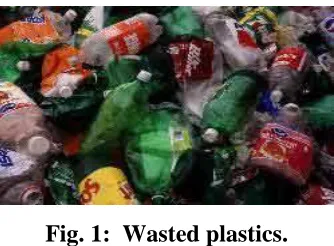
Fig. 1: Wasted plastics.
Using biodegradable plastics could cut down on the amount of space taken up in landfills and
reduce the impact that litter has on the environment Also, the majority of bioplastic is made
from renewable resources, such as corn or other plant material, and it can be reproduced fast
enough to keep up with our needs.
With thoughtful development, redesign could have an impact at all levels of the hierarchy
established by the European Waste Framework Directive: prevention, re-use, recycle,
recovery and disposal. The future brief explores current research into the redesign of plastics
and developments in biodegradable plastics. It considers the implications of redesign and
increased use of biodegradable plastics, as well as policy options to maximize benefits and
minimize risks.
Polymers synthesized from monomers derived from renewable resources. For example, PLA
(polylactic acid) is a polymer of lactic acid that is produced by the fermentation of starch,
corn or sugar. Polymers produced by microorganisms, for example, PHA
(polyhydroxyalkanoate) is produced by bacteria through fermentation of sugar or lipids.
Biodegradable: Plastics decompose from the action of biological agents, usually bacteria.
Compostable: Plastics are biodegradable and meet certain criteria, such as rate of biodegradation and impact on the environment.
Decomposition generally begins with fragmentation, i.e. the material that is exposed to living
or non-living factors undergoes a chemical decomposition of the polymer and therefore
decomposes mechanically (fragments). In the next phase, the products of this decomposition
are mineralized by microorganisms. This second phase is a necessary step that characterizes
this process as biodegradation, because the partially degraded polymers (fragments) are
hereby metabolized into end products. There are other cases (oxo- degradable materials)
where the material undergoes a quick fragmentation under the influence of heat and UV light
but the mineralization stage is very slow, which means that the relatively inert micro particles
of the plastic material remain that have a poor susceptibility to biodegradation.The common
materials used for the biodegradable plastics are
1. Starch based plastics
2. Agricultural waste based plastic
3. Biodegradable polyesters (PHA, PLA, PHB)
Plastics derived from petroleum are made from synthetic polymers. However, polymer chains
are also found in nature. These chains are common in cellulose, lignin, and starch. Cellulose
is abundant in all plants, although some plants produce more than others. Lignin is typically
found in wood, and starch is common in plants such as corn, potatoes, and wheat. Plants,
wood, corn, potatoes, and wheat are all raw materials that are renewable and readily
available. The major difference between synthetic polymers and polymers found in nature is
that the natural polymers contain oxygen and nitrogen. The oxygen and nitrogen in the
polymer structure permit the polymer to biodegrade.
MATERIALS AND METHODS
A. Materials
Potato starch, corn starch, agar, vinegar, glycerine, sodium alginate, water, microwave and
glass plates.
B. Methods
Potato starch based plastic: 10 g of starch (potato) powder was taken in 500 mL beaker. Then 50 mL of water was added, the suspension was mixed well to get the clear solution.
Then 10 mL of vinegar and 10 mL of glycerin was added to solution, stirred solution well.
Then the suspension was heated under the Bunsen burner until the sticky precipitate forms.
After that, the precipitated suspension was spread over flat the glass plate. The glass plate
Next day the produced fabric was observed.
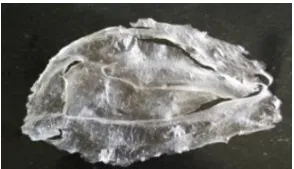
Fig. 2: Potato starch based fabric.
Corn starch based plastic: 10 g of starch (corn) powder was taken in 500 mL beaker. Then 50 mL of water was added, the suspension was mixed well to get the clear solution. Then 10
mL of vinegar and 10 mL of glycerin was added to solution, stirred solution well. Then the
suspension was heated under the Bunsen burner until the sticky precipitate forms. After that,
the precipitated suspension was spread over flat the glass plate. The glass plate was kept in
oven for 30 min at 45o C or keeps the glass plate at room temperate for 24 hrs.
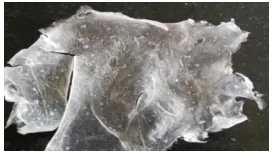
Fig. 3: Corn starch based fabric.
Potato and corn starch based: In this procedure the mixture of both corn and potato starch were used. Equal quantity of both starches were added i.e. 5 gm of potato starch and 5gm of
corn starch. Then 50 mL of water was added to mix the starch powder completely and added
10 ml of vinegar and 10 mL of glycerin and stirred well. Then heat the suspension under the
Bunsen burner until the sticky precipitate forms. After the heating process, the precipitate
was spread to a glass plate and kept in oven for 30min at 45o C or keep the glass plate at
room temperature for one day. After one day the glass plate was observed.
Potato starch and Agar mixture: In order to get the thickness of fabric, 5 gm of agar was added to the 5 gm of potato starch. Here agar acts as thickener. Then processed with the same
protocol i.e. to the mixture of starch and agar, 50mL of water, 10 ml of vinegar and 10 ml of
glycerin were added. Then suspensions was mixed well until the clear solution forms, after
that heat the clear solution under the Bunsen burner until the sticky precipitate forms. The
formed precipitate was spread over the glass plate and kept for one day at room temperature
or at 45oC in oven for 30 min. After next day glass plate was observed.
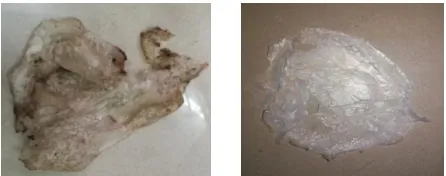
Fig. 5: Potato starch and agar mixed fabric.
Potato starch and sodium alginate based plastic: Sodium alginate also a biomaterial and also showed elasticity to the fabrics therefore sodium alginate used to develop the
biodegradable plastics. 10 g of starch (potato) powder was taken in 500 mL beaker. Then 30
mL of RO water was added, 20 mL of sodium alginate solution was added to beaker. Then
the suspension was mixed well to get the clear solution. Then 10 mL of vinegar and 10 mL of
glycerin was added to solution, stirred solution well. Then the suspension was heated under
the Bunsen burner until the sticky precipitate forms. After that, the precipitated suspension
was spread over flat the glass plate. The glass plate was kept in oven for 30 min at 45oC (Fig.
6).
Fig. 6: Starch and sodium alginate fabric.
Testing for Characterization
1) Solubility testing
Produced fabrics were made into 2 g of five pieces. Then those fabrics were kept in 100 mL
water (RO) containing beaker i.e. each of 2 g fabric were kept in separate beaker for testing
test solubility. In the same way up to 5th day the process was processed. The fabrics were
observed after every day and weighed and tested. The fabrics were unable to show the
solubility. This observation was showed positive result because the fabric was not soluble in
water so that produced fabrics helps to make the bottle to carry the water.
2) Heat testing
Heating test was carried out by two processes i.e. by direct heating and indirect heating the
fabrics. The 5 g of fabrics were made into pieces. Then the fabric was kept on current coil
(direct). In 5-7 min the fabric was start burning, within 10 min it completely burns by
exposing to heat (fig. 7). Then tested for indirect heating i.e. the weighed fabrics were kept in
250 mL water containing beaker, maintained the different temperature from 40o C to 100o C
(shown in results). After every heating process the fabrics were again weighed to test heating
and observed the fabrics.
Fig. 7: Direct heating and indirect heating.
3) Degradability testing
5 g of produced fabrics were buried in the 2 different soils contacting places i.e. one in the
pot and another one in the garden land and left for biodegradation processing. After the five
days of processing the fabrics were taken out from both places, weighed and tested for
characterization. After the five days biodegradation the fabrics were observed and soil the
around the fabrics was taken and processed with serial dilution identify the type of the
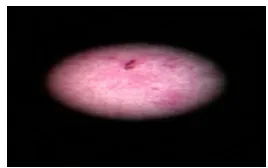
microorganisms which helps in biodegradation process microbes were showed the pink in
Fig. 8: Degradation of produced fabric in soil and pot.
RESULTS AND DISCUSSION
4) Identification of microorganisms
The 5 g of soil taken from garden area where the fabrics were buried, then from that 1 g of
soil and 9 mL of water taken in test tube and labeled 1st dilution. Then from 1st dilution took
the 1 mL of soil water and added 9 mL of RO water. In the same way the 6th dilution ware
made kept aside for while. The 2.5g nutrient broth was weighed and added 1.5 g of agar to
produce the platform to grow the microorganisms in the Petri plate. The broth containing
conical flask, pipettes, Petri plates were autoclaved in cooker for 20 min. Then all of these
were taken out from cooker and placed in laminar air flow chamber. The broth was poured to
the 2 Petri plates and made two compartments in each Petri plate. A loop of suspension of
soil took from 2nd to 5th dilution of serial diluted and streaked out over the broth media in
Petri plate.
Fig. 9: Gram negative bacteria.
After streaking of soil suspension on Petri plate left for 24 hrs to grow the microbes and after
1 day the microorganisms colonies were observed and took a colony of microbe on the slide,
then slide was processed with staining procedure. On the microbe culture the stains were
saffron stain and left for 1 min and washed again. After that 1 drop of alcohol was added to
culture slide. Then the slide was observed under the microscope to identify the type of the
microorganisms. After visualization under the microscope the To make plastic from natural
sources, the polymers are isolated from the raw material. Depending on the material used,
different technologies are required to produce plastic. Typically, the polymers are synthesized
using chemicals or by fermenting the sugars. When using corn to produce plastic, the lactic
acid is extracted from the corn. Through purification processes, the starches in the corn are
broken down into sugars. The sugar is fermented and the carbons in the sugar are removed.
Solubility inference Table I: Solubility testing
Methods Days Weight of the fabric
Before placing in water After placing in water
Potato starch + Corn starch
1 2 2
2 2 2
3 2 2
4 2 2
5 2 2
Potato starch + agar
1 2 2
2 2 2
3 2 2
4 2 2
5 2 2
Potato starch + Sodium alginate
1 2 2
2 2 2
3 2 2
4 2 2
5 2 2
The above table showed that, the different fabrics were produced with different biomaterials
were tested for solubility. Those produced fabrics were weighed before placing in water
beaker for days and again weighed after the solubility. All the different materials methods
were showed that fabrics unable to soluble in the water. Therefore these produced fabrics
may help in help formation bottle structure.
Temperature effects on produced starch fabric
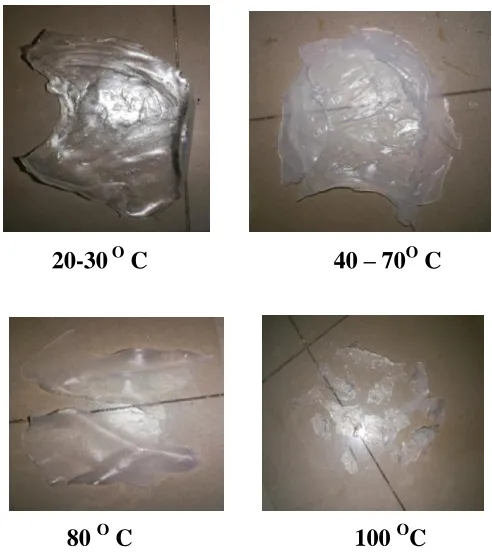
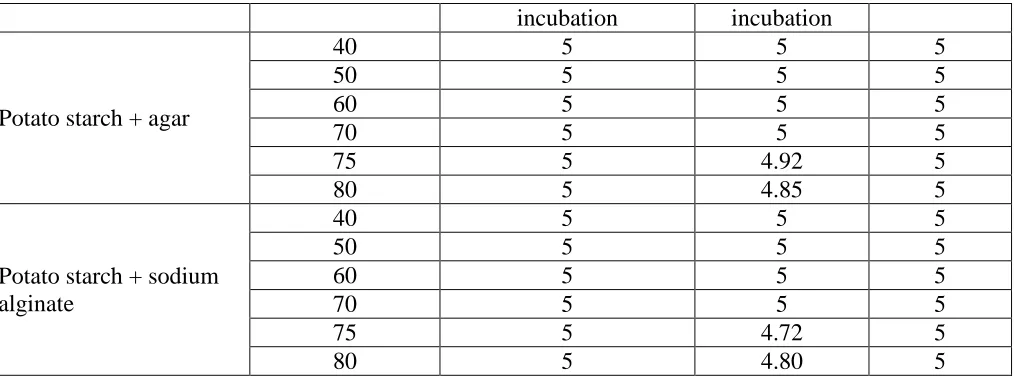
The Table II shows that, the produced fabrics with different biomaterial were tested for heat
test. For single methods from 40-100OC temperature water was maintained and kept for 10
min and observed (Fig.10). As shown in table the readings of starch with agar and starch with
sodium alginate biomaterial fabrics were more strength and compatibility. The single starch
20-30 O C 40 – 70O C
80 O C 100 OC Fig. 10: Effect of temperature on fabric.
Biodegradation inference
Biodegradation or biotic degradation is a specific property of certain plastic materials - that
is, of the polymers these materials are made of. It is a process by which a polymer material
decomposes under the influence of biotic components (living organisms). Microorganisms
(bacteria, fungi, algae) recognize polymers as a source of organic compounds (e.g.
simple monosaccharides, amino acids, etc.) and energy that The potato starch and corn
starch used fabric was kept in refrigerator for 2 days to test the freezing condition of the
biomaterial fabric. The result of this fabric showed positive that is the biomaterial can store in
refrigerator by making water carrying bottles.
Table II: Effect of temperature on produced fabric.
Methods Temperature (oC) Weight of the fabric Timings (min)
Before heating (g) After heating (g)
Potato starch + Corn starch
40 5 5 5
50 5 5 5
60 5 5 5
70 5 5 5
80 5 4.50 5
90 5 4.15 5
100 5 3.85 5
incubation incubation
Potato starch + agar
40 5 5 5
50 5 5 5
60 5 5 5
70 5 5 5
75 5 4.92 5
80 5 4.85 5
Potato starch + sodium alginate
40 5 5 5
50 5 5 5
60 5 5 5
70 5 5 5
75 5 4.72 5
80 5 4.80 5
Sustain them. In other words, biodegradable polymers are their food. Under the influence of
intracellular and extracellular enzymes (endo- and exoenzymes) the polymer undergoes
chemical reactions and the polymer degrades by the process of scission of the polymer chain,
oxidation, etc.
Fig. 11: Biodegraded fabric in soil.
Decomposition generally begins with fragmentation, i.e. the material that is exposed to living
or non-living factors undergoes a chemical decomposition of the polymer and therefore
decomposes mechanically (fragments). In the next phase, the products of this decomposition
are mineralized by microorganisms. This second phase is a necessary step that characterizes
this process as biodegradation, because the partially degraded polymers (fragments) are
hereby metabolized into end products. There are other cases (oxo- degradable materials)
where the material undergoes a quick fragmentation under the influence of heat and UV light
but the mineralization stage is very slow, which means that the relatively inert micro particles
of the plastic material remain that have a poor susceptibility to biodegradation.
CONCLUSION
Technical and economic problems associated with recycling materials have prompted
researchers to look for new materials that can be recycled organically. The negative impact of
waste and consumption. Biodegradable polymer based sources that are renewable are the
most desirable. The main advantage of biodegradable polymers is that they can be composted
with organic waste and release back to enrich the soil. Their use will not only reduce threats
to wildlife caused by dumping conventional plastic but will also reduce the cost of labor for
removal of plastic waste in the environment because they are parsed by nature.
Decomposition will help increase the longevity and stability of the landfills by reducing the
amount of waste, which can be recycled to useful monomers and oligomers by microbial and
enzyme treatments. Using biodegradable polymers in a variety of industries instead of
synthetic materials can significantly help to protect the natural environment.From the
different starch sources, the biodegradable fabrics were developed and tested. By the obtained
results the following conclusions can be drawn:
The biomaterials used for making the biodegradable plastics were starch based materials
i.e. potato starch, corn starch, agar and sodium alginate.
The starch mixed with agar showed more elasticity, strength, compatibility and stiffness
by appearance.
The starch with sodium alginate also showed the more elasticity compared to single
starch used fabrics.
The fabric was degraded when it is exposed to heat or above 70O C temperature.
The fabric was degraded by the Gram negative microorganisms.
ACKNOWLEDGMENT
I would like to thank Dr. G. N Rameshaiah Ph. D. (IITM) for providing immense support
during the project. We would also like to thank Department of Chemical Engineering, B.M.S
College of Engineering and faculty members for providing facility to conduct experiments.
Also like to thank my parents and my friends for moral support.
REFERENCES
1. J. H. Song et al., Biodegradable plastics, 2006; 364: 2127– 2139.
2. Davis, G. & Song, J. H. Biodegradable packaging based on raw materials from crops and
their impact on waste management, 2006; 23: 147–161.
3. J. Greene, et. al., Plastic Debris and Toxin Releases in the Pacific Ocean, 2012.
4. Safa, H.L., Sorption-desorption of aromas on multi- use PET bottles. A test procedure.
5. P. Halley. Biodegradable packaging for the food industry, 2002; 4(4): 56-57.
6. Augusta, J., R.J. Muller and H. Widdecke, Arapid evaluation plate-test for the
biodegradability of plastics. Appl. Microbiol. Biotechnol., 1993; 39: 673-678.
7. Hemashenpagam N, Growther L., Murgalatha N., Raj V. S., Vimal S. S. Isolation and
characterization of a bacterium that degrades PBSA. International Journal of Pharma and
Bio Sciences, 2013; 4: 335–342.
8. Lee, B., Pometto, A.L., Fratzke, A. and Bailey Jr., T. B. Biodegradation of degradable
plastic polyethylene by Phanerochaete and Streptomyces species. Appl. Environ.
Microbiol, 1991; 57: 678-685.
9. Shimao M. Biodegradation of plastics. Current Opinion in Biotechnology, 2001; 12:
242-247.
10.Cerdan, C., Gazulla, C., Raugei, M., Martinez, E. & Fullana-i-Palmer, P. Proposal for
new quantitative eco-design indicators: a first case study. Journal of Cleaner Production,
2009; 17: 1638-1643.
11.Mooney, B.P. Production of plant-based biodegradable plastics. Biochemical Journal,