
YIELD FORMING EFFECT OF APPLICATION OF COMPOSTS CONTAINING
POLYMER MATERIALS ENRICHED IN BIOCOMPONENTS
Florian Gambuś1, Jerzy Wieczorek1, Tomasz Czech1, Olga Gorczyca1, Iwona Spałek1, Katarzyna
Urbańska1, Jacek Babula1, Monika Mierzwa-Hersztek1, Henryk Rydarowski2, Michał Kopeć1
1 Department of Agricultural and Environmental Chemistry, Faculty of Agriculture and Economics, University
of Agriculture in Krakow, 21 A. Mickiewicza Ave., 30-120 Kraków, Poland, e-mail: [email protected]; [email protected]; [email protected]; [email protected]; [email protected]; [email protected]; [email protected]; [email protected]; [email protected]
2 Central Mining Institute (GIG), 1 Gwarków Sq., 40-166 Katowice, Poland, e-mail: [email protected]
INTRODUCTION
Management of organic matter in the field is a complex issue [3, 4] which influences a number of factors depending on and independent from the farmer. Some more important among these are: soil granulometric composition, agrotechnologies and climatic conditions. Organic matter losses from soil occur each year of vegetation. Par
-ticularly, in case of roots crops, agrotechnologi
-cal measures deplete soil of humus compounds, which oxidise in result of soil translocation.
According to Wiśniowska-Kielian and Kli
-ma [6] organic -matter is important in cultivation system regarding heavy metal accumulation by Volume 15, No. 1, Jan. 2014, pp. 81–86
DOI: 10.12911/22998993.1084222 Research Article
ABSTRACT
In a pot experiment the impact of composts containing polymeric materials modified with biocomponents on the diversity of crops of oats and mustard was examined. The composts used in the study were produced in the laboratory from wheat and rape straw, and pea seed cleaning waste with 8-percent addition of chopped biopolymer materials (films) which were prepared in the Central Mining Institute (GIG) in Kato
-wice. Three polymers differing in content of starch and density were selected for the composting. The pot experiment was conducted on three substrates: light and medium soil and on the sediment obtained after flotation of zinc and lead ores, coming from the landfill ZGH “Boleslaw” S.A. in Bukowno. The need for using such materials and substrates results from the conditions of processing some morphological fractions of municipal waste and from improving methods of reclamation. Yield enhancing ef
-fect of composts depends on the substrate on which the compost was used, cultivated plants and crop succession. Application of composts prepared with 8% of polymeric materials based on polyethylene, modified with starch as biocomponent, resulted in significantly lower yields in sandy (light) soil in case of oats and, in some cases, in medium soil. Subsequent plant yield did not differ significantly between the objects fertilized with compost.
Keywords: compost, polyethylene-based polymer, biocomponent, plant yielding. Received: 2013.11.29
Accepted: 2013.12.17 Published: 2014.01.15
plants. The authors observed differences in Cd and Ni concentrations in the cultivated crops between ecological and traditional farms, which they explained, among others, by different accu
-mulation of organic matter resulting from these systems. On the other hand, numerous authors, among them Antonkiewicz [1] or Bożym [2] having in mind reclamation and yield forming aspect of the measure, suggest application of sewage sludge for fertilizing, sometimes in com
More and more often a practical decision must be made concerning application as fertil
-izers composts of municipal waste or their se
-lected fractions, including morphological frac
-tion, which in its composition contains polymers with admixtures of biocomponents or preparation accelerating polymer disintegration. The basic dilemma which a farmer will face is a decision whether it is worth supplying a compost into the soil whose manufacturing was conditioned not exactly by it fertilizer value, but rather by the ne
-cessity of management of biodegradable fractions of municipal waste. Such a compost is polluted with ceramics and/or plastics, halogenated com
-pounds and other contaminants. Also the hazard of soil contamination with heavy metals, despite their considerable binding by organic matter, should not be disregarded in practical compost application [5].
The research aimed at determining whether organic matter dilution during composting with polymer materials modified by biocomponent af
-fects diversification of yields.
METHODS
The experiment was conducted in plastic con
-tainers with 3 kg a.d.m. of substratum. In experi
-ment three substrata, five composts and two plant species were tested.
Two soils with diversified physicochemi
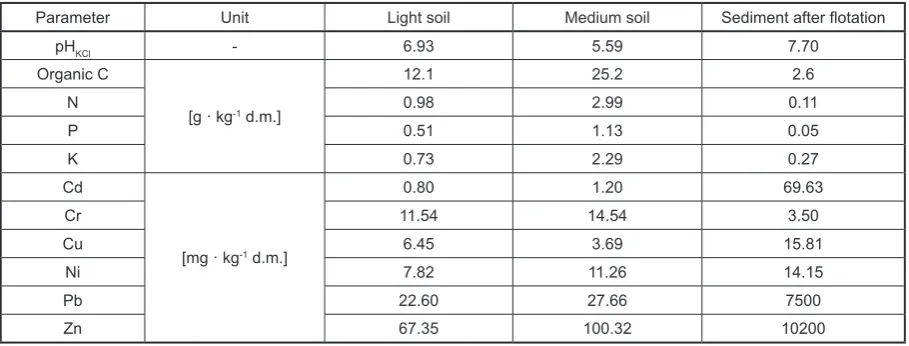
-cal properties and post-flotation sludge from “Bolesław” S.A. mining enterprise in Bukowno landfill were used as substrata. The post-flotation waste revealed an alkaline pH, the light soil neu
-tral and the medium soil slightly acid (Table 1).
Medium soil contained from twice to thrice bigger quantities of organic C, N, P and K and only slightly bigger amounts of heavy metals in comparison with the light soil. Macroelement con
-tent in the post-floatation waste was on a very low level, reaching only from several to a dozen or so percent of their content in soils. The post-floata
-tion waste contained very high amounts of heavy metals, particularly cadmium, lead and zinc.
The composts used for the experiment were prepared in laboratory on the basis of wheat straw, rape straw and waste from pea cleaning (Table 2). The composts mixture was prepared assuming op
-timal C:N ratio. The value slightly exceeding 30, which was reached at the above mentioned compo
-nents proportion 1:1:0.5, was regarded as advan
-tageous for the process. The mixture prepared in this way was supplemented with an 8% admixture (in relation to its dry mass) of crushed biopolymer materials (foils), prepared in the Central Mining Institute in Katowice. Three polymers differing in starch proportion and density were selected for the experiment. The composting was conducted in a bioreactor (V = 20 dm3) under controlled condi
-tions of moisture and aeration, at the temperature maintained at 35–40 ºC for 90 days and subse
-quently until the 180th day of the process at 30 ºC. On each substratum (in 3 replications) seven fertilizer treatments were applied: the control – without fertilization (1), mineral – NPK fertiliza
-tion (2) and compost treatments (3–7). On the or
-ganic treatments the composts were applied in the amount allowing for the introduction of 0.2 g N per 1 kg of the substratum. In order to equalize the amount of phosphorus and potassium, a supple
-mentary mineral fertilization was used to the level allowing to maintain the optimum N:P2O5:K2O
Table 1. Physico-chemical properties of substrata used in the experiment
Parameter Unit Light soil Medium soil Sediment after flotation
pHKCl - 6.93 5.59 7.70
Organic C
[g · kg-1 d.m.]
12.1 25.2 2.6
N 0.98 2.99 0.11
P 0.51 1.13 0.05
K 0.73 2.29 0.27
Cd
[mg · kg-1 d.m.]
0.80 1.20 69.63
Cr 11.54 14.54 3.50
Cu 6.45 3.69 15.81
Ni 7.82 11.26 14.15
Pb 22.60 27.66 7500
ratio (1:0.3:1.37). In the variant receiving exclu
-sively mineral fertilizers the quantities of supplied macroelemets were half lower than on compost treatments. Mineral fertilizers were added in the form of the following salt solutions: NH4NO3, Ca(H2PO4)2 H2O, KH2PO4 and K2SO4.
The experimental design comprised the fol
-lowing objects:
• K1 – organic material without biopolymer foil admixture – control,
• K2 – organic material + 8% of B37 foil; Poly
-ethylene C – 47.5%, thermoplastic corn starch – 45%, compatibilizer 7.5%,
• K3 – organic material + 8% of B36 foil, Poly
-ethylene C – 65%, thermoplastic corn starch – 30%, compatibilizer 5%,
• K4 – organic material + 8% of B22 foil, Poly
-ethylene – 65%, thermoplastic corn starch – 30%, compatibilizer – copolymer,
• K4+SM – organic material + 8% of B22 foil, Polyethylene – 65%, thermoplastic corn starch – 30%, compatibilizer – copolymer + micro
-bial vaccine (SM).
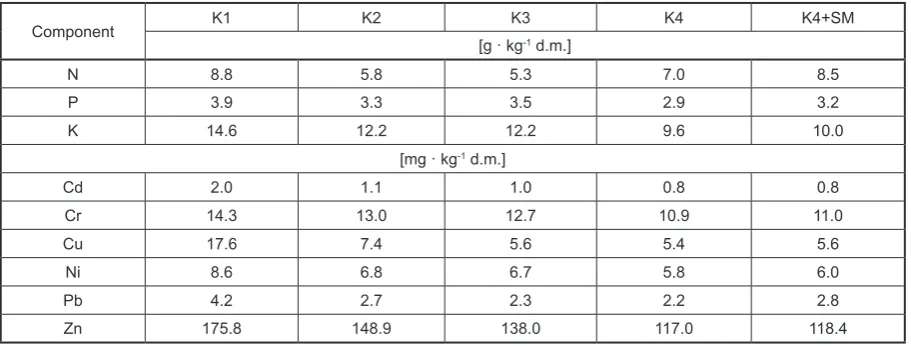
The composts obtained as a result of com
-posting revealed a relatively slight diversifica
-tion of macroelements and trace elements content (Table 3). The greatest content of minerals was registered in the compost to which no polymer materials were added (K1). In the other composts,
the contents of individual elements were usually on an approximate level.
When the substrata were prepared, as described earlier, oat was sown to each of the 63 pots on 14 May and harvested on 17 July after 63 days of veg
-etation. Subsequently, white mustard was sown as a successive crop, harvested on 27 September after 72 days of vegetation. Throughout the plant veg
-etation period the moisture content in the substrata was maintained (using distilled water) on the level of 50% of the maximum water capacity.
In order to assess mineral component concen
-trations, samples of organic materials were “dry” mineralized in a muffle furnace at 450 ºC for 12 hours. After cooling, ash of the aboveground parts and roots was digested in HCl (1:1) and HNO3
ac-ids (1:2), whereas the substrata were dissolved in concentrated HNO3 and HClO4 acids mixed in 1:2 (v/v) ratio and after their evaporating in the hy
-drochloric acid (1:1). In the prepared filtrates the mineral content was assessed by atomic emission spectrometer with inductively coupled plasma (ICP-OES). Total nitrogen concentrations were determined using Kjeldahl’s method. Besides, the following soil properties were determined: granulometric composition using Bouyoucose-Casagrande method in Prószyński’s modification, pH by potentiometer in 1 mol ∙ dm-3 KCl solution
and organic C content by Tiurin’s method. Table 2. Selected parameters of the components of a mixture of organic materials
Component of organic material N C Ash Dry mass
[g · kg-1]
Wheat straw 5.3 406 38.4 885
Rape straw 9.9 374 81.3 882
Waste from pea cleaning 37.9 369 36.6 901
Table 3. The content of selected mineral components in composts used in the experiment
Component K1 K2 K3 K4 K4+SM
[g · kg-1 d.m.]
N 8.8 5.8 5.3 7.0 8.5
P 3.9 3.3 3.5 2.9 3.2
K 14.6 12.2 12.2 9.6 10.0
[mg · kg-1 d.m.]
Cd 2.0 1.1 1.0 0.8 0.8
Cr 14.3 13.0 12.7 10.9 11.0
Cu 17.6 7.4 5.6 5.4 5.6
Ni 8.6 6.8 6.7 5.8 6.0
Pb 4.2 2.7 2.3 2.2 2.8
The results of the yields were subjected to two-way ANOVA analyses regarding fertilization and substrata. The computations were made using Statistica w.10PL programme.
RESULTS
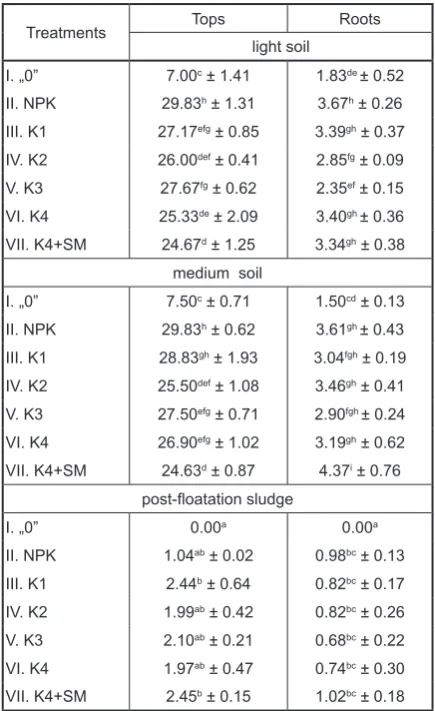
The quantities of harvested oat biomass (Ta
-ble 4) differed significantly not only in respect of applied fertilization but also the substratum used for the experiment (light soil, medium soil and post-floatation sludge).
Post-floatation sludge used for the experiment proved the worst with respect to the amount of harvested oat biomass. Applied fertilization, in
-cluding composts with polymer material admix
-tures was of a secondary importance and did not alleviate unfavourable, particularly physical and chemical, properties of this substratum. Two soil
materials used for the experiment differed con
-siderably by their granulometric composition and contents of components available to plants. Not
-withstanding, the quantities of gathered biomass of both oat aboveground parts and roots gener
-ally did not differ significantly between analo
-gous objects. Beside the post-floatation waste, oat biomass yield was most beneficently affected by fertilization with chemically pure mineral salts, which should be associated with NPK compo
-nents availability. Irrespectively of the polymer supplement, adding composts to the post-floata
-tion sludge influenced growth and development of oat aboveground parts more positively than on the control or the mineral salts treatment. Howev
-er, statistically significantly bigger amount of oat aboveground parts was harvested from the object where compost was applied without admixtures (control) or compost with 8% admixture of B22 foil+microbial vaccine. No similar dependence was observed for oat roots. A beneficial effect of applied composts on oat biomass increments in comparison with the control (0) should be con
-nected not only with supplying nutrients to plants, but also with an improvement of the post-floata
-tion sludge physical properties, improvement of water-air and chemical conditions - immobiliza
-tion of mobile forms of toxic heavy metals in re
-sult of binding them by organic matter.
Amounts of harvested white mustard biomass (Table 5) did not differ significantly, either in re
-spect of applied fertilization, or due to the substra
-tum used in the experiment (light soil, medium soil or post-floatation sludge). Because of the or
-der of cultivation (after oat) mustard plants had different conditions considering availability of nutrients. A clear diversification was observed in the quantity of mustard biomass cultivated on the soils and post-floatation waste. Applied fertiliza
-tion, including composts with polymer materials admixture, was not in any obvious way important for the amount of plant biomass cultivated on the soils (light and medium). Two soil materials used for the experiment differed considerably with their granulometric composition and the content of components bioavailable to plants. Neverthe
-less, the amounts of gathered biomass of both mustard aboveground parts and roots generally did not differ significantly between the analogous objects. The post-floatation sludge proved a mark
-edly better substratum in case of both soils consid
-ering the amount of harvested mustard biomass. Significantly the greatest biomass quantities were Table 4. The amount of oats biomass collected in the
pot experiment (g d.m. · pot-1 ± SD)
Treatments Tops Roots
light soil
I. „0” 7.00c ± 1.41 1.83de ± 0.52
II. NPK 29.83h ± 1.31 3.67h ± 0.26
III. K1 27.17efg ± 0.85 3.39gh ± 0.37
IV. K2 26.00def ± 0.41 2.85fg ± 0.09
V. K3 27.67fg ± 0.62 2.35ef ± 0.15
VI. K4 25.33de ± 2.09 3.40gh ± 0.36
VII. K4+SM 24.67d ± 1.25 3.34gh ± 0.38
medium soil
I. „0” 7.50c ± 0.71 1.50cd ± 0.13
II. NPK 29.83h ± 0.62 3.61gh ± 0.43
III. K1 28.83gh ± 1.93 3.04fgh ± 0.19
IV. K2 25.50def ± 1.08 3.46gh ± 0.41
V. K3 27.50efg ± 0.71 2.90fgh ± 0.24
VI. K4 26.90efg ± 1.02 3.19gh ± 0.62
VII. K4+SM 24.63d ± 0.87 4.37i ± 0.76
post-floatation sludge
I. „0” 0.00a 0.00a
II. NPK 1.04ab ± 0.02 0.98bc ± 0.13
III. K1 2.44b ± 0.64 0.82bc ± 0.17
IV. K2 1.99ab ± 0.42 0.82bc ± 0.26
V. K3 2.10ab ± 0.21 0.68bc ± 0.22
VI. K4 1.97ab ± 0.47 0.74bc ± 0.30
VII. K4+SM 2.45b ± 0.15 1.02bc ± 0.18
Explanation: Means marked by the same letters did
Table 5. The amount of white mustard biomass col
-lected in the pot experiment [g d.m. · pot-1 ± SD]
Treatments Tops Roots
light soil
I. „0” 1.51 bc ± 0.48 0.34 bcde ±0.04
II. NPK 1.62 bc ± 0.19 0.29 bcde ± 0.01
III. K1 2.66 de ± 0.26 0.49 ef ± 0.02
IV. K2 2.21 cd ± 0.53 0.41 def ± 0.02
V. K3 2.19 cd ± 0.17 0.40 def ± 0.06
VI. K4 1.81 cd ± 0.39 0.36 cde ± 0.04
VII. K4+SM 1.98 cd ± 0.19 0.39 def ± 0.08
medium soil
I. „0” 1.53 bc ± 0.09 0.23 bcd ± 0.06
II. NPK 0.67 ab ± 0.01 0.14 ab ± 0.02
III. K1 1.46 bc ± 0.45 0.29 bcde ± 0.07
IV. K2 2.21 cd ± 0.29 0.29 bcde ± 0.04
V. K3 1.56 bc ± 0.07 0.31 bcde ± 0.03
VI. K4 1.51 bc ± 0.08 0.35 cde ± 0.05
VII. K4+SM 1.57 bc ± 0.06 0.22 abcd ± 0.05
post-floatation sludge
I. „0” 0.05 a ± 0.01 0.02 a ± 0.01
II. NPK 0.25 a ± 0.17 0.18 abc ± 0.05
III. K1 4.49 gh ± 0.56 0.81 hi ± 0.10
IV. K2 4.21 fg ± 0.66 0.57 fg ± 0.22
V. K3 5.18 h ± 0.30 0.77 hi ± 0.07
VI. K4 3.44 ef ± 0.79 0.70 gh ± 0.13
VII. K4+SM 4.48 gh ± 1.22 0.91 i ± 0.23
Explanation: Means marked by the same letters did
not differ significantly at α< 0.05 according to the Duncan test, factors: fertilization × substrate.
produced in the objects where composts were ap
-plied. A beneficial effect of composts on mustard biomass increments, in comparison with the con
-trol (0) and NPK treatment should be connected not only with nutrient release to plants in result of mineralization, but most probably with the im
-provement of physical properties of post-floatation sludge – improvement of water-air conditions. It should be also emphasized that on the mineral salt treatments, irrespectively of the substratum, the amounts of mustard biomass (aboveground parts and roots) were markedly lower than gathered from the objects receiving compost fertilization.
A confirmation of a diverse response of the plant yield to the substratum conditions is the analysis of variance for this factor, considering homogenous groups. Average oat dry matter yield on post-floatation sludge was 1.71a g d.m. ∙ pot-1 and differed significantly from mean yields ob
-tained on light soil (23.95b g d.m. ∙ pot-1) and on medium soil (24.39b g d.m. ∙ pot-1).
Three homogenous groups were revealed for mustard yield. The aboveground part yield from this plant was the lowest on medium soil (1.45a g d.m. ∙ pot-1). On light soil on average 1.99b g d.m. ∙ pot-1 was gathered and on post-floatation sludge 3.16c g d.m. ∙ pot-1. Homogenous groups of aver -age yields for substrata did not change even after elimination from the analysis of the objects with
-out fertilization and receiving mineral fertilizers. It indicates a considerable importance of substra
-tum choice (Figure 1) regarding the results which
one plans to achieve when using composts. The selection of plant allowing for optimum utiliza
-tion of components is no less important.
CONCLUSION
1. Yield forming effect of compost application depends on the substratum to which the com
-post was used and its decomposition time. 2. Composts prepared with 8% admixture of
polymer materials on the basis of polyethylene modified with starch as biocomponent led to a lower oat yield, particularly on light soil. 3. Mustard, a successive plant yield was not sig
-nificantly diversified among the objects fertil
-ized with composts.
4. No unanimous effect of the kind of polymer used in composting on plant yield was noted.
Acknowledgements
Realized within the project BIOMASA (POIG 01.01.02-10-123/09) and partially financed by the European Union from the European Regional De
-velopment Fund.
REFERENCES
1. Antonkiewicz J. 2010. Effect of sewage sludge and furnace waste on the content of selected elements in the sward of legume-grass mixture. J. Elemen
-tol., 15(3): 435-443.
2. Bożym M. 2010. Wykorzystanie pyłów dymni
-cowych ze spalania węgla brunatnego w gospo
-darce osadowej. Prace Instytutu Szkła, Cerami
-ki, Materiałów Ogniotrwałych i Budowlanych, Warszawa-Opole, Rok III, Nr 5: 103-112.
3. Gondek K., Filipek-Mazur B. 2005. Agrochemiczna ocena wartości nawozowej kompostów roślinnego pochodzenia. Acta Agrophys., 5(2): 271-282. 4. Gondek K., Filipek-Mazur B. 2006. Akumu
-lacja mikroelementów w biomasie owsa oraz ich dostępność w glebie nawożonej kompostem z od
-padów roślinnych. Acta Agrophys., 8(3): 579-590. 5. Ryant P., Wiśniowska-Kielian B. 2003. Effect of
compost application on copper and nickel content in the aboveground biomass of oats (Avena sativa L.). Acta Agr. et Silv. Ser. Agr., XL: 221-228. 6. Wiśniowska-Kielian B., Klima K. 2007. Com
![Table 5. The amount of white mustard biomass col-lected in the pot experiment [g d.m. · pot-1 ± SD]](https://thumb-us.123doks.com/thumbv2/123dok_us/8362482.1671999/5.595.134.464.516.750/table-white-mustard-biomass-col-lected-pot-experiment.webp)
