125
INTRODUCTION
In the integrated and ecological agriculture systems, more attention is being paid to the cul-tivation of catch crops, which should be a regu-lar part of crop rotation. The cultivation of catch crops for ploughing in is a precursor of the long-lasting organic matter, which is an energy source
for micro-organisms, and influences physical and
chemical properties of the soil [Vos and van der Putten 2001, Marshall et al.2003, Clark et al. 2007]. When catch crop organic matter is regu-larly supplied to the soil, its biological activity can be preserved. Catch crops incorporated as
green manures prior to sweet corn cultivation favourably affect the quantity and quality of ear and kernel yields [Zhang et al. 2010, Zaniewicz-Bajkowska et al. 2011, Rosa 2014].
Sweet corn is a poor competitor with weeds in the initial period of growth. Weed infestation can contribute to decreased yields of ears by up to 85% [Williams 2010]. It is therefore cru-cial to control weeds from the very beginning of sweet corn cultivation. The most effective method of weed control is to apply herbicides which, however, have an adverse effect on the natural environment and may negatively affect yield quality.
THE EFFECT OF WINTER CATCH CROPS ON WEED INFESTATION
IN SWEET CORN DEPENDING ON THE WEED CONTROL METHODS
Robert Rosa1
1 Department of Vegetable Crop,Siedlce University of Natural Sciences and Humanities, Bolesława Prusa 14,
08-110 Siedlce.Poland, e-mail: [email protected] Volume 16, Issue 2, Apr. 2015, pages 125–135
DOI: 10.12911/22998993/1867 Research Article
ABSTRACT
An experiment was carried out in east-central Poland (52°06’ N, 22°55’ E) over 2008– 2011 to study the effect of winter catch crops on the weed infestation, number, and fresh matter of weeds in sweet corn (Zea mays L. var. saccharata). The following winter catch crops were grown: hairy vetch (Vicia villosa Roth.), white clover (Trifo-lium repens L.), winter rye (Secale cereale L.), Italian ryegrass (Lo(Trifo-lium multiflorum L.) and winter turnip rape (Brassica rapa var. typica Posp.). The catch crops were sown in early September and incorporated in early May. The effect of the catch crops was compared to the effect of FYM (30 t·ha-1) and control without organic manuring
(NOM). Three methods of weed control were used: HW – hand weeding, twice during the growing period, GCM – the herbicide Guardian Complete Mix 664 SE, immedi-ately after sowing of corn seeds, Z+T – a mixture of the herbicides Zeagran 340 SE and Titus 25 WG applied at the 3–4-leaf stage of sweet corn growth. Rye and turnip rape catch crops had least weeds in their fresh matter. Sweet corn following winter catch crops was less infested by weeds than corn following farmyard manure and non-manured corn. Least weeds and their lowest weight were found after SC, BRT and VV. LM and BRT reduced weed species numbers compared with FYM and NOM.
The greatest weed species diversity, determined at the corn flowering stage, was deter
-mined after SC and FYM. The number and weight of weeds were significantly lower
when chemically controlled compared with hand weeding. The best results were ob-served after a post-emergent application of the mixture Z+T. The weed species diver-sity on Z+T-treated plots was clearly lower compared with GCM and HW.
Keywords: weed infestation, green manure, organic fertilisation, weed control
meth-od,Zea mays L. var saccharata.
Because of environmental and human health concerns, worldwide efforts are being made to re-duce the heavy reliance on synthetic herbicides that are used to control weeds. The modern approach to the issue of weed control in integrated agriculture involves a rational (that is taking into account the economic calculus) combination of effective meth-ods, which are safe for the environment and con-sumers, applied to reduce the number of unwanted segetal plants to the level known as the econom-ic threshold for weeds occurring in a crop plant [Singh et al. 2003, Armengot et al. 2013].
Many authors stress that well established
catch crops efficiently compete with weeds; some
plants species cultivated for incorporation are even able to hamper weed seed sprouting and initial growth [Teasdale et al. 1991, Akemo et al. 2000, Caporali et al. 2004, O’Reilly et al. 2011]. What is more, Liebman and Davis [2000] as well as Barberi [2002] believe that catch crops can be an alternative to chemical weed control.
The objective of this work was to assess the effect of winter catch crop ploughed in and an ap-plication of different weed control methods on weed infestation of sweet corn.
MATERIAL AND METHODS
The experiment was carried out over 2008– 2011 at the Experimental Station of the Siedlce University of Natural Sciences and Humanities, which is located in east-central Poland (52°03’N, 22°33’E). According to the international system
of FAO classification, the soil was classified as a
Luvisol (LV) [World Reference… 2006]. The ex-periment was established in a split-block design with three replicates.
The effect of winter catch crops and weed control methods on the weed infestation, num-ber, and fresh matter in ‘Sweet Nugget F1’ sweet corn was investigated. The following winter catch crops were grown: VV – hairy vetch (Vicia villosa Roth.), TR – white clover (Trifolium repens L.), SC – winter rye (Secale cereale L.), LM – Italian ryegrass (Lolium multiflorum L.) and BRT – win-ter turnip rape (Brassica rapa var. typica Posp.). Their seeds were sown in early September in the years 2008–2010, at the following rates: VV – 70 kg, TR – 20 kg, SC – 180 kg, LM – 35 kg, BRT – 12 kg per 1 ha. Different nitrogen rates were applied: 30 kg N·ha-1 for VV and TR, and 60 kg
N·ha-1 for SC, LM and BRT. The rates of
phos-phorus and potassium applied to all the catch crop plants were 40 kg P2O5·ha-1 and 80 kg K
2O·ha-1,
respectively. The effect of winter catch crops was compared to a control plot without organic ma-nure (NOM) and farmyard mama-nure (FYM) at a rate of 30 t·ha-1. Green matter of the catch crops
(roots + above ground parts) and FYM were in-corporated in early May.
Directly before catch crop incorporation, the samples of plant material (roots + above ground parts) were taken to assess fresh (FM) and dry matter (DM) yields. Samples were taken from an area of 1 m2 at three randomly selected places in
each experimental combination. The dry matter contents in the catch crops were determined using the oven-drying gravimetric method. Moreover, the percentage share of weeds in catch crop bio-mass and dominating weeds were determined.
The field for cultivation of the catch crop plants
and sweet corn was prepared in accordance with the principles of proper agricultural technology.
Seeds of sweet corn were sown in the years 2009–2011 between 11and 24May, at a spacing of 60 × 25 cm. Before sowing, mineral fertilis-ers were applied at the following rates: 60 kg N (urea), 50 kg P2O5 (superphosphate), 180 kg K2O (60% potassium chloride) per 1 ha. When plants of sweet corn were 20 cm high, top dressing with 60 kg N·ha-1 (ammonium nitrate) was applied.
Three weed control methods were applied: HW – hand weeding (twice during the growing season), GCM – herbicide Guardian CompleteMix 664 SE (acetochlor + terbuthylazine) immediately after sowing of sweet corn seeds, at the rate of 3.5 l·ha-1 per 250 dm3 water, Z+T – a mixture of
the herbicides Zeagran 340 SE (bromoxynil +
ter-buthylazine) (1.6 l∙ha-1) + Titus 25 WG
(rimsul-furon) (40 g∙ha-1) + adjuvant Trend 90 EC (0.1%)
per 250 dm3 water, applied at the 3–4 leaf stage
of sweet corn growth. Herbicide treatments were performed by knapsack sprayer. Other cultivation practices followed the generally established rules of sweet corn agrotechnology.
ap-127
peared on corn plants. Weed infestation wasde-termined by the quantitative-weighing method. This method entailed determining the number of individual weeds species and their fresh mass in each plot. Samples were taken from an area of a selected 0.5 m2 at three randomly selected places
in each plot. The number and weight of the weeds were expressed per 1 m2.
The following indices of weed species diver-sity were calculated:
• Shannon-Wiener index of species diversity (H’), which takes into account species evenness
and richness. The index reflects the probability
that two individuals chosen randomly from a sample will represent different species. Its value depends on the species number and proportions between species numbers [Zanin et al. 1992]:
3
The following indices of weed species diversity were calculated:
–
Shannon-Wiener index of species diversity (H’), which takes into account species evenness and
richness. The index reflects the probability that two individuals chosen randomly from a sample will
represent different species. Its value depends on the species number and proportions between species
numbers [Zanin et al. 1992]:
𝐻𝐻
′= − ∑(𝑝𝑝
𝑖𝑖
ln 𝑝𝑝
𝑖𝑖)
–
Simpson’s index of domination (
D
), reflects the probability of choosing two individuals
representing the same species. It takes into account species number and relative abundance of each
species [Zanin et al. 1992]:
𝐷𝐷 = ∑ 𝑝𝑝
𝑖𝑖2where
p
iis the share of ith species in the sample.
The results were statistically analysed by ANOVA following the model for the split-block design.
The significance of differences was determined by the Tukey test at the significance level of
P
≤
0.05. All the calculations were performed in Statistica 10.0.
RESULTS AND DISCUSION
Biomass yields of the catch crops are presented in figure 1. The greatest fresh (FM) and dry matter
(DM) yields were produced by winter rye (35.5 t·ha
-1FM and 7.3 t·ha
-1DM) and winter turnip rape
catch crops (29.1 t·ha
-1FM and 4.9 t·ha
-1DM). Rye produced over twice as much DM as hairy vetch
and Italian ryegrass and over three times more DM than white clover. Farmyard manure at a rate of
30 t·ha
-1supplied the soil with 7.6 t·ha
-1dry matter.
Analysis of the percentage share of weeds in the fresh matter of winter catch crops demonstrated
substantial differences in their resistance to infestation by weeds (Figure 2). The infestation ranged
from 2.8 to 25.3%, being the lowest in winter rye (2.8%) and winter turnip rape (4.1%) catch crops,
and the greatest in Italian ryegrass catch crop (25.3%). In general, the dominant weedy species in the
catch crops were
Viola arvensis
L.,
Amaranthus retroflexus
L.,
Anthemis arvensis
L
., Matricaria
perforata
Mérat.,
Vicia sativa
L. and
Elymus repens
(L.) Gould. However, not all the aforementioned
species occurred in each catch crop (Table 1). The most weedy species were noted in white clover,
winter rye and Italian ryegrass (four in each catch crop) and the least in hairy vetch (two). What is
more, self-seeded
Secale cereale
plants were found in hairy vetch. Only
Viola arvensis
L.
accompanied all the catch crops.
The species composition of weed communities depends largely on soil and climate conditions
(Zarzecka and Gąsiorowska 2001) and agrotechnical practices (Pszczółkowski 2003). In thi
s study,
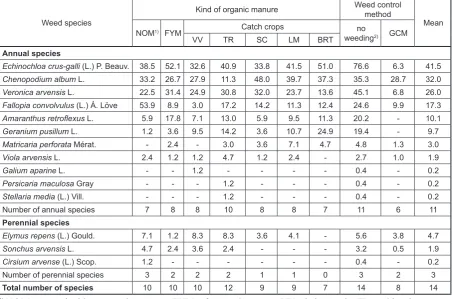
21 days after sweet corn sowing, 14 weed species including 11 annuals and 3 perennials, were noted
(Table 2). They belonged to the species typically establishing in sweet corn crop. Irrespective of the
examined factors, the dominant species among the annuals were
Echinochloa crus-galli
(L.) P.
Beauv.,
Chenopodium album
L.,
Veronica arvensis
L.,
Fallopia convolvulus
(L.) Á. Löve,
Amaranthus retroflexus
L. and
Geranium pusillum
L. Of the perennials, the most common weed was
Elymus repens
(L.) Gould. The composition of the weed species was similar to that found in the
study carried out in east-
central Poland (Zarzecka and Gugała 2005, Kosterna 2014). On day 21 after
sowing, most weedy species (12) were recorded in TR plots and the least (7) in BRT plots.
Pre-emergent GCM resulted in by 7 times less weedy species compared with the treatment where
weeds were not controlled for 20 days of sweet corn cultivation. The most noxious weeds
establishing in sweet corn include:
Ch. album
,
F. convolvulus
,
A. retroflexus, E. crus-galli
oraz
Polygonum aviculare
[Waligóra et al. 2008]. No
A. retroflexus
,
G. pusillum
,
G. aparine
,
P.
maculosa
,
S. media
or
C. arvense
species were found in GCM-treated plots. Additionally, GCM
reduced the number of
E. crus-galli
,
V. arvensis
,
F. convolvulus
and
Ch. album
by 92, 85, 60 and
24%, respectively.
• Simpson’s index of domination (D), reflects
the probability of choosing two individuals representing the same species. It takes into ac-count species number and relative abundance of each species [Zanin et al. 1992]:
3
The following indices of weed species diversity were calculated:
–
Shannon-Wiener index of species diversity (
H’), which takes into account species evenness and
richness. The index reflects the probability that two individuals chosen randomly from a sample will
represent different species. Its value depends on the species number and proportions between species
numbers [Zanin et al. 1992]:
𝐻𝐻
′= − ∑(𝑝𝑝
𝑖𝑖ln 𝑝𝑝
𝑖𝑖)
–
Simpson’s index of domination (
D
), reflects the probability of choosing two individuals
representing the same species. It takes into account species number and relative abundance of each
species [Zanin et al. 1992]:
𝐷𝐷 = ∑ 𝑝𝑝
𝑖𝑖2where
p
iis the share of ith species in the sample.
The results were statistically analysed by ANOVA following the model for the split-block design.
The significance of differences was determined by the Tukey test at the significance level of
P
≤
0.05. All the calculations were performed in Statistica 10.0.
RESULTS AND DISCUSION
Biomass yields of the catch crops are presented in figure 1. The greatest fresh (FM) and dry matter
(DM) yields were produced by winter rye (35.5 t·ha
-1FM and 7.3 t·ha
-1DM) and winter turnip rape
catch crops (29.1 t·ha
-1FM and 4.9 t·ha
-1DM). Rye produced over twice as much DM as hairy vetch
and Italian ryegrass and over three times more DM than white clover. Farmyard manure at a rate of
30 t·ha
-1supplied the soil with 7.6 t·ha
-1dry matter.
Analysis of the percentage share of weeds in the fresh matter of winter catch crops demonstrated
substantial differences in their resistance to infestation by weeds (Figure 2). The infestation ranged
from 2.8 to 25.3%, being the lowest in winter rye (2.8%) and winter turnip rape (4.1%) catch crops,
and the greatest in Italian ryegrass catch crop (25.3%). In general, the dominant weedy species in the
catch crops were
Viola arvensis
L.,
Amaranthus retroflexus
L.,
Anthemis arvensis
L
., Matricaria
perforata
Mérat.,
Vicia sativa
L. and
Elymus repens
(L.) Gould. However, not all the aforementioned
species occurred in each catch crop (Table 1). The most weedy species were noted in white clover,
winter rye and Italian ryegrass (four in each catch crop) and the least in hairy vetch (two). What is
more, self-seeded
Secale cereale
plants were found in hairy vetch. Only
Viola arvensis
L.
accompanied all the catch crops.
The species composition of weed communities depends largely on soil and climate conditions
(Zarzecka and Gąsiorowska 2001) and agrotechnical practices (Pszczółkowski 2003). In thi
s study,
21 days after sweet corn sowing, 14 weed species including 11 annuals and 3 perennials, were noted
(Table 2). They belonged to the species typically establishing in sweet corn crop. Irrespective of the
examined factors, the dominant species among the annuals were
Echinochloa crus-galli
(L.) P.
Beauv.,
Chenopodium album
L.,
Veronica arvensis
L.,
Fallopia convolvulus
(L.) Á. Löve,
Amaranthus retroflexus
L. and
Geranium pusillum
L. Of the perennials, the most common weed was
Elymus repens
(L.) Gould. The composition of the weed species was similar to that found in the
study carried out in east-
central Poland (Zarzecka and Gugała 2005, Kosterna 2014). On day 21 after
sowing, most weedy species (12) were recorded in TR plots and the least (7) in BRT plots.
Pre-emergent GCM resulted in by 7 times less weedy species compared with the treatment where
weeds were not controlled for 20 days of sweet corn cultivation. The most noxious weeds
establishing in sweet corn include:
Ch. album
,
F. convolvulus
,
A. retroflexus, E. crus-galli
oraz
Polygonum aviculare
[Waligóra et al. 2008]. No
A. retroflexus
,
G. pusillum
,
G. aparine
,
P.
maculosa
,
S. media
or
C. arvense
species were found in GCM-treated plots. Additionally, GCM
reduced the number of
E. crus-galli
,
V. arvensis
,
F. convolvulus
and
Ch. album
by 92, 85, 60 and
24%, respectively.
where pi is the share of ith species in the sample. The results were statistically analysed by ANOVA following the model for the split-block
design. The significance of differences was deter
-mined by the Tukey test at the significance level
of P ≤ 0.05. All the calculations were performed
in Statistica 10.0.
RESULTS AND DISCUSION
Biomass yields of the catch crops are presented in Figure 1. The greatest fresh (FM) and dry mat-ter (DM) yields were produced by winmat-ter rye (35.5 t·ha-1 FM and 7.3 t·ha-1 DM) and winter turnip rape
catch crops (29.1 t·ha-1 FM and 4.9 t·ha-1 DM). Rye
produced over twice as much DM as hairy vetch and Italian ryegrass and over three times more DM than white clover. Farmyard manure at a rate of 30 t·ha-1 supplied the soil with 7.6 t·ha-1 dry matter.
Analysis of the percentage share of weeds in the fresh matter of winter catch crops demon-strated substantial differences in their resistance to infestation by weeds (Figure 2). The infestation ranged from 2.8 to 25.3%, being the lowest in win-ter rye (2.8%) and winwin-ter turnip rape (4.1%) catch crops, and the greatest in Italian ryegrass catch crop (25.3%). In general, the dominant weedy spe-cies in the catch crops were Viola arvensis L.,
Amaranthus retroflexus L., Anthemis arvensis L., Matricaria perforata Mérat., Vicia sativa L. and Elymus repens (L.) Gould. However, not all the aforementioned species occurred in each catch crop (Table 1). The most weedy species were noted in white clover, winter rye and Italian rye-grass (four in each catch crop) and the least in hairy vetch (two). What is more, self-seeded Secale ce-reale plants were found in hairy vetch. Only Viola arvensis L. accompanied all the catch crops.
The species composition of weed commu-nities depends largely on soil and climate
con-ditions [Zarzecka and Gąsiorowska 2001] and agrotechnical practices [Pszczółkowski 2003]. In
this study, 21 days after sweet corn sowing, 14
Figure 2. Share of weeds (%) in the catch crops biomass (mean for 2009–2011)
Table 1. The dominant weed species in the catch crops biomass (mean for 2009–2011)
Weed species Hairy vetch Kind of catch crop
(VV) White clover(TR) Winter rye(SC) Italian ryegrass(LM) Winter turnip rape(BRT)
Viola arvensis L. + + + + +
Amaranthus retroflexus L. + + + + –
Anthemis arvensis L. – – + + +
Matricaria perforata Mérat. – + – – –
Vicia sativa L. – – + – –
Secale cereale (self-seeded) + – – – –
Elymus repens (L.) Gould
.
– + – + ++ – species presence, – – species absence.
Table 2. The species composition of weeds (plant·m-2) 21 days after sweet corn sowing (mean for 2009–2011)
Weed species
Kind of organic manure Weed control method
Mean
NOM1) FYM Catch crops no
weeding2) GCM
VV TR SC LM BRT
Annual species
Echinochloa crus-galli (L.) P. Beauv. 38.5 52.1 32.6 40.9 33.8 41.5 51.0 76.6 6.3 41.5
Chenopodium album L. 33.2 26.7 27.9 11.3 48.0 39.7 37.3 35.3 28.7 32.0
Veronica arvensis L. 22.5 31.4 24.9 30.8 32.0 23.7 13.6 45.1 6.8 26.0
Fallopia convolvulus (L.) Á. Löve 53.9 8.9 3.0 17.2 14.2 11.3 12.4 24.6 9.9 17.3
Amaranthus retroflexus L. 5.9 17.8 7.1 13.0 5.9 9.5 11.3 20.2 - 10.1
Geranium pusillum L. 1.2 3.6 9.5 14.2 3.6 10.7 24.9 19.4 - 9.7
Matricaria perforata Mérat. - 2.4 - 3.0 3.6 7.1 4.7 4.8 1.3 3.0
Viola arvensis L. 2.4 1.2 1.2 4.7 1.2 2.4 - 2.7 1.0 1.9
Galium aparine L. - - 1.2 - - - - 0.4 - 0.2
Persicaria maculosa Gray - - - 1.2 - - - 0.4 - 0.2
Stellaria media (L.) Vill. - - - 1.2 - - - 0.4 - 0.2
Number of annual species 7 8 8 10 8 8 7 11 6 11
Perennial species
Elymus repens (L.) Gould. 7.1 1.2 8.3 8.3 3.6 4.1 - 5.6 3.8 4.7
Sonchus arvensis L. 4.7 2.4 3.6 2.4 - - - 3.2 0.5 1.9
Cirsium arvense (L.) Scop. 1.2 - - - 0.4 - 0.2
Number of perennial species 3 2 2 2 1 1 0 3 2 3
Total number of species 10 10 10 12 9 9 7 14 8 14
1) NOM – control without organic manure, FYM – farmyard manure, VV – hairy vetch, TR – white clover,
SC – winter rye, LM – Italian ryegrass, BRT – winter turnip rape.
129
weed species including 11 annuals and 3peren-nials, were noted (Table 2). They belonged to the species typically establishing in sweet corn crop. Irrespective of the examined factors, the dominant species among the annuals were Echi-nochloa crus-galli (L.) P. Beauv., Chenopodium album L., Veronica arvensis L., Fallopia convol-vulus (L.) Á. Löve, Amaranthus retroflexus L. and Geranium pusillum L. Of the perennials, the most common weed was Elymus repens (L.) Gould. The composition of the weed species was similar to that found in the study carried out in
east-cen-tral Poland (Zarzecka and Gugała 2005, Kosterna
2014). On day 21 after sowing, most weedy spe-cies (12) were recorded in TR plots and the least (7) in BRT plots.
Pre-emergent GCM resulted in by 7 times less weedy species compared with the treatment where weeds were not controlled for 20 days of sweet corn cultivation. The most noxious weeds establishing in sweet corn include: Ch. album, F. convolvulus, A. retroflexus, E. crus-galli oraz Polygonum aviculare [Waligóra et al. 2008]. No
A. retroflexus, G. pusillum, G. aparine, P. macu-losa, S. media or C. arvense species were found in GCM-treated plots. Additionally, GCM reduced
the number of E. crus-galli, V. arvensis, F. con-volvulus and Ch. album by 92, 85, 60 and 24%, respectively.
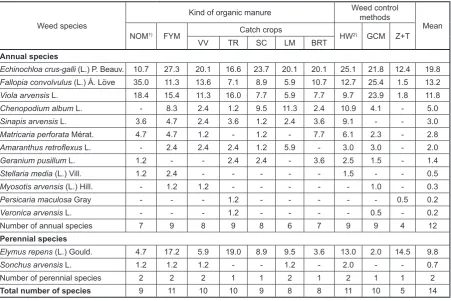
Number of weeds recorded 72 days after sweet corn planting was the same as during the
first assessment. However, the species composi -tion was different (Table 3). During the second assessment, annual G. aparine, was not found but S. arvensis and M. arvensis were present. C. arvense was not found either. E. crus-galli, F. convulvulus, V. arvensis were the most abundant species. Of the dominating species, least E. crus-galli plants were noted for NOM control, and F. convulvulus and V. arvensis after LM catch crop. Least weedy species were recorded after LM and BRT catch crops (8), and most (11) after FYM. For all the organic manuring treatments, the aver-age number of weeds representing each species
declined compared with the first assessment. It
was due to the weed control treatments applied to HW and Z+T plots.
An application of Z+T on day 21 of sweet corn growing killed most weedy species observed at the beginning of sweet corn growing season. Also, hand weeding performed twice contributed to a reduced number of weedy species as well as
Table 3. The species composition of weeds (plant·m-2) 72 days after sweet corn sowing (mean for 2009–2011)
Weed species
Kind of organic manure Weed control methods
Mean
NOM1) FYM Catch crops HW2) GCM Z+T
VV TR SC LM BRT
Annual species
Echinochloa crus-galli (L.) P. Beauv. 10.7 27.3 20.1 16.6 23.7 20.1 20.1 25.1 21.8 12.4 19.8
Fallopia convolvulus (L.) Á. Löve 35.0 11.3 13.6 7.1 8.9 5.9 10.7 12.7 25.4 1.5 13.2
Viola arvensis L. 18.4 15.4 11.3 16.0 7.7 5.9 7.7 9.7 23.9 1.8 11.8
Chenopodium album L. - 8.3 2.4 1.2 9.5 11.3 2.4 10.9 4.1 - 5.0
Sinapis arvensis L. 3.6 4.7 2.4 3.6 1.2 2.4 3.6 9.1 - - 3.0
Matricaria perforata Mérat. 4.7 4.7 1.2 - 1.2 - 7.7 6.1 2.3 - 2.8
Amaranthus retroflexus L. - 2.4 2.4 2.4 1.2 5.9 - 3.0 3.0 - 2.0
Geranium pusillum L. 1.2 - - 2.4 2.4 - 3.6 2.5 1.5 - 1.4
Stellaria media (L.) Vill. 1.2 2.4 - - - 1.5 - - 0.5
Myosotis arvensis (L.) Hill. - 1.2 1.2 - - - 1.0 - 0.3
Persicaria maculosa Gray - - - 1.2 - - - 0.5 0.2
Veronica arvensis L. - - - 1.2 - - - - 0.5 - 0.2
Number of annual species 7 9 8 9 8 6 7 9 9 4 12
Perennial species
Elymus repens (L.) Gould. 4.7 17.2 5.9 19.0 8.9 9.5 3.6 13.0 2.0 14.5 9.8
Sonchus arvensis L. 1.2 1.2 1.2 - - 1.2 - 2.0 - - 0.7
Number of perennial species 2 2 2 1 1 2 1 2 1 1 2
Total number of species 9 11 10 10 9 8 8 11 10 5 14
1) NOM – control without organic manure, FYM – farmyard manure, VV – hairy vetch, TR – white clover,
SC – winter rye, LM – Italian ryegrass, BRT – winter turnip rape
number of plants of a given species. In GCM-treated plots, the number of weedy species
in-creased during the second compared with the first
counting. What is more, some species increased in abundance (in particular E. crus-galli, Viola ar-vensis, F. convolvulus) whereas the abundance of Ch. album, Veronica arvensis, E. repens declined, S. media and S. arvensis being totally eliminated.
Number of weeds and amount of their dry
matter per unit of area, reflecting weed infestation
in sweet corn cultivated in the experimental plots,
was significantly affected by organic manuring
and weed control methods (Tables 4–5).
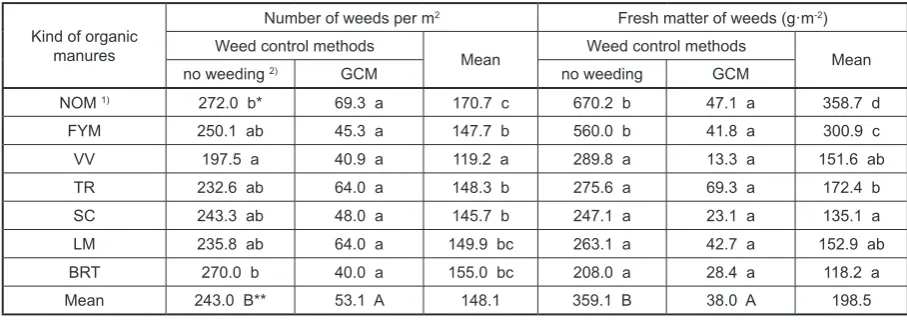
Regardless of weed control method, on day 21 after sweet corn sowing the least weeds (119.2 no.·m-2) were found following an incorporation of
VV catch crop (Table 4). In contrast, most weeds (170.7 no.·m-2) were noted for NOM and a similar
number after LM and BRT catch crops (149.9 and 155.0 no.·m-2, respectively). No significant changes
in the number of weeds and amount of their fresh matter were observed in GCM-treated plots due to an application of different organic manuring. In plots which were not treated for 20 days after corn sowing, least weeds were recorded after VV and most after BRT and in NOM. All the catch crops which were followed by sweet corn reduced the weight of fresh matter compared with FYM and NOM, the greatest decrease being observed after BRT and SC. It amounted to, respectively, 61% and 55% compared with FYM, and 67% and 62% com-pared with NOM.
Pre-emergent application of GCM reduced the number of weeds and amount of their fresh
matter compared with non-treated plots by 78 and 89%, respectively.
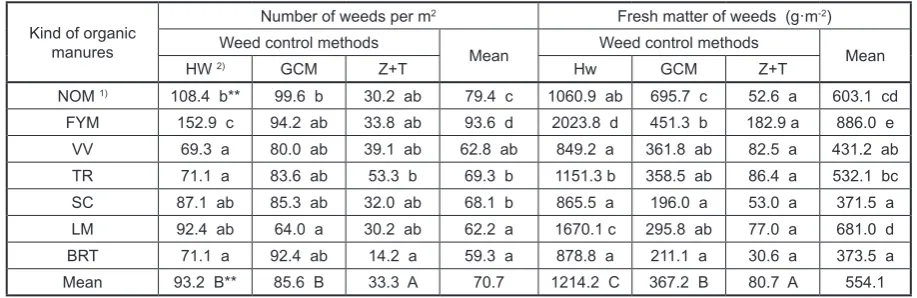
The average number of weeds, determined 72 days after corn planting, was by 77.4 no.·m-2
lower and the average fresh matter weight by 355.6 g·m-2 greater compared with the first as
-sessment (Table 5). The decrease in weed abun-dance was due to weed control practices applied in HW and Z+T plots. Also, developing corn plants and weeds that remained between rows competed with newly established weeds. A lower number of weeds per unit area resulted in them freely increasing in size and weight. According
to Jodaugienė et al. [2006], weed sprouting is
poorer in the period starting in mid-summer com-pared with spring and early summer so the effect of weed control methods is the most pronounced
during the first part of the growing season. In turn
Armengot et al. [2013] stress that total
eradica-tion of weeds in cultivated fields is not necessary
but weeds should be controlled to the level when they do not affect negatively the crop plant.
Regardless of the weed control method,
sig-nificantly most weeds were counted after farm -yard manure (on average 93.6 no.·m-2). FYM is
widely believed to be a source of weed infestation
in arable fields [Wichrowska and Jaskólski 2014].
The number of diaspores spread with FYM may in extreme cases exceed 420 th no.·mg-1.
Bed-ding and faeces are the major sources of weeds in farmyard manure [Pleasant and Schlather 1994].
Just like during the first assessment, the num -ber of weeds after all the catch crops was
sig-nificantly lower compared with FYM and NOM.
Table 4. Number and fresh mass of weeds (g·m-2) 21 days after sweet corn sowing (mean for 2009–2011)
Kind of organic manures
Number of weeds per m2 Fresh matter of weeds (g·m-2)
Weed control methods
Mean Weed control methods Mean
no weeding 2) GCM no weeding GCM
NOM 1) 272.0 b* 69.3 a 170.7 c 670.2 b 47.1 a 358.7 d
FYM 250.1 ab 45.3 a 147.7 b 560.0 b 41.8 a 300.9 c
VV 197.5 a 40.9 a 119.2 a 289.8 a 13.3 a 151.6 ab
TR 232.6 ab 64.0 a 148.3 b 275.6 a 69.3 a 172.4 b
SC 243.3 ab 48.0 a 145.7 b 247.1 a 23.1 a 135.1 a
LM 235.8 ab 64.0 a 149.9 bc 263.1 a 42.7 a 152.9 ab
BRT 270.0 b 40.0 a 155.0 bc 208.0 a 28.4 a 118.2 a
Mean 243.0 B** 53.1 A 148.1 359.1 B 38.0 A 198.5
1) NOM – control without organic manure, FYM – farmyard manure, VV – hairy vetch catch crop, TR – white
clo-ver catch crop, SC – winter rye catch crop, LM – Italian ryegrass catch crop, BRT – winter turnip rape catch crop
2) no weeding– no weeding to 21 days from sweet corn sowing, GCM – Guardian CompleteMix 664 SE,
131
Weed abundance was most effectively reducedby BRT and LM catch crops. In GCM-treated plots the most weeds were observed in NOM and in Z+T-treated plots after TR. The greatest differences in the number of weeds and their fresh matter weight between the experimental organic manures were observed in hand weeded
(HW) plots. Weed weight was significantly low -er aft-er catch crops than FYM. Compared with FYM, the greatest reduction in weed weight was observed after SC and BRT which had produced most biomass. Singh et al. [2003] have reported that catch crops reduce weed infestation because they overgrow weeds, and due to allelopathy. The more green matter is produced by catch
crops, the greater the reduction. Bogužas et al.
[2010] found that, of the catch crops they ex-amined, winter rape and white mustard were the best, and red clover was the worst (it produced least biomass) at reducing the number of weeds and weight of their fresh matter. Malik et al.
[2008], Jędrszczyk and Poniedziałek [2009] and
O’Reilly et al. [2011] pointed to rye as a good
catch crop which was very efficient at reducing
weed load in sweet corn. In the present study, the weight of weeds after VV, SC and BRT was
sig-nificantly lower compared with NOM. Abdin et
al. [2000] reported lower numbers of weeds and their weight after fall rye, hairy vetch, white clo-ver + ryegrass catch crops compared with corn cultivated without catch crop. Also Caporali et al. [2004] claimed that the number and weight of weeds establishing between rows were lower after ryegrass, subclover and hairy vetch catch crops compared with control where no catch
crops were incorporated, ryegrass being the best weed competitor.
Olorunmaiye [2010] has suggested that legu-minous plants can potentially be effective at con-trolling weeds but the amount of their biomass is crucial here. Under the growing conditions of
Poland, Jędrszyk and Poniedziałek [2009] found
that weed infestation of sweet corn was lower af-ter white clover compared with the control with-out catch crop but much higher than after a rye catch crop. Special weed control properties of winter turnip rape and other Brassica plants have been highlighted by e.g.: Al-Khatib et al. [1997], Petersen et al. [2001] and O’Reilly et al. [2011]. They are connected with the fact that these plants secrete isothiocyanates which are toxic to some weedy species. It has been proven that winter tur-nip rape secretes substances which hinder seed sprouting of Sonchus asper (L.) Hill, Matricaria inodora L., Amaranthus hybridus L., Echinochloa crus-galli (L.) Beauv. and Alopecurus myosuroi-des Huds. [Petersen et al. 2001]. Also Caamal-Maldonado et al. [2001] and Weih et al. [2008] have pointed to a possibility of using allelopathic properties of plants representing other botanical families to reduce an occurrence of weeds.
In the present study, the herbicides Z+T were the best suppressors of weed number and weight. The superiority of chemical weed control over hand weeding repeated several times has been demonstrated by Abdin et al. [2000] and Malik et al. [2008]. Brandsæter et al. [2012] have sug-gested that post-emergent herbicides are more ef-fective at reducing weed biomass compared with pre-emergent chemicals.
Table 5. Number and fresh mass of weeds (g·m-2) 72 days after sweet corn sowing (mean for 2009–2011)
Kind of organic manures
Number of weeds per m2 Fresh matter of weeds (g·m-2)
Weed control methods
Mean Weed control methods Mean
HW 2) GCM Z+T Hw GCM Z+T
NOM 1) 108.4 b** 99.6 b 30.2 ab 79.4 c 1060.9 ab 695.7 c 52.6 a 603.1 cd
FYM 152.9 c 94.2 ab 33.8 ab 93.6 d 2023.8 d 451.3 b 182.9 a 886.0 e
VV 69.3 a 80.0 ab 39.1 ab 62.8 ab 849.2 a 361.8 ab 82.5 a 431.2 ab
TR 71.1 a 83.6 ab 53.3 b 69.3 b 1151.3 b 358.5 ab 86.4 a 532.1 bc
SC 87.1 ab 85.3 ab 32.0 ab 68.1 b 865.5 a 196.0 a 53.0 a 371.5 a
LM 92.4 ab 64.0 a 30.2 ab 62.2 a 1670.1 c 295.8 ab 77.0 a 681.0 d
BRT 71.1 a 92.4 ab 14.2 a 59.3 a 878.8 a 211.1 a 30.6 a 373.5 a
Mean 93.2 B** 85.6 B 33.3 A 70.7 1214.2 C 367.2 B 80.7 A 554.1
1) NOM – control without organic manure, FYM – farmyard manure, VV – hairy vetch catch crop, TR – white
clover catch crop, SC – winter rye catch crop, LM – Italian ryegrass catch crop, BRT – winter turnip rape catch crop
2) HW – hand weeding, GCM – Guardian CompleteMix 664 SE, Z+T – Zeagran 340 SE + Titus 25 WG + Trend 90 EC
Figur
e 3.
Shannon-W
iener index of species diversity (H’) and Simpson’
s index of domination (D) in sweet corn depending on the factors examined (mean for 2009–201
133
Figure 3 demonstrates segetal flora diversity reflected by the Shannon-Wiener index of diver -sity (H’) and Simpson’s index of domination (D). Values of index D range from 0 to 1; values ap -proximating 1 indicate that one or several species are clearly dominant and diversity of the commu-nity is low. By contrast, the higher index of di-versity (H’), the greater didi-versity of phytocenose [Zanin et al. 1992]. In the experiment discussed here, the average value of index H’ at the
begin-ning of the growing season and sweet corn flow -ering did not change and amounted to 0.35. By contrast, the value D index increased from 0.41 to 0.50. According to Stupnicka-Rodzyniewicz et al. [2004] and Kostrzewska et al. [2011], the species biodiversity of weeds changes during the growing season and is affected by agrotechno-logical factors. The authors observed increased biodiversity during the mid-growing season of cereals. Regardless of the weed control method, on day 21 after sweet corn sowing the greatest di-versity of weeds was found after FYM (H’=0.38) and for NOM (H’=0.40), and the lowest after VV (H’=0.27). During the second assessment, SC plots had the most diverse species composi-tion of weeds (H’=0.40) whereas the least diver-sity was found for VV plots (H’=0.27) (as was
the case during the first assessment). Majchrzak and Skrzypczak [2007] found no significant dif -ferences between index H’ values for corn culti-vated after spring vetch and control without catch
crop. Wanic et al. [2004] pointed out that floristic
composition of weed communities got impover-ished due to the effect of Italian ryegrass whereas
Kuraszkiewicz and Pałys [2003] reported a simi
-lar influence of red clover and annual ryegrass. In
the study discussed here, weed diversity increased in GCM-treated plots on day 72 from corn
plant-ing, compared with the first assessment, the great -est diversity being observed after BRT catch crop.
The highest values of the index of domination (D) on day 21 and 72 from sweet corn planting were obtained after VV. Of all the GCM-treated plots, the greatest index D was calculated for NOM. In the case of Z+T plots, it was the great-est after FYM and LM. O’Reilly et al. [2011] cul-tivated sweet corn after rye and oat catch crops
and found a significantly lower value of index D compared with cultivation without catch crop.
A post-emergent application of the herbicides
Z+T definitely reduced species diversity of weeds
compared with GCM and hand weeding repeated twice, as revealed by a decline in the value of
index of biodiversity (H’) and an increase in the index of domination (D). Also Yao et al. [2010] observed declining values of index H’ and in-creasing values of index D after chemical weed control compared with hand weeding.
CONCLUSIONS
1. Winter catch crops incorporated prior to sweet corn planting reduced weed infestation of the crop compared with cultivation including an ap-plication of farmyard manure and without catch crop. The most effective weed suppressors were rye, turnip rape and hairy vetch catch crops. 2. Italian ryegrass and turnip rape catch crops
reduced weed richness compared with cultiva-tion including an applicacultiva-tion of farmyard ma-nure and without catch crop.
3. The greatest species diversity of weeds,
de-termined at the flowering stage of sweet corn,
was observed after rye catch crop and farm-yard manure.
4. Chemical weed control more effectively re-duced the number and weight of weeds than hand weeding. The best effects were obtained after post-emergent application of the mixture of herbicides Zeagran 340 SE + Titus 25 WG. 5. Species diversity of weeds following an appli-cation of Zeagran 340 SE + Titus 25 WG was
definitely lower compared with a pre-emer -gent application of Guardian CompleteMix 664 SE and hand weeding performed twice.
Acknowledgements
The research was supported by the Polish Ministry of Science and Higher Education as part of the statutory activities of the Department of Vegetable Crops, Siedlce University of Natural Sciences and Humanities.
REFERENCES
1. Abdin O.A., Zhou X.M., Cloutier D., Coulman D.C., Faris M.A., Smith D.L. 2000. Cover crops and interrow tillage for weed control in short season maize (Zea mays L.). Eur. J. Agron., 12, 93–102. 2. Akemo M., Regnier E., Bennet M. 2000. Weed
3. Al-Khatib K., Libbey C., Boydston R. 1997. Weed suppression with Brassica green manure crops in green pea. Weed Sci., 45 (3), 439–445.
4. Armengot L., José-María L., Chamorro L., Sans F.X. 2013. Weed harrowing in organically grown cereal crops avoids yield losses without reducing weed diversity. Agron. Sustain. Dev., 33, 405–411. 5. Barberi P. 2002. Weed management in organic ag-riculture: are we addressing the right issues. Weed Res., 42, (3), 177–193.
6. Bogužas V., Marcinkevičienė A., Pupalienė R. 2010.
Weed response to soil tillage, catch crops and farm-yard manure in sustainable and organic agriculture.
Žemdirbystė – Agriculture, 97 (3), 43–50.
7. Brandsæter L.O., Mangerud K., Rasmussen J. 2012. Interactions between pre- and post-emer-gence weed harrowing in spring cereals. Weed Res., 52, 338–347.
8. Caamal-Maldonado J.A., Jiménez-Osornio J.J., Torres-Barragán A., Anaya A.L. 2001. The use of allelopathic legume cover and mulch species for weed control in cropping systems. Agron. J., 93 (1), 27–36.
9. Caporali, F., Campiglia, E., Mancinelli, R., Paolini,
R. 2004. Maize performances as influenced by
winter cover crop green manuring. Ital. J. Agron., 8 (1), 37–45.
10. Clark A.J., Meisinger J.J., Decker A.M., Mulford F.R. 2007. Effects of a grass-selective herbicide in a vetch-rye cover crop system on corn grain yield and soil moisture. Agron. J., 99, 43–48.
11. Jędrszczyk E., Poniedziałek M. 2009. Wpływ żywych ściółek na wybrane właściwości gleby i
zachwaszczenie w uprawie kukurydzy cukrowej. Zesz. Problem. Post. Nauk Rol. 539, 265–271. 12. Jodaugienė D., Pupalienė R., Urbonienė M.,
Pranckietis V., Pranckietienė I. 2006. The impact
of different types of organic mulches on weed emergence. Agron. Res., 4, Special issue, 197–201. 13. Kosterna E. 2014. The effect of soil mulching with
organic mulches, on weed infestation in broccoli and
tomato cultivated under polypropylene fibre, and
without a cover. J. Plant Prot. Res., 54 (2), 188–198. 14. Kostrzewska M.K., Wanic M., Jastrzębska M.,
Nowicki J. 2011. Wpływ życicy wielokwiatowej jako wsiewki międzyplonowej na różnorodność zbiorowisk chwastów w jęczmieniu jarym. Fragm.
Agron., 28 (3), 42–52.
15. Kuraszkiewicz R., Pałys E. 2003. Wpływ wsiewek międzyplonowych na zachwaszczenie łanu roślin
ochronnych na glebie lekkiej. Ann. UMCS, Sec. E, 58, 53–67.
16. Liebman M., Davis A. S. 2000. Integration of soil, crop and weed management in low-external-input farming systems. Weed Res., 40 (1), 27–47
17. Majchrzak L., Skrzypczak G. 2007. Wpływ spo -sobu przygotowania gleby do siewu i rodzaju po-zostawionej biomasy na zachwaszczenie
kukury-dzy. Prog. Plant Prot./Post. Ochr. Roślin, 47 (3),
191–198.
18. Malik M.S., Norsworthy J.K., Culpepper A.S., Riley M.B., Bridges W. Jr. 2008. Use of wild radish (Rapha-nus raphanistrum) and rye cover crops for weed sup-pression in sweet corn. Weed Sci., 56 (4), 588–595. 19. Marshall E.J.P., Brown V.K., Boatman N.D.,
Lut-man P.J.W., Squire G.R., Ward L.K. 2003. The role of weeds in supporting biological diversity within
crop fields. Weed Res., 43, 77–89.
20. Olorunmaiye P.M. 2010. Weed control potential of
five legume cover crops in maize/cassava intercrop
in a Southern Guinea savanna ecosystem of Nige-ria. Aust. J. Crop Sci., 4 (5), 324–329.
21. O’Reilly K.A., Robinson D.E., Vyn R.J., Van Eerd L.L. 2011. Weed populations, sweet corn yield, and economics following fall cover crops. Weed Tech-nol., 25, 374–384.
22. Petersen J., Belz R., Walker F., Hurle K. 2001. Weed suppression by release of isothiocyanates from turnip-rape mulch. Agron. J., 93 (1), 37–43. 23. Pleasant J., Schlather K. J. 1994. Incidence of weed
seed in cow (Bos sp.) manure and its importance as a weed source for cropland. Weed Technol., 8, 304–310.
24. Pszczółkowski P. 2003. The attempts to con -trol weed infestation in potatoes cultivated under shields. Part I. Plant response to herbicides. Biul. IHAR, 228, 249–260.
25. Rosa R. 2014. The structure and yield level of sweet corn depending on the type of winter catch crops and weed control method. J. Ecol. Eng., 15 (4), 118-130.
26. Singh H.P., Batish D.R., Kohli R.K. 2003. Allelo-pathic interactions and allelochemicals: new pos-sibilities for sustainable weed management. Critic. Rev. Plant Sci., 22 (3-4), 239–311.
27. Stupnicka-Rodzynkiewicz E., Stępnik K., Le
-piarczyk A. 2004. Wpływ zmianowania, sposobu uprawy roli i herbicydów na bioróżnorodność
zbiorowisk chwastów. Acta Sci. Pol., Agricultura, 3 (2), 235–245.
28. Teasdale J., Beste E., Potts W. 1991. Response of weeds tillage and cover crop residue. Weed Sci., 39, 195–199.
29. Wanic M., Kostrzewska M.K., Jastrzębska M., Brzezin G. 2004. Rola wsiewek międzyplonowych w regulacji zachwaszczenia jęczmienia jarego w płodozmianach zbożowych. Fragm. Agron., 21 (1), 85–100.
nitro-135
gen to the succeeding main crop. Plant and Soil,236, 263–273.
31. Yao H.J., Jin Z.L., Yang W.B., Zhao J.H., Zhang F. 2010. Effects of weeding methods on weed community and its diversity in a citrus orchard in southwest Zhejiang. Ying yong sheng tai xue bao = The journal of applied, 21 (1), 23–28.
32. Waligóra H., Skrzypczak W., Szulc P. 2008. Zach-waszczenie i plonowanie kukurydzy cukrowej po
zastosowaniu pielęgnacji mechanicznej. J. Res.
Appl. Agric. Engng., 53 (4).
33. Weih M., Didon U.M.E., Ronnberg-Wastljung A.C., Bjorkman C. 2008. Integrated agricultural research and crop breeding: Allelopathic weed control in cereals and long-term productivity in pe-rennial biomass crops. Agr. Syst., 97, 99–107. 34. Wichrowska D., Jaskólski D. 2014. Effect of
or-ganic and mineral fertilization and soil fertilizer on the weed infestation of potato plantation. Acta Sci. Pol., Agricultura, 13 (1), 61–71.
35. Williams M.M. 2010. Biological significance
of low weed population densities on sweet corn. Agron. J., 102, 464–468.
36. World Reference Base for Soil Resources. 2006. A
Framework for International Classification, Corre -lation and Communication. World Soil Resources
Report FAO, 103. Food and Agriculture Organiza-tion of the United NaOrganiza-tions, Rome, 116.
37. Zanin G., Mosca G., Catizone P. 1992. A profile of the potential flora in maize fields of the Po Valley.
Weed Res., 32 (5), 407–418.
38. Zarzecka K., Gąsiorowska B. 2001. Wpływ metod pielęgnacji na zachwaszczenie i plonowanie
ziemniaka. [The effect of weed control methods on the infestation and potato yields]. Zesz. Nauk. Akademii Podlaskiej w Siedlcach, Ser. Rolnic-two, 59, 15–25.
39. Zarzecka K., Gugała M. 2005. Population and spe -cies composition of weed under differentiated con-ditions of weed control method. Acta Agrobot., 58 (1), 291–302.
40. Zaniewicz-Bajkowska A., Rosa R., Kosterna E., Franczuk J. 2011. Serradella and faba bean catch crops as a kind of organic manuring in sweet corn cultvaton. (in:) Nowoczesne metody analizy sur-owców rolniczych. Red. Puchalski Cz. i Bartosz G., Wyd. Uniwersytetu Rzeszowskiego,
Monogra-fia Nauk., 227–240.
41. Zhang Y., GaoL., Zhou W., Li Z. 2010. Effects of intercropping clover on yield, quality of sweet corn