ISSN: 2334-2366 (Print), 2334-2374 (Online) Copyright © The Author(s). All Rights Reserved. Published by American Research Institute for Policy Development DOI: 10.15640/jcsit.v3n1a2 URL: http://dx.doi.org/10.15640/jcsit.v3n1a2
Understanding the Difficulties African-American Middle School Girls Face While Enacting Computational Algorithmic Thinking in the Context of Game
Design
Jakita O. Thomas1, O. Carlette Odemwingie2, Quimeka Saunders2 & Malika Watlerd2
Abstract
Computational algorithmic thinking (CAT) is the ability to design, implement, and assess the implementation of algorithms to solve a range of problems. It involves identifying and understanding a problem, articulating an algorithm or set of algorithms in the form of a solution to the problem, implementing that solution in such a way that it solves the problem, and evaluating the solution based on some set of criteria. CAT has roots in Mathematics, through problem solving and algorithmic thinking. CAT lies at the heart of Computer Science, which is defined as the study of algorithms. CAT embodies the ability to think critically and creatively to solve problems and has applicability in a range of areas from Computer Science to cooking to music. This article introduces CAT as explored through the Supporting Computational Algorithmic Thinking (SCAT) project, an on-going longitudinal between-subjects research project and enrichment program that guides African-American middle school girls (SCAT Scholars) through the iterative game design cycle resulting in a set of complex games around broad themes. This article also explores the difficulties SCAT Scholars face while using CAT capabilities in the context of game design over almost two years as described by the Scholars themselves in online journals.
Keywords: Computational algorithmic thinking, game design, middle-school, girls, African-American
1. Introduction
Jeanette Wing [41] defines computational thinking as “a way humans solve problems…”.
1
Spelman College, Department of Computer & Information Science, 350 Spelman Lane, SW, Box 1257 Atlanta, GA 30314. Email: [email protected], Phone: 404-820-9788
2
This research makes explicit a critical aspect of computational thinking through its focus: the design, development, and implementation of algorithms to solve problems. An algorithm is defined as a well-ordered collection of unambiguous and effectively computable operations that, when executed, produces a result and halts in a finite amount of time [34]. Computational algorithmic thinking (CAT) is the ability to design, implement, and assess the implementation of algorithms to solve a range of problems. It involves identifying and understanding a problem, articulating an algorithm or set of algorithms in the form of a solution to the problem, implementing that solution in such a way that it solves the problem, and evaluating the solution based on some set of criteria. CAT has roots in Mathematics [30], through problem solving and algorithmic thinking [20]. CAT lies at the heart of Computer Science, which is defined as the study of algorithms [34]. CAT embodies the ability to think critically and creatively to solve problems and has applicability in a range of areas from Computer Science to cooking to music [16, 29, 42].
While there is a great deal of research that examines how to engage students in computational thinking and learning in Computer Science (CS) or that focuses on how game design improves IT fluency, algorithmic thinking, collaboration, programming capability, and broader participation from under-represented groups, there is a scarcity of research that focuses on understanding and describing how the development of CAT happens over time as a complex cognitive capability [32, 24, 36, 40, 23, 13, 6, 18, 19, 28]. Furthermore, there is less research that focuses on understanding how the development of these kinds of complex cognitive capabilities can impact not only how we leverage game design to teach and support students as they develop these capabilities, but also how we define and measure the learning that happens during that development. We begin to address this research question by examining the online journals of SCAT Scholars collected during the first two Seasons of SCAT from July 2013 – January 2015. The next section of this paper will provide the background context that grounds the research. Then, the SCAT learning environment, including the scaffolds that support Scholars as they engage in game design, will be described. Next, we will describe the data collection and analysis methods, followed by a description of findings from our analysis of the first Season and a half of online journal data. Finally, we will discuss what these findings not only suggest about supporting CAT capabilities, but also how they inform the project going forward as it moves through the second year of data collection.
2. Background
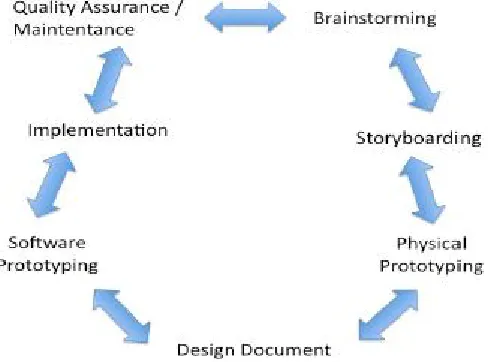
As a domain, engaging in game design aligns with the eight practices outlined by the NRC [25]. The iterative game design lifecycle involves several phases, which are also iterative [15], as shown in Figure 1. During brainstorming, game designers generate many ideas for games and present those ideas. Once an idea is selected, paper-and-pencil drawings are created, called storyboards that include demo artwork. Play testing is next, which involves bringing actual players from the target user group in and observing them as they play the game (or engage with the storyboard) in real time, getting feedback about the game experience to inform the design of the game [15, 13]. Next, game designers create a playable physical prototype using paper-and-pencil and/or craft materials, which is play tested. Then, a rough software prototype is created which models some aspect(s) of core game play. Then follows more play testing. Next comes creating the design document, which outlines every aspect of the game and how it will function. This is followed by implementing the game with play testing throughout implementation. Finally, quality assurance testing is done with continued play testing. Game design has been chosen as the domain for a number of reasons. First, game design is a domain with which middle-schoolers have a great deal of familiarity as consumers [18, 17]. The Pew Internet & American Life Project’s survey revealed that among young people, ages 12 – 17, 97% of respondents play
Video games [22]. As such, this domain can provide motivation as learners “look under the hood” of their favorite games to understand how they are designed and implemented. Second, game design is centered around the iterative design, representation, and implementation of algorithms, which makes it an ideal domain to understand and describe the development of CAT over time [12]. Third, based upon industry practices, game designers iteratively move from game conceptualization to production and release over time [15], making game design an ideal domain for conducting longitudinal studies. Lastly, game design is a domain in which African-American women are grossly under-represented [10]. Of the 97% of young people who stated they played games in the Pew Institute’s survey, over 94% of girls play video games with little difference in the percentages by race, ethnic group, or socio-economic status [22]. However, women represent only about 10 – 12% of the game design workforce, and Latinos and African-Americans comprise less than 5% combined [31].
The acquisition and development of skills, capabilities, and practices involves the changing of declarative knowledge, or independent pieces of factual knowledge, to procedural knowledge, or connected knowledge that forms a process for carrying out a skill [2, 1]. Applied in context and/or among a community, a process evolves into a practice [27, 21]. While skills, or abilities refer to what one can do in the present, capabilities refer to what one can learn to do with instruction and support, or scaffolding [3, 4, 38, 9, 35]. However, moving learners from capability to ability requires several things [9, 24, 36]. First, learners need opportunities to make connections between their experiences and the knowledge or skills they are learning. Second, learners need enough time to learn and develop skills and capabilities so that they can use them flexibly in appropriate situations. Third, learners should be supported as they attempt to represent problems at higher levels of abstraction. Finally, learners should be encouraged to monitor their learning and should be supported as they learn meta-cognitive
strategies.
3. Scat Learning Environment
In addition, the facilitator leads and supports discussions that help Scholars as they think through their designs, helps them make connections across dyad experiences and problems as they design and implement their games, and models the kinds of questions Scholars should be asking themselves and their peers as they develop algorithms for their game designs, move through the iterative game design cycle, and reflect on their use of CAT [19]. As dyads work on their game designs, she walks from group to group asking them questions about their designs, helping them identify problems and issues, illustrating for them how to use the Design Notebook and other tools and resources provided to them to help them design their games, and serving as a sounding board for dyads as they design. Although the facilitator is a critical component to the SCAT learning environment, she cannot be with every group or individual all the time. To help overcome that limitation and to help Scholars develop more expert CAT capabilities, the Design Notebook has been created to coach Scholars as they engage in CAT through game design. The Design Notebook has been integrated into SCAT activities, affording Scholars multiple opportunities to develop CAT capabilities while working individually and collaboratively in dyads.
Given that Scholars will be able to move through the iterative game design cycle at their own pace, it is likely that those Scholars or dyads who are further along in the game design cycle will be able to scaffold dyads who are not as far along [38, 33, 24, 36, 27]. In addition, different Scholars will bring different perspectives to the dyad, which will contribute to greater understanding by the dyad. The literature shows that small group collaboration and discussion has many benefits [14, 19, 33, 8, 39, 7, 5].
4. Cat in Scat
As mentioned previously, game design is all about algorithms, and computational algorithmic thinking is enacted in a number of places throughout the game design cycle. The game design cycle itself is an algorithm consisting of seven phases as described in Section 2, BACKGROUND. In addition, as Scholars move through the phases of the game design cycle, they engage in computational algorithmic thinking. For example, during the Storyboarding phase, Scholars engage in computational algorithmic thinking as they draw stills that depict the game play for the user from beginning to end as well as the non-visual elements of the game. In fact, the storyboard is the first enactment of CAT as it visually describes many of the game’s algorithms. During the Physical Prototyping phase, Scholars articulate the rules and procedures of the game play, which are the primary algorithms that govern game play and how players engage with the game. The implementation phase involves Scholars not only articulating algorithms in SCRATCH to implement game play functionality and behavior, but also adapting and implementing SCRATCH algorithms (e.g., creating a scrolling screen, keeping score, enacting a timer, detecting and responding to a collision between objects, etc.). As Scholars move through the phases of the game design cycle, they articulate the algorithms in their games more and more specifically as they move toward a more fully functional game.
5. Method
5.1 Setting and Participants
This longitudinal between-groups research takes place at a small women’s liberal arts college in the Southeastern United States. Each year, or Season, Scholars participate in the three activities described earlier: two-week summer camp, workshops, and field trips. This paper focuses on data collected during SCAT Seasons 1 and 2. Season 1 ran from July 2013 – May 2014, and Season 2 began in June 2014, and will be running through May 2015. To date, we have worked with 23 African-American girls: 20 during Season 1 (the Scholar’s 6th grade year) and 20 during Season 2 (their 7th grade year). Of these SCAT Scholars, 95% have never used SCRATCH, and none of the Scholars have ever engaged in the game design cycle in this way to design novel games.
5.2 Data Collection and Analysis
Table 1: Changes to the Online Journal Questions from SCAT Season 1 to Season 2
6. Findings
This section presents findings based on our analysis of the online journal data for Season 1 and Season 2 so far (June 2014 – January 2015), which Scholars completed at the end of each SCAT meeting (every day during the two-week summer camps and each week for 12 weeks during the two 6-week workshops of Season 1 as well as the six (out of twelve) workshops Scholars have completed thus far during Season 2). In particular, we describe and discuss the most prevalent themes that emerged as a result of our analysis across these two Seasons, focusing on the difficulties that Scholars described in their online journals as they engaged in CAT in the context of game design as well as how those difficulties change, or resolve, across seasons. We also include actual Scholar responses from both Seasons that align with each category of difficulty or theme as representative examples of how Scholars articulated difficulties within each category.
6.1 Articulating Algorithms to Describe User Actions and Related Game play Functionality or Behavior
Across Seasons 1 and 2, Scholars experienced the most difficulty as they attempted to articulate algorithms to describe user actions and game play functionality or behavior. Responses described this difficulty in two ways: either 1) figuring out how to build a set of blocks in SCRATCH (i.e., articulating an algorithm) that would allow the game to respond or behave in an appropriate way based on some aspect of the game that the Scholar dyads designed (e.g., “Getting ghouls to move right”, “Fixing the money so that the character collects it every time”, “Getting the dot to show” or “Making the coins disappear”), or 2) remembering how to articulate common SCRATCH algorithms (e.g., “Creating the timer”, “Changing to the next level”, “Moving sprites” or “Broadcasting”).
6.2 Building the Foundation of the Physical Prototype
In particular, Scholars experienced difficulty either 1) figuring out how they would effectively represent different aspects of their games so that others would understand the representation during play testing (e.g., “The difficult thing was the characters” or “Thinking about how I wanted my prototype to look like”); 2) constructing the foundation of their physical prototypes, which involves building a representation of their core game play and d signing the basic game objects (physical setting, units, resources, etc.) (e.g., “gluing things”); or 3)Completing their physical prototypes within an allotted period of time (e.g., “finishing everything in time”, “finishing my prototype” or “Nothing was particularly difficult- it's just that I tended to take a long time to do simple things, so I took a long time”).
6.3 Assessing Algorithms That Behave in Unexpected Ways and Adapting Those Algorithms
6.4 Collaborating Within Dyads
Scholars worked in dyads to design and implement their games, and many Scholars described collaborating with their partner as a difficulty they had to overcome during Season 1 (e.g., “working with my partner”, “what was difficult was when my partner and I weren’t coming together with ideas”, or “It was difficult to come up with solutions that both my partner and I agreed on”). Many of the Scholars expressed during whole group discussions that they had never worked with a partner before the SCAT program or, if they had, their previous group experiences had not been positive. Some of those collaborative difficulties seemed to arise because of conflicting personalities (i.e., two dominant personalities not being able to agree on who will do what or one dominant personality not allowing a quiet personality to be involved) (e.g., “Trying not to completely take over everything and let my partner do some things”), the social awkwardness of 6th grade girls (for instance, two Scholars who are friends outside of SCAT are not partners and one becomes jealous of the friendship that her friend is developing with her partner), as well as having little prior experience engaging in group work prior to SCAT (e.g., “The easiest thing today was coming up with ideas when we actually put our thoughts together”).
During Season 2, however, all but three of the Scholars returned, so many of the difficulties that Scholars experienced collaborating with their partners during Season 1 did not arise during Season 2. However, dyads did express experiencing some difficulty designing their games when their partner was not present (e.g., “my partner was not there and I really didn’t know what she was thinking in the process of how to make the game”). This suggests that, over the course of two Seasons, Scholars grew to view their partner as a valuable source of ideas as well as a sounding board.
6.5 Understanding the Difference between Rules and Procedures
That discussion was revisited during the workshops as feedback during play testing brought the distinction between the two back to the fore. However, Scholars described understanding the difference between the two as a difficulty they faced, especially during the summer camp (e.g., “It was difficult trying to figure out what to put on the rules because the steps and rules kept getting me confused”, “coming up with procedures and rules”, or “understanding the difference between rules and procedures was difficult for me”). Between SCAT Seasons 1 and 2, we adapted the Design Notebook to provide additional support to help Scholars better distinguish between rules and procedures, with a particular focus on helping them better articulate procedures during game design. We updated the Procedures of My Game Design Page to make the definition of procedures more salient and distinct from rules and to guide Scholars better through the creation of their procedures (Figure 2). This Design Page reminds Scholars that procedures describe who does what, where, when, and how. It also prompts them to describe the starting action of the game, how action progresses during the game, what actions end game play, and special actions a player might take in unusual game situations (e.g., providing a get out of jail free card).
Figure 2: Procedures of My Game Design Notebook Page
For those few entries that did occur, they were mostly about re-writing the procedures as opposed to having difficulty distinguishing procedures from rules (e.g., “It was hard for me to do the paper with the procedures because I already put the list in our rules” or “writing procedures and rules over again”).
6.6 Describing Aspects of the Game Design More Specifically
Over the course of the two-week summer camp during Season 1, Scholars brainstormed ideas for games, selected a game idea, and engaged in storyboarding and physical prototyping that game idea. As mentioned earlier, each subsequent phase required Scholars to be more and more specific in describing aspects of the game design in order to move through that phase. As such, Scholars often experienced difficulty with articulating that specificity as they moved from phase to phase (e.g., “Coming up with the actual game and trying to think about the details” or “Writing our formal elements”).
In addition, Scholars were expected to design and implement at least one level of their game over the course of Season 1. However, many Scholar dyads were able to begin implementing additional levels over the course of the Season. As they began implementing those additional levels, many dyads realized that they had not described those levels in enough detail during the storyboarding and physical prototyping phases to implement them in SCRATCH (e.g., “Thinking about level two was [kind] of hard” or “Getting ideas for level 2”). Dyads found that they often had to revisit the brainstorming, storyboarding, and/or physical prototyping phases to describe the game and gameplay (including the rules and procedures) with enough specificity to then implement the additional level(s) using SCRATCH. Between Season 1 and Season 2, we created the Algorithm Design Template (Figure 3). This Design Notebook page was created to help Scholars better articulate algorithms to describe user actions and related gameplay functionality or behavior. This template helps Scholars not only describe, step-by-step, the actions they want the player to perform and the game behavior that should result from that action, but it also helps Scholars connect those action/result pairs to implementation blocks in SCRATCH.
Leveraging their experiences during SCAT Season 1 and supported by the Algorithm Design Template, Scholars were able to not only complete the brainstorming, storyboarding, and physical prototyping phases during the SCAT Season 2 Summer Camp, but they were also able to implement the first level of their games during the two-week summer camp, moving much more quickly through the game design cycle in that timeframe than we expected. Scholars have not described including more specific details in their game designs as a difficulty they have faced during Season 2, suggesting that their experiences during Season 1 as well as the scaffolding provided by the Algorithm Design Template have been effective at supporting Scholars as they describe their game designs more specifically from phase to phase during Season 2.
7. Discussion and Future Work
8. References
Anderson, J. R. (2000). Cognitive Psychology and Its Implications: Fifth Edition. New York: Worth Publishing.
Anderson, J. R., Greeno, J. G., Kline, P.J. & Neves, D.M. (1981). Acquisition of problemsolving skills. In J. R. Anderson(Ed.), Cognitive skills and their acquisition. Hillsdale, NJ: Lawrence Erlbaum Associates.
Bandura, A. (1994). Self-efficacy. In R. J. Corsini (Ed.), Encyclopedia of psychology (2nd ed.,
Vol. 3, pp. 368-369). New York: Wiley.
Bandura blog entry. Ability and Capability. Downloaded from Bandura’s blog, http://des.emory.edu/mfp/AbilityCapability.html.
Barron, B. (2003). When smart groups fail. Journal of the Learning Sciences, 12, 307-359. Barnes, T., Richter, H., Chaffin, A., Godwin, A., Powell, E., Ralph, T., Matthews, P. &
Jordan, H. (2007). Game2Learn: A study of games as tools for learning introductory programming. In Proc. of SIGCSE2007.
Barron, B., Schwartz, D.L., Vye, N.J., Moore, A., Petrosino, A., Zech, L., Bransford, J. D. & The Cognition and Technology Group at Vanderbilt (1998). Doing with understanding: Lessons from research on problem- and project-based learning. Journal of the Learning Sciences, 7(3&4), 271-311.
Bayer, A. (1990). Collaborative-apprenticeship learning: Language and thinking across the curriculum, K-12. Mountain View, CA: Mayfield.. Bransford, J. D., Brown, A.L., & Cocking, R. R. (1999). How people learn: Brain,mind,experience, and school. Washington, DC: National Academy Press.
Brathwaite (2009). Interview on Women, Games and Design. Downloaded from Applied Game Design blog, http://bbrathwaite.wordpress.com/2009/01/07/interview-onwomengames-and-design/.
Collins, A., Brown, J.S., & Newman, S.E. (1989). Cognitive apprenticeship: Teaching the crafts of reading, writing, and mathematics. In L.B. Resnick (Ed.), Knowing, learning, and instruction: essays in honor of Robert Glaser, 453-494. Hillsdale, NJ: Lawrence Erlbaum Associates.
Crawford, C. (2010) How to Think: Algorithmic Thinking, In the Journal of Computer Game Design v.7.
DiSalvo, B. J., Guzdial, M., Mcklin, T., Meadows, C., Perry, K., Steward, C. &
Bruckman, A. (2009). Glitch Game Testers: African American Med Breaking Open the Console. In Proc of DiGRA 2009.
Feltovich, P.J., Spiro, R.J., Coulson, R.L., & Feltovich, J. (1996). Collaboration within and among minds: Mastering complexity, individually and in groups. In T. Koschmann (Ed), Computer systems for collaborative learning, Hillsdale, NJ: Lawrence Erlbaum, 25-44.
Fullerton, T., Swain, C., and Hoffman, S. (2004). Game Design Workshop: designing, prototyping and playtesting games. San Francisco, CA: CMP Books.
International Society for Technology in Education – National Education Technology Standards (2007). NETS for Students 2007, downloaded from
Irvine, M. (2008). “Survey: 97 Percent of Children Play Video Games”. Downloaded from The Huffington Post, http://www.huffingtonpost.com/2008/09/16/survey-97-percentofchil_n_126948.html.
Kafai, Y. B. (2006). Playing and Making Games for Learning: Instructionist and Constructionist Perspectives for Game Studies. In Games and Culture, 1(1), pp. 36-39.
Koschmann, T., Kelson, A.C., Feltovich, P.J., & Barrows, H.S. (1996). Computersupported problem-based learning: A principled approach to the use of computers in collaborative learning. In T.D. Koschmann (Ed.), CSCL: Theory and practice of an emerging paradigm (pp. 83—124). Hillsdale, NJ: Lawrence Erlbaum.
Kramer, Kramer, D. (2002). Algorithms Should Mind Your Business, downloaded from http://www.outsourcing-russia.com/docs/?doc=680ssification. J. Mach. Learn. Res. 3 (Mar. 2003), 1289-1305.
Lave, J., & Wenger, E. (1991). Situated learning: Legitimate peripheral participation. Cambridge, UK: Cambridge University Press.
] Lenhart, A., Kahne, J., Macgill, A. R., Evans, C. & Vitak, J. (2008). Teens’ gaming experiences are diverse and included significant social interaction and civic engagement. Report 202-415-4500 for the Pew Internet & American Life Project: Washington, D.C.
Maloney, J., Burd, L., Kafai, Y., Rusk, N., Silverman, B., and Resnick, M. (2004). Scratch: A Sneak Preview. Second International Conference on Creating, Connecting, and Collaborating through Computing. Kyoto, Japan, pp. 104-109.
Owensby, J.N. (2006). Exploring the Development and Transfer of Case Use Skills in Middle-School Project-Based Inquiry Classrooms. Completed Dissertation, Georgia Institute of Technology. Proquest (1115125971).
National Research Council (2011). A Framework for K-12 Science Education: Practices, Crosscutting Concepts, and Core Ideas. Washington, DC: The National Academies Press.
Nersessian, N.J. (2008) Creating Scientific Concepts. Cambridge, MA: MIT Press.
Palincsar, A. & Brown, A. (1984). Reciprocal teaching of comprehension-fostering and comprehension-monitoring activities. Cognition and Instruction, 1, 117 – 175. Papert, S. (1993). The children’s machine: Rethinking school in the age of the computer. New
York: Basic Books.
Polya, G. (1973). How to Solve It: A New Aspect of Mathematical Method, 2nd Edition. Princeton, NJ: Princeton University Press.
Puntembekar, S., & Kolodner, J. L. (1998). The Design Diary: Development of a Tool to Support Students Learning Science By Design. Proc of the Interational Conference of the Learning Sciences ’98, 230-236.
Plutzik, N. (2010). “So, Only White Men Can Be Game Designers?” Downloaded from the NPR All Tech Considered blog,
http://www.npr.org/blogs/alltechconsidered/2010/03/if_youre_not_white_and_m ale_yo.html.
Roschelle, J. (1996). Learning by collaborating: Convergent conceptual change. In T. Koschmann (Ed.). CSCL: Theory and practice of an emerging paradigm, Mahwah, NJ: Lawrence Erlbaum, 209-248.
Schneider, G. M. & Gersting, J. L. (2010). Invitation to Computer Science, 5th Edition. Boston, MA: Course Technology, Cengage Learning, 4-16.
Tabak, I. (2004). A complement to emerging patterns of distributed scaffolding. The Journal of the Learning Sciences, 13(3), 305-335.
Thomas, J.O. (2008). Scaffolding Complex Cognitive Skill Development: Exploring the Development and Transfer of Case Use Skills In Middle-School Project-Based Inquiry Classrooms. VDM Publishing.
Thomas, J. O. (2014). Supporting Computational Algorithmic Thinking (SCAT): Development of a complex cognitive capability in African-American middle-school girls, ACM Special Interest Group on Computer Science Education Conference, (SIGCSE 2014), ACM Press.
Vygotsky, L. S. (1978) Mind and society: The development of higher mental processes. Cambridge, MA: Harvard University Press.
Wells, G. & Chang-Wells, G. L. (1992). Constructing knowledge together. Portsmouth, NH: Heinemann.
Werner, L., Campe, S., & Denner, J. (2005). Middle school girls + games programming= Information technology fluency. ACM special interest group in information technology education (SIGITE). Newark, NJ.