Design and validation of appearance and content
of an oral health questionnaire for parents or
caregivers of children with cerebral palsy.
Daniel Carreño-Henríquez,1,2 Javier Silvestre-Rangil,3 Alonso Carrasco-Labra4 & Francisco Javier Silvestre.3
Affiliations: 1School of Dentistry, Faculty of
Medicine, Pontificia Universidad Católica de Chile, Santiago, Chile. 2Instituto Nacional de
Rehabilitación Pedro Aguirre Cerda. 3Faculty of
Medicine and Dentistry, Universidad de Valencia, Spain. 4Faculty of Dentistry, Universidad de
Chile, Santiago, Chile.
Corresponding author: Daniel Carreño-Henríquez. Pontificia Universidad Católica de Chile, Avda Vicuña Mackenna 4860, Macul, Santiago, Chile. Phone: (56-2) 3548400. E-mail: [email protected]
Abstract: Introduction: Cerebral palsy is a syndrome that involves a large number of childhood movement and posture disorders, resulting in activity limitation. It is attributed to non-progressive alterations in the fetal or infant brain. This disorder can also be accompanied by oral alterations, some of which can be prevented if the caretaker knows how to manage them. An adequate knowledge of oral health on the part of the caregivers has a positive impact on the oral status of their patients. Objective: To design and validate a questionnaire to assess the oral health knowledge of caregivers of children with cerebral palsy. Methods: A literature search was conducted to identify published questionnaires on oral health knowledge related to people with disabilities. In the absence of questionnaires in Spanish, the search was focused on other surveys aimed at parents of healthy children. Validation of appearance and content was carried out by a panel of experts and a group representing the target population. Subsequently, two pilot studies were carried out to determine the questions that would make up the final instrument, analyze the need to modify its wording and establish alternative answers. Results: The designed questionnaire was approved by the panel of experts and by the representatives of the population at whom the instrument is aimed. After two pilot studies, a Cronbach's alpha of 0.83 was obtained. Conclusion: The designed and validated questionnaire has good internal consistency. It is necessary to evaluate its reliability so that it can be used clinically and in research studies.
Keywords: oral health; cerebral palsy; surveys and questionnaires; knowledge; caregivers.
INTRODUCTION.
Cerebral palsy (CP) is a syndrome that involves a large number of childhood movement and posture disorders caused by non-progressive damage to the fetal or infant brain. CP can affect sensation, perception, cognition, communication and behavior.1 Its main characteristic is motor disorders, manifested through different patterns of spasticity, dyskinesia, hyperreflexia, excessive coactivation of antagonist muscles, secondary musculoskeletal problems together with paresis and defective programming.1 Prevalence in the general population is 2.5 per 1,000 live births, with multiple etiological factors that can be grouped by the stage of life in which they occur.1,2 CP can be associated with epilepsy, intellectual disability, visual and auditory alterations, gastrointestinal and growth alterations, respiratory alterations, sensory integration disorders, mood disorders, sleep disorders and dysphagia.1,2,3
Conflict of interests: The authors declare no conflicts of interest of any kind.
Ethics approval: The study was approved by the Ethics Committee of the East Metropolitan Health Service of Santiago, Chile, on November 22nd, 2016.
Funding: None.
Authors’ contributions: Daniel Carreño-Henrí-quez: carried out literature search, analysis of all the articles, designed the questions of the questionnaire, carried out the two pilot studies, participated in the analysis of the results, drafted the manuscript. Javier Silvestre-Rangil: analyzed the preliminary questionnaire, gave his opinion as an expert in patients with special needs, contributed to the elaboration of the questions and in the analysis of the results. Alonso Carrasco-Labra: contributed to the methodological design of the study and supervised the validation process of the instrument's content. Francisco Javier Silvestre: supervised the work carried out by Daniel Carreño-Henríquez, confirmed that the literature search was carried out correctly, contributed to the elaboration of the instrument questions, analyzed the results, reviewed the manuscript.
Acknowledgements: None.
Cite as: Carreño-Henríquez D, Silvestre-Rangil J, Carrasco-Labra A & Silvestre FJ. Design and validation of appearance and content of an oral health questionnaire for parents or caregivers of children with cerebral palsy. J Oral Res 2018; 7(5):198-205. doi:10.17126/joralres.2018.048
Clinical characteristics of CP can negatively affect patients’ oral health, increasing their risk of developing oral disease.
Children with CP have an increased risk of dental caries mainly due to motor disorders that affect their ability to maintain adequate oral hygiene, and to cognitive deficits that affect their ability to cooperate when receiving oral care. A higher prevalence of gingivitis has been reported in these patients as they find it difficult to properly brush their teeth and also suffer from intraoral hypersensitivity; both these factors contribute to the accumulation of biofilm. Moreover, children with CP are more prone to dental injuries, with a prevalence raging from 10% to 60%, usually accompanied by seizures, malocclusion and labial incompetence. They may also present dento-maxillary anomalies, mainly overbite or anterior open bite, which increase in severity as the child ages.4
On the other hand, studies on the relationship between the oral health knowledge of parents and their children's oral health status5,6 have reported that parents should have basic notions of oral health care so that they can help prevent their children from developing oral pathologies.7,8 Although there are specialized centers where children with CP receive dental care, programs to specifically educate about oral health care have not been implemented for the patients parents and/or caregivers.
This is why it is necessary to assess whether caregivers of children with disabilities have a basic knowledge of oral health and are adequately trained to provide the necessary care. The objective of this study was to design a questionnaire to assess the oral health knowledge of caregivers of children with cerebral palsy. It is important to bear in mind that there are no studies in Spanish focused on this matter and population. A further objective could be to design an educational program on oral health focused exclusively on these patients.
MATERIALS AND METHODS.
Prior to the elaboration of the questionnaire, a literature search was carried out in order to identify if similar instruments were available in the literature. PubMed, Cochrane Library and EMBASE databases were selected. Inclusion criteria included articles in English and Spanish published between 1994 and 2014 that described
questionnaires designed to determine the oral health knowledge of parents and/or caregivers of children with cerebral palsy or another disability; the instrument had to be published in full. To identify the studies considered in this review, specific search strategies were employed for each database. Keywords used ("MESH") for the search were, among others, "Carer", "Parents", "Cerebral palsy", "Oral health knowledge", "Parental oral health knowledge", "Questionnaire", "Survey" and "Learning disability." Studies that meet the inclusion criteria and whose title and abstract did not provide sufficient information were fully analyzed by the author of this review. As a result of this first search, no published and validated questionnaires were found that could help determine the degree of the oral health knowledge of parents and/or caregivers of children with cerebral palsy or any other disability. For this reason, a new search was carried out with the aim of finding articles including questionnaires that assessed the oral health knowledge of parents and/or caregivers of children without disabilities. Articles written in English were found, and those that included a complete sample of the questionnaire were selected. Then, an inventory of questions from the publis-hed questionnaires was drawn up with and they were informally translated into Spanish.
All the questions related to relevant oral health aspects of people with cerebral palsy were selected. New questions were also created to cover those topics not originally considered. In this way, the resulting instrument included questions that specifically addressed the characteristics of the population to be evaluated.
Two specialists in the care of people with cerebral palsy were requested to assess validation of appearance of the proposed questionnaire.
Content validation was carried out on two levels: judgment of expert professionals and of representatives of parents and caregivers of children with cerebral palsy.
A panel of experts in the care of people with cerebral palsy and special needs evaluated the content of the questionnaire, the relevance of the questions, the wording, the relationship with the construct and its clinical appli-cation. Additionally, they used a digital form to keep a record of their suggestions and criticisms.
the questionnaire and reported their opinions through a semi-structured interview. Saturation was reached at ten participants. Selection criteria for the validation of content by parents and/or caregivers were the following: Having a dependent child with cerebral palsy aged between 1 and 17 years; willingness and availability to analyze the questionnaire (9 to 10 minutes to answer and 10 minutes to report their opinions). All parents who participated in the validation of the content attended a rehabilitation center for patients with cerebral palsy that provided dental care. At the time of the interview, each parent or caregiver was provided with a questionnaire and its objective was explained. Once the parent and/or caregiver finished reading the questionnaire, a feedback questionnaire was provided including directed and open
questions, whose objective was to know their opinion about the instrument and the degree of difficulty in answering it. They were asked to point out if there was a term too complex or any particularly difficult question and why; to give their opinion regarding the length of the questionnaire (number of questions); and finally, if they thought that the questions were focused on relevant aspects of the oral health care of their dependent child.
Once suggestions and answers to the open questions were analyzed, a preliminary questionnaire of 20 ques-tions was obtained with seven alternatives from totally disagree to fully agree.
The study was approved by the Ethics Committee of the East Metropolitan Health Service of Santiago, Chile.
A pilot study was carried out. The questionnaire
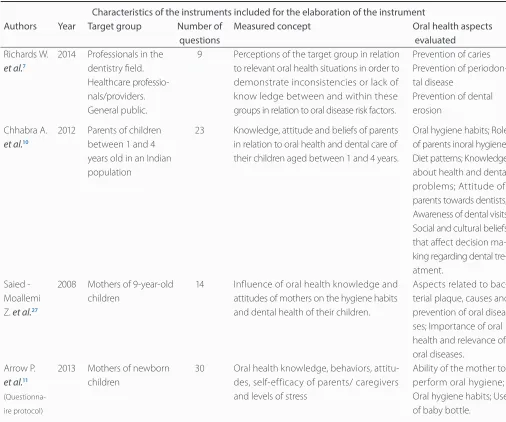
Characteristics of the instruments included for the elaboration of the instrument
Authors Year Target group Number of Measured concept Oral health aspects
questions evaluated
Richards W. 2014 Professionals in the 9 Perceptions of the target group in relation Prevention of caries
et al.7 dentistry field. to relevant oral health situations in order to Prevention of
periodon-Healthcare professio- demonstrate inconsistencies or lack of tal disease
nals/providers. know ledge between and within these Prevention of dental General public. groups in relation to oral disease risk factors. erosion
Chhabra A. 2012 Parents of children 23 Knowledge, attitude and beliefs of parents Oral hygiene habits; Role
et al.10 between 1 and 4 in relation to oral health and dental care of of parents inoral hygiene;
years old in an Indian their children aged between 1 and 4 years. Diet patterns; Knowledge population about health and dental
problems; Attitude of
parents towards dentists; Awareness of dental visits; Social and cultural beliefs that affect decision ma-king regarding dental
atment.
Saied - 2008 Mothers of 9-year-old 14 Influence of oral health knowledge and Aspects related to bac-Moallemi children attitudes of mothers on the hygiene habits terial plaque, causes and Z. et al.27 and dental health of their children. prevention of oral
disea-ses; Importance of oral health and relevance of oral diseases.
Arrow P. 2013 Mothers of newborn 30 Oral health knowledge, behaviors, attitu- Ability of the mother to
et al.11 children des, self-efficacy of parents/ caregivers perform oral hygiene;
(Questionna- and levels of stress Oral hygiene habits; Use
ire protocol) of baby bottle.
Cuestionario: “Conocimiento sobre salud bucodental de padres y/o cuidadores de niños con parálisis cerebral”. Este cuestionario tiene como objetivo determinar el conocimiento de los padres de niños con parálisis cerebral sobre aspectos importantes de salud oral. Todos los datos obtenidos serán mantenidos de forma anónima.
Le agradeceré que pueda contestar este cuestionario.
Debe marcar con una X sobre la opción que usted considere apropiada.
1. Aunque las encías de mi hijo sangren, debo cepillarle los dientes.
Lo ignoro Lo ignoro Me parece No estoy Me parece Lo tengo Lo tengo
completamente que no seguro(a) que sí claro absolutamente claro
2. Aunque el médico haya indicado que mi hijo no puede tragar alimentos y/o líquidos, debo limpiarle los dientes con una técnica adaptada.
Lo ignoro Lo ignoro Me parece No estoy Me parece Lo tengo Lo tengo
completamente que no seguro(a) que sí claro absolutamente claro
3. La enfermedad de las encías es provocada por placa bacteriana.
Lo ignoro Lo ignoro Me parece No estoy Me parece Lo tengo Lo tengo
completamente que no seguro(a) que sí claro absolutamente claro
4. Identifico cuál es la técnica de higiene bucal indicada para mi hijo(a).
Lo ignoro Lo ignoro Me parece No estoy Me parece Lo tengo Lo tengo
completamente que no seguro(a) que sí claro absolutamente claro
5. Es importante que los dientes de leche de mi hijo no tengan caries aunque sé que los cambiará.
Lo ignoro Lo ignoro Me parece No estoy Me parece Lo tengo Lo tengo
completamente que no seguro(a) que sí claro absolutamente claro
6. Si mi hijo debe tomar algún medicamento en forma de jarabe, debo limpiar los dientes después de que lo ingiera.
Lo ignoro Lo ignoro Me parece No estoy Me parece Lo tengo Lo tengo
completamente que no seguro(a) que sí claro absolutamente claro
7. Eliminar de forma efectiva la placa bacteriana ayuda a prevenir la caries y las enfermedades de las encías.
Lo ignoro Lo ignoro Me parece No estoy Me parece Lo tengo Lo tengo
completamente que no seguro(a) que sí claro absolutamente claro
8. El flúor ayuda a prevenir la aparición de caries.
Lo ignoro Lo ignoro Me parece No estoy Me parece Lo tengo Lo tengo
completamente que no seguro(a) que sí claro absolutamente claro
9. Si los dientes de leche están infectados por caries podrían afectar los dientes definitivos.
Lo ignoro Lo ignoro Me parece No estoy Me parece Lo tengo Lo tengo
completamente que no seguro(a) que sí claro absolutamente claro
10. La parálisis cerebral de mi hijo puede afectar su salud oral.
Lo ignoro Lo ignoro Me parece No estoy Me parece Lo tengo Lo tengo
completamente que no seguro(a) que sí claro absolutamente claro
11. Identifico los productos para realizar la higiene bucal indicados para mi hijo(a).
Lo ignoro Lo ignoro Me parece No estoy Me parece Lo tengo Lo tengo
completamente que no seguro(a) que sí claro absolutamente claro
12. Se puede evitar que mi hijo tenga caries.
Lo ignoro Lo ignoro Me parece No estoy Me parece Lo tengo Lo tengo
completamente que no seguro(a) que sí claro absolutamente claro
13. Se puede evitar que mi hijo tenga enfermedades de las encías.
Lo ignoro Lo ignoro Me parece No estoy Me parece Lo tengo Lo tengo
completamente que no seguro(a) que sí claro absolutamente claro
14. Las bacterias que producen enfermedad de las encías pueden llegar a los pulmones y producir neumonía.
Lo ignoro Lo ignoro Me parece No estoy Me parece Lo tengo Lo tengo
completamente que no seguro(a) que sí claro absolutamente claro
15. El hecho de no poder cerrar bien los labios aumenta el riesgo de que se dañe sus dientes luego de un golpe o una caída.
Lo ignoro Lo ignoro Me parece No estoy Me parece Lo tengo Lo tengo
completamente que no seguro(a) que sí claro absolutamente claro
16. Dientes en mal posición pueden favorecer el desarrollo de caries y de enfermedad de las encías.
Lo ignoro Lo ignoro Me parece No estoy Me parece Lo tengo Lo tengo
completamente que no seguro(a) que sí claro absolutamente claro
17. La caries es producida por varios factores, entre ellos, las bacterias.
Lo ignoro Lo ignoro Me parece No estoy Me parece Lo tengo Lo tengo
completamente que no seguro(a) que sí claro absolutamente claro
18. Hábitos orales como interponer la lengua entre los dientes, usar chupete y/o usar mamadera pueden alterar la posición de los dientes, por ejemplo, que los dientes de adelante no contacten o no cierren.
Lo ignoro Lo ignoro Me parece No estoy Me parece Lo tengo Lo tengo
completamente que no seguro(a) que sí claro absolutamente claro
Las últimas dos preguntas se refieren a la regurgitación que algunos pacientes con parálisis cerebral pueden presentar. Regurgitación ocurre cuando un niño traga su alimento y la comida regresa a la boca desde el estómago.
19. La regurgitación de los alimentos ingeridos aumenta el riesgo de caries de mi hijo.
Lo ignoro Lo ignoro Me parece No estoy Me parece Lo tengo Lo tengo
completamente que no seguro(a) que sí claro absolutamente claro
20. La regurgitación de los alimentos favorece que se pierdan minerales de los dientes.
Lo ignoro Lo ignoro Me parece No estoy Me parece Lo tengo Lo tengo
completamente que no seguro(a) que sí claro absolutamente claro
Edad Parentesco Sexo Masculino Femenino
Educación Básica Completa Incompleta
Media Completa Incompleta
Técnica Completa Incompleta
Universitaria Completa Incompleta
Postgrado Completa Incompleta
Comuna de Residencia Profesión u oficio
was administered to 25 people who met the inclusion criteria. All of them were parents of patients attending
the Dental Unit at Instituto Nacional de Rehabilitación
Pedro Aguirre Cerda (INRPAC), Santiago, Chile.
INRPAC is a public institution that provides health care for people with motor disorders such as cerebral palsy. After analyzing the data obtained, it was decided three questions needed modification because 75% or more of the answers were at both ends of the alternatives. Changes were also made in the writing of the alternatives, from "I have no idea" to "I know it very well."
Subsequently, a new pilot study was carried out on 25 people who were also parents of patients attending the
INRPAC Dental Unit. None of them had participated in the first pilot study. At the end of this stage Cronbach's alpha was calculated and the final questionnaire was obtained.
RESULTS.
validated questionnaire; the other one was a protocol in which the questionnaire to be used in a future study was presented.
All the selected studies reported the questions and the form of evaluating the construct comprehensively. Table 1 summarizes the relevant information in relation to the questionnaires obtained through the literature search (Table 1).
The most relevant items related to the different components of oral health of the target patients were selected (knowledge of caries, periodontal disease, oral hygiene habits and poor oral habits). The necessary changes were made to adapt them to the target population of the questionnaire.
Because the selected questionnaires did not cover all the important aspects required to assess the degree of oral health knowledge of parents and/or caregivers of children with cerebral palsy or any other disability, it was necessary to design new questions to be added.
A new questionnaire was designed consisting of two parts. The first section was composed of 20 closed response questions in a 7-point Likert scale, whose purpose is to determine the knowledge of parents and/or caregivers of children with cerebral palsy aged between 1 and 17 years regarding aspects of oral health directly related to their condition. The second section focused on demographic aspects such as parent and/or caregiver age, kinship, gender, level of education and district of residence.
The panel of experts stated that the questionnaire did indeed measure the construct and had appropriate vocabulary. They suggested improving the format in which the questions were written. When analyzing the opinions of the ten parents who participated in this stage, it was concluded that they all approved the questionnaire. They did not suggest any changes to the wording or vocabulary and said that the time allocated to answer the instrument was adequate. The results obtained were considered reliable since the interview was semi-structured, was carried out in a safe environment and respondents did not feel any pressure or interference while expressing their opinions.
After carrying out two pilot studies, the resulting Cronbach's alpha was 0.83%, indicating that the
internal consistency of the instrument was good. The final version of the questionnaire is shown in Figure 1.
DISCUSSION.
Patients with cerebral palsy depend greatly on their parents and/or caregivers to perform routine activities,9 which contributes significantly to the development of oral pathologies. Parents and/or caregivers of children with cerebral palsy play a crucial role in maintaining the oral health of their dependents, which is why it is necessary to assess their knowledge on this matter.
The only available questionnaires to date are those assessing the oral health knowledge of parents and/or caregivers of healthy children.10,11
This new instrument was designed with the aim of helping patients with cerebral palsy. Assessing the oral health knowledge of parents may contribute to the development of individualized educational strategies. It has been reported that caregivers of patients with or without special needs, who have received special training on oral health care, have a positive impact on the oral status of these patients.12
This instrument could also be useful to infer the baseline oral health status of patients with CP before their direct evaluation in a dental unit, since a relationship has been established between the oral health status of children and the level of know-ledge of their parents.5,6,10 Additionally, this instrument would be a useful tool to collect data that could later be analyzed to develop community education strategies focused on aspects less known to caregivers.
The resulting questionnaire is composed of twenty questions related to aspects of oral health that can be observed in children with cerebral palsy. After identifying these aspects, parents should make the necessary changes to provide more appropriate oral care for these patients.
It has been reported that people with cerebral palsy may have a higher prevalence of oral diseases than the general population.13,14 Question 10 (Figure 1) aims to identify if the caregiver has at least a general knowledge of the influence of cerebral palsy on the child's oral health status.
oral hygiene on their own due to their motor disorders, resulting in the development of oral diseases related to the accumulation of bacterial plaque.15,16 In addition, due to swallowing problems, residual food can be found in the oral cavity of these patients.17 Therefore, it is essential to determine if the caregivers have a basic level of knowledge of periodontal health, assessing if the parents and/or caregivers pay the necessary attention to oral hygiene, not only of teeth, but also of the soft tissues and mucosa that surround them. Questions 1, 3, 4, 6, 7 and 13 assess this particular aspect (Figure 1).
Although conflicting results have been published in relation to the prevalence of caries in patients with cerebral palsy,13,18 it has been demonstrated that these patients face situations that may increase their risk of developing dental caries and that, in addition, they have a greater number of untreated carious lesions.18
Questions 5, 8, 9, 12 and 17 (Figure 1) seek to identify whether parents or caregivers recognize the importance of primary teeth and whether they have basic information on the etiology and prevention of dental caries.
Patients with cerebral palsy usually ruminate, resul-ting in a decrease in pH of the oral cavity to values of 1.5 to 2, which has been associated with an increased risk of developing caries.14,19 The aim of questions 19 and 20 (Figure 1) is to determine if caregivers know that regurgitating food from the stomach can result in dental health problems of patients with cerebral palsy.
Dento-maxillary anomalies can be found in patients with CP.
Questions 16 and 18 (Figure 1) are aimed at recognizing whether caregivers associate dental malocclusions with an increased risk of caries and periodontal disease, and whether they link bad habits with the appearance of dento-maxillary alterations,20 such anterior open bite.
A high percentage of patients with CP suffer from dysphagia, which can have serious consequences if not detected or properly managed.21 It is essential to assess if caregivers know that, even though their child may not be fed by mouth, it is important to maintain adequate oral hygiene to reduce the development of periodontal and bronchopulmonary pathologies (see questions 2, 11 and 14, Figure 1).
Patients with CP have a high prevalence of
dentoalveolar trauma,22,23 and if a patient has labial incompetence, they are at an even higher risk. An adequate labial closure is a protective factor.24 It is important to determine if parents and/or caregivers of children with CP are aware that labial incompetence makes the patient prone to further damage in case of suffering oral trauma. Knowing how to identify this type of condition will improve the referral time to orofacial motor therapy. Question 15 (Figure 1) is related to this aspect.
Among the strengths of this study is the methodology used to find articles that contained relevant information for the development of the proposed questionnaire. The results obtained in the review revealed that it appears there are no validated questionnaires published on this topic. There are only some qualitative studies evaluating the relationship between the quality of life of individuals with a disability and their oral health problems.25,26
However, these studies do not assess the oral health knowledge of parents and/or caregivers. Therefore, ano-ther strength of this study is that it provides an original instrument to perform such measurement or assessment.
The fact that the reliability of the instrument has not yet been tested is a limitation of the study. This means its use in clinical practice and in research should be done with caution, since the psychometric properties of the present questionnaire have not been evaluated.
CONCLUSION.
Cerebral palsy affects the oral health of patients, so it is necessary to implement procedures to prevent the onset and progression of oral pathologies. A way to prevent oral diseases in people with cerebral palsy is the training of parents and/or caregivers of children with this condition, since it has been observed that adequate oral health knowledge could help improve the oral condition of patients.
1. Colver A, Fairhurst C, Pharoah PO. Cerebral palsy. Lancet. 2014;383(9924):1240–9.
2. Stavsky M, Mor O, Mastrolia SA, Greenbaum S, Than NG,
Erez O. Cerebral Palsy-Trends in Epidemiology and Recent Development in Prenatal Mechanisms of Disease, Treatment, and Prevention. Front Pediatr. 2017;5:21.
3. Saether R, Helbostad JL, Riphagen II, Vik T. Clinical tools
to assess balance in children and adults with cerebral palsy: a systematic review. Dev Med Child Neurol. 2013;55(11):988–99.
4. Jan BM, Jan MM. Dental health of children with cerebral
palsy. Neurosciences. 2016;21(4):314–8.
5. Poutanen R, Lahti S, Seppä L, Tolvanen M, Hausen
H. Oral health-related knowledge, attitudes, behavior, and family characteristics among Finnish schoolchildren with and without active initial caries lesions. Acta Odontol Scand. 2007;65(2):87–96.
6. Dye BA, Vargas CM, Lee JJ, Magder L, Tinanoff N. Assessing
the relationship between children's oral health status and that of their mothers. J Am Dent Assoc. 2011;142(2):173–83.
7. Richards W, Filipponi T, Roberts-Burt V. Mind the gap! A
comparison of oral health knowledge between dental, healthcare professionals and the public. Br Dent J. 2014;216(4):E7.
8. Gläser-Ammann P, Lussi A, Bürgin W, Leisebach T. Dental
knowledge and attitude toward school dental-health programs among parents of kindergarten children in Winterthur. Swiss Dent J. 2014;124(7-8):770–83.
9. Majnemer A, Shikako-Thomas K, Shevell M, Poulin C,
Lach L, Law M, Schmitz N, QUALA Group. The relationship between manual ability and ambulation in adolescents with cerebral palsy. Phys Occup Ther Pediatr. 2013;33(2):243–52.
10. Chhabra N, Chhabra A. Parental knowledge, attitudes
and cultural beliefs regarding oral health and dental care of preschool children in an Indian population: a quantitative study. Eur Arch Paediatr Dent. 2012;13(2):76–82.
11. Arrow P, Raheb J, Miller M. Brief oral health promotion
intervention among parents of young children to reduce early childhood dental decay. BMC Public Health. 2013;13:245. 12. Frenkel H, Harvey I, Needs K. Oral health care education and its effect on caregivers' knowledge and attitudes: a randomised controlled trial. Community Dent Oral Epidemiol. 2002;30(2):91–100.
13. Al Hashmi H, Kowash M, Hassan A, Al Halabi M. Oral
Health Status among Children with Cerebral Palsy in Dubai, United Arab Emirates. J Int Soc Prev Community Dent. 2017;7(Suppl 3):S149–54.
14. Jan BM, Jan MM. Dental health of children with cerebral
palsy. Neurosciences. 2016;21(4):314–8.
15. Santos MT, Ferreira MC, Guaré RO, Diniz MB, Rösing
CK, Rodrigues JA, Duarte DA. Gingivitis and salivary
osmolality in children with cerebral palsy. Int J Paediatr Dent. 2016;26(6):463–70.
16. Cardoso AM, Gomes LN, Silva CR, Soares Rde S, Abreu
MH, Padilha WW, Cavalcanti AL. Dental caries and periodontal disease in Brazilian children and adolescents with cerebral palsy. Int J Environ Res Public Health. 2014;12(1):335–35.
17. Dourado MR, Andrade PM, Ramos-Jorge ML, Moreira
RN, Oliveira-Ferreira F. Association between executive/ attentional functions and caries in children with cerebral palsy. Res Dev Disabil. 2013;34(9):2934–9.
18. Akhter R, Hassan NM, Martin EF, Muhit M, Haque MR,
Smithers-Sheedy H, Jones C, Badawi N, Khandaker G. Risk factors for dental caries among children with cerebral palsy in a low-resource setting. Dev Med Child Neurol. 2017;59(5):538–43.
19. Idaira Y, Nomura Y, Tamaki Y, Katsumura S, Kodama
S, Kurata K, Asada Y. Factors affecting the oral condition of patients with severe motor and intellectual disabilities. Oral Dis. 2008;14(5):435–9.
20. Rodríguez JPL, Ayala-Herrera JL, Muñoz-Gomez N, Martínez-Martínez RE, Santos-Díaz MA, Olvera-Delgado JH, Loyola-Leyva A. Dental Decay and Oral Findings in Children and Adolescents Affected by Different Types of Cerebral Palsy: A Comparative Study. J Clin Pediatr Dent. 2018;42(1):62–6.
21. Robertson J, Chadwick D, Baines S, Emerson E, Hatton
C. Prevalence of Dysphagia in People With Intellectual Disability: A Systematic Review. Intellect Dev Disabil. 2017;55(6):377–91.
22. Bagattoni S, Sadotti A, D'Alessandro G, Piana G. Dental trauma in Italian children and adolescents with special health care needs. A cross-sectional retrospective study. Eur J Paediatr Dent. 2017;18(1):23–6.
23. Cardoso AM, Silva CR, Gomes LN, Gomes Mda N,
Padilha WW, Cavalcanti AL. Dental trauma in Brazilian children and adolescents with cerebral palsy. Dent Traumatol. 2015;31(6):471–6.
24. Al-Batayneh OB, Owais AI, Al-Saydali MO, Waldman HB. Traumatic dental injuries in children with special health care needs. Dent Traumatol. 2017;33(4):269–75.
25. Abanto J, Ortega AO, Raggio DP, Bönecker M, Mendes
FM, Ciamponi AL. Impact of oral diseases and disorders on oral-health-related quality of life of children with cerebral palsy. Spec Care Dentist. 2014;34(2):56–63.
26. El Ashiry EA, Alaki SM, Nouri SM. Oral Health Quality of Life in Children with Cerebral Palsy: Parental Perceptions. J Clin Pediatr Dent. 2016;40(5):375–87.
27. Saied-Moallemi Z, Virtanen J, Ghofranipour F, Murtomaa
H. Influence of mothers' oral health knowledge and attitudes on their children's dental health. Eur Arch Paediatr Dent. 2008;9(2):79–83.