The matching predicate and a filtering scheme
based on matroids
Dimitris Magos
Department of Informatics, Technological Educational Institute of Athens, 12210 Egaleo , Greece, Email: [email protected]
Ioannis Mourtos
Department of Economics, University of Patras, 26500 Rion, Patras, Greece, Email: [email protected]
Leonidas Pitsoulis
Department of Mathematical and Physical Sciences, Aristotle University of Thessaloniki, 54124 Thessaloniki, Greece, Email: [email protected]
Abstract— Finding a maximum cardinality matching in a
graph is a problem appearing in numerous settings. The problem asks for a set of edges of maximum cardinality, such that no two edges of this set have an endpoint in common. The variety of applications of this problem, along with the fact that several logic predicates can be modelled after it, motivates the study of a related global constraint in the context of Constraint Programming. In this work, we describe a filtering scheme for such a predicate based on matroids. Our method guarantees hyper-arc consistency in polynomial time. It is also applicable to any predicate expressed in terms of an independent system, and remains of polynomial complexity if there exists a polynomial time algorithm for finding a maximum cardinality basis of this independent system. Furthermore, we show that this filtering scheme can be employed to find a maximum cardinality matching.
Index Terms— matching, hyper-arc consistency, matroid
in-tersection
I. INTRODUCTION
Let G(V, E) denote an undirected graph with V, E being the sets of its nodes and edges, respectively. A matchinginG(V, E)is a subset of edges with no common endpoints. Finding a matching of maximum cardinality constitutes the maximum cardinality matching (MCM) problem. This is a fundamental problem in graph theory and one of the first problems analysed within the com-binatorial optimisation literature. It has been extensively studied because of its inherent theoretical properties as well as its numerous applications in various fields, includ-ing Economics, Engineerinclud-ing, Computer Science and Ar-tificial Intelligence. For a thorough theoretical discussion,
This paper is based on ”Consistency of the matching predicate” by D. Magos, I. Mourtos and L.Pitsoulis which appeared in the Proceedings of the Fourth Hellenic Conference on AI, SETN 2006, LNAI 3955, pp. 555-558.
This research has been partially funded by the Greek Ministry of Education under the program Pythagoras II.
including solution methods, we refer to [1], while several applications can be found in [2]. We briefly present three examples of such applications to motivate the definition of a correspondingglobal constraint (for the definition of a global constraint and related concepts, see [3]).
• A hotel manager wishes to assign pairs of roommates to rooms of her hotel. The sex, nationality, religion and cultural background are factors, which could de-termine compatible pairs of roommates. The problem of finding the maximum number of compatible pairs, thus identifying the maximum room requests, is an MCM problem.
• A set of processes are to be assigned to a set of processors. Depending on the computational power of each processor and the resource requirements of each process, compatible pairs of processes and processors are formed. Given that each process can only be assigned to one processor and each processor can be engaged by a single process, the problem asks for a set of pairs (process, processor) of maximum cardinality.
Apart from its applications, the MCM problem is of specific interest from a Constraint Programming (CP) point of view because it can model several logical con-straints. The last example presented describes such a model for theall differentpredicate [4]. Further examples are thesymmetric all different predicate [5] and the sys-tem of twoall differentpredicates [6]. Thus, the definition of a maximum cardinality matching constraint provides a framework encompassing other predicates. This has a potential impact on the development of CP solution strate-gies. Specifically, designing and implementing inference techniques for this constraint provides tools that can be used “out-of-the-box” on other predicates expressed as special cases of it.
Along this line of research, we study the global con-straint with respect to the MCM, originally defined in [7], in terms ofhyper-arcconsistency. With respect to the graphG(V, E), this amounts to identifying the edges not participating in any maximum cardinality matching. Such an identification, also called filtering, is carried out in [4], [8] for bipartite graphs only. The approach presented here applies to any graph. The wider applicability of our method stems from the exploitation of the matroidal struc-ture of the problem. In short, we propose an algorithm for establishing hyper-arc consistency for problems defined as the intersection of matroids and, since matching can be regarded as such, the algorithm becomes applicable to the MCM problem. In this way, we achieve two goals. First, we provide a filtering scheme for both bipartite and non-bipartite matching through a unifying theoretical approach and, secondly, the procedure described applies to any predicate that could be expressed as a matroid intersection. Thus the broader research question being addressed is whether matroid theory could be valuable for designing efficient filtering algorithms. Finally, the paper also investigates the relation between the MCM problem and that of establishing hyper-arc consistency for MCM. It is shown that the two problems are equivalent.
II. PRELIMINARIES ANDPROBLEMFORMULATION
We refer to [3], [9] for formal definitions concerning the Constraint Satisfaction Problem (CSP). We only give a brief exposition of certain notions, in order to facilitate the following discussion. A global constraint C(xi : i ∈I) imposes a condition on the set of variables ∪i∈I{xi}, each receiving values from a domain Di. A solution to C(xi : i ∈ I) is a tuple (d1, . . . , d|I|) ∈ D1 ×
· · · ×D|I|, which satisfies this constraint. A constraint
is hyper-arc consistent, if and only if for eachi∈I and dj ∈Di there existd1, . . . , dj−1, dj+1, . . . , d|I|such that
d1, . . . , dj, . . . , d|I|is a solution.
A formal definition of the MCM problem follows. Let V (E) denote the set of nodes (edges) of an undirected graph G(V, E). As a matter of convention, we consider that each element ofEis a set consisting of two elements (nodes) belonging toV. Hence, fore∈Eandv∈V, one can write 0≤ |e∩ {v}| ≤1. Similarly, edgesei, ej ∈E are incident to the same node if and only if|ei∩ej|= 1.
A set M ⊆E is called a matching if, for every pair of edges ei, ej ∈M, it holds that |ei∩ej|= 0. The MCM problem is defined as
max
M⊆E:|ei∩ej|=0,∀ei,ej∈M |M|
Thematchingconstraint is presented in the global con-straint format described above. The concon-straint is imposed on a set of variables, each corresponding to a node of the graph G(V, E). That is, for eachv ∈V there exists a variable xv. Let d : E → Z+ be a bijection, i.e. d maps each edge to a unique positive integer. For v∈V, let Ev denote the set of edges incident to node v, i.e. Ev = {e ∈ E : |e∩ {v}| = 1}. The domain of xv is defined asDv={d(e) :e∈Ev} ∪ {0}, where value 0 is reserved and its meaning is explained next. The variables xu, xw are said to form a pair if they share the same value (called pair value), which is also different than 0. Apparently, this value must belong to bothDu, Dw. This implies that nodesu, ware linked via the edge associated with the common value of the variables xu, xw.
The predicate
matching{xv:v∈V}, xv ∈Dv,∀v∈V,
asks for a maximum number of pairs with distinct pair values. The variables not selected to form a pair are assigned value 0. Hence, the above constraint can be equivalently thought of as minimising the number of variables with value0.
Before proceeding, we should recall certain definitions related to matroids. Matroid theory is a very elegant approach used in combinatorial optimisation (see [2], [10]). The motivation for applying matroid theory to combinatorial optimisation problems could be traced back to the pioneering work of Edmonds, who proved that several important models associated with matching and matroids are solvable, and observed an apparent connec-tion between polynomial solvability and the existence of a matroidal structure. After providing some basic defini-tions, we focus on the relationship of these structures to matchings in graphs.
Denote the collection of subsets of a set Aas 2A.
Definition 1: Given a finite set E and some family of subsets F ⊂2E, the set systemM= (E,F)is a matroid
if the following conditions hold
(I1) ∅ ∈ F,
(I2) IfX∈ F andY ⊂X thenY ∈ F,
r(X) of a set X ⊆ E is the cardinality of a maximal independent subset ofX. Thespansp(X)of a setX ⊆ E
is the maximal superset ofX having the same rank asX. An IS can be described by a set of matroids on the same ground set. Consider the matroids
M1= (E,F1), . . . ,Mk= (E,Fk). Their intersection, also called k-matroid intersection, is defined as (E,Ti=1,...,kFi). Clearly this is an IS. Moreover,
Theorem 1 ( [11]): Any independence system is the
intersection of a finite number of matroids .
A critical implication of (I3) is that all the maximal independent subsets of any X ⊆ E are of the same cardinality. This does not apply to independent systems in general. Consequently, the problem of finding a base of a matroid is quite different than that of finding a maximum cardinality basis (MCB) of an IS. In general, the latter problem remains polynomially solvable if the IS is the intersection of only two matroids. An algorithm for the MCB problem on a 2-matroid intersection system, proposed by Edmonds, is described in [2].
The connection between matchings in a graph and independence systems is direct: the set of matchings forms an IS, to be denoted by M(G), on the ground set of edges E. It is not difficult to observe that properties (I1) and (I2) hold. An MCM is simply an MCB in M(G). Therefore, when M(G) can be expressed as a 2-matroid intersection, an algorithm identifying an MCB (e.g. Edmonds’ algorithm), can provide an MCM. In an analogous manner, a filtering procedure identifying the elements ofEthat do not belong to any MCB is applicable to the MCM problem. Such a scheme, when applied to M(G), produces the set of edges not participating in any maximum cardinality matching. In the following section, we describe algorithms of this kind, which achieve hyper-arc consistency, i.e. identify all “inconsistent” edges.
III. CONSISTENCY OF THEmatchingCONSTRAINT
Achieving hyper-arc consistency on thematching con-straint implies identifying all edges of the graph which do not appear in any maximum cardinality matching. An ad-ditional step would be to identify the edges that participate inevery such matching. The overall aim is to establish a partitioning ofEto setsEALL, ESOM E, EN ON E, which include the edges participating to all, some or none maximum cardinality matchings, respectively.
This section resolves this question by first considering graphs for which the matching is given by the intersection of two matroids and subsequently describing a filtering procedure applicable to the general case. This distinction is necessary because in the first case there already exists an algorithm for producing the above partitioning [12], while a new algorithm is presented for the second case. Since the algorithms to be presented next apply to any IS, the notation used for the ground set isE. Naturally, when we discuss application of these methods to M(G), the ground set is denoted byE. The same convention applies to the sets forming the partition of the ground set.
A. A special case: the 2-matroid intersection
The matroid used to describeM(G), in the special case where the graphGism-partite, is the so called partition
matroid. To formally define partition matroids, consider a
partition of the ground set E
E=E1∪ E2∪ · · · ∪ En
and define the independence relationship as
F :={X ⊆ E:|X∩ Ei| ≤1, i= 1, . . . , n}.
It is not difficult to show that the system (E,F) is a matroid. Given anm-partite graphG(SiVi, E)each node setVi imposes a partition of the edge set
E=E(1i)∪E2(i)∪ · · · ∪E|(Vi) i|, where
Ej(i):={e∈E:eincident to nodevj∈Vi},
for j = 1, . . . ,|Vi|. Defining the partition matroids for each node set with the independence relationship
Fi:={X⊆E:|X∩Ej(i)| ≤1, j= 1, . . . ,|Vi|},
the independence system which is defined by the intersec-tion of the mpartition matroids(E,Fi)describes the set of matchings of them-partite graphG. Evidently,M(G) can be described as the intersection of two matroids if graph G is bipartite. Moreover, the following theorem provides a characterisation of the class of graphs, for which the set of matchings is the intersection of two matroids.
Theorem 2 ( [13]): The set of matchings M(G) of a graph G(V, E) is the intersection of two matroids iffG contains no odd cycle of cardinality≥5and each triangle of Ghas at most one node with degree>2 .
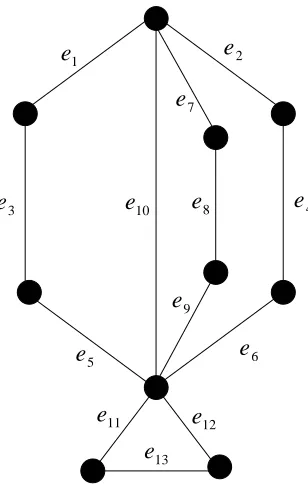
Observe that the class implied by the above theorem is slightly larger than the class of bipartite graphs. Given that the class of bipartite graphs includes those graphs which contain no odd cycles, the class of graphs in Theorem 2 includes also bipartite graphs with triangles attached at their nodes. An example of such a graph is shown in Figure 1.
The authors in [12] describe anO(max{Λ1,Λ2} · |E|2) algorithm for constructing the partitionEALL∪ ESOM E∪
1
e
e
23
e
e
45
e
e
67
e
8
e
10
e
9
e
11
e
e
1213
e
Figure 1. A graph whoseM(G)is an intersection of two matroids
B. The general case
We know that, for a given graphG, the set of matchings M(G)is an IS and therefore, by Theorem 1, an intersec-tion of a finite numbermof matroids. If thosemmatroids were known, one could iteratively consider all ¡m2¢ 2-matroid intersections and apply the algorithm mentioned above [12]. In fact, it has been proved that the set of matchings in an arbitrary graphGis the intersection of at mostO(log|V|/loglog|V|)matroids [13]. Apparently, the above procedure terminates when all such intersections are tested and no additional edge is filtered out. Although this approach achieves a certain level of consistency, it definitely does not guarantee hyper-arc consistency.
The algorithm presented next achieves hyper-arc con-sistency on any IS under the condition that we can compute the rank of any subset of the ground set E. An additional requirement is to be able to find a maximum cardinality base, which includes a specific e ∈ E. We denote such a base by B(e). Note that, in the case of M(G), this problem as well as the problem of computing the rank of any subset of edges are polynomially solvable.
Theorem 3: Algorithm 1 correctly determines in O((Ω1+ Ω2)|E|) steps the partitioningEALL, ESOM E,
EN ON E, where Ω1, Ω2 are, respectively, the computa-tional complexities of computing the rank function and B(e), for e∈ E.
Proof: (Correctness) The algorithm consists of two
loops. The first one separates the elements of EN ON E from those of X = EALL ∪ ESOM E. The separation is achieved by identifying for each e ∈ E an MCB containing it. Apparently, if the rank of such a base is
Algorithm 1 Achieving hyper-arc consistency for the
MCB problem on an IS X :=∅;
EN ON E :=∅;
EALL :=∅; rankE:=r(E);
for all e∈ E \X do
Compute a basisB(e);
if r(B(e))< rankE then
EN ON E :=EN ON E∪ {e};
else
X :=X∪ {B(e)};
end if end for
for all e∈X do
if r(E \ {e})< rankE then
EALL:=EALL∪ {e};
end if end for
ESOM E:=E \ {EALL∪ EN ON E};
smaller than the rank of E thene∈ EN ON E; otherwise, all the elements ofB(e)belong toX. In the second loop, we identify those elements of X that belong to EALL. Observe that |EALL| ≤ r(E) and recall that for each e ∈ X there is a basis containing it, whose rank is the same as E. Thus, for each such element we check if its deletion fromE decreases its rank. If this is true then the element belongs to EALL; otherwise, it must belong to
ESOM E.
(Complexity) Let Ω1, Ω2 denote the computational complexity of computing the rank function and of finding B(e), respectively. The first loop is performed at most
|E| times. At each iteration, we need to compute B(e), r(B(e)) and perform one comparison. Thus, the com-plexity of the first loop is O((Ω1+ Ω2)|E|). Similarly, the complexity of the second loop is O(Ω1|E|).
1
e
e
23
e
4
e
e
56
e
e
78
e
11
e
9
e
e
1012
e
13
e
14
e
1
2
3
4 5
6
7
8
9 10
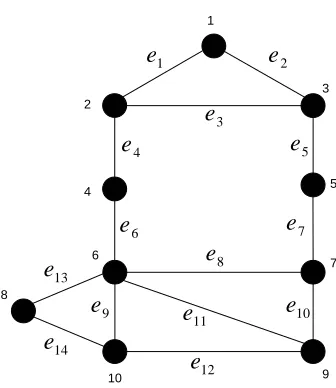
Figure 2. Filtering with respect to a matching on a arbitrary graph
B(e) =B∪ {e}.
To better clarify the above, we provide the following example.
Example 4: The maximum cardinality matching
con-straint for the graph of Figure 2 is matching{xi : i ∈
{1, ...,10}}. Assuming d(ei) = i, for allei of E, the domains of the variables are D1 = {0,1,2}, D2 =
{0,1,3,4}, D3 = {0,2,3,5}, D4 = {0,4,6}, D5 =
{0,5,7}, D6 = {0,6,8,9,11,13}, D7 = {0,7,8,10}, D8 = {0,13,14}, D9 = {0,10,11,12}, D10 =
{0,9,12,14}.
A maximum cardinality matching is induced by the edge set M = {e1, e5, e6, e10, e14}. Thus, r(E) = 5. We can set B(e1) =M. Since r(B(e1)) = r(E) = 5, X = {e1, e5, e6, e10, e14}. The next element to con-sider is e2. There exists B(e2) = {e2, e4, e7, e12, e13}. Again because r(B(e2)) = r(E) = 5, X = X ∪ B(e2) = {e1, e2, e4, e5, e6, e7, e10, e12, e13, e14}. Ob-serve that any maximum cardinality matching that in-cludes either e3, or e8 consists of 4 edges. Thus, r(B(e3)) = r(B(e8)) = 4 and EN ON E = {e3, e8}. FinallyX =X∪ {e11}because there exists the matching B(e11) ={e2, e4, e7, e11, e14}. For each of the elements of X we can find a matching of cardinality 5 that does not include it. Overall, EALL = ∅, ESOM E = X = {e1, e2, e4, e5, e6, e7, e10, e11, e12, e13, e14} and EN ON E ={e3, e8}.
Conclusively, the matching constraint becomes hyper-arc consistent if we remove the value3fromD2, D3and the value8 fromD6, D7.
From the above presentation, it is evident that, given
an algorithm for calculating an MCM, one can compute the partition(EALL, ESOM E, EN ON E)for the matching predicate. The inverse direction is also plausible, i.e. given an algorithm that identifies the edges that participate in all (none) MCMs, calculate an MCM. This is exactly achieved by Algorithm 2, presented next.
Algorithm 2 Finding a maximum cardinality matching
X, using the routine partition which computes the par-titioning of the edge set of a graph with respect to the MCM
(EALL, ESOM E, EN ON E) :=partition(E); X :=∅;
while ESOM E6=∅ →
X :=X∪EALL∪ {e}, for somee∈ESOM E; ¯
E:=E\(X∪EN ON E);
( ¯EALL,E¯SOM E,E¯N ON E) :=partition( ¯E); E:= ¯E;
EALL := ¯EALL; ESOM E:= ¯ESOM E; EN ON E := ¯EN ON E;
endwhile;
return(X∪EALL);
Observe that the Algorithm 2 is polynomial in the cardinality of the set of edges E and the complexity of the routine partition.
IV. CONCLUSIONS
The matching constraint enjoys various applications and generalises other well-known predicates. In the cur-rent work, we propose a scheme for achieving hyper-arc consistency, for this constraint, by establishing an equivalence between consistency and a certain partition-ing of the set of edges (the ground set). The algorithm proposed constructs the “consistency” partitioning of the ground set in polynomial time, thus identifying edges that cannot appear in any MCM and edges that appear in all MCM’s. Moreover, the ideas presented in this paper could be applied to other predicates, which can be modeled as the intersection of matroids. The aim would be to obtain efficient implementations of filtering routines within Constraint Programming solvers. Furthermore, we have also proposed an algorithm which can solve the MCM problem, given an algorithm that computes the above-mentioned partitioning of the set of edges E. Consequently, the two problems are equivalent. An open question is whether this result also holds for any problem formulated as the maximum cardinality basis problem in the intersection of a finite number of matroids.
REFERENCES
[1] L. Lovasz and M. D. Plummer, Matching theory, ser. Annals of Discrete Mathematics. North Holland, 1986, vol. 29.
[2] E. Lawler, Combinatorial Optimization: Networks and
[3] R. Dechter, Constraint Processing. Morgan Kaufmann, 2003.
[4] J. C. R´egin, “A filtering algorithm for constraints of difference in csps,” in Proceedings of National Conference
on Artificial Intelligence, 1994, pp. 362–367.
[5] ——, “The symmetric alldifferent constraint,” in
Proceed-ings of the IJCAI-99, 1999, pp. 420–425.
[6] G. Appa, D. Magos, and I. Mourtos, “On the system of two all different predicates,” Inform. Process. Lett., vol. 94, pp. 99–106, 2005.
[7] D. Magos, I. Mourtos, and L. Pitsoulis, “Consistency of the matching predicate,” in Proceedings of SETN’06, LNAI
3955, 2006, pp. 555–558.
[8] M. Costa, “Persistency in maximum cardinality bipartite matchings,” Oper. Res. Lett., vol. 15, pp. 143–149, 1994. [9] J. Hooker, Logic-Based Methods for Optimization:
Com-bining Optimization and Constraint Satisfaction, ser.
Wiley-Interscience Series in Discrete Mathematics and Optimization. J. Wiley, 2000.
[10] J. G. Oxley, Matroid Theory, ser. Oxford Graduate Texts in Mathematics, K. Donaldson, S., S. Hildenbrandt, J. Taylor, M., and R. Cohen, Eds. Oxford University Press, 1992, vol. 3.
[11] B. Korte and J. Vygen, Combinatorial optimization:
The-ory and algorithms, ser. Algorithms and Combinatorics.
Springer, 1991, vol. 21.
[12] K. Cechl´arova and V. Lacko, “Persistency in combinatorial optimization problems on matroids,” Discrete Appl. Math., vol. 110, pp. 121–132, 2001.
[13] S. P. Fekete, R. T. Firla, and B. Spille, “Characterizing matchings as the intersection of matroids,” Math. Methods
Oper. Res., vol. 58, pp. 319–329, 2003.
[14] J. Edmonds, “Paths, trees and flowers,” Canad. J. Math., vol. 17, pp. 449–467, 1965.
Dimitris Magos received his Ph. D. from the Athens University of Economics and Business (Department of Informatics). He is currently an associate professor at the Department of Informat-ics of the Technological Educational Institute of Athens. His research interests include mathematical programming, constraint programming and combinatorial optimization.
Ioannis Mourtos is a lecturer at the Department of Economics, University of Patras. He obtained his Ph. D. from the London School of Economics, Operational Research Department. His research interests lie in the areas of integer programming and combinatorial optimisation.