Design And Development Of A Mobile-Based
Intelligent System For Weight Management
Ele, Sylvester I.1, Ele, B. I. and Obono, I. Ofem
1, 2, 3 Departmentof Computer Science, University of Calabar, Nigeria
Abstract—The majority of people do not know that overweight, obesity and heart ailments are intermingled. Moreover, people are not familiar with mathematical processes and so find it a difficult task calculating their Body Mass Index (BMI) from raw data such as weight and height. A self support system, especially one that utilizes empirical inputs and mathematical models can be very good and specific to that effect. This paper aim is to develop a framework for a Mobile - Based Intelligent System for Weight Management that is capable of calculating a patient's BMI and providing appropriate expert advice on weight management to the user. The research adopted a fusion of the Structured System Analysis and Design Methodology (SSADM) and Object Oriented Methodology. The system was designed using unified modeling language (UML) as the design tool. It employed Java/XML on Android platform for its implementation. The Mobile-Based Intelligent System for Weight Management developed in this work was tested using several test data.
Keywords—BMI, Obesity, Overweight, Expert System, Knowledge Base.
1. Introduction
According to the World Health Organization (2007) [1], heart related ailments are the major causes of death. Magnificent developments in the physiology and medicine have come to conclude that almost all heart related and circulatory ailments except congenital heart defect stem from the accumulation of bad fat (called cholesterol) in the body of adults. Adults who have attained constant vertical weight tend to store excess fat cells at some designated areas and around the body.
Gibson, H.G. (2013), via the US National Heart, Lung and Blood Institute [2] stated that energy imbalance can cause overweight and obesity.
According to the NHLBI report, an energy imbalance means that your energy IN does not equal your energy OUT. This energy is measured in calories. Energy IN is the amount of calories you get from food and drinks. Energy OUT is the amount of calories your body uses for things such as breathing, digesting, being physically active, and
regulating body temperature.
(www.nih.gov/health/NIHandweightofthenation ).
Lau D.C et al (2007) [3] maintain that the main treatment of obesity consists of dieting and physical exercise. Datta (2016) [4], Who refers to WHO global Data, 2015, stated that WHO global estimates state that in the year 2014 1.9 billion adults worldwide were overweight and of these 600 million were obese. Overall, about 13% of the world’s adult populations (11% of men and 15% of women) were obese in 2014. That the worldwide
prevalence of obesity more than doubles
between1980 and 2014. He continues by saying it is not just adults, in 2013, 42 million children under the age of 5 were overweight or obese. As per knowing your obesity state, he defined overweight “as BMI greater than or equal to 25” and obesity as “a BMI greater than or equal to 30”. BMI is body index mass, an index commonly use for classification of obesity. WHO defines BMI “as a person’s weight in kilograms divided by the square
of his height in meters (kg/m2).
According to NHLBI (1997), for Adults, a body mass index (BMI) of 25 or more is considered “overweight” and a BMI of 30 or more is considered “obese”. For Children, the chart of body mass index (BMI) for Age is used. Where the BMI
of overweight” and BMI greater than 95th percentile is considered “obese”.
The Body Weight Mass Index (BMI) is calculated based on the formula below:
2
/
log
M
KG
meters
in
Height
X
meters
in
Height
ram
Ki
in
BodyWeight
Or Ym Ym Kg in X BMI Where X = bodyweight in Kg
Ym = height in M
If people can at an early age realize that they are at the edge of overweight, then they can take minimal but appropriate remedies such as dieting, exercise and drug therapy. How can individuals determine if they are becoming obese without due consultation with a doctor?[4] .
Hopkins recommended the use of Body Mass Index (BMI), a simple calculation which divides the weight in kilogram of an individual by the squared height in the meters of the same individual to give a value which can fall within a regimented range to describe a healthy individual, and outside range to describe either an underweight or an overweight patient.
Artificial Intelligence (AI) has been studied for decades and is still one of the most elusive subjects in Computer Science [5]. This partly due to how large and nebulous the subject is. AI ranges from machines truly capable of thinking to search algorithms used to play board games. It has applications in nearly every way we use computers in society (Smith, 2006) [6]. Diagnostic expert systems, especially one that makes use of empirical
inputs and mathematical models can be very good and specific to this kind of problem scenario.
Expert systems are a part of the larger area of Artificial Intelligence. The goal of Artificial Intelligence is to develop systems which exhibit human behavior. An early attempt in the field was in the 1960s by Allen Newell and Herbert Simon from Carnegie Mellon University was to create general purpose intelligent systems which could handle tasks in a diversity of domains. Edward
Feigenbaum from Stanford University then
proposed the notion of expert systems, as systems that encode human expertise in limited domains. According to Mabotuwana et al (2009) [7], expert systems can be characterized by: using symbolic logic rather than only numerical calculations; the processing is data-driven; a knowledge database containing explicit contents of certain area of knowledge; and the ability to interpret its conclusions in the way that is understandable to the user. Expert systems, as a subset of AI, first emerged in the early 1950s when the Rand-Carnegie team developed the general problem solver to deal with theorems proof, geometric problems and chess playing (Newell, 1959) [8]. About the same time, LISP, the later dominant programming language in AI and expert systems, was invented by John McCarthy in MIT (McCarthy, 1960)[9].
2.0 Literature Review
systems were mostly considered as a viable tool to sustain technological advantages by the industry. During the late 1980s, over half of the Fortune 500 companies were involved in either developing or maintaining of expert systems.
Excess body weight causes the majority of public health challenges of the 21st century for the WHO European Region [10]. Overweight is responsible for a greater proportion of the total burden of disease in the WHO European Region: more than 1 million deaths and 12 million life-years of ill health every year) [11]. The health consequences of overweight for children during childhood are less clear, but a 1998 review as reported by [12] showed that childhood obesity is strongly related to risk factors for cardiovascular diseases and diabetes, orthopaedic problems and mental disorders, and associated with underachievement in school and to lower self-esteem. Other recent researches by scholars also shows both short-term and long-term
adverse psychosocial and other health
consequences resulting from overweight in
childhood and adolescence
Another scholar [13] opined that childhood obesity is an important predictor of adult obesity. As a
follow-up, [14] noted that metabolic and
cardiovascular risk profiles tend to track from childhood into adult life, resulting in an elevated risk of ill health and premature mortality. Moreover, again, a researcher [15], revealed that adults who were obese adolescents are more likely to have lower incomes and experience higher degrees of social exclusion. According to them, over 60% of children who are overweight before puberty will be overweight in early adulthood, reducing the average age at which non-communicable diseases become apparent and greatly increasing the burden on health services, which have to provide treatment during much of their adult life.
3. Design and Methodology 3.1 Methodology
A research methodology is a systematical programming approach of a well-defined procedure that should be followed in carrying out a thorough research work. The researcher adopted a hybrid of the Structured System Analysis and Design Methodology (SSADM) fused with Object Oriented
Analysis and Design. The object-oriented analysis
and design (OOAD) with Unified Modeling Language (UML).UML is a graphical language that allows people who design software systems to use an industry standard notation to represent them [16]. The study was conducted in the order of analysis-design-implementation-evaluation based on the Structured System Analysis and Design methodology (SSADM) model. The technology employed in the implementation of the system developed in this paper is Java/XML on Android platform.
3.2 System Design
3.2.1 Knowledge acquisition
The acquisition of knowledge in this paper is conducted through interviews with medical doctors, consultation with published clinical practice guidelines for obesity management and related papers as knowledge sources, magazines, Obesity related journals. Clinical practice guidelines and related papers were searched by applying the keywords 'obesity management' and 'obesity treatment' to the National Guideline Clearinghouse (NGC) and National Institute for Health and
Clinical Excellence (NICE) search engines. The
main objective of this research is to design and develop a mobile-based intelligent system that will assist end-user in managing their weight.
3.2.2 Representation Process
necessarily undertaken when developing expert
system[17]. The knowledge base of the expert
system stores the extensive knowledge gathered from experts, in the form of production rules, which contains the IF THEN rules. The data gathered are put in the data base of the application. The inference engine provides the system control. It matches facts in the working memory against rules in the rule base, and it determines which rules are applicable according to the reasoning method adopted by the engine.
3.3 System design
Systems design is the process or art of defining the architecture, components, modules, interfaces, and data for a system to satisfy specified requirements. One could see it as the application of systems theory to product development. There is some overlap and synergy with the disciplines of systems analysis, systems architecture and systems
3.3.1 Use case diagram
A use case specifies the behavior of a system or a part of a system, and is a description of a set of sequences of actions, including variants, that a system performs to yield an observable result of value to an actor. An actor is an idealization of an external person, process, or thing interacting with a system, subsystem, or class [18]. The use cases and the actor of the Intelligent Weight Management System is shown in figure 1 below.
Figure1: Use Case Diagram of the Intelligent Weight Management System
3.3.2 Class Diagram
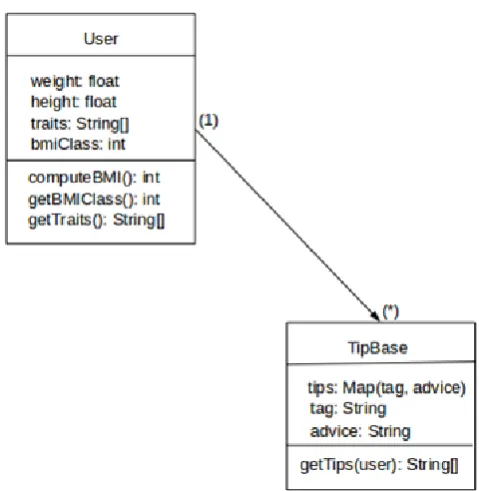
Class diagram is created simply by analyzing the class names and their operations of the interaction diagrams [18]. The class diagram of our case-study system is shown in Figure 2 below.
3.3.3 Activity Diagram
3.3.4 Algorithm for the Intelligent Weight Management System
1. get user height;
2. get user weight;
3. BMI =
2 / log
M KG meters in Height X meters in Height
ram Ki in BodyWeight
4. calculate BMI;
5. On a scale of 1 – 10, to what extent is the user comfortable with weight?
6. IF extent > 7 then user is comfortable ELSE
user is uncomfortable with weight;
7. On a scale of 1 – 10, to what extent did the
user respond to previous trials to correct weight?
8. IF extent > 7 then user didn't have
difficulties in the past else user had difficulties in the past;
9. On a scale of 1 – 10, to what extent did the
user engage in exercises?
10.IF extent > 7 then user loves to exercise in the past ELSE user is ambivalent towards exercising;
11. Provide tip for user based on user traits =>
[comfort, difficulty in the past and exercise]
12. IF user is ambivalent towards exercising
THEN do not task user with high-resistance exercises ELSE task user with high-resistance exercise;
13. IF user responded to previous attempts to
correct weight with ease THEN do not task user with hard-gainer or hard-loser feeding or exercising tips ELSE task user with hard-gainer or hard-loser feeding or exercising tip;
14. IF user is comfortable with weight THEN
do not task user with stressful tips ELSE task user with stressful tips;
4.0 Implementation
The Mobile Based Intelligence System for Weight management has been developed using Java/XML technology in Android platform.
4.1 System testing
Testing is a process, which reveals errors in the program. It is the major quality measure employed during software development. During testing, the program is executed with a set of conditions known as test cases and the output is evaluated to determine whether the program is performing as expected.
In order to make sure that the system does not have errors, the different levels of testing strategies that are applied at differing phases of software development are:
4.2 Unit testing
Unit Testing is done on individual modules as they are completed and become executable. It is confined only to the designer's requirements. The different modules of this system were tested individually.
Black Box Testing
In this strategy some test cases were generated as input conditions that fully execute all functional requirements for the program. This testing has been used to find errors in the following categories:
a) Incorrect or missing functions
b) Interface errors
c) Errors in data structure or external
database access
d) Performance errors
e) Initialization and termination errors.
4.3 Integrating Testing
Integration testing ensures that software and subsystems work together as a whole. It tests the interface of all the modules to make sure that the modules behave properly when integrated together. The system designed in this work was tested after the integration of the individual modules.
Figure4: Interface of the Intelligent Weight Management System prompting users to view BMI Chart or Calculate BMI.
Figure5: BMI Chart Interface of the Intelligent Weight Management System indicating regions of underweight, normal weight and overweight respectively.
Figure6: BMI Calculator Interface of the Intelligent Weight Management System. User supplies the needed data for BMI calculation to enable the intelligent system make decision.
Figure7: User Interaction/Diagnosis Interface of the Intelligent Weight Management System. User respond to diagnostic questions from the system.
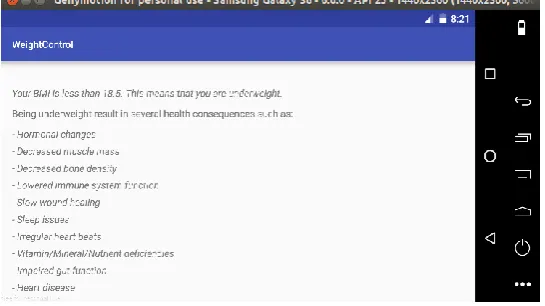
Figure 9: System’s Advice/Diagnosis result
Figure10: User scale in response to query by the System in order to rate the user’s previous attempts to gain weight, and physical, activity level and attitude towards exercise.
Conclusion
The Mobile based Intelligent System for Weight Management has been implemented in this research paper. The system has been tested using the weight and height of many users to compute their BMI. Computerized BMI chart is generated by the system indicating regions of underweight, normal weight and overweight respectively. User scale in response to query by the System is also generated by the system. The user scale function is to rate the user’s previous attempts to gain weight, and physical activity level and attitude towards exercise. The Intelligent Weight Management System also has the capability to give advice to users based on the user’s query during interaction with the system.
Acknowledgement
We sincerely acknowledge the immense
contribution of Mr. Mbachu Nnaemeka Godsgift, an undergraduate project Student of the Department of Computer Science, University of Calabar, for his
massive effort and contribution in the
implementation of the Intelligent Weight
Management System. We are grateful.
References
1. World Health Organization (2007) 2. Gibson, H.G. (2013). The US National
Heart, Lung and Blood Institute.
www.nih.gov/health/NIHandweightoft henation
3. Lau DC et al (2007). 2006 Canadian clinical guideline practice on the management and Prevention of obesity in adults and children [summary] CMAJ 176 (8) S1 -13.). 4. Datta, R. (2016). 13 Effective Tips to
Control Obesity. SmartCooky, NDTV.
www.m.food.ndtv.com/health/effect eive-tips-to-control-obesity).ing 5. Ele, S. I., Umoh, E. E. and Adesola, W. A.
(2014). An Overview of the Development Principles, Stages and Building Blocks of Expert System. In the West Africa Journal of Industrial and Academic Research (WAJIAR), Vol.II No.1 pp. 40 – 52.
6. Smith, B. Ceusters, W., Klagges, B., Köhler, J., Kumar, A. and Lomax, J. (2005). Relations in biomedical ontologies. Genome Biol: 6(5):R46. 7. Mabotuwana, T. and Warren, J. (2009).
An Ontology-based Approach to Enhance Querying Capabilities of General Practice Medicine for Better Management of Hypertension. Artif Intell Med;47(2):87-103.
8. Newell, A. et al (1959). Report on a General Problem-Solving Program. Proceedings of the International Conference on Information Processing. Pp. 256 – 264.
9. McCarthy, J. et al (1960). LISP Programmers Manual. Boston Massachusetts: Artificial Intelligence Group. M.I.T. Computation Centre and Research Laboratory. www.history.siam.org. Accessed: 18 – 04 – 2017.
10. World Health Organization Regional Office for Europe (2007)
Consumption of Carbonated Drinks: Cluster Randomized Controlled Trial. BMJ 22:328(7450):1236.
12. Dietz, W. H. (1998). Health Consequences of Obesity in Youth: Childhood Predictor of Adult Disease. Pediatrics. 101(3 pt 2) 518 – 25. www.ncbi.nlm.nih.gov.
13. Serdula, M. K. et al (1993). Do Obese Children Become Obese Adult? A review of the Literature. Prev. Med.
22(2):167 – 77.
www.ncbi.nlm.nih.gov.
14. Gortmaker et al (1994). Social and Economic Consequences of Overweight in Adolescence. N Endl J. Med. 330:647. www.nejm.org.
15. Deshmukh-Taskar, P. R., et al (2010). The Relationship of Breakfast Skipping and Type of Breakfast Consumption with Nutrition Intake and Weight Status in Children and Adulescents. NHN Examination Survey 1999 – 2006. J AM Diet Association 110 869 – 878. www.ceeral.eu.
16. Ele, S. I., Ofem, A. O., Ele, B. I. and Adesola, W. A. (2016). Dynamic Modeling of a Futuristic Frame-Based Knowledge Representation Using Unified Modeling Language (UML): A Case of an Intelligent Drug Marketers Tracking System (IDMTS). 17. Ele, S. I. and Adesola, W.A. (). Design of
Computer Fault Diagnosis and Troubleshooting System (CFDTS). West African Journal of Industrial and Academic Research (WAJIAR) Vol.9 No.1 December 2013.