Volume 43: December 2019
ISSN 2414-6633
https://doi.org/10.22151/politikon.43
Editorial Board
Editor-in-Chief:
Max Steuer (Slovakia)
Deputy Editor-in-Chief:
Rafael Plancarte (Mexico)
Karla Drpić (Croatia)
Ana Magdalena Figueroa (Brazil)
Dana Rice (Australia)
Emmanuelle Rousseau (France)
Gergana Tzvetkova (Bulgaria)
Editorial Assistants
Cláudia Susana Rodrigues de Araújo
(Portugal)
Andressa Liegi Vieira Costa (Brazil)
Andrew Devine (USA)
Julia Jakus (USA)
Damla Keşkekci
(Turkey)
Jesslene Lee (Singapore)
Spyridon Parthenis (Greece)
Eszter Sághy (Hungary)
Kamila Suchomel (Czech Republic
/ USA)
Table of Contents
Editorial Note ... 4
Articles
A Behavioural Approach to International Climate Negotiations: An Analysis of
Latin American Strategies from Berlin to Paris /
Verónica Gutman
... 7
Tunisia’s Institutional Change after the Revolution: Politics, Institutions and
Change Agents /
Luigi Cino
... 32
Polytropic Socrates’ Implicit
Defence of Philosophy: Lying, Justice, and
Sophistry in Plato’s Lesser Hippias / Samantha Trudeau
... 50
The Contemporary Turkish Government, Ideological Strategies and the
Symbolic: A Psychoanalytic Approach to the Contemporary Politics of Turkey
/
Yankı Doruk Doğanay ... 65
Book Review
Editorial Note
https://doi.org/10.22151/politikon.43.0
The discipline of Political Science is mature enough to celebrate anniversaries. This year, the International Political Science Association (IPSA, a prime partner of the publisher of IAPSS Politikon) celebrates its 70th anniversary; next year, the European Consortium for Political
Research (ECPR, another important partner organization of IAPSS) celebrates 50 years since its foundation. There is, furthermore, a rich array of national disciplinary associations of various age and stages of development worldwide. This could indicate that the discipline is thriving and that its impact and relevance has grown over the last decades. At the same time, a number of criticisms have emerged especially against the very narrow specializations that may occasionally prevent ‘seeing the forest for the trees’ and make the outputs of the research irrelevant.1 To this, a historical criticism of the ‘dark origins’ of the discipline can be added:
in the United States at least, political science emerged as a discipline that had endorsed racist prejudices and practices, and many political scientists of the early 20th century were trained
in ‘scholarship’ supportive of such positions. Some of them even contributed to the engineering of legislation hostile to various, especially racial, minorities, as pointed out by the Past President of the American Political Science Association (Smith, 2019).2
Few if any discipline explicitly include the study of justice, freedom, equality or (gradually and especially after the mid-20th century) human rights. Yet, it would perhaps be too much
to expect that a discipline may emerge as resilient to the prevailing modes of the times in which it operates. Ralf Dahrendorf’s statement on the challenge of building a civil society as opposed to formal institutions and an economic system is well-known.3 Could his statement
be applied to political science as a discipline? Creating written rules and bodies that aim to be standard-setters of the discipline is challenging but may be accomplished in a relatively short time. Creating a disciplinary discourse, present in specialized publications, regular meetings and other formats requires a more long-term commitment. Yet, it is the embedding of the scholarly discourse into the broader public discourse and the development of meaningful interactions within and beyond the scholarly circles that poses the most serious challenges, especially if the incentives from within the discipline do not necessarily require or encourage such interactions.4
1 There are diverse criticisms revolving around the ‘relevance’ of the discipline (relevance in itself being a
concept in need of clarification). See the collection edited by Stoker, Peters, Pierre (2015). A particular take is provided by Rothstein (2015) in his chapter (also presented at the IAPSS World Congress 2017) where he
argues for relevance in terms of proposing concrete solutions to ‘bad governance’ and other problems of human
well-being. These more ‘practical’ notions of relevance, when read as an encouragement to focus on small-scale
policy issues, are countered by scholars who assert that ‘by attempting to become more technical in the manner
in which [political scientists] choose to address policy issues [they] may be denying [their] greatest claim to
relevance’ (Peters, 2014: 290).
2 Obviously, the history of the discipline is much more complex, not linked to the United States only, and it
cannot be covered here in full. For a historical account going back to Ancient Greece, see Almond (1998).
3‘It takes six months to create new political institutions; to write a new constitution and electoral laws. It may
take six years to create a half-way viable economy. It will probably take sixty years to create a civil society’ (1990:
42).
4 Polemics on these issues continue among contemporary scholars and they would benefit from a more
By upholding its general focus instead of identifying a gap in the existing set of specialized publications, and by speaking to the political science student community, IAPSS Politikon aims to contribute to such discourse not only topic-wise but also by involving student and junior scholar voices with a strong interest and potential to contribute to the discussions within and beyond the narrow confines of the ‘core’ of the discipline. The current issue of the journal once again features timely contributions from different subfields. If one were to identify ‘labels’ for them, they would fall into political philosophy, public policy and the study of political institutions. Fortunately, however, all articles successfully resist the confinement to a very narrow subfield.
Thus, Verónica Gutman’s piece on the reasons why Latin American countries gradually embraced more extensive commitments of the international climate regime speaks to a range of subfields: political economy, international relations, international law and Latin American studies, to name a few. Her content analysis spanning two decades of the United Nations Climate Change Conferences generates a range of hypotheses for further research that may provide novel empirical support for theories of the influence of global governance bodies and of the transnational legal process.
Luigi Cino’s work speaks more directly to a particular theoretical account, the diverse traditions in the study of political institutions. He analyses the case of the Tunisian revolution through institutionalist lenses, trying to apply a number of typologies from existing literature in order to better understand the characteristics of the institutional change that took place after the Arab Uprisings. Again, his findings may be of interest beyond students of political institutionalisms such as constitutional scholars studying the MENA region or policy analysts of the developments in Tunisia.
Samantha Trudeau goes back to the ever-fruitful discussions of Greek philosophy, placing under scrutiny the rarely discussed (in political science at least) Plato’s dialogue ‘Lesser Hippias’. With its philosophical approach, her article maintains an interdisciplinary focus. The perhaps most relevant finding for political philosophy is its reconciliation of Socrates’ seemingly deceptive actions in the dialogue and his intentions that are found to be fundamentally in line with the conventional perception of Socrates as possessing deep understanding of truth and justice. The article’s interpretation makes a distinction between different audiences, thus contributing to modern studies of rhetoric as well by highlighting the dynamics of interactions between the speakers and their (often contrasting) audiences (such as Hippias and Socrates’ students). The result makes an interesting read for political communication enthusiasts as well, even more commendable in times of growing popular concerns about a ‘post-truth world’.
perspectives on how a counter-discourse with higher prospects of success (recognizing the institutional limitations caused by limited political rights) may be developed. Clearly, the paper’s approach speaks to inquiries in political psychology as well as in critical theory and Turkish studies.
In addition, readers may find it stimulating to think about the review of Francis Fukuyama’s new book (‘Identity: Contemporary Identity Politics and the Struggle for Recognition’) written by Joshua Makalintal, which assesses the book’s main theses from the angle of contemporary critical theory.
The Editorial Board continues to welcome submissions to the journal on a rolling basis, noting that the 14 original articles published in the four issues of 2019 automatically enter the competition for the journal’s 2020 Best Article Award. More information on that is to follow in the new year.
Max Steuer
Editor-in-Chief
References
Almond, Gabriel A. (1998): ‘Political Science: The History of the Discipline’, in Goodin, Robert E. and Hans-Dieter Klingemann (eds.) A New Handbook of Political Science.
Oxford: Oxford University Press. pp. 50–96. DOI:
https://doi.org/10.1093/0198294719.003.0002
Dahrendorf, Ralf (1990): ‘Has the East Joined the West?’, New Perspectives Quarterly 7(2): pp. 41–43.
Peters, B Guy (2014): ‘Further Thoughts on the Relevance of Political Science – A Response to Matthew Wood’, Politics 34(3): pp. 287–90. DOI: https://doi.org/10.1111/1467-9256.12060
Rothstein, Bo (2015): ‘Guilty as Charged? Human Well-Being and the Unsung Relevance of Political Science’, in Stoker, Gerry, B. Guy Peters and Jon Pierre (eds.) The Relevance of Political Science. Basingstoke & New York: Red Globe Press. pp. 84–103. DOI:
https://doi.org/10.1007/978-1-137-50660-3_6
Smith, Rogers (2019): APSA President addresses Ralph Bunch Summer Institute 2019, Department of Political Science, Duke University. Accessible at:
https://www.youtube.com/watch?v=gnmEtMY4SOg (15 November 2019).
A Behavioural Approach to International Climate
Negotiations: An Analysis of Latin American Strategies from
Berlin to Paris
Verónica Gutman
https://doi.org/10.22151/politikon.43.1
Verónica Gutman, from Buenos Aires (Argentina), is a PhD graduate specialising in Environmental
Economics, climate change and sustainable development. She received her PhD degree in ‘Economic Sciences’
at the University of Buenos Aires in 2015. Her PhD thesis focused on climate change negotiations and mitigation incentives. She currently works at the Torcuato Di Tella Foundation (FTDT) in Buenos Aires. Her interests include the Economics of climate change, international negotiations, climate policy, regulatory frameworks, climate finance, carbon prices, carbon markets, low emission development strategies and behavioural change. E-mail: [email protected].
Abstract
The article analyses the strategies of Latin American countries in international climate negotiations, their main determinants and modifications in the last twenty years. It aims at understanding why at the beginning of the negotiation process in the 1990s Latin American countries were reluctant to make GHG mitigation commitments but at present they have all signed the Paris Agreement and are working on implementing their Nationally Determined Contributions (NDCs). Content analysis was performed on Latin American
delegates’ declarations in UNFCCC Climate Change Conferences (COPs) between 1995 and 2014. The article identifies the economic and governance incentives that have been introduced in the international climate regime to induce behavioural change among developing countries’ decision makers, including economic instruments (carbon markets), higher recognition of equity issues within the UNFCCC participation mechanisms, availability of new information, climate finance provision and growing trade restrictions for market access based on the carbon content of exported products.
Keywords
Introduction
At the beginning of the climate change negotiation process in the 1990s, developing countries were opposed to making greenhouse gases (GHG) mitigation commitments similar to those made by developed countries within the framework of the Kyoto Protocol. The Kyoto Protocol was the climate treaty signed in 1997 that established quantitative GHG reduction targets for developed countries (the so-called ‘Annex I countries’1) based on the
principle of common but differentiated responsibilities. This principle acknowledges that countries have different capabilities in combating climate change and that the obligation to reduce GHG emissions should fall mostly on developed nations, given their historical responsibility for the current levels of GHG in the atmosphere.
Climate negotiations went on with advances, setbacks and crossroads until the Paris Agreement was finally adopted in 2015 at the 21st Conference of the Parties to the United
Nations Framework Convention on Climate Change (UNFCCC COP 21). The Paris Agreement aims at keeping global temperature well below 2° C above pre-industrial levels and pursues efforts to limit further temperature increase to 1.5° C. It builds on the voluntary efforts that individual countries, including developing countries, are willing to commit to. These commitments are expressed in the Nationally Determined Contributions (NDCs) that are submitted every five years to the UNFCCC Secretariat.
The research question this article aims to address is what has caused this observed change in developing countries’ negotiation strategies regarding participation in the global GHG mitigation effort since the 1990s, with focus on Latin America.
From an international climate policy perspective, this question is relevant to the debate on whether the Paris Agreement has been a multilateral negotiation success or rather a failure. On the one hand, climate negotiations have moved from the discussion of a more ambitious top-down agreement in the 1990s (the Kyoto Protocol), which established a global GHG reduction goal (5.2% compared to 1990 levels by the end of the 2008-2012 first commitment period) and obligated developed nations to accomplish quantitative GHG reduction targets, to the discussion of a bottom-up accord (the Paris Agreement) which is based on the submission of voluntary national contributions based on the mitigation effort each country is willing to commit. On the other hand, the Kyoto Protocol had limited durability and participation while the Paris Agreement is applicable to all countries (including developing countries) and will probably have a greater permanence of efforts over time, since
1 The term refers to the developed economies that are listed in Annex I to the United Nations Framework
mitigation objectives in each country are embedded within national circumstances and development priorities.
From an economic perspective, the research question is relevant to the discussion on whether the incentives that have been introduced in the international climate regime in the last twenty years have been effective in inducing behavioural change among developing countries’ decision-makers.
The ultimate goal of this research is to demonstrate that there has been a break in the negotiation positions of Latin American countries regarding climate change mitigation efforts since the 1990s and analyse the reasons behind it by identifying the global incentive structure that has been created within the international climate regime.
The article begins with a brief outline of the theoretical framework for analysing climate change from an economic perspective and a literature review of the approaches for fostering GHG mitigation and inducing countries’ participation in international climate agreements.
The article then documents the shift in Latin American negotiation positions regarding GHG mitigation by analysing the evolution of the oral declarations made by national delegates and Heads of State during the twenty UNFCCC Climate Change Conferences (COPs) held between 1995 and 2014. These declarations have been taken from the Earth Negotiation Bulletins (ENB), the daily reports that are published by the International Institute for Sustainable Development (IISD) during United Nations environment and development negotiations. These bulletins are the most complete available source that reports on the debates and the interventions made by country representatives. Content analysis was conducted to analyse the discourse change of Latin American delegates over time and identify the key words related to engagement in climate change mitigation efforts that have been discussed for developing countries and how they have changed as time went by.
articulated through the provision of climate finance flows and growing consideration of trade restrictions for market access based on the carbon content of exported products).
Theoretical Framework and Literature Review
In economics, climate change is conceived as the result of a market failure derived from a global negative externality, i.e. a consequence of human activity that affects others without being reflected on market prices (Stern, 2006). Damages caused by the accumulation of GHG in the atmosphere are not included in goods and services prices and therefore are not considered in production decisions. Thus, markets overproduce CO2-intensive goods
and services because GHG emissions costs are not priced in transactions. To restore efficiency in a market with externalities, incentives need to be introduced in order to make GHG emitters internalise the costs they impose on society.
The economic literature groups climate change policy incentives into two broad categories. On the one hand, there are positive and negative incentives provided by different climate policy instruments aimed at modifying individual behaviour. These policy instruments can either be ‘command and control’ or economic (‘market-based’). ‘Command and control’ instruments impose direct limits and restrictions on emitters (e.g. prohibitions, emission standards or quotas, technological standards), while economic instruments introduce a price linked to the behaviour that is to be discouraged or encouraged (e.g. carbon taxes, subsidies, emission trading systems, payments for environmental services). From a theoretical point of view, carbon taxes and emission trading systems emerge as the optimal policy options to correct climate externalities since they provide price signals that make emitters face appropriate incentives for GHG reduction and technological innovation (Weitzman, 1974; Tietenberg, 1998; Milliman and Prince, 1989; Pizer, 2002; Aldy and Stavins, 2008).
must be met: i) agreements should be rational from an individual perspective (i.e. each country should perceive that it will gain benefits from participating); ii) they should be rational from a collective perspective (i.e. parties as a whole should be better off after the implementation of the agreement); and iii) they should be perceived as equitable and fair (i.e. they should be based on a symmetric distribution of net benefits or, at least, consider international compensations and cross subsidies mechanisms). The instruments that may induce behavioural change through international climate agreements include positive and negative economic incentives (e.g. information provision, financial transfers mechanisms, trade restrictions), provisions for the entry into force of the agreement and enforcement mechanisms (e.g. sanctions or penalties for non-compliance) (Barrett, 2003, 2008).
Climate change is also defined as a social dilemma, i.e. a collective action situation that exhibits conflict between individual and collective interests. In these situations, some authors argue that individual behaviour may affect collective behaviour and lead to cooperation levels higher than expected due to the fact that individuals give positive or negative internal valuations to particular types of action, meaning that they adopt certain moral perspectives to guide their choices towards the direction they internally believe is ‘ethically correct’, going even beyond the monetary benefits they can directly accrue. This type of individual behaviour affects others’ behaviour and expectations, which results in the development of collective shared beliefs about what actions should be implemented and the penalties that should be applied in the case of misbehaviour (Ostrom, 1997; Ostrom et al, 1994). Therefore, to induce behavioural change not only is the provision of new information essential, but the way the information is presented is also key. The presentation of information influences how it is processed because human beings think differently about gains and losses depending on the status quo. Thus, if a decision task is framed in a way that alters the perceived status quo, then choice behaviour can be altered. This means that there are contextual effects, which generally refer to the current and historical settings in which choices are made (McFadden, 1999; Kahneman and Tversky, 1984).
Morello, 1980; Galeano, 1971). The analysis of the connections between markets and the environment allows for an understanding of why Latin America (and other developing regions) has specialised in the production and export of goods that deplete environmental resources and also explains why global climate change negotiations have emerged and developed as a North-South issue (Chichilnisky, 1994). This means that preconceptions and learned facts (including perceptions about world history) affect the way in which decision makers conceive global geopolitics and power relations regarding climate issues.
Developing countries’ decision makers’ perceptions of gains and losses associated to participating in an international climate agreement prevalent in the 1990s needed to be modified in order to achieve global participation in the GHG mitigation effort. The following sections analyse the elements that have contributed to modifying these perceptions, after introducing and justifying the data sources and research methods used throughout the research.
Methodology and Data
In order to analyse if there had been a break in the Latin American negotiation strategies regarding GHG mitigation efforts since the 1990s, this article focuses on the countries that were already developing national mitigation actions prior to the adoption of the Paris Agreement in 2015. The aim is to study the evolution of the negotiation positions of those countries that showed a higher comparative performance regarding climate action already in 2014.
Firstly, the database used for selecting these countries is presented together with an explanation of the methodology used for analysing and documenting the change in the diplomatic discourse of Latin American negotiators over time. Then, the methods applied for analysing the words and concepts used in the discussions related to developing countries’ participation in the global mitigation effort and for assessing the incentives to foster mitigation and participation in international climate agreements that have been introduced in the international climate architecture since the 1990s are explained.
Change in Latin American Negotiation Strategies Since the 1990s
developing countries would not make mandatory mitigation commitments as developed countries did but would rather implement GHG emission reduction actions that would be voluntary, in line with national economic development priorities and supported by developed countries through financial resources and technological transfer.
According to this database, nine Latin American countries were working on national mitigation actions (NAMAs) up to December 2014: Mexico (22 initiatives), Colombia (13 initiatives), Chile (9 initiatives), Peru (9 initiatives), Dominican Republic (6 initiatives), Uruguay (5 initiatives), Costa Rica (5 initiatives), Argentina (2 initiatives) and Brazil (2 initiatives). It is worth pointing out that this database is currently out-of-date, since the relevant international efforts regarding GHG mitigation in developing countries have moved forward from NAMAs to NDCs. However, the database provides useful information regarding developing countries’ mitigation efforts before the adoption of the Paris Agreement in 2015.
To analyse and document the change in the diplomatic discourse over time, quotes related to Latin American negotiators’ interventions in discussions on developing countries’ participation in the global mitigation effort were extracted from the IISD Earth Negotiation Bulletins. It should be mentioned that Latin American countries have historically expressed their positions in climate negotiations grouped together within the G-77/China and other alliances (AOSIS2, ALBA3, AILAC4, among others). This means that many declarations
include oral statements made by representatives of the negotiation groups to which they have belonged.
The IISD reports consulted were the Earth Negotiation Bulletins (ENB) Volume 12, which report the discussions held under the United Nations Framework Convention on Climate Change (UNFCCC) conferences. The content analysis was conducted on the Summary Issues published for each COP between 1995 and 2014 (IISD 1995, 1996, 1997, 1998, 1999, 2000, 2001a, 2001b, 2002, 2003, 2004, 2005, 2006, 2007, 2008, 2009, 2010, 2011, 2012, 2013 and 2014). Quotes reflecting the evolution of Latin American negotiatiors’ declarations in COPs are presented in Annex.
Words and Concepts Used in the Discussions Related to Developing Countries’
Participation in the Global Mitigation Effort
In order to analyse if there had been a change in the terminology that had been used in discussions related to developing countries’ participation in the global mitigation effort
2“AOSIS” stands for Alliance of Small Island States
3“ALBA” stands for Bolivarian Alliance for the Peoples of Our America
through time, a qualitative assessment was first conducted on the IISD ENB bulletins, with special focus on the sections dedicated to mitigation discussions. Most frequent words that emerged in the debates include the concepts of ‘mandatory commitments’ to reduce GHG emissions, ‘voluntary nationally appropriate mitigation actions’ (‘NAMAs’) and ‘voluntary contributions’. A word frequency count analysis was then conducted throughout the 1995-2014 IISD ENB in order to assess quantitaively the most used words during each COP. The analysis was conducted on the words ‘commitments’ (in relation to developing countries’ engagement), ‘NAMAs’ and ‘contributions’.
Incentives to Foster Mitigation and Participation in International Climate Agreements
Finally, a qualitative assessment was undertaken in order to analyse whether the incentives that foster mitigation and participation in international climate agreements, as identified in the literature review, have been effectively introduced within the international climate regime. The specific incentives that were looked for and analysed were the following:
1. Economic instruments
2. Increasing consideration of equity and fairness issues regarding developing countries’ participation mechanisms in the global mitigation effort
3. Information generation and spread 4. Financial transfers mechanisms 5. Sanctions for misbehaviour
Analysis and Findings
The conducted analysis shows that there has effectively been a change in Latin American negotiation strategies since the 1990s and that incentives to foster mitigation and participation have been introduced in the international climate architecture since the 1990s. These findings are presented below.
Change in Latin American Negotiation Strategies Since the 1990s
Costa Rica and Argentina have somehow been an exception. In 1997-1999 both countries expressed their willingness to make mitigation commitments similar to those made by developed countries within the framework of the Kyoto Protocol. Costa Rica has defended since then a stable position in favor of making voluntary mitigation efforts, while Argentina has moderated its position with the successive government changes.
On the other hand, a group of countries led by Bolivia and comprised mostly in the Bolivarian Alliance for the Peoples of Our America (ALBA) has historically been opposed to making mitigation efforts similar to those of developed countries. Their arguments have been based on the notion that ‘developed countries have expropriated more of their share of the Earth's environmental space’ (IISD, 2009: 12) and that they should ‘honour their climate debt’ (IISD, 2009: 16). However, even these countries have finally agreed to sign the Paris Agreement and have submitted NDCs to the UNFCCC.
Quotes of country negotiatiors’ interventions in mitigation discussions throughout the years are presented in the Annex, as documented in the 1995-2014 IISD Earth Negotiation Bulletins (IISD 1995, 1996, 1997, 1998, 1999, 2000, 2001a, 2001b, 2002, 2003, 2004, 2005, 2006, 2007, 2008, 2009, 2010, 2011, 2012, 2013 and 2014).
Words and Concepts Used in the Discussions Related to Developing Countries’
Participation in the Global Mitigation Effort
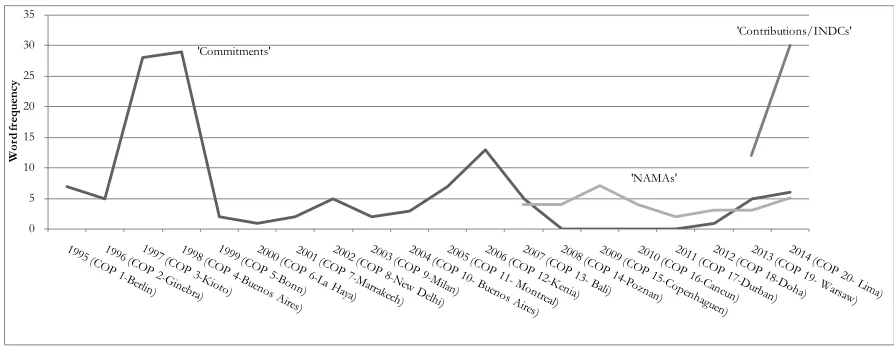
The word frequency count shows that the use of the term ‘commitments’ (related to developing countries’ participation in the global mitigation effort) peaked in the discussions that led to the signature of the Kyoto Protocol in 1997 (COP 3), fell in 1999 and resurged in the negotiations on the post-2012 period that began in 2005. The term then disappeared in 2007 (COP 13-Bali), when it was agreed that developing countries would implement NAMAs, and it reappeared in 2012 in the negotiations aimed at developing a new protocol by 2015 (the Paris Agreement).
The term ‘NAMA’ emerged in 2007, associated, as it was mentioned above, to voluntary actions based on sustainable development priorities for developing countries.
The word ‘intended’ was introduced because countries were communicating proposed climate actions before the adoption of the Paris Agreement. As countries formally joined the agreement, the term ‘intended’ was omitted and ‘INDCs’ were converted into ‘NDCs’ (‘Nationally Determined Contributions’) (Figure 1).
Figure 1: Words used in the 1995-2014 Climate Change Conferences (COPs) in discussions on developing countries’ participation in the global mitigation effort
Source: Author, based on IISD (1995, 1996, 1997, 1998, 1999, 2000, 2001a, 2001b, 2002, 2003, 2004, 2005, 2006, 2007, 2008, 2009, 2010, 2011, 2012, 2013 and 2014).
As shown in the quotes presented in Annex, the opposition of most developing countries to undertake mitigation efforts similar to those of developed countries’ coincides over time with the discussions based on ‘commitments’. After the agreement on the term ‘NAMA’ was reached at COP 13 (in 2007), a new space for dialogue was opened.
Incentives to Foster Mitigation and Participation in International
Climate Agreements
Different types of incentives have been introduced in the international climate architecture that has been created since the 1990s, including economic instruments, increasing consideration of equity and fairness issues within developing countries’ participation mechanisms, information generation and proliferation, financial transfer mechanisms and sanctions for misbehaviour, analysed below.
Economic Instruments
The Kyoto Protocol introduced three market-based flexibility mechanisms aimed at providing developed countries with additional means of meeting their GHG reduction targets and encouraging developing countries and the private sector to join the GHG
'Commitments'
'NAMAs'
'Contributions/INDCs'
0 5 10 15 20 25 30 35
W
or
d
fr
eq
ue
nc
emissions reduction efforts. These mechanisms, which created the so-called ‘carbon markets’, were: i) Emissions Trading (ET); ii) Clean Development Mechanism (CDM) and iii) Joint Implementation (JI).
Developed countries’ GHG reduction targets within the Kyoto Protocol have been expressed as levels of allowed emissions over the 2008-2012 commitment period. ET allows industries in developed countries that had excess allowed emissions to sell them to facilities that are over their targets. Meanwhile, CDM and JI are project-based mechanisms. CDM involves investment in mitigation projects in developing countries that contribute to their sustainable development, while JI enables developed countries to invest in mitigation projects in other developed countries. CDM and JI projects generate credits according to the emissions they avoid or reduce compared to a baseline. The Kyoto Protocol allowed developed countries to partly meet their GHG reduction commitments by buying allowed emissions and CDM and JI certificates. Therefore, a new commodity was created in the form of GHG emission reductions.
One of the most important contributions of carbon markets has been that participants from both developed and developing countries have experienced decision-making in a market context with the commodification of GHG emissions.
With regards to the CDM, over 8,000 projects in renewable energy production, efficient cookstoves, landfill and waste management, and afforestation and reforestation have avoided or reduced 2 billion tonnes of CO2e and have enabled USD 300 billion
investments since 2001. 72% of these projects have been developed in the renewables sector, with wind (31%) and hydro (26%) accounting for the lion’s share. Although the countries that have benefitted mostly from the CDM have been big economies already attracting high levels of economic investment, such as China, India, Mexico, Brazil and Korea, 111 developing countries including least developed countries and small island developing states have managed to benefit by undertaking CDM projects. In addition, by allowing companies to develop projects and trade certificates, the CDM has mobilised the private sector and has contributed to creating awareness of the need for climate action. CDM has also enhanced the learning processes of baseline analysis, construction of mitigation and development scenarios and application of methodologies for estimating mitigation potentials and project costs (UNFCCC Secretariat, 2018).
were eager to sell their emission reductions to buyers in developing countries under the CDM, at present even developing countries have mitigation targets to comply with, which requires them to keep the emission reduction options for themselves. Negotiators are still discussing how to use markets and market mechanisms under the Paris Agreement.
Increasing Consideration of Equity and Fairness Issues Regarding Developing Countries’ Participation in the Global Mitigation Effort
Ethical and equity questions regarding climate change responsibility and fairness in the mitigation effort burden-sharing have been central in North-South climate debates since the 1990s. The United Nations Framework Convention on Climate Change (UNFCCC, 1992; Article 4) recognises that developed countries (included in Annex I of the Convention) are expected to take the lead regarding mitigation action, assume a greater share of the burden of the mitigation effort and provide financial resources to developing countries to meet the incremental costs of implementing mitigation measures. However, in practice, Annex I countries have been putting pressure on the more advanced developing states (namely, China, India, Mexico and Brazil) to undertake more ambitious actions. Meanwhile, debates on financial resources provision have developed within different negotiation tracks, although effective paid up resources have never reached the levels required by developing countries. Whether this constitutes a departure from the principles of equity and common but differentiated responsibilities has been a central issue of debate (Schwarte and Massawa, 2009).
Negotiations were at a crossroads, with developed countries trying to make developing countries adopt mitigation commitments and developing countries claiming that this did not respect ethical and fairness principles, until 2007 when the agreement based on the ‘NAMA’ concept managed to untangle debates. Developing countries would implement more ambitious climate actions but on a voluntary basis and according to their national capacities and development priorities. Furthermore, developing countries would count on new additional finance, technological transfer and capacity building support from developed countries. This agreement based on the concept of ‘NAMA’ prepared the ground for negotiating, later, further mitigation efforts under the form of ‘national voluntary contributions’, which finally materialised in the form of NDCs submitted to the UNFCCC within the framework of the Paris Agreement.
flexibility in order to ensure broader participation and accommodates ‘national circumstances’ and voluntary contributions as a new context for fairness. Thus, the Paris Agreement has managed to provide a different answer to the question of what constitutes an equitable and fair response to climate change (Chan, 2016).
Information Generation and Spread
Prior to climate change conferences, negotiators identify the issues that will likely be discussed, understand their position on each issue, evaluate options and finally determine their priorities across different issues. Therefore, information is key to success in negotiations (Young et al, 2012).
International organisations have made deliberate efforts to generate and disseminate information on the expected impacts of climate change as well as on the synergies that may exist between climate change mitigation and national development goals such as poverty reduction, food and energy security and adaptation to the expected effects of climate change. The Intergovernmental Panel on Climate Change (IPCC), created in 1988 by the World Meteorological Organisation in partnership with the United Nations Environmental Program (UNEP), has been the leading international scientific body related to climate change research dissemination. The IPCC Assessment Reports (IPCC, 1990; 1995; 2001; 2007a; 2007b; 2007c; 2013; 2014a; 2014b) have played a key role in defining agreements and discussion agendas. Along similar lines, United Nations agencies and other multilateral organizations and development banks have been responsible for the development of international campaigns and agendas (such as the Sustainable Development Goals) and the creation of multiple programs to enhance climate action with focus on providing support to developing countries, such as the REDD+ program, aimed at reducing emissions from deforestation and forest degradation, or the Climate Technology Centre & Network (CTCN), aimed at promoting the transfer of environmentally sound technologies for low carbon and climate resilient development.
The generated information has been communicated with special focus on two issues: i) the expected climate change impacts and the consequences of inaction; ii) the economic, social and environmental co-benefits GHG mitigation may generate specially in developing countries (eg. energy savings and employment generation in new sectors such as renewable energies).
Financial Transfer Mechanisms
creation of the Green Climate Fund (GCF) in 2010 as part of the UNFCCC financial mechanisms incorporated an additional equity mechanism for resource provision through concessional lending instruments, a 50:50 balance between mitigation and adaptation investments and the allocation of 50% of the climate change adaptation funds for particularly vulnerable countries. The GCF’s current portfolio has more than 100 projects benefitting more than 300 million people and avoiding the emission of 1.5 billion tCO2 through the
investment of USD 3.5 billion. Sanctions for Misbehaviour
Although neither the UNFCCC (1992) nor the Kyoto Protocol (1997) or the Paris Agreement (2015) include explicit sanctions for non-accomplishment of mitigation targets or contributions, there is a growing threat of trade sanctions imposition associated to the carbon content of exported products. For example, in 2007 the United States Congress introduced the Lieberman-Warner America’s Climate Security Act (S.2191) which included the proposal of applying border tax adjustments (BTAs) to imports from countries that had not taken action comparable to that taken by the United States to limit GHG emissions. Other climate bills such as Bingaman-Specter in 2007, Waxman-Markey in 2009 and Kerry-Boxer in 2009 included similar provisions. With regards to the European Union, it enacted the Renewable Energy Directive (2009/28/EC )in 2009, establishing that imported biofuels must demonstrate GHG emission savings as compared to the fossil fuel they replace and that the raw materials used for production had not been planted in a previously deforested land.
The possibility of extending the evaluation of international suppliers based on the carbon footprint of exported products is of particular concern for developing countries, including Latin America, given the export profile and productive specialisation relatively intensive in natural resources.
Conclusion
Content analysis conducted on the oral declarations made by Latin American delegates and Heads of State throughout the 1995-2014 UNFCCC COPs, as reported in the IISD Earth Negotiation Bulletins, shows a first breaking point in discourse in 2007, when it was agreed that developing countries would not undertake mandatory mitigation commitments but would instead implement voluntary Nationally Appropriate Mitigation Actions (NAMAs), with financial and technological support from developed countries. The agreement on the notion of ‘NAMAs’ paved the way for agreeing in 2011 that all countries would make mitigation efforts under a new protocol that would be developed by 2015. The learning process of developing countries in planning ‘national-level voluntary mitigation actions’, which depended on continuous support from United Nations agencies and other multilateral organisations, prepared the ground for the emergence of a new bottom-up climate protocol based on voluntary mitigation ‘contributions’ from all countries (the Paris Agreement).
The change in terminology referring to developing countries’ participation in the global mitigation effort, moving forward from the notion of ‘commitments’ to ‘NAMAs’ and finally to ‘contributions’, was accompanied by the introduction of different types of incentives within the international climate regime aimed at inducing perception and behavioural change among developing countries’ decision makers. These incentives have been in line with the theoretical recommendations of the economic literature to encourage mitigation efforts and enhance participation in international climate agreements. Five such incentives can be identified.
agencies playing a key role. Fourthly, an international compensation (transfer) scheme was created through the development of a global climate financial architecture that currently channels most resources for mitigation and adaptation actions to developing countries through the Green Climate Fund (GCF). Finally, sanctions for non-compliance in the form of threats of imposition of trade barriers based on the carbon content of export products began to consolidate at the international level. This has been especially so in the United States and Europe, which are key export markets for Latin American countries.
From an international policy perspective, the main implication of these findings is that it is important to have a retrospective and dynamic look of the international climate process, since the global governance architecture that has been created since the 1990s has been able to foster transformation processes and behavioural change, finally including developing countries in an international climate agreement applicable to all. Although the submitted NDCs are insufficient for preventing temperature increases above 2 °C, the Paris Agreement itself is a valuable framework for achieving further reductions in the future, since it establishes provisions for countries submitting new contributions every five years which should represent progressions beyond the previous ones.
After documenting the change in Latin American countries’ negotiation positions regarding participation in the global mitigation effort since the 1990s and identifying the economic and governance incentives that have been introduced in the international climate regime, the next research steps involve testing empirically if these incentives have effectively induced the observed behavioural changes among Latin American decision makers. Surveys with negotiators and econometric studies should be conducted to test causality between the introduced incentives and negotiators’ perception change regarding costs and benefits of joining an international climate agreement with a more active role.
References
5Abbott, Kenneth (2012): ‘The Transnational Regime Complex for Climate Change’, Environment and Planning C: Government and Policy 30 (4): pp. 571-590. DOI:
https://doi.org/10.1068/c11127
Aldy, Joseph and Robert Stavins (2008): ‘Economic Incentives in a New Climate Agreement’, Issue Paper, Belfer Center for Science and International Affairs, Harvard Kennedy School. Available at: https://www.belfercenter.org/publication/economic-incentives-new-climate-agreement
Barrett, Scott (2003): Environment and Statecraft. The Strategy of Environmental
Treaty-Making. Oxford: Oxford University Press. DOI:
https://doi.org/10.1093/0199286094.001.0001
Barrett, Scott (2008): ‘Rethinking Global Climate Change Governance’, Economics: The
Open-Access, Open-Assessment E-Journal 3(5): pp. 1-14. DOI:
https://doi.org/10.5018/economics-ejournal.ja.2009-5
Bulmer-Thomas, Victor (2014): The Economic History of Latin America since
Independence. Cambridge: Cambridge University Press. DOI:
https://doi.org/10.1017/CBO9781139208710
Chan, Nicholas (2016): ‘Climate Contributions and the Paris Agreement: Fairness and Equity in a Bottom-Up Architecture’, Ethics & International Affairs 30(3): pp. 291-301. DOI:
https://doi.org/10.1017/S0892679416000228
Chichilnisky, Graciela (1994): ‘North-South Trade and the Global Environment’, American Economic Review 84(4): pp. 851-874. Available at: https://ssrn.com/abstract=1374644
Ecofys (2014): ‘Ecofys NAMA Database’. Available at: http://www.nama-database.org/
Fajnzylber, Fernando (2006): Una visión renovadora del desarrollo de América Latina. Santiago de Chile: Libros de la CEPAL.
Galeano, Eduardo (1971): Las venas abiertas de América Latina. Buenos Aires: Catálogos.
Gligo, Nicalo and Jorge Morello (1980): ‘Notas sobre la historia ecológica de América Latina’, Estudios internacionales 13(49): pp. 112-148. DOI: https://doi.org/10.5354/0719-3769.1980.16622
International Institute for Sustainable Development (IISD) (1995): ‘Summary of the First Conference of the Parties for the Framework Convention on Climate Change: 28 March-7 April 1995.’ Earth Negotiations Bulletin 12(21): pp. 1-11. Available at:
http://enb.iisd.org/download/pdf/enb1221e.pdf
International Institute for Sustainable Development (IISD) (1996): ‘Summary of the Second Conference of the Parties for the Framework Convention on Climate Change: 8-19 July 1996.’ Earth Negotiations Bulletin 12(38): pp. 1-14. Available at:
http://enb.iisd.org/download/pdf/enb1238e.pdf
International Institute for Sustainable Development (IISD) (1997): ‘Report of the Third Conference of the Parties to the United Nations Framework Convention on Climate Change: 1-11 December 1997.’ Earth Negotiations Bulletin 12(76): pp. 1-16. Available at:
http://enb.iisd.org/download/pdf/enb1276e.pdf
November 1998.’ Earth Negotiations Bulletin 12(97): pp. 1-14. Available at:
http://enb.iisd.org/download/pdf/enb1297e.pdf
International Institute for Sustainable Development (IISD) (1999): ‘Summary of the fifth Conference of the Parties to the Framework Convention on Climate Change: 25 October-5 November 1999.’ Earth Negotiations Bulletin 12(123): pp. 1-16. Available at:
http://enb.iisd.org/download/pdf/enb12123e.pdf
International Institute for Sustainable Development (IISD) (2000): ‘Summary of the sixth Conference of the Parties to the Framework Convention on Climate Change: 13-25 November 2000.’ Earth Negotiations Bulletin 12(163): pp. 1-19. Available at:
http://enb.iisd.org/download/pdf/enb12163e.pdf
International Institute for Sustainable Development (IISD) (2001a): ‘Summary of the resumed Sixth Session of the Conference of the Parties to the Framework Convention on Climate Change: 16-27 July 2001.’ Earth Negotiations Bulletin 12(176): pp. 1-15. Available at: http://enb.iisd.org/download/pdf/enb12176e.pdf
International Institute for Sustainable Development (IISD) (2001b): ‘Summary of the seventh Conference of the Parties to the Framework Convention on Climate Change: 29 October-10 November 2001.’ Earth Negotiations Bulletin 12(189): pp. 1-16. Available at:
http://enb.iisd.org/download/pdf/enb12189e.pdf
International Institute for Sustainable Development (IISD) (2002): ‘Summary of the eight Conference of the Parties to the Framework Convention on Climate Change: 23 October-1 November 2002.’ Earth Negotiations Bulletin 12(209): pp. 1-15. Available at:
http://enb.iisd.org/download/pdf/enb12209e.pdf
International Institute for Sustainable Development (IISD) (2003): ‘Summary of the ninth Conference of the Parties to the UN Framework Convention on Climate Change: 1-12 December 2003.’ Earth Negotiations Bulletin 12(231): pp. 1-19. Available at:
http://enb.iisd.org/download/pdf/enb12231e.pdf
International Institute for Sustainable Development (IISD) (2004): ‘Summary of the tenth Conference of the Parties to the UN Framework Convention on Climate Change: 6-18 December 2004.’ Earth Negotiations Bulletin 12(260): pp. 1-16. Available at:
http://enb.iisd.org/download/pdf/enb12260e.pdf
International Institute for Sustainable Development (IISD) (2005): ‘Summary of the eleventh Conference of the Parties to the UN Framework Convention on Climate Change: 28 November-10 December 2005.’ Earth Negotiations Bulletin 12(291): pp. 1-20. Available at:
http://enb.iisd.org/download/pdf/enb12291e.pdf
International Institute for Sustainable Development (IISD) (2006): ‘Summary of the twelfth Conference of the Parties to the UN Framework Convention on Climate Change: 6-17 November 2006.’ Earth Negotiations Bulletin 12(318): pp. 1-22. Available at:
International Institute for Sustainable Development (IISD) (2007): ‘Summary of the thirteenth Conference of the Parties to the UN Framework Convention on Climate Change: 3-15 December 2007.’ Earth Negotiations Bulletin 12(354): pp. 1-22. Available at:
http://enb.iisd.org/download/pdf/enb12354e.pdf
International Institute for Sustainable Development (IISD) (2008): ‘Summary of the fourteenth Conference of the Parties to the UN Framework Convention on Climate Change: 1-12 December 2008.’ Earth Negotiations Bulletin 12(395): pp. 1-20. Available at:
http://enb.iisd.org/download/pdf/enb12395e.pdf
International Institute for Sustainable Development (IISD) (2009): ‘Summary of the Copenhagen Climate Change Conference: 7-19 December 2009.’ Earth Negotiations Bulletin 12(459): pp. 1-30. Available at: http://enb.iisd.org/download/pdf/enb12459e.pdf
International Institute for Sustainable Development (IISD) (2010): ‘Summary of the Cancun Climate Change Conference: 29 November-11 December 2010.’ Earth Negotiations Bulletin 12(498): pp. 1-30. Available at: http://enb.iisd.org/download/pdf/enb12498e.pdf
International Institute for Sustainable Development (IISD) (2011): ‘Summary of the Durban Climate Change Conference: 28 November-11 December 2011.’ Earth Negotiations Bulletin 12(534): pp. 1-34. Available at: http://enb.iisd.org/download/pdf/enb12534e.pdf
International Institute for Sustainable Development (IISD) (2012): ‘Summary of the Doha Climate Change Conference: 26 November-8 December 2012.’ Earth Negotiations Bulletin 12(567): pp. 1-30. Available at: http://enb.iisd.org/download/pdf/enb12567e.pdf
International Institute for Sustainable Development (IISD) (2013): ‘Summary of the Warsaw Climate Change Conference: 11-23 November 2013.’ Earth Negotiations Bulletin 12(594): pp. 1-32. Available at: http://enb.iisd.org/download/pdf/enb12594e.pdf
International Institute for Sustainable Development (IISD) (2014): ‘Summary of the Lima Climate Change Conference: 1-14 December 2014.’ Earth Negotiations Bulletin 12(619): pp. 1-46. Available at: http://enb.iisd.org/download/pdf/enb12619e.pdf
Intergovernmental Panel on Climate Change (IPCC) (1990): AR1: Scientific Assessment of Climate Change. Cambridge: Cambridge University Press. Available at:
https://www.ipcc.ch/report/ar1/wg1/
Intergovernmental Panel on Climate Change (IPCC) (2014b): AR5 Climate Change 2014: Impacts, Adaptation, and Vulnerability. Cambridge: Cambridge University Press. Available at: https://www.ipcc.ch/report/ar5/wg2/
Intergovernmental Panel on Climate Change (IPCC) (2007a): Climate Change 2007: Impacts, Adaptation and Vulnerability, Contribution of Working Group II to the Fourth Assessment Report of the Intergovernmental Panel on Climate Change. Cambridge: Cambridge
University Press. Available at:
Intergovernmental Panel on Climate Change (IPCC) (2007b): Climate Change 2007: Mitigation, Contribution of Working Group III to the Fourth Assessment Report of the Intergovernmental Panel on Climate Change. Cambridge: Cambridge University Press. Available at: https://archive.ipcc.ch/report/ar4/wg3/
Intergovernmental Panel on Climate Change (IPCC) (2007c): Climate Change 2007: The Physical Science Basis, Working Group I Contribution to the Fourth Assessment Report of the Intergovernmental Panel on Climate Change. Cambridge: Cambridge University Press. Available at: https://www.ipcc.ch/report/ar4/wg1/
Intergovernmental Panel on Climate Change (IPCC) (2013): Climate Change 2013: The Physical Science Basis, Contribution of Working Group I to the Fifth Assessment Report of the Intergovernmental Panel on Climate Change. Cambridge: Cambridge University Press. Available at: https://www.ipcc.ch/report/ar5/wg1/
Intergovernmental Panel on Climate Change (IPCC) (2014a): Climate Change 2014: Mitigation of Climate Change. Working Group III Contribution to the IPCC 5th Assessment
Report. Cambridge: Cambridge University Press. Available at:
https://www.ipcc.ch/site/assets/uploads/2018/02/ipcc_wg3_ar5_frontmatter.pdf
Intergovernmental Panel on Climate Change (IPCC) (1995): IPCC Second Assessment Report - Climate Change 1995. Cambridge: Cambridge University Press. Available at:
https://www.ipcc.ch/report/ipcc-second-assessment-full-report/
Intergovernmental Panel on Climate Change (IPCC) (2001): IPCC Third Assessment Report: Climate Change 2001. Cambridge: Cambridge University Press. Available at:
https://www.ipcc.ch/report/ar3/wg1/
Kahneman, Daniel and Amos Tversky (1984): ‘Choices, Values, and Frames’, American Psychologist 39(4): pp. 341-350. DOI: http://doi.org/10.1037/0003-066X.39.4.341
Knieling, Jörg and Walter Leal Filho (2013): ‘Climate Change Governance: The Challenge for Politics and Public Administration, Enterprises and Civil Society’, in Knieling, Jörg and Walter Leal Filho (eds.) Climate Change Governance. Berlin: Springer. pp. 1-5.
https://doi.org/10.1007/978-3-642-29831-8_1
McFadden, Daniel (1999): ‘Rationality for Economists?’. Journal of Risk and Uncertainty 19(1-3): pp. 73-105. DOI: https://doi.org/10.1023/A:1007863007855
Meadowcroft, James (2009): ‘Climate change governance’, World Bank Policy Research Working Paper Series. DOI: https://doi.org/10.1596/1813-9450-4941
Nemet, Gregory (2010): ‘Robust Incentives and the Design of a Climate Change Governance
Regime’, Energy Policy 38(11): 7216-7225. DOI:
https://doi.org/10.1016/j.enpol.2010.07.052
Ostrom, Elinor (2012): ‘Nested Externalities and Polycentric Institutions: Must We Wait for Global Solutions to Climate Change Before Taking Actions at other Scales?’ Economic Theory (49)2: pp. 353-369. DOI: https://doi.org/10.1007/s00199-010-0558-6
Ostrom, Elinor (2009): ‘A Polycentric Approach for Coping with Climate Change’, Policy Research Working Paper No. WPS 5095. Washington, DC: World Bank. DOI:
https://doi.org/10.1596/1813-9450-5095
Ostrom, Elinor (1997): ‘A Behavioral Approach to the Rational Choice Theory of Collective Action’, The American Political Science Review 92(1): pp. 1-22. DOI:
http://doi.org/10.2307/2585925
Ostrom, Elinor, Roy Gardner and James Walker (1994): Rules, Games, and Common-Pool
Resources. Michigan: University of Michigan Press. DOI:
https://doi.org/10.3998/mpub.9739
Pizer, William (2002): ‘Combining Price and Quantity Controls to Mitigate Global Climate Change’, Journal of Public Economics 85(3): pp. 409-434. DOI:
https://doi.org/10.1016/S0047-2727(01)00118-9
Schwarte, Christoph and Emily Massawa (2009): ‘Equity Issues in the Climate Change Negotiations’, European Capacity Building Initiative (ECBI) Policy Report. Available at:
https://pubs.iied.org/pdfs/G03002.pdf
Stern, Nicholas (2006): The Economics of Climate Change: The Stern Review. Cambridge: Cambridge University Press. DOI: https://doi.org/10.1017/CBO9780511817434
Tietenberg, Tom (1998): ‘Disclosure Strategies for Pollution Control’, Environmental and
Resource Economics 11(3-4): pp. 587-602. DOI:
https://doi.org/10.1023/A:1008291411492
UNFCCC Secretariat (2018): ‘Achievements of the Clean Development Mechanism’, Harnessing Incentive for Climate Action, 2001-2018. United Nations Climate Change.
Available at:
https://unfccc.int/sites/default/files/resource/UNFCCC_CDM_report_2018.pdf
Weitzman, Martin (1974): ‘Prices vs Quantities’, Review of Economic Studies 41(4): pp. 477-491. DOI: https://doi.org/10.2307/2296698
Young, Maia et al. (2012): ‘The Pursuit of Missing Information in Negotiation’, Organizational Behavior and Human Decision Processes 117(1): pp. 88-95. DOI:
Appendix
Evolution of Latin American Delegates’ Declarations in Climate Change Conferences (COPs) regarding GHG Mitigation Efforts (COP 1-COP 20 / 1995-2014)
COP 1 (1995) - Berlin, Germany
‘The G-77/China stated that [...] the responsibility [for mitigation] should not be transferred from
Annex I Parties to non-Annex I Parties [and] [...] stressed the need for a Protocol that imposed
commitments only for Annex I parties’ (IISD, 1995; page 3).
‘Brazil said that [...] the right of developing countries to develop should not be put in risk and that trying to involve developing countries in a hasty manner [...] will not solve the problems [...]. The
[Brazilian] delegation does not want to exchange ‘smoke for trees’ [...] (Ibid: 4-5).
‘Colombia said that developing countries should not assume the same obligations as developed
countries’ (Ibid: 5).
COP 2 (1996) - Geneva, Switzerland
‘Delegates from developing countries expressed dissatisfaction with what they considered an attempt
by developed countries to shift the weight of implementation [of mitigation measures] from Annex I Parties to non-Annex I Parties [...]. These delegates strongly objected the language that proposed
that the mitigation projects carried out in non-Annex I countries should be financed by themselves’
(IISD, 1996: 12).
COP 3 (1997) - Kyoto, Japan
‘The G-77/China took every opportunity to keep away from any attempt to attract developing
countries to accept any element that could be interpreted as new commitments’ (IISD, 1997: 2).
‘Costa Rica said that the Kyoto Protocol should include […] an active voluntary participation of developing nations’ (Ibid: 5).
‘Developing countries […] stressed that the Berlin Mandate does not provide for developing
countries to take responsibility for what it is, essentially, the result of industrialised countries’ actions’
(Ibid: 6).
‘The G-77/China, supported by [...] Colombia, Nicaragua, Honduras, Chile, Peru, Uruguay,
Venezuela, Costa Rica [...] and Argentina, said that the concepts of ‘equity’ and ‘common but
differentiated responsibilities’ were key for success. The group highlighted the low per capita
emissions of developing countries and their priorities regarding economic and social development.
This is not the time to address developing countries’ commitments but to strengthen developed
countries’. The group concluded with a word: ‘no’ [...]. Brazil said that a declaration from a developed
country had implied ‘if you do not comply, we do notcomply’, to which he replied ‘until you do not
‘Although the Summit achieved the signing of the Kyoto Protocol […] the ambition to universalise
the imperative to reduce global GHG emissions through expanded participation to developing
countries holds several steps back’ (Ibid: 15). COP 4 (1998) - Buenos Aires, Argentina
‘Argentina [said that] developing countries share some responsibility for climate change and that they
have an ethical obligation to ensure sustainable development’ (IISD, 1998: 2).
‘Brazil warned about the fact that assigning mitigation commitments to developing countries [...] did
not seek to promote the principles of the Convention but rather would help some developed countries avoid their existing commitments [...]. China said that [...] the assumption of commitments would destroy the unity of the G-77/China [...]. Colombia suggested discussing the vulnerability of
developing nations instead of their commitments’ (Ibid: 3).
Cuba [...] opposed to any attempt to force developing countries to assume commitments [...]. Bolivia
stressed that the […] the limits [of Argentina] on their emissions could neither constitute a precedent
nor compromise other countries to make similar commitments (Ibid: 11).
Developing countries raised their guard against any attempt to impose new obligations or associated conditionalities [...]. The G-77/China continues to consider it inappropriate to make commitments given the poor performance of Annex I Parties, while developed countries insist that the problem is
the lack of global participation, particularly by key developing countries such as China and Brazil’
(Ibid: 14).
COP 6 (2000-2001) - The Hague, Netherlands; Bonn, Germany
‘The G-77/China rejected the proposal of a 'key Annex I country' to condition the provision of
financial assistance to some form of new emissions reduction commitments for developing countries’
(IISD, 2000: 3).
COP 7 (2001) - Marrakech, Morocco
‘The G-77/China stated that COP 7 [...] was not the appropriate forum to address the issue of new
commitments for developing countries [...]. Brazil said that it hoped that negotiations on the second
commitment period would take into account the `Brazilian Proposal’ based on the responsibility of
having caused climate change’ (IISD, 2001: 13).
COP 8 (2002) - New Delhi, India
‘Theusual division between the developed and developing countries’ positions on many issues was
evident at COP 8 [...]. The Delhi Declaration reaffirms the development and eradication of poverty as top priorities in developing countries and the implementation of the Convention's commitments
according to Parties’ common but differentiated responsibilities, development priorities and
circumstances. It does not call for a dialogue to broaden commitments’ (IISD, 2002: 1).
‘AOSIS [...] and Mexico noted that Annex I countries were not accomplishing their commitments
G-77/China opposed to any text that could imply new commitments for non-Annex I countries [...].
Claiming its right to develop, Cuba opposed to new commitments for developing countries’ (Ibid:
12).
COP 10 (2004) - Buenos Aires, Argentina
‘Long negotiations were held on the complex and sensitive issue of how the parties would get
involved in making commitments to fight climate change in the post-2012 period. The Kyoto Protocol, according to its Article 3.9, requires that Parties should begin to consider the post-2012 period in year 2005[...]. Argentina proposed, and the Parties agreed, to incorporate a text stating that [...] the Seminar would not initiate any negotiations leading to new commitments for developing countries (IISD, 2004: 14).
COP 11 (2005) - Montreal, Canada
‘Reaffirming that no new commitments for non-Annex I Parties would be introduced under the Protocol, the G-77/China proposal called for the creation of an ad hoc working group to consider
future commitments for Annex I countries’ (IISD, 2005: 13). COP 12 (2006) - Nairobi, Kenya
‘It seems that the conditions for the participation of the main developing countries are not yet given (IISD, 2006: 17).
‘According to most observers, two issues must be solved first: historical emissions and the 'fair' (or acceptable) distribution of future emissions. In this context, the meaning of `fair’ will ultimately depend on political agreement. And, in any case, the only consensus at this point seems to be that there will be no possible commitments until developed countries show that they take seriously the
idea of fighting climate change in the context of common but differentiated responsibilities’ (IISD,
2006: 20).
COP 13 (2007) - Bali, Indonesia
"The text on developed and developing countries’ mitigation efforts was especially controversial [...].
While the United States, Canada and others sought stronger language to refer to developing countries’
commitments, the G-77/China opposed and, instead, tried to focus on language that referred to
commitments for Annex I Parties [...]. The agreement did not seem possible, but then the Parties finally agreed
on a proposal from India and another developing country on a text that refers to adequate mitigation actions at the national level to be implemented in developing Parties in the context of sustainable development, supported by technology transfer and possibly by financial flows and capacity building and developed in a way that could be measured, reported
and verified’ (IISD, 2007: 15).
‘For the first time it established a negotiating agenda that included discussions on mitigation for both
developed and developing countries (Ibid: 19).
COP 14 (2008) - Poznan, Poland
‘The Parties discussed the idea of establishing a registry of mitigation actions undertaken in developing countries. Brazil stated that the registry should match actions with needed and offered