INTRODUCTION
Digestate liquors produced from the anaero-bic digestion process could be considered as both a problematic medium as well as a valuable re-source. Improperly treated digestate liquors may lead to serious environmental threats, such us emissions of greenhouse gases (GHG) and leach-ing of nutrients and organic matter to the natural environment (Holm-Nielsen et al., 2009). On the other hand, digestate liquors are also a valuable source of nitrogen and phosphorus compounds (e.g. ammonium (NH4+) with the concentrations higher than 1000 g N/ m3) due to the hydrolysis and fermentation of the nitrogen and phosphorus
fractions of the slowly biodegradable substrates (Onay and Pohland, 1998).
With regard to the treatment of digestate li-quors, nutrients in the colloidal and suspended forms could be removed through a wide range of the physical and chemical separation methods, such as centrifugation, coagulation and floatation (Møller et al., 2006). The dried products could be further refined into concentrated fertilizers or fiber products (Holm-Nielsen et al., 2009). How-ever, a substantial amount of dissolved nutrients still remains in the digestate liquors and may po-tentially cause eutrophication. In order to remove the dissolved nutrients from the digestate liq-uors, biological processes are considered, among
ADAPTATION OF THE ACTIVATED SLUDGE TO THE DIGESTATE LIQUORS
DURING THE NITRIFICATION AND DENITRIFICATION PROCESSES
Joanna Majtacz1*, Przemyslaw Kowal1, Xi Lu1,2, Hussein Al-Hazmi1, Jacek Mąkinia1
1 Faculty of Civil and Environmental Engineering, Gdansk University of Technology, ul. Narutowicza 11/12,
80-233, Gdansk, Poland
2 Institute of Environmental Science and Engineering, Tongji University, 1239 Siping Road, Shanghai,
200092, China
* Corresponding author’s e-mail: [email protected]
Volume 18, Issue 5, Sep. 2017, pages 104–109
DOI: 10.12911/22998993/75762 Research Article
ABSTRACT
The activated sludge process of the digestate liquors after chemical separation was conducted using a 10 L lab-scale sequencing batch reactor (SBR) and a 0.50 m3
pilot-scale SBR independently (with pH control). Due to the relatively high concentration
of free ammonia (FA), clear inhibitory effects of the digestate liquors on the nitrifying
bacteria were observed. The adaptation of the activated sludge to the toxicity was
evaluated with the trends of ammonia uptake rate (AUR) and nitrate utilization rate
(NUR). The lab-scale AUR values decreased from 5.3 to 2.6 g N/(kg VSS·h) over time after the addition of digestate liquors (5–10% of the reactor working volume),
in-dicating an apparent FA inhibition on the nitrification process in the FA concentration
range of 0.3–0.5 mg N/L. The pilot-scale AUR values increased from 1.8 to 3.6 g N/
(kg VSS·h) in the first two weeks and then decreased to 2.4 g N/(kg VSS·h), showing a lag of the inhibition on the nitrifying bacteria at the FA concentration ≈ 0.15 mg N/L.
The lab-scale NURs increased from 2.6 to 10.4 g N/(kg VSS·h) over time, and the pilot-scale NURs increased from 1.0 to 4.0 g N/(kg VSS·h) in a similar pattern. The clear dependence of both the lab- and pilot-scale NURs on time indicated the adapta-tion of the heterotrophic biomass to the digestate liquors. Ethanol – used instead of
fusel oil – was found to be a more efficient external carbon source for better adaptation
of the activated sludge under unfavorable conditions.
Keywords: digestate liquors; activated sludge; free ammonia; adaptation; inhibition Received: 2017.06.23
which the activated sludge process is regarded as a promising alternative due to the ease of main-tenance and high economic efficiency. Further -more, the nutrients concentrated and deposited in the biomass could be subsequently processed for recovery (Daigger, 2014).
However, one of the most challenging issues for the pre-treatment of the ammonium-rich an-aerobic sludge digestate liquors is the adaptation of the nitrifying bacteria to the high free ammo-nia (FA) concentration. Similarly to the landfill leachate, digestate liquors may exert toxicity on nitrifying bacteria due to the high FA concentra-tion (Cotman and Gotvajn, 2010). The inhibi-tion thresholds for ammonia oxidizing bacteria (AOB) and nitrite oxidizing bacteria (NOB) have been reported in the range of 10–150 and 0.1–1.0 g N/ m3, respectively (Turk and Mavinic, 1989). It was also stated by Anthonisen et al. (1976) that the AOB activity is inhibited at FA concentration of 8–120 mg N/L, while the inhibition of NOB is observed at an FA concentration of 0.08–0.82 mg N/L. Furthermore, nitrobacter has been reported to be immediately inhibited (both growth and res-piration processes) at FA concentrations greater than 1.0 mg N/L (Jaroszynski, 2012). However, limited information is available on the inhibi-tory effect of the digestate liquors on the nitrifi -cation and adaptation of the activated sludge to the digestate liquors.
In this study, in order to conduct successful implementation of the activated sludge process for the pre-treatment of digestate liquors, the fol-lowing investigations were carried out: 1) deter-mination of the allowable load of the digestate liquors to prevent FA inhibition on nitrification, 2) evaluation of the adaptation of the activated sludge under different loads of the digestate li -quors, 3) optimization of the operational condi -tions (e.g. type of the external carbon source) for nutrient removal from the digestate liquors and further recovery.
MATERIALS AND METHODS
The experiments were carried out in two stag-es, with regard to the determination of the acti-vated sludge adaptation rate under different loads of the digestate liquors in the lab scale (first stage) and in the pilot scale (second stage). Before ap-plying biological treatment, suspended solids were removed from digestate liquors by
coagula-tion with ferric (III) chloride preceding sedimen-tation. The studied digestate liquors exhibited a high NH4+ variation (300–1200 g N/m3) due to the different substrates for anaerobic digestion. In the lab-scale experiments, the dosing amount of the digestate liquors varied in the range of 5–10% of the reactor working volume to maintain a constant NH4+ concentration (≈ 30 mg N/L). As far as the pilot-scale experiment is concerned, the dosing amount of the digestate liquors ranged from 5to 7.5% of the reactor working volume to maintain a constant NH4+ concentration (≈ 15 mg N/L).
GmbH). TN was determined with TOC Analyz -ers – TNM-1 (Shimadzu, North America). The concentrations of MLVSS were determined by means of the gravimetric method, according to the Polish Standards (PN-72/C-04559).
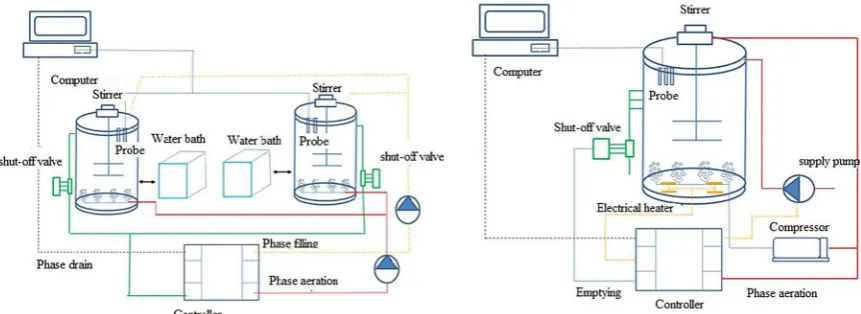
The pilot-scale experiments were carried out during a period of 30 days in a pilot-scale SBR characterized by the working volume ranging from 0.25 to 0.50 m3(with the drainage pipes fixed at different heights), equipped with the SC 1000 control module (Hach Lange, U.S.A) for continuous monitoring of DO (LDO LXV 416.99.0000.1), NH4-N and NO3-N (ANISE), pH control module (CPS model 11- 2BA2ESA, Endress + Hauser, Germany) for continuous monitoring of pH and the pH adjustment systems (Grundfos Alldos / DDI 222, Germany) (Figure 1b). The process temperature was kept constant at 20°C. The reactor was inoculated with the acti-vated sludge originating from Swarzewo WWTP. The MLVSS concentrations varied in the range of 4.5–4.8 kg/m3. The operational parameters were set in accordance with those from the lab-scale SBR. Fossil oil was added as the external carbon source (6 g COD/ g N) during the denitri-fication phase. The AUR, NUR were determined once a week.
RESULTS AND DISCUSSION
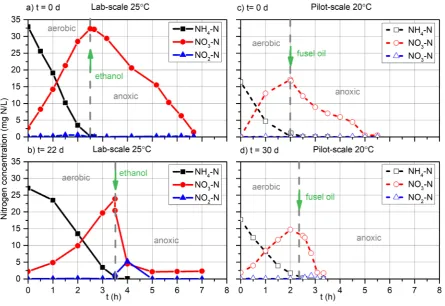
Four typical samples are presented in Figure 2, with regard to the beginning and end of the lab-scale (a-b) and pilot-lab-scale (c-d) experiments. In the lab-scale experiments (Figure 2a-2b), a nearly constant NH4+ concentration (≈ 30 mg N/L) was maintained by dosing the digestate liquors in the range of 5–10% of the reactor working volume.
A slower NH4+ consumption was observed over time (from t = 0 to t = 22 d), which indicated a potential inhibitory effect of the digestate liquors on the nitrifying bacteria. However, an apparent faster NO3- consumption was noted over time (from t = 0 to t = 22 d), indicating the adaptation of the activated sludge to the digestate liquors, es-pecially for the heterotrophic biomass.
In the pilot-scale experiments (Figure 2c-2d), the dosing amount of the digestate liquors varied in the range of 5–7.5% of the reactor working vol-ume to maintain a constant NH4+ concentration of 15 mg N/L. Different NH4+ consumption patterns were observed over time (from 0 to 30 d). In the beginning (t = 0 d), the NH4+ consumption was faster during the first hour of the nitrification pro -cess and then slowed down until the reaction fin -ished, showing a lag of the inhibitory effect on the nitrifying bacteria. Conversely, at the end (t = 30 d), the NH4+ consumption showed a constant rate during the whole nitrification process, indicating a potential adaptation of the nitrifying bacteria to the toxicity. A slightly slower NH4+ consumption was noticed during the whole period (from t = 0 to t = 30 d) The NO3- consumption in the deni-trification process was faster when t = 30 d, in comparison with t = 0 d.
For further investigations, AUR (a) and NUR (b) measurements during the lab- and pilot-scale experiments are presented in Figure 3. During the nitrification process (Figure 3a), the lab-scale AUR values gradually decreased from 5.3 to 2.6 g N/(kg VSS·h) over time and finally remained sta -ble around 2.6 g N/(kg VSS·h), showing a clear inhibitory effect of the digestate liquors on the ni -trification process. The trend was well described by the exponential function in Figure 3a. This negative effect was probably attributed to the rel
ative high FA concentration (0.3–0.5 mg N/L), as Turk and Mavinic (1989) reported that FA inhib-ited the activity of AOB and NOB in the concen-tration range of 10–150 and 0.1–1.0 g N/ m3, re-spectively. The pilot-scale AUR values increased from 1.8 to 3.6 g N/(kg VSS·h) in the first two weeks and then decreased to 2.4 g N/(kg VSS·h). This observation could be well described by the linear equation groups in Figure 3a. It indicated the lag of the inhibitory effect of the studied di -gestate liquor on the nitrifying bacteria at the rela-tively low FA concentration ≈ 0.15 mg N/L. The apparent lag time of the FA inhibition showed a
bacterial resistance to the toxicity. In comparison, similar AUR ranges were also reported by Bernat et al. (2011) and Zhu et al. (2013), i.e. 1.73–4.6 g N/(kg VSS·h) for the treatment of a mixture of wastewater and anaerobic sludge digester super-natant in an SBR at limited oxygen concentration (DO < 0.7 mg O2/L) and 7.43 g N/(kg VSS·h) for the treatment of the diluted landfill leachate in a post-denitrification SBR.
During the denitrification process (Figure 3b), the lab-scale NURs increased from 2.6 to 10.4 g N/(kg VSS·h) over time. A similar trend was also observed in the pilot-scale NURs, i.e. Figure 3. AUR (a) and NUR (b) measurements during the lab- and pilot-scale experiments
from 1.0 to 4.0 g N/(kg VSS·h). Both trends could be well described with the exponential functions, as shown in Figure 2b. During both the lab- and pilot-scale experiments, the shortening of the de-nitrification phases over time corresponded well to the increase in the NURs. A similar trend was also reported by Czerwionka et al. (2014), i.e. the NURs increased continuously from below 1 to 10 g N/(kg VSS·h) under ethanol substrate with the increase in the volumetric addition of sludge digester liquors over time. A similar value was also reported by Gong et al. (2013), i.e. 5.16 g N/(kg VSS·h) under acetate substrate at 22 °C. Furthermore, both observations with the lag in the beginning of the experimental period showed the adaptation of the heterotrophic biomass to the digestate liquors. The differences between the lab scale and pilot scale could partially be attributed to the type of the external carbon sources (ethanol vs. fusel oil) applied to support the denitrifica -tion process at slightly different temperatures (25 vs. 20 °C). It indicated that at a slightly higher temperature, ethanol served as a more efficient external carbon source for the adaptation of the activated sludge. The efficiencies of nitrogen re -moval during the lab and pilot-scale experiments were similar and ranged from 88 to 93%.
CONCLUSIONS
A lag of the inhibition of the digestate liquors on the nitrification process was observed, indicat -ing the resistance of the nitrify-ing bacteria to the FA toxicity . Even though a relatively high FA concentration (0.3–0.5 mg N/L) showed a clear inhibitory effect on nitrification, a potential ad -aptation of the nitrifying bacteria to the FA inhi-bition was also observed at a relatively low FA concentration (0.15 mg N/L). The adaptation of the heterotrophic biomass to the digestate liquors was observed both in the lab-and pilot-scale ex-periments. The relatively higher NUR values in the lab scale indicated that at a slightly higher temperature, ethanol served as a more efficient external carbon source for better adaptation of the biomass under unfavorable conditions. In com-parison with the denitrification process, greater attention had to be paid to the nitrification pro -cess for stable maintenance, as the latter pro-cess was more vulnerable to the toxicity. The activated sludge process, technically feasible and economi-cally efficient for nutrient removal under unfavor
-able conditions, proved to be a promising alterna-tive for the pre-treatment of the digestate liquors.
Acknowledgments
This study was financially supported by Norwegian funds Program implemented by the National Center for Research and Development (implementation period 2013–2016), within the framework of the Polish-Norwegian Research Cooperation under research project No. Pol-Nor / 202919/57/2013 Pomeranian Biogas Model.
REFERENCES
1. Anthonisen, A.C., Loehr, R.C., Prakasam, T.B.S.,
Srinath, E.G., 1976. Inhibition of Nitrification by
Ammonia and Nitrous Acid. J. (Water Pollut. Con-trol Fed. 48, 835–852.
2. Bernat, K., Kulikowska, D., Zielińska, M.,
Cydzik-Kwiatkowska, A., Wojnowska-Baryła, I., 2011.
Nitrogen removal from wastewater with a low COD/N ratio at a low oxygen concentration. Bio-resour. Technol. 102, 4913–4916. doi:10.1016/j. biortech.2010.12.116
3. Cotman, M., Gotvajn, A.Ž., 2010. Compari
-son of different physico-chemical methods for the removal of toxicants from landfill leachate. J. Hazard. Mater. 178, 298–305. doi:10.1016/j. jhazmat.2010.01.078
4. Czerwionka, K., Luczkiewicz, A., Majtacz, J.,
Kowal, P., Jankowska, K., Ciesielski, S., Pagilla, K., Makinia, J., 2014. Acclimation of denitrifying activated sludge to a single vs. complex external carbon source during a start-up of sequencing batch reactors treating ammonium-rich anaerobic sludge digester liquors. Biodegradation 25, 881– 892. doi:10.1007/s10532–014–9707–0
5. Daigger G. T. 2014. Ardern and Lockett remem-brance. W: Jenkins D., Wanner J. (edit.) Activated sludge – 100 years and counting (p. 1–15). Lon-don. IWA Publishing.
6. Gong, L., Huo, M., Yang, Q., Li, J., Ma, B., Zhu, R., Wang, S., Peng, Y., 2013. Performance of
het-erotrophic partial denitrification under feast-famine
condition of electron donor: A case study using ac-etate as external carbon source. Bioresour. Technol. 133, 263–269. doi:10.1016/j.biortech.2012.12.108
7. Holm-Nielsen, J.B., Al Seadi, T., Oleskowicz-Pop
-iel, P., 2009. The future of anaerobic digestion and
biogas utilization. Bioresour. Technol. 100, 5478–
5484. doi:10.1016/j.biortech.2008.12.046
8. Jaroszynski, L.W., 2012. The Influence of Nitrite
Anoxic Ammonium Oxidation Reactors.
9. Møller, H.B., Nielsen, A.M., Andersen, G.H., Na-kakubo, R., 2006. Process performance of biogas plants integrating pre-separation of manure, in: 12th Ramiran International Conference.
10. Onay, T.T., Pohland, F.G., 1998. In situ nitro-gen management in controlled bioreactor
land-fills. Water Res. 32, 1383–1392. doi:10.1016/
S0043–1354(97)00392–8
11. Turk O., Mavinic D.S., 1989. Stability of nitrite build-up in an activated sludge system. J.W.P.C.F. 61, 1440–1448.
12. Zhu, R. long, Wang, S. ying, Li, J., Wang, K., Miao,
L., Ma, B., Gong, L. xiao, Peng, Y. zhen, 2013. Ef
-fect of influent C/N ratio on nitrogen removal using