Background: Almost seven percent of disease burden is due to genetic disorders and birth defects and they are
associated to genetic as well as environmental factors. Prevention of such problems by making aware and increasing
knowledge level with the help of health education during adolescence is cost-effective among others. In this context,
current study proposed whether mini-lecture and/or poster is/are effective in changing adolescents’ knowledge
regarding genetic disorders and birth defects.
Methods: Mini-lectures followed by posters on genetic disorders and birth defects were used for intervention
group, whereas for control, only mini-lectures based on health promotion were delivered by trained personnel in
nine through 12 grade students of conveniently selected two public schools of Kaski district using quasi-experimental
design. Knowledge was assessed using a pretested inventory at baseline, after two weeks of mini-lectures and two
more weeks after poster for intervention group, whereas, only at baseline and two weeks after mini-lectures for
control. Statistical analysis was carried out to compare the intervention group of 133 students with that of control
group of 154.
Results: Mean knowledge increments among control and intervention groups were 0.20 and 0.68 points respectively
after mini-lecture. An addition of 0.84 points gained after the poster, yielding overall increment of 1.52 in intervention
group. Inferential analysis showed that effect of control was not effective (p=0.60), whereas mini-lecture (p=0.032),
poster (p=0.008) and both mini-lecture and poster (p<0.001) were effective.
Conclusions: The mini-lecture and/or poster for grade nine through 12 are effective methods and media for bringing
about changes in knowledge of adolescents regarding genetic disorders and birth defects.
Keywords: Genetic disorder and birth defect; health education; intervention; knowledge; nepal.
Effectiveness of Poster and/or Mini-Lecture on
Genetic Disorders and Birth Defects Related
Knowledge among Secondary Level Students of
Kaski, Nepal
Babu Ram Pokharel,1 Chiranjivi Adhikari2
1Purbanchal University, College of Medical and Allied Sciences, Gothgaun, Morang, Nepal. 2School of Health
and Allied Sciences, Pokhara University, Pokhara-30, Kaski, Nepal.
Correspondence:
Chiranjivi Adhikari, School of Health and Allied Sciences, Pokhara University, Pokhara-30, Kaski, Nepal. Email: chiranadhikari@gmail. com, Phone: +9779851192200.ABSTRACT
J Nepal Health Res Counc 2019 Jul-Sep;17(44): 331-5
INTRODUCTION
Genetics education and counselling (GEC) can increase knowledge and thereby changing behaviours that can prevent various genetic disorders and birth defects
(GDBD). Genetic education is cost-effective and can also
be applied in school settings.1
Genetic disorders related studies are scanty in Nepalese context. A recent study in India showed a malformation frequency of 2.03 percent, the commonest malforma-tions are neural tube defects, musculoskeletal disorders and Down syndrome.2 The Human Genome Project and
recently published national health policy of the govern-ment of Nepal including focus in the grey literatures emphasized the necessity of appropriate genetics edu-cation in schools to address the cutting-edge technolo-gies and issues regarding genetics and GDBD.3-7 In this
context, this study aims to find out the effectiveness of
genetics education module that included either poster or mini-lecture or both among grade nine to 12 students
of Kaski district, Nepal.
METHODS
Quasi-experimental with two sequential interventions in
DOI https://doi.org/10.33314/jnhrc.v17i3.1795
Original
intervention group and a general health promotion was given to control group with conveniently selected 287 students in classroom settings8 from two public schools
of Kaski district. Sample was calculated applying the formula, n=(1/1-f) [{2(Zα+Zβ)2}/p(1-p)(p0-p1)2], where,
f as dropout rate of 10%, αas 1.96, βas 1.28, p0as 0, p1as 0.6 and getting the samples in school-1(control=154) and school-2 (intervention=133). The study was carried out during the period of 2nd January to 30th March, 2016.
We differentiated the strategies of mini-lectures to two
groups delivered by trained personnel, in contents and approaches. The content of mini-lectures to control group was focused on prevalence of GDBD and blanket health promotion strategies, whereas, for interventional group
it was focused on causes, major and easily identifiable
symptoms and preventive techniques of GDBD that were synthesized from feedback provided by Health Promotion and Education Experts. In addition, six-page lecture note was provided to students of intervention school. The 2.5-by-4 feet poster was designed to address major eight GDBD pictures and ten GDBD prevention and detection messages for second phase intervention in intervention group.
Modified pre-tested structured knowledge inventory
with 30 structured questions obtaining maximum of 48 point score was used to collect the longitudinal data at three times of two intervention phases. The tool
included the knowledge inventory based on modified
genetic concept assessment.9 The knowledge inventory
was modified by adding the contents of genetic disorders and self-administrated with aided clarification and in
the presence of the researchers.
The test inventory for data collection was taken three times for intervention group and two times for control group. Baseline data collection in both groups followed the mini-lectures of two sessions, each of one hour in two consecutive days. Second series data collection was carried out after two weeks of mini-lectures in both groups and then two weeks after hanging a poster in intervention group.
Data was entered in EpiData and analysed in Statistical Package for Social Sciences (SPSS). The statistical descriptions of summary was done by mean with 95%
confidence limits, standard deviation, and standard error of the mean; and the difference of the intervention was
done by pairwise Spearman’s rho and Wilcoxon matched-pair signed-rank test. Type I and II errors were set at 5 percent and 20 percent respectively.
Ethical approval was taken from Nepal Health Research Council (NHRC). The permission from the two school
authorities was taken before intervention along with verbal consent from the students before starting the inventories. The objectives of the study and assurance of no harm from intervention were clearly addressed
and confidentiality of the responses was maintained.
RESULTS
Study results have been summarized under three sub-headings: socio-demographic characteristics, descriptive analysis of the knowledge scores, and the comparison of the scores with inferences.
The plurality of the students were studying in grade nine (29%) followed by grade 11 (27%), grade 12, and 10. Similarly, majority of the students comprised of middle adolescents of 15-17 years (63%) followed by late adolescence (24%). Less than three percent students
above the age of 19 were studying in different grades of
nine to twelve (table 1).
Table 1. Socio-demographic profile of the students.
Variables Frequency (%)
Intervention Control Total Sex
Male 53(39.8) 66(42.9) 119(41.5) Female 80(60.2) 88(57.1) 168(58.5) Grade
Nine 41(30.8) 43(27.9) 84(29.3)
Ten 20(15.0) 42(27.3) 62(21.6)
Eleven 39(29.3) 38(24.7) 77(26.8) Twelve 33(24.8) 31(20.1) 64(22.2) Age (years)
Early
Adolescent
(13-14) 15(11.3) 16(10.4) 31(10.8)
Middle Adolescent
(15-17) 70(52.6) 110(71.4) 180(62.7) Late Adolescent
(18-19) 42(31.6) 27(17.5) 69(24.0) Above
Adolescent
(20-25) 6(4.5) 1(0.6) 7(2.4)
Total 133(46.3) 154(53.7) 287(100)
0.20) after mini-lectures in first phase. It was even higher
after mini-lecture and poster (1.52 points increment) in intervention group after second phase (table 2).
Table 2. Descriptive statistics of knowledge scores in intervention and control groups.
Group n Mean (95%CI) SD SE of
mean Baseline Score
Control 154 23.0 (22.48-23.52) 3.29 0.27 Intervention 133 21.0 (20.45-21.55) 3.22 0.28 Score after Mini lecture intervention
Control 88 23.20(22.38-24.03) 3.89 0.41 Intervention 98 21.68(20.90-22.46) 3.89 0.39 Score after both Mini lecture and Poster
Intervention 99 22.52(21.72-23.31) 4.00 0.40
Mean score among the students was found to be
increased in first and second intervention in intervention
group and also in control group (Table. 2).
Since all the difference scores of pairs of control and intervention groups were found to be non-normal (K-S
tests, p<0.05), Spearman’s rho tests for correlation and Wilcoxon sign-ranked tests for comparison were carried out.
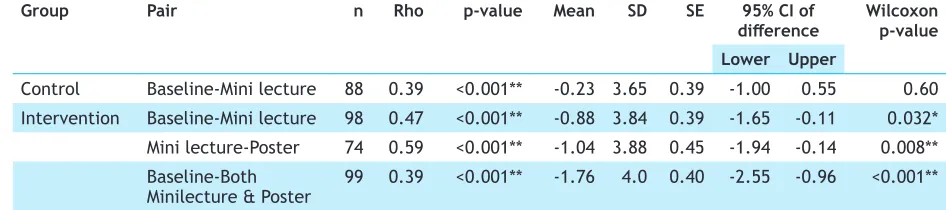
Correlation values were significant across all differences,
however, found stronger among the intervention pairs (0.39 versus 0.47, 0.59, 0.39) (tab 3). Although knowledge score was higher in the control group (tab 2),
the effect was insignificant (p=0.60) (tab 3). Whereas, the effect of intervention was significant in
baseline-minilecture (p=0.032), baseline-minilecture-poster (0.008) and
highly significant in baseline-both minilecture and poster
(p<0.001) (table 3).
Table 3. Pairwise Spearman’s rho and Wilcoxon matched-pair signed-rank test.
Group Pair n Rho p-value Mean SD SE 95% CI of
difference Wilcoxon p-value Lower Upper
Control Baseline-Mini lecture 88 0.39 <0.001** -0.23 3.65 0.39 -1.00 0.55 0.60 Intervention Baseline-Mini lecture 98 0.47 <0.001** -0.88 3.84 0.39 -1.65 -0.11 0.032* Mini lecture-Poster 74 0.59 <0.001** -1.04 3.88 0.45 -1.94 -0.14 0.008** Baseline-Both
Minilecture & Poster 99 0.39 <0.001** -1.76 4.0 0.40 -2.55 -0.96 <0.001** *Significance at 0.05 level, **Significance at 0.01 level
DISCUSSIONS
Poster, mini-lecture, and both were effective for changing
the knowledge of GDBD among school adolescents although higher scores were obtained in control group consistently before and after the intervention.
Median age at marriage of boys and girls in Nepal with some secondary education is 18.5 years10 and the current study shows that majority (63%) of school going secondary adolescents are 15-17 years old and most of them are studying in grade nine (29%). Hence it is customary to initiate genetics education at grade nine. Findings from the literatures are also consistent with this.3,11 This study added that school health education
programs are effective for knowledge intervention in
GDBD.
Some of the GDBDs especially thalassemia and sickle cell anemia are mainly amenable through awareness and educating the professionals and secondary level students3,5-7
Alternative form of genetics education, though slightly costlier is counseling. Literature shows that the third highest proportion of patients provided genetic counseling was chromosomal disorders (11%) after
repeated abortion and identifiable syndromes. Among
the other categories were high risk pregnancy (9.1%), hematologic disorders (7.4%), multiple congenital anomalies (4.2%) and others.3 Similarly, a hospital showed more than one-third (38.9%) of the patients were counseled on reproductive genetics.2 Studies from blind adolescents also revealed that the genetic counseling should be sought before they are entering and preparing to childbearing period.12
Although mini-lecture or poster whichever is superior to each-other could not be determined from the current study, among the undergraduate nursing students of Taiwan the majority reported that lecture method
was most effective for genetic information.13However, another cluster-randomised study evidenced that the poster was better for training for basic life supports
behaviours-cognitive, affective and psychomotor; poster was found
indeterministic.15 During adolescent genetics counseling, literature suggests that the technical jargons should be minimized or explained in simpler terms and dealt with
first language.16 This finding could also be considered when developing a poster, or a mini-lecture.
The consistent higher scores from control school before and after the intervention might be due to conveniently selected schools, among which, the students from control school might have been delivered the lectures related to GDBD before the study was carried out because it is closer to Pokhara main city and extra-curricular exposures to such activities are possible. The sample in intervention school was also less than that of control even though all the students from grade nine through 12 were included.
CONCLUSIONS
Mini-lecture and/or poster were effective to increase
knowledge of genetic disorders and birth defects among secondary level students. However, equivalent groups and cross-over design in both arms are recommended
before reaching the firm conclusion.
ACKNOWLEDGEMENTS
The authors are thankful to University Grants Commission
(UGC) of Nepal for providing financial support (under
mini-research grant number Education Cluster 14-071-072). The authors also thank school authorities
and students of participating schools; Bachelor of
Public Health students, sixth batch of School of Health and Allied Sciences (SHAS), PU for partial support in preparing intervention and control packages of the
study; and various organizations and google website for pictures and figures of GDBDs.