R E S E A R C H A R T I C L E
Open Access
Tutor assessment of PBL process: does
tutor variability affect objectivity and
reliability?
Bidyadhar Sa
1*, Chidum Ezenwaka
2, Keerti Singh
3, Sehlule Vuma
2and Md. Anwarul Azim Majumder
3Abstract
Background:Ensuring objectivity and maintaining reliability are necessary in order to consider any form of assessment valid. Evaluation of students in Problem-Based Learning (PBL) tutorials by the tutors has drawn the attention of critiques citing many challenges and limitations. The aim of this study was to determine the extent of tutor variability in assessing the PBL process in the Faculty of Medical Sciences, The University of the West Indies, St Augustine Campus, Trinidad and Tobago.
Method:All 181 students of year 3 MBBS were assigned randomly to 14 PBL groups. Out of 18 tutors, 12 had an opportunity to assess three groups: one assessed 2 groups and 4 tutors assessed one group each; at the end each group had been assessed three times by different tutors. The tutors used a PBL assessment rating scale of 12 different criteria on a six-point scale to assess each PBL Group. To test the stated hypotheses, independent t-test, one-way ANOVA followed by post-hoc Bonferroni test, Intra Class Correlation, and Pearson product moment correlations were performed.
Result:The analysis revealed significant differences between the highest- and lowest-rated groups (t-ratio = 12.64;p< 0. 05) and between the most lenient and most stringent raters (t-ratio = 27.96;p< 0.05). ANOVA and post-hoc analysis for highest and lowest rated groups revealed that lenient- and stringent-raters significantly contribute (p< 0.01) in diluting the score in their respective category. The intra class correlations (ICC) among rating of different tutors for different groups showed low agreement among various ratings except three groups (Groups 6, 8 and 13) (r= 0.40). The correlation between tutors’PBL experiences and their mean ratings was found to be moderately significant (r= 0.52;p> 0.05). Conclusion:Leniency and stringency factors amongst raters affect objectivity and reliability to a great extent as is evident from the present study. Thus, more rigorous training in the areas of principles of assessment for the tutors are
recommended. Moreover, putting that knowledge into practice to overcome the leniency and stringency factors is essential.
Keywords:Problem based learning, Process Assessment, Tutor variability, Objectivity, Reliability
Background
Problem based learning (PBL) is adopted by many medical schools worldwide. PBL approach rests the responsibility of learning on students [1,2]. This problem-solving approach encourages them to take center stage in case-based, self-directed learning and explore the pool of knowledge from varied sources using an active learning process to
realize their learning objectives [2]. Since its introduction more than four decades ago, PBL is found to be more active and engaging learning than the traditional approaches of teaching [1–4] - it helps to promote critical thinking in students, sharpen their communication skills, enhance general professionalism, increase retention knowledge and transferable skills, and develop teamwork and collaborative skills [3–5]. It discourages students from rote memorization and simple acquisition of knowledge but encourages and emphasizes the integration of basic knowledge and clinical skills [4–6]. However, the major challenge for PBL is in the * Correspondence:[email protected]
1Centre for Medical Sciences Education, The Faculty of Medical Sciences, The
University of the West Indies, St Augustine Campus, St Augustine, Trinidad and Tobago
Full list of author information is available at the end of the article
assessment of its process. In PBL, tutors’role is different from the role of a teacher in a traditional and didactic
teaching setting [7]. Tutors facilitate active learning,
encourage critical thinking, and promote self-directed learning among students [3–5]. The tutors’ role is de-scribed as ‘conducive’ or ‘facilitative’ [8] which requires understanding of the learning process [9]. Both (?) tutor and tutoring are important factors which influence PBL
process and learning outcomes [10]. Though tutors are in
a better position to assess students’skills and abilities dur-ing the PBL process, several studies highlighted the diffi-culty in generating reliable ratings of the tutors [11–14].
The outcome of tutors’ evaluation of students in PBL
tutorials has been contentious in terms of the validity of the ratings and scores given to different students [10–14].
Similar ‘hawk-dove’ effect has been observed in clinical
examination where examiners differ in their relative
leni-ency or stringleni-ency [15]. Hawks usually fail more
candi-dates, whereas doves tend to pass most candidates [15].
Rater variability in student assessments is found to be
problematic in medical education [16] and harsh or
inconsistent rater can pose negative consequences for
students’ outcome [17]. The literature review showed
that‘hawk-dove’phenomenon was not extensively studied
in problem-based learning. This may be due to the ab-sence of an ‘effective statistical technique’ to examine it
[15]. Well trained tutors using well-constructed rubrics
may eliminate these discrepancies [11–13,18].
In order to generate reliable ratings in PBL, Ingchatcharoena et al. (2016) recommended developing rater context factors consisting of rater’s motivation, ac-countability, conscientiousness, rater goals and ability for rating’ [19]. Mook et al. (2007) identified factors limiting
the assessment of students’ professional behavior in PBL
which includes absence of effective interaction, lack of thoroughness, tutors’failure to confront students with un-professional behavior, lack of effort to find solutions and
lack of student motivation [20]. Dolmans et al. (2006)
tried to explore the relationship between grades of
stu-dents’ professional behavior and students rating of
tutor performance in PBL and found that tutor per-formance ratings were not significantly related to
harshness of students’ grading. However, the
explana-tions supplemented by authors was two-fold i.e. tutors’
performance ratings were based on rating by groups of
students; the percentage of tutors who rated students’
professional behavior as unsatisfactory, was low [21].
Therefore, it is difficult to deny that ratings reflect tutors’ leniency or harshness in judging professional behavior rather than their real contribution to student learning. This phenomenon is referred to as the‘grading leniency effect’ – students may give higher than deserved rating to the tutors
if they received higher than deserved grades [21]. The
opposite of leniency effect is the harshness effect; i.e. low
grading teachers may receive lower than deserved ratings [22–25]. Indeed, it has been reported that examiners differ significantly in their degree of severity and this might reflect in PBL tutors’assessment [15,20,26].
Although tutorial assessment in PBL is thought to be a valid approach on the learning process, research reports have shown that facilitator assessment can be unreliable
[27]. Indeed, human factors such as personal bias,
er-rors/effects such as leniency effect, stringency effect, central tendency error, logical error, and halo effect may affect tutors’ rating of students in PBL [3]. The aim of this study was to determine the extent of tutor variabil-ity in assessing the PBL process in the School of Medi-cine, The University of the West Indies (UWI), St Augustine Campus, Trinidad.
Methods
The medical school at the UWI, St Augustine Campus, Trinidad, uses a hybrid system of PBL and lectures/la-boratory practicals since its inception in 1989 [7, 28]. The school follows the seven-step systematic approach of PBL developed by the University of Limburg, Maastricht
[29]. A PBL group, which meets once a week, comprises
11–13 students and a tutor and all used the same PBL
cases.
The study population were all tutors (n= 18) involved
in the facilitation of 3rd year Bachelor of Medicine and Bachelor of Surgery (MBBS) students. All 181 students were assigned randomly to 14 groups. In this study, each tutor was described with the letter T (T1-T18) and each class Groups with a letter G (G1-G14). Out of 18 tutors, 12 had the opportunity to assess three groups, one assessed 2 groups and 4 tutors assessed one group each. At the end each group was assessed three times by dif-ferent tutors using the PBL assessment rubrics as men-tioned below.
All students were familiar with the PBL process as they received formal orientation regarding PBL at the begin-ning of the Year 1. It is the university-established policy that all tutors received necessary structured training in PBL delivery and assessment. The structured training covers topics such as, an introduction to the educational philosophy of PBL, systematic approach to PBL, the role of the tutor as a facilitator, encouraging critical thinking and self-directed learning, PBL process assessment and rubrics.
The tutors were required to rate each student on his/ her involvement and contribution in the PBL process in solving PBL cases utilizing the Maastricht seven-step
approach [29]. For the student rating, tutors used the
University of the West Indies PBL tutorial assessment
rating scale [30]. The rating scale consists of 13 items
Poor (0), Poor (1), Adequate (2), Good (3), Very Good (4) and Excellent (5). The first 12 criteria included: (i) Ability to clarify, define and analyze problem; (ii) ability to generate and test hypotheses; (iii) ability to generate learning objectives; (iv) ability to select, sort, synthesize & evaluate learning resources; (v) cognitive reasoning/ critical thinking skills; (vi) self-monitoring skills; (vii)
demonstrating initiative, curiosity and
open-mindedness; (viii) organization and preparation for group sessions; (ix) commitment and participation in group sessions; (x) ability to express ideas & use lan-guage; and (xi) collaborative decision making skills; and (xii) team skills. In the last item, tutors used the six-point rating scale as Novice (0), Beginning (1), De-veloping (2), Accomplished (3), Exemplary (4), Master (5) to assess the global performance/competence of the
student. On this scale, “novice” indicated below basic
competence, “beginning” and “developing” students
in-dicate having achieved basic competence, “
accom-plished” and “exemplary” indicated having attained
advanced competence level and those who were rated
as “master” with a score of 5 indicated those that
exceeded all expectation in a positive direction. Conse-quently the total maximum score for the PBL assess-ment was 65; out of this the weightage of summative assessment for PBL was only 5%.
The PBL assessment rating instrument is being used by the school to evaluate acquisition of PBL skills by the students for more than 25 years. The Centre of Medical Sciences Education (CMSE), UWI, St Augustine reviewed the rating scales and criteria used to assess PBL process by other pioneer medical schools worldwide (such as McMaster University, Canada; Queen’s University, Australia; University of New Mexico, USA; National Autonomous University of Mexico; the University of Malay, Malaysia) and found that the rating scale and criteria used at UWI is quite
comparable and comprehensive [8]. An in-house evaluation
in 2009 found that 73% of the facilitators found the instru-ment to be acceptable, user-friendly and it successfully mea-sured the criteria of PBL delivery and assessment [8].
Ethical approval
Ethical approval for the study was not sought as it was a part of the quality assurance review of the curriculum mandated by the university. It was approved by the Office of the Deputy Dean, Basic Health Sciences, Faculty of Medical Sciences, University of West Indies (UWI), St Augustine Campus, Trinidad and Tobago. The aim of the research was explained to the PBL tutors and they gave their verbal consent to use the PBL ratings in this study. To avoid the disclosure of the personal information of the tutors, the data was codified by the Assessment Unit, Dep-uty Dean Office.
Statistical analysis
All calculations and statistics were explored using the Statistical Package for the Social Sciences (SPSS) soft-ware Version 21. With a population mean = 50.55 ± 8.20,
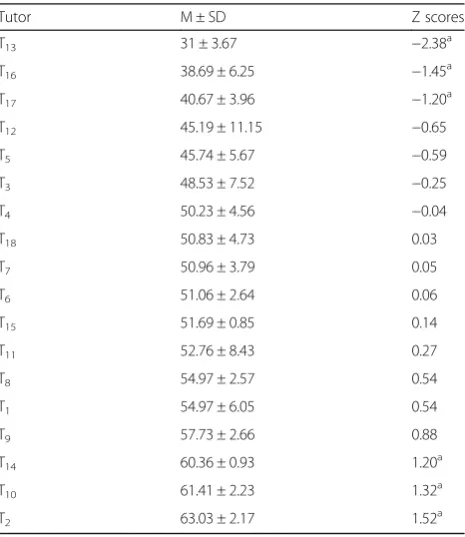
those tutors’ rating fall below the Z-score of −1.20 are
treated as stringent and above the Z-score of 1.20 are
considered to be lenient as presented in Table1.
To find out the significant differences between most lenient versus most stringent raters and highest versus lowest rated groups, independent sample t-test was used. After identifying highest and lowest rated groups; one-way ANOVA followed by post-hoc Bonferroni test was performed to find out the significant effect of tutors in the selected highest and lowest rated groups. Intra class correlation was calculated to determine inter-rater agreements and Pearson product moment correlation was used to find out association between PBL experi-ences and mean rating of tutors.
Results
The PBL experience of tutors ranged from 5 to 25 years
(mean 12.8 years). The correlation between tutors’ PBL
experiences and their mean ratings was found to be moderately significant (r= 0.52;p< 0.05). The mean rat-ing of male (mean = 51.41 ± 9.44) versus female (mean = 48.83 ± 5.24) was also found to be statistically insignifi-cant ((t-ratio = 0.62;p> 0.05).
Table 1Tutor Mean Ratings Converted to Z-scores
Tutor M ± SD Z scores
T13 31 ± 3.67 −2.38a
T16 38.69 ± 6.25 −1.45a
T17 40.67 ± 3.96 −1.20a
T12 45.19 ± 11.15 −0.65
T5 45.74 ± 5.67 −0.59
T3 48.53 ± 7.52 −0.25
T4 50.23 ± 4.56 −0.04
T18 50.83 ± 4.73 0.03
T7 50.96 ± 3.79 0.05
T6 51.06 ± 2.64 0.06
T15 51.69 ± 0.85 0.14
T11 52.76 ± 8.43 0.27
T8 54.97 ± 2.57 0.54
T1 54.97 ± 6.05 0.54
T9 57.73 ± 2.66 0.88
T14 60.36 ± 0.93 1.20a
T10 61.41 ± 2.23 1.32a
T2 63.03 ± 2.17 1.52a
a
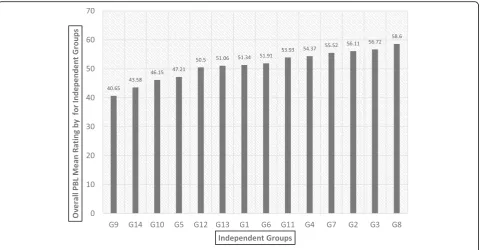
The overall mean ratings for each group (G1 through G14) and for each tutor (T1 through T18) was calculated
and presented in Fig. 1 and Fig.2 respectively. Figure1
shows the mean ratings of all 14 PBL tutorial groups. Further t-ratio reveals that there is a statistically signifi-cant difference between highest and lowest rated groups G8 vs. G9 (t-ratio = 12.64;p< 0.05).
Figure 2 shows the overall mean rating of individual
tutor. The t-ratio reveals there is a statistically significant difference between most lenient and most stringent raters i.e. T2 vs. T13 (t-ratio = 27.96,p< 0.05).
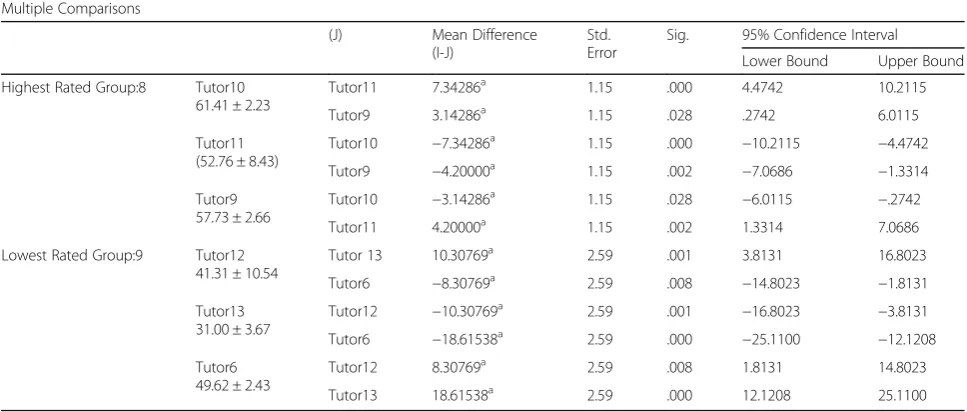
Outcome of the one-way ANOVA revealed significant (p< 0.01) effect of lenient and stringent tutors for the highest rated group i.e. Group 8 (F = 20.64, with df 2/39) and the lowest rated group i.e. Group 9 (F = 26.00, with df 2/36). In the Table1, further post-hoc Bonferroni analysis revealed the significant differences (p< 0.05) between the tutors in their rating for the highest and lowest rated
groups. It was also found that presence of T10 (second
most lenient tutors - Fig.2) and T13 (the most stringent
rating tutor - Fig.2) might have significantly affected the outcomes. Thus, it can be inferred that the most lenient
Fig. 1Overall mean ratings for independent groups (G1-G14) in increasing order
rating tutor is significantly contributing in enhancing scores of the highest rated group and vice versa.
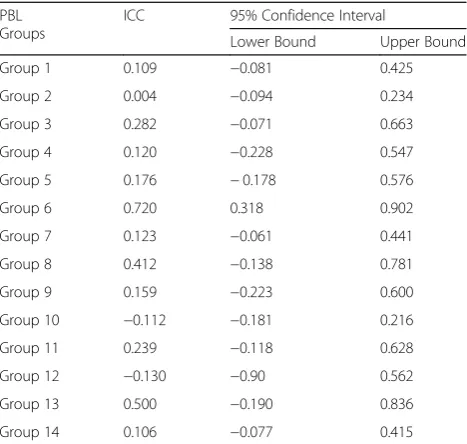
The intra class correlations (ICC) among rating of dif-ferent tutors for difdif-ferent groups showed a low agreement among various ratings except three groups (6, 8 and 13) (r= 0.40) (Table2).
Discussion
The key findings of the present study are as follows: (i) significant difference between highest and lowest rated groups (t-ratio = 12.64), (ii) significant differences between lenient and stringent tutor’ ratings (t-ratio = 27.96), (iii) Lenient tutors had a significant effect on increasing the group mean scores (F = 20.64), (iv) stringent tutors had a significant effect on decreasing the group mean scores (F = 26.00), (v) disagreement existed among tutor rat-ings of different groups (r= 0.40), and (vi) a significant
relationship existed between tutors’ PBL experiences
and their mean ratings (r= 0.52).
The mean average score rating by the tutors shows that there is a significant difference between the mean rating of highest rater/lenient rater (M = 63.03 ± 2.17) and lowest rater/stringent rater (M = 31.00 ± 3.67). Ana-lysis of lowest rated groups shows that the stringent rater has a significant role in lowering the mean rating of the lowest rated groups (‘dilution effect’) (Table 3). Further, the lenient rating tutors significantly contributed towards highest mean rating of the tutorial groups. As a
matter of leniency, those students who didn’t deserve
pass/higher marks got high marks; and because of strin-gency, those students who deserve higher score, got lower scores. Thus, this puts the good students in disadvantageous situations and vice versa. In analyzing the MRCP(UK) clinical examination (PACES) using multi-facet Rasch
modelling, McManus et al. [15] found examiner bias
and stringency-leniency-effect have substantial effects
on the students’ outcome in clinical examinations. We
also found moderately significant correlation between
tutors’ PBL experiences and their mean ratings.
Previ-ous studies showed that there may be differences in
assessment based on tutor experiences [31]. Other
fac-tors affecting the assessment of professional skills in PBL included lack of effective interaction, lack of thor-oughness, failure to confront students, lack of effort to
find solutions, lack of motivation [20]. Research was
also focused to explore self-, peer-, and tutor assess-ment of performance in PBL tutorials among medical students in problem-based learning curricula. It was found that tutor assessment correlated poorly with self-assessment ratings and peer scores correlated mod-erately with tutor ratings [11,32].
The present study focused on process assessment of PBL using a locally developed and validated instrument.
Process-oriented assessment in PBL focuses on students’
performance during prolonged interactions, which allows the tutors to make a more accurate estimate of a student’s competence when compared with formal examinations
[11]. A number of process-oriented instruments were
de-veloped by many academic institutes and used to assess the development of PBL skills. Though these instruments are essential to examine PBL skills, they possess psycho-metric shortcomings which limit their use in high-stake
examinations [33, 34]. The University of Maastricht has
avoided the use of tutor-based assessment [35], because
the dual roles of PBL tutors (i.e. tutor–rater and tutor– teacher) were viewed to be incompatible [35–37]. Litera-ture review showed that the leniency and stringency of PBL tutor ratings in medical schools were not studied
Table 2Post-hoc Bonferroni analysis for Highest and Lowest Rated Groups
Multiple Comparisons
(J) Mean Difference
(I-J)
Std. Error
Sig. 95% Confidence Interval
Lower Bound Upper Bound
Highest Rated Group:8 Tutor10 61.41 ± 2.23
Tutor11 7.34286a 1.15 .000 4.4742 10.2115
Tutor9 3.14286a 1.15 .028 .2742 6.0115
Tutor11 (52.76 ± 8.43)
Tutor10 −7.34286a 1.15 .000 −10.2115 −4.4742
Tutor9 −4.20000a 1.15 .002 −7.0686 −1.3314
Tutor9 57.73 ± 2.66
Tutor10 −3.14286a 1.15 .028 −6.0115 −.2742
Tutor11 4.20000a 1.15 .002 1.3314 7.0686
Lowest Rated Group:9 Tutor12 41.31 ± 10.54
Tutor 13 10.30769a 2.59 .001 3.8131 16.8023
Tutor6 −8.30769a 2.59 .008 −14.8023 −1.8131
Tutor13 31.00 ± 3.67
Tutor12 −10.30769a 2.59 .001 −16.8023 −3.8131
Tutor6 −18.61538a 2.59 .000 −25.1100 −12.1208
Tutor6 49.62 ± 2.43
Tutor12 8.30769a 2.59 .008 1.8131 14.8023
Tutor13 18.61538a 2.59 .000 12.1208 25.1100
a
widely. Hebert and Bravo [38] used a testing instrument at the Université de Sherbrooke Faculty of Medicine, Canada; their results showed a good correlation of scores with the tutor’s global evaluation (r= 0.64). The Newcastle University developed a Group Task exam for summative assessment of students, in which tutors observed a group of students; however, the authors did
not report any reliability and validity data [39]. In a
study conducted by Dodds et al. (2001), 74 tutors assessed 187 students twice (formative assessment in mid-semester, summative assessment at the end of semester) and tutor scores correlated moderately and significantly with other assessment modalities of each
course examined [4]. The authors concluded that
scores given by PBL tutors‘contribute useful, distinctive
dimensions to assessment’ in a PBL curriculum. Thus,
tutor rating is found to be a valid and reliable form of PBL process assessment. The present study also recorded a disagreement among tutor ratings of different groups (r= 0.40), and a significant relationship between tutors’ PBL experiences and their mean ratings (r= 0.52).
PBL tutors are important elements in the success of PBL tutorials. It is established that different dimensions of tutor performance influences student learning [40]. In PBL, the role of a tutor is to scaffold student learning which is different from that of teachers in a more
trad-itional medical programme [40–42]. The required tutor
activities and commitments in PBL sometimes poses
challenges and confusion regarding the tutor’s role in
handling learning and students’ ratings [40]. Faculty
development and student orientation programmes orga-nized by the medical schools may improve the consistency
of scoring and outcomes of the PBL curriculum [40–42].
In our context, robust faculty development may minimize the effect of individual differences of tutor rating.
This study had a small sample size and was performed at a single-center, therefore, caution needs to be taken to generalize the data to other settings. Further studies could be conducted utilizing tutor, peer and self-assessments to examine the reliability of interrater and inter-rater ratings in PBL.
Conclusion
Ensuring objectivity and maintaining reliability are neces-sary conditions in order to consider any form of assess-ment valid. Leniency and stringency factors in the raters affect objectivity and reliability to a great extent as demon-strated in the present study. Thus, more rigorous training in the areas of principles of assessment for the tutors are recommended. Moreover, putting those knowledge and principles to overcome the leniency and stringency sub-jective factors are essential. Further studies could be con-ducted triangulating tutor, peer and self-assessment of the PBL process that would also address the effects of any other existing confounding variables such as PBL con-tents, and difficulty and quality on potential scores. Neces-sary training is also required to raise the awareness of inevitability of differences of rating which needs to be con-sidered by the tutors while assessing the PBL process.
Abbreviations
ANOVA:Analysis of Variance; CMSE: Centre for Medical Sciences Education; ICC: Intra class correlations; MBBS: Bachelor of Medicine and Bachelor Surgery; MRCP: Membership of Royal Colleges of Physicians; PACES: Practical Assessment of Clinical Examination Skills; PBL : Problem based learning; SPSS: Statistical Package for the Social Sciences; UWI: The University of The West Indies
Acknowledgements
The authors would like to thank the Dean of The Faculty of Medical Sciences and staff of the Assessment Unit, Centre for Medical Sciences Education, The University of the West Indies, St Augustine Campus, Trinidad and Tobago. We would also like to express our special thanks to all the tutors who participated in this research.
We extend our thanks to Mrs. Stella Williams, Former Lecturer in Communication studies, Centre for Medical Sciences Education, Faculty of Medical Sciences, The University of the West Indies, St Augustine Campus, Trinidad and Tobago for her assistance in reviewing this manuscript for English language and grammar.
Funding
None
Availability of data and materials
The datasets of the current study available from the corresponding author on reasonable request.
Authors’contributions
BS designed the study, collected data, analyzed data, wrote manuscript, revised manuscript, submitted manuscript. CE designed the study, wrote manuscript, revised manuscript. KS wrote manuscript, revised manuscript. SV wrote manuscript, revised manuscript. MM analyzed data, wrote manuscript, revised manuscript. All authors approved publication of abstract and manuscript.
Table 3The intra class correlations (ICC) showing tutor ratings for different groups
PBL Groups
ICC 95% Confidence Interval
Lower Bound Upper Bound
Group 1 0.109 −0.081 0.425
Group 2 0.004 −0.094 0.234
Group 3 0.282 −0.071 0.663
Group 4 0.120 −0.228 0.547
Group 5 0.176 −0.178 0.576
Group 6 0.720 0.318 0.902
Group 7 0.123 −0.061 0.441
Group 8 0.412 −0.138 0.781
Group 9 0.159 −0.223 0.600
Group 10 −0.112 −0.181 0.216
Group 11 0.239 −0.118 0.628
Group 12 −0.130 −0.90 0.562
Group 13 0.500 −0.190 0.836
Ethics approval and consent to participate
Ethical approval for the study was not necessary as it was part of the monitoring of PBL assessment strategies mandated by the Office of the Deputy Dean, Basic Health Sciences, Faculty of Medical Sciences, University of West Indies (UWI), St Augustine Campus, Trinidad and Tobago. The aim of the research was explained to the PBL tutors and they gave their verbal consent to use the PBL ratings in this study.
Consent for publication
Not applicable
Competing interests
The authors declare that they have no competing interests.
Publisher’s Note
Springer Nature remains neutral with regard to jurisdictional claims in published maps and institutional affiliations.
Author details 1
Centre for Medical Sciences Education, The Faculty of Medical Sciences, The University of the West Indies, St Augustine Campus, St Augustine, Trinidad and Tobago.2Department of Para-clinical Sciences, Faculty of Medical Sciences, The University of the West Indies, St Augustine Campus, St Augustine, Trinidad and Tobago.3Faculty of Medical Sciences, The University of the West Indies, Cave Hill Campus, Bridgetown, Barbados.
Received: 8 October 2018 Accepted: 26 February 2019
References
1. Vernon DT, Blake RL. Does problem-based learning work? A meta-analysis of evaluative research. Acad Med. 1993;68:550–63.
2. Majumder MAA. Pros and cons of problem-based learning. Bangladesh Med J. 2004;33:67–9.
3. Zahid MA, Varghese R, Mohammed AM, Ayed AK. Comparison of the problem-based learning-driven with the traditional didactic-lecture-based curricula. Int J Med Educ. 2016;7:181–7.
4. Dodds AE, Orsmond RH, Elliott SL. Assessment in problem-based learning: the role of the tutor. Annal Acad Med Singapore. 2001;30:366–70. 5. Assessment in Problem-based Learning ASA. Biochem Mol Biol Educ. 2003;
31:428–34.
6. Cindy HE, Gerald SG, John DB. A theory-driven approach to assessing the cognitive effects of PBL. Instr Sci. 1997;25:387–408.
7. Addae JI, Sahu P, Sa B. The relationship between the monitored performance of tutors and students at PBL tutorials and the marked hypotheses generated by students in a hybrid curriculum. Med Educ Online. 2017;22(1):1270626.
8. Sa, B. Acceptability and feasibility of facilitator assessment model and tutorial rating scale used to assess PBL tutorial process. PBL Curriculum Committee, Faculty of Medical Sciences, UWI, St. Augustine, Trinidad and Tobago, 2009.
9. Azer SA. Problem-based learning: where are we now? Guide supplement 36.1 - viewpoint. Med Teach. 2011;33:121–2.
10. Chan LC. The role of a PBL tutor: a personal perspective. Kaohsiung J Med Sci. 2008;24:S34–8.
11. Papinczak T, Young L, Groves M, Haynes M. An analysis of peer, self, and tutor assessment in problem-based learning tutorials. Med Teach. 2007; 29(5):e122–32.
12. Eva KW. Assessing tutorial-based assessment. Adv Health Sci Edu. 2001;6: 243–57.
13. Eva KW, Cunnington JPW, Reiter HI, Keane DR, Norman GR. How can I know what I don’t know? Poor self-assessment in a well-defined domain. Adv Health Sci Edu. 2004;9:211–24.
14. Whitefield CF, Xie SX. Correlation of Problem-based Learning facilitators’ scores with student performance on written exams. Adv Health Sci Edu. 2002;7:41–51.
15. McManus IC, Thompson M, Mollon J. Assessment of examiner leniency and stringency ('hawk-dove effect') in the MRCP (UK) clinical
examination (PACES) using multi-facet Rasch modelling. BMC Med Educ. 2006;6:42.
16. Sebok SS, Roy M, Klinger DA, De Champlain AF. Examiners and content and site: oh my! A national organization’s investigation of score variation in large-scale performance assessments. Adv Health Sci Edu. 2015;20:81–94. 17. Daly M, Salmonson Y, Glew PJ, Everett B. Hawks and doves: the influence of
nurse assessor stringency and leniency on pass grades in clinical skills assessments. Collegian. 2017;24:449–54.
18. Moore I, Poikela S. Evaluating problem-based learning initiatives. In: Barrett T, Moore S, editors. New approaches to problem- based learning revitalising your practice in higher education. New York: Taylor & Francis; 2010. p. 100–11.
19. Ingchatcharoena S, Tangdhanakanonda K, Pasiphola S. Testing measurement invariance of quality rating causal models in tutorial-based Assessment. Procedia–Soc. Behav Sci. 2016;217:867–77.
20. Mook WN, Grave WS, Huijssen-Huisman E, Witt-Luth M, Dolmans DH, Muitjens AM, et al. Factors inhibiting assessment of students’ professional behavior in the tutorial group during problem-based learning. Med Educ. 2007;41:849–56.
21. Dolmans DH, Luijk SJ, Wolfhagen IH, Scherpbier AJ. The relationship between professional behavior grades and tutor performance rating in problem-based learning. Med Educ. 2006;40:180–6.
22. Gijbels D, Dochy F, Bossche P, Mien S. Effects of problem-based learning: a meta- analysis from the angle of assessment. Rev Educ Res. 2005;75:27–61.
23. Greenwald AG. Validity concerns and usefulness of student ratings of instruction. Am Psychol. 1997;52:1182–6.
24. Marsh HW, Roche LA. Making students' evaluations of teaching effectiveness effective. Am Psychol. 1997;52(11):1187–97.
25. Greenwald AG, Gillmore GM. Grading leniency is a removable contaminant of student ratings. Am Psychol. 1997;52(11):1209–17.
26. Weingarten MA, Polliack MR, Tabankin H, Kahan E. Variation among examiners in family medicine residency board oral examinations. Med Educ. 2000;34:13–7.
27. Dalrymple KR, Wong S, Rosenblum A, Wuenschell C, Paine M, Shuler CF. Core skills faculty development workshop 3: understanding PBL process assessment and feedback via scenario-based discussions, observation, and role-play. J Dent Educ. 2007;71(12):1561–73.
28. Vuma S, Sa B. Self-assessment: how do third year medical students rate their performance during problem-based learning? Int J Res Med Sci. 2017;5(7): 3044–52.
29. Schmidt HG. Problem-based learning: rationale and description. Med Educ. 1983;17:11–6.
30. De Lisle J. Assessment Rubrics & Performance Standards for Problem based Learning, PBL Rubrics: Quick Reference Guide. Assessment Unit, Centre for Medical Sciences Education, Faculty of Medical Sciences, the University of the West Indies, St Augustine, Trinidad & Tobago, 2000.
31. Menéndez-Varela JL, Gregori-Giralt E. The reliability and sources of error of using rubrics-based assessment for student projects. Ass Eva High Educ. 2018;43(3):488–99.
32. Reiter HI, Eva KW, Hatala RM, Norman GR. Self and peer assessment in tutorials: application of a relative-ranking model. Acad Med. 2002;77: 1134–9.
33. Gordon MJ. A review of the validity and accuracy of self-assessments in health professions training. Acad Med. 1991;66:762–9.
34. Kaufman DM, Hansell MM. Can non-expert PBL tutors predict their students’ achievement? An exploratory study. Acad Med. 1997;72:S16–8.
35. Nendaz MR, Tekian A. Assessment in problem-based learning medical schools: a literature review. Teach Learn Med. 1999;11:232–43. 36. Blake JM, Norman GR, Smith EKM. Report card from McMaster:
student evaluation at a problem-based medical school. Lancet. 1995;345:899–902.
37. van der Vleuten CPM, Verwijnen M. A system for student assessment. In: van der Vleuten CPM, Verwijnen M, editors. Problem- based learning: perspectives from the Maastricht approach. Amsterdam: thesis-Publisher; 1990.
38. Hebert R, Bravo G. Development and validation of an evaluation instrument for medical students in tutorials. Acad Med. 1996;71:488–94.
40. Rangachari PK, Crankshaw DJ. Beyond facilitation: the active tutor in a problem-based course. Biochem Educ. 1996;24:19–25.
41. De Grave WS, Dolmans DHJM, Van der Vleuten CPM. Tutor intervention profile: reliability and validity. Med Educ. 1998;32:262–8.