RESEARCH
HAlign-II: efficient ultra-large multiple
sequence alignment and phylogenetic tree
reconstruction with distributed and parallel
computing
Shixiang Wan
1and Quan Zou
1,2*Abstract
Background: Multiple sequence alignment (MSA) plays a key role in biological sequence analyses, especially in phy-logenetic tree construction. Extreme increase in next-generation sequencing results in shortage of efficient ultra-large biological sequence alignment approaches for coping with different sequence types.
Methods: Distributed and parallel computing represents a crucial technique for accelerating ultra-large (e.g. files more than 1 GB) sequence analyses. Based on HAlign and Spark distributed computing system, we implement a highly cost-efficient and time-efficient HAlign-II tool to address ultra-large multiple biological sequence alignment and phylogenetic tree construction.
Results: The experiments in the DNA and protein large scale data sets, which are more than 1GB files, showed that HAlign II could save time and space. It outperformed the current software tools. HAlign-II can efficiently carry out MSA and construct phylogenetic trees with ultra-large numbers of biological sequences. HAlign-II shows extremely high memory efficiency and scales well with increases in computing resource.
Conclusions: THAlign-II provides a user-friendly web server based on our distributed computing infrastructure. HAlign-II with open-source codes and datasets was established at http://lab.malab.cn/soft/halign.
Keywords: Multiple sequence alignment, Phylogenetic trees, Distributed computing, Spark
© The Author(s) 2017. This article is distributed under the terms of the Creative Commons Attribution 4.0 International License (http://creativecommons.org/licenses/by/4.0/), which permits unrestricted use, distribution, and reproduction in any medium, provided you give appropriate credit to the original author(s) and the source, provide a link to the Creative Commons license, and indicate if changes were made. The Creative Commons Public Domain Dedication waiver (http://creativecommons.org/ publicdomain/zero/1.0/) applies to the data made available in this article, unless otherwise stated.
Background
Multiple sequence alignment (MSA) is a necessary step for analyzing biological sequence structures and func-tions, phylogenetic inferences, and other basic fields in bioinformatics [1]. Given the rapid increment of biologi-cal sequences in next-generation sequencing [2], difficul-ties arise from insufficiency of available state-of-the-art methods for addressing ultra-large sources.
Increasingly more different parallelization strategies are implemented for reducing time and space complexity of MSA. These strategies can be mainly categorized into
three levels: multiple threads based on central processing unit (CPU) on a single machine, multiple threads based on graphics processing unit (GPU) on a single machine, and multiple threads based on CPUs or GPUs on cluster machines. CPU-based multiple threads, which are com-mon and effortless, suit small-scale sequence alignment. With emergence of bottlenecks in increasing clock fre-quency of multi-core CPUs, Moore’s law became mean-ingless [3]. Based on NVIDIA GPU, compute unified device architecture (CUDA) technique was designed for efficient parallelism [4, 5]. GPU functions in real-time rendering of screens, because hundreds of cores in GPUs can efficiently calculate pixels or coordinates in parallel. However, under limited video memory size and band-width, alignment of ultra-large sequences becomes dif-ficult or even impossible [6]. With high computational
Open Access
*Correspondence: [email protected]
2 Guangdong Province Key Laboratory of Popular High Performance Computers, Shenzhen University, Shenzhen, China
cost, most naive algorithms attempted to reduce time and space complexity to cope with ultra-large analysis tasks.
Recently, large-scale distributed computing was applied extensively to various biological analyses, such as ClustalW-MPI [7], Hadoop-BAM [8], HAlign [9], and HPTree [10]. For next-generation sequencing, CloudDOE [11], BioPig [12], and SeqPig [13] were implemented; these software benefited from using open-source dis-tributed frameworks. Different from traditional single machine systems, distributed computing systems perform load-balancing for fault-tolerant parallelized tasks and can be easily extended to cheaper devices for improvement of computing power. Additionally, distributed computing systems based on MapReduce framework present more abstract interfaces and more elastic computing resources than those based on message passing interface (MPI) [14]. Ultra-large biological sequence analysis can be efficiently addressed by assembling distributed and parallel comput-ing systems with numerous cheap devices [15–17].
Although HAlign software, which is based on Hadoop framework [18], exhibits better computing power and expansibility than other strategies running on a sin-gle machine. Apache Spark framework works up to 100 times faster than Hadoop, especially in iterative operators. Apache Spark can also accelerate real-world data analytics approximately 40 times faster than Hadoop and can even be employed to scan one TB data in five- to seven-second latency [19]. Based on Spark framework [20], Marek et al. developed SparkSeq [21], which can be used to analyze nucleotide sequences with considerable scalability. Zhao et al. developed SparkSW [3], which can carry out Smith– Waterman algorithm [22] in load-balancing way on a dis-tributed system to cope with increasing sizes of biological sequence databases. However, SparkSeq can only work with nucleotide sequences but not with protein sequences; thus, Smith–Waterman algorithm in SparkSW cannot achieve peer performance on nucleotide sequences. Additionally, both SparkSeq and SparkSW are fairly suitable for develop-ers, they do not support generation of phylogenetic trees.
We implemented HAlign-II based on HAlign work, HPTree work, and Apache Spark framework to address ultra-large multiple biological sequence alignment and construct large-scale phylogenetic trees. HAlign-II shows high memory efficiency with large-scale MSA and phy-logenetic trees construction, scales well with increasing computing resources, and provides a user-friendly web server deployed on our infrastructure.
The rest of this paper is organized as follows. In the following section, we first introduce the Apache Spark framework. Based on Spark framework, respectively, we describe Smith–Waterman algorithm for protein sequence alignment, trie trees algorithm for nucleotide sequence alignment, and neighbor-joining (NJ) method
[23] for phylogenetic trees construction. Thereafter, we present datasets and comparative experiments with state-of-the-art tools and evaluate memory efficiency and scal-ability of HAlign-II. Last, preceding experimental results are discussed, and conclusion of the study is provided.
Methods
Overview of Apache Spark
Apache Hadoop and Apache Spark are famous open-source frameworks in the field of distributed computing. Hadoop mainly contains Hadoop Distributed File System (HDFS) [18] for distributed storage and MapReduce pro-gramming model for big datasets [24]. HDFS stores data on inexpensive machines, providing dependable fault-tolerant mechanism and high-aggregate bandwidth across clusters. Spark aims to blueprint a programming model that extends applications of MapReduce model and achieves high com-putational efficiency-based memory cache.
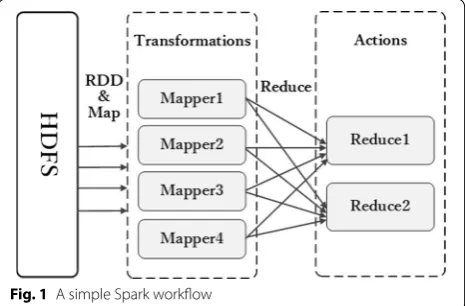
Spark designs an abstract data structure named resil-ient distributed datasets (RDDs) [19] to support efficient computing and to ensure distribution of datasets on clus-ter machines. RDDs support extensive variety of iclus-terative algorithms, a highly efficient SQL engine Shark, and a large-scale graph computing engine GraphX. RDDs stay-ing in memory cache will visibly reduce load time when requiring replication, especially in iterative operations. From Fig. 1, to further reduce time and cost, two types of operations in RDDs are designed: transforms and actions [19]. Transforms only deliver computing graphs, which only describe how to compute and not how to carry out computing operations, such as map and filter operation. Actions carry out computing, such as reduce and col-lect operations, results of which are stored as new RDDs. Based on these operations, RDDs are efficiently executed in parallel. To ensure dependable fault tolerance, RDDs will be recomputed after data loss, for example, because of halting of individual machines. Based on RDDs, Spark can implement up to 100 times theoretical speed than Hadoop in real-world datasets [19].
Smith–Waterman algorithm for protein sequences with Spark
With its high sensitivity, Smith–Waterman algorithm [23] can locally align object and subject sequences to obtain similarity segments based on dynamic program-ming; however, global alignment results cannot be obtained. In the past decades, this algorithm was cited over 8000 times in the biological field.
Smith–Waterman algorithm can search the best align-ment location through given scoring methods, such as substitution matrix and gap-scoring scheme. Negative scoring matrix cells of this algorithm are set to zero, which is necessary for achieving alignment location. Traceback procedure of alignment starts from highest scoring matrix cell and proceeds until a cell with score of zero is encountered, thereby yielding the highest local alignment scoring. Suppose that n and m correspond to respective lengths of A and B sequences, then substitu-tion matrix and gap-scoring scheme are respectively represented by s(a,b) and Wk. Then, Smith–Waterman algorithm creates scoring matrix H and initializes the first row and column; the process can be formulated as follows:
Then, the rest of matrix H should be filled with similar-ity scores, which are formulated as follows:
where Hi−1,j−1+s
ai,bj represents similarity scores
between ai and bj, Hi−k,j − Wk corresponds to matched
scores when ai points to the end of a k length gap,
Hi,j−l − Wl is the matched scores when bj points to the
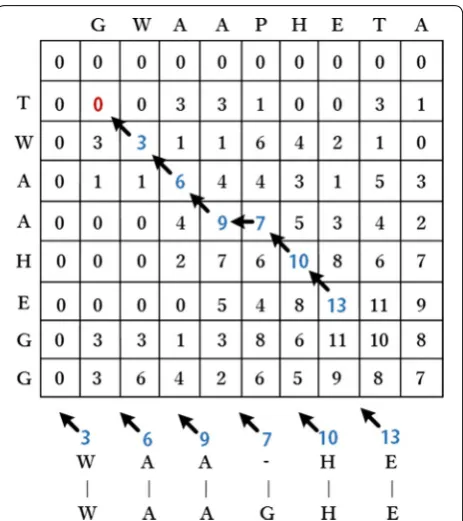
end of a l length gap, and 0 indicates absence of similarity. Figure 2 shows gradual traceback from the highest-score matrix cell to lowest-highest-score matrix cell, looping to dynamic programming based on zero-score matrix cell. The algorithm obtains inserted space positions and gen-erates pairwise alignment results.
As high time and space complexity of Smith–Water-man algorithm poses challenges concerning ultra-large datasets, this paper implements this algorithm on distrib-uted computing system based on Spark framework.
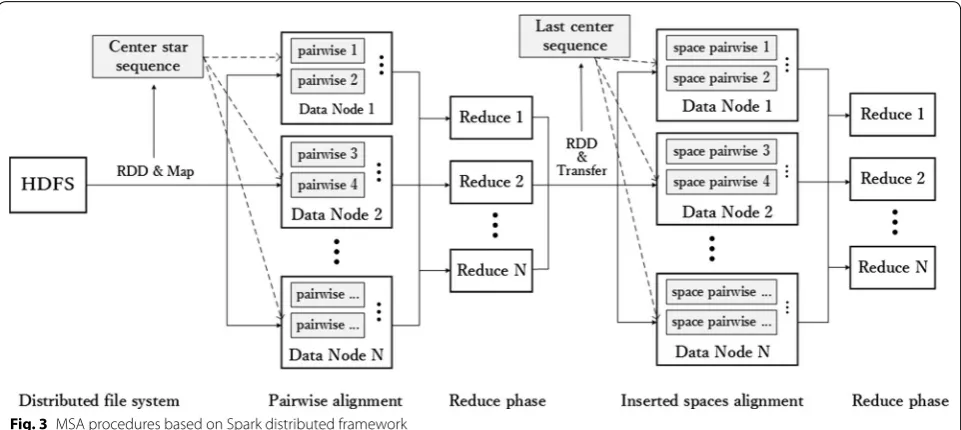
As shown in Fig. 3, the entire processing procedure is partitioned into two MapReduce steps. In the first step, the extracted center star sequence based on Smith– Waterman algorithm becomes a broadcast variable to align other sequences for filling inserted space matrix cells; this sequence records positions and numbers of
(1) Hk0=H0l =0,(0≤k ≤n, 0≤l≤m).
(2) Hij=max
Hi−1,j−1+s �
ai,bj �
,
maxk≥1 �
Hi−k,j−Wk �
,
maxl≥1 �
Hi,j−l−Wl �
, 0
�
1≤i≤n, 1≤j≤m� .
inserted space. Then, first reduction generates the last and longest center star sequence for further calcula-tions. Score matrix and center star sequence are cached in memory, spreading the center star sequence to each data node. Next, final pairwise alignment is initiated by inserted space matrix and each individual sequence. Finally, HDFS stores MSA results.
Trie trees method for similar nucleotide sequences with Spark
Smith–Waterman algorithm is accurate and mature and thus is suitable for protein sequence alignment of com-plex structures and elements. However, to obtain high similarity of most nucleotide sequences during alignment, running time of Smith–Waterman algorithm extremely increases, especially with ultra-large nucleotide sequences. Hence, this work considers tree-based data structures to address the problem in ultra-large nucleotide sequence alignment. A series of MSA methods about tree-based data structures are applied; such methods include BLAT [25] and Hobbes [26]. According to HAlign [9], trie tree serves as an efficient data structure for storing multiple sequences; this structure quickly indexes common sub-strings from long sub-strings and accelerates MSA search. A trie tree only features one root node and n leafs for n
nucleotide sequences [27]. Additionally, trie tree can speed up search in linear running time by failure links.
Two primary steps can be used to realize MSA based on trie tree: select a center star sequence for pairwise alignment and to integrate inserted spaces. Center star sequence contains the most segments among all sequences, thereby implying that it is the most similar to other sequences. As large-scale nucleotide sequences are similar, the first sequence represents the center sequence. Thereafter, other sequences are aligned to center sequence based on unmatched segments from the trie tree. In HAlign-II, this step is designed as numer-ous highly parallel operations across data construction of RDDs and is partitioned into memory on multiple workers. Pairwise alignment costs linear running time instead of exponential running time. Suppose that n simi-lar nucleotide sequences with average length of m exists. Then, time complexity of trie tree algorithm is O(n2m); trie tree algorithm requires less running time than the original center star method (time complexity is O(n2m2)). For n − 1 times pairwise sequence alignment, time com-plexity is O
nm2
. However, practical time consumed is far less than theoretical value because matched segments are skipped in high sequences. If n≪m, then practical
time consumed can be regarded as linear. In the last step, multiple alignment results are partitioned into new RDDs and delivered to multiple distributed workers for calcu-lation. Center star sequence and its alignment results spread to entire Spark cluster as shared similar constants, as presented in Fig. 3, to further reduce running time.
NJ method for constructing phylogenetic trees with Spark
Frequently, MSA is required before constructing phyloge-netic trees, such as MAFFT, MEGA, IQ-TREE, FastTree,
iGTP, SATe-II, phangorn and our NJ method. However, most MSA tools cannot address large or ultra-large num-bers of sequences. Based on MSA and Spark framework, this paper implement NJ method for constructing phylo-genetic trees.
Phylogenetic trees can be built using distance-based, maximum parsimony, and maximum likelihood approaches [10]. NJ approach [23] represents one of the distance-based approaches, and according to HPTree work, it is time-efficient and suitable for ultra-large sequences data.
As shown in Fig. 4, based on parallel computing, we first cluster all MSA results into several clusters. Then, we calculate individual phylogenetic tree based on indi-vidual clusters. Last, all phylogenetic trees are merged on clusters into the final evolution tree. We highlight the ini-tial clustering procedure. Approximately 10% (a changea-ble threshold value) of all MSA sequences are selected by random sampling for initial clustering. Then, functional distance of each pairwise MSA sequence is calculated, clustered, and labeled until all sequences are identified. When few clusters whose number of elements is over 10%, then they are merged into other clusters; otherwise, they are divided into more balanced clusters until bal-anced construction. The entire procedure is designed for Spark parallel model in Fig. 4.
Results and experiments Datasets and metrics
BAliBASE [28] is regarded as golden benchmark, with BAliBASE 4 as the newest version. The tests in the BAli-BASE 4 benchmark suite are divided into 10 different ref-erence sets. For each test, a number of files are provided, while all files derived from different families contain the sequences corresponding to the homologous regions only. And a family in a reference set is matched to a given reference alignment for evaluating. Each family need to be aligned simultaneously. In order to focus on the per-formance with increasing sequences scale, we employ the newest and largest R10 reference set ΦProtein as our
pro-tein sequence datasets (that is, 218 MSAs are indepen-dently constructed).
According to previous HAlign work [9], we use human mitochondrial genomes ΦDNA and 16s rRNA ΦRNA as
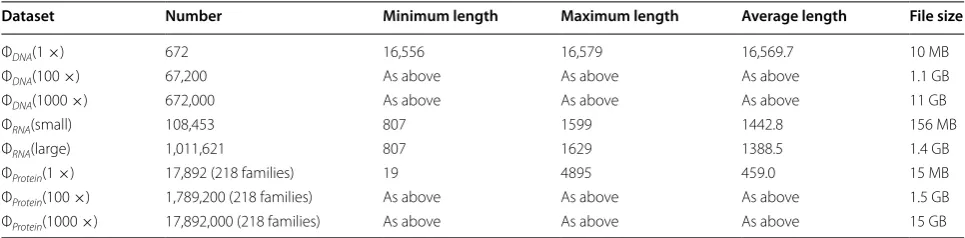
nucleotide sequences datasets [29]. After MSA, phyloge-netic trees are generated by MSA results on Spark plat-form. Table 1 shows more detailed information regarding biological datasets.
The original bali score program in BAliBASE used a different way of handling gaps in segments, which resulted in incorrect normalizations, so that even perfect multiple alignments could have a score less than one. To determine the similarity of the alignment obtained by a
program to the reference alignment in BAliBASE, col-umn score (CS) and sum-of-pair score (SPS) are calcu-lated as two alignment scores according to Karplus’s work [30]. The CS counts the number of columns of the seg-ments that are aligned correctly in all sequences, normal-ized by the number of alignment columns. It is noticeable however, that one badly misaligned sequence reduces CS from 1 to 0. Indeed we have observed that CS tends to be almost a binary value—with each alignment either being very good or scoring 0. The SPS counts how many pairs of residues are correctly aligned. Suppose that there is an alignment with N sequences of length of M, if in column
i, both sequence x and sequence y have residues aligned in a segment of the reference alignment, then pair value
Pixy equals 2; if one of both alignments has a gap, then
Pixy equals 1, otherwise Pixy equals 0. The total score is
normalized by the maximum possible score, so that the range of possible values is from 0 to 1, with 1 indicating a multiple alignment that is identical on the segments. The score Si with the ith column and SPS are
where Mr is the number of columns in the segments of
the reference alignment and Sri is the score Si for the ith
column in the reference alignment. For achieving better evaluation of ultra-large-scale alignments, we employ average SPS as the final metric of MSA experiments.
In essence, the higher the SPS or is, the more accu-rate is the alignments geneaccu-rated by the programs. In this paper, we calculated the alignment scores for evaluating protein and nucleotide alignments.
As HAlign-II contains three types of biological sequence alignment and phylogenetic tree construction based on Spark platform, our experimental environment consists of a cluster comprising 12 workstations. Each workstation features 384 GB physical memory with Intel
Si= N � j=1
�
k�=j
Pijk
SPS=
M �
i=1 Si
� Mr
�
i=1 Sri
.
Fig. 4 Constructing phylogenetic trees based on distance measure
Table 1 Original dataset and datasets after threshold removal
Dataset Number Minimum length Maximum length Average length File size
ΦDNA(1 ×) 672 16,556 16,579 16,569.7 10 MB
ΦDNA(100 ×) 67,200 As above As above As above 1.1 GB
ΦDNA(1000 ×) 672,000 As above As above As above 11 GB
ΦRNA(small) 108,453 807 1599 1442.8 156 MB
ΦRNA(large) 1,011,621 807 1629 1388.5 1.4 GB
ΦProtein(1 ×) 17,892 (218 families) 19 4895 459.0 15 MB
ΦProtein(100 ×) 1,789,200 (218 families) As above As above As above 1.5 GB
Xeon E5-2620 processors, and each processor contains eight processing cores. Based on Ubuntu 16.04 operating system and Spark 2.0.2, a series of experiments are pre-sented in succeeding sections.
Comparison with state‑of‑the‑art tools
We select a series of state-of-the-art tools to compare with HAlign-II and evaluate its performance on address-ing ultra-large datasets. Our comparison eliminates Kalign [31] is completely unsuitable for large-scale data-sets. Similarly, phangorn [32], RAxML [33], Pasta [34], and STELLS [35] are eliminated because of their nearly intolerable time consumption. In particularly, Clustal Omega [36], designed for handling data-sets of hundreds of thousands of sequences in reasonable time, has no edge than other state-of-the-art tools in our large-scale datasets. As should be mentioned, SparkSW method uses Spark version 1.0; however, the newest version used in our cluster is 2.0, which performs better in theory. Addi-tionally, we deploy the newest Hadoop framework on our cluster for running HAlign.
Experiment (a) Based on MUSCLE (version 3.8, fast
parameter “− maxiters 2” is used, the same below) [37], MAFFT (version 7.3, fast parameter “− parttree” is used, the same below) [38], Clustal-Omega (version 1.2.4, default mode is used, the same below) [36], HAlign, and HAlign-II tools, we implement ultra-large multiple similar genome sequence alignments with ΦDNA(1 ×),
ΦDNA(100 ×), and ΦDNA(1000 ×) datasets.
Experiment (b) Based on MUSCLE, MAFFT,
Clustal-Omega, HAlign, and HAlign-II tools, we implement ultra-large multiple dissimilarity RNA sequence align-ments with ΦRNA(small) and ΦRNA(large) datasets.
Experiment (c) Based on MUSCLE, MAFFT,
Clustal-Omega, SparkSW, and HAlign-II tools, we implement ultra-large multiple dissimilarity protein sequence alignments with ΦProtein(1 ×), ΦProtein(100 ×), and
ΦProtein(1000 ×) datasets. It is noticeable that MUSLE,
MAFFT, SparkSW and HAlign-II align each family in the reference set, respectively.
Experiment (d) Based on IQ-TREE (version 1.5.5,
mul-tithread mode) [39], HPTree, and HAlign-II tools, we construct ultra-large phylogenetic trees with ΦDNA(1 ×),
ΦDNA(100 ×), ΦDNA(1000 ×), ΦRNA(small), ΦRNA(large),
ΦProtein(1 ×), ΦProtein(100 ×), and ΦProtein(1000 ×)
data-sets. For our HAlign-II method, we initially align multi-ple sequences and then build phylogenetic trees.
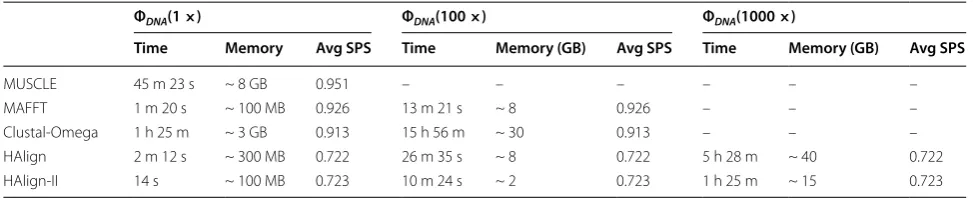
Tables 2, 3, and 4 respectively show all experiment results with genome MSA, RNA MSA, and protein MSA. Surprisingly, MUSCLE exhibits extreme time consump-tion. Based on our experiments, MUSCLE performs best with small datasets, but it cannot properly allocate memory resource, resulting in high memory occupancy rate. Hence, MUSCLE eventually reports an out-of-mem-ory message with ultra-large datasets. For large data-sets, Mafft and Clustal-Omega are faster than default Muscle and fast Muscle. And Mafft is always the fastest one than Muscle and Clustal-Omega. However, MUS-CLE, MAFFT and Clustal-Omega cannot deal with the present ultra-large datasets. Based on Hadoop frame-work, HAlign and HPTree perform better, but many key-value pair conversion operators also result in high memory occupancy rate. Considering the problems lead-ing to degraded performance, HAlign-II utilizes memory operation on hard disks, cutting down space complexity and memory occupancy rate. These improvements facili-tate running of sequence analysis on clusters compris-ing cheap large-scale and low-end machines. However, HAlign-II features an average SP score that is inferior to those of other methods. Our method ignores high preci-sion for changing large-scale computing power, which is necessary for several decision research.
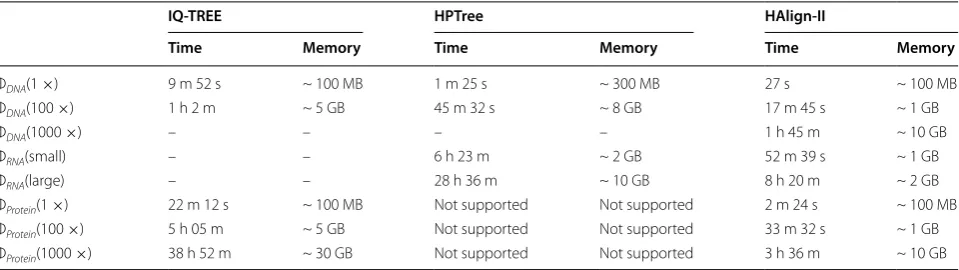
Table 5 presents running times of several outstand-ing tools on phylogenetic trees construction. IQ-TREE with multiple threads consumes more time than HPTree and HAlign-II, as distributed computing on a single node utilizes multiple threads and features time-effi-cient data construction. Phylogenetic tree performance is evaluated by maximum likelihood value under log functions. HPTree point reaches – 219,543,85, which is similar to that of NJ model in MEGA [40], implying
Table 2 Running time and average SPS with genome MSA
Memory is the maximum memory usage (the same as below)
ΦDNA(1 ×) ΦDNA(100 ×) ΦDNA(1000 ×)
Time Memory Avg SPS Time Memory (GB) Avg SPS Time Memory (GB) Avg SPS
MUSCLE 45 m 23 s ~ 8 GB 0.951 – – – – – –
MAFFT 1 m 20 s ~ 100 MB 0.926 13 m 21 s ~ 8 0.926 – – –
Clustal-Omega 1 h 25 m ~ 3 GB 0.913 15 h 56 m ~ 30 0.913 – – –
close performance of results of both methods. Similarly, out-of-memory error occurs when running the HPTree method. Currently, no outstanding method exists for constructing large-scale evolutionary trees, even on workstation clusters. Constructing phylogenetic trees based on MSA results can speed up construction speed.
Memory efficiency and scalability
Currently, most time-efficient methods, such as MUS-CLE with small datasets and Mafft/Clustal-Omega/ HAlign for large-scale datasets, present extremely large space complexities, resulting in impossibility to actually address ultra-large datasets. Based on all experimental results of Tables 2, 3, 4 and 5, we compare memory usage of HAlign-II with other state-of-the-art methods in Fig. 5.
Figure 5 shows average maximum memory usage of each machine on the cluster containing 12 machines for SparkSW/HAlign/HAlign-II and a standalone machine for MUSCLE/Mafft/Clustal-Omega. To conclude, Spark framework exhibits more efficient memory than Hadoop framework, as shown by inferiority of HAlign compared with other methods. Whether for nucleotide sequences or protein sequences, HAlign-II presents the lowest average maximum memory usage, thereby facilitating ultra-large MSA and phylogenetic tree construction on cheaper clusters.
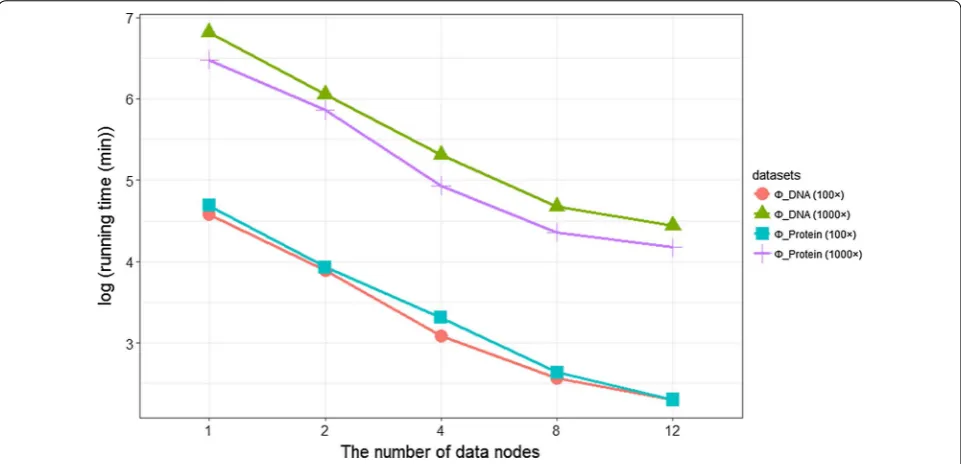
Additionally, Fig. 6 shows that with increase in worker nodes, running time and memory efficiency becomes sig-nificantly low, indicating linear growth of capacity and computing power with increase of such nodes.
Table 3 Running time and average SPS with RNA MSA
ΦRNA(small) ΦRNA(large)
Time Memory (GB) Avg SPS Time Memory (GB) Avg SPS
MUSCLE 1 h 25 m ~ 13 0.821 – – –
MAFFT 45 m 33 s ~ 10 0.815 – – –
Clustal-Omega 4 h 16 m ~ 10 0.835 – – –
HAlign 1 h 32 s ~ 2 0.631 3 h 15 m ~ 10 0.631
HAlign-II 23 m 34 s ~ 1 0.633 59 m 42 s ~ 2 0.633
Table 4 Running time and average SPS with protein MSA
ΦProtein(1 ×) ΦProtein(100 ×) ΦProtein(1000 ×)
Time Memory (MB) Avg SPS Time Memory (GB) Avg SPS Time Memory (GB) Avg SPS
MUSCLE 3 m 13 s ~ 300 0.892 ~ 34 h ~ 10 0.892 – – –
MAFFT 5 m 53 s ~ 100 0.878 37 m 51 s ~ 5 0.878 7 h 22 m ~ 30 0.878
Clustal-Omega 54 m 08 s ~ 100 0.912 28 h 15 m ~ 5 0.912 – – –
SparkSW 3 m 23 s ~ 100 0.716 1 h 12 m ~ 2 0.716 5 h 30 m ~ 18 0.716
HAlign-II 1 m 45 s ~ 100 0.695 26 m 36 s ~ 1 0.695 2 h 52 m ~ 10 0.695
Table 5 Running time during phylogenetic trees construction
IQ‑TREE HPTree HAlign‑II
Time Memory Time Memory Time Memory
ΦDNA(1 ×) 9 m 52 s ~ 100 MB 1 m 25 s ~ 300 MB 27 s ~ 100 MB
ΦDNA(100 ×) 1 h 2 m ~ 5 GB 45 m 32 s ~ 8 GB 17 m 45 s ~ 1 GB
ΦDNA(1000 ×) – – – – 1 h 45 m ~ 10 GB
ΦRNA(small) – – 6 h 23 m ~ 2 GB 52 m 39 s ~ 1 GB
ΦRNA(large) – – 28 h 36 m ~ 10 GB 8 h 20 m ~ 2 GB
ΦProtein(1 ×) 22 m 12 s ~ 100 MB Not supported Not supported 2 m 24 s ~ 100 MB
ΦProtein(100 ×) 5 h 05 m ~ 5 GB Not supported Not supported 33 m 32 s ~ 1 GB
Discussion
Multiple biological sequence alignment and phylogenetic tree construction present complicated inter-relationships, and both are necessary for sequence analysis. In the last several decades, many state-of-the-art methods and algo-rithms were created for more time- and space-efficient
MSA and phylogenetic trees construction issues. With increasing next-generation sequence database, addressing ultra-large datasets became an unprecedented challenge. Other outstanding methods were developed to improve time efficiency even with precision loss; such meth-ods include ClustalW-MPI, Hadoop-BAM, HAlign, and Fig. 5 Average maximum memory usage of various experiments
HPTree. Thus, with the urgent need for additional time-efficient and computing power for ultra-large datasets, we conduct a series of experiments to assess the performance of our HAlign-II method.
Based on Spark distributed and parallel computing model, Smith–Waterman algorithm, trie trees, and NJ methods are employed to completely utilize hardware resources and computing power. For ultra-large genome and RNA MSA experiments, MUSCLE, MAFFT and Clustal-Omega achieve high accuracies. However, both traditional tools show complete incompatibility with large datasets. Methods based on distributed comput-ing model present remarkable advantages, especially HAlign-II, which presents the highest memory efficiency. SparkSW and HAlign-II work well for ultra-large pro-tein MSA experiments. However, the former still needs to further cut down memory occupation. Difficulty also arises from insufficient phylogenetic tree construction for ultra-large protein sequences. For ultra-large phyloge-netic tree construction based on MSA results, most tools run out of memory, and even nearly 400 GB memory can-not address the requirement of 10 GB size datasets. All experimental results indicate that with regard to ultra-large nucleotide MSA or protein MSA and phylogenetic tree construction, HAlign-II performs best with regard to time efficiency, memory efficiency, and scalability.
Conclusions
This paper presents a distributed and parallel comput-ing tool named HAlign-II to address ultra-large multiple biological sequence alignment and phylogenetic tree con-struction. After comparing this tool with a series of state-of-the-art methods with ultra-large data, we conclude that HAlign-II features three advantages: (1) extremely high memory efficiency and good scaling with increases in computing resource; (2) efficient construction of phy-logenetic trees with ultra-large biological sequences; (3) provision of user-friendly web server based on high per-formance and distributed computing infrastructure; the server is established at http://lab.malab.cn/soft/halign. These improvements will be significant in coping with extreme increases in next-generation sequencing.
Authors’ contributions
SW and QZ conceived and designed the study. SW performed the experi-ments and wrote the paper. Prof. reviewed and edited the manuscript. Both authors read and approved the manuscript.
Author details
1 School of Computer Science and Technology, Tianjin University, Tianjin, China. 2 Guangdong Province Key Laboratory of Popular High Performance Computers, Shenzhen University, Shenzhen, China.
Competing interests
The authors declare that they have no competing interests.
Availability of data and materials Available.
Consent for publication Agree.
Ethics approval and consent to participate Not applicable.
Funding
The work was supported by the Natural Science Foundation of China (No. 61771331).
Publisher’s Note
Springer Nature remains neutral with regard to jurisdictional claims in pub-lished maps and institutional affiliations.
Received: 20 March 2017 Accepted: 22 September 2017
References
1. Edgar RC, Batzoglou S. Multiple sequence alignment. Curr Opin Struct Biol. 2006;16:368–73.
2. Segata N, Börnigen D, Morgan XC, Huttenhower C. PhyloPhlAn is a new method for improved phylogenetic and taxonomic placement of microbes. Nat Commun. 2013;4:2304.
3. Zhao G, Ling C, Sun D. Sparksw: scalable distributed computing system for large-scale biological sequence alignment. In: 2015 15th IEEE/ACM international symposium on, cluster, cloud and grid computing (CCGrid). 2015. p. 845–52.
4. Tölke J. Implementation of a Lattice Boltzmann kernel using the compute unified device architecture developed by nVIDIA. Comput Vis Sci. 2010;13:29.
5. Xi C, Chen W, Tang S, Yu C, Quan Z. CMSA: a heterogeneous CPU/GPU computing system for multiple similar RNA/DNA sequence alignment. BMC Bioinform. 2017;18:315.
6. Harish P, Narayanan P. Accelerating large graph algorithms on the GPU using CUDA. In: International conference on high-performance comput-ing. 2007. p. 197–208.
7. Li K-B. ClustalW-MPI: clustalW analysis using distributed and parallel computing. Bioinformatics. 2003;19:1585–6.
8. Niemenmaa M, Kallio A, Schumacher A, Klemelä P, Korpelainen E, Hel-janko K. Hadoop-BAM: directly manipulating next generation sequencing data in the cloud. Bioinformatics. 2012;28:876–7.
9. Zou Q, Hu Q, Guo M, Wang G. HAlign: fast multiple similar DNA/RNA sequence alignment based on the centre star strategy. Bioinformatics. 2015;31:2475–81.
10. Zou Q, Zeng X. HPTree: reconstructing phylogenetic trees for ultra-large unaligned DNA sequences via NJ model and Hadoop. In: 2016 IEEE inter-national conference on bioinformatics and biomedicine (IEEE BIBM 2016). 2016. p. 53–8.
11. Chung W-C, Chen C-C, Ho J-M, Lin C-Y, Hsu W-L, Wang Y-C, et al. Cloud-DOE: a user-friendly tool for deploying Hadoop clouds and analyz-ing high-throughput sequencanalyz-ing data with MapReduce. PLoS ONE. 2014;9:e98146.
12. Nordberg H, Bhatia K, Wang K, Wang Z. BioPig: a Hadoop-based analytic toolkit for large-scale sequence data. Bioinformatics. 2013;29:3014–9. 13. Schumacher A, Pireddu L, Niemenmaa M, Kallio A, Korpelainen E, Zanetti
G, et al. SeqPig: simple and scalable scripting for large sequencing data sets in Hadoop. Bioinformatics. 2014;30:119–20.
14. Gropp W, Lusk E, Doss N, Skjellum A. A high-performance, portable implementation of the MPI message passing interface standard. Parallel Comput. 1996;22:789–828.
• We accept pre-submission inquiries
• Our selector tool helps you to find the most relevant journal
• We provide round the clock customer support
• Convenient online submission
• Thorough peer review
• Inclusion in PubMed and all major indexing services
• Maximum visibility for your research
Submit your manuscript at www.biomedcentral.com/submit
Submit your next manuscript to BioMed Central
and we will help you at every step:
16. Ebedes J, Datta A. Multiple sequence alignment in parallel on a worksta-tion cluster. Bioinformatics. 2004;20:1193–5.
17. Moritz P, Nishihara R, Stoica I, Jordan MI. Sparknet: training deep networks in spark. 2015. arXiv preprint arXiv:1511.06051.
18. Vavilapalli VK, Murthy AC, Douglas C, Agarwal S, Konar M, Evans R, et al. Apache hadoop yarn: Yet another resource negotiator. In: Proceedings of the 4th annual symposium on cloud computing. 2013. p. 5.
19. Zaharia M, Chowdhury M, Das T, Dave A, Ma J, McCauley M, et al. Resilient distributed datasets: A fault-tolerant abstraction for in-memory cluster computing. In: Proceedings of the 9th USENIX conference on networked systems design and implementation. 2012. p. 2.
20. Gupta S, Dutt N, Gupta R, Nicolau A. SPARK: A high-level synthesis frame-work for applying parallelizing compiler transformations. In: Proceedings 16th international conference on VLSI design, 2003. 2003. p. 461–6. 21. Wiewiórka MS, Messina A, Pacholewska A, Maffioletti S, Gawrysiak P,
Okoniewski MJ. SparkSeq: fast, scalable, cloud-ready tool for the interac-tive genomic data analysis with nucleotide precision. Bioinformatics. 2014;30:2652–3.
22. Smith TF, Waterman MS. Identification of common molecular subse-quences. J Mol Biol. 1981;147:195–7.
23. Saitou N, Nei M. The neighbor-joining method: a new method for recon-structing phylogenetic trees. Mol Biol Evol. 1987;4:406–25.
24. Shanahan JG, Dai L. Large scale distributed data science using apache spark. In: Proceedings of the 21th ACM SIGKDD international conference on knowledge discovery and data mining, 2015. p. 2323–4.
25. Kent WJ. BLAT—the BLAST-like alignment tool. Genome Res. 2002;12:656–64.
26. Ahmadi A, Behm A, Honnalli N, Li C, Weng L, Xie X. Hobbes: optimized gram-based methods for efficient read alignment. Nucleic Acids Res. 2012;40:e41.
27. Wang J, Cetindil I, Ji S, Li C, Xie X, Li G, et al. Interactive and fuzzy search: a dynamic way to explore MEDLINE. Bioinformatics. 2010;26:2321–7. 28. Thompson JD, Koehl P, Ripp R, Poch O. BAliBASE 3.0: latest developments
of the multiple sequence alignment benchmark. Proteins Struct Funct Bioinform. 2005;61:127–36.
29. Tanaka M, Cabrera VM, González AM, Larruga JM, Takeyasu T, Fuku N, et al. Mitochondrial genome variation in eastern Asia and the peopling of Japan. Genome Res. 2004;14:1832–50.
30. Karplus K, Hu B. Evaluation of protein multiple alignments by SAM-T99 using the BAliBASE multiple alignment test set. Bioinformatics. 2001;17:713–20.
31. Lassmann T, Sonnhammer EL. Kalign—an accurate and fast multiple sequence alignment algorithm. BMC Bioinform. 2005;6:298. 32. Schliep KP. Phangorn: phylogenetic analysis in R. Bioinformatics.
2011;27:592–3.
33. Stamatakis A. RAxML version 8: a tool for phylogenetic analysis and post-analysis of large phylogenies. Bioinformatics. 2014;30:1312–3.
34. Trovato A, Seno F, Tosatto SCE. The PASTA server for protein aggregation prediction. Protein Eng Des Sel. 2007;20:521–3.
35. Wu Y. Coalescent-based species tree inference from gene tree topologies under incomplete lineage sorting by maximum likelihood. Evolution. 2012;66:763–75.
36. Sievers F, Wilm A, Dineen D, Gibson TJ, Karplus K, Li W, et al. Fast, scalable generation of high-quality protein multiple sequence alignments using Clustal Omega. Mol Syst Biol. 2011;7:1429–32.
37. Edgar RC. MUSCLE: multiple sequence alignment with high accuracy and high throughput. Nucleic Acids Res. 2004;32:1792–7.
38. Katoh K, Misawa K, Kuma KI, Miyata T. MAFFT: a novel method for rapid multiple sequence alignment based on fast Fourier transform. Nucleic Acids Res. 2002;30:3059–66.
39. Nguyen L-T, Schmidt HA, von Haeseler A, Minh BQ. IQ-TREE: a fast and effective stochastic algorithm for estimating maximum-likelihood phy-logenies. Mol Biol Evol. 2015;32:268–74.