R E S E A R C H
Open Access
Incompatible quartets, triplets, and characters
Brad Shutters
*, Sudheer Vakati and David Fernández-Baca
Abstract
We study a long standing conjecture on the necessary and sufficient conditions for the compatibility of multi-state characters: There exists a functionf(r)such that, for any setCofr-state characters,Cis compatible if and only if every subset off(r)characters ofCis compatible. We show that for everyr≥2, there exists an incompatible setCof(r2) r-state characters such that every proper subset ofCis compatible. This improves the previous lower bound of f(r)≥rgiven by Meacham (1983), andf(4)≥5 given by Habib and To (2011). For the case whenr=3, Lam, Gusfield and Sridhar (2011) recently showed thatf(3)=3. We give an independent proof of this result and completely characterize the sets of pairwise compatible 3-state characters by a single forbidden intersection pattern.
Our lower bound onf(r)is proven via a result on quartet compatibility that may be of independent interest: For every n≥4, there exists an incompatible setQof(n2)quartets overnlabels such that every proper subset ofQis compatible. We show that such a set of quartets can have size at most 3 whenn=5, and at mostO(n3)for arbitrary n. We contrast our results on quartets with the case of rooted triplets: For everyn≥3, ifRis an incompatible set of more thann−1 triplets overnlabels, then some proper subset ofRis incompatible. We show this bound is tight by exhibiting, for everyn≥3, a set ofn−1 triplets overntaxa such thatRis incompatible, but every proper subset ofRis compatible.
Keywords: Phylogenetics, Quartet compatibility, Triplet compatibility, Character compatibility, Perfect phylogeny
Background
The multi-state character compatibility (or perfect phy-logeny) problem is a basic question in computational phylogenetics [1]. Given a set C of characters, we are asked whether there exists a phylogenetic tree that dis-plays every character inC; if so,Cis said to be compatible, and incompatible otherwise. The problem is known to be NP-complete [2,3], but certain special cases are known to be polynomially-solvable [4-10]. See [11] for more on the perfect phylogeny problem.
In this paper we study a long standing conjecture on the necessary and sufficient conditions for the compatibility of multi-state characters.
Conjecture 1.There exists a function f(r)such that, for any set C of r-state characters, C is compatible if and only if every subset of f(r)characters of C is compatible.
If Conjecture 1 is true, it would follow that we can deter-mine if any setC of r-state characters is compatible by
*Correspondence: [email protected]
Department of Computer Science, Iowa State University, Ames, IA 50011, USA
testing the compatibility of each subset off(r)characters ofC, and, in case of incompatibility, output a subset of at mostf(r)characters ofCthat is incompatible. This would allow us to reduce the character removal problem (i.e., finding a subset of characters to remove fromCso that the remaining characters are compatible) tof(r)-hitting set which is fixed-parameter tractable [12].
A classic result on binary character compatibility shows thatf(2) = 2; see [1,6,13-15]. In 1975, Fitch [16,17] gave an example of a setCof three 3-state characters such that Cis incompatible, but every pair of characters inCis com-patible; showing thatf(3) ≥ 3. In 1983, Meacham [15] generalized this example to r-state characters for every r≥3 demonstrating a lower bound off(r)≥rfor allr; see also [9]. For the case ofr= 3, Lam, Gusfield, and Sridhar [9] recently established thatf(3)=3.
While the previous results could lead one to conjecture that f(r) = r for allr, Habib and To [18] recently dis-proved this possibility by exhibiting a setCof five 4-state characters such thatCis incompatible, but every proper subset of the characters inCare compatible, showing that f(4) ≥ 5. They conjectured thatf(r) ≥ r+1 for every r≥4.
The main result of this paper is to prove the conjec-ture stated in [18] by giving a quadratic lower bound on f(r). Formally, we show that for everyr ≥ 2, there exists a setCofr-state characters such that all of the following conditions hold.
1. C is incompatible.
2. Every proper subset ofC is compatible. 3. |C| =r2·2r+1.
Therefore,f(r)≥r2·2r+1 for everyr≥2.
Our proof relies on a new result on quartet compatibility we believe is of independent interest. We show that for everyn≥4, there exists a setQof quartets over a set ofn labels such that all of the following conditions hold.
1. Q is incompatible.
2. Every proper subset ofQ is compatible. 3. |Q| =n−22·n−22+1.
This is an improvement over the previous lower bound on the maximum cardinality of such an incompatible set of quartets ofn−2 given in [3]. We show that such a set of quartets can have size at most 3 whenn=5, and at most O(n3) for arbitrary n. We note here that the construc-tion given in [18] showing thatf(4) ≥ 5 can be viewed as a special case of the construction given here when n=6.
We study the compatibility of three-state characters fur-ther. The work of [9] completely characterized the sets of pairwise compatible 3-state characters by the existence of one of four forbidden intersection patterns. An alternative characterization of this result was given in [10] and was partially derived using the results of [9]. In this paper, we give a proof thatf(3)=3 that is independent of the results in [9], and we completely characterize the sets of pair-wise compatible 3-state characters by a single forbidden intersection pattern.
We contrast our result on quartet compatibility with a result on the compatibility of rooted triplets: For every n≥3, ifRis an incompatible set of triplets overnlabels, and|R|>n−1, then some proper subset ofRis incompat-ible. We show this bound is tight by exhibiting, for every n ≥ 3, a set ofn−1 triplets overnlabels such thatRis incompatible, but every proper subset ofRis compatible.
Preliminaries
Given a graphG, we represent the vertices and edges of GbyV(G)andE(G)respectively. We use the abbreviated notationuvfor an edge{u,v} ∈ E(G). For anye ∈ E(G), G−erepresents the graph obtained fromGby deleting edge e. For an integeri, we use [i] to represent the set {1, 2,· · ·,i}.
Unrooted phylogenetic trees
An unrooted phylogenetic tree (or just tree) is a tree T whose leaves are in one to one correspondence with a label setL(T), and has no vertex of degree two. See Figure 1(a) for an example. For a collectionT of trees, thelabel setof T, denotedL(T), is the union of the label sets of the trees inT. A tree is binaryif every internal (non-leaf ) vertex has degree three. Aquartetis a binary tree with exactly four leaves. A quartet with label set{a,b,c,d}is denoted ab|cdif the path between the leaves labeledaandbdoes not intersect with the path between the leaves labeledc andd.
For a tree T, and a label setL ⊆ L(T), therestriction ofT toL, denoted byT|L, is the tree obtained from the minimal subtree ofTconnecting all the leaves with labels inLby suppressing vertices of degree two. See Figure 1(b) for an example. A treeT displaysanother treeT, ifTcan be obtained fromT|L(T)by contracting edges. A treeT displays a collection of treesT ifT displays every tree in T. If such a treeTexists, then we say thatT iscompatible; otherwise, we say thatT isincompatible. See Figure 1(a) for an example. Determining if a collection of unrooted trees is compatible is NP-complete [3].
Multi-state characters
There is also a notion of compatibility for sets of partitions of a label setL. AcharacterχonLis a partition ofL; the parts ofχare calledstates. Ifχhas at mostrparts, then χ is anr-state character. Given a treeT withL = L(T) and a statesofχ, we denote byTs(χ )the minimal subtree ofT connecting all leaves with labels having statesforχ. We say thatχisconvexonT, or equivalentlyT displaysχ, if the subtreesTi(χ )andTj(χ )are vertex disjoint for all statesiandjofχwherei = j. A collectionCof charac-ters iscompatibleif there exists a treeT on which every character in Cis convex. If no such tree exists, then we say thatCisincompatible. See Figure 1(a) for an example.
a
b
Theperfect phylogeny problem(orcharacter compatibility problem) is to determine whether a given set of characters is compatible.
For a collectionCof characters, theintersection graph of C which we will denote by G(C), is the undirected graphG = (V,E)which has a vertexci for each charac-terc ∈Cand each stateiofc, and an edgecidjprecisely when there is a taxon having stateifor character cand state jfor character d. Note that G(C) cannot have an edge between vertices associated with different states of the same character.
A graphGischordalif there are no induced chordless cycles of length four or greater inH. In [19], Buneman established a fundamental connection between the per-fect phylogeny problem and chordal graphs which we now describe. For a given setCof characters, suppose we color each of the vertices ofG(C)by assigning a unique color to each characterc∈C, and giving each vertex ofG(C) cor-responding to a state ofcwith the color assigned to the characterc. Aproper triangulation ofG(C) is a chordal supergraph of G(C) such that every edge has endpoints with different colors.
Theorem 1.A set C of characters is compatible if and only if G(C)has a proper triangulation.
Since there is no proper triangulation for a cycle inG(C) involving only vertices from two characters, we have the following corollary.
Corollary 1.Let C be a collection of two characters. Then C is compatible if and only if G(C)is acyclic.
Quartet rules
We now introducequartet (closure) ruleswhich were orig-inally used in the contexts of psychology [20] and linguis-tics [21]. The idea is that for a collectionQof quartets, any tree that displaysQmay also necessarily display another quartetq∈Q, and if so we writeQq.
Example 1.Let Q = {ab|ce,ae|cd}. Then the tree of Figure 1(b) displays Q, and furthermore, it is easy to see that it is the only tree that displays Q. Hence, Q ab|de, Qab|cd, and Qbe|cd.
We use the following quartet rules in this paper:
{ab|cd,ab|ce} ab|de (R1)
{ab|cd,ac|de} ab|ce (R2)
For the purposes of this paper, we define theclosureof an arbitrary collectionQof quartets, denotedQ∗, as the minimal set of quartets that containsQ, and has the prop-erty that if for someq1,q2∈Q∗,{q1,q2} q3using either
(R1) or (R2), then q3 ∈ Q∗. Clearly, any tree that dis-playsQmust also displayQ∗. We will use the following lemma which follows by repeated application of (R1) and is formally proven in [22].
Lemma 1.Let Q be an arbitrary set of quartets with {x,y,z1,. . .,zk} ⊆L(Q). If
k−1
i=1
{xy|zizi+1} ⊆Q∗ ,
then xy|z1zk∈Q∗.
We refer the reader to [1,23] for more on quartet rules.
Incompatible quartets
For every s,t ≥ 2, we fix a set of labels Ls,t =
{a1,a2,. . .,as,b1,b2,. . .,bt}and define the set
Qs,t= {a1b1|asbt} ∪ s−1
i=1
t−1
j=1
{aiai+1|bjbj+1}
of quartets with L(Qs,t) = Ls,t. We denote the quartet a1b1|asbtbyq0, and a quartet of the formaiai+1|bjbj+1by qi,j.
Observation 1.For all s,t≥2,|Qs,t| =(s−1)(t−1)+ 1.
Lemma 2.For all s,t≥2, Qs,tis incompatible.
Proof.For eachi∈[s−1],
t−1
j=1
{aiai+1|bjbj+1} ⊆Qs,t⊆Q∗s,t.
Then, by Lemma 1, it follows that for each i ∈[s−1], aiai+1|b1bt∈Q∗s,t. So,
s−1
i=1
{b1bt|aiai+1} ⊆Q∗s,t.
Then, again by Lemma 1, it follows thatb1bt|a1as ∈Q∗s,t. But then{a1b1|asbt,b1bt|a1as} ⊆Q∗s,t. It follows that any tree that displays Qs,t must display both a1b1|asbt and b1bt|a1as. However, no such tree exists. Hence, Qs,t is incompatible.
Lemma 3.For all s,t ≥ 2, every proper subset of Qs,tis compatible.
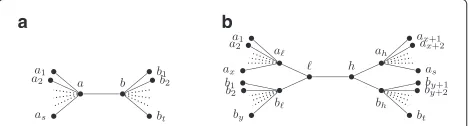
q=qx,yfor some 1≤x<sand 1≤y<t. In either case, we exhibit a tree witnessing thatQs,t\ {q}is compatible.
Case 1. Supposeq=q0. We build the treeT as follows: There is a nodefor each label∈Ls,tand
two additional nodesa and b along with the edge ab. There is an edgeaxafor everyax∈Ls,t, and an edge bxbfor everybx∈Ls,t. There are no other nodes or
edges inT. See Figure 2(a) for an illustration. Now consider any quartetq∈Qs,t\ {q0}. Then
q=aiai+1|bjbj+1for some1≤i<sand1≤j<t. Then, the minimal subgraph ofT connecting leaves with labels in{ai,ai+1,bj,bj+1}is the quartetq.
HenceT displays q.
Case 2. Supposeq=qx,yfor some1≤x<sand 1≤y<t. We build the treeT as follows: There is a nodefor each label∈Ls,tand six additional nodes a,b,,h,ah, andbh. There are edgesa,b,h, hah, andhbh. For everyai∈Ls,t, there is an edgeaia
ifi≤x, and an edgeaiahifi>x. For everybj∈Ls,t
there is an edgebjbifj≤x, and an edgebjbhifj>y.
There are no other nodes or edges inT. See Figure 2(b). Now consider any quartet
q∈Qs,t\ {qx,y}. Eitherq=q0orq=qi,jwherei=x
orj=y. Ifq=q0, then the minimal subgraph ofT connecting leaves with labels in{a1,b1,as,bt}is the
subtree ofT induced by the nodes in
{a1,a,,b,b1,as,ah,h,bh,bt}. Suppressing all
degree two vertices results in a tree that is the same asq0. SoT displays q. So assume that
q=aiai+1|bjbj+1wherei=xorj=y. We define the following subset of the nodes inT :
V= ⎧ ⎪ ⎪ ⎪ ⎪ ⎪ ⎪ ⎪ ⎪ ⎪ ⎪ ⎪ ⎪ ⎪ ⎪ ⎨ ⎪ ⎪ ⎪ ⎪ ⎪ ⎪ ⎪ ⎪ ⎪ ⎪ ⎪ ⎪ ⎪ ⎪ ⎩
{ai,ai+1,a,,b,bj,bj+1} ifi<xandj<y,
{ai,ai+1,a,,by,b,h,bh,by+1} ifi<xandj=y, {ai,ai+1,a,,h,bh,bj,bj+1} ifi<xandj>y,
{ax,a,,h,ah,ax+1,b,bj,bj+1} ifi=xandj<y,
{ax,a,,h,ah,ax+1,bh,bj,bj+1} ifi=xandj>y, {aj,aj+1,ah,h,,b,bj,bj+1} ifi>xandj<y,
{aj,aj+1,ah,h,by,b,,bh,by+1} ifi>xandj=y, {aj,aj+1,ah,h,bh,bj,bj+1} ifi>xandj>y.
Now, the subgraph ofT induced by the nodes in V is the minimal subgraph ofT connecting leaves with
a b
Figure 2Illustrating the proof of Lemma 3.(a) Case 1: a tree that displaysQs,t\ {q0}. (b) Case 2: a tree that displaysQs,t\ {qx,y}.
labels inq. Suppressing all degree two vertices gives q. Hence, T displays q.
Withs = n2 andt = n2, Observation 1and Lem-mas 2 and 3 imply the following theorem.
Theorem 2.For every integer n ≥ 4, there exists a set Q of quartets over n taxa such that all of the following conditions hold.
1. Q is incompatible.
2. Every proper subset of Q is compatible. 3. |Q| =n−22·n−22+1.
Incompatible quartets on five taxa
WhenQis a set of quartets over five taxa, we show that the set of quartets given by Theorem 2 is as large as possible. We hope that the technique used in the proof of the fol-lowing theorem might be useful in proving tight bounds forn>5.
Theorem 3. If Q is an incompatible set of quartets over five taxa such that every proper subset of Q is compatible, then|Q| ≤3.
Proof. Let Q be an incompatible set of quartets with L(Q) = {a,b,c,d,e}andq0 = ab|cd ∈ Q. We will show thatQcontains an incompatible subset of at most three quartets. IfQcontains two different quartets on the same four taxa, thenQ must contain an incompatible pair of quartets. So, we may assume that each quartet is on a unique subset of four of the five taxa. Hence, every pair of quartets inQshares three taxa in common. We have the following two cases.
Case 1 : Q contains at least one of the quartetsac|be, ac|de,ad|be,ad|ce,ae|bc,ae|bd,bc|de, orbd|ce. W.l.o.g. we may assume thatQ containsq1=ac|de, as all other cases are symmetric. By (R2),
{q0,q1} ab|ce. Then, by (R1),
{q0,q1,ab|ce} ab|de. Then, again by (R1), {q0,q1,ab|ce,ab|de} bc|de. Now let
Q= {q0,q1,ab|ce,ab|de,bc|de}. Now, any quartet in Q must be either inQor be pairwise incompatible with a quartet inQ. SinceQis compatible, but by assumption,Q is incompatible, Q must contain a quartetq2that is pairwise incompatible with some quartet inQ. Hence,{q0,q1,q2}is an incompatible subset ofQ.
Q is compatible, contradicting our assumption that Q is incompatible.
In either case, the theorem holds.
Incompatible quartets on arbitrarily many taxa
We say a setQof compatible quartets isredundantif for someq∈Q,Q\ {q} q; otherwise, we say thatQis irre-dundant. The following lemma establishes a connection between sets of irredundant quartets and minimal sets of incompatible quartets.
Lemma 4.If Q is incompatible, but every proper sub-set of Q is compatible, then every proper subsub-set of Q is irredundant.
Proof.Suppose thatQis incompatible and every proper subset of Q is compatible. Furthermore, suppose that some proper subset Q of Q is redundant. Since every compatible superset of a redundant set of quartets is also redundant, we may assume w.l.o.g., that there is a unique quartet q ∈ Q \ Q (i.e., |Q| = |Q| +1). SinceQ is redundant, there exists a q ∈ Q such that Q \ {q} q. But then (Q \ {q}) ∪ {q} is incom-patible, contradicting that every proper subset of Q is compatible.
It follows from Lemma 4 that any upper bound on the maximum cardinality of an irredundant set of quartets can be used to place an upper bound on the maximum cardi-nality of a set of quartets satisfying the first two conditions of Theorem 2. The theorem follows from [22].
Theorem 4.Let Q be a set of quartets over a set of n taxa. If Q is irredundant, then Q has cardinality at most (n−3)(n−2)2/3.
Lemma 4 together with Theorem 4 gives the follow-ing upper bound on the maximum cardinality of a setQ of quartets over n > 5 taxa that satisfies the first two conditions of Theorem 2.
Theorem 5.Let Q be a set of incompatible quartets
over a set of n taxa such that every proper subset of Q is compatible. Then|Q| ≤(n−3)(n−2)2/3+1.
Incompatible characters
There is a natural correspondence between quartet compatibility and character compatibility that we now describe. Let Q be a set of quartets, n = |L(Q)|, and r = n − 2. For each q = ab|cd ∈ Q, we define the r-state character corresponding to q, denoted χq, as the character where a and b have state 0 for χq; c and d have state 1 for χq; and, for each ∈ L(Q) \
{a,b,c,d}, there is a statesofχq such thatis the only label with state s for character χq (see Example 2). We define the set ofr-state characters corresponding toQby CQ=q∈Q{χq}.
Example 2.Consider the quartets and characters given in Figure 1(a): χq1 is the character corresponding to q1,
χq2 is the character corresponding to q2, andχq3 is the
character corresponding to q3.
The following lemma relating quartet compatibility to character compatibility is well known [24], and its proof is omitted here.
Lemma 5.A set Q of quartets is compatible if and only if CQis compatible.
The next theorem allows us to use our result on quartet compatibility to establish a lower bound onf(r).
Theorem 6. Let Q be a set of incompatible quartets over n labels such that every proper subset of Q is compatible, and let r = n−2. Then, there exists a set C of|Q|r-state characters such that C is incompatible, but every proper subset of C is compatible.
Proof.We claim thatCQis such a set of incompatibler -state characters. Since for two quartetsq1,q2∈ Q,χq1 =
χq2, it follows that|CQ| = |Q|. SinceQis incompatible,
it follows by Lemma 5 thatCQis incompatible. LetCbe any proper subset ofC. Then, there is a proper subsetQ ofQsuch thatC = CQ. Then, sinceQis compatible, it follows by Lemma 5 thatCis compatible.
Theorem 2 together with Theorem 6 gives the main theorem of this paper.
Theorem 7.For every integer r≥2, there exists a set C of r-state characters such that all of the following hold.
1. C is incompatible.
2. Every proper subset of C is compatible. 3. |C| =r2·2r+1.
Proof.By Theorem 2 and Observation 1, there exists a set Q of 2r· r2 +1 quartets over r+ 2 labels that that are incompatible, but every proper subset is com-patible, namely Qr+2
2
,r+22. The theorem follows from Theorem 6.
The quadratic lower bound on f(r) follows from Theorem 7.
Three-State Characters
In the remainder of this section we focus on the case when r = 3, and thus, fix C to be an arbitrary set of 3-state characters over a set S of taxa. Lam, Gusfield, and Sridhar [9] recently established thatf(3) = 3, and they completely characterized the sets of pairwise com-patible 3-state characters by the existence of one of four forbidden intersection patterns. We give an independent proof that f(3) = 3. We then completely character-ize the sets of pairwise compatible 3-state characters by a single forbidden intersection pattern. Our proof uses several structural results from the algorithm for the three-state perfect phylogeny problem given by Kannan and Warnow [7].
The Algorithm of Kannan and Warnow
The algorithm of [7] takes a divide and conquer approach to determining the compatibility of a set of three-state characters. An instance is reduced to subproblems by finding a partitionS1,S2of the taxon setSofCwith both of the following properties:
1. 2≤ |Si| ≤n−2,i=1, 2.
2. WheneverC is compatible S there is a perfect phylogenyP that contains an edge e whose removal breaksP into subtreesP1andP2with
L(Pi)=Si,i=1, 2.
A partition ofSsatisfying both of these properties is a legal partition, and the following theorem shows that find-ing such a partition for a given set of characters is the crux of the algorithm.
Theorem 8.[7] Given a set C of three state characters, we can in O(nk) time either find a legal partition of S of determine that the set of characters is incompatible.
Finding a legal partition
We now discuss the manner in which such a legal parti-tion is found for a set of three-state characters C. Let T be a tree witnessing thatCis compatible. Thecanonical labelingofTis the labeling where, for each internal node vofT, and each characterα∈C, if there are leavesxandy in different components ofT− {v}such thatα(x)=α(y), thenα(v) = α(x); otherwiseα(v) = ∗where∗denotes a dummystate forC. Note that such a labeling ofT always exists and is unique. We will assume that every compatible tree forCis canonically labeled.
Thetree-structure for a characterα inT is formed by repeatedly contracting edges ofT connecting nodes that have the same state (other than∗) forα. Note that this tree does not depend on the sequence of edge-contractions and is thus well defined. Furthermore, there is exactly one node for each state (other than the dummy state) of
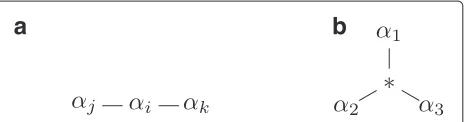
α, and each node labeled by∗has degree at least three. A tree-structure for α that is formed from some com-patible tree forC is called arealizable tree-structurefor α. There are four possible realizable tree-structures for a three-state characterαwhich are shown in Figure 3.
To find a realizable tree structure for a character α, the algorithm examines the pairwise intersection patterns of α with every other characterβ ∈ C, and applies the following rules to rule out possible tree structures forα.
Rule 1.Letαandβbe two characters of C. If, under some relabeling of the states ofαandβ, we have thatα1 ⊆ β1, α2∩β2= ∅, andα3∩β2= ∅, then P1is not a realizable tree-structure forα. If this is the case, we say thatαandβ match Rule 1 with respect toα1.
Rule 2.aLetα andβ be two characters of C. If, under some relabeling of the states ofαandβ, we have thatα1∩
β1= ∅,α2∩β1= ∅,α2∩β2= ∅, andα3∩β2= ∅, then P2is the only possible realizable tree-structure forα. If this is the case, we say thatαandβmatch Rule 2 with respect toα2.
The set QCα of candidate tree-structures for α are all of those possible tree-structures for α that are not ruled out after comparing the intersection pattern of α with every other character in C and applying Rules 1 and 2.
The following theorem which follows from [7] shows that a legal partition is found by choosing an arbitrary α∈Cfor whichQCα = ∅. Furthermore, if there is anα∈C for whichQCα = ∅, thenCis incompatible.
Theorem 9([7]).If QC
α = ∅, then we can find a legal partition of S.
Corollary 3.A set C of 3-state characters is compatible if and only if QCα = ∅for everyα∈C.
Tight bounds on three-state character compatibility
We use Corollary 3 to give upper bounds on the maximum cardinality of a minimal set of incompatible three-state characters.
a
b
Theorem 10.Let C be a set of three-state characters on species set S. Then C is incompatible if and only if there exists a characterα∈C, and two distinct statesαiandαj ofα, such that both of the following hold:
1. There is aβ∈Cwhere the intersection pattern ofα
andβmatches Rule 2 with respect toαi.
2. There is aγ ∈Cwhere the intersection pattern ofα
andγ matches Rule 2 with respect toαj.
Proof.(⇒) If C is pairwise incompatible, then by Corollary 1, there is a pair α,β ∈ C whose intersec-tion graph contains a cycle. Since the intersecintersec-tion graph is bipartite, this cycle must have length at least four and contain at least two states of each character. Letαi and αj be the two states of α on this cycle. Then, the intersection pattern of α and β matches Rule 2 with respect to both αi and αj, and so the theorem holds. So we may assume that C is incompatible but pairwise compatible.
It follows from Corollary 3 that there exists anα ∈ C such thatQCα = ∅. Then there must exist a characterβ ∈ Csuch that the intersection pattern ofα andβ matches Rule 2 with respect to some stateαiofα; otherwiseS∗∈ QCα. Hence,QCα ⊆ {Pi}. Then, sinceQCα = ∅, there must be a characterγ ∈Csuch that the intersection pattern of αandγ places a constraint onQCα that preventsQCα from containingPi. There are two possibilities.
Case 1: There is a state αj of α where j = i and the intersection pattern ofα andγ matches Rule 2 with respect toαj. In this case the theorem holds.
Case 2: The intersection pattern ofα andγ matches Rule 1 with respect toαi. W.l.o.g., we fixi=1, and relabel the states ofα,β, andγ so thatα1∩β1= ∅,α1∩β2= ∅,
α2∩β1 = ∅,α3∩β2 = ∅,α1 ⊆ γ1,α2∩γ2 = ∅, and
α3∩γ2 = ∅. Such a labeling exists since, by assumption,
αandβmatches Rule 2 with respect toα1, andα andγ matches Rule 1 with respect toα1.
Ifα2∩γ1 = ∅, then the intersection pattern ofα and γ matches Rule 2 with respect to α2, in which case the theorem holds. Ifα3∩γ1= ∅, then the intersection pattern ofα andγ matches Rule 2 with respect toα3, in which case the theorem holds. So we may assume hatα1 = γ1. Now, sinceα1∩β1= ∅,α1∩β2= ∅, andα1=γ1, we have that bothβ1∩γ1= ∅andβ2∩γ2= ∅.
γ3must have a nonempty intersection with at least one state ofα, and sinceα1=γ1, we have thatα1∩γ3= ∅. So
γ3has a nonempty intersection with eitherα2orα3. Due to the symmetry of the intersection graph ofαandβ, we may assume, w.l.o.g., thatα3∩γ3= ∅.
By assumption,α2∩γ1 = ∅, and ifα2∩γ3 = ∅, then the intersection graph ofαandβcontains a cycle, contra-dicting our assumption thatCis pairwise compatible. So
we may assume thatα2⊂γ2. Then, sinceβ1∩α2= ∅, we have thatβ1∩γ2= ∅.
Lets∈ α3∩β2. Since, by assumption,α3∩γ1 = ∅, we have that eithers∈γ2ors∈γ3. However, ifs∈γ2, then
β2∩γ2 = ∅and intersection graph ofβ andγ contains a cycle, contradicting our assumption thatCis pairwise compatible. Hences∈γ3andβ2∩γ3= ∅.
We have now established all of the edges of the inter-section graph of α, β, and γ represented by the solid edges in Figure 4. Now, lets5 ∈ α3∩γ2. Nows5 must be in some state of β. If s5 ∈ β1, then s5 ∈ β1 ∩α3 and the intersection graph ofβ andα contains a cycle, contradicting our assumption thatCis pairwise compat-ible. Ifs5 ∈ β2, thens5 ∈ β2∩γ2, and the intersection graph ofβandγ contains a cycle, again contradicting our assumption thatCis pairwise compatible. Hences5∈β3. Then, we have that s5 ∈ β3 ∩α3 and s5 ∈ β3 ∩ γ2, witnessing the dotted edges in Figure 4. So we have that the intersection pattern ofβ andα matches Rule 2 with β2 as witness, and the intersection pattern of β and γ matches Rule 2 withβ1 as witness. Hence the theorem holds.
Note that in the statement of Theorem 10, the charac-tersβ andγ are not necessarily distinct. In cases where they are not distinct,Ccontains an incompatible pair.
Corollary 4.A set C of 3-state characters is compatible if and only if every subset of at most three characters of C is compatible.
In [9], it was also shown that we can determine the compatibility of a pairwise compatible setCof three-state characters by testing the intersection patterns ofCfor the existence of one of a set of four forbidden patterns. As a corollary to Theorem 10, we have that a single forbidden pattern suffices to determine the compatibility ofC.
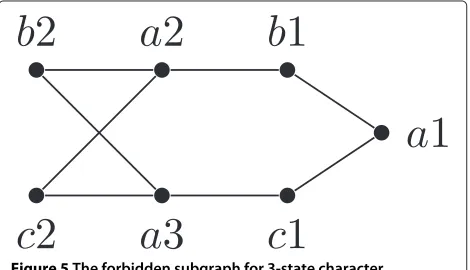
Corollary 5.A pairwise compatible set C of 3-state characters is compatible if and only if the partition inter-section graph of C does not contain, up to relabeling of characters and states, the subgraph of Figure 5.
Note that each edge of the graph of Figure 5 has one endpoint which is a state inα. It follows that we can find such a subgraph in the partition intersection graph ofCby testing the intersection pattern of each pair of characters inC[10]. Furthermore, allpoccurrences of the forbidden subgraph in the intersection graph ofmcharacters onn taxa can be found inO(m2n+p)time. Whereas the for-bidden subgraph given here is witnessed by eight taxa (or edges), each of the four forbidden subgraphs of [9] are wit-nessed by five taxa, making them better suited for taxon removal problems.
Incompatible Triplets
A rooted phylogenetic tree (or justrooted tree) is a tree whose leaves are in one to one correspondence with a label setL(T), has a distinguished vertex called theroot, and no vertex other than the root has degree two. See Figure 6(a) for an example. A rooted tree is binaryif the root ver-tex has degree two, and every other internal (non-leaf ) vertex has degree three. Atriplet is a rooted binary tree with exactly three leaves. A triplet with label set{a,b,c}is denotedab|cif the path between the leaves labeledaand bavoids the path between the leaf labeledcand the root vertex. For a treeT, and a label setL ⊆ L(T), letTbe the minimal subtree of T connecting all the leaves with labels inL. TherestrictionofTtoL, denoted byT|L, is the rooted tree obtained fromTby distinguishing the vertex closest to the root ofT as the root ofT, and suppress-ing every vertex other than the root havsuppress-ing degree two. A rooted treeT displaysanother rooted treeTifTcan be obtained fromT|L(T)by contracting edges. A rooted treeTdisplays a collection of rooted treesT ifT displays every tree inT. If such a treeT exists, then we say that T is compatible; otherwise, we say thatT is incompatible. Given a collection of rooted treesT, it can be determined in polynomial time ifT is compatible [3,25].
The following theorems follow from the connection between collections of unrooted trees with at least one
Figure 5The forbidden subgraph for 3-state character compatibility.
a
b
Figure 6Example of rooted phylogenetic trees.(a) shows a treeT that is a witness that the tripletsab|c,de|b,ef|c, andec|bare compatible; (b) shows the treeTrestricted to the label set{a,b,c,e}.
common label across all the trees, and collections of rooted trees [3].
Theorem 11. Let Q be a collection of quartets where every quartet in Q shares a common label. Let R be the set of triplets such that there exists a triplet ab|c in R if and only if there exists a quartet ab|cin Q. Then, Q is compatible if and only if R is compatible.
LetRbe a collection of triplets. For a subsetS ⊆ L(R), we define the graph [R,S] as the graph having a vertex for each label inS, and an edge{a,b} if and only ifab|c ∈ Rfor some c ∈ S. The following theorem is from page 439 of [26].
Theorem 12. A collection R of rooted triplets is compat-ible if and only if[R,S]is not connected for every S⊆L(R) with|S| ≥3.
Corollary 6.Let R be a set of rooted triplets such that R is incompatible but every proper subset of R is compatible. Then,[R,L(R)]is connected.
We now contrast our result on quartet compatibility with a result on triplets.
Theorem 13. For every n≥3, if R is an incompatible set of triplets over n labels, and|R|>n−1, then some proper subset of R is incompatible.
Consider any edgeein the cycleC. Lettbe the triplet that contributed edge e in [R,L(R)]. Let R = R \ t. Since the graph [R,L(R)]−e is connected, [R,L(R)] is connected. By Theorem 12, R is incompatible. But R ⊂ R, contradicting that every proper subset of R is compatible.
To show the bound is tight, we first prove a more restricted form of Theorem 2.
Theorem 14.For every n≥4, there exists a set of quar-tets Q with|L(Q)| =n, and a label∈L(Q), such that all of the following hold.
1. Everyq∈Qcontains a leaf labeled by. 2. Q is incompatible.
3. Every proper subset of Q is compatible. 4. |Q| =n−2.
Proof.Consider the set of quartets Q2,n−2. From Lemmas 2 and 3,Q2,n−2is incompatible but every proper subset ofQ2,n−2 is compatible. The setQ2,n−2 contains exactlyn−2 quartets. From the construction, there are two labels in L which are present in all the quartets in Q2,n−2. Set one of them to be.
The following is a consequence of Theorems 14 and 11.
Corollary 7.For every n ≥ 3, there exists a set R of triplets with|L(R)| =n such that all of the following hold.
1. R is incompatible.
2. Every proper subset of R is compatible. 3. |R| =n−1.
The generalization of the Fitch-Meacham examples given in [9] can also be expressed in terms of triplets. For anyr≥2, letL= {a,b1,b2,· · ·,br}. Let
Rr =abr|b1∪
r−1
i=1
abi|bi+1
LetQ= {ab|c:ab|c∈ Rr}for some label /∈L. The set CQofr-state characters corresponding to the quartet set Qis exactly the set of characters built forrin [9]. In the partition intersection graph ofCQ, (following the termi-nology in [9]) labelsandacorrespond to the end cliques and the rest of therlabels{b1,b2,· · ·,br}correspond to thertower cliques. From Lemma 5 and Theorem 11,Rris compatible if and only ofQis compatible.
Conclusion
We have shown that for everyr≥2,f(r)≥r2·2r+1, by showing that for everyn≥4, there exists an incompat-ible setQofn−22·n−22+1 quartets over a set ofnlabels
such that every proper subset ofQis compatible. Previous results [1,6,9,13-15], along with our discussion in Section Incompatible Characters, show that our lower bound on f(r)is tight forr = 2 andr = 3. For quartets, our dis-cussion in Section Incompatible quartets gives an upper bound on the maximum cardinality of a minimal set of incompatible quartets. However, this argument does not extend to multi-state characters. Indeed, an upper bound on the maximum cardinality of a minimal set of incom-patibler-state characters remains a central open question. We give the following conjecture.
Conjecture 2.f(r)∈(r2).
A less ambituous goal would be to narrow the gap between the upper bound ofO(n3)and lower bound of (n2)on the maximum cardinality of a minimal incom-patible set of quartets overntaxa given in Section Incom-patible Quartets. Note that, due to Theorem 6, a proof of Conjecture 2 would also show that the number of incom-patible quartets given in the statement of Theorem 2 is also as large as possible.
Endnote
aRule 2 was state incorrectly in [7].
Competing interests
The authors declare that they have no competing interests.
Authors’ contributions
BS was responsible for the lower bounds on character compatibility, the upper and lower bounds on quartet compatibility, the characterization of three-state character compatibility, and wrote all portions of the manuscript other than the section on triplet compatibility. SV was responsible for the upper and lower bounds on triplet compatibility, contributed to the lower bounds on quartet and character compatibility, and wrote the portion of the manuscript on triplet compatibility. DFB supervised the project. All authors read and approved the final manuscript.
Acknowledgements
We thank Sylvain Guillemot, Mike Steel, and Rob Gysel for valuable comments. This work was supported in part by the National Science Foundation under grants CCF-1017189 and DEB-0829674.
Received: 20 December 2012 Accepted: 6 February 2013 Published: 1 April 2013
References
1. Semple C, Steel M:Phylogenetics.Oxford Lecture Series in Mathematics and its Applications. USA: Oxford University Press; 2003.
2. Bodlaender H, Fellows M, Warnow T:Two strikes against perfect
phylogeny.InAutomata, Languages and Programming, Volume 623 of
Lecture Notes in Computer Science. Edited by Kuich W. Berlin/Heidelberg: Springer; 1992:273–283.
3. Steel M:The complexity of reconstructing trees from qualitative characters and subtrees.J Classif1992,9:91–116.
4. Agarwala R, Fernández-Baca D:A polynomial-time algorithm for the perfect phylogeny problem when the number of character states is fixed.SIAM J Comput1994,23(6):1216–1224.
5. Dress A, Steel M:Convex tree realizations of partitions.Appl Math Lett
6. Gusfield D:Efficient algorithms for inferring evolutionary trees.
Networks1991,21:19–28.
7. Kannan S, Warnow T:Inferring evolutionary history from DNA
sequences.SIAM J Comput1994,23(4):713–737.
8. Kannan S, Warnow T:A fast algorithm for the computation and
enumeration of perfect phylogenies.SIAM J Comput1997,
26(6):1749–1763.
9. Lam F, Gusfield D, Sridhar S:Generalizing the splits equivalence theorem and four Gamete condition: perfect phylogeny on three-state characters.SIAM J Discrete Math2011,25(3):1144–1175. 10. Shutters B, Fernández-Baca D:A simple characterization of the
minimal obstruction sets for three-state perfect phylogenies.Appl
Math Lett2012,25(9):1226–1229.
11. Fernández-Baca D:The Perfect Phylogeny Problem.InSteiner Trees in Industry. Dordrecht: Kluwer; 2001:203–234.
12. Niedermeier R, Rossmanith P:An efficient fixed-parameter algorithm for 3-Hitting Set.J Discrete Algorithms2003,1:89–102.
13. Buneman P:The recovery of trees from measurements of dissimilarity.InMathematics in the Archeological and Historical Sciences. Edinburgh: Edinburgh University Press; 1971:387–395.
14. Estabrook GF, Johnson J, McMorris FR:A mathematical foundation for the analysis of cladistic character compatibility.Math Biosci1976, 29(1-2):181–187.
15. Meacham CA:Theoretical and computational considerations of the
compatibility of qualitative taxonomic characters.InNumerical
Taxonomy, Volume G1 of Nato ASI series. Heidelberg: Springer; 1983:304–314.
16. Fitch WM:Toward finding the tree of maximum parsimony.In
Proceedings of the 8th International Conference on Numerical Taxonomy. San Francisco: Freeman; 1975:189–230.
17. Fitch WM:On the problem of discovering the most parsimonious tree.Am Nat1977,111(978):223–257.
18. Habib M, To TH:On a conjecture of compatibility of multi-states characters.InAlgorithms in Bioinformatics, Volume 6833 of Lecture Notes in Computer Science. Edited by Przytycka T, Sagot MF. Berlin/Heidelberg: Springer; 2011:116–127.
19. Buneman P:A characterization of rigid circuit graphs.Discrete Math
1974,9:205–212.
20. Colonius H, Schulze HH:Tree structures for proximity data.Br J Math Stat Psychol1981,34(2):167–180.
21. Dekker MCH: Reconstruction methods for derivation trees. Master’s thesis. Amsterdam: Vrije Universiteit; 1986.
22. Dietrich M, McCartin C, Semple C:Bounding the maximum size of a minimal definitive set of quartets.Inf Process Lett2012,
112(16):651–655.
23. Grünewald S, Huber KT:Identifying and defining trees.In
Reconstructing Evolution: New Mathematical and Computational Advances. Edited by Gascuel O, Steel M: Oxford University Press; 2007.
24. Steel M:Personal communications.2012.
25. Aho AV, Sagiv Y, Szymanski TG, Ullman JD:Inferring a tree from lowest common ancestors with an application to the optimization of relational expressions.SIAM J Comput1981,10(3):405–421.
26. Bryant D, Steel M:Extension operations on sets of leaf-labelled trees.
Adv Appl Math1995,16:425–453.
doi:10.1186/1748-7188-8-11
Cite this article as:Shutters et al.:Incompatible quartets, triplets, and characters.Algorithms for Molecular Biology20138:11.
Submit your next manuscript to BioMed Central and take full advantage of:
• Convenient online submission
• Thorough peer review
• No space constraints or color figure charges
• Immediate publication on acceptance
• Inclusion in PubMed, CAS, Scopus and Google Scholar
• Research which is freely available for redistribution