R E S E A R C H
Open Access
Efficient procedures for the numerical simulation
of mid-size RNA kinetics
Iddo Aviram, Ilia Veltman, Alexander Churkin and Danny Barash
*Abstract
Motivation:Methods for simulating the kinetic folding of RNAs by numerically solving the chemical master equation have been developed since the late 90's, notably the programs Kinfold and Treekin with Barriers that are available in the Vienna RNA package. Our goal is to formulate extensions to the algorithms used, starting from the Gillespie algorithm, that will allow numerical simulations of mid-size (~ 60–150 nt) RNA kinetics in some practical cases where numerous distributions of folding times are desired. These extensions can contribute to analyses and predictions of RNA folding in biologically significant problems.
Results:By describing in a particular way the reduction of numerical simulations of RNA folding kinetics into the Gillespie stochastic simulation algorithm for chemical reactions, it is possible to formulate extensions to the basic algorithm that will exploit memoization and parallelism for efficient computations. These can be used to advance forward from the small examples demonstrated to larger examples of biological interest.
Software:The implementation that is described and used for the Gillespie algorithm is freely available by
contacting the authors, noting that the efficient procedures suggested may also be applicable along with Vienna's Kinfold.
Background
The RNA molecule, once considered as an intermediate step between DNA and proteins, has drawn much atten-tion in recent years. Discoveries relating to its unique capabilities to prominently participate in gene regulation have motivated even more the concerted efforts to understand its folding and structural arrangement at several levels, both at the level of tertiary structure and that of secondary structure. The functional form of single stranded RNA molecules frequently requires a specific tertiary structure, but the scaffold for this struc-ture is provided by secondary structural elements which are hydrogen bonds within the molecule. The four build-ing blocks of RNAs are A,C,G,U and the base pairbuild-ings among them form the secondary structure. This leads to several recognizable "domains" of secondary structure like hairpin loops, bulges and internal loops. Although the functional role of the RNA molecule in more detail is related to its three-dimensional structure, the RNA secondary structure is experimentally accessible and in
many interesting cases may contain substantial import-ant information to shed light on the relationship be-tween structure and function. In general, RNA folding is thought to be hierarchical in nature [1,2], whereby a stable secondary structure forms first and subsequently there is a refinement to the tertiary fold. Thus, RNA conformational rearrangements that will be mentioned in the discussion can often be studied by examining their secondary structure, while keeping in mind the import-ance of tertiary structure.
When attempting to simulate the complete folding event, the time needed to reach equilibrium can become very long and it is computationally too expensive to con-sider the kinetics of the tertiary structure by using a mo-lecular dynamics approach. Therefore, beyond the static view of RNA folding using energy minimization methods to predict the final state of the folding, a time-dependent view is desired in order to extract information on the folding kinetics. To do so practically, it is imperative to simulate the complete folding event at the level of RNA secondary structure. For that, the chemical master equa-tion can be solved numerically by a stochastic simulaequa-tion algorithm, as was first shown in that context in [3,4].
* Correspondence:[email protected]
Department of Computer Science, Ben-Gurion University, 84105 Beer Sheva, Israel
Potentially, important information can be extracted from such a simulation that considers the suboptimal solu-tions, which were dealt with before in refs [5,6] in an in-formative manner. The motivation and importance from the biochemical perspective for this type of computa-tional simulations, also describing the experimental observables that can be extracted from the calculations, can be found in [7]. A recent comprehensive review of the field is available in [8]. Other computational simula-tion approaches for RNA kinetics besides Kinfold [4] that are beyond the regime of the mid-size RNA kinetics described herein include RNAkinetics [9], Kinefold [10], and Kinwalker [11] for large RNAs. To further motivate the time-dependent view, it was shown in [12] that RNA genes not only encode information about their func-tional structure, but also on their co-transcripfunc-tional fold-ing pathway (and, e.g. transient structures). More recently, kinetically trapped RNA secondary structures were thermodynamically analysed in [13] and an efficient method for computing folding pathways between RNA secondary structures was developed in [14] that follows the work of [15] on determining an optimal folding pathway and barrier energies introduced in [4,16]. For an overview on RNA folding kinetics and the import-ance of RNA folding intermediates, some recent review articles are available in [17-21].
Methods
The complete folding event is governed by the chemical master equation [8]. In order to introduce the concept behind the reduction of the time-dependent RNA fold-ing problem to that of stochastic chemical kinetics de-scribing the time evolution of a well-stirred chemically reacting system, the Appendix follows closely references [22,23] in summarizing the formulation leading to Gille-spie's Stochastic Simulation Algorithm (SSA).
Our goal is to model the problem of RNA secondary structure folding in such a way that it can be reduced to the algorithm with the pseudocode given in the Appen-dix. Therefore, we will describe a reduction into the Sto-chastic Simulation Algorithm (SSA). The rationale behind this way of formulating the problem is that after the reduction it becomes easier to devise an efficient ver-sion of the SSA for RNA folding kinetics, with multiple runs performed in parallel (see SSA version II and dis-cussion thereafter).
Using the Vienna's notations as can be found in [4,24],
the RNA sequence in time t will be represented as two
strings. Both are of the size of the RNA sequence. One is over the character set {A,U,G,C} also providing what the order of the nucleotides is. It will be called from here on the 'sequence string'. The other is a string of balanced parentheses over the character set {., (,)}, known as "dot-bracket" notation, describing the secondary structure of
the RNA sequence (dot means no base-pairing, and each open and close parentheses represent a base pairing). It will be named here the 'structure string'. We shall notice that while the former does not change over time, the lat-ter does.
In attempting to simulate over time the secondary-structure changes of a certain RNA sequence, let us de-note SRð Þt as the random variable that contains what is the structure string of the RNA structure at time t, when the sequence string is known to be R. In the settings of this simulation,SRð Þ0 is set to be the string} . . .;⋯;. . . }, which is the initial folding open state without any base pairings. Our goal is to predict what SRð Þt is for some parameter t. In particular, we would like to predict how much time it will take for an RNA sequence to fold into its 'optimal' state, defined as the structure whose Gibbs free energy is minimal. To formalize that, we will denote the optimal structure for the sequence R as Op(R). Thus,
our simulation goal is to find the smallest t for which
SRð Þ ¼t Op Rð Þ.
Having defined our goal, we will introduce some
more notations to explain the reduction. FR¼
s1R;s2R;. . .;s M Rð Þ
R
n o
will be the finite set (whose size is
denoted by M(R)) of the feasible structure strings for the sequence string R, feasible meaning taking into account biological constraints. Now, for some 1≤i≤M(R), a single step move ofsi
R is a structure string sjR2FR such that sjR and si
R differ only by omitting a pair of parentheses, add-ing a pair, or flippadd-ing a pair in the way that is well described in [4]. We will define the neighbourhood of si
R, denoted Ni
R¼ si1R;si2R;. . .;siRL
, as the subset ofFR which can be reached from si
Rwithin a single step, unless siR¼ OP Rð Þ, in which case we will define Ni
R to be an empty
set.
Gillespie's SSA deals with simulations of reactions of a system [22,23]. A possible reaction from molecule of
structure sa into molecule of structure sb is denoted
sa !sb. We will define a shortened notation for a set of possible reactions:
sa!sB¼ sb1;sb2;. . .;sbp
¼sa !sb1;sa !sb2;. . .;sa !sbp:
The reduction of the input is done by treating single-step moves of the RNA structure as 'possible reactions'. Using the given notations, we will obtain that the total
possible moves are: s1
R!NR1;s2R!NR2;. . .;sM R
ð Þ
R !
NRM Rð Þ. But, since the simulation is at a specific time at state siRfor some 1≤i≤M(R), we are only left with the feasible moves of si
using the program RNAeval available in the Vienna RNA package, along with a stochastic Monte Carlo feature. The equation we used in our implementation is the one based on the simulated annealing approach [25] and known as the Metropolis [26] step, which is:
aij ¼ expð1Δ;Gotherwise=RTÞ;if:ΔG≥0;
A¼ aij is the transition probability matrix, with
ΔG¼G0
j G0i when considering the rate of a transition to j, being ati. G0
iis the Gibbs free energy of ifor each
secondary structure i for the SSA algorithm version 1
below; for the SSA algorithm version 2 that follows, it is the sum of the free energies over an n-tuple of second-ary structures. We shall note that in our implementa-tion, we used Vienna's own program called RNAeval to get the Gibbs free energy values for the RNA structures. In addition, similar to Vienna's Kinfold, a Kawasaki step can be used instead of the Metropolis step in the equa-tion above. We can observe that we now have a proper input problem that fits Gillespie's SSA algorithm. Thus, we can use the following algorithm:
SSA for RNA folding, version I–simulating one
RNA-structure fold
1. The current structure issiRfor some 1≤i≤M(R). While stopping conditionsiRequals to Op(R) is not met:
2. CalculateNRi.
3. Evaluate for each member ofNRi its probability factor, and the total sum of the factors. We defineakRas the probability factor ofsiR!skRifskR2NRi and 0 otherwise. We will also denoteasumas the total sum of all the factors.
4. Draw two independent uniform (0,1) random numbers:ξ1andξ2.
5. Set j to be the smallest integer satisfying
Xj
k¼1
ak
R>ξ1asum:
6. Setτ¼ ln 1=ða ξ2Þ
sum :
7. Set the current structure to besjR, and the time to be (t +τ). Return to step 1.
At this point, a beneficial observation is that we can ac-tually expand the model to run this way many simulations simultaneously. If we have different RNA sequences with the sequence strings of R1;R2;R3;. . .;Rn as in all possible single point mutations, we will have the possible
moves of s1
R1!NR11;s2R1!NR21;. . .;sM R 1 ð Þ
R1 !NM R
1 ð Þ
R1 ;
s1
R2!NR12;s2R2!NR22;. . .;sM R 2 ð Þ
R2 !NM R
2 ð Þ
R2 ;. . .;s1Rn! NRn1 ;s2Rn!A2Rn;. . .;. Let sRi11;siR22;. . .;sinRn be the current
states of the n RNA sequences, then we are left with the feasible moves ofsi1
R1!NRi11;siR22!NRi22;. . .;sinRn!NRnin. Using these formulations, we suggest a somewhat opti-mized and generalized variation of the aforementioned algorithm. In the following version, the indices i and j will not anymore correspond directly to an explicit aij matrix instance of the Metropolis step's equation. In-stead, although we still are doing a Metropolis step, it will correspond to a much larger matrix which is defined only implicitly.
SSA for RNA folding, version II–simulating numerous
RNA-structure folds
1. The initial structure array isSarr ¼<
si1
R1;s
i2
R2;s
i3
R3;. . .;s
in Rn >. 2. CalculateNarr ¼<NRi11;N
i2
R2;N
i3
R3;. . .;N
in Rn>. 3. Evaluate for each member ofNRjij 2Narr its
probability factor, and the total sum of the factors. We denote byakiRi as the factor related to the k'th member ofNRjij, andasumthe total sum of all the
factors related toNi1
R1;N
i2
R2;N
i3
R3;. . .;N
in
Rn:Having all the factors ordered by some total order, we will obtain a seriesð Þak . Each member ofð Þak corresponds to a specific member ofNarr, and we
will denote this mapping to the correspondingNarr
indices byðmkÞ.
4. WhileSarr is not equal to<
Op Rð Þ1 ;Op Rð Þ2 ;Op Rð Þ3 ;. . .;Op Rð Þn >: 5. Draw two independent uniform (0,1) random
numbers:ξ1andξ2.
6. Set j to be the smallest integer satisfying
Xj
k¼1
ak>ξ1asum. We shall denote j* and k* as the
indices for whichaj¼ajk:
7. Setτ¼ ln 1=ða ξ2Þ
sum :
8. Set themj'th component ofSarr to besjR, the time to
be (t +τ).
9. Recalculate themj'th neighborhood (with its corresponding factors,aRi), and updateNarr as well
asð Þak andasum. Return to step 4.
Repetitions of the same experiment, i.e. setting R1¼
(up to 40 nt). We measured running times with a mem-oization that memorizes the neighborhoods of 10,000 different structures. The allocated RAM space was large enough not to require swapping. We obtained a signifi-cant speedup: 43 seconds with memoization vs. 684 sec-onds without memoization for a sequence of size 35, with 100 simultaneous simulations, and approximately 6 seconds with memoization against 60 seconds without memoization for a sequence of size 20, with 1000 simul-taneous simulations. When implementing memoization, keeping in memory all neighborhood sets possible is not feasible since their number grows too fast in respect to the size of the sequence. But because most of the transi-tions occur in the basins of the local minima, in terms of the energy values of the structures, keeping a fixed number of sets may suffice to decrease the computation time. We suggest the use of a cache-like LRU (least re-cently used) algorithm as mentioned above for deciding which information is likely to be re-usable among all neighboring sets and probabilities ever computed during a run. In addition, interesting ideas can be developed to make the memoization more efficient along the lines of calculating useful measures in order to assess the "fold-ing progress" of all molecules. Since fold"fold-ing times may well be distributed over several orders of magnitude, one may want to let those molecules that have "fallen be-hind" given some time to catch up, such that all mole-cules fold at approximately the same speed without large time deviations that are problematic because of having to wait for the slowest molecules to terminate. A simple and practical candidate for such a measure is the base pair distance between the starting and stopping struc-tures. In addition, we claim that the strategy outlined in the SSA for RNA folding, version II above is better tai-lored for biological problems in which it is not necessary to wait for all molecules to reach their target structure. For such type of problems, there are several advantages to our approach. First, when a particular molecule gets folded, it frees its memoization resources and also reduces the size of the probability space in the sense that it makes the transitions of the rest of the molecules more probable to be the next to occur.
Aside of memoization, an advantage of the approach of the SSA for RNA folding version II presented above over a repetition of single structure simulations is that we can stop the simulation after an elapsed simulation time τ, and extract the folding time of all the experi-ments that were already folded in time which is the most
τ. Moreover, taking this approach, no single long-lasting simulation can delay the intermediate results of the overall run. It is well on our interest that the molecules that are last to be folded will not constitute a bottleneck for the whole computation. In our settings, if we could use an anytime computation approach in which the
probability is revealed gradually, what we might give up by not waiting for the last molecules to terminate is just the extent of a long probability tail. If the whole compu-tation is stopped before all molecules have terminated their folding, it may again be useful to calculate their base pair distances to the stopping structures in order to predict the amount of error by not letting all molecules terminate their folding. For some problems the error might be small enough or the computation can be resumed some more until the approximation is satisfac-tory for the particular problem's needs. It should also be noted that if the sequence strings R1;R2;R3;. . .;Rn are different mutants of the same wildtype then the ideas discussed above can still be used to considerably reduce the computation time.
Results
Here below, we demonstrate our SSA implementation on two "toy problem" examples. Our program that we have been developing is similar in style to Vienna's Kin-fold [4], but has been built in principle to have the
abil-ity of exploiting memoization and efficiency
considerations as proposed above.
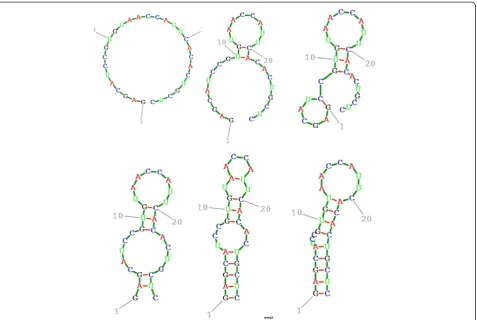
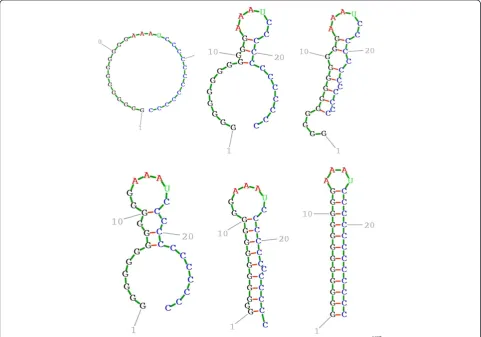
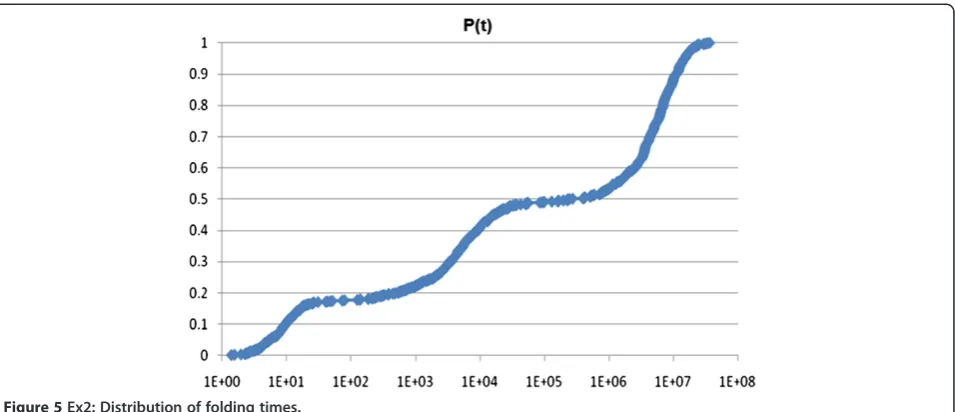
Before examining Figures 1, 2, 3, 4, 5, 6, the two re-spective sequences for Example 1 and Example 2 are given below. Next, for each of the two examples, the RNA secondary structures in 5 different stages are drawn, after the drawing of the open chain at the very left of Figures 1 and 4, respectively. The main analysis plots of the time-dependent simulations are the distribu-tion of folding times P tð Þin Figures 2 and 5, and the folding characteristic in Figures 3 and 6. The distribution of folding times is the fraction of folding trajectories that reached the mean free energy structure plotted on a logarithmic time scale, with the time units arbitrary. The plot was generated after collecting 1000 points. The folding characteristic is given by tP0ð Þt =P tð Þand dis-tinctive humps on this figure correspond to different folding paths. These figures, namely the distribution of folding times and the folding characteristic, are well described in Flamm et al. 2000 [4] and are given here for
consistency with the aforementioned paper that
The sequences used for illustration in Figures 1, 2, 3, 4, 5, 6 are:
Example 1: SSA version I, R =
` GAGCAUCCGUGUAACCAUUCACACUGCUC ' Example 2: SSA version I, R =
` GGGGGGGGGGGGAAAUCCCCCCCCCCCC '
Discussion
As a possible application of biological significance, the time-dependent approach discussed above is suggested for beneficial use in the problem of deleterious mutation pre-diction. To elaborate on this problem, a common way to detect deleterious mutations in the secondary structure of RNAs is to look for mutations that may cause a
Figure 2Ex1: Distribution of folding times.
conformational rearrangement to occur. It was noted in [27] that there is some probability that even a single muta-tion can substantially alter the RNA secondary structure. Experimentally, this was observed in the spliced leader of Leptomonas collosoma[28], in RNA viruses [29,30], and in some other biological systems. Another very recent find-ing of biological importance is the existence of disease-associated Single Nucleotide Polymorphisms (SNPs) called
"RiboSNitches" that have an RNA secondary structural consequence that results in a disease phenotype [31]. Computationally, even before the added motivation as a consequence of the latter disease related finding, this gave rise to a procedure for detecting deleterious mutations using RNA folding predictions numerous times [32]. Each time, relevant programs from an energy minimization package such as RNAfold from the Vienna RNA package
Figure 3Ex1: Time evolution of the folding characteristic.
[24,33] or Zuker's mfold [34,35] can be used. In these packages, expanded energy rules [36] that were derived from an independent set of experiments are incorporated into the folding prediction algorithm. While the folding prediction problem described above is the most funda-mental problem in RNA bioinformatics, the RNA muta-tion predicmuta-tion problem is a sub-problem that uses the former multiple times, for various mutation combinations. Historically, initial works for the mutation prediction problem can be traced back to [37,38] and have been sub-stantially revived in [32,39]. The first publicly available program for the RNA mutation prediction problem that takes into account only single-point mutation predictions was called RNAMute [40,41]. It uses the Vienna RNA package in its core. Subsequently, a web server dealing with similar issues was put forth called RDMAS [42]. There are also some computationally challenging issues in the mutation prediction problem [43], mainly in the generalization to multiple-point mutations that can
become computationally heavy if a 'brute-force' strategy of calculating all possible mutations is used without devising any unique approach. There have been various suggestions on how to reduce the number of mutations simulated or make the computations more efficient, for example [44-46]. In general, neither the original RNAMute [41] nor RDMAS [42] can handle multiple-point mutations. Consequently, RNAMute [41] was extended to Multi-RNAMute [44] and based on the approach of [45], the web servers RNAmutants [47] and later corRna [48] were developed. A web server for MultiRNAMute was worked out in [49]. There is, however, one common feature that should be taken into account when considering all of the programs dealing with RNA deleterious mutation predic-tions. Because several single point mutations inserted to the wildtype sequence can bring about to the same sec-ondary structure, oftentimes there is a degeneracy in the mutations that is needed to be addressed. Any mutation prediction method for the purpose of conformational
Figure 5Ex2: Distribution of folding times.
rearrangement in the secondary structure should therefore aim to report in each step (i.e., one-mutation, two-mutations, etc.) several mutation possibilities, not only a single one. If the method only reports a single possible mutation in each step, it probably means that a computa-tional efficiency consideration was taken that may neglect many good candidate mutations that are conformationally rearranging just as well and will lead to the same second-ary structure. Therefore, in order to fundamentally solve the degeneracy of mutations leading to the same struc-ture, we suggest to perform for each one a time-dependent calculation and check how smooth the folding occurs in time, to discriminate those mutation candidates that get stuck in a local optimum for a while during the folding in time. This is quite an intensive calculation for sequences that are beyond "toy problems", leading to a computational challenge from the numerical standpoint. It is also of considerable interest to check whether there is a correlation between the kinetic calculation and the
static information obtained by performing energy
minimization without taking into account what happens during the folding event. In order not to lose reliability, we suggest to consider all single point mutation combina-tions, and decide which one is the most likely to occur without getting trapped in a local minimum by using a time-dependent approach.
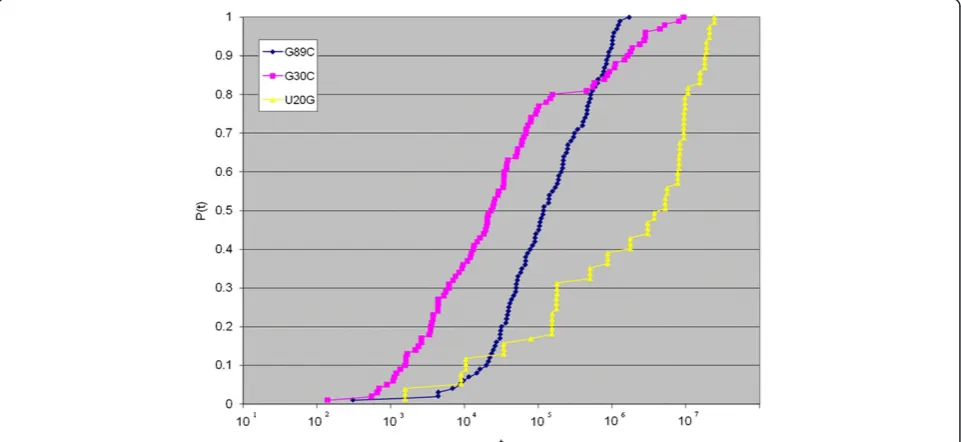
In Figure 7, the idea of using a time-dependent ap-proach for RNA deleterious mutation prediction is ex-emplified on a segment taken from an HCV IRES within the 5' UTR, for which experimental results are already known and the wildtype structure is well pre-dicted by energy minimization. It was found in an
experiment on this segment [29], which is notably located far away from the well-known pseudoknot of the IRES and its folding is well predicted by mfold and the Vienna RNA package when compared to the experi-mental result, that a single point mutation will cause a dramatic reduction in translation initiation. With RNAMute [41] it is possible to capture this mutation inside a list of about 60 other selected single point mutations that can potentially induce a conformational rearrange-ment, all resulting in a common or very similar sec-ondary structure when checked with mfold or Vienna's RNAfold. Consequently, the question that a potential ra-tional design experiment might want to address is which mutation will likely show the most pronounced affect, assuming that a reduction in translation initiation corre-lates with a smooth transition from the wildtype struc-ture to a conformationally rearranging one without getting trapped in local minima. Figure 7 displays the re-sult of Kinfold [4] for 3 mutations from the list of 60 candidate mutations, providing an indication of how smooth is the folding for each mutant. For mutations G89C and G30C, about 100 points were collected when generating the distribution of folding times P tð Þ, which all together took from several hours to more than a day, and for the mutation U20G only 20 points were
col-lected in the course of more than 2–3 days. From the
one hand, the feasibility of a time-dependent simulation for such a sequence that is biologically significant and in the range of mid-size RNA (60–150 nt long) is quali-tatively demonstrated in Figure 7 for a small sample of points. From the other hand, it is clearly evident that computational strategies to reduce the heavy
computation time, as proposed here with the SSA for RNA folding version II, can be of benefit.
Conclusions
The significance of the initial development of efficient pro-cedures described here can be divided into several items. First, the time-dependent folding is what takes place within the RNA molecule, and the static view of RNA structure only at the beginning and end may not be sufficient or complete in many cases. Experimental approaches to measure folding kinetics in detail, such as temperature jump experiments or single molecular methods [7], can be employed to check the computational model and predic-tions, in turn, can be pivotal to RNA rational design. Developing efficient numerical methods for the time-dependent folding simulation is therefore, by itself, an important goal. Here, we embarked on the stochastic ap-proach, noting that if at all possible to achieve with prac-tical computation time then one should definitely consider deterministic approaches [50] for the simulations of bio-logically relevant examples. Another direction for reducing computational cost is by an efficient exploration of discrete energy landscapes, which was developed in a recent work [51] by introducing a sampling method that allows for a fast yet accurate estimation of the transition probabilities between macrostates when coarse graining of the state space is used [4,16,50,52,53]. Second, a time-dependent ap-proach to contribute in deleterious mutation prediction is suggested, which is still an open problem of considerable biological interest in a variety of RNA systems. For ex-ample, point mutations performed on an RNA virus such as HCV can alter virus replication [30] or lead to a dra-matic reduction in translation initiation [29]. Development of efficient time-dependent simulations can well assist from the predictive standpoint in such efforts.
Appendix
The probability of a reactionRk to occur in an infinitesi-mal time interval [t, t + dt) will be denoted byakðX tð ÞÞdt, known as the propensity function. Applying the law of total probability, one can obtain:
Pðx;tþdtÞ ¼ 1X M
j¼1
ajð Þdtx
! Pðx;tÞ
þXM j¼1
aj xvj
dtPðxvj;tÞ
,P xð ;tþdtÞ P xð ;tÞ
dt ¼
XM
j¼1
ðaj xvj
Pðxvj;tÞ
ajPðx;tÞÞ
⇒dt!0dP xð ;tÞ
dt ¼
XM
j¼1
ðaj xvj
Pðxvj;tÞ ajPðx;tÞÞ
The last equation is known as the chemical master equation. It is a set of linear ordinary differential equations (ODEs), one ODE for each possible state of the system. Solution of each of the equations at time t is a real number giving the probability of the system being in that particular state at time t. X(t) is the state vector, X(0) is the initial condition, and the quantity P(x,t) is the probability that X (t) = x. The inputs to the equation are the chemical reac-tions and their propensity functionakðX tð ÞÞ. An illustrative example of how this equation is applied for studying the Michaelis-Menten model system is available in [23]. In order to solve the chemical master equation for practical cases, a stochastic simulation algorithm was devised, also known as the Gillespie algorithm [22], by simulating the changes in the system as they evolve in time. Because single steps are treated, the following quantities are introduced:
– p(τ,j|x,t) is the probability that reaction j happens in the time interval [t,t +τ] given that X(t) = x. – p(τ,0|x,t) is the probability that no reaction happens
in the time interval [t,t +τ] given that X(t) = x.
It is assumed that p(τ,0|x,t) and p(dτ,0|x,t +τ) are inde-pendent. It follows that: Pðτþdτ;0jx;tÞ ¼Pðτ;0jx;tÞ
Pðdτ;0jx;tþτÞ ¼Pðτ;0jx;tÞ 1X M
k¼1
akð Þdx τ
! ,
Pðτþdτ;0jx;tÞPðτ;0jx;tÞ
dτ ¼asumðxÞPðτ;0jx;tÞ;where
asum¼
XM
k¼1
akð Þx ⇒
dt!0
Pðτ;0jx;tÞ ¼easumð Þxτ
And, since:P τ;j xj ;tÞ ¼P τ;0jx;tÞajð Þx dτ
Then Pðτ;jjx;tÞ¼ajðxÞeasumð Þxτ ,Pðτ;jjx;tÞ¼ ajð Þx
asumð Þx
asumðxÞeasumð Þxτ
The last equation shows thatPðτ;j xj ;tÞcan be written as the product of two individual density functions:
– Next reaction indexajð Þx =asumð Þx corresponds to a
discrete random variable: pick one of the reactions with the rule that the chance of picking thejth reaction is proportional to the propensity functionajð Þx . – Time until next reactionasumð Þx easumð Þτx is the
density function for a continuous random variable with an exponential distribution. These exponential random variables arise universally in descriptions of the time elapsing between unpredictable events.
SSA for chemical reactions
1. Evaluatefakðx tð ÞÞgMk¼1andasum¼
XM
k¼1
akðx tð ÞÞ:
2. Draw two independent uniform (0,1) random numbers:ξ1andξ2.
3. Set j to be the smallest integer satisfying
XM
k¼1
akðx tð ÞÞ>ξ1asumðx tð ÞÞ:
4. Setτ¼aln 1=ð ξ2Þ
sumðx tð ÞÞ
5. Set x(t +τ) = x(t) +νjand update t to t +τ
6. If no stopping condition is met, return to step 1.
This is the basic algorithm for simulating chemical reactions that is described in more detail in [22,23], and has been used as well for simulating RNA folding kinetics [4].
Additional files
Additional file 1: Table S1.Ex1: Output illustration of the evolved RNA secondary structure. The list is in "dot-bracket" notation. Energies are in kcal/mol and time units are arbitrary. The five underlined secondary structures of Ex1 are drawn in Figure 1.
Additional file 2: Table S2.Ex2: Output illustration of the evolved RNA secondary structure. The list is in "dot-bracket" notation. Energies are in kcal/mol and time units are arbitrary. The five underlined secondary structures of Ex2 are drawn in Figure 4.
Competing interests
The authors declare that they have no competing interests.
Authors' contributions
IA and IV and AC worked on the software design, carried out development and implementation, and participated in drafting the manuscript. DB conceived the study, coordinated the software design and drafted the manuscript. All authors read and approved the final manuscript.
Acknowledgements
The research was partially supported by the Lynn and William Frankel Center for Computer Sciences at Ben-Gurion University.
Received: 26 October 2009 Accepted: 22 August 2012 Published: 7 September 2012
References
1. Brion P, Westhof E:Hierarchy and dynamics of RNA folding.Annu Rev Biophys Biomol Struct1997,26:113–137.
2. Tinoco I, Bustamante C:How RNA Folds.J Mol Biol1999,293(2):271–281. 3. Flamm C, Hofacker IL, Stadler PF:RNA In Silico: The Computational Biology
of RNA Secondary Structures.Adv Complex Syst1999,2:65–90. 4. Flamm C, Fontana W, Hofacker IL, Schuster P:RNA Folding at Elementary
Step Resolution.RNA2000,6(3):325–338.
5. Wuchty S, Fontana W, Hofacker IL, Schuster P:Complete suboptimal folding of RNA and the stability of secondary structures.Biopolymers
1999,49(2):145–165.
6. Zuker M:On finding all suboptimal foldings of an RNA molecule.Science
1989,244:48–52.
7. Vieregg JR, Tinoco I:Modeling RNA Folding Under Mechanical Tension.
Mol Phys2006,104(8):1343–1352.
8. Flamm C, Hofacker IL:Beyond Energy Minimization: Approaches to the Kinetic Folding of RNA.Monatsh Chem2008,139(4):447–457.
9. Danilova LV, Pervouchine DD, Favorov AV, Mironov AA:RNAKinetcs: A Web Server that Models Secondary Structure Kinetics of an Elongating RNA.
J Bioinform Comput Biol2006,4(2):589–596.
10. Xayaphoummine A, Bucher T, Isambert H:Kinefold Web Server for RNA/ DNA Folding Path and Structure Prediction Including Pseudoknots and Knots.Nucleic Acids Res2005,33:605–610.
11. Geis M, Flamm C, Wolfinger MT, Hofacker IL, Middendorf M, Mandl C, Stadler PF, Thurner C:Folding Kinetics of Large RNAs.J Mol Biol2008,
379(1):160–173.
12. Meyer IM, Miklós I:Co-transcriptional Folding is Encoded within RNA Genes.BMC Mol Biol2004,5:10.
13. Lorenz WA, Clote P:Computing the Partition Function for Kinetically Trapped RNA Secondary Structures.PLoS One2011,6(1):e16178. 14. Dotu I, Lorenz WA, Van Hentenryck P, Clote P:Computing Folding
Pathways Between RNA Secondary Structures.Nucleic Acids Res2010,
38(5):1711–1722.
15. Morgan S, Higgs P:Barrier Heights Between Ground States in a Model of RNA Secondary Structure.J Phys A Math Gen1998,31:3153–3170. 16. Flamm C, Hofacker IL, Stadler PF, Wolfinger MT:Barrier Trees of
Degenerate Landscapes.Z Phys Chem2002,216:155–173.
17. Al-Hashimi H, Walter NG:RNA Dynamics: It is about Time.Curr Opin Struct Biol2008,18:321–329.
18. Shcherbakova I, Mitra S, Laederach A, Brenowitz M:Energy Barriers, Pathways, and Dynamics During Folding of Large, Multidomain RNAs.
Curr Opin Chem Biol2008,12:655–666.
19. Chen SJ:RNA Folding: Conformational Statistics, Folding Kinetics, and Ion Electrostatics.Ann Rev Biophys2008,37:197–214.
20. Isambert H:The Jerky and Knotty Dynamics of RNA.Methods2009,
49:189–196.
21. Woodson SA:Compact Intermediates in RNA Folding.Ann Rev Biophys
2010,39:61–77.
22. Gillespie DT:Stochastic Simulation of Chemical Kinetics.Annu Rev Phys Chem2007,58:35–55.
23. Higham DJ:Modeling and Simulating Chemical Reactions.SIAM Rev2008,
50(2):347–368.
24. Hofacker IL, Fontana W, Stadler PF, Bonhoeffer LS, Tacker M, Schuster P:Fast Folding and Comparison of RNA Secondary Structures.Monatsh Chem
1994,125:167–188.
25. Kirkpatrick S, Gelatt CD, Vecchi MP:Optimization by simulated annealing.
Science1983,220:671–680.
26. Metropolis N, Rosenbluth AW, Rosenbluth MN, Teller AH, Teller E:Equations of State Calculations by Fast Computing Machines.J Chem Phys1953,
21(6):1087–1092.
27. Schuster P, Fontana W, Stadler PF, Hofacker IL:From Sequences to Shapes and Back: A Case Study in RNA Secondary Structures.Proc R Soc Lond B Biol1993,255(1344):279–284.
28. LeCuyer KA, Crothers DM:Kinetics of an RNA Molecular Switch.Proc Natl Acad Sci1994,91:3373–3377.
29. Tang S, Collier AJ, Elliott RM:Alterations to both the primary and predicted secondary structure of stem-loop IIIc of the Hepatitis C Virus 1b 5' untranslated region (5' UTR) lead to mutants severely defective in translation which cannot be complemented in trans by the wild-type 5' UTR sequence.J Virol1999,73:2359–2364.
30. You S, Stump DD, Branch AD, Rice CM:A cis-acting replication element in the sequence encoding the NS5B RNA-dependent RNA polymerase is required for Hepatitis C Virus RNA replication.J Virol2004,
78:1352–1366.
31. Halvorsen M, Martin JS, Broadaway S, Laederach A:Disease-Associated Mutations that Alter the RNA Structural Ensemble.PLoS Genet2010,
6(8):e1001074.
32. Barash D:Deleterious Mutation Prediction in the Secondary Structure of RNAs.Nucleic Acids Res2003,31(22):6578–6584.
33. Hofacker IL:Vienna RNA Secondary Structure Server.Nucleic Acids Res
2003,31:3429–3431.
34. Zuker M, Stiegler P:Optimal Computer Folding of Large RNA Sequences Using Thermodynamics and Auxiliary Information.Nucleic Acids Res1981,
9(1):133–148.
36. Mathews DH, Sabina J, Zuker M, Turner DH:Expanded sequence dependence of thermodynamic parameters improves prediction of RNA secondary structure.J Mol Biol1999,288:911–940.
37. Shapiro BA:An Algorithm for Comparing Multiple RNA Secondary Structures.Comput Appl Biosci1988,4:387–393.
38. Margalit H, Shapiro BA, Oppenheim AB, Maizel JV:Detection of common motifs in RNA secondary structures.Nucleic Acids Res1989,
17(12):4829–4845.
39. Barash D:Second Eigenvalue of the Laplacian Matrix for Predicting RNA Conformational Switch by Mutation.Bioinformatics2004,
20(12):1861–1869.
40. Churkin A, Barash D:Structural Analysis of Single-Point Mutations Given an RNA Sequence: A Case Study with RNAMute.EURASIP J Appl Signal Process Spec Issue Bioinformatics2006,56246:1–7.
41. Churkin A, Barash D:RNAMute: RNA Secondary Structure Mutation Analysis Tool.BMC Bioinforma2006,7:221.
42. Shu W, Bo X, Liu R, Zhao D, Zheng Z, Wang S:RDMAS: a web server for RNA deleterious mutation analysis.BMC Bioinforma2006,7:404. 43. Barash D, Churkin A:Mutational Analysis in RNAs: Comparing Programs
for RNA Deleterious Mutation Prediction.Brief Bioinformatics2010,
12:104–114.
44. Churkin A, Barash D:An Efficient Method for the Prediction of Deleterious Multiple-Point Mutations in the Secondary Structure of RNAs Using Suboptimal Folding Solutions.BMC Bioinforma2008,9:222.
45. Waldispühl J, Devadas S, Berger B, Clote P:Efficient Algorithms for Probing the RNA Mutation Landscape.PLOS Computational Biology2008,
4(8):e1000124.
46. Waldispühl J, Ponty Y:An Unbiased Adaptive Sampling Algorithm for the Exploration of RNA Mutational Landscapes Under Evolutionary Pressure. InProceedings of the 15thAnnual International Conference on Research in Computational Molecular Biology (RECOMB 2011), Lecture Notes in Computer Science, Volume 6577. 2011:501–515.
47. Waldispühl J, Devadas S, Berger B, Clote P:RNAmutants: A Web Server to Explore the Mutational Landscape of RNA Secondary Structures.Nucleic Acids Res2009,1(37):W281–W286.
48. Lam E, Kam A, Waldispühl J:CorRna: A Web Server for Predicting Multiple-Point Deleterious Mutations in Structural RNAs.Nucleic Acids Res
2011,39:W160–W166.
49. Churkin A, Gabdank I, Barash D:The RNAmute Web Server for the Mutational Analysis of RNA Secondary Structures.Nucleic Acids Res2011,
39:W92–W99.
50. Wolfinger MT, Svrcek-Seiler AW, Flamm C, Hofacker IL, Stadler PF:Efficient Computation of RNA Folding Dynamics.J Phys A Math Gen2004,
37:4731–4741.
51. Mann N, Klemm K:Efficient Exploration of Discrete Energy Landscapes.
Phys Rev E2011,83:011113.
52. Tang X, Thomas S, Tapia L, Giedroc DP, Amato NM:Simulating RNA Folding Kinetics on Approximated Energy Landscapes.J Mol Biol2008,
381(4):1055–1067.
53. Hofacker IL, Flamm C, Heine C, Wolfinger MT, Scheuermann G, Stadler PF:
BarMap: RNA Folding on Dynamic Energy Landscapes.RNA2010,
16(7):1308–1316.
doi:10.1186/1748-7188-7-24
Cite this article as:Aviramet al.:Efficient procedures for the numerical simulation of mid-size RNA kinetics.Algorithms for Molecular Biology2012 7:24.
Submit your next manuscript to BioMed Central and take full advantage of:
• Convenient online submission
• Thorough peer review
• No space constraints or color figure charges
• Immediate publication on acceptance
• Inclusion in PubMed, CAS, Scopus and Google Scholar
• Research which is freely available for redistribution